
Financing Entrepreneurial Ventures Georg Licht Centre for European
- Slides: 61
Financing Entrepreneurial Ventures Georg Licht Centre for European Economic Research (ZEW) Industrial Economics and International Management Mannheim Economics of Entrepreneurship and Self-Employment April 29, 2009
Outline v Some examples of startups in high tech v How are entrepreneurial ventures financed? v Business Angels v Venture Capital v Banks v Start-up activity in High-tech Sectors in Germany v Literature
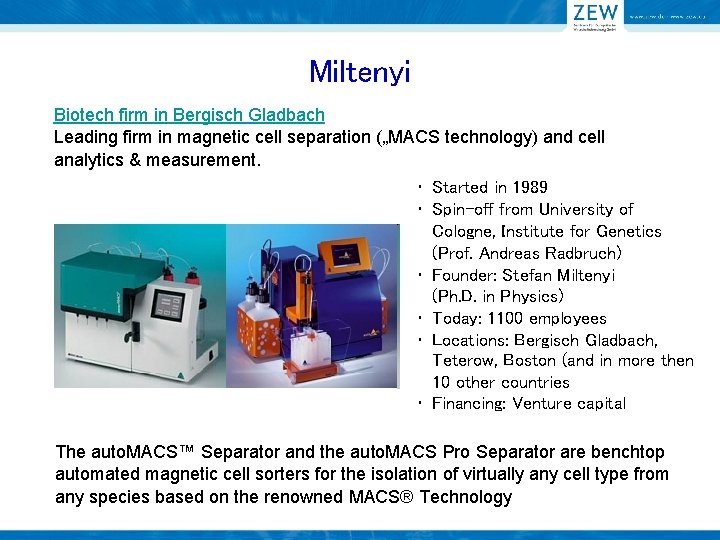
Miltenyi Biotech firm in Bergisch Gladbach Leading firm in magnetic cell separation („MACS technology) and cell analytics & measurement. • Started in 1989 • Spin-off from University of Cologne, Institute for Genetics (Prof. Andreas Radbruch) • Founder: Stefan Miltenyi (Ph. D. in Physics) • Today: 1100 employees • Locations: Bergisch Gladbach, Teterow, Boston (and in more then 10 other countries • Financing: Venture capital The auto. MACS™ Separator and the auto. MACS Pro Separator are benchtop automated magnetic cell sorters for the isolation of virtually any cell type from any species based on the renowned MACS® Technology
Metaio v v v v Leading in development of Augmented Reality Technology. Unique software platform to combine interaktiv solutions and application in mixed real and virtual worlds Application: Marketing (e. g. furniture, cars, . . ), automation, factory planing, Application possible via internet, mobile phones, PCs, . . Started in 2003 in Munich Spin-off from Munich Technical University Today: 50 employees Sales and development units in San Francisco and Seoul Financing: Cash flow and founding teams equity + government R&D money
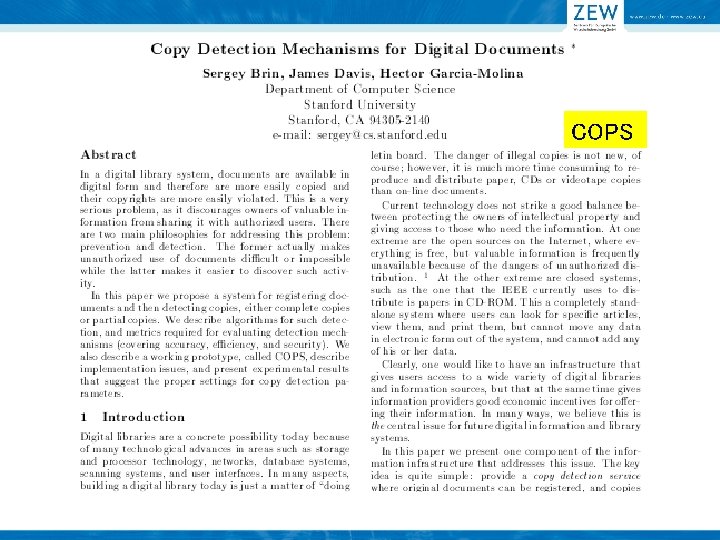
COPS
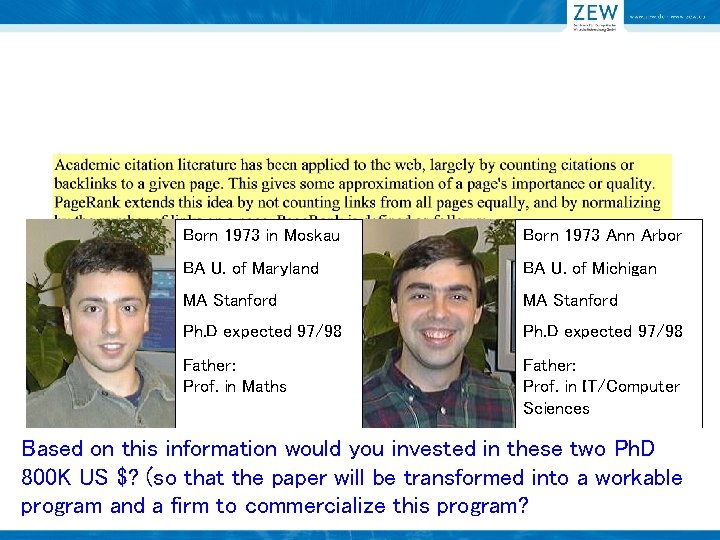
Born 1973 in Moskau Born 1973 Ann Arbor BA U. of Maryland BA U. of Michigan MA Stanford Ph. D expected 97/98 Father: Prof. in Maths Father: Prof. in IT/Computer Sciences Based on this information would you invested in these two Ph. D 800 K US $? (so that the paper will be transformed into a workable program and a firm to commercialize this program?
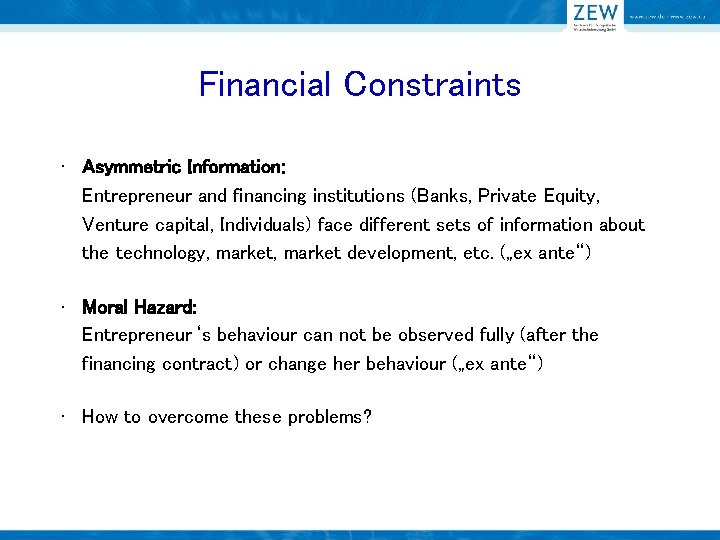
Financial Constraints • Asymmetric Information: Entrepreneur and financing institutions (Banks, Private Equity, Venture capital, Individuals) face different sets of information about the technology, market development, etc. („ex ante“) • Moral Hazard: Entrepreneur‘s behaviour can not be observed fully (after the financing contract) or change her behaviour („ex ante“) • How to overcome these problems?
How are young ventures financed?
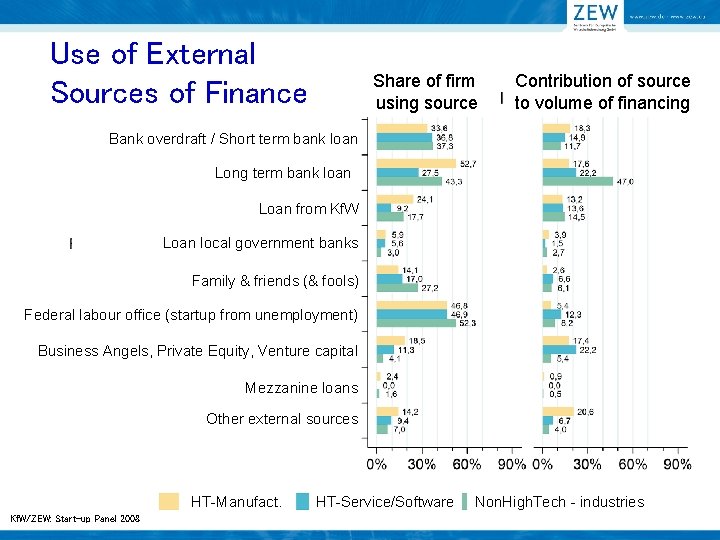
Use of External Sources of Finance Share of firm using source Contribution of source to volume of financing Bank overdraft / Short term bank loan Long term bank loan Loan from Kf. W Loan local government banks Family & friends (& fools) Federal labour office (startup from unemployment) Business Angels, Private Equity, Venture capital Mezzanine loans Other external sources HT-Manufact. Kf. W/ZEW: Start-up Panel 2008 HT-Service/Software Non. High. Tech - industries
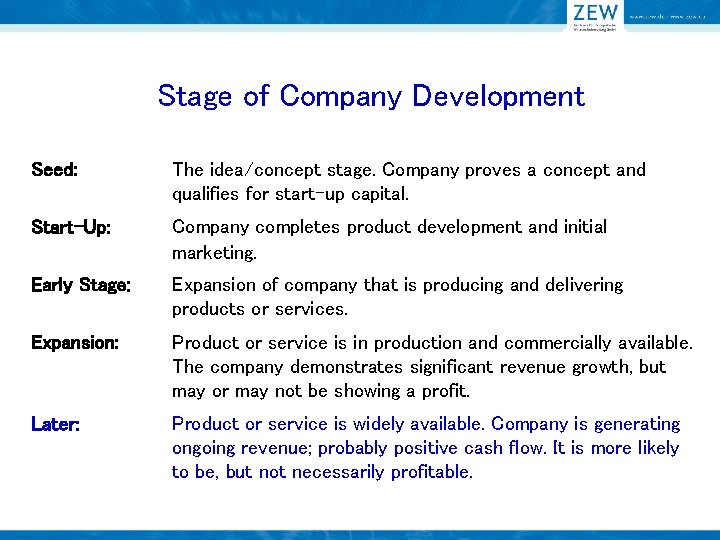
Stage of Company Development Seed: The idea/concept stage. Company proves a concept and qualifies for start-up capital. Start-Up: Company completes product development and initial marketing. Early Stage: Expansion of company that is producing and delivering products or services. Expansion: Product or service is in production and commercially available. The company demonstrates significant revenue growth, but may or may not be showing a profit. Later: Product or service is widely available. Company is generating ongoing revenue; probably positive cash flow. It is more likely to be, but not necessarily profitable.
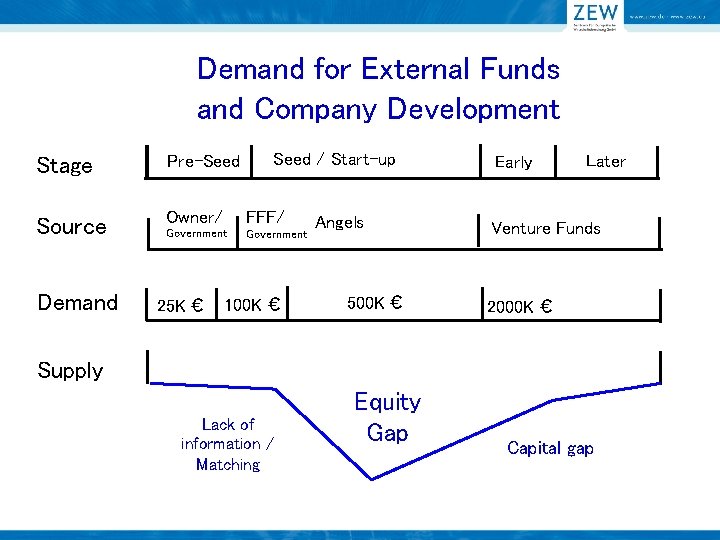
Demand for External Funds and Company Development Seed / Start-up Stage Pre-Seed Source Owner/ FFF/ Government Demand 25 K € 100 K € Angels 500 K € Early Later Venture Funds 2000 K € Supply Lack of information / Matching Equity Gap Capital gap
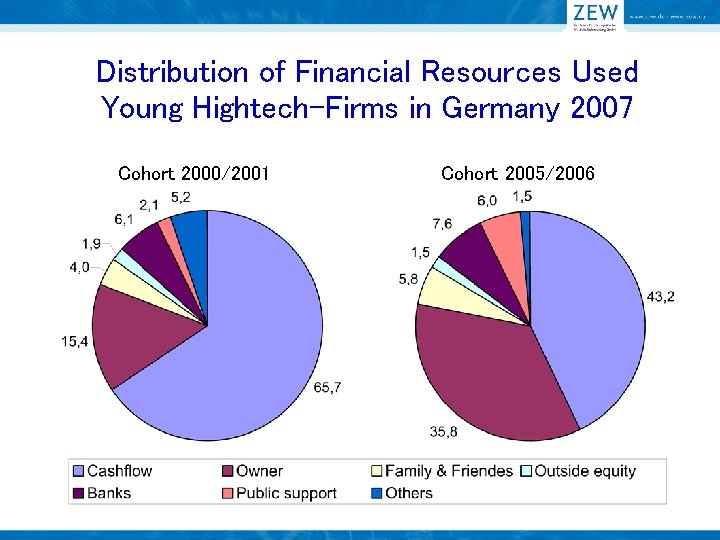
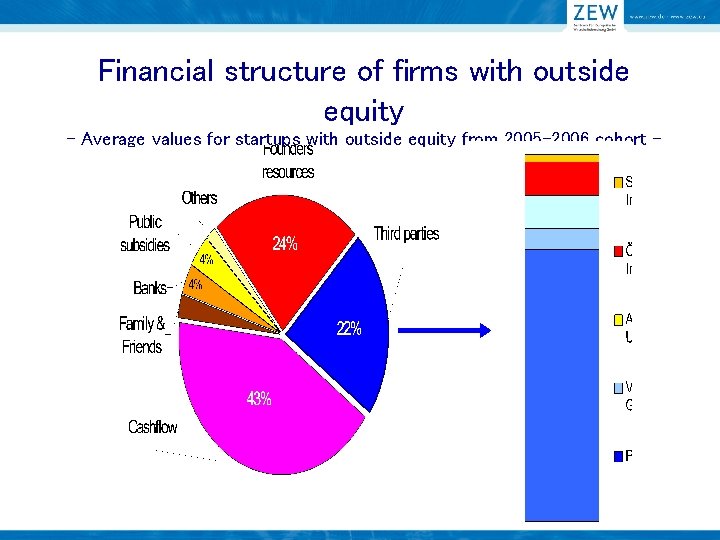
Distribution of Financial Resources Used Young Hightech-Firms in Germany 2007 Cohort 2000/2001 Cohort 2005/2006
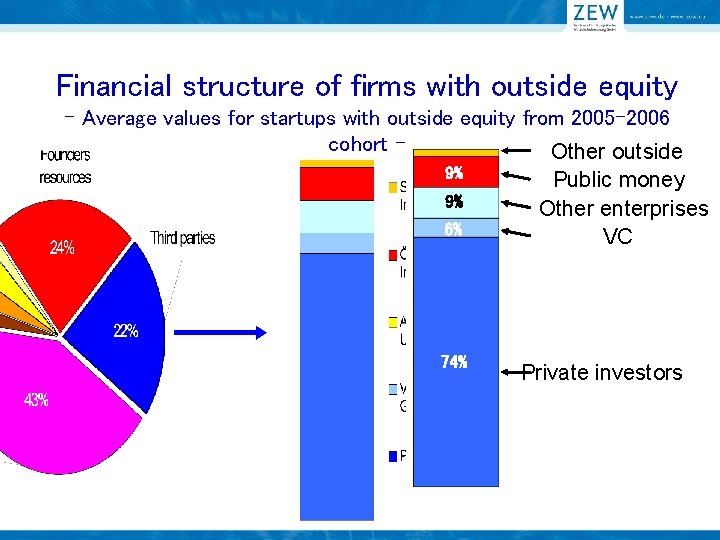
Financial structure of firms with outside equity - Average values for startups with outside equity from 2005 -2006 cohort - thereof
Financial structure of firms with outside equity - Average values for startups with outside equity from 2005 -2006 cohort Other outside 9% Public money 9% Other enterprises 6% VC thereof 74% Private investors
Business Angel Finance
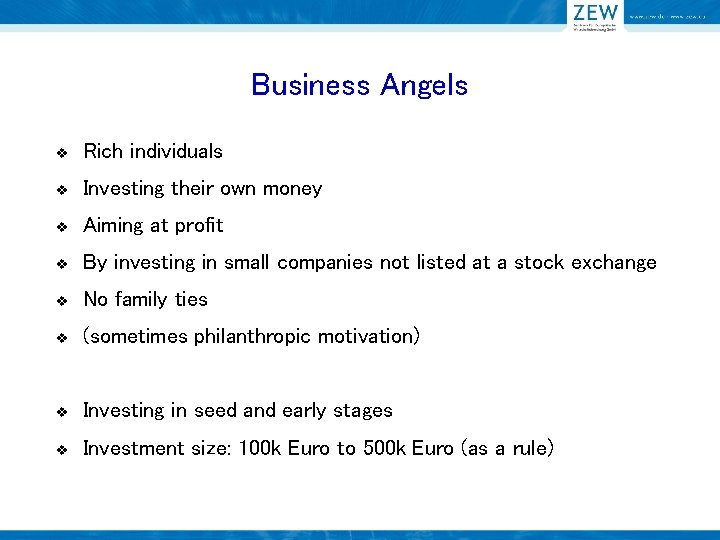
Business Angels v Rich individuals v Investing their own money v Aiming at profit v By investing in small companies not listed at a stock exchange v No family ties v (sometimes philanthropic motivation) v Investing in seed and early stages v Investment size: 100 k Euro to 500 k Euro (as a rule)
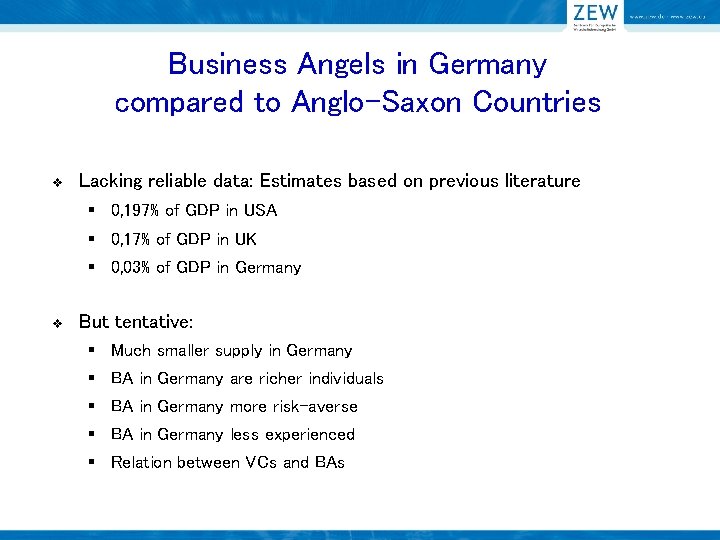
Business Angels in Germany compared to Anglo-Saxon Countries v Lacking reliable data: Estimates based on previous literature § 0, 197% of GDP in USA § 0, 17% of GDP in UK § 0, 03% of GDP in Germany v But tentative: § Much smaller supply in Germany § BA in Germany are richer individuals § BA in Germany more risk-averse § BA in Germany less experienced § Relation between VCs and BAs
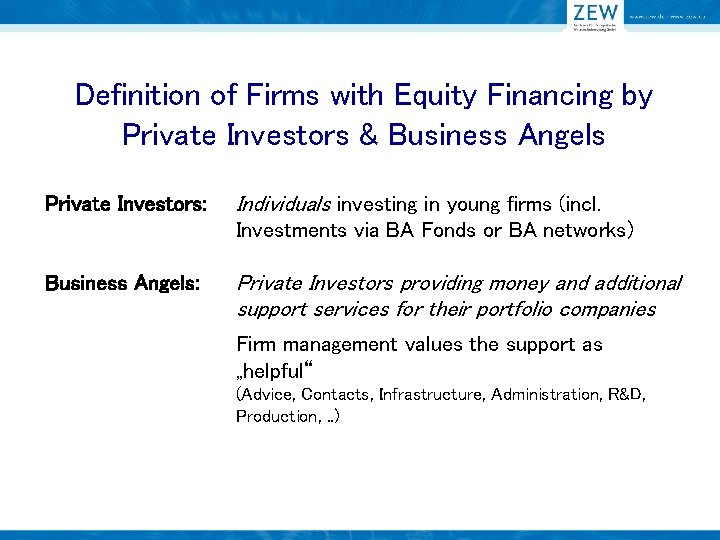
Definition of Firms with Equity Financing by Private Investors & Business Angels Private Investors: Individuals investing in young firms (incl. Investments via BA Fonds or BA networks) Business Angels: Private Investors providing money and additional support services for their portfolio companies Firm management values the support as „helpful“ (Advice, Contacts, Infrastructure, Administration, R&D, Production, . . )
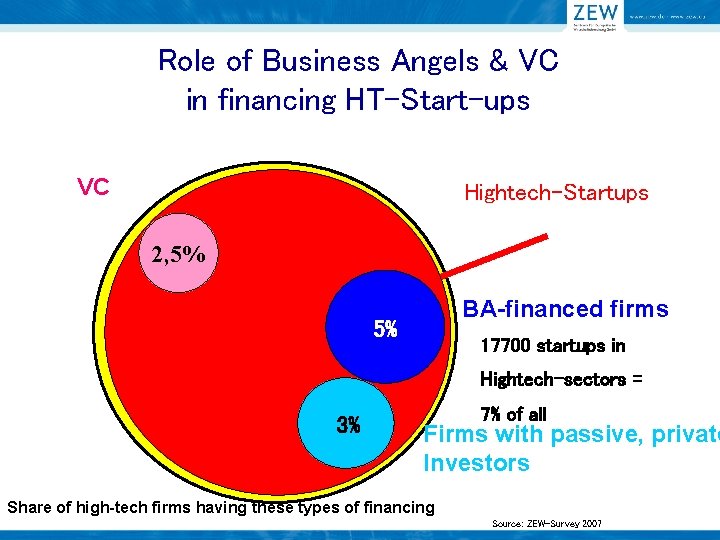
Role of Business Angels & VC in financing HT-Start-ups VC Hightech-Startups Alle Unternehmens 2, 5% gründungen BA-financed firms 5% 17700 startups in Hightech-sectors = 3% 7% of all Firms with passive, private Investors Share of high-tech firms having these types of financing Source: ZEW-Survey 2007
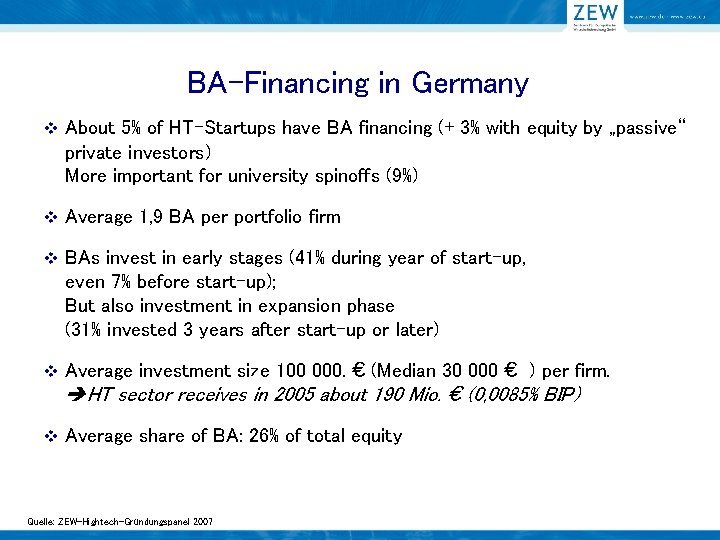
BA-Financing in Germany v About 5% of HT-Startups have BA financing (+ 3% with equity by „passive“ private investors) More important for university spinoffs (9%) v Average 1, 9 BA per portfolio firm v BAs invest in early stages (41% during year of start-up, even 7% before start-up); But also investment in expansion phase (31% invested 3 years after start-up or later) v Average investment size 100 000. € (Median 30 000 € ) per firm. HT sector receives in 2005 about 190 Mio. € (0, 0085% BIP) v Average share of BA: 26% of total equity Quelle: ZEW-Hightech-Gründungspanel 2007
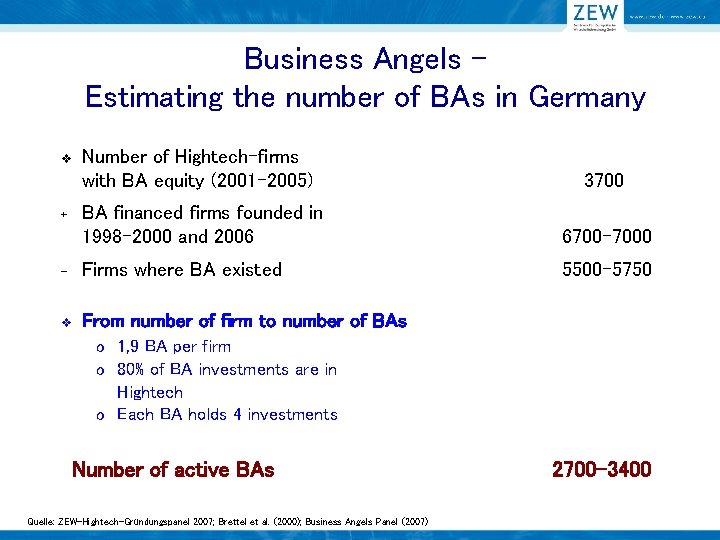
Business Angels Estimating the number of BAs in Germany Number of Hightech-firms with BA equity (2001 -2005) 3700 BA financed firms founded in 1998 -2000 and 2006 6700 -7000 - Firms where BA existed 5500 -5750 v From number of firm to number of BAs v + o 1, 9 BA per firm o 80% of BA investments are in Hightech o Each BA holds 4 investments Number of active BAs Quelle: ZEW-Hightech-Gründungspanel 2007; Brettel et al. (2000); Business Angels Panel (2007) 2700 -3400
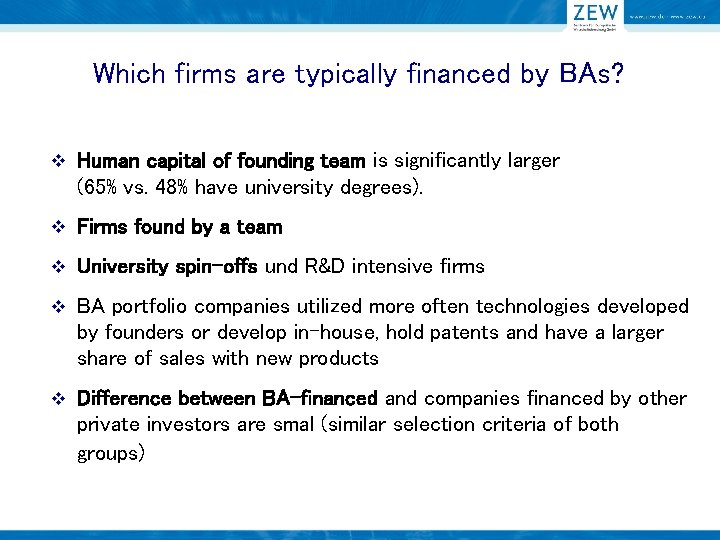
Which firms are typically financed by BAs? v Human capital of founding team is significantly larger (65% vs. 48% have university degrees). v Firms found by a team v University spin-offs und R&D intensive firms v BA portfolio companies utilized more often technologies developed by founders or develop in-house, hold patents and have a larger share of sales with new products v Difference between BA-financed and companies financed by other private investors are smal (similar selection criteria of both groups)
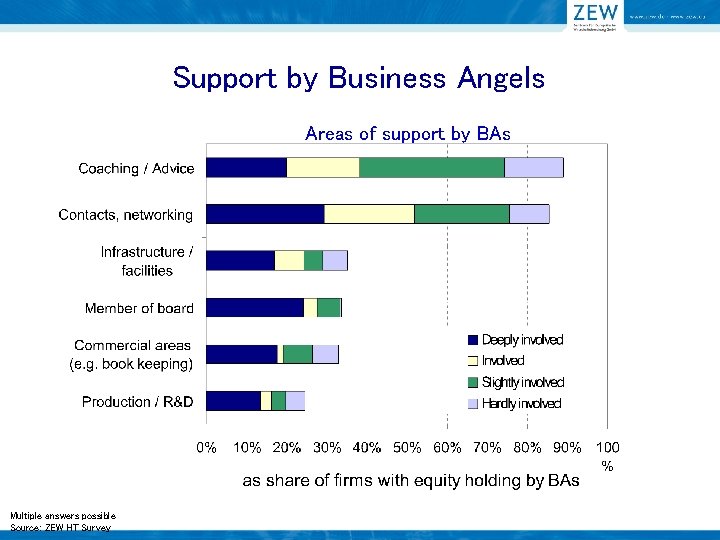
Support by Business Angels Areas of support by BAs Multiple answers possible Source: ZEW HT Survey
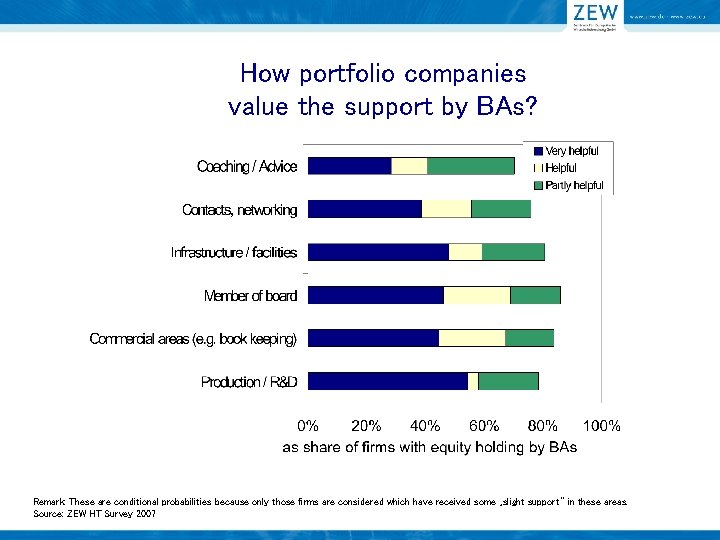
How portfolio companies value the support by BAs? Remark: These are conditional probabilities because only those firms are considered which have received some „slight support“ in these areas. Source: ZEW HT Survey 2007
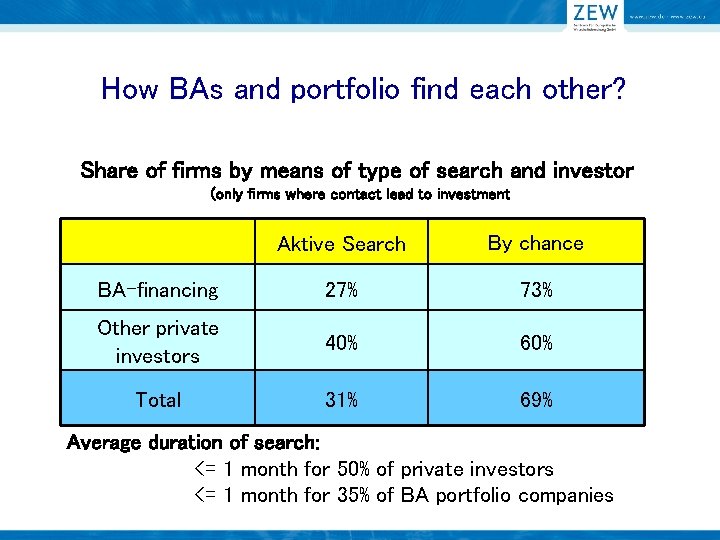
How BAs and portfolio find each other? Share of firms by means of type of search and investor (only firms where contact lead to investment Aktive Search By chance BA-financing 27% 73% Other private investors 40% 60% Total 31% 69% Average duration of search: <= 1 month for 50% of private investors <= 1 month for 35% of BA portfolio companies
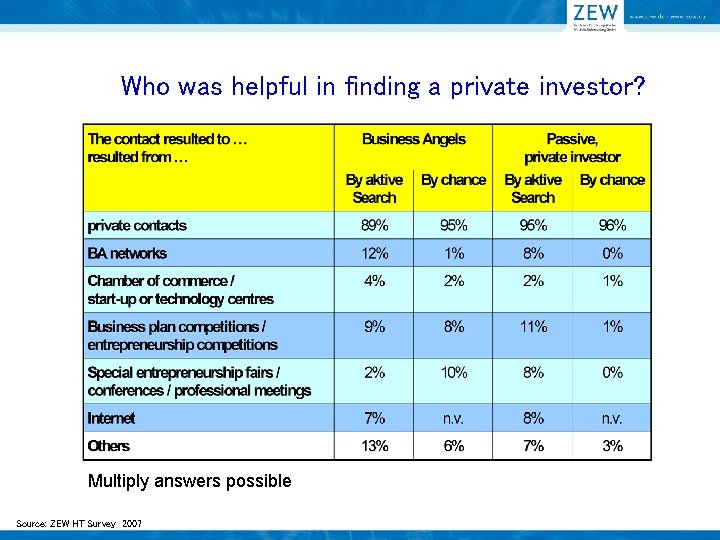
Who was helpful in finding a private investor? Multiply answers possible Source: ZEW HT Survey 2007
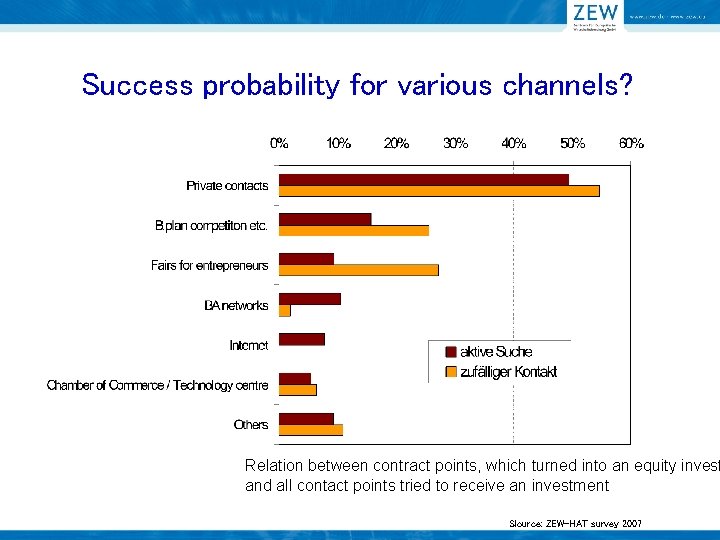
Success probability for various channels? Relation between contract points, which turned into an equity invest and all contact points tried to receive an investment Slource: ZEW-HAT survey 2007
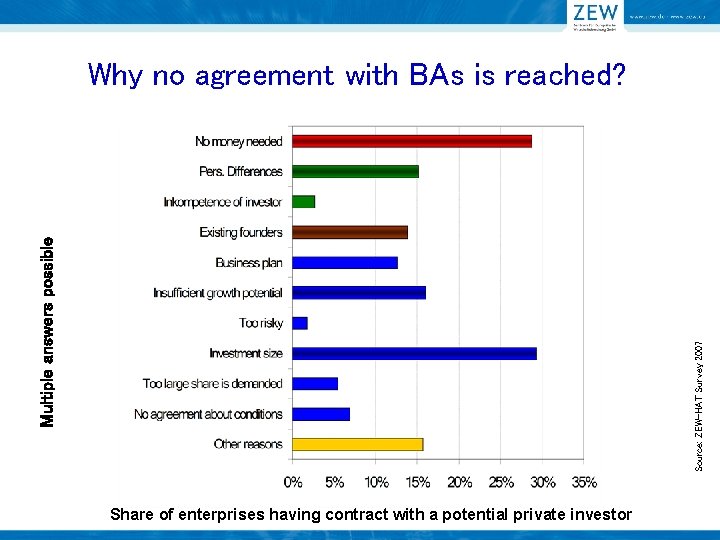
Source: ZEW-HAT Survey 2007 Multiple answers possible Why no agreement with BAs is reached? Share of enterprises having contract with a potential private investor
Venture Capital Financing
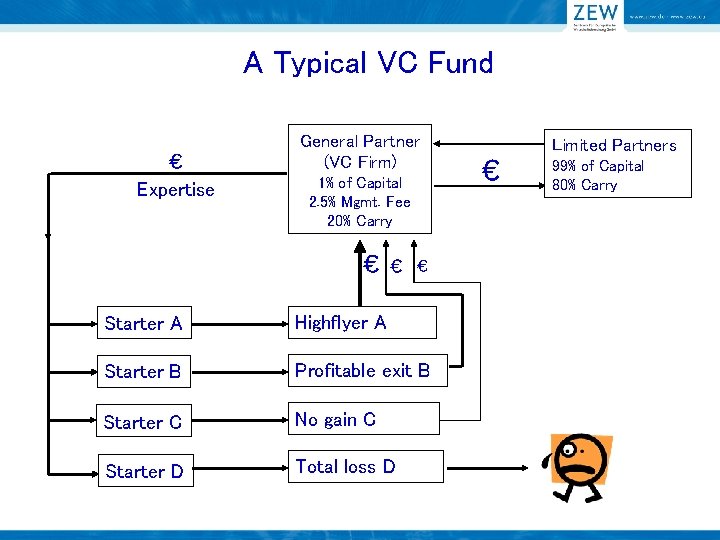
A Typical VC Fund € Expertise General Partner (VC Firm) 1% of Capital 2. 5% Mgmt. Fee 20% Carry € € € Starter A Highflyer A Starter B Profitable exit B Starter C No gain C Starter D Total loss D Limited Partners € 99% of Capital 80% Carry
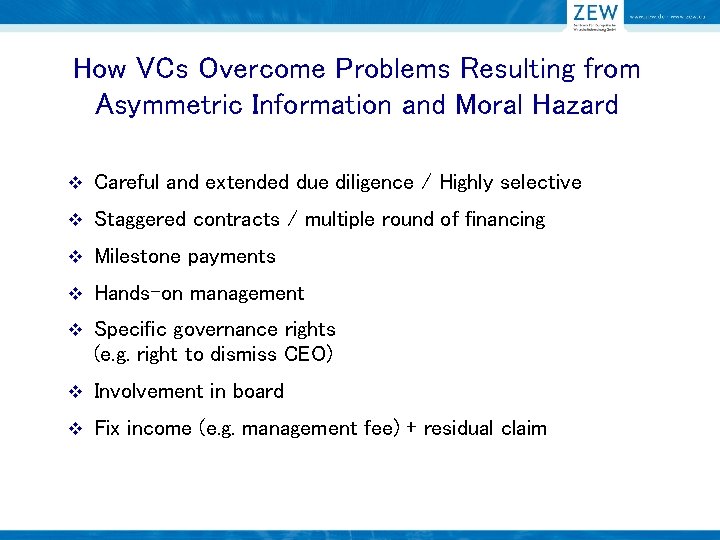
How VCs Overcome Problems Resulting from Asymmetric Information and Moral Hazard v Careful and extended due diligence / Highly selective v Staggered contracts / multiple round of financing v Milestone payments v Hands-on management v Specific governance rights (e. g. right to dismiss CEO) v Involvement in board v Fix income (e. g. management fee) + residual claim
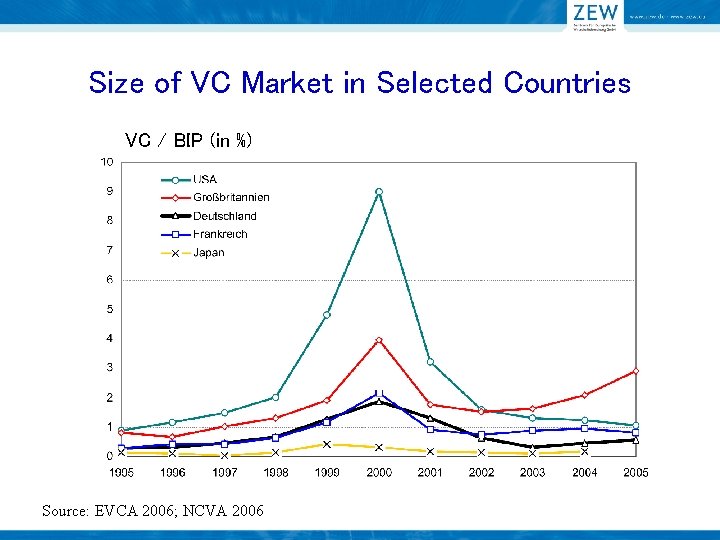
Size of VC Market in Selected Countries VC / BIP (in %) Source: EVCA 2006; NCVA 2006
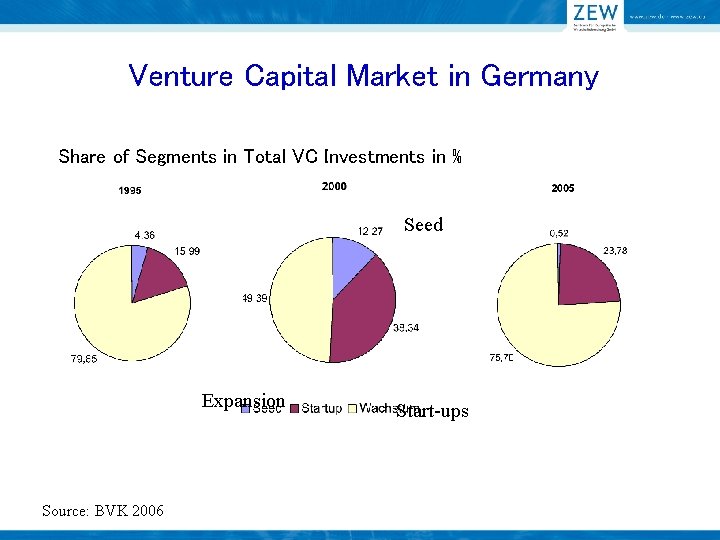
Venture Capital Market in Germany Share of Segments in Total VC Investments in % Seed Expansion Source: BVK 2006 Start-ups
Banks and Financing of SMEs
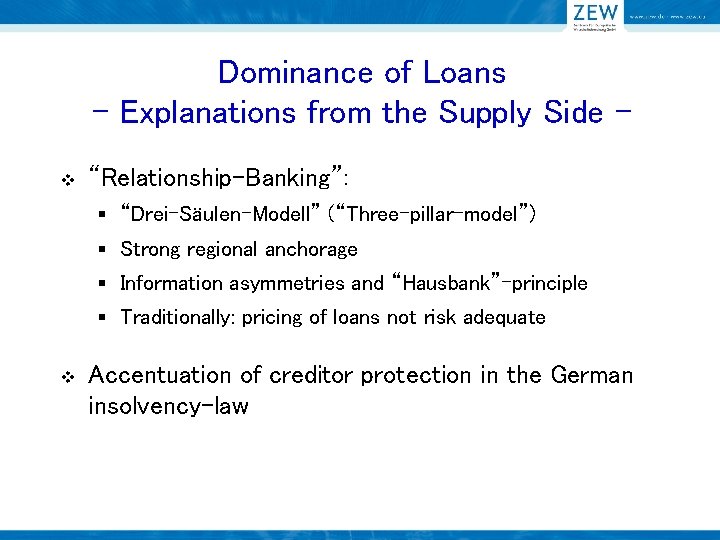
Dominance of Loans - Explanations from the Supply Side v “Relationship-Banking”: § “Drei-Säulen-Modell” (“Three-pillar-model”) § Strong regional anchorage § Information asymmetries and “Hausbank”-principle § Traditionally: pricing of loans not risk adequate v Accentuation of creditor protection in the German insolvency-law
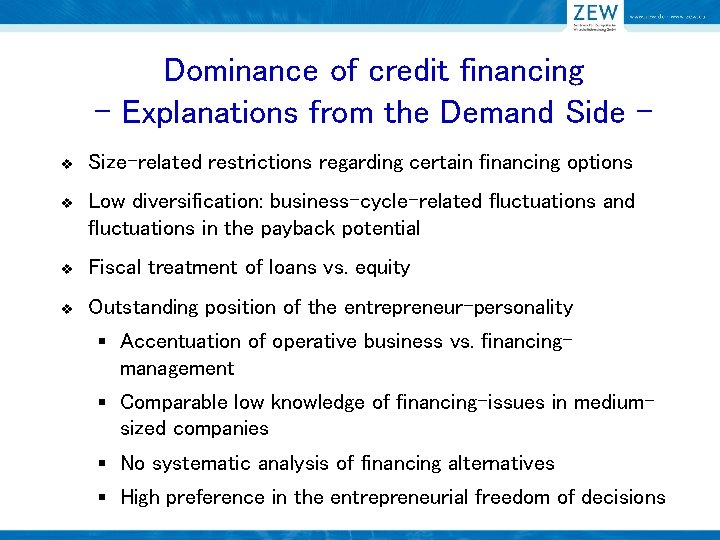
Dominance of credit financing - Explanations from the Demand Side v Size-related restrictions regarding certain financing options v Low diversification: business-cycle-related fluctuations and fluctuations in the payback potential v Fiscal treatment of loans vs. equity v Outstanding position of the entrepreneur-personality § Accentuation of operative business vs. financing- management § Comparable low knowledge of financing-issues in medium- sized companies § No systematic analysis of financing alternatives § High preference in the entrepreneurial freedom of decisions
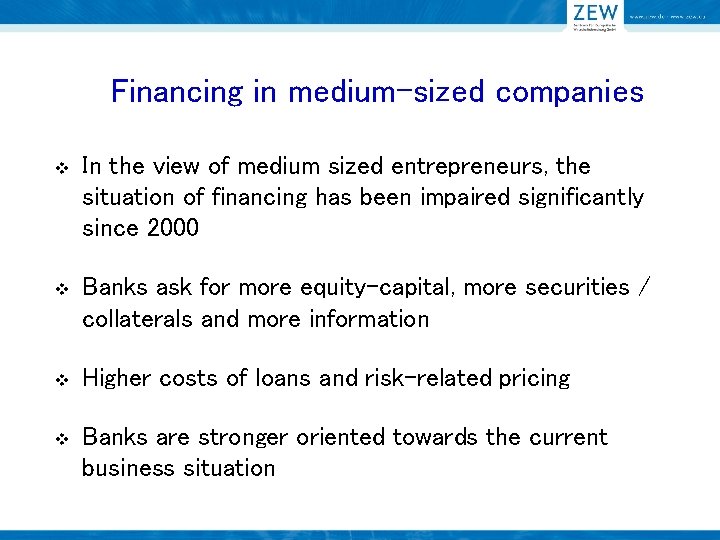
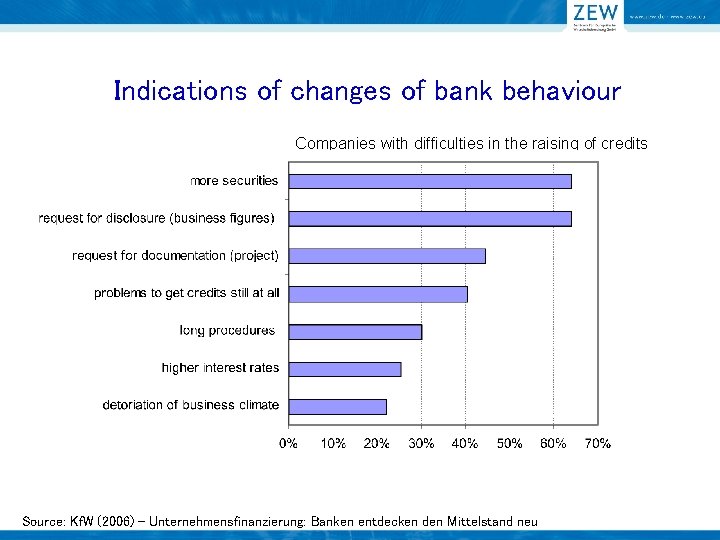
Financing in medium-sized companies v In the view of medium sized entrepreneurs, the situation of financing has been impaired significantly since 2000 v Banks ask for more equity-capital, more securities / collaterals and more information v Higher costs of loans and risk-related pricing v Banks are stronger oriented towards the current business situation
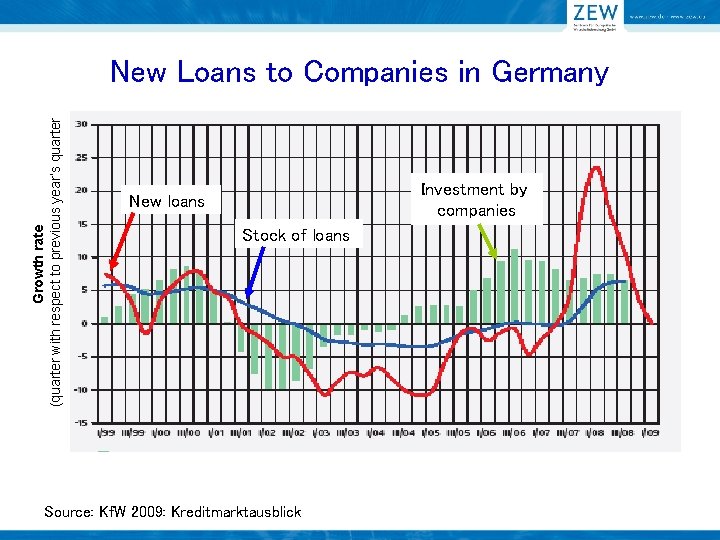
Growth rate (quarter with respect to previous year‘s quarter New Loans to Companies in Germany Investment by companies New loans Stock of loans Source: Kf. W 2009: Kreditmarktausblick
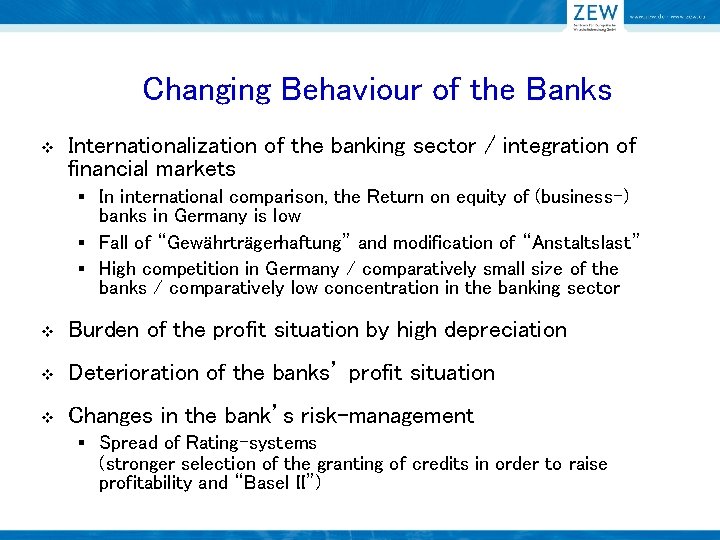
Changing Behaviour of the Banks v Internationalization of the banking sector / integration of financial markets § In international comparison, the Return on equity of (business-) banks in Germany is low § Fall of “Gewährträgerhaftung” and modification of “Anstaltslast” § High competition in Germany / comparatively small size of the banks / comparatively low concentration in the banking sector v Burden of the profit situation by high depreciation v Deterioration of the banks’ profit situation v Changes in the bank’s risk-management § Spread of Rating-systems (stronger selection of the granting of credits in order to raise profitability and “Basel II”)
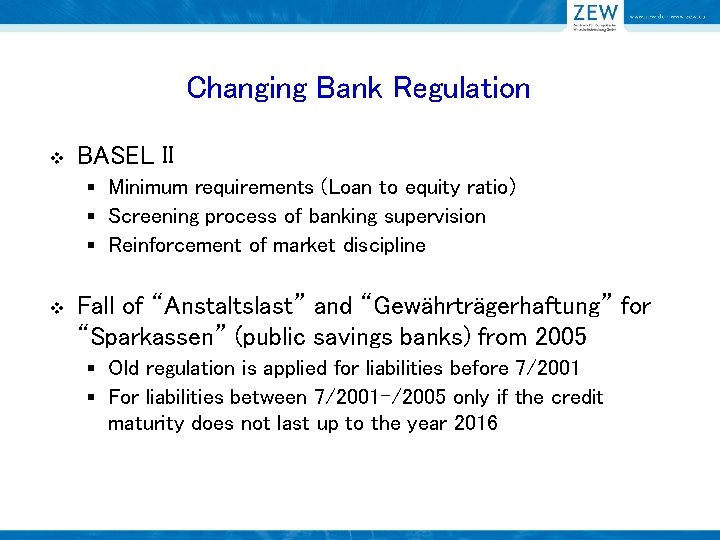
Changing Bank Regulation v BASEL II § Minimum requirements (Loan to equity ratio) § Screening process of banking supervision § Reinforcement of market discipline v Fall of “Anstaltslast” and “Gewährträgerhaftung” for “Sparkassen” (public savings banks) from 2005 § Old regulation is applied for liabilities before 7/2001 § For liabilities between 7/2001 -/2005 only if the credit maturity does not last up to the year 2016
Indications of changes of bank behaviour Companies with difficulties in the raising of credits Source: Kf. W (2006) – Unternehmensfinanzierung: Banken entdecken den Mittelstand neu
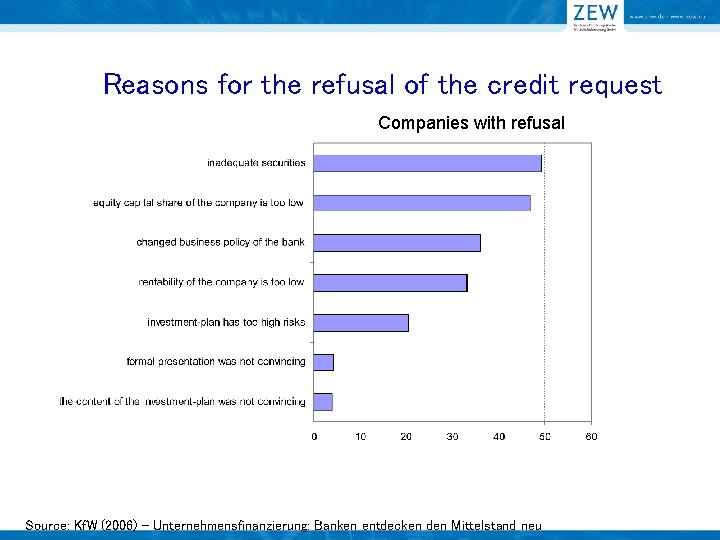
Reasons for the refusal of the credit request Companies with refusal Source: Kf. W (2006) – Unternehmensfinanzierung: Banken entdecken den Mittelstand neu
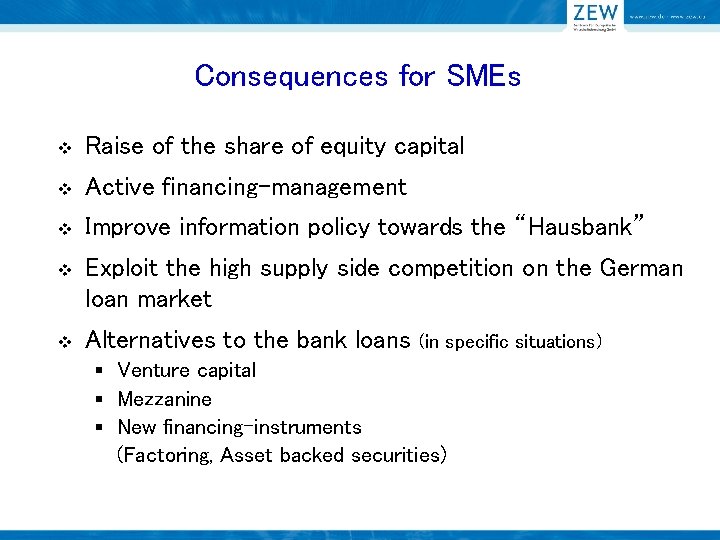
Consequences for SMEs v Raise of the share of equity capital v Active financing-management v Improve information policy towards the “Hausbank” v Exploit the high supply side competition on the German loan market v Alternatives to the bank loans (in specific situations) § Venture capital § Mezzanine § New financing-instruments (Factoring, Asset backed securities)
Further Reading RECOMMENDED v Gompers, P. And J. Lerner (1999), The Venture Capital Cycle, MIT Press: Boston v Freear, J. , Sohl, J. and Wetzel, W. , 1994, Angels and non-Angels: are there differences? , Journal of Business Venturing, 9, 85 -94. v UN Economic Commission For Europe (2007), Financing Innovative Development. Comparative Review of the Experiences of UNECE Countries in Early-Stage Financing, New York and Geneva. v Shane, Scott (2008), The Illusions of Entrepreneurship – The Costly Myths that Entrepreneurs, Investors and Policy Makers Live By, Yale University Press: New Haven. (esp. chapter 5: How are New Businesses Financed? ) v Gorman/Sahlman (1989): What do Venture Capitalists do? in: Journal of Business Venturing, 4. Jg. , S. 231248 ADDITIONAL LITERATURE v Homepage des BVK (www. bvk-ev. de) v Vise, David A. , Mark Malseed (2005), The Google Story – Inside the Hottest Business, Media and Technology of Our Times, Delacorte Press/Random House: New York. . v Sahlman (1990): The Structure and Governance of Venture-Capital Organizations, in: Journal of Financial Economics, 27, 473 -521. v Brettel, M. (2003): Business Angels in Germany: a research note, in: Venture Capital, 5, 251 -268. v Kaplan, S. and Zingales, L. (1997) ‘Do investment - cash flow sensitivies provide useful measures of financing constraints? ’, Quarterly Journal of Economics 112, 169 -216. v Hubbard, R. G. (1998): ‘Capital-Market Imperfections and Investment’, Journal of Economic Literature, 36, 193 -225.
The End Thanks for your attention
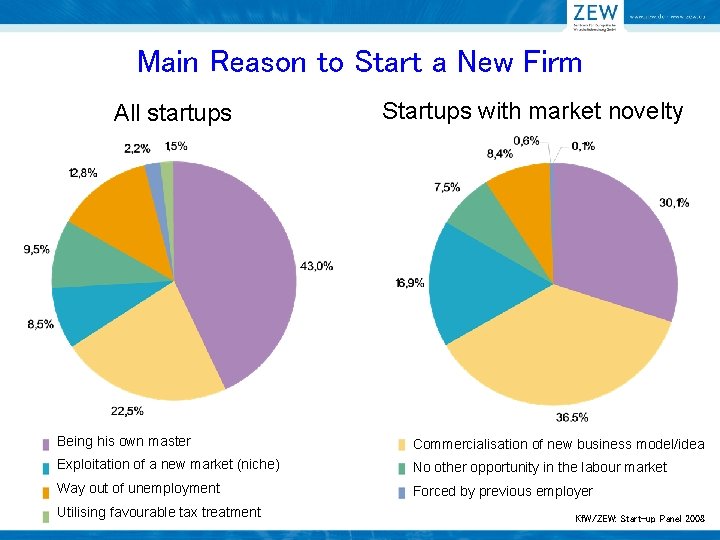
Main Reason to Start a New Firm All startups Startups with market novelty Being his own master Commercialisation of new business model/idea Exploitation of a new market (niche) No other opportunity in the labour market Way out of unemployment Forced by previous employer Utilising favourable tax treatment Kf. W/ZEW: Start-up Panel 2008
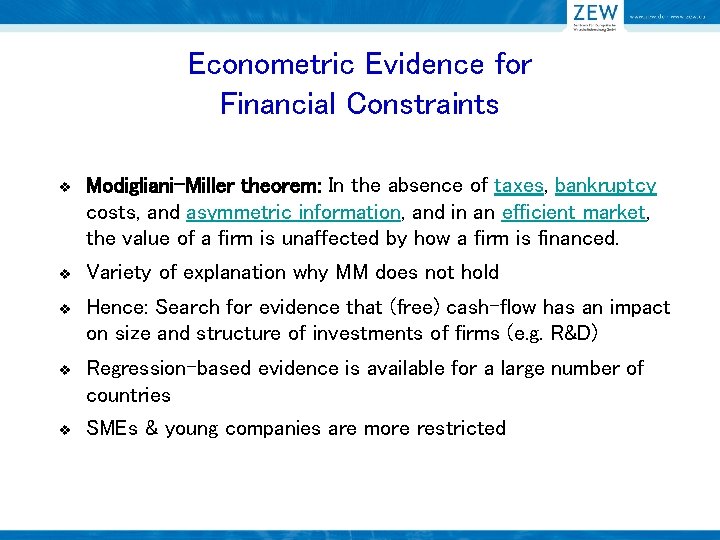
Econometric Evidence for Financial Constraints v Modigliani-Miller theorem: In the absence of taxes, bankruptcy costs, and asymmetric information, and in an efficient market, the value of a firm is unaffected by how a firm is financed. v Variety of explanation why MM does not hold v Hence: Search for evidence that (free) cash-flow has an impact on size and structure of investments of firms (e. g. R&D) v Regression-based evidence is available for a large number of countries v SMEs & young companies are more restricted
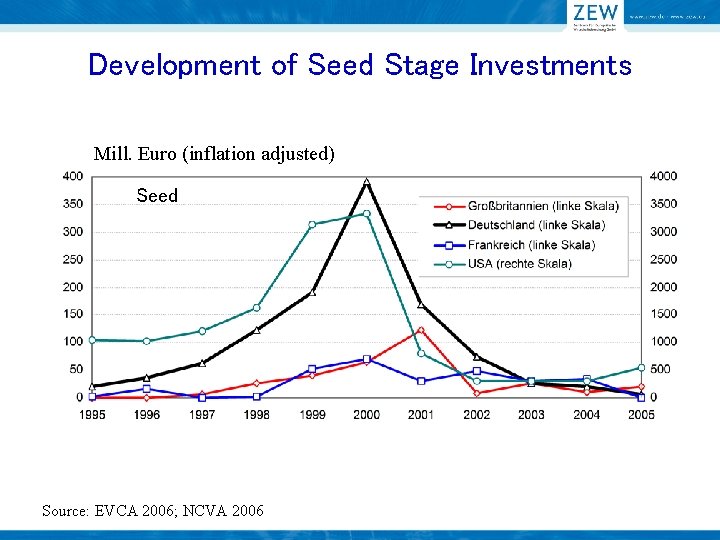
Development of Seed Stage Investments Mill. Euro (inflation adjusted) Seed Source: EVCA 2006; NCVA 2006
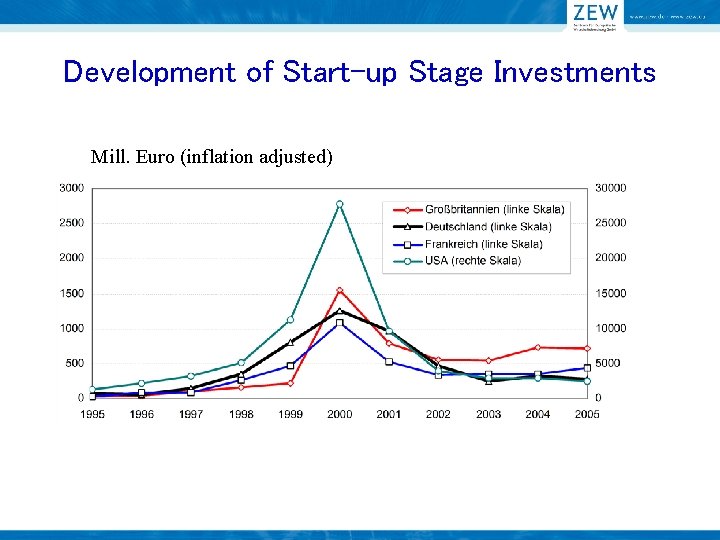
Development of Start-up Stage Investments Mill. Euro (inflation adjusted)
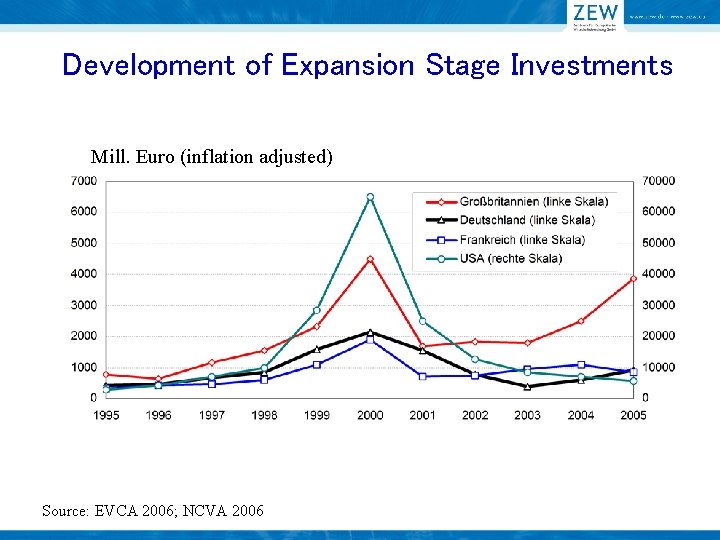
Development of Expansion Stage Investments Mill. Euro (inflation adjusted) Source: EVCA 2006; NCVA 2006
High-tech Start-ups in Germany
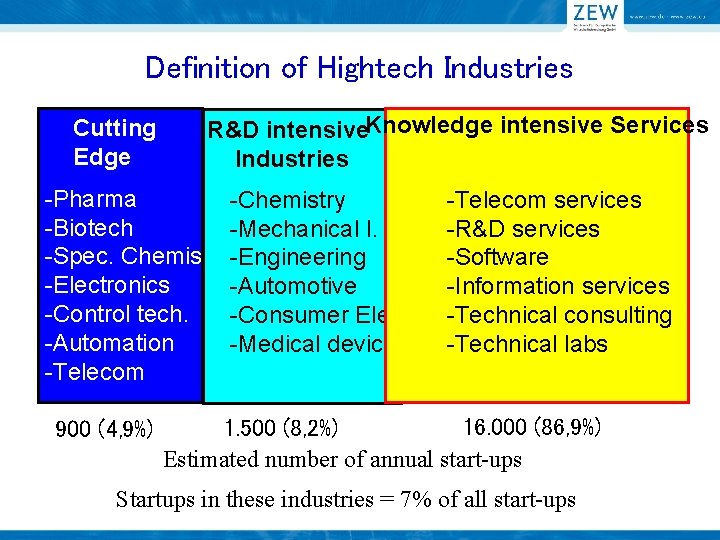
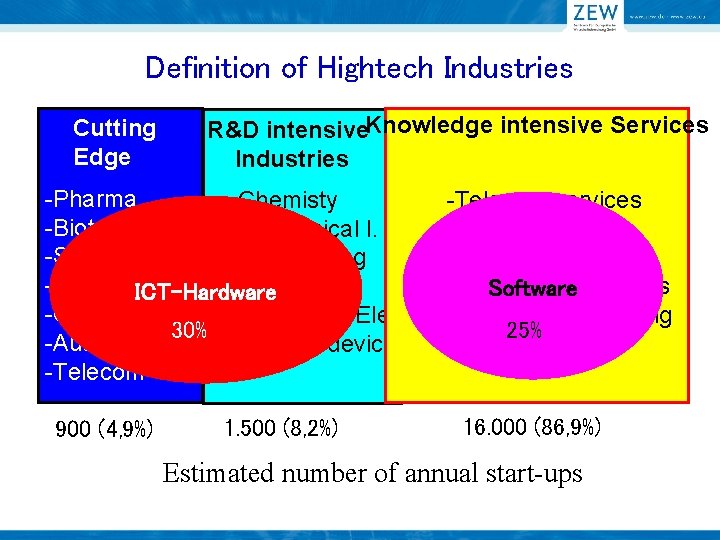
Definition of Hightech Industries Cutting Edge R&D intensive. Knowledge intensive Services Industries -Pharma -Biotech -Spec. Chemisty -Electronics -Control tech. -Automation -Telecom 900 (4, 9%) -Chemistry -Mechanical I. -Engineering -Automotive -Consumer Elec. -Medical devices -Telecom services -R&D services -Software -Information services -Technical consulting -Technical labs 16. 000 (86, 9%) 1. 500 (8, 2%) Estimated number of annual start-ups Startups in these industries = 7% of all start-ups
Definition of Hightech Industries Cutting Edge R&D intensive. Knowledge intensive Services Industries -Pharma -Chemisty -Biotech -Mechanical I. -Spec. Chemisty -Engineering -Electronics -Automotive ICT-Hardware -Control tech. -Consumer Elec. 30% -Automation -Medical devices -Telecom 900 (4, 9%) 1. 500 (8, 2%) -Telecom services -R&D services -Software -Information Software services -Technical consulting 25% -Technical labs 16. 000 (86, 9%) Estimated number of annual start-ups
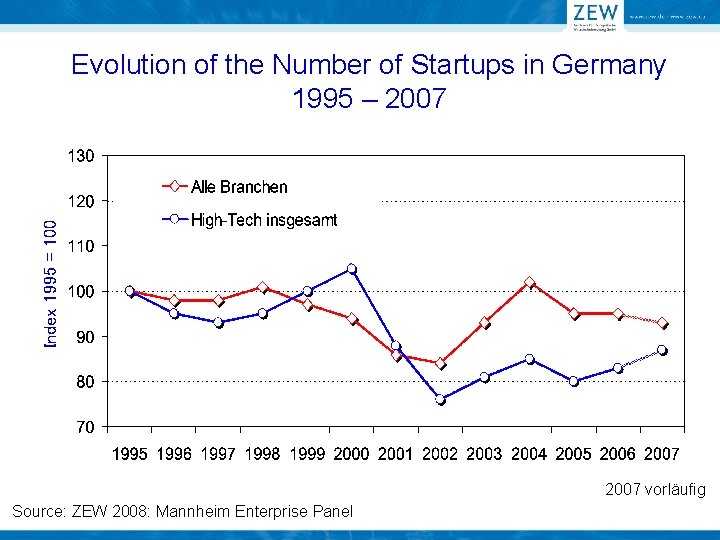
Index 1995 = 100 Evolution of the Number of Startups in Germany 1995 – 2007 vorläufig Source: ZEW 2008: Mannheim Enterprise Panel
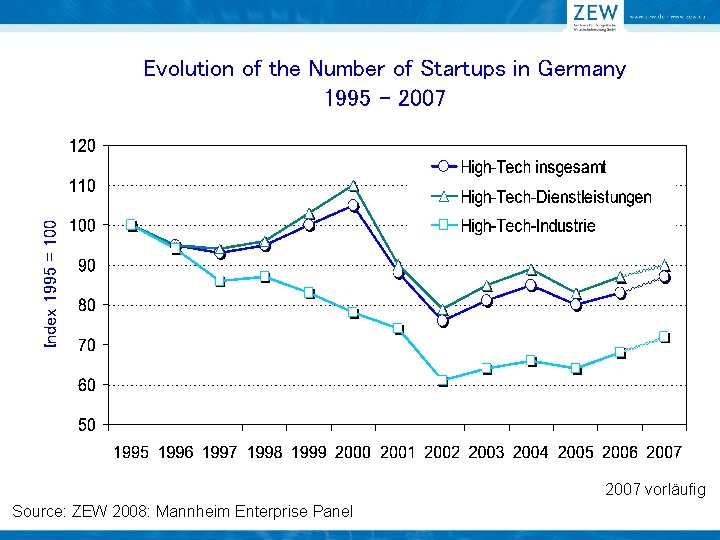
Index 1995 = 100 Evolution of the Number of Startups in Germany 1995 – 2007 vorläufig Source: ZEW 2008: Mannheim Enterprise Panel
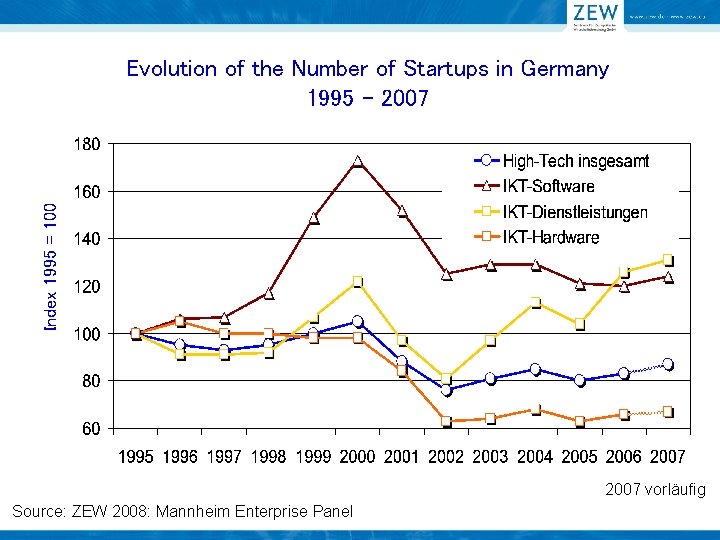
Index 1995 = 100 Evolution of the Number of Startups in Germany 1995 – 2007 vorläufig Source: ZEW 2008: Mannheim Enterprise Panel
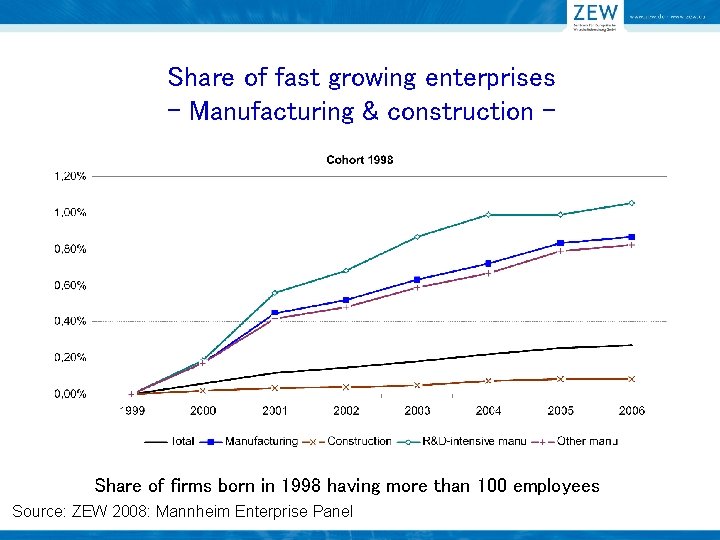
Share of fast growing enterprises - Manufacturing & construction - Share of firms born in 1998 having more than 100 employees Source: ZEW 2008: Mannheim Enterprise Panel
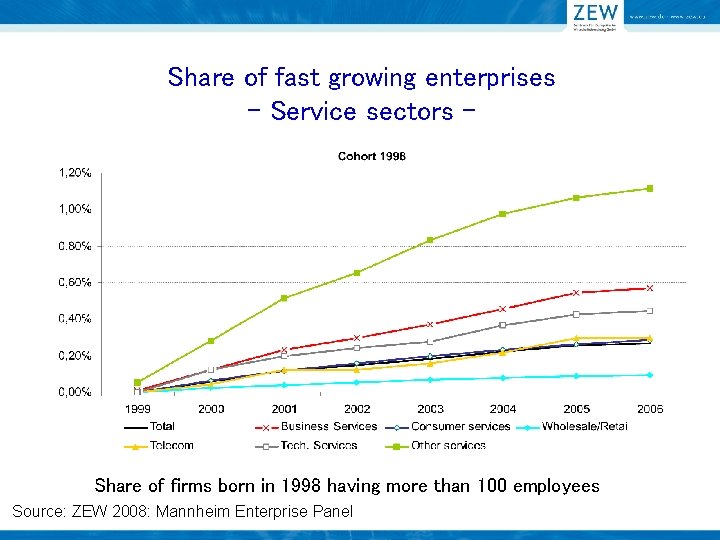
Share of fast growing enterprises - Service sectors - Share of firms born in 1998 having more than 100 employees Source: ZEW 2008: Mannheim Enterprise Panel
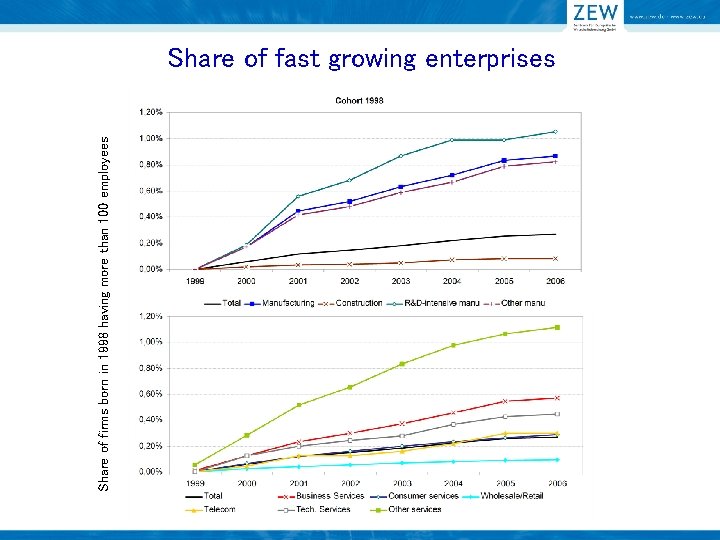
Share of firms born in 1998 having more than 100 employees Share of fast growing enterprises
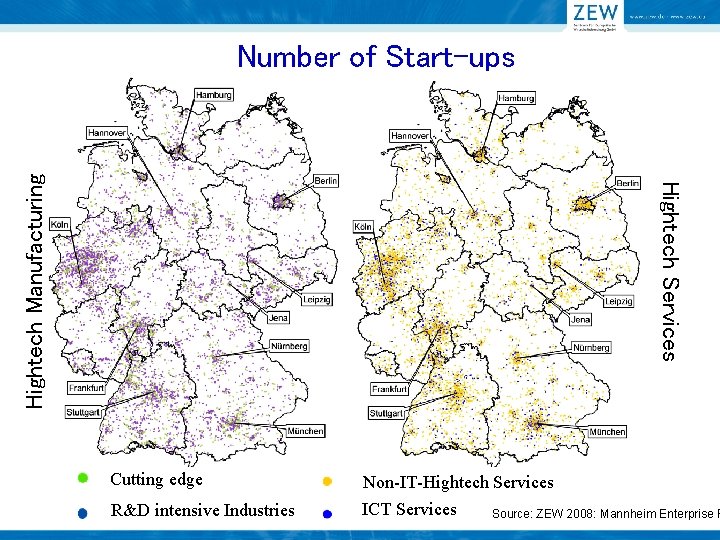
Hightech Services Hightech Manufacturing Number of Start-ups Cutting edge R&D intensive Industries Non-IT-Hightech Services ICT Services Source: ZEW 2008: Mannheim Enterprise P
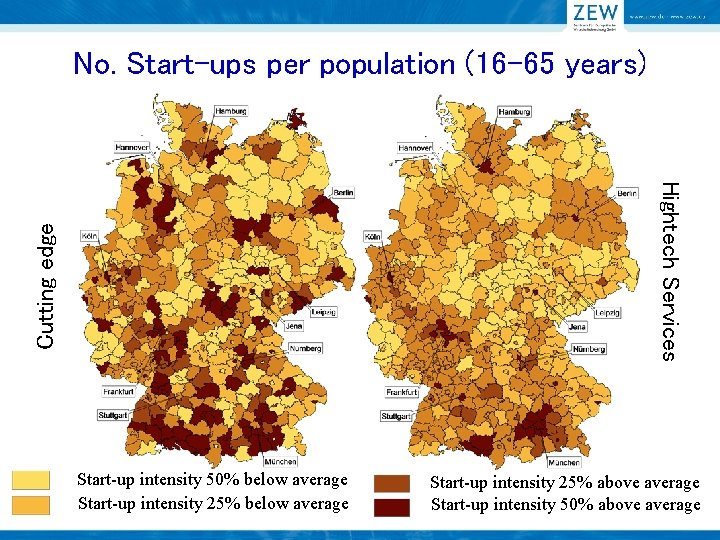
No. Start-ups per population (16 -65 years) Cutting edge Hightech Services Start-up intensity 50% below average Start-up intensity 25% above average Start-up intensity 50% above average