
Financing Disruption John Armour Luca Enriques Oxford University



![Zynga’s employees (2) “[O]ur ability to execute our strategy depends on our continued ability](https://slidetodoc.com/presentation_image/ca61c0239107a33af678a48bf73004f7/image-21.jpg "Zynga’s employees (2) “[O]ur ability to execute our strategy depends on our continued ability")
- Slides: 23
Financing Disruption John Armour Luca Enriques Oxford University GCGC Colloquium 2015 Stanford Law School
1. Introduction
Motivation • Innovation thought to drive growth, jobs • ‘Disruption’ – innovation + impact • Policymakers want to stimulate innovation because of these good things ÞNew policy initiatives– ‘lower costs’ of accessing outside capital (JOBS Act, EU Capital Markets Union Green Paper) ÞAlso changes in financing practices (crowdsourcing, dual-class tech IPOs) To think about policy, need to understand practice
The idea • Innovation requires more than just finance • Requires judgment about project development • Think of innovative projects as real options • Information revelation informs continuation decision • More valuable if decisions made with more information, by people who better understand implications (capabilities of technology, social impact). • Basic idea: mode of finance affects firm’s investment decisions
The problem • Innovating agent • Has relevant knowledge (access to revelation of information, human capital regarding interpretation) • But liquidity constrained– needs outside finance • Investor • Concerned about agent opportunism • Investor control rights • Reduce (observable) agent opportunism • But induce agent to substitute effort from unobservables into observables • Optimum level of investor control depends on ‘wisdom’ of investor • ‘Wisdom’ : how much information observable to investor, or investor’s capacity to interpret it
Sources of finance • Public equity markets • Specialist private investors (venture capital) • Debt? (no collateral) Also • Non-specialist private investors (crowdfunding) • Consumers (crowdfunding) • Employees (stock compensation)
2. Public equity markets
The wisdom of markets • Stock markets aggregate information about investors’ expectations through trading (Gilson & Kraakman, 1984; 2014) • Crucial for this process are ‘smart money’ investors who do analysis of fundamentals (Goshen & Parchomovsky, 2006) • Analysts focus on comparison– how does event x relate to y which is already known? • Where it works well, can be a good guide for managers (Dow & Gorton, 1997 JF; Gordon, 2007 Stanf L Rev) • Tying managers to stock price not only reduces agency costs but can aid corporate investment policy • The bigger the innovative leap then the less useful such comparative analysis is Þ‘Market control’-- tying managerial payoffs to stock price – can distort corporate investment in favour of things analysts understand (Stein, 1988 JPE)
The wisdom of markets (2) • Empirical findings: exposure to mechanisms of market efficiency associated with less exploratory innovation • Analyst coverage (He & Tian, 2013 JFE) • Stock market liquidity (Fang, Tian & Tice, 2014 JF) • Undergoing an IPO (Bernstein, 2015 JF forthcoming) • Effects mitigated if have ‘dedicated’ institutional investor(s) (Aghion, van Reenen & Zingales, 2013 AER) • Buy & hold significant stake • Interpretation: invest more in understanding firm’s innovations rather than comparing with rest of industry • Rationale for controller entrenchment? (Goshen & Hamdani, 2014; Cremers and Sepe, 2014) • But how to mitigate agency costs?
3. Venture capitalists
The wisdom of specialist investors • VC as the archetypal ‘wise’ investor for innovative projects • Bring knowledge, take control rights (staging, vetos, board seats) (Black & Gilson, 1998; Gompers & Lerner, 1999) • But VC human capital varies (Gompers & Lerner, 1999; Ewens & Rhodes-Kropf, 2013 NBER WP) • More control, in hands of less experienced VCs, associated with less innovation (Mao, Tian & Yu, 2014) • And VCs’ ability to add value decreases with distance (Lerner, 1995) ÞFinite supply of VCs with appropriate knowledge for a particular innovation ÞCostly to identify them ex ante
4. Crowdfunding
The wisdom of crowds? • Crowdfunding (CF) • Going direct to the public for funding via internet • Investors do not take control rights • Sole control over firm’s investment policy is through decision to fund • Types of CF contract • Equity CF: funders get shares in firm • Reward CF: funders get unit(s) of the product
The wisdom of crowds? (2) • Equity CF • Retail CF investors don’t bring specialist knowledge (unlike VCs) • No secondary market to aggregate information (unlike public equity markets) • Likely to result in herding (Agrawal et al, 2013; Armour and Enriques, 2015) • Funding decision may have little to do with merits of project
The wisdom of crowds? (3) • Reward CF • Funders do have specialist knowledge: about their preferences regarding product • Reward CF financing is conditional on meeting target: aggregates information: allows firm to test product market • Herding less likely than equity CF (unless similar products are on offer) • Tapping consumers for finance yields new knowledge for firm about product impact
4. Employees
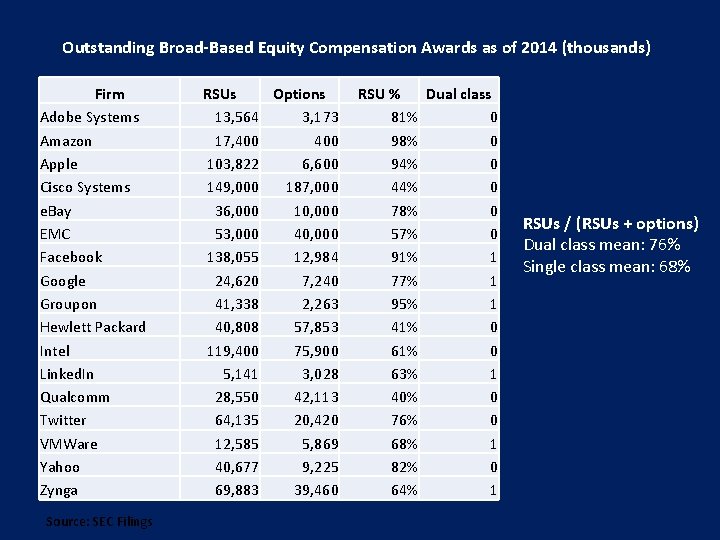
The wisdom of techies • R&D employees have knowledge about capabilities of innovations and firm’s culture for making use of them • “Raising capital” from employees by paying them in stock is expensive because of risk premia • Poorly-explained as incentive alignment– employees don’t usually have ability to influence stock price • (Options, on the other hand, create incentives to innovate: Chang, Fu, Low & Zhang, 2015 JFE) • But paying employees in stock creates a commitment to outside investors • If controllers abuse discretion, employees will leave • Paying them in stock can help outside investors accept a lower level of control rights • Mitigate adverse impact of managing to stock price on innovation
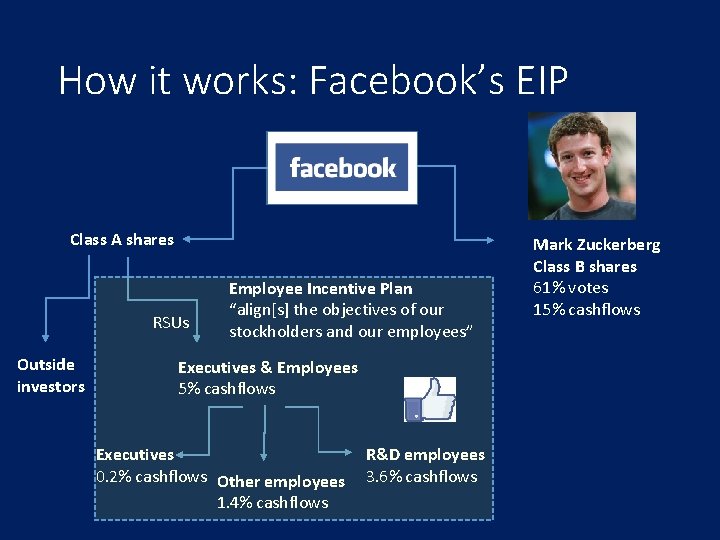
How it works: Facebook’s EIP Facebook Inc Class A shares RSUs Outside investors Employee Incentive Plan “align[s] the objectives of our stockholders and our employees” Executives & Employees 5% cashflows Executives 0. 2% cashflows Other employees 1. 4% cashflows R&D employees 3. 6% cashflows Mark Zuckerberg Class B shares 61% votes 15% cashflows
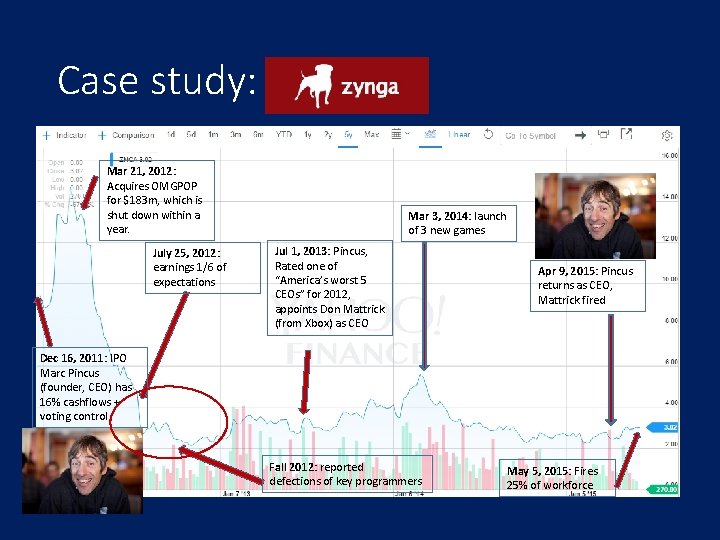
Case study: Zynga Mar 21, 2012: Acquires OMGPOP for $183 m, which is shut down within a year. July 25, 2012: earnings 1/6 of expectations Mar 3, 2014: launch of 3 new games Jul 1, 2013: Pincus, Rated one of “America’s worst 5 CEOs” for 2012, appoints Don Mattrick (from Xbox) as CEO Apr 9, 2015: Pincus returns as CEO, Mattrick fired Dec 16, 2011: IPO Marc Pincus (founder, CEO) has 16% cashflows + voting control Fall 2012: reported defections of key programmers May 5, 2015: Fires 25% of workforce
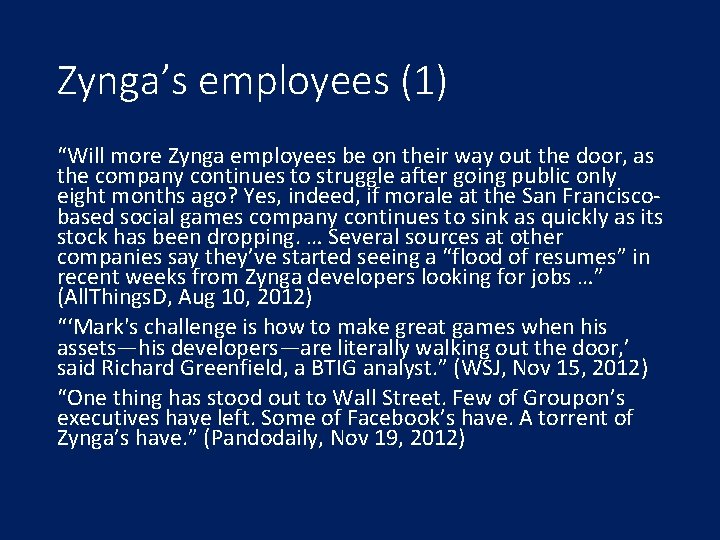
Zynga’s employees (1) “Will more Zynga employees be on their way out the door, as the company continues to struggle after going public only eight months ago? Yes, indeed, if morale at the San Franciscobased social games company continues to sink as quickly as its stock has been dropping. … Several sources at other companies say they’ve started seeing a “flood of resumes” in recent weeks from Zynga developers looking for jobs …” (All. Things. D, Aug 10, 2012) “‘Mark's challenge is how to make great games when his assets—his developers—are literally walking out the door, ’ said Richard Greenfield, a BTIG analyst. ” (WSJ, Nov 15, 2012) “One thing has stood out to Wall Street. Few of Groupon’s executives have left. Some of Facebook’s have. A torrent of Zynga’s have. ” (Pandodaily, Nov 19, 2012)
Zynga’s employees (2) “[O]ur ability to execute our strategy depends on our continued ability to identify, hire, develop motivate and retain highly skilled employees, particularly game designers, product managers and engineers. These employees are in high demand, and we devote significant resources to identifying, recruiting, hiring, training, successfully integrating and retaining them. We have experienced significant turnover in our headcount over the last year, which has placed and will continue to place significant demands on our management and our operational, financial and technological infrastructure. As of March 31, 2015, approximately 33% of our employees had been with us for less than one year and approximately 51% for less than two years. … In addition, our recent operating results, the decline in our revenue and the current trading price of our Class A common stock may cause our employee base to be more vulnerable to be targeted for recruitment by competitors. Some of our employees may have been motivated to work for us by an expectation that our Class A common stock would be trading at a higher value and may be less motivated by the equity compensation they receive as a result. Competitors may leverage any resulting disappointment as a tool to recruit talented employees. Competition for highly skilled employees is intense, particularly in the San Francisco Bay Area, where our headquarters is located. ” (Zynga 10 -Q, May 7, 2015)
Outstanding Broad-Based Equity Compensation Awards as of 2014 (thousands) Firm Adobe Systems Amazon Apple Cisco Systems e. Bay EMC Facebook Google Groupon Hewlett Packard Intel Linked. In Qualcomm Twitter VMWare Yahoo Zynga Source: SEC Filings RSUs Options 13, 564 3, 173 17, 400 103, 822 6, 600 149, 000 187, 000 36, 000 10, 000 53, 000 40, 000 138, 055 12, 984 24, 620 7, 240 41, 338 2, 263 40, 808 57, 853 119, 400 75, 900 5, 141 3, 028 28, 550 42, 113 64, 135 20, 420 12, 585 5, 869 40, 677 9, 225 69, 883 39, 460 RSU % Dual class 81% 0 98% 0 94% 0 44% 0 78% 0 57% 0 91% 1 77% 1 95% 1 41% 0 63% 1 40% 0 76% 0 68% 1 82% 0 64% 1 RSUs / (RSUs + options) Dual class mean: 76% Single class mean: 68%
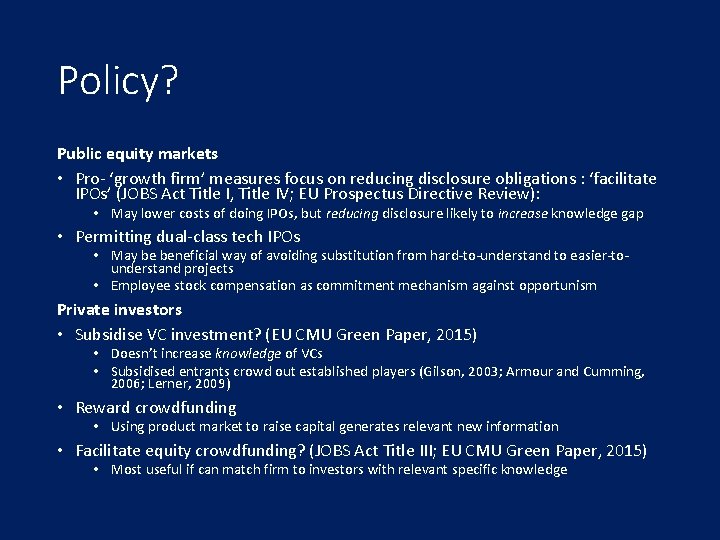
Policy? Public equity markets • Pro- ‘growth firm’ measures focus on reducing disclosure obligations : ‘facilitate IPOs’ (JOBS Act Title I, Title IV; EU Prospectus Directive Review): • May lower costs of doing IPOs, but reducing disclosure likely to increase knowledge gap • Permitting dual-class tech IPOs • May be beneficial way of avoiding substitution from hard-to-understand to easier-tounderstand projects • Employee stock compensation as commitment mechanism against opportunism Private investors • Subsidise VC investment? (EU CMU Green Paper, 2015) • Doesn’t increase knowledge of VCs • Subsidised entrants crowd out established players (Gilson, 2003; Armour and Cumming, 2006; Lerner, 2009) • Reward crowdfunding • Using product market to raise capital generates relevant new information • Facilitate equity crowdfunding? (JOBS Act Title III; EU CMU Green Paper, 2015) • Most useful if can match firm to investors with relevant specific knowledge