
Financing Change of Ownerships Business Valuation Training WPASGL
Financing Change of Ownerships & Business Valuation Training WPASGL – March 15, 2018 Presented by: Neal Patel, CBA, CVA
Neal Patel, CBA, CVA Ø Neal Patel, CBA, CVA is the Principal of Reliant Business Valuation, a business valuation and equipment appraisal firm specialized in SBA related valuations nationwide. Ø Recipient of Coleman Report’s ‘ 2017 Emerging Leader Award’ Ø Our firm currently works with over 150 SBA lenders around the nation. Ø Certified Business Appraiser through the Institute of Business Appraisers (IBA) (ex-Chair of the Board of Governors) Ø Certified Valuation Analyst through the National Association of Certified Valuators and Analysts (NACVA).
Topics Covered SOP Guidelines / Updates Intangible Assets / Deal Structure Equipment Appraisals Factors that Impact Value
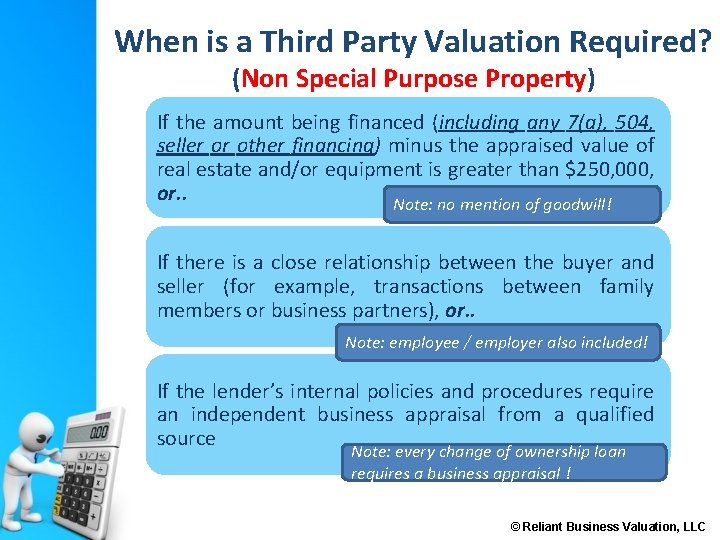
When is a Third Party Valuation Required? (Non Special Purpose Property) If the amount being financed (including any 7(a), 504, seller or other financing) minus the appraised value of real estate and/or equipment is greater than $250, 000, or. . Note: no mention of goodwill! If there is a close relationship between the buyer and seller (for example, transactions between family members or business partners), or. . Note: employee / employer also included! If the lender’s internal policies and procedures require an independent business appraisal from a qualified source Note: every change of ownership loan requires a business appraisal ! © Reliant Business Valuation, LLC
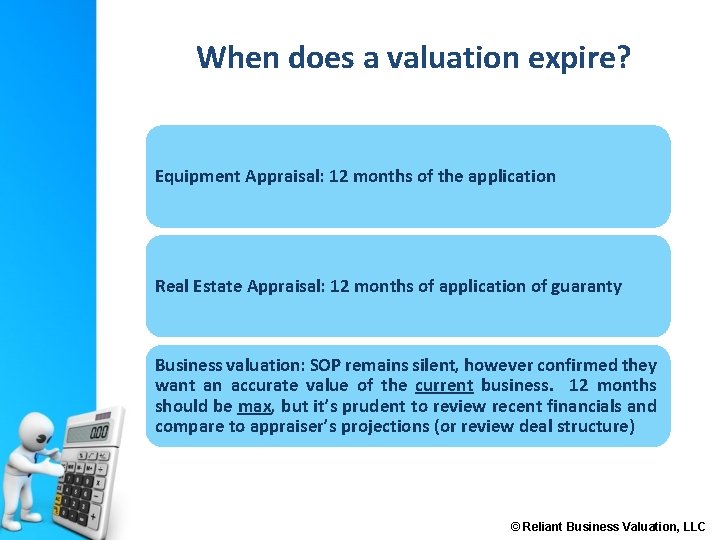
When does a valuation expire? Equipment Appraisal: 12 months of the application Real Estate Appraisal: 12 months of application of guaranty Business valuation: SOP remains silent, however confirmed they want an accurate value of the current business. 12 months should be max, but it’s prudent to review recent financials and compare to appraiser’s projections (or review deal structure) © Reliant Business Valuation, LLC
Special Purpose Property SOP 50 10 5(J) – pg. 197 § A Special Purpose Property is defined in the SOP as "a limited-market property with a unique physical design, special construction materials, or a layout that restricts its utility to the specific use for which it was built. " © Reliant Business Valuation, LLC
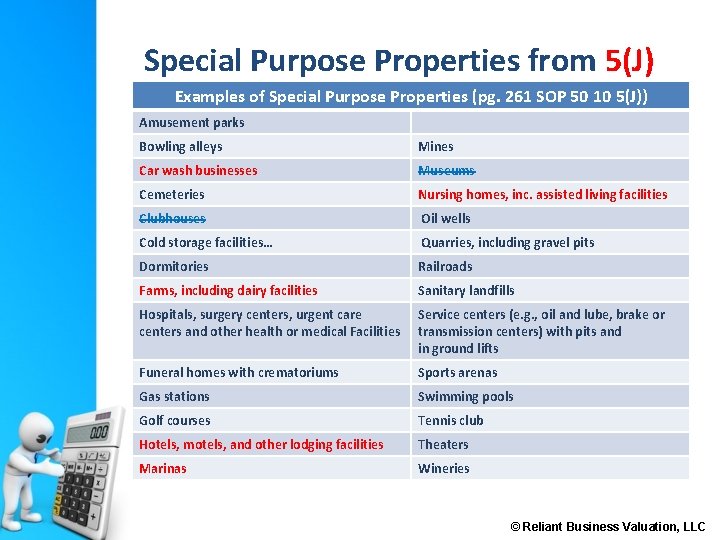
Special Purpose Properties from 5(J) Examples of Special Purpose Properties (pg. 261 SOP 50 10 5(J)) Amusement parks Bowling alleys Mines Car wash businesses Museums Cemeteries Nursing homes, inc. assisted living facilities Clubhouses Oil wells Cold storage facilities… Quarries, including gravel pits Dormitories Railroads Farms, including dairy facilities Sanitary landfills Hospitals, surgery centers, urgent care centers and other health or medical Facilities Service centers (e. g. , oil and lube, brake or transmission centers) with pits and in ground lifts Funeral homes with crematoriums Sports arenas Gas stations Swimming pools Golf courses Tennis club Hotels, motels, and other lodging facilities Theaters Marinas Wineries © Reliant Business Valuation, LLC
Special Purpose Properties “…the lender must obtain an independent business valuation performed by a Certified General Real Property Appraiser. “ Additionally, § The business valuation must allocate separate values to the individual components of the transaction including land, building, equipment and intangible assets. § The Certified General Real Property Appraiser must have completed no less than four going concern appraisals of equivalent special use property as the property being appraised, within the last 36 months, as identified in the qualifications portion of the Appraisal Report. § Each business valuation assignment under this section must be. . . in compliance with current USPAP guidelines. © Reliant Business Valuation, LLC
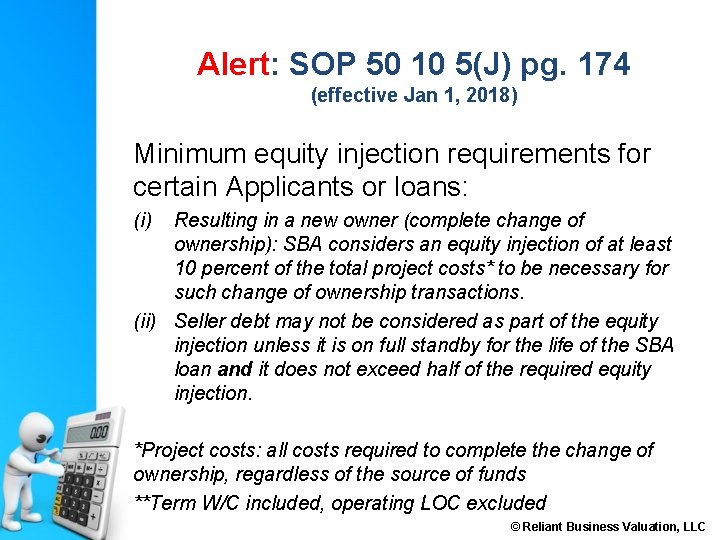
Alert: SOP 50 10 5(J) pg. 174 (effective Jan 1, 2018) Minimum equity injection requirements for certain Applicants or loans: (i) Resulting in a new owner (complete change of ownership): SBA considers an equity injection of at least 10 percent of the total project costs* to be necessary for such change of ownership transactions. (ii) Seller debt may not be considered as part of the equity injection unless it is on full standby for the life of the SBA loan and it does not exceed half of the required equity injection. *Project costs: all costs required to complete the change of ownership, regardless of the source of funds **Term W/C included, operating LOC excluded © Reliant Business Valuation, LLC
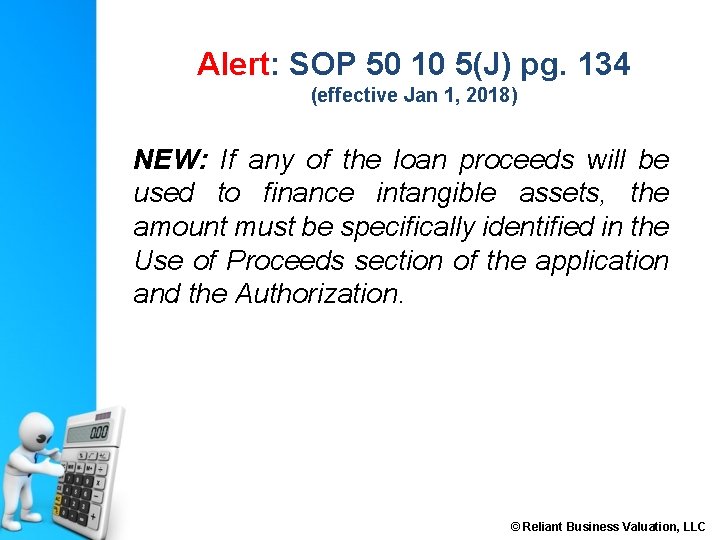
Alert: SOP 50 10 5(J) pg. 134 (effective Jan 1, 2018) NEW: If any of the loan proceeds will be used to finance intangible assets, the amount must be specifically identified in the Use of Proceeds section of the application and the Authorization. © Reliant Business Valuation, LLC
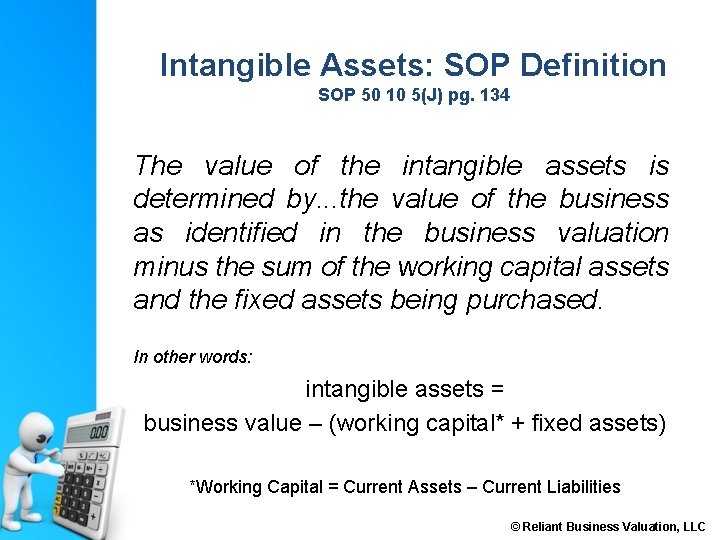
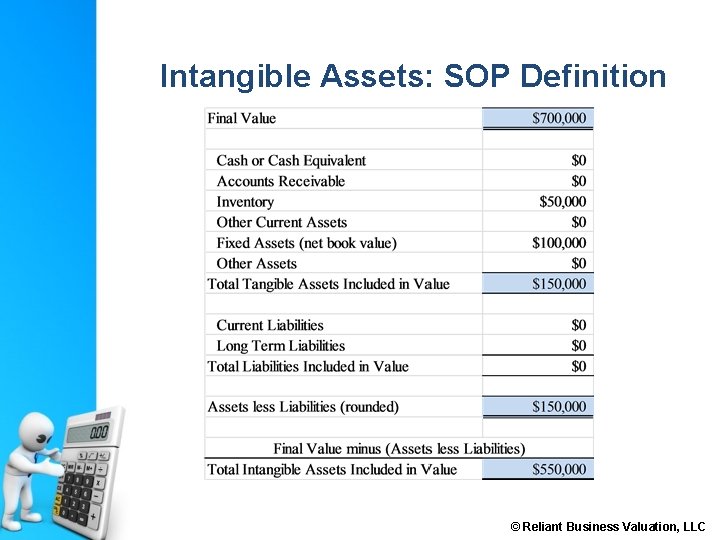
Intangible Assets: SOP Definition SOP 50 10 5(J) pg. 134 The value of the intangible assets is determined by. . . the value of the business as identified in the business valuation minus the sum of the working capital assets and the fixed assets being purchased. In other words: intangible assets = business value – (working capital* + fixed assets) *Working Capital = Current Assets – Current Liabilities © Reliant Business Valuation, LLC
Intangible Assets: SOP Definition © Reliant Business Valuation, LLC
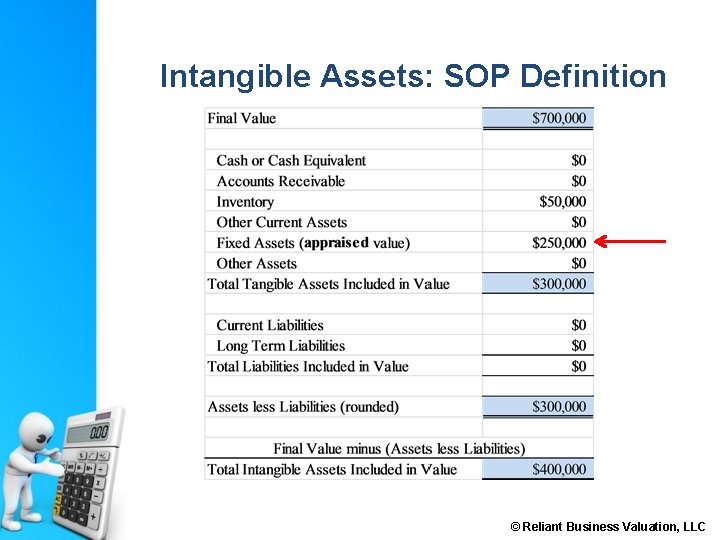
Intangible Assets: SOP Definition © Reliant Business Valuation, LLC
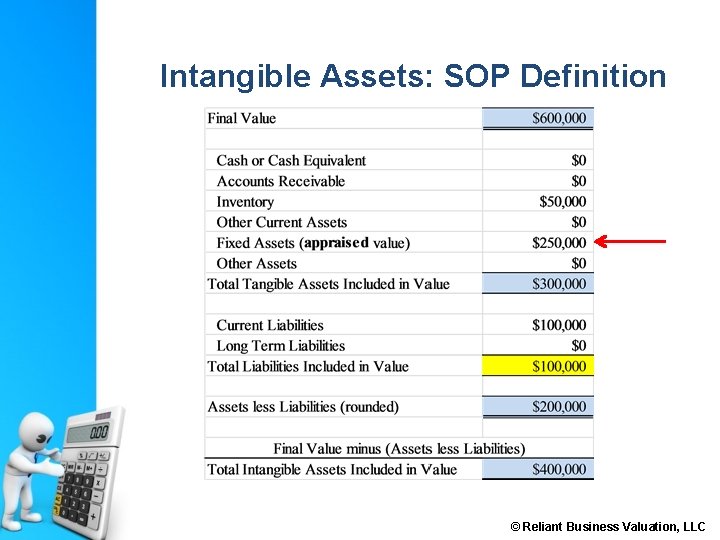
Intangible Assets: SOP Definition © Reliant Business Valuation, LLC
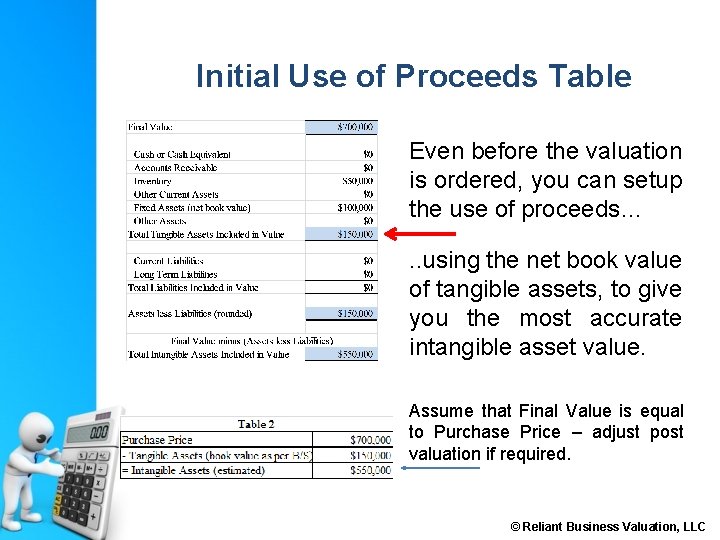
Initial Use of Proceeds Table Even before the valuation is ordered, you can setup the use of proceeds…. . using the net book value of tangible assets, to give you the most accurate intangible asset value. Assume that Final Value is equal to Purchase Price – adjust post valuation if required. © Reliant Business Valuation, LLC
Important Reminder: Transaction Type The following paragraph was moved up to the top of the Business Valuation Requirements section, most likely due to the importance of its contents. SOP 50 10 5(J) States: "The scope of work should identify whether the transaction is an asset purchase or stock purchase and be specific enough for the individual performing the business valuation to know what is included in the sale (including any assumed debt). " • All assets and liabilities that are included in the final transaction must be included in the business valuation. This is similar to the basic concept of "comparing apples to apples". © Reliant Business Valuation, LLC
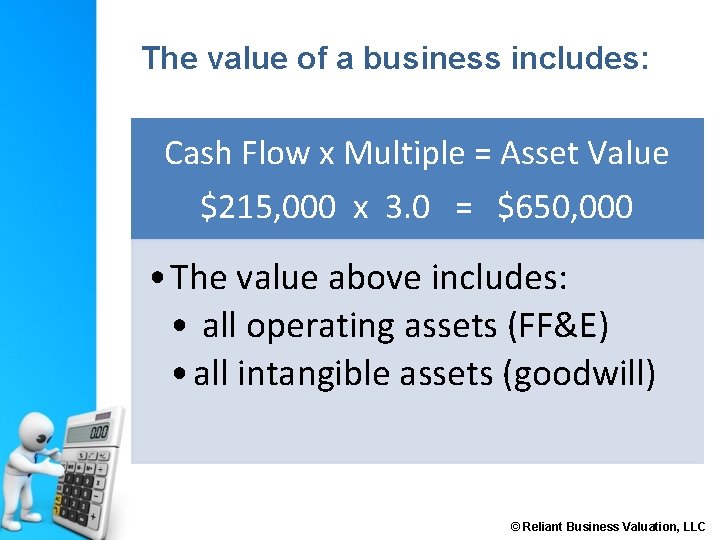
The value of a business includes: Cash Flow x Multiple = Asset Value $215, 000 x 3. 0 = $650, 000 • The value above includes: • all operating assets (FF&E) • all intangible assets (goodwill) © Reliant Business Valuation, LLC
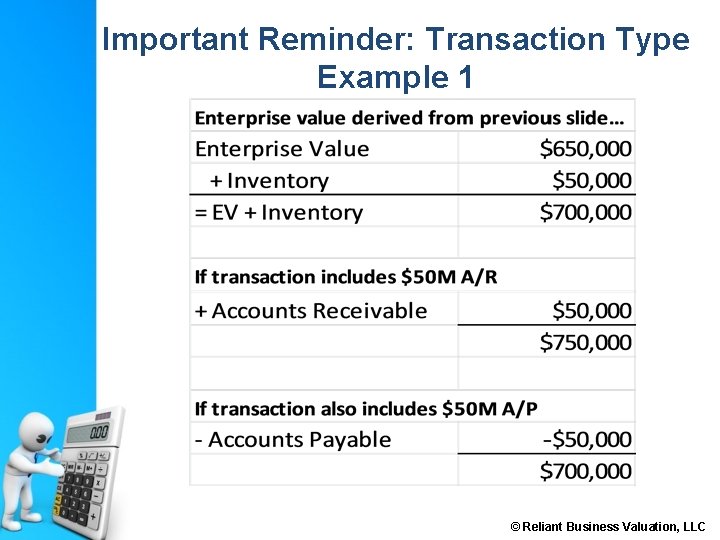
Important Reminder: Transaction Type Example 1 © Reliant Business Valuation, LLC
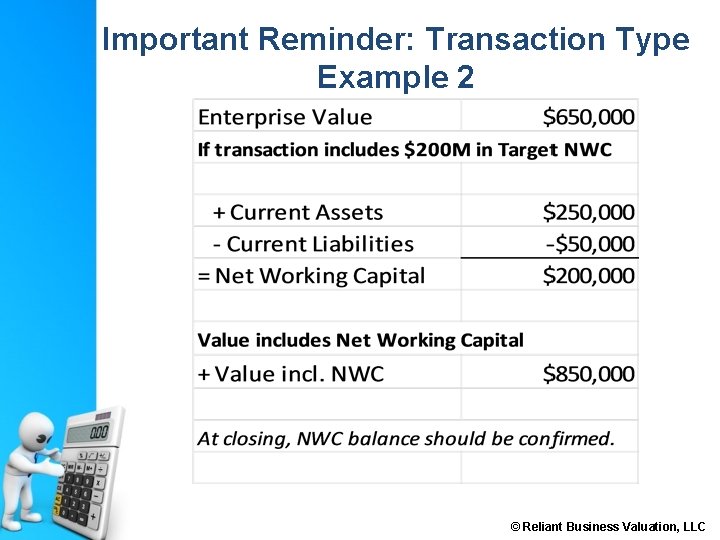
Important Reminder: Transaction Type Example 2 © Reliant Business Valuation, LLC
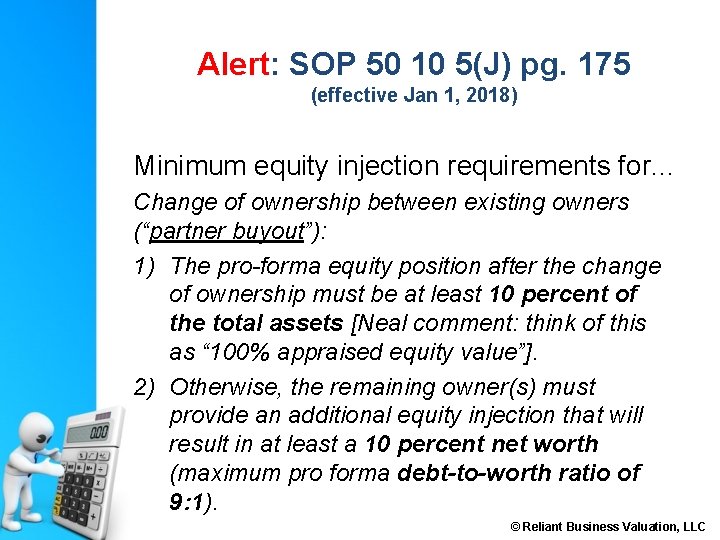
Alert: SOP 50 10 5(J) pg. 175 (effective Jan 1, 2018) Minimum equity injection requirements for. . . Change of ownership between existing owners (“partner buyout”): 1) The pro-forma equity position after the change of ownership must be at least 10 percent of the total assets [Neal comment: think of this as “ 100% appraised equity value”]. 2) Otherwise, the remaining owner(s) must provide an additional equity injection that will result in at least a 10 percent net worth (maximum pro forma debt-to-worth ratio of 9: 1). © Reliant Business Valuation, LLC
Partnership Buyout Can the owner’s existing equity in the business be used to satisfy the 10% “equity requirement”? § Example: 10% partner is buying out a 90% partner’s ownership interest, resulting in 100% ownership vesting in the purchaser. § The business valuation reflects a pre-sale stock value equaling $1, 000 § value includes all assets ($300, 000 Cash, AR, Inventory and $200, 000 liabilities (pre-sale)) © Reliant Business Valuation, LLC
Partnership Buyout (Interpretation #1 (subject to SBA clarification)) SOP: The pro-forma equity position after the change of ownership must be at least 10 percent of the total assets. Value = $1 MM, Debt = $900 M, Pro forma equity = $100 M / $1 MM = 10% SOP: Otherwise, the remaining owner(s) must provide an additional equity injection that will result in at least a 10 percent net worth (maximum pro forma debt-to-worth ratio of 9: 1). Debt = $900 M, net worth (pro forma equity) = $100 M Debt to Worth = $900 M/$100 M = 9: 1 © Reliant Business Valuation, LLC
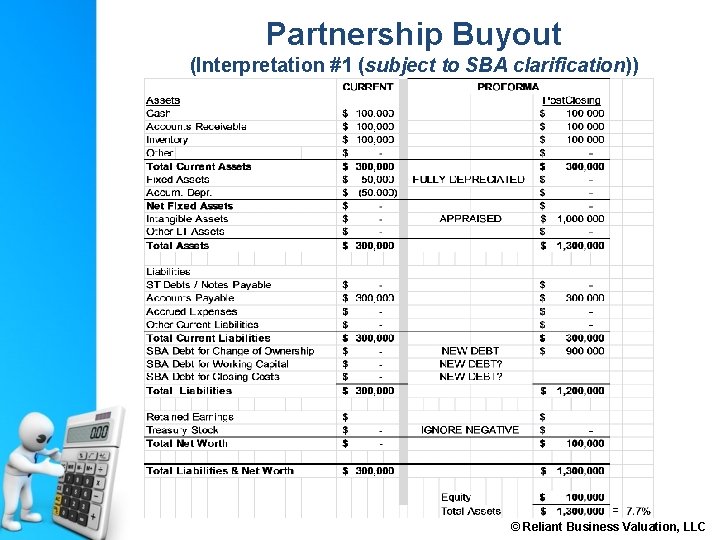
Partnership Buyout (Interpretation #1 (subject to SBA clarification)) © Reliant Business Valuation, LLC
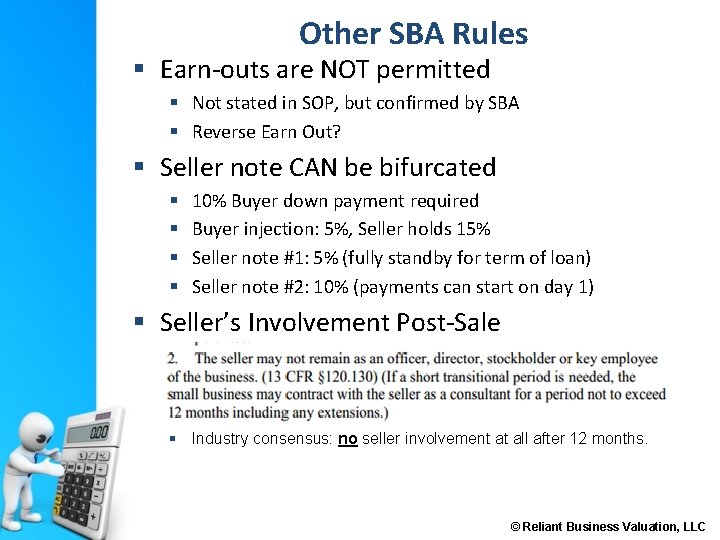
Other SBA Rules § Earn-outs are NOT permitted § Not stated in SOP, but confirmed by SBA § Reverse Earn Out? § Seller note CAN be bifurcated § § 10% Buyer down payment required Buyer injection: 5%, Seller holds 15% Seller note #1: 5% (fully standby for term of loan) Seller note #2: 10% (payments can start on day 1) § Seller’s Involvement Post-Sale § Industry consensus: no seller involvement at all after 12 months. © Reliant Business Valuation, LLC
Equipment Appraisals § When ordering an equipment appraisal, always request both standards of value: § Fair Market Value • No time restriction to sell assets • FMV of equipment can be used in Business Valuation in lieu of Net Book Value § Orderly Liquidation Value • Approx. 90 -120 Days and typically 65% of Fair Market Value § Also ask the equipment appraiser to separately allocate aggregate values of machinery/equipment and furniture/fixtures Collateral requirements updated (next slide) © Reliant Business Valuation, LLC
Equipment Appraisals 7(a) Loan Program – Equipment Appraisals (pg. 186 -187) Collateral Requirements (loans over $350, 000): § For collateral purposes, the SBA has intentionally separated machinery and equipment from furniture and fixtures, as highlighted in bold below. § New machinery and equipment (excluding furniture and fixtures) may be valued at 75% of price minus any prior liens for the calculation of “fully-secured”; § Used or existing machinery and equipment (excluding furniture and fixtures) may be valued at 50% of Net Book Value or 80% with [sic] an Orderly Liquidation Appraisal minus any prior liens for the calculation of “fully-secured. ” § Furniture and Fixtures may be valued at 10% of Net Book Value or appraised value. (SBA has confirmed “appraised value” is also Orderly Liquidation) Equipment appraisers should now separately allocate aggregate values of machinery/equipment and furniture/fixtures when providing the lender with Fair Market and Orderly Liquidation Values. © Reliant Business Valuation, LLC
Equipment Appraisals 504 Loan Program – Collateral Requirements (pg. 312) New language for equipment appraisal requirements utilized in conjunction with the 504 loan program: § SBA requires that an equipment appraisal be obtained when used equipment is part of the Project and is either being purchased from someone other than an equipment dealer, or being refinanced. The equipment appraisal needs to be a written document from a (1) person that is qualified to provide a valuation, (2) is independent of the transaction, and (3) has performed an onsite inspection of the equipment. The appraisal must be dated no more than twelve months prior to the date of the application. § ‘Project’ as noted above is defined in the SOP as: the purchase or lease, and/or improvement or renovation of long-term fixed assets by a small business, with 504 financing, for use in its business operations. © Reliant Business Valuation, LLC
The Valuation Process Valuation Methods Reasonable Valuation Multiples Factors that Impact Value Typical Valuation Multiple Ranges © Reliant Business Valuation, LLC
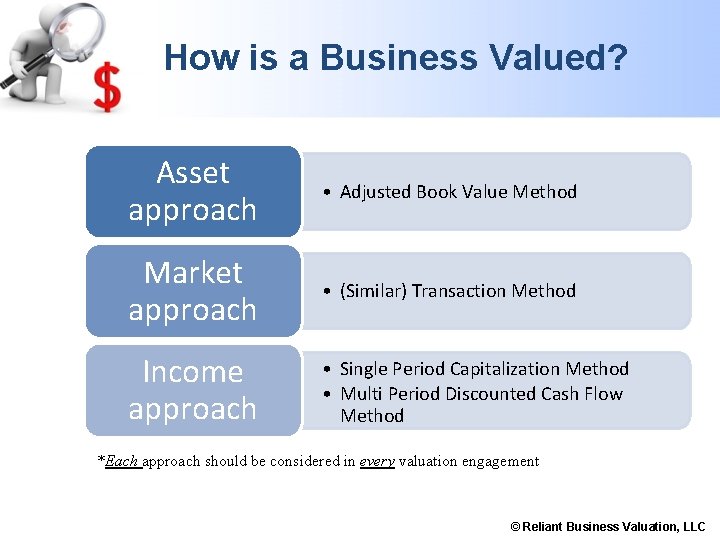
How is a Business Valued? Asset approach • Adjusted Book Value Method Market approach • (Similar) Transaction Method Income approach • Single Period Capitalization Method • Multi Period Discounted Cash Flow Method *Each approach should be considered in every valuation engagement © Reliant Business Valuation, LLC
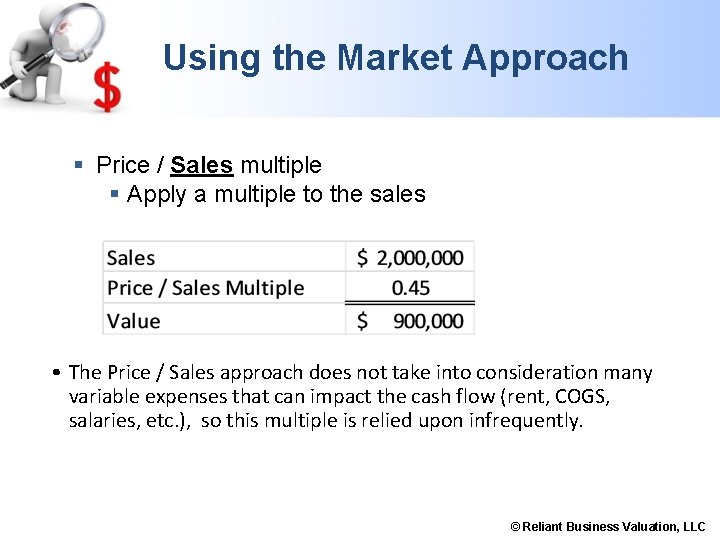
Using the Market Approach § Price / Sales multiple § Apply a multiple to the sales • The Price / Sales approach does not take into consideration many variable expenses that can impact the cash flow (rent, COGS, salaries, etc. ), so this multiple is relied upon infrequently. © Reliant Business Valuation, LLC
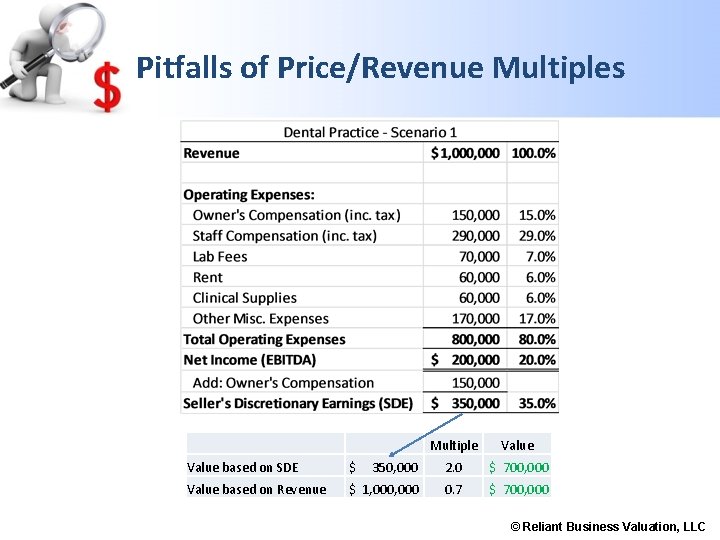
Pitfalls of Price/Revenue Multiples Multiple Value based on SDE $ 350, 000 2. 0 $ 700, 000 Value based on Revenue $ 1, 000 0. 7 $ 700, 000 © Reliant Business Valuation, LLC
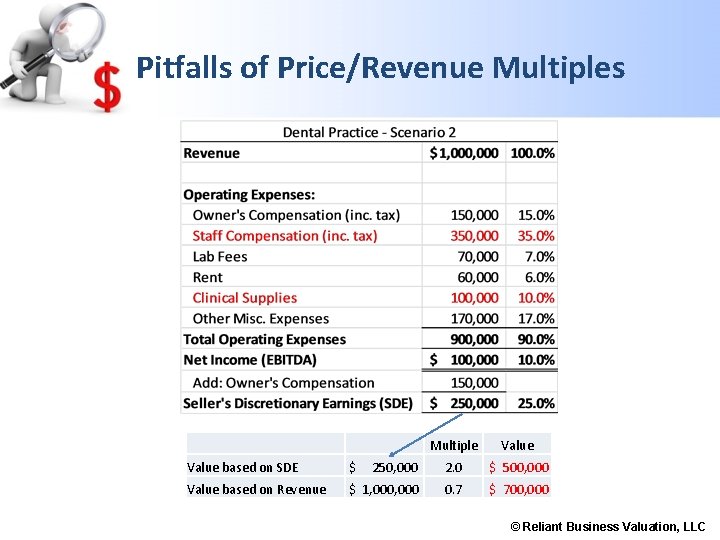
Pitfalls of Price/Revenue Multiples Multiple Value based on SDE $ 250, 000 2. 0 $ 500, 000 Value based on Revenue $ 1, 000 0. 7 $ 700, 000 © Reliant Business Valuation, LLC
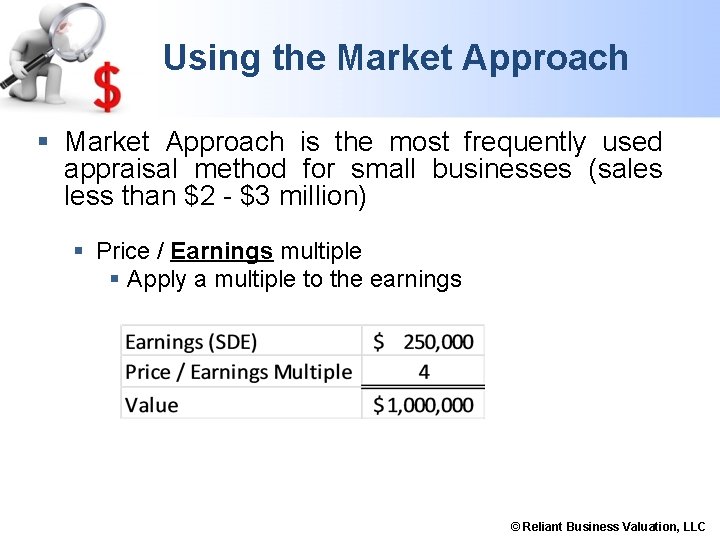
Using the Market Approach § Market Approach is the most frequently used appraisal method for small businesses (sales less than $2 - $3 million) § Price / Earnings multiple § Apply a multiple to the earnings © Reliant Business Valuation, LLC
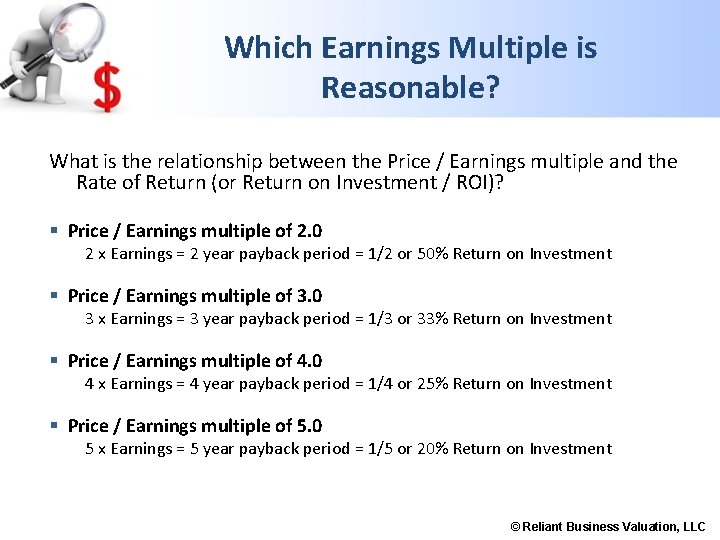
Which Earnings Multiple is Reasonable? What is the relationship between the Price / Earnings multiple and the Rate of Return (or Return on Investment / ROI)? § Price / Earnings multiple of 2. 0 2 x Earnings = 2 year payback period = 1/2 or 50% Return on Investment § Price / Earnings multiple of 3. 0 3 x Earnings = 3 year payback period = 1/3 or 33% Return on Investment § Price / Earnings multiple of 4. 0 4 x Earnings = 4 year payback period = 1/4 or 25% Return on Investment § Price / Earnings multiple of 5. 0 5 x Earnings = 5 year payback period = 1/5 or 20% Return on Investment © Reliant Business Valuation, LLC
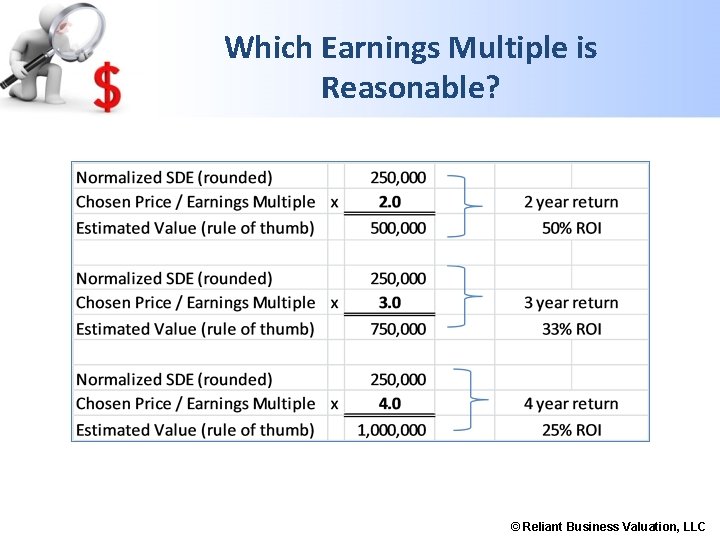
Which Earnings Multiple is Reasonable? © Reliant Business Valuation, LLC
Factors that Influence the Multiple • Diversification – How many customers does the company have? – Does any one single client make up for more than 15% of the company’s sales? -- Check the Aging AR Report – What percentage of sales do the top 5 customers represent? – Does the company have any vendors or suppliers in which they purchase more than 25% of the company’s products/services? • Personal/Professional Goodwill – If the owner of the company were to fall ill or a key employee were to leave, what effect would it have on company? © Reliant Business Valuation, LLC
Factors that Influence the Multiple • Barriers of Entry – Are there any licenses, patents, etc. increasing barriers to entry for a competitor to offer similar products/services? • Recurring Revenue – Does the company have recurring revenue model? (i. e. customer contracts which guarantee steady revenue stream)? © Reliant Business Valuation, LLC
Factors that Influence the Multiple Owner’s involvement Marketability Financial Strength Brand recognition Transferability of Revenues Size of Potential Buyer Pool Customer Concentration Industry and company risk Management depth Employee retention Ease of operations Size of Company / Revenues Quality of clients Growth Prospects Product mix © Reliant Business Valuation, LLC
Typical Multiples for Other Industries • Dentist Practice - 2. 0 x SDE multiple – – high chance of attrition if dentist sells small buyer pool (for the business) no brand recognition no depth in management structure • Franchised Restaurant - 3. 0 – 4. 0 SDE multiple – – little attrition upon sale large buyer pool (for the business) training manuals / franchise support ease of operations / ability to run absentee © Reliant Business Valuation, LLC
Typical Multiples for Other Industries • Insurance Agency - 3. 0 – 5. 0 SDE multiple – – recurring revenues new clients must exceed annual attrition (simple enough!) large buyer pool (including other insurance agencies) no customer concentration • Home Health Care - 3. 0 – 4. 0 SDE multiple – – reliant on Medicaid vs. self-pay? Medicaid is risky… large buyer pool no customer concentration possible large depth of management structure © Reliant Business Valuation, LLC
Contact Information Neal Patel, CBA, CVA Reliant Business Valuation 908. 888. 6030 neal@reliantvalue. com www. reliantvalue. com The contents of this presentation is provided for informational purposes only. They are not intended as and do not constitute legal or valuation advice and should not be acted on as such.
- Slides: 41