
Financing a Small Business The ABCs from Start
Financing a Small Business The ABC’s from Start to Finance… BUS 202 Financing a SB Spring 2006 copyright sjh
Why Worry about Financing? v The key to a successful business often depends on the ability to have sound management, financing & cash flow to fund the operations v Inadequate financing is one of the major causes of business failure v To avoid this pitfall, small business owners need enough money and need to know how to manage it to STAY in Business!
What Financial Resources are available for my business? The most common resources: • • • Personal Savings Friends & Relatives Venture Capital Firms Government Loans Commercial Loans Knowing Who, When and Where to ask for financing can be a key to your success!
Debt or Equity? • DEBT is borrowed money…it becomes a liability on your balance statement (long term loan) • EQUITY is an “investment” in your business (silent partner or venture capital) Remember the Accounting Equation Asset = Liabilities - Owners’ Equity
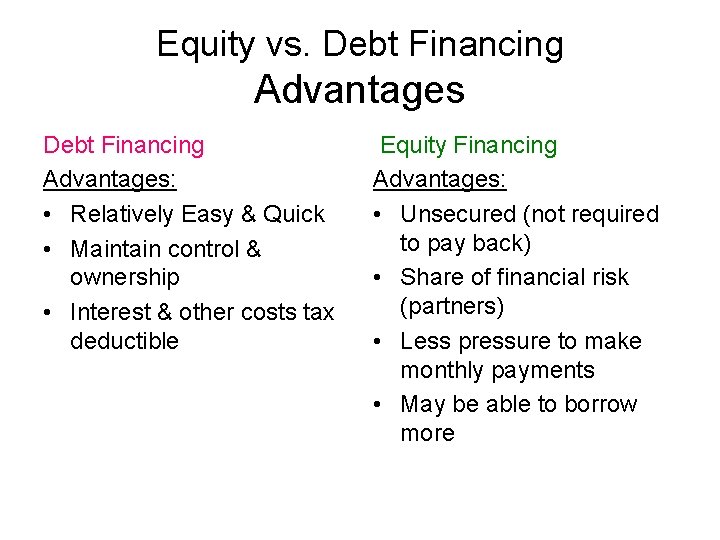
Equity vs. Debt Financing Advantages: • Relatively Easy & Quick • Maintain control & ownership • Interest & other costs tax deductible Equity Financing Advantages: • Unsecured (not required to pay back) • Share of financial risk (partners) • Less pressure to make monthly payments • May be able to borrow more
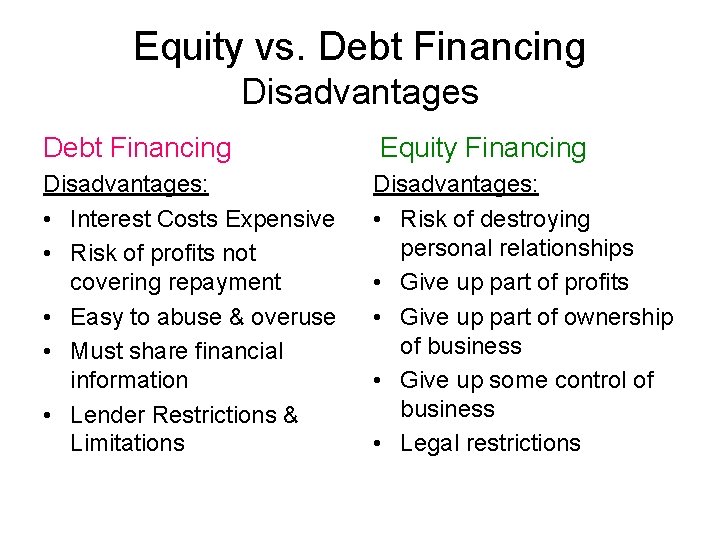
Equity vs. Debt Financing Disadvantages Debt Financing Equity Financing Disadvantages: • Interest Costs Expensive • Risk of profits not covering repayment • Easy to abuse & overuse • Must share financial information • Lender Restrictions & Limitations Disadvantages: • Risk of destroying personal relationships • Give up part of profits • Give up part of ownership of business • Give up some control of business • Legal restrictions
Debt: A Loan by any other name q Debt Financing is most frequently used when there are minimal risks and the investment return is acceptable to the lender. q Businesses that rely on debt financing are those in earlier stages of business development (primary & secondary levels of business growth). There are two specific types of debt financing 1) Conventional Loan Programs 2) Government Guaranty Loan Programs
Needs for Capital to Open the Store Capital to Keep Store Open • Start-up costs to cover a term loan • Equipment • Lease hold improvements • Inventory • Working capital to cover growth expenditures normally a “line of credit” • coverhead • payroll • purchase inventory • maintain cash flow
Common Uses for Financing • Start-up Capital • Working Capital • Permanent Working Capital • Growth Capital • Equity Transfer Capital • Debt- refinancing (more difficult to get a business loan)
Conventional Bank Loans • • Short-term Demand loans Seasonal lines of credit Single-purpose loans for machinery and equipment. • Banks generally are reluctant to offer longterm loans to smaller firms.
A Guaranteed Loan? • SBA and State Guarantee Programs are loans made by private lenders and guaranteed up to 85% by the federal or state government • The government is not a “direct” lender, but acts as a co-signer • This takes the risk off the lender. Business + Lender + Loan guaranty from federal or state programs = AN Approved Loan
What’s a Lender to Do? ? Lender’s can: • Approve your Loan Request • Seek a guarantee from SBA to support their loan to you • Decline your application all together
US Small Business Administration The SBA guaranteed lending program encourages banks and non-bank lenders to make longterm loans to small firms by reducing their risk and leveraging the funds they have available.
SBA & State Loan Eligibility • Independently owned & operated; not dominate in field • Press & real estate not eligible • Considerations: Business Type Size Use of Proceeds Personal Net Worth Character of Individual
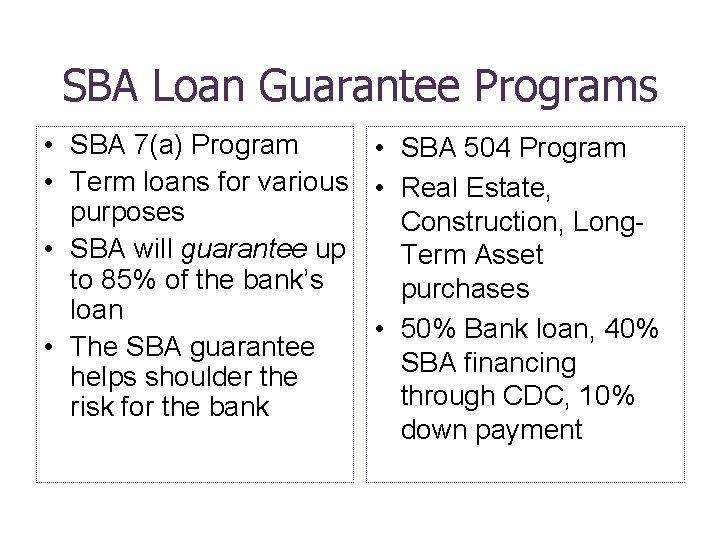
SBA Loan Guarantee Programs • SBA 7(a) Program • SBA 504 Program • Term loans for various • Real Estate, purposes Construction, Long • SBA will guarantee up Term Asset to 85% of the bank’s purchases loan • 50% Bank loan, 40% • The SBA guarantee SBA financing helps shoulder the through CDC, 10% risk for the bank down payment
SBA 7(a) Loans Loan Proceeds can be used for: • Inventory • Equipment • Machinery • Start-Up Costs • Working Capital • Real Estate
SBA & State Guarantee Loans Small Business Administration • 7 a Loan • Low-doc/Women & Minority Pre-qualification • 504 Loan • SBA Micro loan • SBA Community Express SOHO Micro Loan State Administered Loan Programs • Nor-CAL FDC State Guarantee • Clean Loan Program (pollution & waste reduction) • Safe-Bidco State Guarantee • State Rural Loans- Agriculture & Industrial
Micro-Loans • Normally $25, 000 or under • Unsecured! • Can go as low as $5, 000 • Used for start-up businesses • Interest rates normally higher than conventional loans ( 3 -6%) above prime • Relaxed criteria • May have qualification restrictions
Local City & Redevelopment Loans • Local City Redevelopment Loans • “Gap” Financing to assist businesses in redeveloped area • Lower interest rate and tied to job creation • Special “Façade” or Signage Loan Programs • Some local micro-enterprise loans
NOT EXACTLY!!! • Applicant must be “Credit Worthy” • 5 “C’s” of Credit • Applicant MUST be able to demonstrate the ability to re-pay the loan – even with the SBA guarantee
What the Bank and SBA Look For in Analyzing a Loan Application 1. ABILITY TO REPAY 2. CREDIT HISTORY 3. EQUITY INVESTMENT 4. SECONDARY SOURCE OF REPAYMENT 5. EXPERIENCE/ABILITY TO MANAGE BUSINESS 6. PERSONAL OBLIGATIONS
#1 Ability to Repay!!! • Financial Statements • P & L’s • CASH FLOW – remember, bills are paid with CASH, not profits! • NEW BUSINESSES – Bus Plan is KEY
2. Credit History • Pull your Credit Report BEFORE you go to the bank! • Mistakes take 3 -6 weeks to correct • Detailed information explaining credit issues
3. Equity • MUST be enough equity in the business to leverage the loan • General Rule – Debt to Equity no higher than 4 • Start-up Businesses – expect 25%
4. Collateral • Secondary Source of Repayment • Personal and Business Assets that can be sold to pay back the loan in the event of default • Co-Signers can pledge collateral
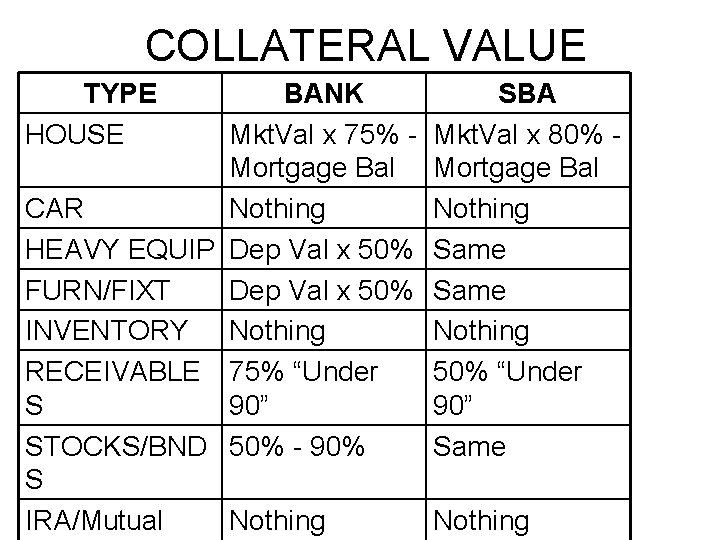
COLLATERAL VALUE TYPE HOUSE BANK Mkt. Val x 75% Mortgage Bal CAR Nothing HEAVY EQUIP Dep Val x 50% FURN/FIXT Dep Val x 50% INVENTORY Nothing RECEIVABLE 75% “Under S 90” STOCKS/BND 50% - 90% S IRA/Mutual Nothing SBA Mkt. Val x 80% Mortgage Bal Nothing Same Nothing 50% “Under 90” Same Nothing
5. EXPERIENCE • Experience COUNTS!!! • Industry Knowledge • Industry CONTACTS • Competition • Target Market • Product/Service Niche
6. Personal Obligations • Outside sources of income to support personal living expenses a PLUS+ • Low Personal Debt a PLUS+ • Excess Outside Income can offset lack of collateral
Build a Banking Relationship • Banks LIKE lending to businesses/people they KNOW! • Community Banks LIKE investing in their communities • Banks WANT you to be SUCCESSFUL!
Checklist for getting it all together! Every bank or organization will have a slightly different list of everything that is needed. Here is a basic list: ü ü ü ü ü Applicant Information Sheet Current Personal Financial Statement (for all partners) Schedule of Real Estate Owned Personal Tax Returns- 3 years (or business if in business) Signed Credit Authorization Current Financial Statement Business Debt Schedule If new business, business plan and projections for first 12 months If purchasing, Purchase agreement If franchising, Franchise agreement
Resources Check out these sites for loan programs • • www. sba. gov www. moneyforsmallbiz. com www. womensinititative. org www. obdc. com www. solanosbdc. org www. Innovativebank. com www. Safe-bidco. com
Buying An Existing Business For Sale
Key Questions to Consider Before Buying a Business • Is the right type of business for sale in the market in which you want to operate? • What experience do you have in this particular business and the industry in which it operates? • How critical is experience in the business to your ultimate success? • What price and payment method are reasonable for you and acceptable to the seller?
More KEY Questions • Should you start the business and build it from the ground up rather than buy an existing one? • What changes will you have to make – and how extensive will they have to be – to realize the business’s full potential? • Will the company generate sufficient cash flow to pay for itself and leave you with a suitable return on your investment?
Advantages of Buying A Business • • • Established good will and customer base It may already have the best location Employees and suppliers are established Equipment is already installed Inventory is in place and trade credit is established You can “hit the ground running” • You can use the previous owner’s experience • Seller may finance or carry
Disadvantages of Buying A Business • “It’s a loser” • Bad reputation is hard to change • “Inherited” employees may be unsuitable • Location may have become unsatisfactory • Equipment may be obsolete
Locating a Business • • Business Brokers “Hidden market” How to Buy a Business Workshop California Businesses For Sale Website www. bizben. com Kwik-Mart
Five Critical Areas for Analyzing an Existing Business 1. 2. 3. 4. 5. Why does the owner want to sell. . the real reason? What is the physical condition of the business? What is the potential for the company's products or services? • Customer characteristics and composition. • Competitor analysis. What legal aspects must I consider? Is the business financially sound?
Valuing of a Business • Balance Sheet Approach – Adjusted Balance Sheet Technique • Earnings Approach – Multiple of Recast Earnings Approach – Discounted Future Earnings Approach • Market Approach – Comps
Planning For Your Capital Needs Having the appropriate business plan is critical! Financing Plan - must support ability to repay. This plan must have realistic projections and justification. Investment Plan - illustrates the strengths & potential of the business in order to capture market share. Describes the “equity investment” and structure (who is contributing and in what proportions) Composite (existing) - often used by existing businesses for on-going financing or for growth stage. This plan is often an “updated” business plan of a first stage business.
More Business Plans • Start-up (“projected”)- details the projected strengths and needs of a new business. The plan MUST BE able to support the assumptions…both the marketing and the financials • Other types of business plans (nonfinancial)- Strategic (Action Plan), Marketing & Operational
Outline of a Typical Small Business Financing Business Plan I. III. IV. V. VIII. IX. X. XI. Cover Page Cover Letter & Statement of Purpose Table of Contents Executive Summary Description of Business Market Analysis Management Operations Use of Funds Financial Information Supporting Information (resumes, agreements)
Ten Most Common Mistakes Found in Financial Business Plans • Too Long • No Competition Indicated • Unreasonable Expectations & Projections • Unreasonable Financial Projections • Unrealistic Profitability for Investors • Management Skills not demonstrated • Unrealistic projections of products & services • Lack of Knowledge of Industry • Inadequate Calculations • NOT Clear to the reader
- Slides: 43