
Financial System part 1 Junhui Qian 2018 Content

- Slides: 26
Financial System (part 1) Junhui Qian 2018
Content • Basics • The Reform of the Financial System • The Banking System • Recent Trends
What is a financial system? • Financial system is the collection of rules and institutions that facilitate the allocation of financial resources between savers and borrowers. • Banks • Insurance • Capital market • Equity market • Bond market • Derivatives market • Others
What Does the Financial System Do? • Financing • Provide financing to households and enterprises. • Saving • Provide financial products to savers (investors). • Information • Generate information on enterprises and investment projects so that risk can be priced and resources can be efficiently allocated. • Control • Impose discipline on managers of public companies
Content • Basics • The Reform of the Financial System • The Banking System • Recent Trends
The Financial System Before The Reform • Monobank: People’s Bank of China • It is both the central bank and the commercial bank. • The monobank system collects savings, channels funds to work units according to plans. No information is generated from the process. • The role of the monobank system is passive, accommodating the needs of the planner. The monobank system does not impose discipline on managers of the work units.
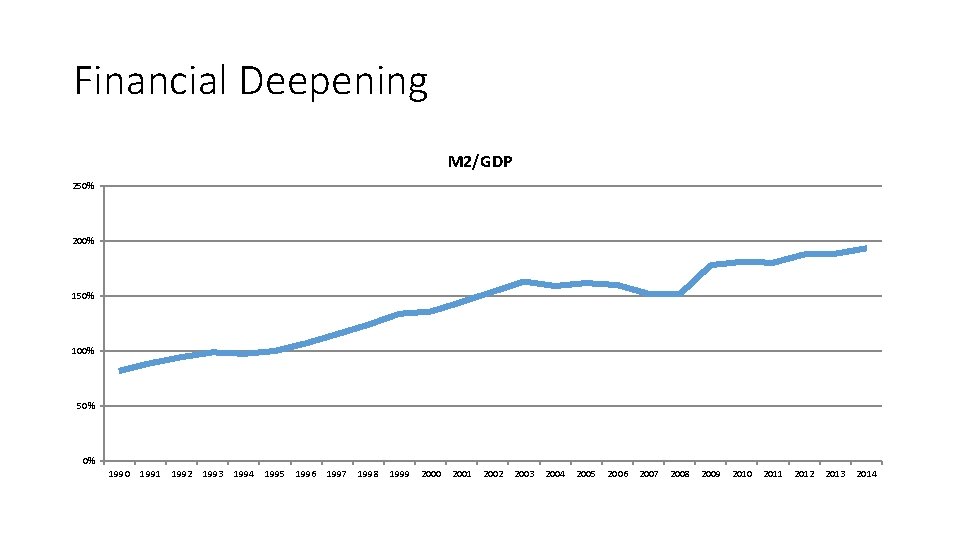
Financial Deepening • Before the reform, financial wealth of the country was limited, mostly in the form of deposits (claims on the monobank). • As the transition from the planned economy to the market economy started, more financial wealth (relative to income) had been created and held as claims on banks and enterprises. This process is often called “financial deepening”. • The financial deepening may be measured by the ratio of financial assets to national income. More conveniently, it is often measured by M 2/GDP.
Financial Deepening M 2/GDP 250% 200% 150% 100% 50% 0% 1990 1991 1992 1993 1994 1995 1996 1997 1998 1999 2000 2001 2002 2003 2004 2005 2006 2007 2008 2009 2010 2011 2012 2013 2014
Financial Broadening • Financial broadening refers to an increase in the variety of financial institutions and instruments. • Over the past three decades, China had transformed the monobank into a sophisticated banking system, had developed stock and bond markets, derivatives market, etc. • During the development, there appeared a wide variety of institutional investors (mutual funds, insurance companies, private equities, hedge funds, etc. ) and financial products.
Content • Basics • The Reform of the Financial System • The Banking System • Recent Trends
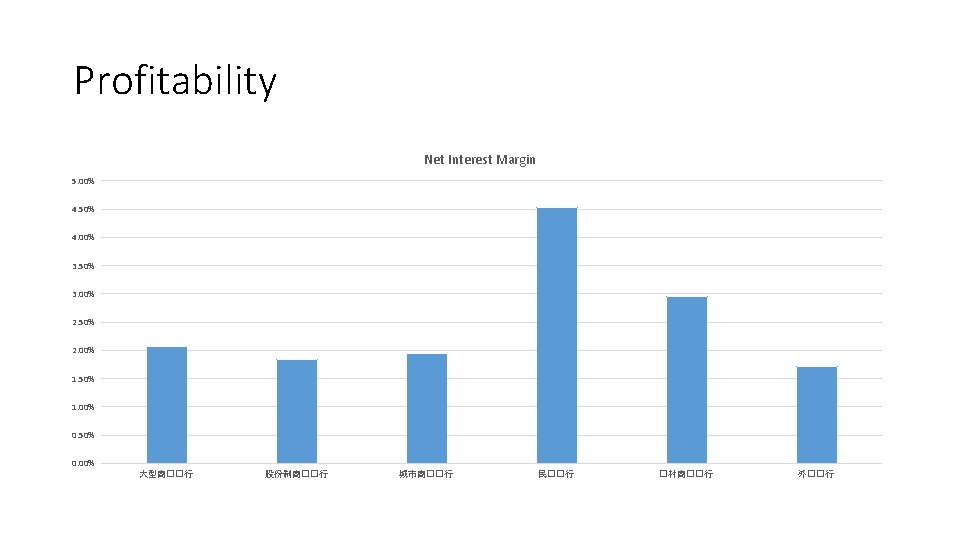
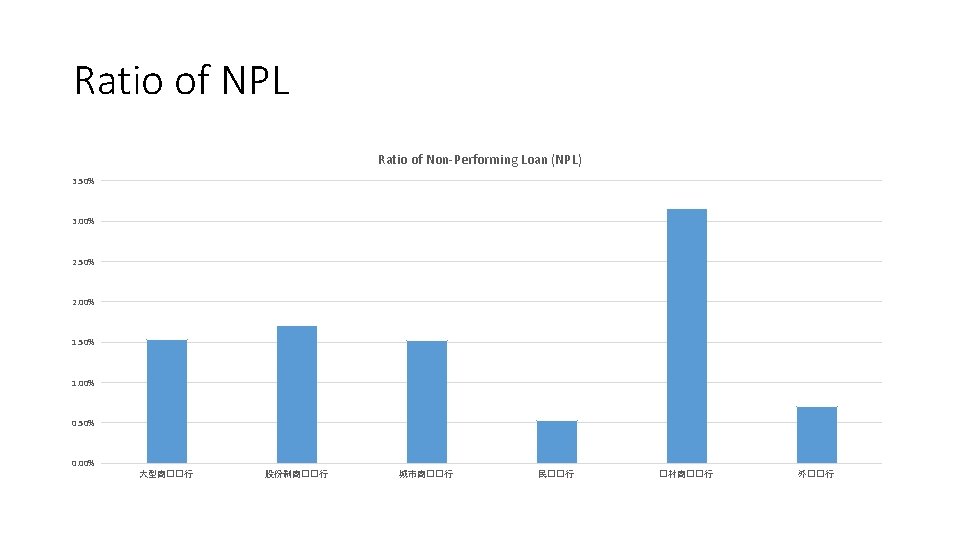
The Banking System • Large commercial banks • Mid-sized commercial banks • City commercial banks • Rural cooperative banks • Rural credit unions • Postal saving bank • Financial asset management companies • Trust companies
Bank’s Fiscal Responsibility • In 1980 s and 1990 s, banks often lent money to SOE’s to keep them afloat. • “The reform without losers” was partly achieved by absorbing losses by the financial system, the banking system in particular. • After the Asian Financial Crisis, the banking reform was given priority.
Banking Reform • The stock problem: the clearing-up of NPLs • Establishment of asset-management companies (one for each of the Big Four) • Recapitalizations (equity investment by Huijin (汇金)) • The flow problem: transformation of the obedient state-owned banks into real commercial banks. • In 2004, CCB and BOC restructured into joint-stock corporations wholly owned by Huijin. • CCB then invited strategic investors (Bo. A and Temasek) and listed on HKEX. • Bo. A pledged to be an active partner, dispatching a 50 -person technical assistance team to CCB headquarters and gaining a seat on the board of directors. • Other banks followed.
Interest Rate Liberalization • Interest rate policy as a financial repression. • Interest rate policy leads to inefficient allocation of financial resources. • Liberalization of interest rates on deposits and loans • The ordering the interest rate liberalization: first foreign, then domestic; first money market, then loans, then deposits; first long-term big-denomination, then short-term small denomination. • By Nov 2013, only the domestic deposit rate has a upper-limit. • By Oct 2015, all interest rates are determined by the market.
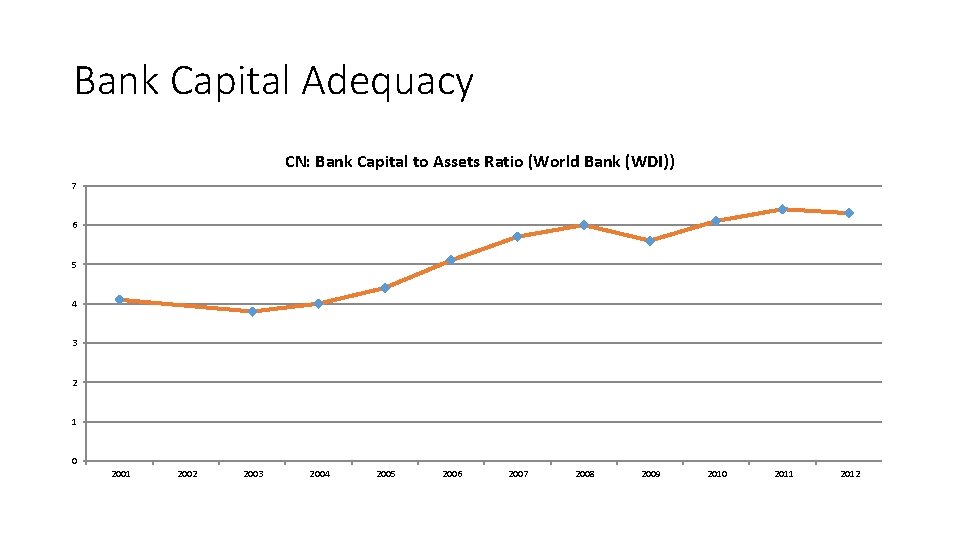
Bank Capital Adequacy CN: Bank Capital to Assets Ratio (World Bank (WDI)) 7 6 5 4 3 2 1 0 2001 2002 2003 2004 2005 2006 2007 2008 2009 2010 2011 2012
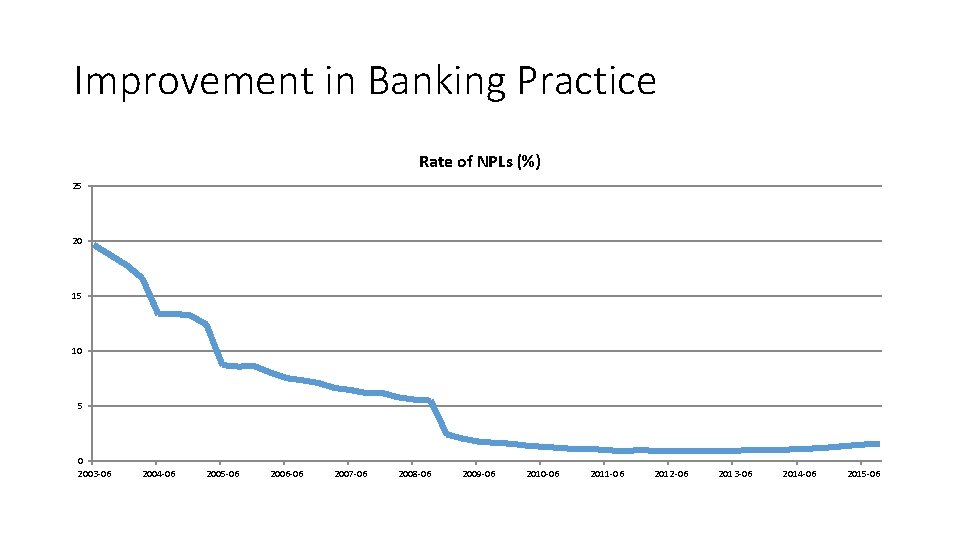
Improvement in Banking Practice Rate of NPLs (%) 25 20 15 10 5 0 2003 -06 2004 -06 2005 -06 2006 -06 2007 -06 2008 -06 2009 -06 2010 -06 2011 -06 2012 -06 2013 -06 2014 -06 2015 -06
Ranking of Global Banks by Market Capitalization Rank 1 2 3 4 5 6 7 8 9 10 Bank JP Morgan Chase ICBC Bank of America Wells Fargo China Construction Bank HSBC Agricultural Bank of China Citigroup Bank of China Merchants Bank Country Market cap. ($b, January 12, 2018) US China US US China UK China US China 390. 934 345. 214 325. 331 308. 013 257. 399 219. 27 203. 244 203. 165 181. 469 122. 616
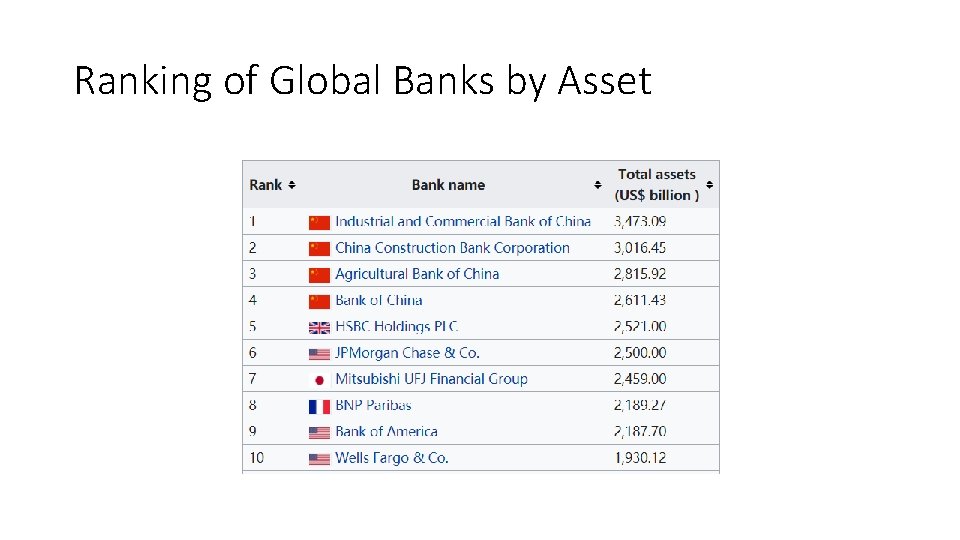
Ranking of Global Banks by Asset
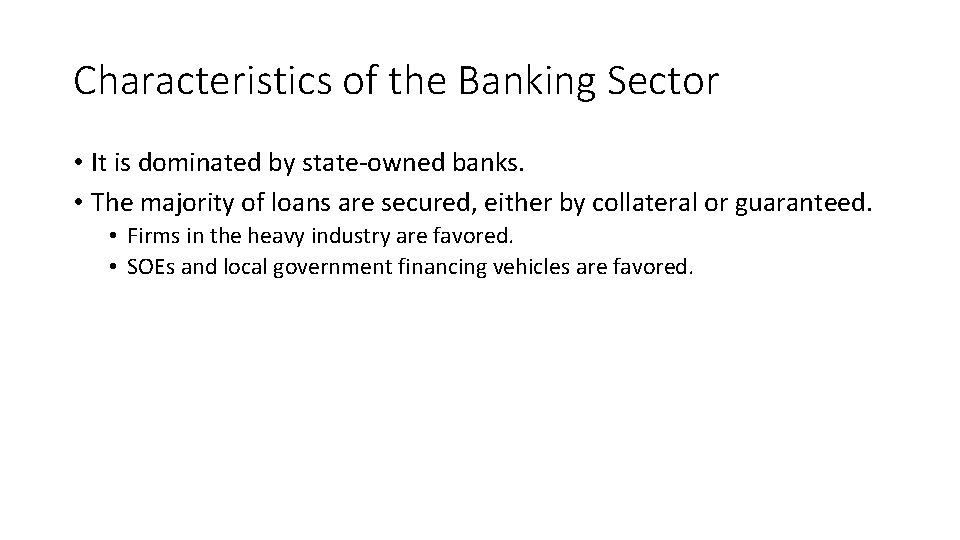
Characteristics of the Banking Sector • It is dominated by state-owned banks. • The majority of loans are secured, either by collateral or guaranteed. • Firms in the heavy industry are favored. • SOEs and local government financing vehicles are favored.
Content • Basics • The Reform of the Financial System • The Banking System • Recent Trends
Recent Trends • Toward the “fee for service” model • The rise of consumer lending • The rise of mid-sized commercial banks • Financial disintermediation • Interest rate liberalization
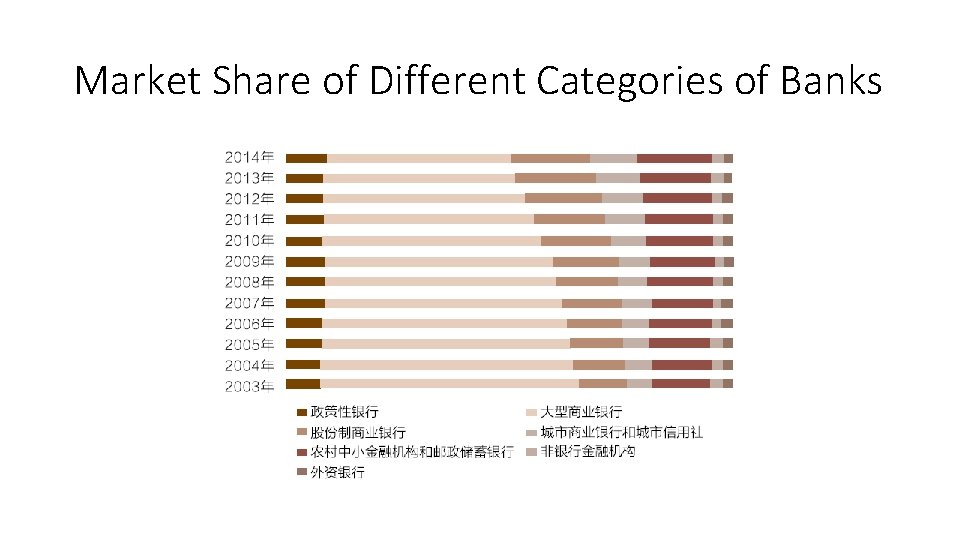
Market Share of Different Categories of Banks
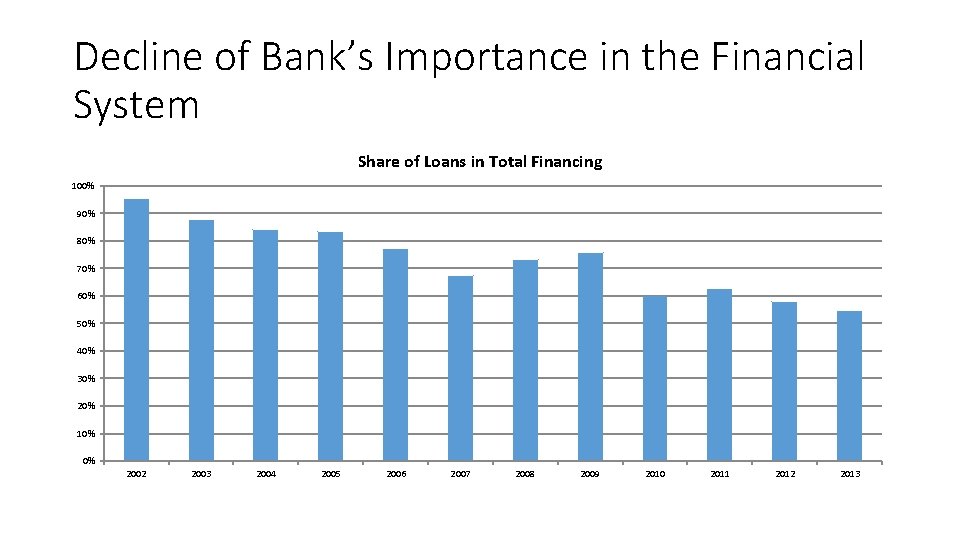
Financial Disintermediation • Banking is a form of intermediate financing, meaning that savings are invested through the intermediation of banks. • Disintermediation occurs when people avoid the intermediation of banks by investing directly in securities (e. g. , bonds and stocks) rather than leaving their money in savings accounts. • Since 2010, signs of financial disintermediation appeared in China • The loan restrictions on real estate developers and local government financing vehicles. • The rise of bond market.
Decline of Bank’s Importance in the Financial System Share of Loans in Total Financing 100% 90% 80% 70% 60% 50% 40% 30% 20% 10% 0% 2002 2003 2004 2005 2006 2007 2008 2009 2010 2011 2012 2013