
Financial Statements Financial vs managerial Accounting Balance Sheets
Financial Statements Financial vs. managerial Accounting Balance Sheets and Income Statements
Financial vs. Managerial • Financial accounting: ▫ Not for managerial decision making ▫ External accounting • Management/Cost accounting: ▫ For managerial decision making (sunk cost(prospective), opportunity cost) ▫ Internal accounting ▫ Company decides cost accounting systems ▫ Management information system
Realization / Accrual accounting • Realization principle / Accrual accounting ▫ When is a sales revenue recognized in accounting? � 1. Order received � 2. Service delivered � 3. Invoice sent � 4. Payment received • Can we estimate the market value of a company from financial statements?
Companies value from Financials • Suppose risk free interest rate is 5%. • If you have an account that pays $10 M/year in interest, who much is that account worth? ▫ (Account Value) (5%) = $10 M AV = $200 M Now suppose some internet startup produces $10 M profit/year, What is the company worth?

Matching Principle • Cost must be recognized when we have recognized the corresponding revenue • Problems with depreciation and future costs of guarantees
Principle of prudence • Do not overestimate your profits (you are allowed to underestimate your profits) R&D cost goes to the income statement: because you are not sure you are getting these benefits in the following years • Many years ago, AOL advertised. Instead of reporting the cost of advertising in the income statement, they considered that customers will stay 10 years. They reported 1/10 of advertising cost in the income statement and the rest went to the balance sheet. When AOL admitted to this aggressive accounting practice, AOL lost 10% in 1 day. This fraudulent behavior allowed them to show profits • A few years ago, AOL-Time Warner laid off people. Instead of reporting the 6 -month salary severance in the income statement, they put both the $ acquisition and the cost of restructuring in the balance sheet. As a result, they faced a lot of pressure
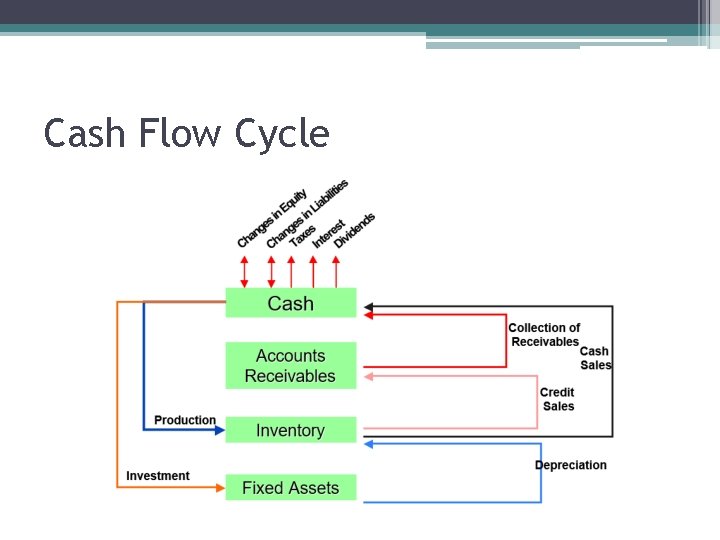
Cash Flow Cycle
Interpreting Financial Statements Financial snapshot, at a point in time, of all the assets a company owns and all the claims against these assets Assets = Liabilities + Shareholders’ equity Question: If a company is short in cash, can it spend some of its shareholders’ equity? Why?
Assets = Liabilities + Stockholder Equity Assets Liabilities+S. E. • • • Liquid assets Accounts receivable Inventories Net Fixed assets Other assets Short Term borrowing Accounts payable Net accruals Long-term debt Owners equity �Paid-in capital �Retained earnings

Balance Sheet – Microsoft 2004
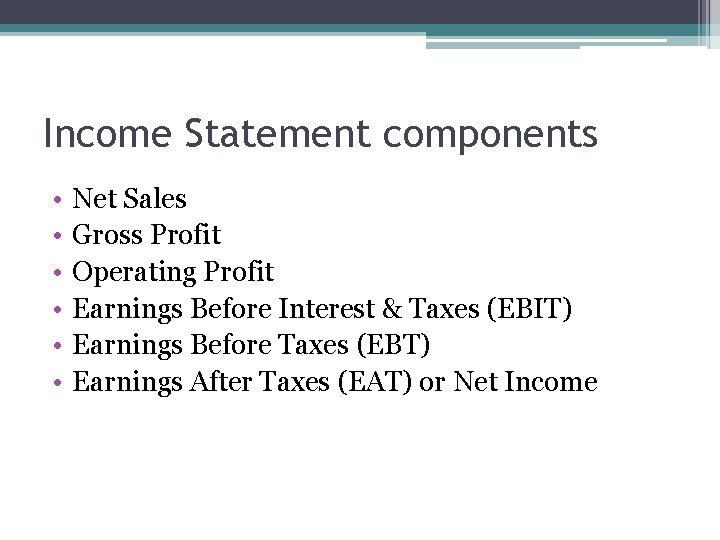
Income Statement components • • • Net Sales Gross Profit Operating Profit Earnings Before Interest & Taxes (EBIT) Earnings Before Taxes (EBT) Earnings After Taxes (EAT) or Net Income
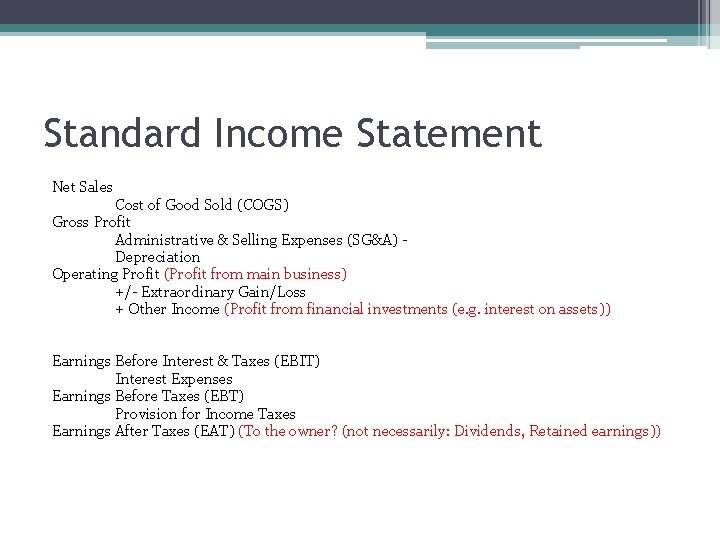
Standard Income Statement Net Sales Cost of Good Sold (COGS) Gross Profit Administrative & Selling Expenses (SG&A) Depreciation Operating Profit (Profit from main business) +/- Extraordinary Gain/Loss + Other Income (Profit from financial investments (e. g. interest on assets)) Earnings Before Interest & Taxes (EBIT) Interest Expenses Earnings Before Taxes (EBT) Provision for Income Taxes Earnings After Taxes (EAT) (To the owner? (not necessarily: Dividends, Retained earnings))
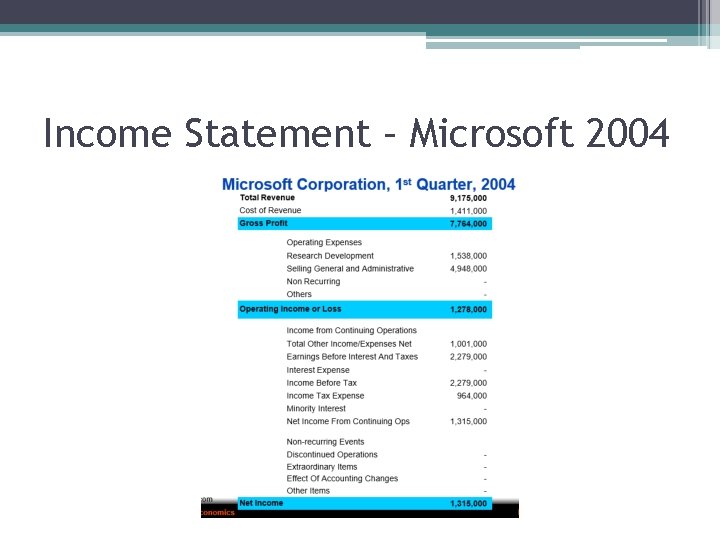
Income Statement – Microsoft 2004
- Slides: 13