
Financial Statements Cash Flow Ratio Analysis and Projection
- Slides: 60
Financial Statements, Cash Flow, Ratio Analysis, and Projection 2 -1
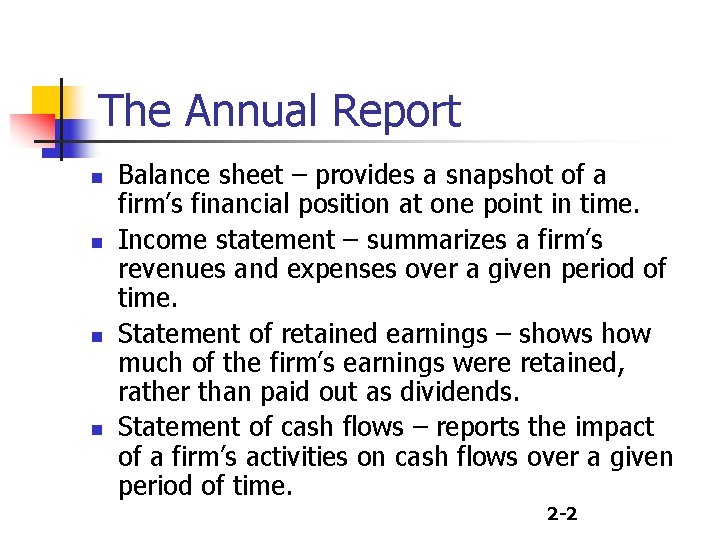
The Annual Report n n Balance sheet – provides a snapshot of a firm’s financial position at one point in time. Income statement – summarizes a firm’s revenues and expenses over a given period of time. Statement of retained earnings – shows how much of the firm’s earnings were retained, rather than paid out as dividends. Statement of cash flows – reports the impact of a firm’s activities on cash flows over a given period of time. 2 -2
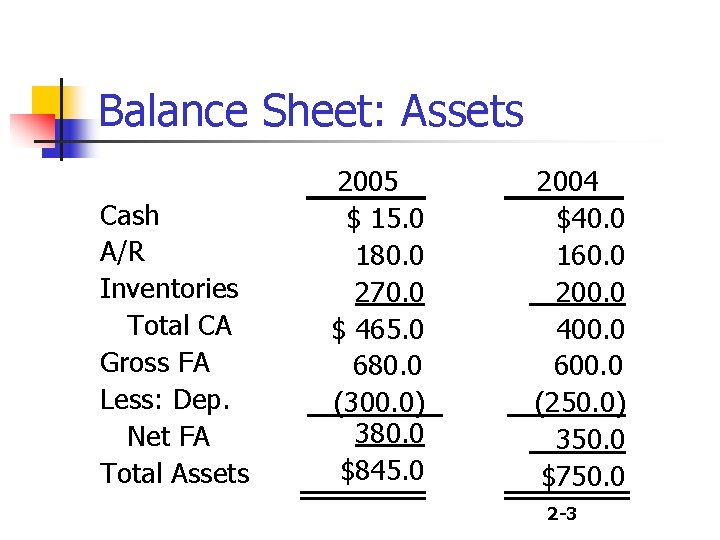
Balance Sheet: Assets Cash A/R Inventories Total CA Gross FA Less: Dep. Net FA Total Assets 2005 $ 15. 0 180. 0 270. 0 $ 465. 0 680. 0 (300. 0) 380. 0 $845. 0 2004 $40. 0 160. 0 200. 0 400. 0 600. 0 (250. 0) 350. 0 $750. 0 2 -3
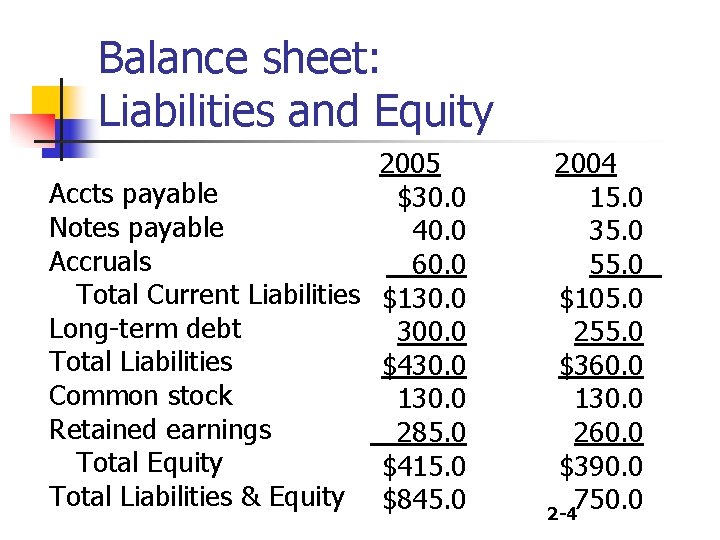
Balance sheet: Liabilities and Equity 2005 Accts payable $30. 0 Notes payable 40. 0 Accruals 60. 0 Total Current Liabilities $130. 0 Long-term debt 300. 0 Total Liabilities $430. 0 Common stock 130. 0 Retained earnings 285. 0 Total Equity $415. 0 Total Liabilities & Equity $845. 0 2004 15. 0 35. 0 55. 0 $105. 0 255. 0 $360. 0 130. 0 260. 0 $390. 0 750. 0 2 -4
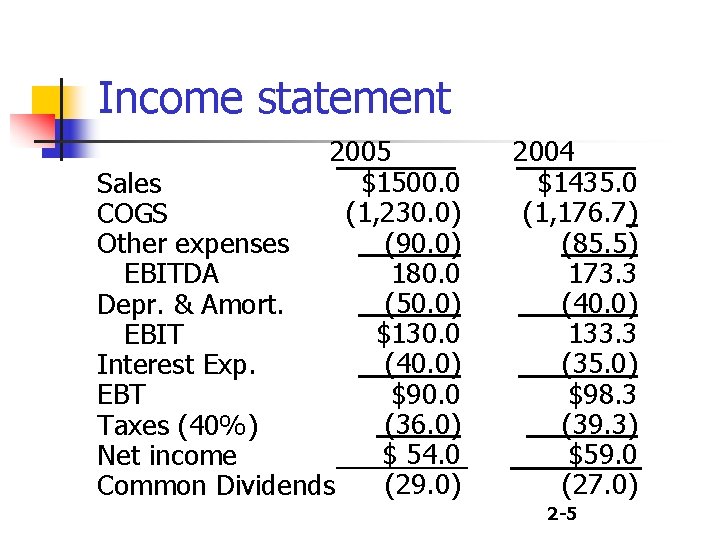
Income statement 2005 $1500. 0 Sales (1, 230. 0) COGS (90. 0) Other expenses 180. 0 EBITDA (50. 0) Depr. & Amort. $130. 0 EBIT (40. 0) Interest Exp. $90. 0 EBT (36. 0) Taxes (40%) $ 54. 0 Net income (29. 0) Common Dividends 2004 $1435. 0 (1, 176. 7) (85. 5) 173. 3 (40. 0) 133. 3 (35. 0) $98. 3 (39. 3) $59. 0 (27. 0) 2 -5
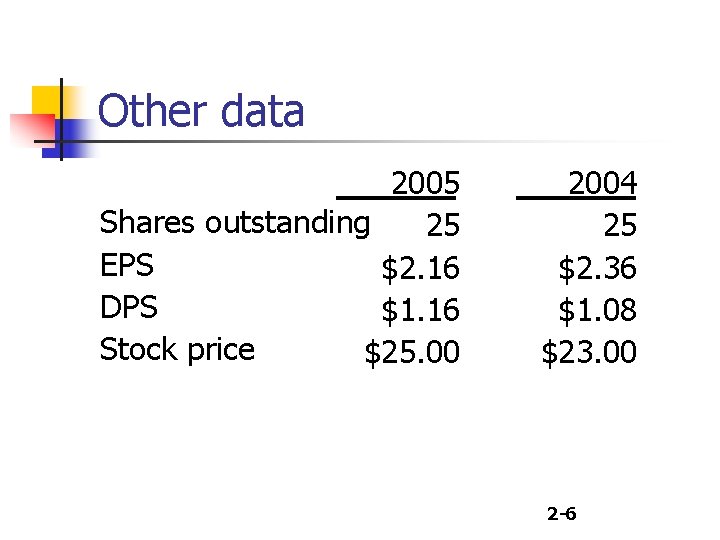
Other data 2005 Shares outstanding 25 EPS $2. 16 DPS $1. 16 Stock price $25. 00 2004 25 $2. 36 $1. 08 $23. 00 2 -6
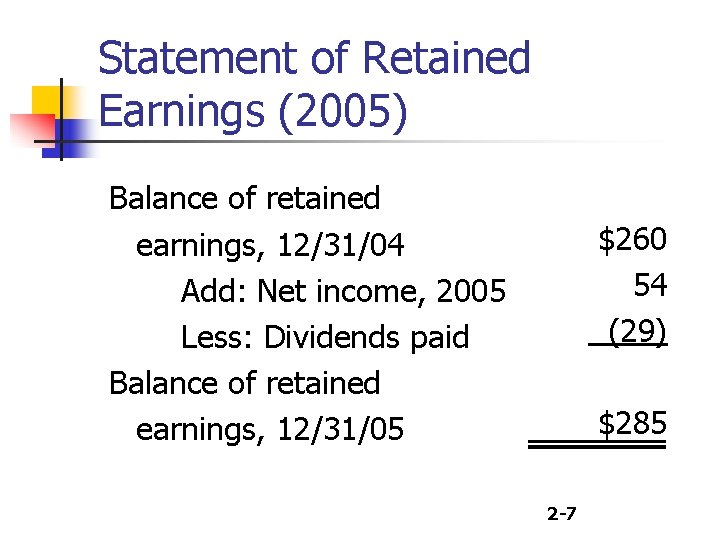
Statement of Retained Earnings (2005) Balance of retained earnings, 12/31/04 Add: Net income, 2005 Less: Dividends paid Balance of retained earnings, 12/31/05 $260 54 (29) $285 2 -7
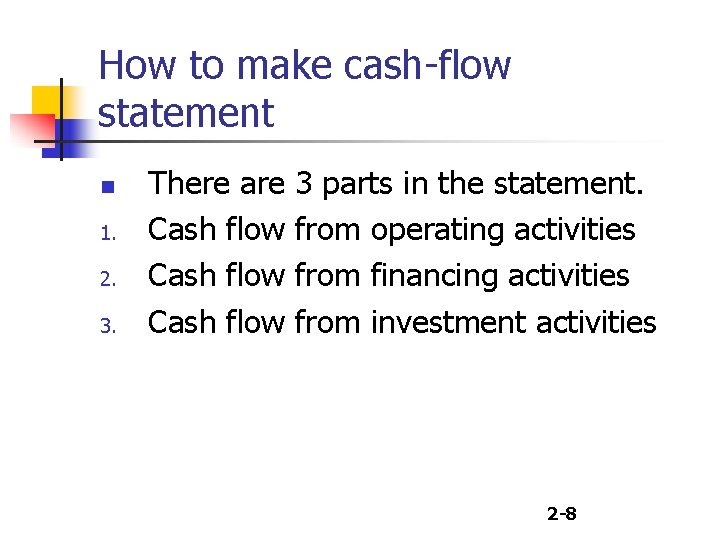
How to make cash-flow statement n 1. 2. 3. There are Cash flow 3 parts in the statement. from operating activities from financing activities from investment activities 2 -8
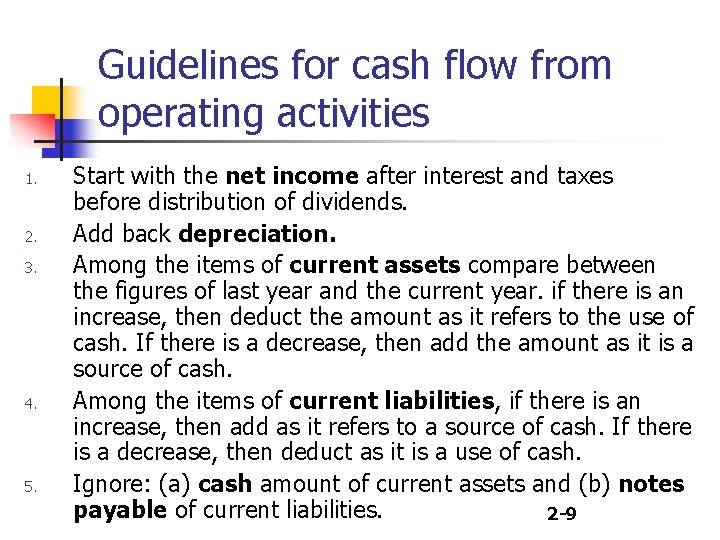
Guidelines for cash flow from operating activities 1. 2. 3. 4. 5. Start with the net income after interest and taxes before distribution of dividends. Add back depreciation. Among the items of current assets compare between the figures of last year and the current year. if there is an increase, then deduct the amount as it refers to the use of cash. If there is a decrease, then add the amount as it is a source of cash. Among the items of current liabilities, if there is an increase, then add as it refers to a source of cash. If there is a decrease, then deduct as it is a use of cash. Ignore: (a) cash amount of current assets and (b) notes payable of current liabilities. 2 -9
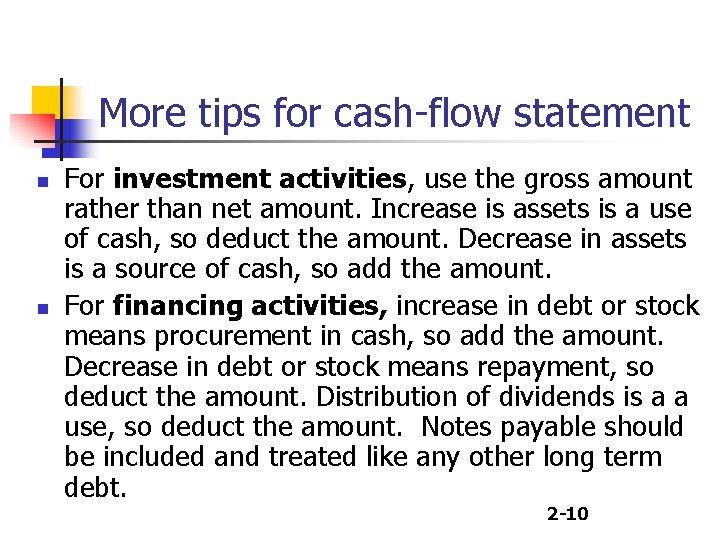
More tips for cash-flow statement n n For investment activities, use the gross amount rather than net amount. Increase is assets is a use of cash, so deduct the amount. Decrease in assets is a source of cash, so add the amount. For financing activities, increase in debt or stock means procurement in cash, so add the amount. Decrease in debt or stock means repayment, so deduct the amount. Distribution of dividends is a a use, so deduct the amount. Notes payable should be included and treated like any other long term debt. 2 -10
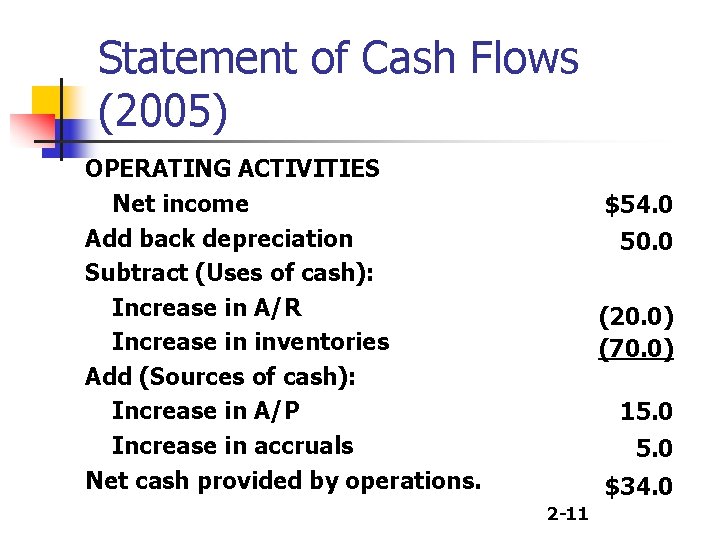
Statement of Cash Flows (2005) OPERATING ACTIVITIES Net income Add back depreciation Subtract (Uses of cash): Increase in A/R Increase in inventories Add (Sources of cash): Increase in A/P Increase in accruals Net cash provided by operations. $54. 0 50. 0 (20. 0) (70. 0) 15. 0 $34. 0 2 -11
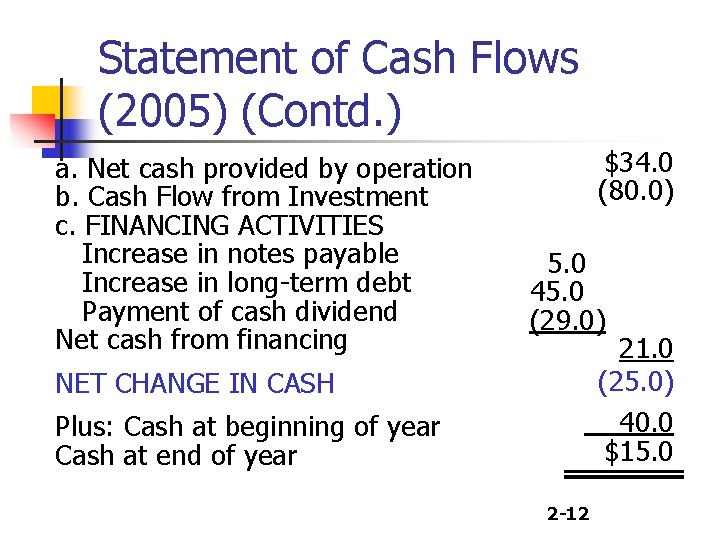
Statement of Cash Flows (2005) (Contd. ) a. Net cash provided by operation b. Cash Flow from Investment c. FINANCING ACTIVITIES Increase in notes payable Increase in long-term debt Payment of cash dividend Net cash from financing $34. 0 (80. 0) 5. 0 45. 0 (29. 0) 21. 0 (25. 0) 40. 0 $15. 0 NET CHANGE IN CASH Plus: Cash at beginning of year Cash at end of year 2 -12
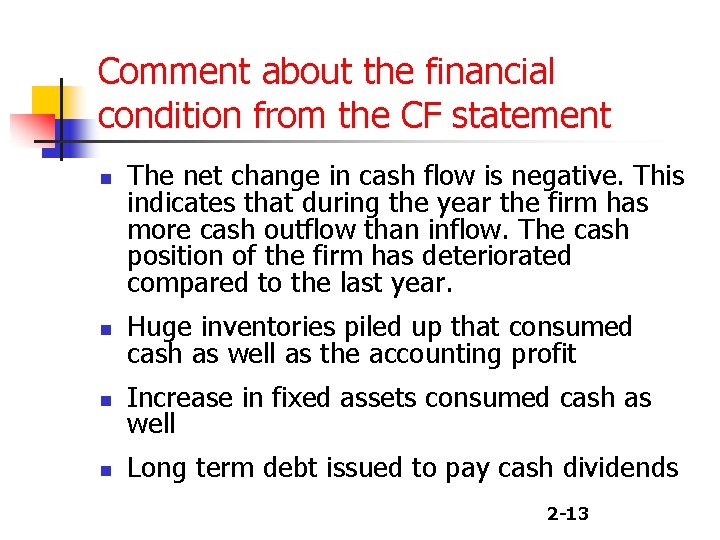
Comment about the financial condition from the CF statement n The net change in cash flow is negative. This indicates that during the year the firm has more cash outflow than inflow. The cash position of the firm has deteriorated compared to the last year. n Huge inventories piled up that consumed cash as well as the accounting profit n Increase in fixed assets consumed cash as well n Long term debt issued to pay cash dividends 2 -13
Methods of Ratio analysis n n n Bench mark analysis Time series analysis Cross section analysis 2 -14
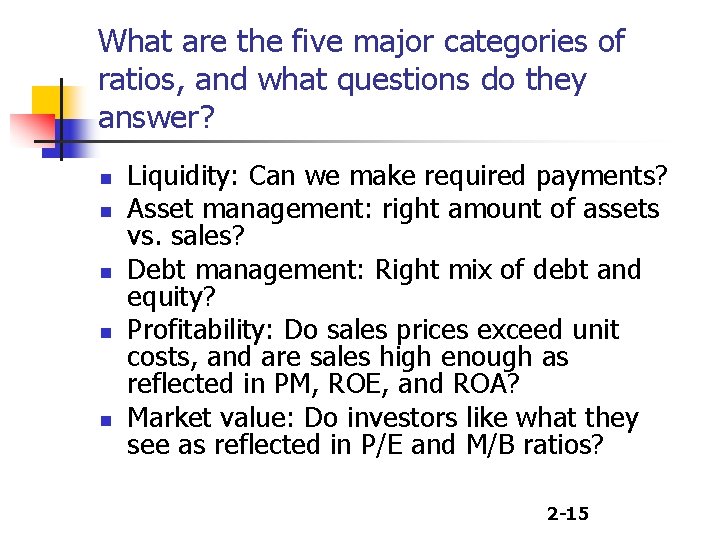
What are the five major categories of ratios, and what questions do they answer? n n n Liquidity: Can we make required payments? Asset management: right amount of assets vs. sales? Debt management: Right mix of debt and equity? Profitability: Do sales prices exceed unit costs, and are sales high enough as reflected in PM, ROE, and ROA? Market value: Do investors like what they see as reflected in P/E and M/B ratios? 2 -15
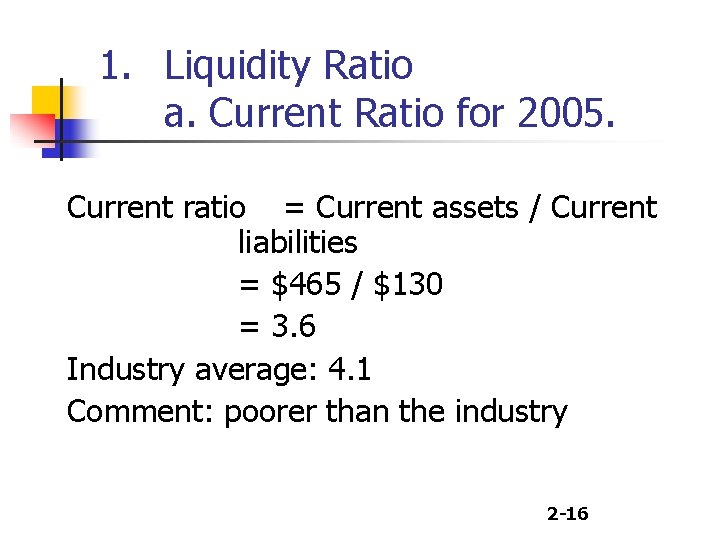
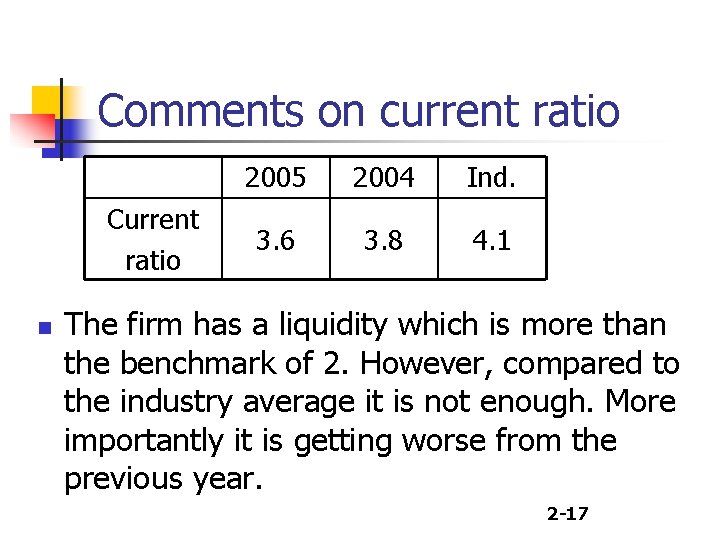
1. Liquidity Ratio a. Current Ratio for 2005. Current ratio = Current assets / Current liabilities = $465 / $130 = 3. 6 Industry average: 4. 1 Comment: poorer than the industry 2 -16
Comments on current ratio Current ratio n 2005 2004 Ind. 3. 6 3. 8 4. 1 The firm has a liquidity which is more than the benchmark of 2. However, compared to the industry average it is not enough. More importantly it is getting worse from the previous year. 2 -17
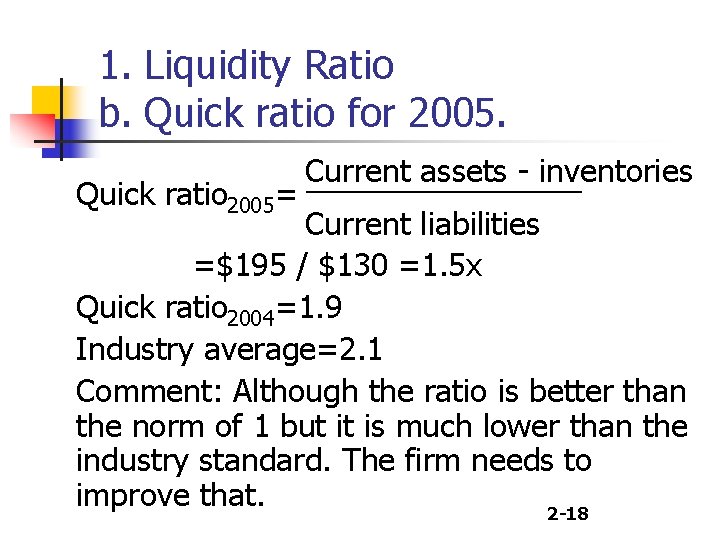
1. Liquidity Ratio b. Quick ratio for 2005. Quick ratio 2005= Current assets - inventories Current liabilities =$195 / $130 =1. 5 x Quick ratio 2004=1. 9 Industry average=2. 1 Comment: Although the ratio is better than the norm of 1 but it is much lower than the industry standard. The firm needs to improve that. 2 -18
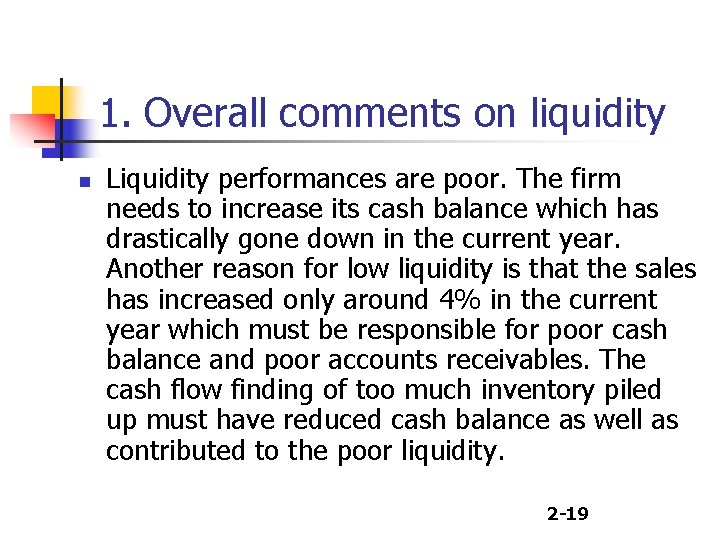
1. Overall comments on liquidity n Liquidity performances are poor. The firm needs to increase its cash balance which has drastically gone down in the current year. Another reason for low liquidity is that the sales has increased only around 4% in the current year which must be responsible for poor cash balance and poor accounts receivables. The cash flow finding of too much inventory piled up must have reduced cash balance as well as contributed to the poor liquidity. 2 -19
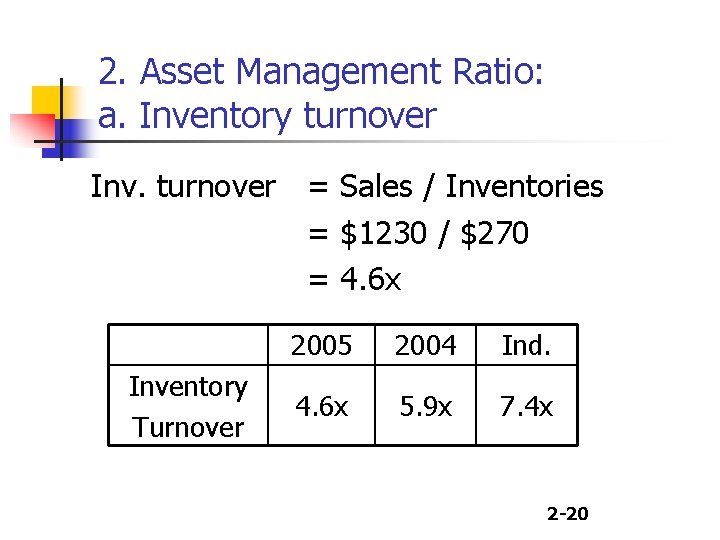
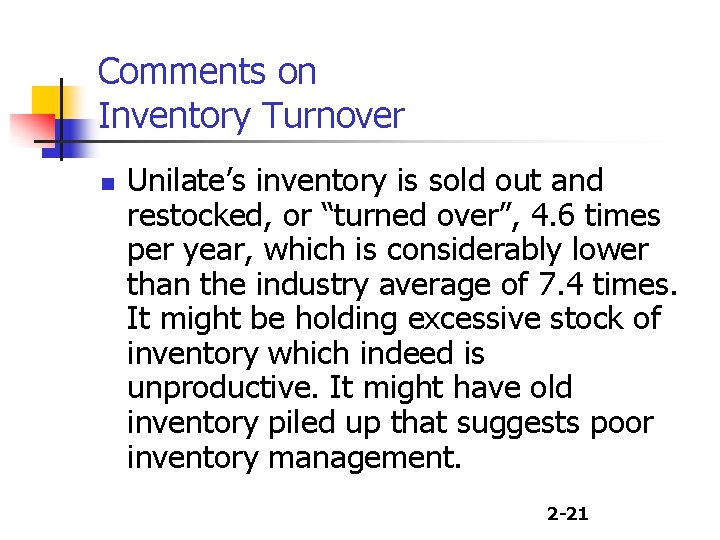
2. Asset Management Ratio: a. Inventory turnover Inv. turnover = Sales / Inventories = $1230 / $270 = 4. 6 x Inventory Turnover 2005 2004 Ind. 4. 6 x 5. 9 x 7. 4 x 2 -20
Comments on Inventory Turnover n Unilate’s inventory is sold out and restocked, or “turned over”, 4. 6 times per year, which is considerably lower than the industry average of 7. 4 times. It might be holding excessive stock of inventory which indeed is unproductive. It might have old inventory piled up that suggests poor inventory management. 2 -21
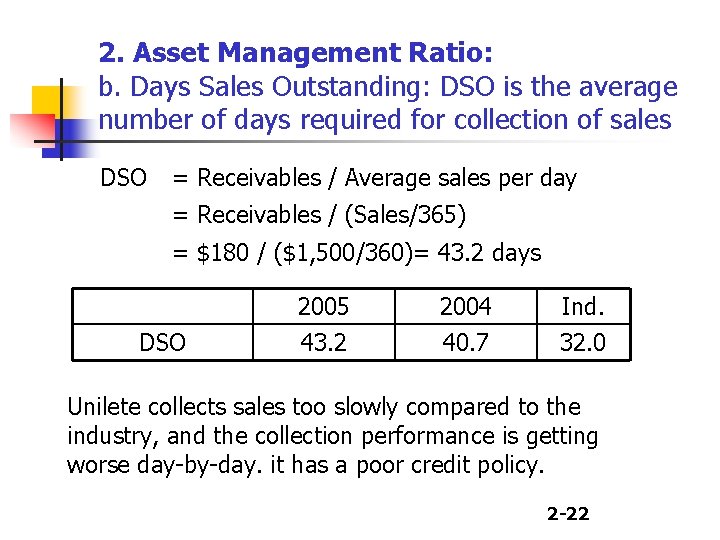
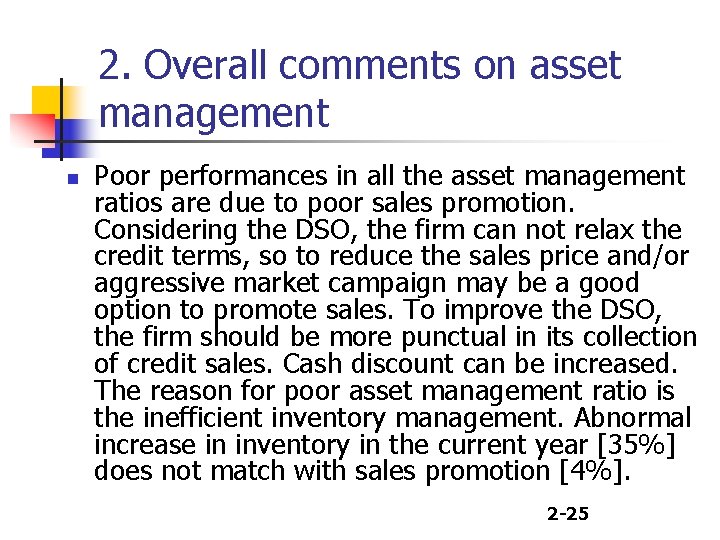
2. Asset Management Ratio: b. Days Sales Outstanding: DSO is the average number of days required for collection of sales DSO = Receivables / Average sales per day = Receivables / (Sales/365) = $180 / ($1, 500/360)= 43. 2 days DSO 2005 43. 2 2004 40. 7 Ind. 32. 0 Unilete collects sales too slowly compared to the industry, and the collection performance is getting worse day-by-day. it has a poor credit policy. 2 -22
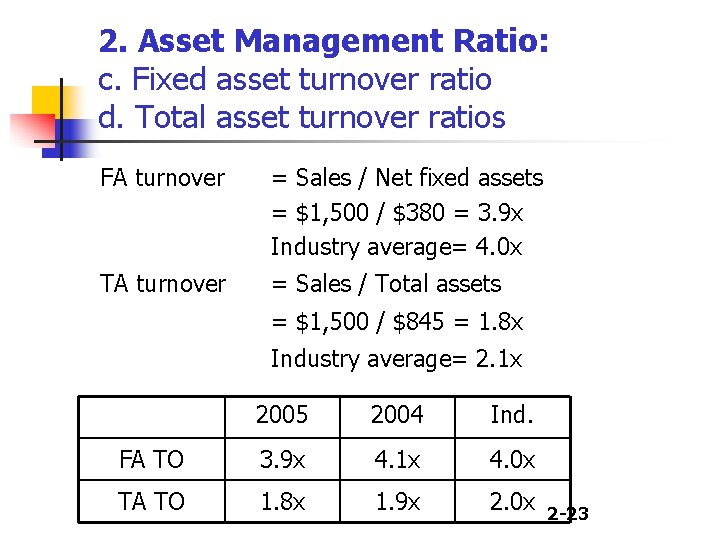
2. Asset Management Ratio: c. Fixed asset turnover ratio d. Total asset turnover ratios FA turnover = Sales / Net fixed assets = $1, 500 / $380 = 3. 9 x Industry average= 4. 0 x TA turnover = Sales / Total assets = $1, 500 / $845 = 1. 8 x Industry average= 2. 1 x 2005 2004 Ind. FA TO 3. 9 x 4. 1 x 4. 0 x TA TO 1. 8 x 1. 9 x 2. 0 x 2 -23
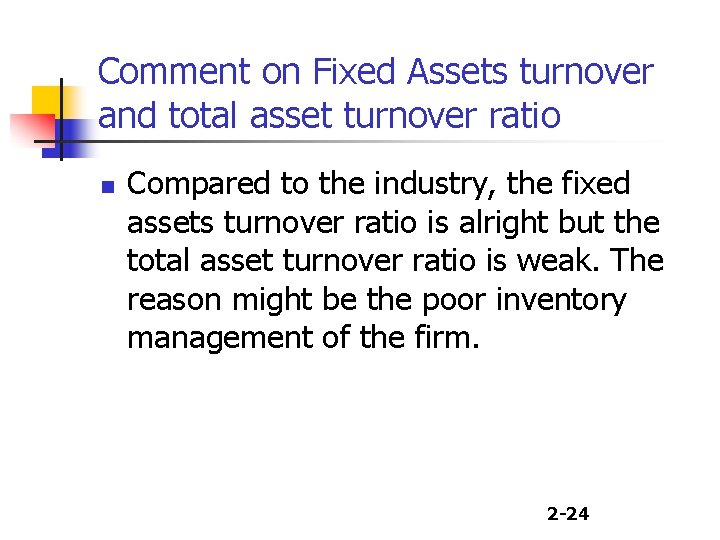
Comment on Fixed Assets turnover and total asset turnover ratio n Compared to the industry, the fixed assets turnover ratio is alright but the total asset turnover ratio is weak. The reason might be the poor inventory management of the firm. 2 -24
2. Overall comments on asset management n Poor performances in all the asset management ratios are due to poor sales promotion. Considering the DSO, the firm can not relax the credit terms, so to reduce the sales price and/or aggressive market campaign may be a good option to promote sales. To improve the DSO, the firm should be more punctual in its collection of credit sales. Cash discount can be increased. The reason for poor asset management ratio is the inefficient inventory management. Abnormal increase in inventory in the current year [35%] does not match with sales promotion [4%]. 2 -25
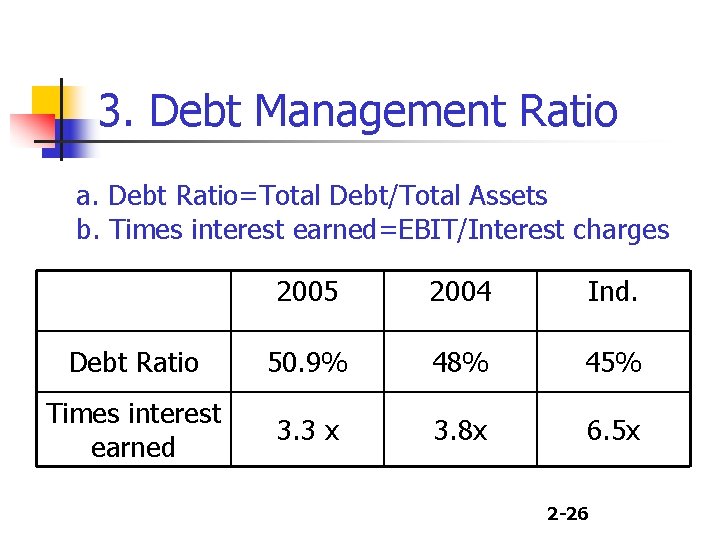
3. Debt Management Ratio a. Debt Ratio=Total Debt/Total Assets b. Times interest earned=EBIT/Interest charges 2005 2004 Ind. Debt Ratio 50. 9% 48% 45% Times interest earned 3. 3 x 3. 8 x 6. 5 x 2 -26
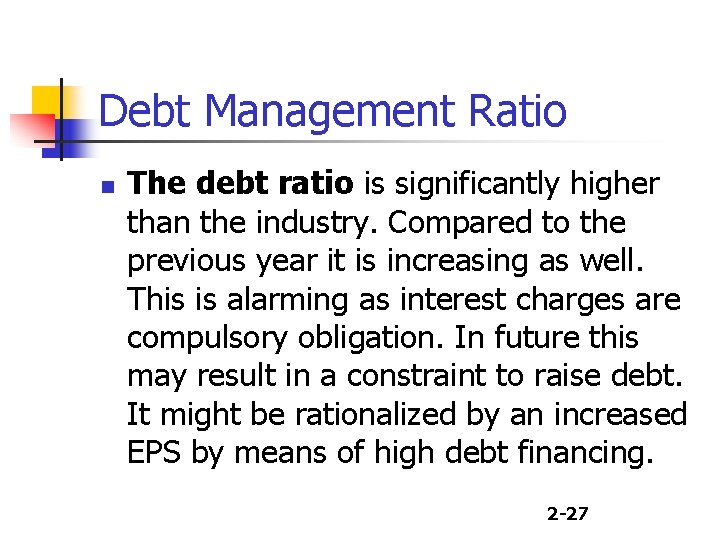
Debt Management Ratio n The debt ratio is significantly higher than the industry. Compared to the previous year it is increasing as well. This is alarming as interest charges are compulsory obligation. In future this may result in a constraint to raise debt. It might be rationalized by an increased EPS by means of high debt financing. 2 -27
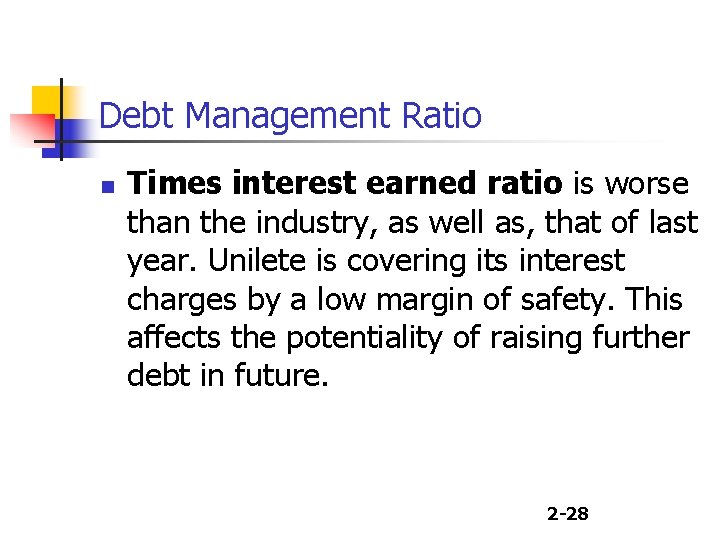
Debt Management Ratio n Times interest earned ratio is worse than the industry, as well as, that of last year. Unilete is covering its interest charges by a low margin of safety. This affects the potentiality of raising further debt in future. 2 -28
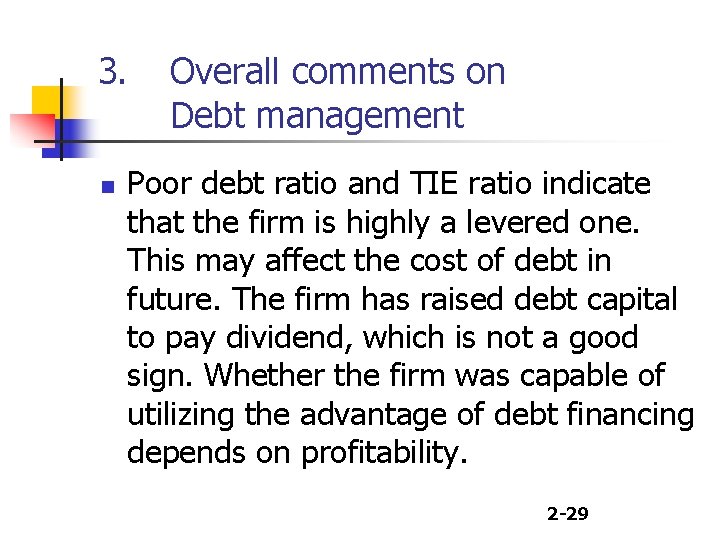
3. n Overall comments on Debt management Poor debt ratio and TIE ratio indicate that the firm is highly a levered one. This may affect the cost of debt in future. The firm has raised debt capital to pay dividend, which is not a good sign. Whether the firm was capable of utilizing the advantage of debt financing depends on profitability. 2 -29
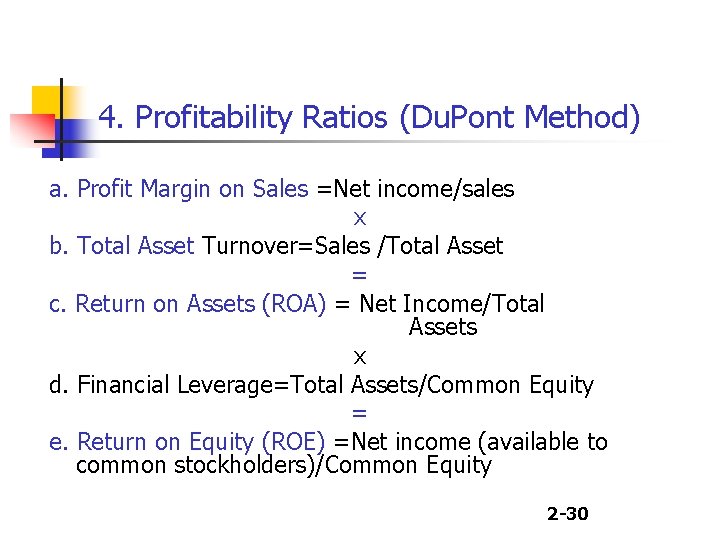
4. Profitability Ratios (Du. Pont Method) a. Profit Margin on Sales =Net income/sales x b. Total Asset Turnover=Sales /Total Asset = c. Return on Assets (ROA) = Net Income/Total Assets x d. Financial Leverage=Total Assets/Common Equity = e. Return on Equity (ROE) =Net income (available to common stockholders)/Common Equity 2 -30
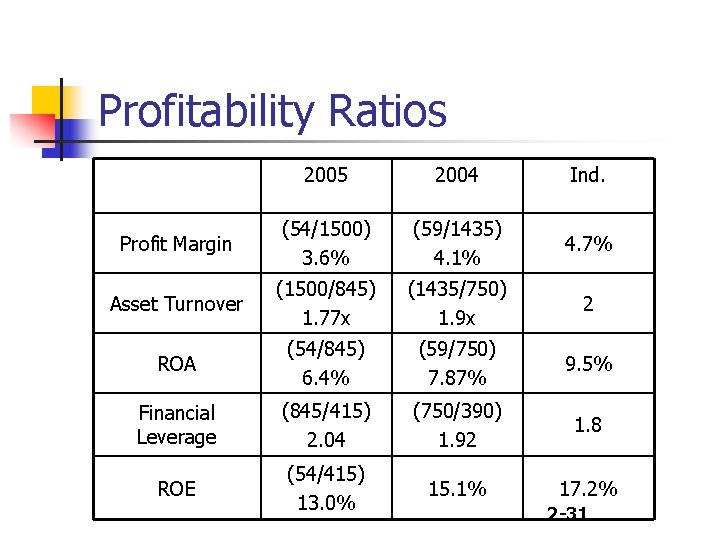
Profitability Ratios 2005 2004 Ind. Profit Margin (54/1500) 3. 6% (59/1435) 4. 1% 4. 7% Asset Turnover (1500/845) 1. 77 x (1435/750) 1. 9 x 2 ROA (54/845) 6. 4% (59/750) 7. 87% 9. 5% Financial Leverage (845/415) 2. 04 (750/390) 1. 92 1. 8 ROE (54/415) 13. 0% 15. 1% 17. 2% 2 -31
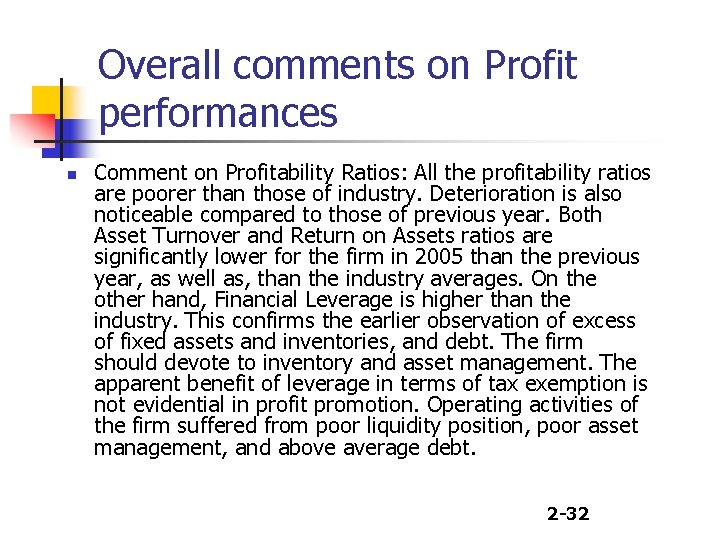
Overall comments on Profit performances n Comment on Profitability Ratios: All the profitability ratios are poorer than those of industry. Deterioration is also noticeable compared to those of previous year. Both Asset Turnover and Return on Assets ratios are significantly lower for the firm in 2005 than the previous year, as well as, than the industry averages. On the other hand, Financial Leverage is higher than the industry. This confirms the earlier observation of excess of fixed assets and inventories, and debt. The firm should devote to inventory and asset management. The apparent benefit of leverage in terms of tax exemption is not evidential in profit promotion. Operating activities of the firm suffered from poor liquidity position, poor asset management, and above average debt. 2 -32
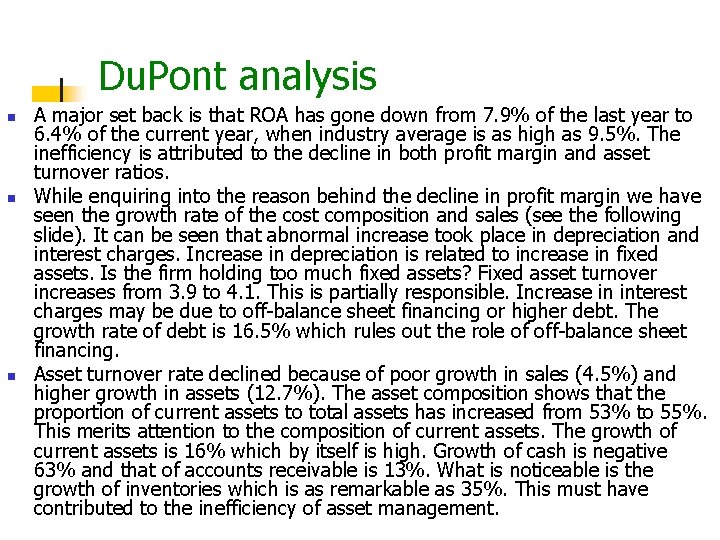
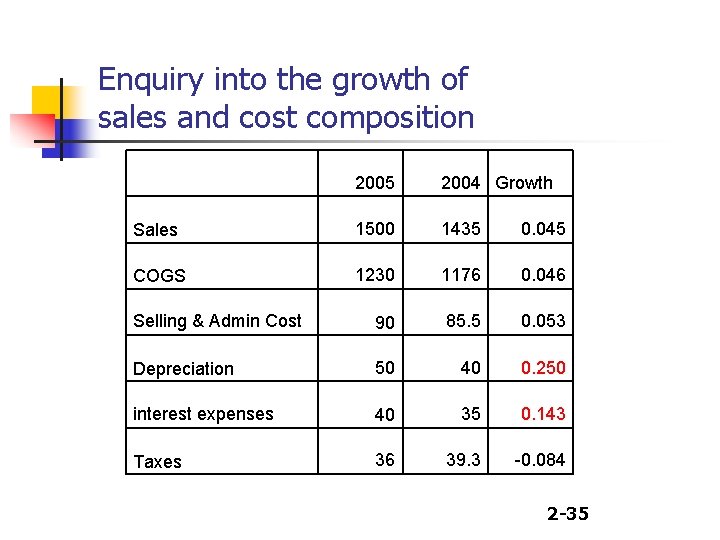
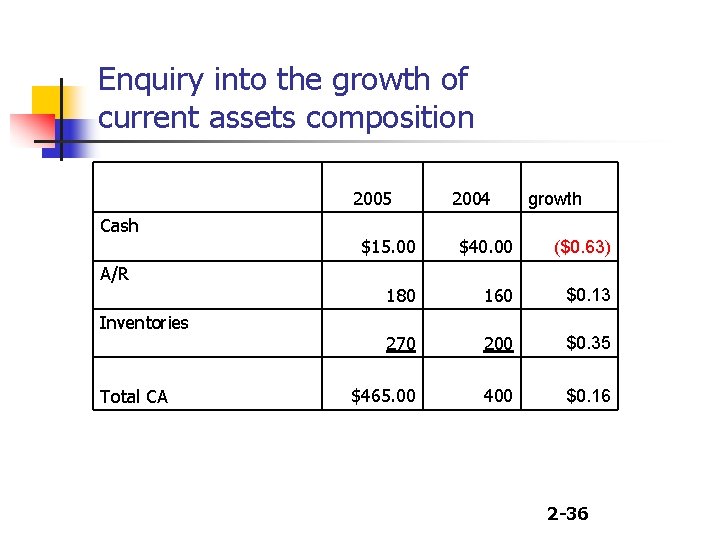
Du. Pont analysis n n n A major set back is that ROA has gone down from 7. 9% of the last year to 6. 4% of the current year, when industry average is as high as 9. 5%. The inefficiency is attributed to the decline in both profit margin and asset turnover ratios. While enquiring into the reason behind the decline in profit margin we have seen the growth rate of the cost composition and sales (see the following slide). It can be seen that abnormal increase took place in depreciation and interest charges. Increase in depreciation is related to increase in fixed assets. Is the firm holding too much fixed assets? Fixed asset turnover increases from 3. 9 to 4. 1. This is partially responsible. Increase in interest charges may be due to off-balance sheet financing or higher debt. The growth rate of debt is 16. 5% which rules out the role of off-balance sheet financing. Asset turnover rate declined because of poor growth in sales (4. 5%) and higher growth in assets (12. 7%). The asset composition shows that the proportion of current assets to total assets has increased from 53% to 55%. This merits attention to the composition of current assets. The growth of current assets is 16% which by itself is high. Growth of cash is negative 63% and that of accounts receivable is 13%. What is noticeable is the growth of inventories which is as remarkable as 35%. This must have contributed to the inefficiency of asset management. 2 -33
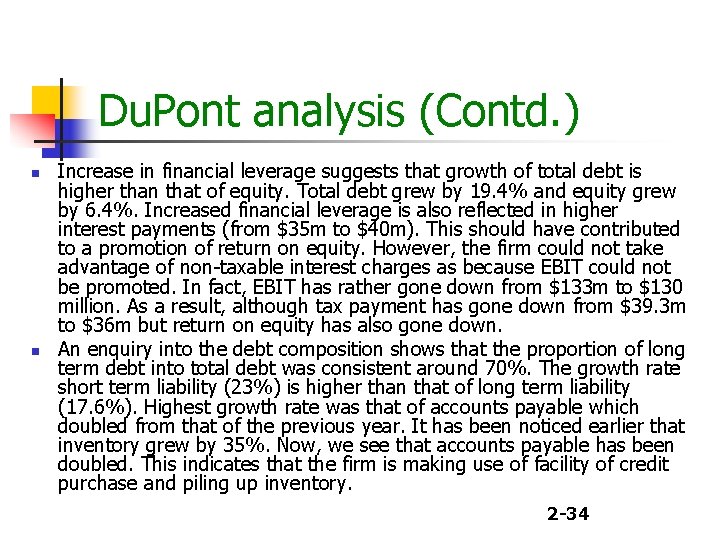
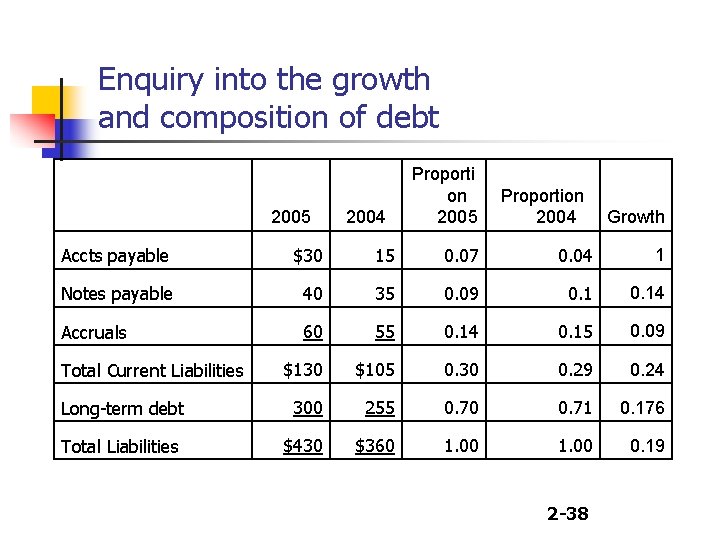
Du. Pont analysis (Contd. ) n n Increase in financial leverage suggests that growth of total debt is higher than that of equity. Total debt grew by 19. 4% and equity grew by 6. 4%. Increased financial leverage is also reflected in higher interest payments (from $35 m to $40 m). This should have contributed to a promotion of return on equity. However, the firm could not take advantage of non-taxable interest charges as because EBIT could not be promoted. In fact, EBIT has rather gone down from $133 m to $130 million. As a result, although tax payment has gone down from $39. 3 m to $36 m but return on equity has also gone down. An enquiry into the debt composition shows that the proportion of long term debt into total debt was consistent around 70%. The growth rate short term liability (23%) is higher than that of long term liability (17. 6%). Highest growth rate was that of accounts payable which doubled from that of the previous year. It has been noticed earlier that inventory grew by 35%. Now, we see that accounts payable has been doubled. This indicates that the firm is making use of facility of credit purchase and piling up inventory. 2 -34
Enquiry into the growth of sales and cost composition 2005 2004 Growth Sales 1500 1435 0. 045 COGS 1230 1176 0. 046 Selling & Admin Cost 90 85. 5 0. 053 Depreciation 50 40 0. 250 interest expenses 40 35 0. 143 Taxes 36 39. 3 -0. 084 2 -35
Enquiry into the growth of current assets composition 2005 Cash A/R Inventories Total CA 2004 growth $15. 00 $40. 00 ($0. 63) 180 160 $0. 13 270 200 $0. 35 $465. 00 400 $0. 16 2 -36
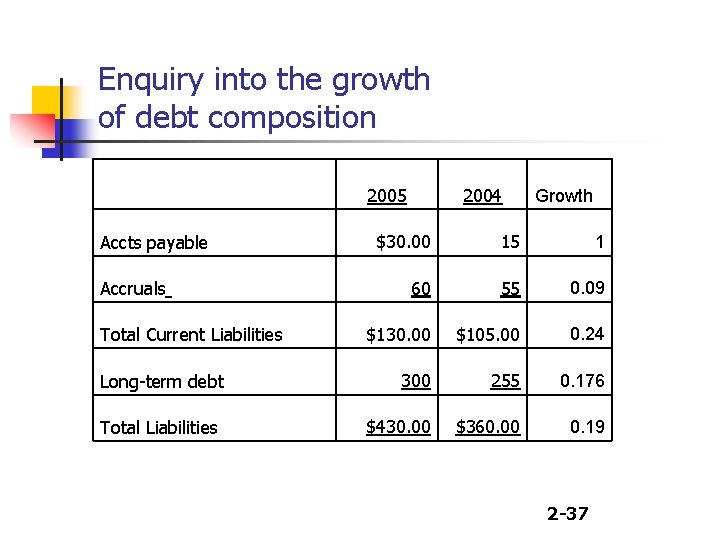
Enquiry into the growth of debt composition 2005 Accts payable Accruals Total Current Liabilities Long-term debt Total Liabilities 2004 Growth $30. 00 15 1 60 55 0. 09 $130. 00 $105. 00 0. 24 300 255 0. 176 $430. 00 $360. 00 0. 19 2 -37
Enquiry into the growth and composition of debt 2005 2004 Proporti on 2005 Proportion 2004 Growth Accts payable $30 15 0. 07 0. 04 1 Notes payable 40 35 0. 09 0. 14 Accruals 60 55 0. 14 0. 15 0. 09 $130 $105 0. 30 0. 29 0. 24 Long-term debt 300 255 0. 70 0. 71 0. 176 Total Liabilities $430 $360 1. 00 0. 19 Total Current Liabilities 2 -38
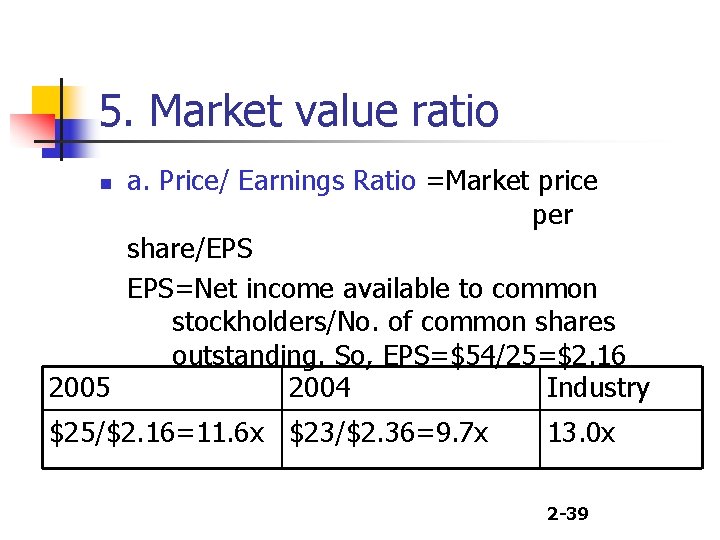
5. Market value ratio a. Price/ Earnings Ratio =Market price per share/EPS EPS=Net income available to common stockholders/No. of common shares outstanding. So, EPS=$54/25=$2. 16 2005 2004 Industry n $25/$2. 16=11. 6 x $23/$2. 36=9. 7 x 13. 0 x 2 -39
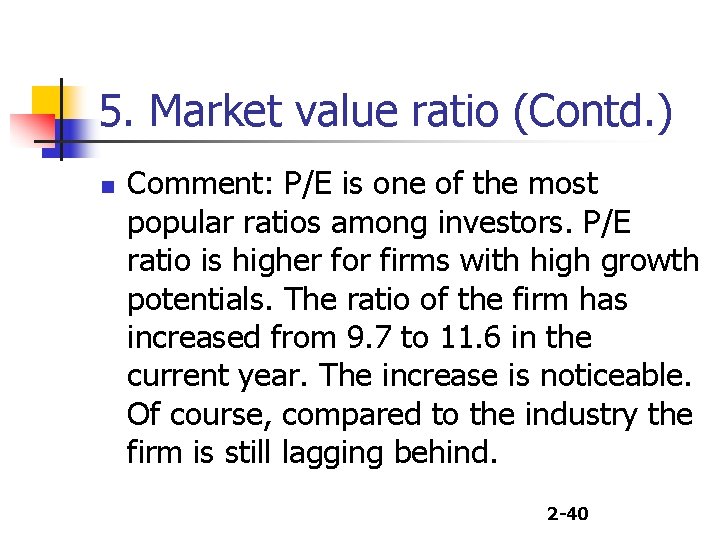
5. Market value ratio (Contd. ) n Comment: P/E is one of the most popular ratios among investors. P/E ratio is higher for firms with high growth potentials. The ratio of the firm has increased from 9. 7 to 11. 6 in the current year. The increase is noticeable. Of course, compared to the industry the firm is still lagging behind. 2 -40
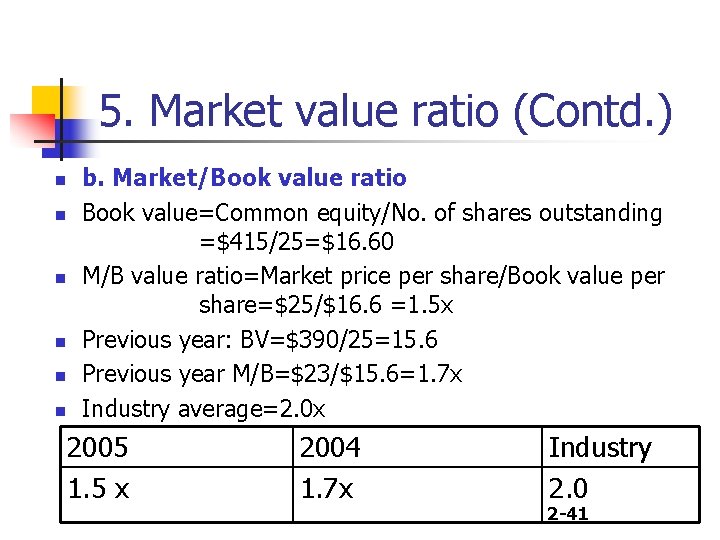
5. Market value ratio (Contd. ) n n n b. Market/Book value ratio Book value=Common equity/No. of shares outstanding =$415/25=$16. 60 M/B value ratio=Market price per share/Book value per share=$25/$16. 6 =1. 5 x Previous year: BV=$390/25=15. 6 Previous year M/B=$23/$15. 6=1. 7 x Industry average=2. 0 x 2005 1. 5 x 2004 1. 7 x Industry 2. 0 2 -41
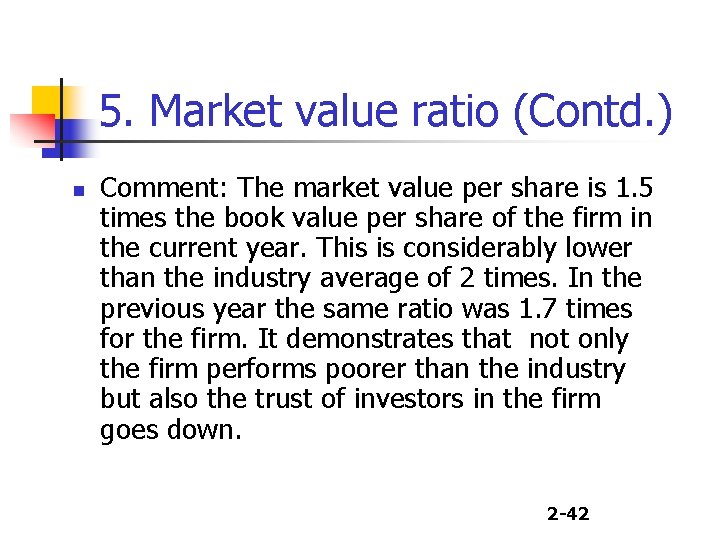
5. Market value ratio (Contd. ) n Comment: The market value per share is 1. 5 times the book value per share of the firm in the current year. This is considerably lower than the industry average of 2 times. In the previous year the same ratio was 1. 7 times for the firm. It demonstrates that not only the firm performs poorer than the industry but also the trust of investors in the firm goes down. 2 -42
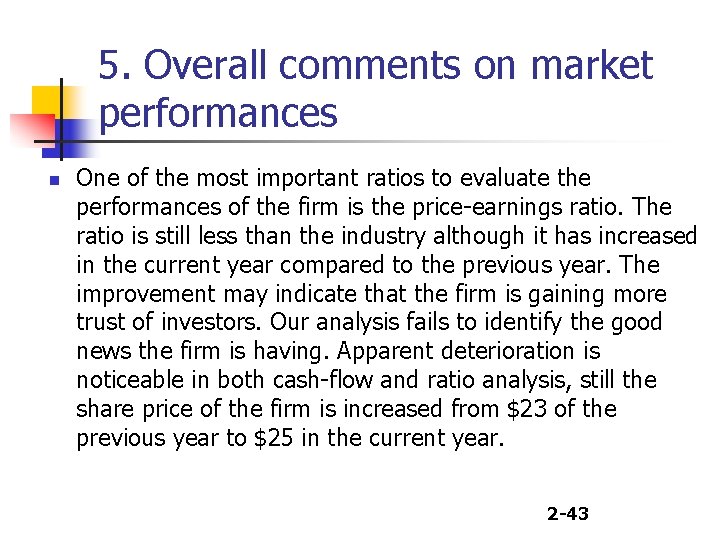
5. Overall comments on market performances n One of the most important ratios to evaluate the performances of the firm is the price-earnings ratio. The ratio is still less than the industry although it has increased in the current year compared to the previous year. The improvement may indicate that the firm is gaining more trust of investors. Our analysis fails to identify the good news the firm is having. Apparent deterioration is noticeable in both cash-flow and ratio analysis, still the share price of the firm is increased from $23 of the previous year to $25 in the current year. 2 -43
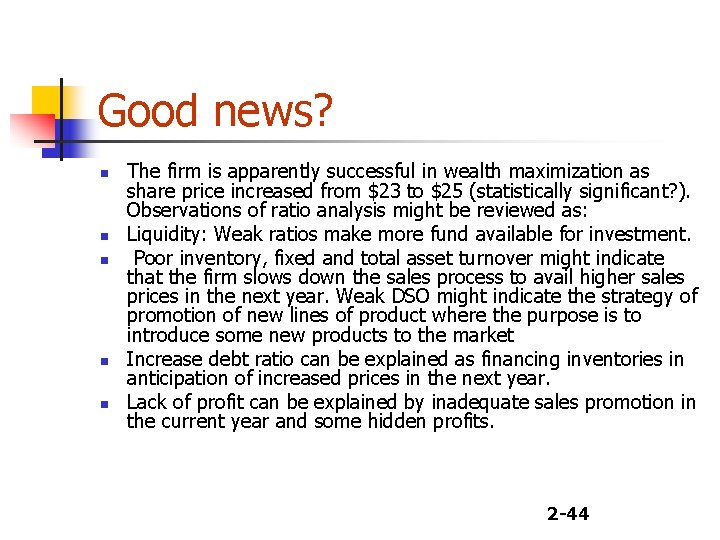
Good news? n n n The firm is apparently successful in wealth maximization as share price increased from $23 to $25 (statistically significant? ). Observations of ratio analysis might be reviewed as: Liquidity: Weak ratios make more fund available for investment. Poor inventory, fixed and total asset turnover might indicate that the firm slows down the sales process to avail higher sales prices in the next year. Weak DSO might indicate the strategy of promotion of new lines of product where the purpose is to introduce some new products to the market Increase debt ratio can be explained as financing inventories in anticipation of increased prices in the next year. Lack of profit can be explained by inadequate sales promotion in the current year and some hidden profits. 2 -44
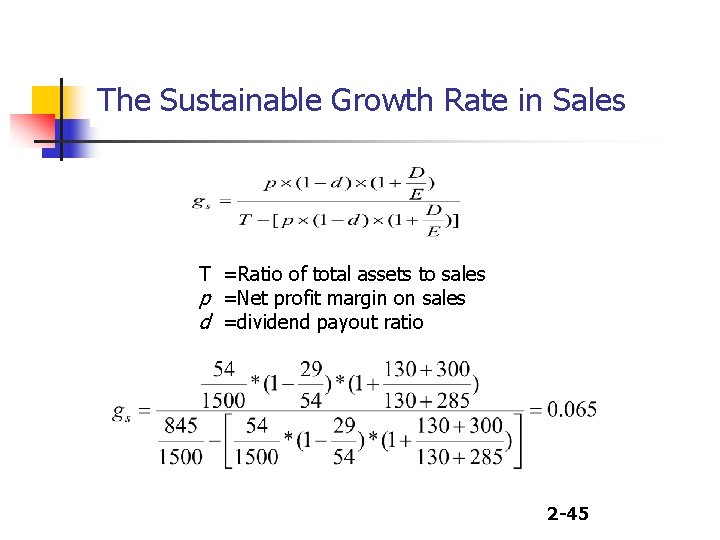
The Sustainable Growth Rate in Sales T =Ratio of total assets to sales p =Net profit margin on sales d =dividend payout ratio 2 -45
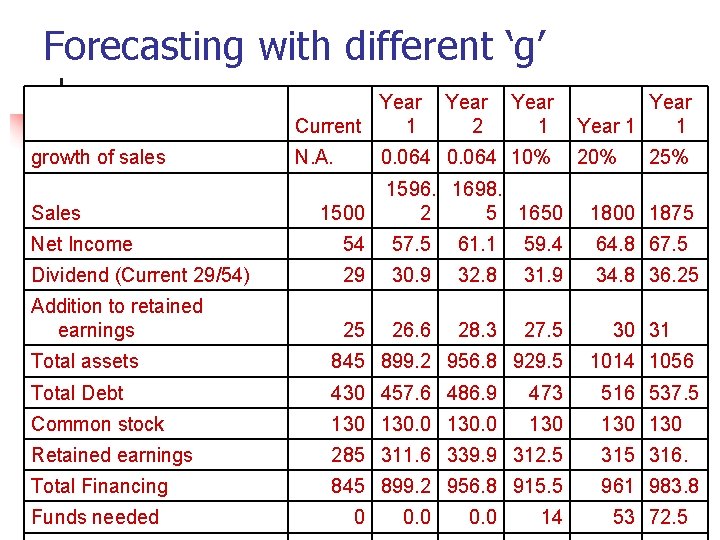
Forecasting with different ‘g’ Year Current 1 growth of sales Sales N. A. Year 2 Year 1 0. 064 10% 1500 Year 1 1 20% 25% 1596. 1698. 2 5 1650 1800 1875 Net Income 54 57. 5 61. 1 59. 4 64. 8 67. 5 Dividend (Current 29/54) 29 30. 9 32. 8 31. 9 34. 8 36. 25 Addition to retained earnings 25 26. 6 28. 3 27. 5 30 31 Total assets 845 899. 2 956. 8 929. 5 Total Debt 430 457. 6 486. 9 473 516 537. 5 Common stock 130. 0 130 130 Retained earnings 285 311. 6 339. 9 312. 5 316. Total Financing 845 899. 2 956. 8 915. 5 961 983. 8 Funds needed 0 0. 0 2 -46 14 1056 53 72. 5
Notes: n n n With a single growth rate of sales, as well as, of all the cost and current liability and long term liability there remains following constraints: Higher growth of sales is not sustainable Floatation of new shares is not a variable Addition to retained earnings depends on net income as well as payout ratio To finance the asset needed to support the sales, External Funds Needed should be identified that often raises further debt and increases the Debt: Equity ratio. So leverage can not be constant. If leverage is constant then dividend policy can not be fixed 2 -47
Increasing the Sustainable Growth Rate n A firm can do several things to increase its sustainable growth rate: n Sell new shares of stock n Increase its reliance on debt n Reduce its dividend-payout ratio n Increase profit margins n Decrease its asset-requirement ratio 2 -48
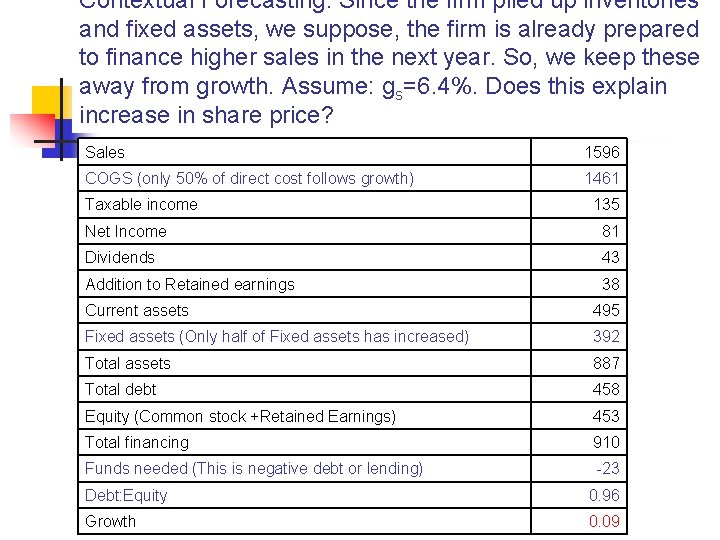
Contextual Forecasting: Since the firm piled up inventories and fixed assets, we suppose, the firm is already prepared to finance higher sales in the next year. So, we keep these away from growth. Assume: gs=6. 4%. Does this explain increase in share price? Sales 1596 COGS (only 50% of direct cost follows growth) 1461 Taxable income 135 Net Income 81 Dividends 43 Addition to Retained earnings 38 Current assets 495 Fixed assets (Only half of Fixed assets has increased) 392 Total assets 887 Total debt 458 Equity (Common stock +Retained Earnings) 453 Total financing 910 Funds needed (This is negative debt or lending) -23 Debt: Equity Growth 0. 96 2 -490. 09
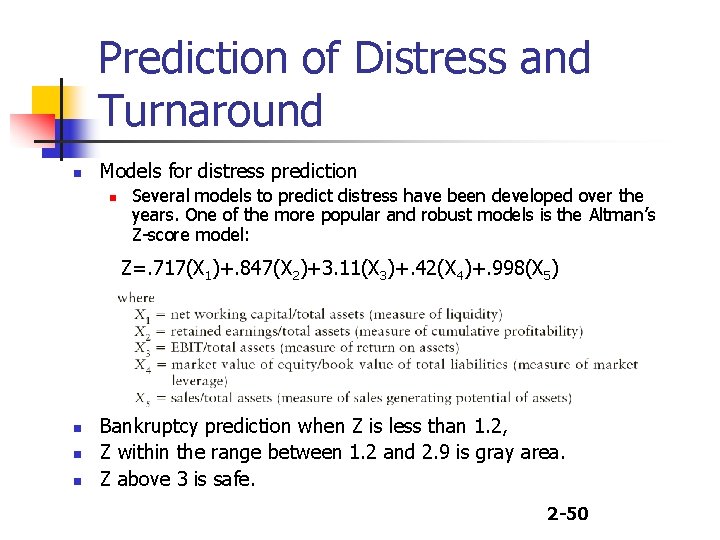
Prediction of Distress and Turnaround n Models for distress prediction n Several models to predict distress have been developed over the years. One of the more popular and robust models is the Altman’s Z-score model: Z=. 717(X 1)+. 847(X 2)+3. 11(X 3)+. 42(X 4)+. 998(X 5) n n n Bankruptcy prediction when Z is less than 1. 2, Z within the range between 1. 2 and 2. 9 is gray area. Z above 3 is safe. 2 -50
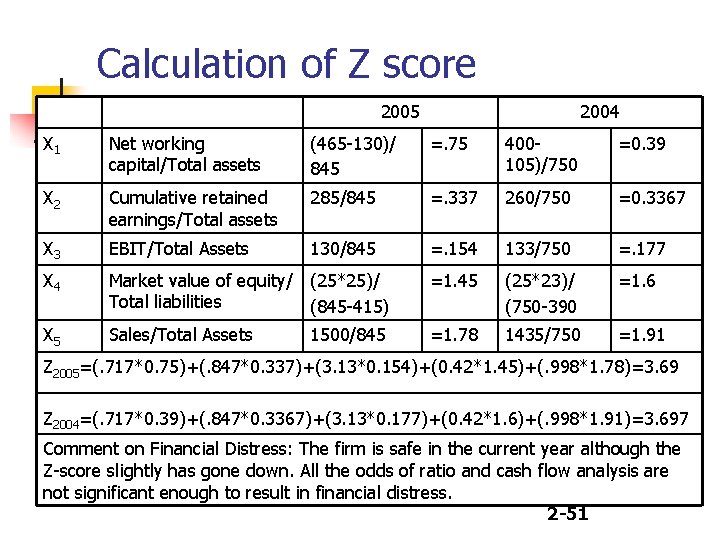
Calculation of Z score 2005 2004 X 1 Net working capital/Total assets (465 -130)/ 845 =. 75 400105)/750 =0. 39 X 2 Cumulative retained earnings/Total assets 285/845 =. 337 260/750 =0. 3367 X 3 EBIT/Total Assets 130/845 =. 154 133/750 =. 177 X 4 Market value of equity/ (25*25)/ Total liabilities (845 -415) =1. 45 (25*23)/ (750 -390 =1. 6 X 5 Sales/Total Assets =1. 78 1435/750 =1. 91 1500/845 Z 2005=(. 717*0. 75)+(. 847*0. 337)+(3. 13*0. 154)+(0. 42*1. 45)+(. 998*1. 78)=3. 69 Z 2004=(. 717*0. 39)+(. 847*0. 3367)+(3. 13*0. 177)+(0. 42*1. 6)+(. 998*1. 91)=3. 697 Comment on Financial Distress: The firm is safe in the current year although the Z-score slightly has gone down. All the odds of ratio and cash flow analysis are not significant enough to result in financial distress. 2 -51
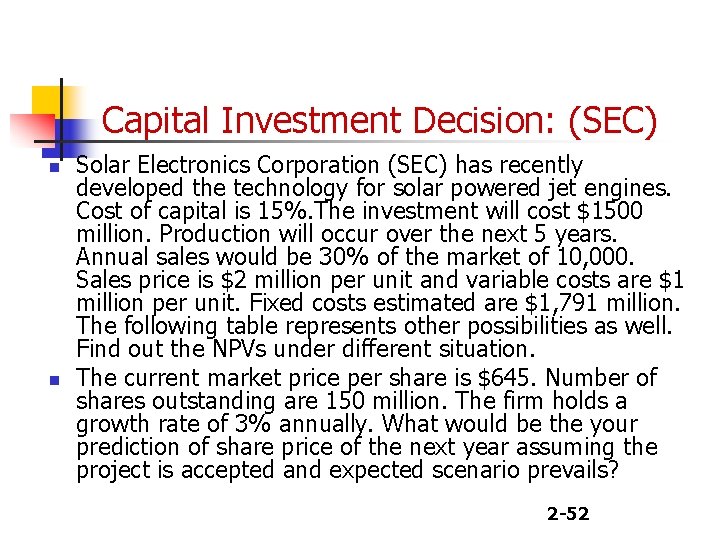
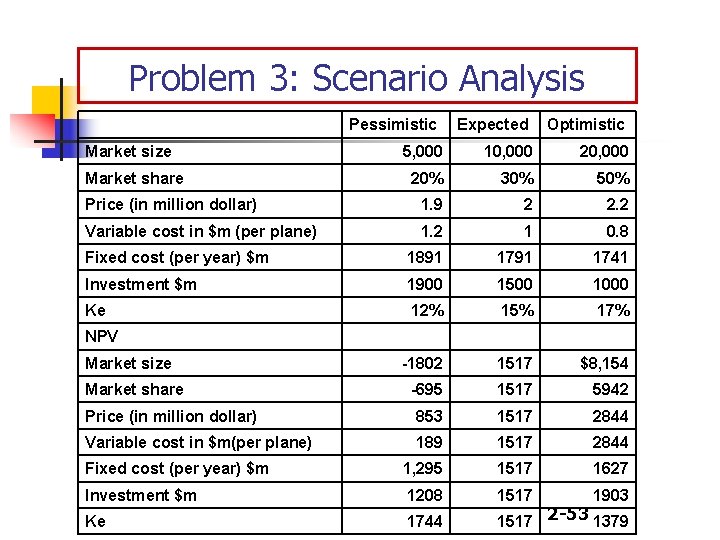
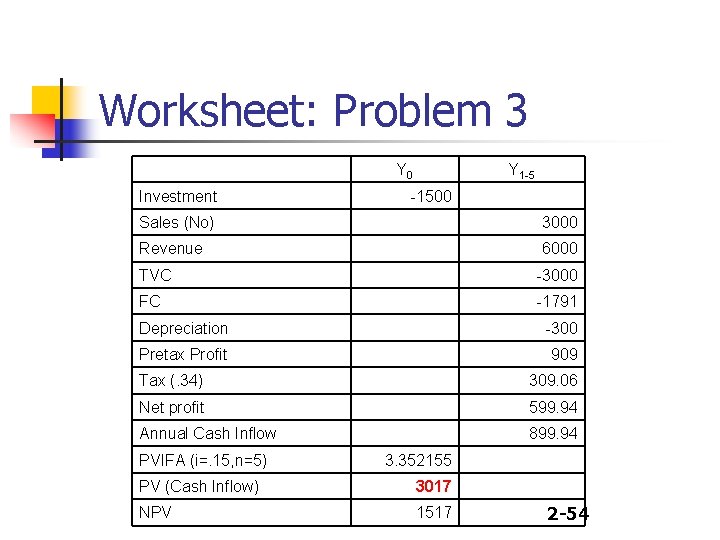
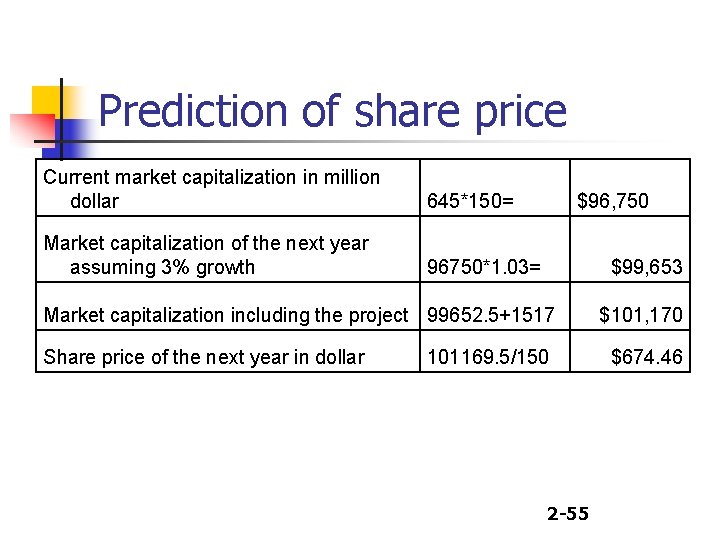
Capital Investment Decision: (SEC) n n Solar Electronics Corporation (SEC) has recently developed the technology for solar powered jet engines. Cost of capital is 15%. The investment will cost $1500 million. Production will occur over the next 5 years. Annual sales would be 30% of the market of 10, 000. Sales price is $2 million per unit and variable costs are $1 million per unit. Fixed costs estimated are $1, 791 million. The following table represents other possibilities as well. Find out the NPVs under different situation. The current market price per share is $645. Number of shares outstanding are 150 million. The firm holds a growth rate of 3% annually. What would be the your prediction of share price of the next year assuming the project is accepted and expected scenario prevails? 2 -52
Problem 3: Scenario Analysis Pessimistic Expected Optimistic 5, 000 10, 000 20% 30% 50% Price (in million dollar) 1. 9 2 2. 2 Variable cost in $m (per plane) 1. 2 1 0. 8 Fixed cost (per year) $m 1891 1741 Investment $m 1900 1500 1000 Ke 12% 15% 17% -1802 1517 $8, 154 -695 1517 5942 Price (in million dollar) 853 1517 2844 Variable cost in $m(per plane) 189 1517 2844 Fixed cost (per year) $m 1, 295 1517 1627 Investment $m 1208 1517 1903 Ke 1744 Market size Market share NPV Market size Market share 1517 2 -53 1379
Worksheet: Problem 3 Y 0 Investment Y 1 -5 -1500 Sales (No) 3000 Revenue 6000 TVC -3000 FC -1791 Depreciation -300 Pretax Profit 909 Tax (. 34) 309. 06 Net profit 599. 94 Annual Cash Inflow 899. 94 PVIFA (i=. 15, n=5) 3. 352155 PV (Cash Inflow) 3017 NPV 1517 2 -54
Prediction of share price Current market capitalization in million dollar 645*150= Market capitalization of the next year assuming 3% growth 96750*1. 03= $96, 750 $99, 653 Market capitalization including the project 99652. 5+1517 Share price of the next year in dollar 101169. 5/150 2 -55 $101, 170 $674. 46
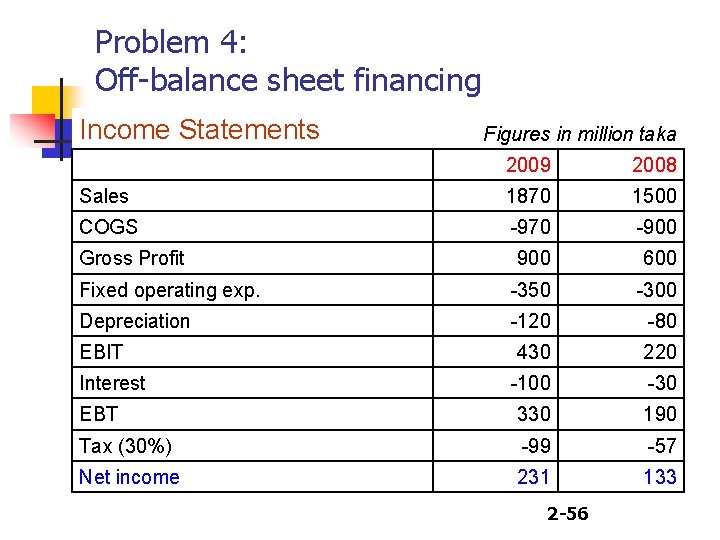
Problem 4: Off-balance sheet financing Income Statements Figures in million taka 2009 2008 Sales 1870 1500 COGS -970 -900 600 Fixed operating exp. -350 -300 Depreciation -120 -80 430 220 -100 -30 EBT 330 190 Tax (30%) -99 -57 Net income 231 133 Gross Profit EBIT Interest 2 -56
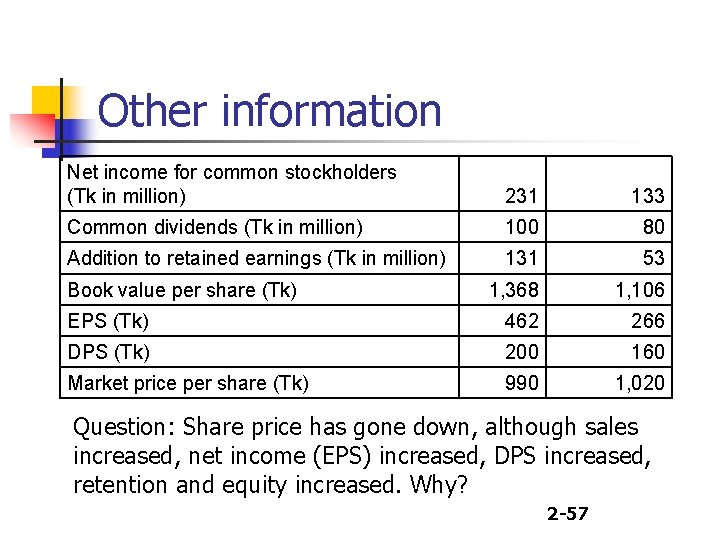
Other information Net income for common stockholders (Tk in million) 231 133 Common dividends (Tk in million) 100 80 Addition to retained earnings (Tk in million) 131 53 1, 368 1, 106 EPS (Tk) 462 266 DPS (Tk) 200 160 Market price per share (Tk) 990 1, 020 Book value per share (Tk) Question: Share price has gone down, although sales increased, net income (EPS) increased, DPS increased, retention and equity increased. Why? 2 -57
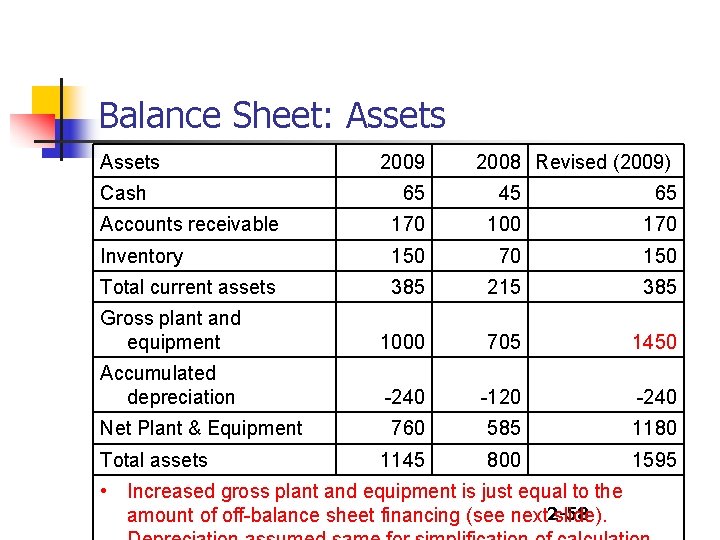
Balance Sheet: Assets Cash 2009 2008 Revised (2009) 65 45 65 Accounts receivable 170 100 170 Inventory 150 70 150 Total current assets 385 215 385 Gross plant and equipment 1000 705 1450 Accumulated depreciation -240 -120 -240 760 585 1180 1145 800 1595 Net Plant & Equipment Total assets • Increased gross plant and equipment is just equal to the amount of off-balance sheet financing (see next 2 -58 slide).
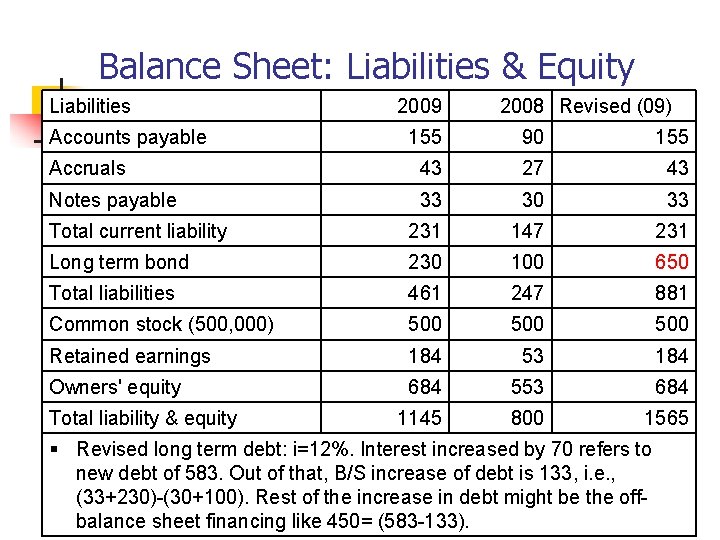
Balance Sheet: Liabilities & Equity Liabilities Accounts payable 2009 2008 Revised (09) 155 90 155 Accruals 43 27 43 Notes payable 33 30 33 Total current liability 231 147 231 Long term bond 230 100 650 Total liabilities 461 247 881 Common stock (500, 000) 500 500 Retained earnings 184 53 184 Owners' equity 684 553 684 1145 800 1565 Total liability & equity § Revised long term debt: i=12%. Interest increased by 70 refers to new debt of 583. Out of that, B/S increase of debt is 133, i. e. , (33+230)-(30+100). Rest of the increase in debt might be the off 2 -59 balance sheet financing like 450= (583 -133).
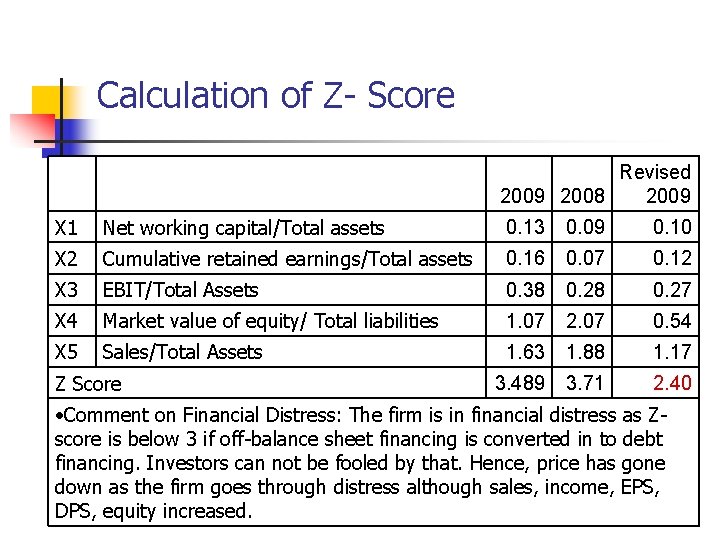
Calculation of Z- Score Revised 2009 2008 2009 X 1 Net working capital/Total assets 0. 13 0. 09 0. 10 X 2 Cumulative retained earnings/Total assets 0. 16 0. 07 0. 12 X 3 EBIT/Total Assets 0. 38 0. 27 X 4 Market value of equity/ Total liabilities 1. 07 2. 07 0. 54 X 5 Sales/Total Assets 1. 63 1. 88 1. 17 3. 489 3. 71 2. 40 Z Score • Comment on Financial Distress: The firm is in financial distress as Zscore is below 3 if off-balance sheet financing is converted in to debt financing. Investors can not be fooled by that. Hence, price has gone down as the firm goes through distress although sales, income, EPS, DPS, equity increased. 2 -60