
FINANCIAL STATEMENT COMPARABILITY Chapter 4 CHAPTER 4 OBJECTIVES
FINANCIAL STATEMENT COMPARABILITY Chapter 4
CHAPTER 4 OBJECTIVES Explain the advantage of common size financial statements compared to those disclosed on a monetary basis. n Compute vertical and horizontal common size income statements and balance sheets. n Calculate compound annual growth rates and explain why this method provides better information than alternative methods of horizontal analysis. n
CHAPTER 4 OBJECTIVES (CONT. ) n Determine financial statement vertical profiles and moving averages. n Use good judgment when reconciling financial statement inconsistencies, rounding numbers, computing ratios, scaling numerical amounts and making qualitative assessments.
BASIC COMMON SIZE CONSIDERATIONS n Enables valid comparisons over time or against competition
BASIC COMMON SIZE CONSIDERATIONS (CONT. ) Vertical common size financial statements n Disclosures are a percentage of another account in the same reporting period n n n Income statement: accounts reported as a percentage of revenues (revenues = 100%) Balance sheet: accounts reported as a percentage of total assets (or liabilities plus shareholders’ equity)

VERTICAL COMMON SIZE EXAMPLE
BASIC COMMON SIZE CONSIDERATIONS (CONT. ) Horizontal common size financial statements n Disclosures are a percentage of the same account from a previous reporting period n n n Income statement: e. g. , this year’s revenues as a percentage of last year’s revenues Balance sheet: e. g. , this year’s cash balance as a percentage of last year’s cash balance
BASIC COMMON SIZE CONSIDERATIONS (CONT. ) n Alternative analysis n Anchoring disclosures of horizontal Uses the earliest year’s data as the base year (100%) n Subsequent observations are a percentage of the base year’s amount n
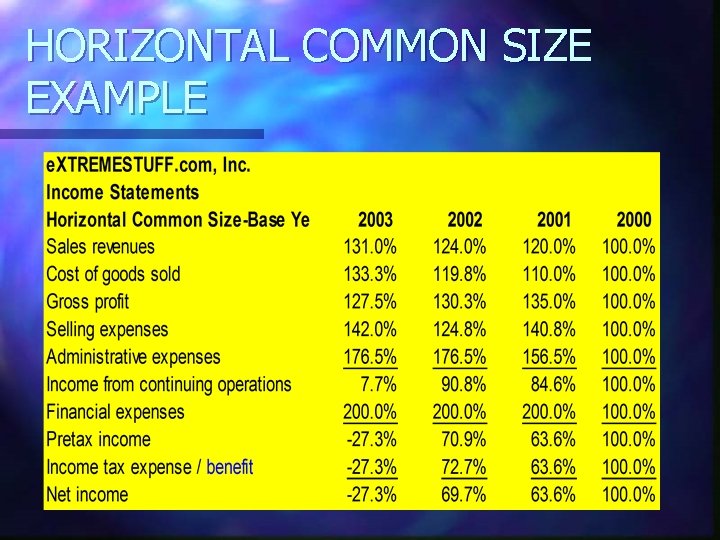
HORIZONTAL COMMON SIZE EXAMPLE
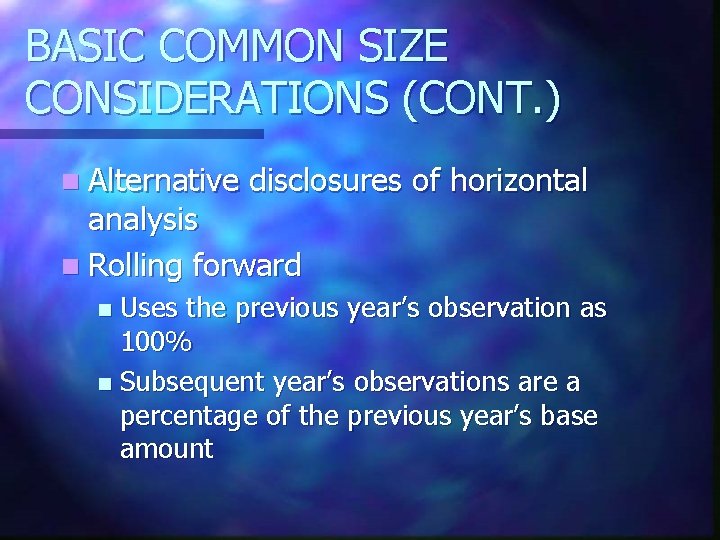
BASIC COMMON SIZE CONSIDERATIONS (CONT. ) n Alternative disclosures of horizontal analysis n Rolling forward Uses the previous year’s observation as 100% n Subsequent year’s observations are a percentage of the previous year’s base amount n
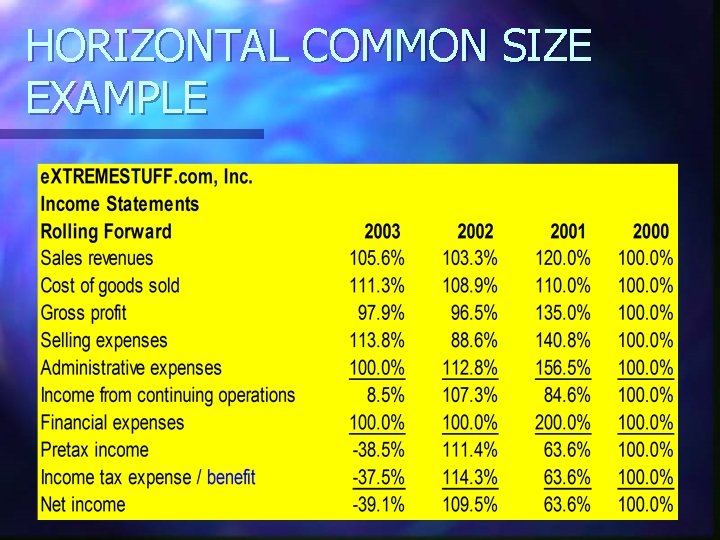
HORIZONTAL COMMON SIZE EXAMPLE
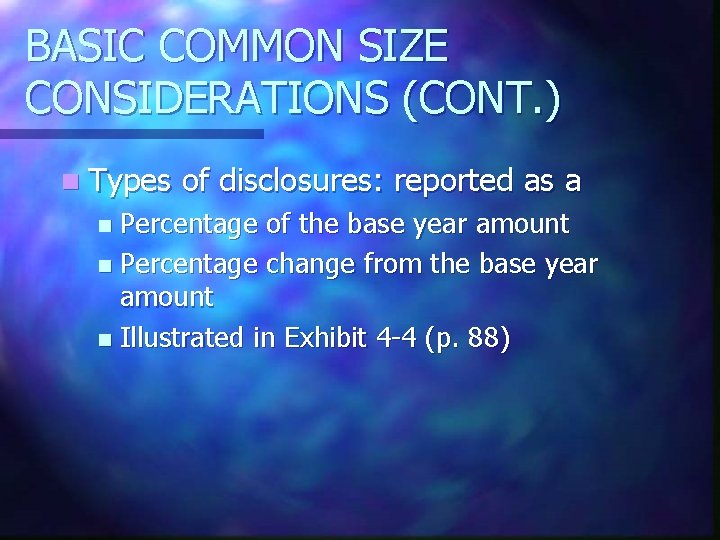
BASIC COMMON SIZE CONSIDERATIONS (CONT. ) n Types of disclosures: reported as a Percentage of the base year amount n Percentage change from the base year amount n Illustrated in Exhibit 4 -4 (p. 88) n
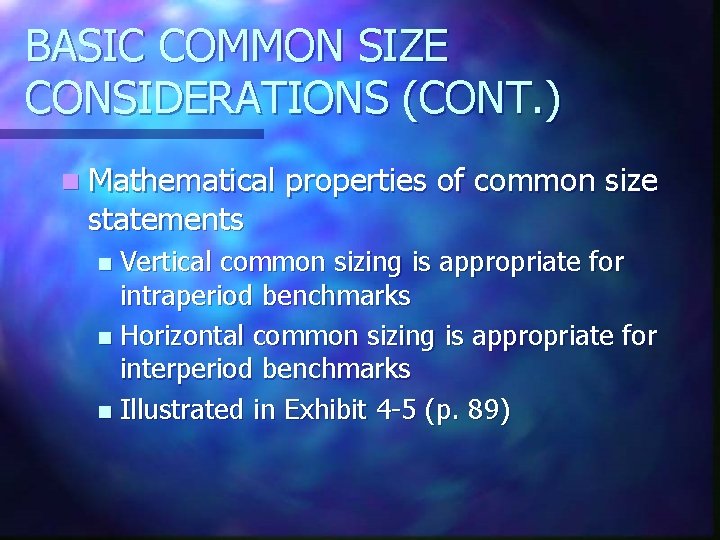
BASIC COMMON SIZE CONSIDERATIONS (CONT. ) n Mathematical statements properties of common size Vertical common sizing is appropriate for intraperiod benchmarks n Horizontal common sizing is appropriate for interperiod benchmarks n Illustrated in Exhibit 4 -5 (p. 89) n
COMMON SIZE EXTENSIONS n Compound annual growth rates— n n better method of horizontal analysis than anchoring or rolling the data forward Mathematically valid: considers the affect of percentage changes on previous periods’ numbers Superiority illustrated in Exhibit 4 -6 (p. 90) Internal rate of return command on spreadsheet application facilitates computations
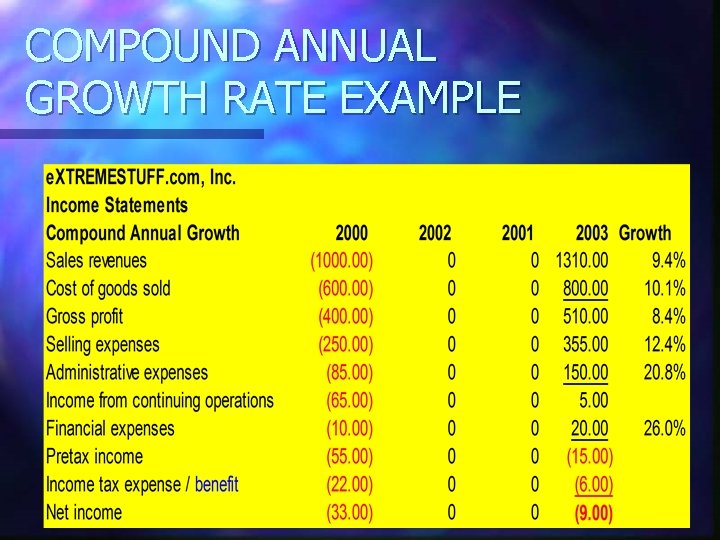
COMPOUND ANNUAL GROWTH RATE EXAMPLE

COMMON SIZE EXTENSIONS (CONT. ) n Financial statement profiles Condenses a vertical common size statement into one “average” reporting period n Measures variability over time n See Exhibit 4 -7 (p. 91) n
COMMON SIZE EXTENSIONS (CONT. ) n Moving averages Condenses three, five, or seven year vertical common size statements into an average for that period of time n Moves the average period forward by dropping the earliest observation and replacing with the most recent period’s data n See Exhibit 4 -8 (p. 93) n
DATA CONSIDERATIONS n Observation quantity Analyzing sufficient reporting disclosures to reach valid conclusions n Usually between five and 10 years of data suffice n
DATA CONSIDERATIONS (CONT. ) n Financial statement inconsistencies Format of reported data change over time and differ among companies n Use judgment to reduce differences in disclosure sets n Use most recent data available if options exist n
DATA CONSIDERATIONS (CONT. ) n Scaling disclosures Companies report financial statements in thousands or millions of dollars n Be aware of the scale or you will fail to grasp the entity’s size n
DATA CONSIDERATIONS (CONT. ) n Numerical rounding Done to avoid insignificant data disclosures n Reduces “clutter” of data disclosures n Should only be done when it does not alter analysts’ decisions n
DATA CONSIDERATIONS (CONT. ) n Qualitative n statements Analysts’ opinions about data (e. g. one company has a better profit margin than another) should be made with care and after sufficient analysis
- Slides: 22