
FINANCIAL STATEMENT Analysis Valuation Fourth Edition Peter D

- Slides: 52
FINANCIAL STATEMENT Analysis & Valuation Fourth Edition Peter D. Easton Mary Lea Mc. Anally Greg Sommers MODULE 1 Framework for Analysis and Valuation ©Cambridge Business Publishers, 2015 Xiao-Jun Zhang
Learning Objective 1 Identify and discuss the users and suppliers of financial statement information. ©Cambridge Business Publishers, 2015 2
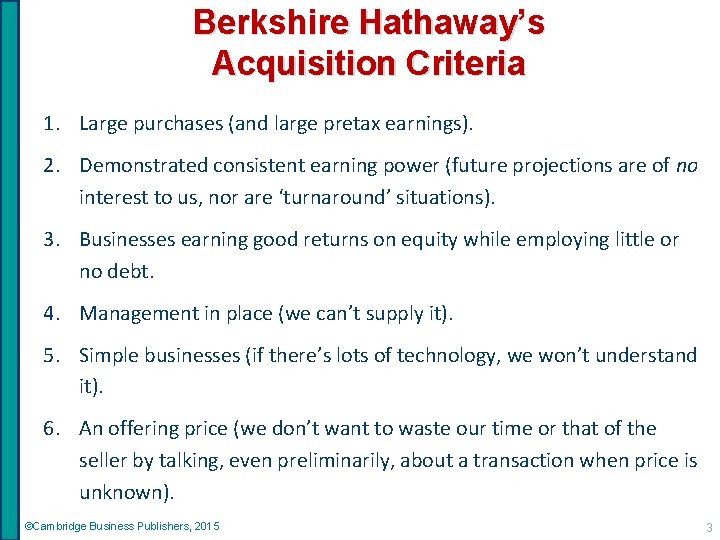
Berkshire Hathaway’s Acquisition Criteria 1. Large purchases (and large pretax earnings). 2. Demonstrated consistent earning power (future projections are of no interest to us, nor are ‘turnaround’ situations). 3. Businesses earning good returns on equity while employing little or no debt. 4. Management in place (we can’t supply it). 5. Simple businesses (if there’s lots of technology, we won’t understand it). 6. An offering price (we don’t want to waste our time or that of the seller by talking, even preliminarily, about a transaction when price is unknown). ©Cambridge Business Publishers, 2015 3
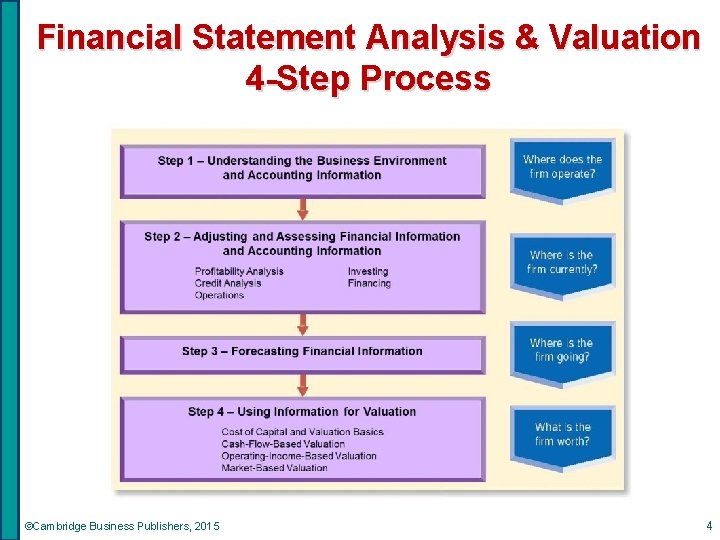
Financial Statement Analysis & Valuation 4 -Step Process ©Cambridge Business Publishers, 2015 4
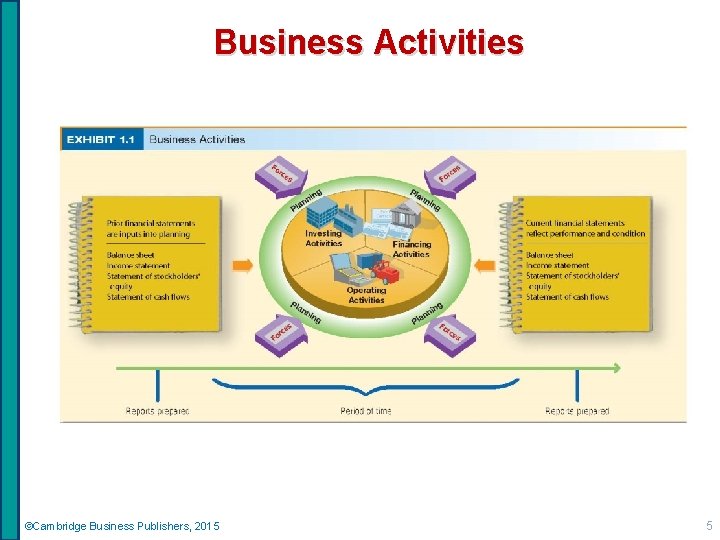
Business Activities ©Cambridge Business Publishers, 2015 5
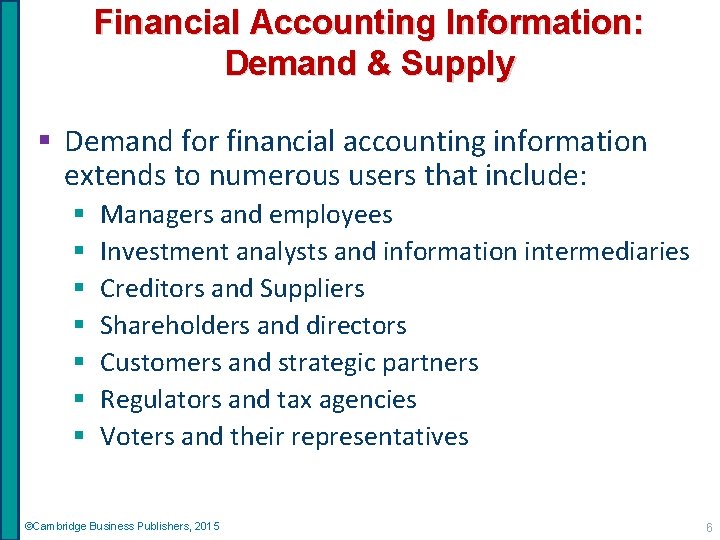
Financial Accounting Information: Demand & Supply § Demand for financial accounting information extends to numerous users that include: § § § § Managers and employees Investment analysts and information intermediaries Creditors and Suppliers Shareholders and directors Customers and strategic partners Regulators and tax agencies Voters and their representatives ©Cambridge Business Publishers, 2015 6
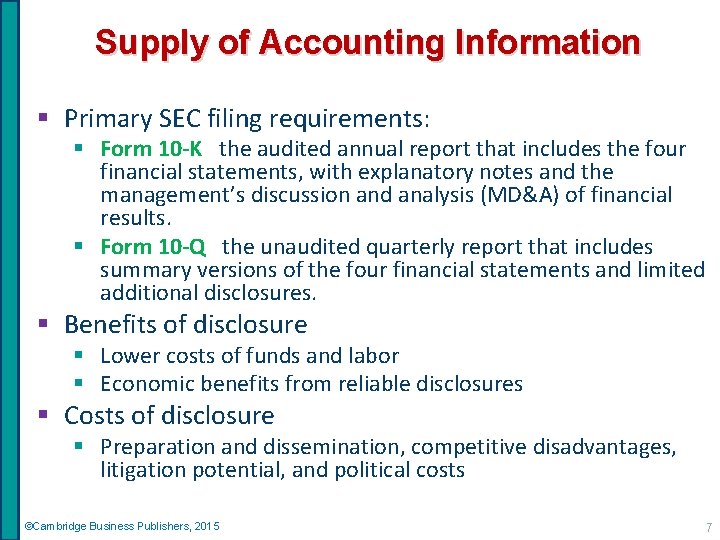
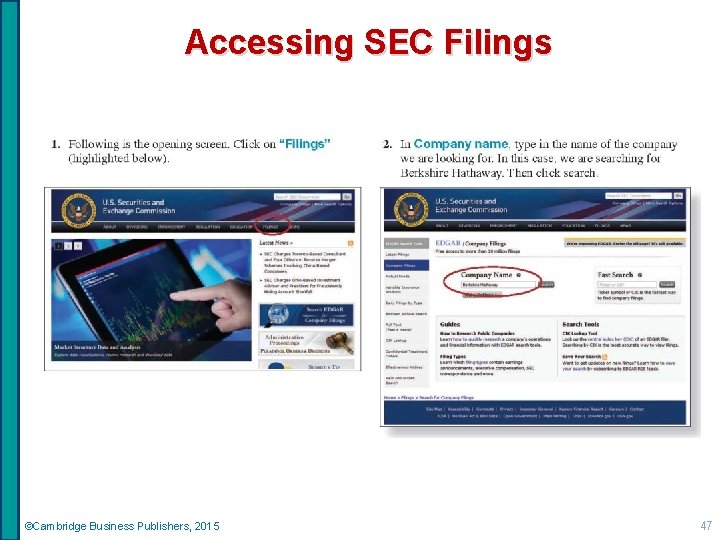
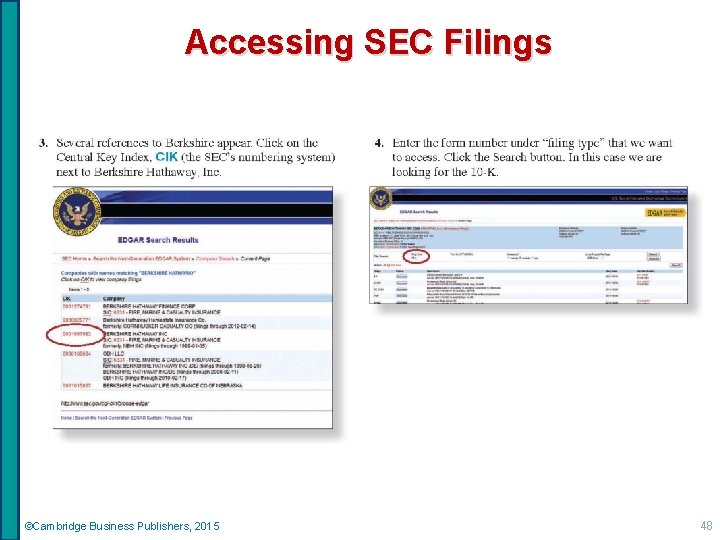
Supply of Accounting Information § Primary SEC filing requirements: § Form 10 -K the audited annual report that includes the four financial statements, with explanatory notes and the management’s discussion and analysis (MD&A) of financial results. § Form 10 -Q the unaudited quarterly report that includes summary versions of the four financial statements and limited additional disclosures. § Benefits of disclosure § Lower costs of funds and labor § Economic benefits from reliable disclosures § Costs of disclosure § Preparation and dissemination, competitive disadvantages, litigation potential, and political costs ©Cambridge Business Publishers, 2015 7
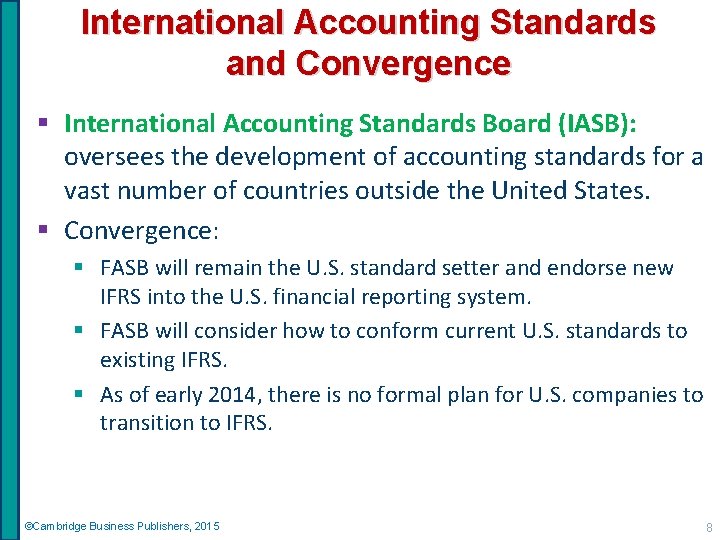
International Accounting Standards and Convergence § International Accounting Standards Board (IASB): oversees the development of accounting standards for a vast number of countries outside the United States. § Convergence: § FASB will remain the U. S. standard setter and endorse new IFRS into the U. S. financial reporting system. § FASB will consider how to conform current U. S. standards to existing IFRS. § As of early 2014, there is no formal plan for U. S. companies to transition to IFRS. ©Cambridge Business Publishers, 2015 8
International Accounting Standards vs. U. S. GAAP § Are financial statements prepared under IFRS substantially different from those prepared under U. S. GAAP? § At a broad level, the answer is no. § Both are prepared using accrual accounting and utilize similar conceptual frameworks. § Both require the same set of financial statements: a balance sheet, an income statement, a statement of cash flows, a statement of stockholders’ equity, and a set of explanatory footnotes. § The differences are typically technical in nature, and do not differ on broad principles discussed in this book. ©Cambridge Business Publishers, 2015 9
Learning Objective 2 Identify and explain the four financial statements, and define the accounting equation. ©Cambridge Business Publishers, 2015 10
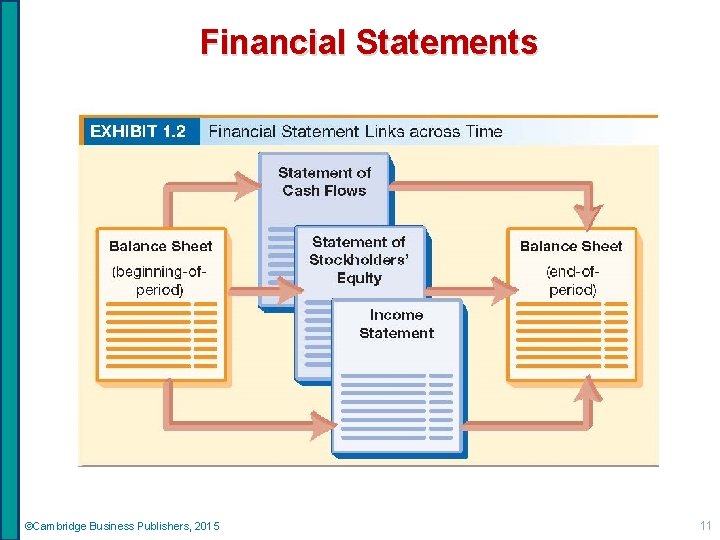
Financial Statements ©Cambridge Business Publishers, 2015 11
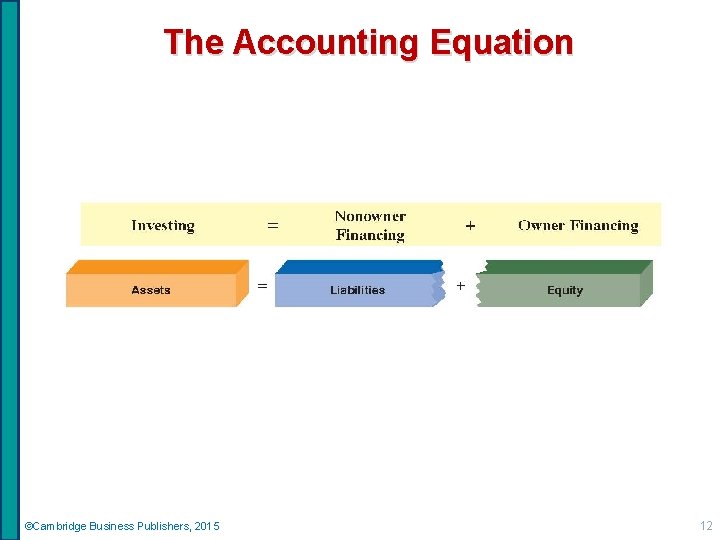
The Accounting Equation ©Cambridge Business Publishers, 2015 12
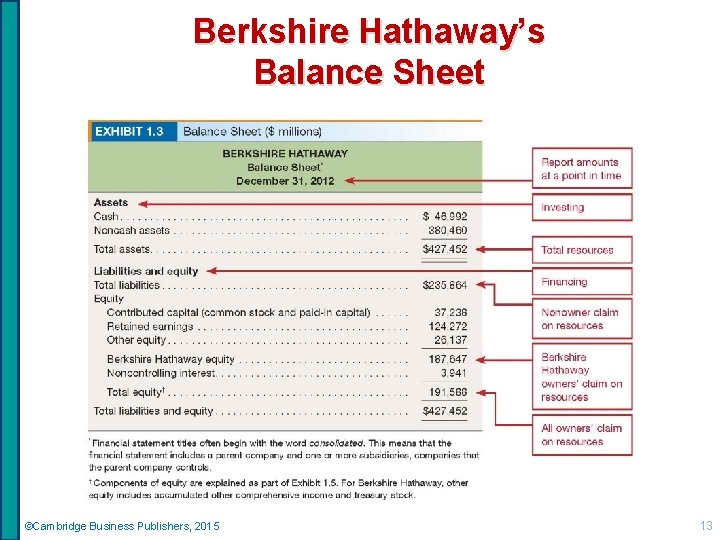
Berkshire Hathaway’s Balance Sheet ©Cambridge Business Publishers, 2015 13
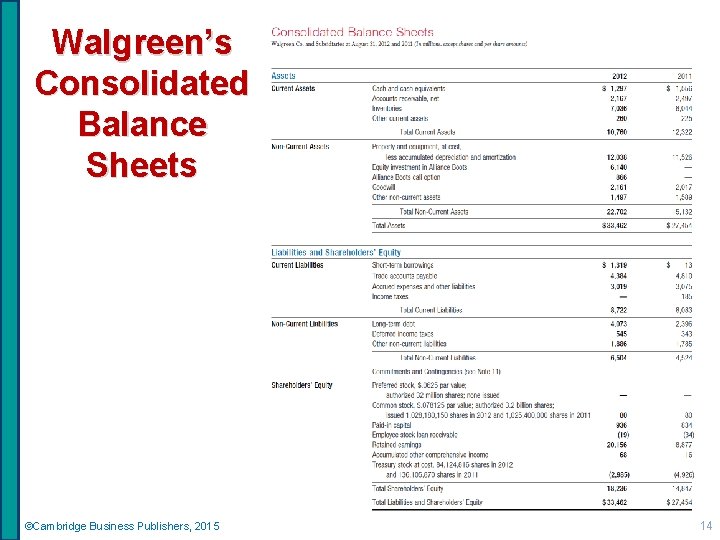
Walgreen’s Consolidated Balance Sheets ©Cambridge Business Publishers, 2015 14
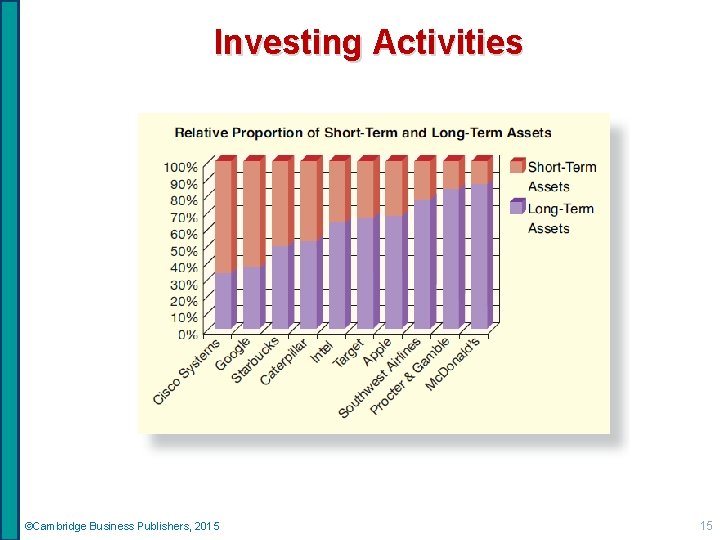
Investing Activities ©Cambridge Business Publishers, 2015 15
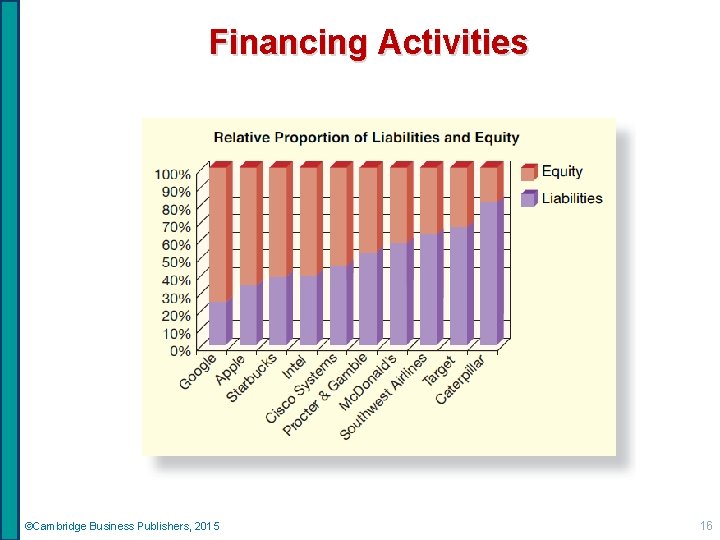
Financing Activities ©Cambridge Business Publishers, 2015 16
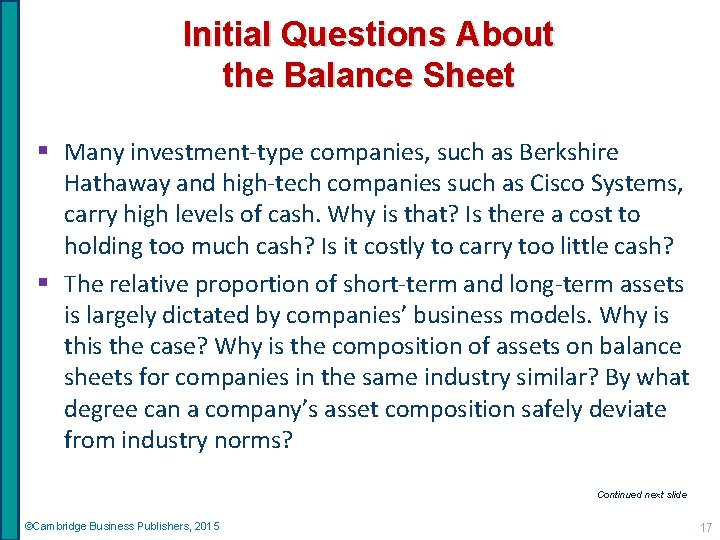
Initial Questions About the Balance Sheet § Many investment-type companies, such as Berkshire Hathaway and high-tech companies such as Cisco Systems, carry high levels of cash. Why is that? Is there a cost to holding too much cash? Is it costly to carry too little cash? § The relative proportion of short-term and long-term assets is largely dictated by companies’ business models. Why is the case? Why is the composition of assets on balance sheets for companies in the same industry similar? By what degree can a company’s asset composition safely deviate from industry norms? Continued next slide ©Cambridge Business Publishers, 2015 17
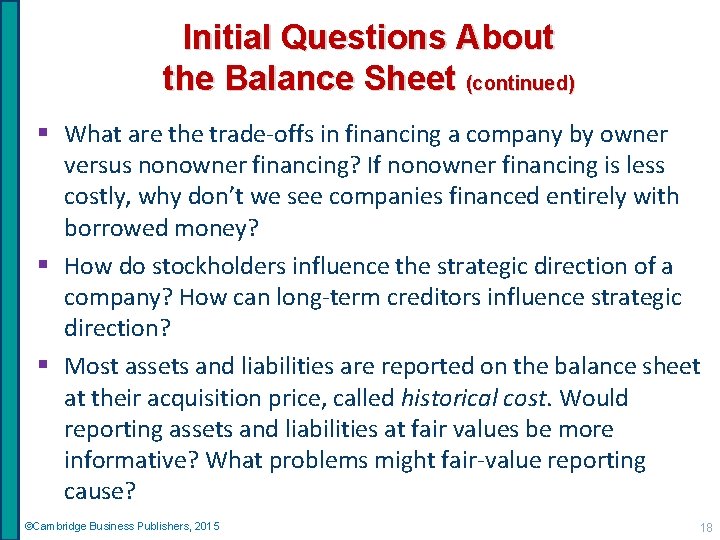
Initial Questions About the Balance Sheet (continued) § What are the trade-offs in financing a company by owner versus nonowner financing? If nonowner financing is less costly, why don’t we see companies financed entirely with borrowed money? § How do stockholders influence the strategic direction of a company? How can long-term creditors influence strategic direction? § Most assets and liabilities are reported on the balance sheet at their acquisition price, called historical cost. Would reporting assets and liabilities at fair values be more informative? What problems might fair-value reporting cause? ©Cambridge Business Publishers, 2015 18
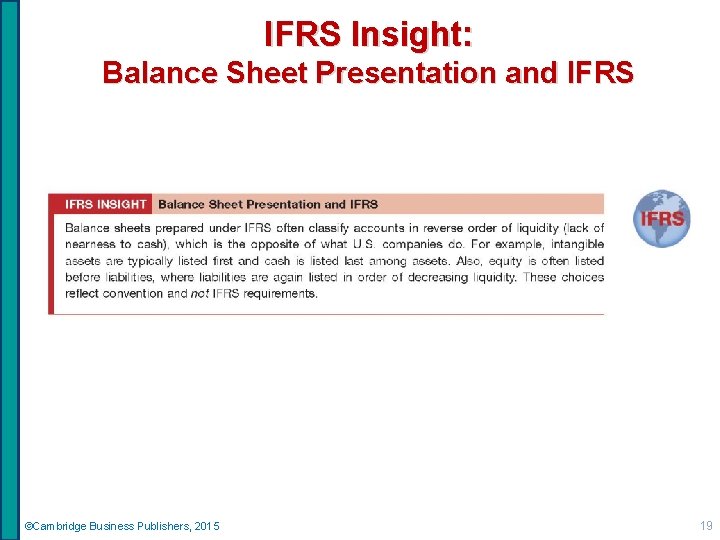
IFRS Insight: Balance Sheet Presentation and IFRS ©Cambridge Business Publishers, 2015 19
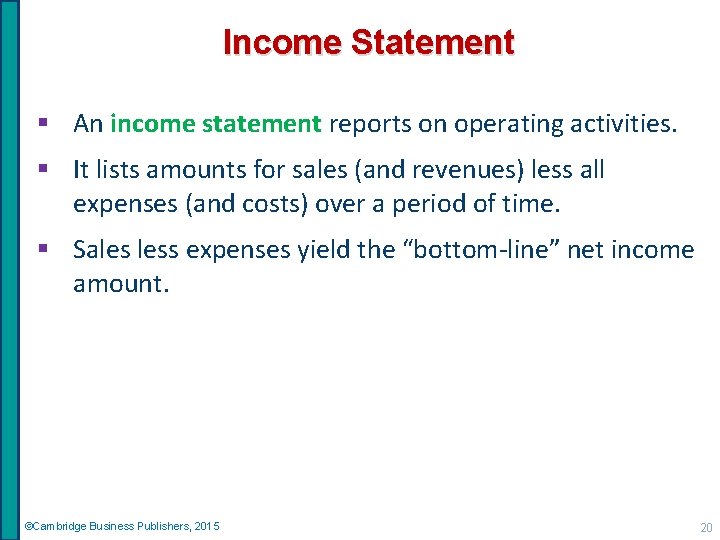
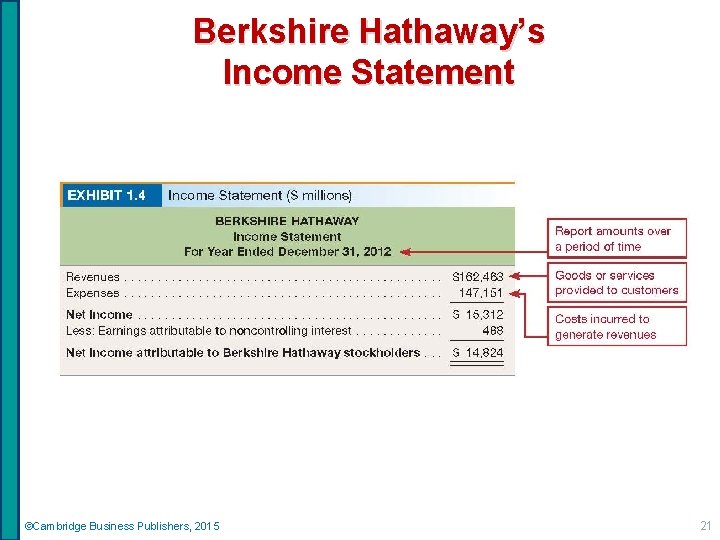
Income Statement § An income statement reports on operating activities. § It lists amounts for sales (and revenues) less all expenses (and costs) over a period of time. § Sales less expenses yield the “bottom-line” net income amount. ©Cambridge Business Publishers, 2015 20
Berkshire Hathaway’s Income Statement ©Cambridge Business Publishers, 2015 21
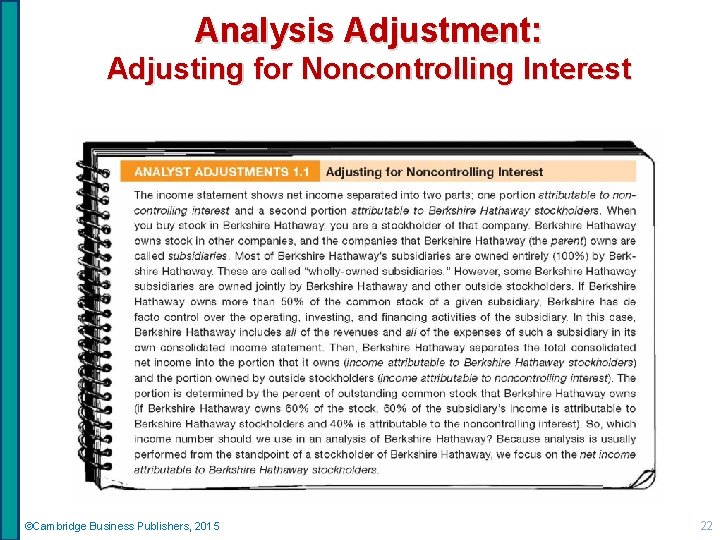
Analysis Adjustment: Adjusting for Noncontrolling Interest ©Cambridge Business Publishers, 2015 22
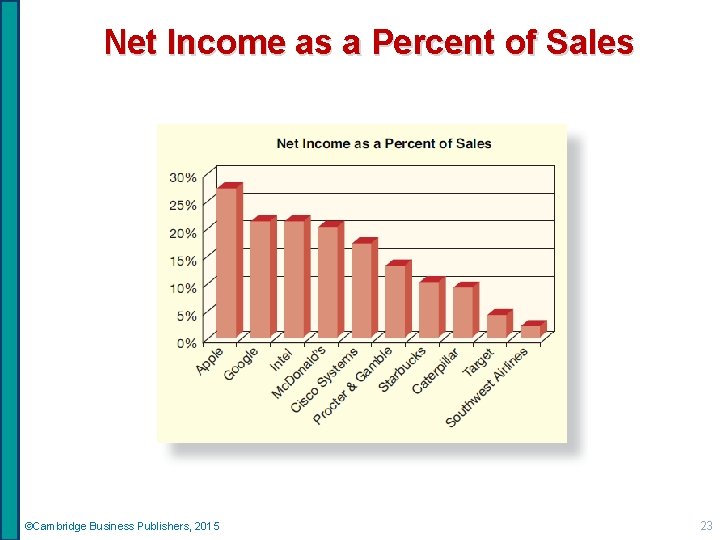
Net Income as a Percent of Sales ©Cambridge Business Publishers, 2015 23
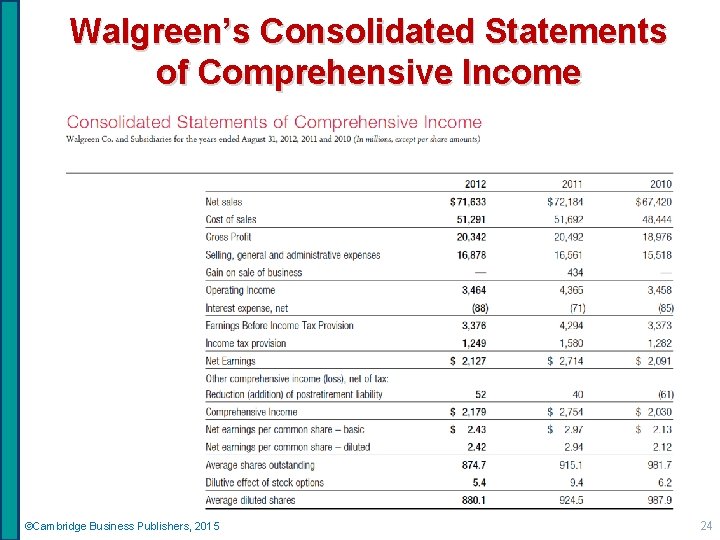
Walgreen’s Consolidated Statements of Comprehensive Income ©Cambridge Business Publishers, 2015 24
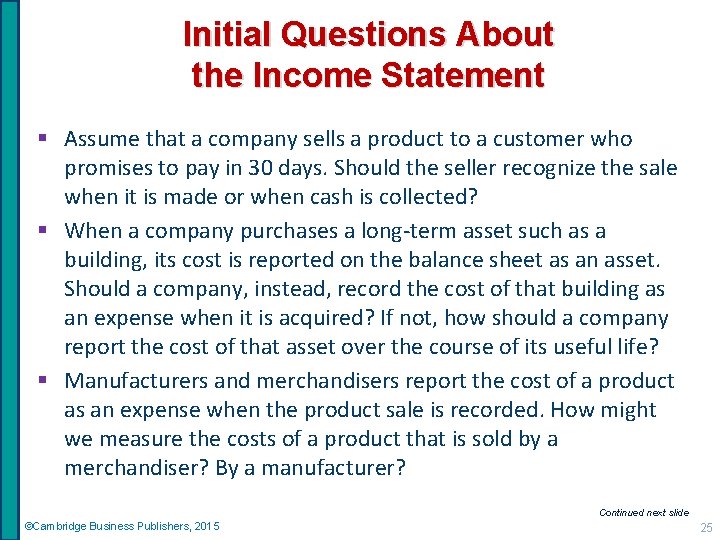
Initial Questions About the Income Statement § Assume that a company sells a product to a customer who promises to pay in 30 days. Should the seller recognize the sale when it is made or when cash is collected? § When a company purchases a long-term asset such as a building, its cost is reported on the balance sheet as an asset. Should a company, instead, record the cost of that building as an expense when it is acquired? If not, how should a company report the cost of that asset over the course of its useful life? § Manufacturers and merchandisers report the cost of a product as an expense when the product sale is recorded. How might we measure the costs of a product that is sold by a merchandiser? By a manufacturer? Continued next slide ©Cambridge Business Publishers, 2015 25
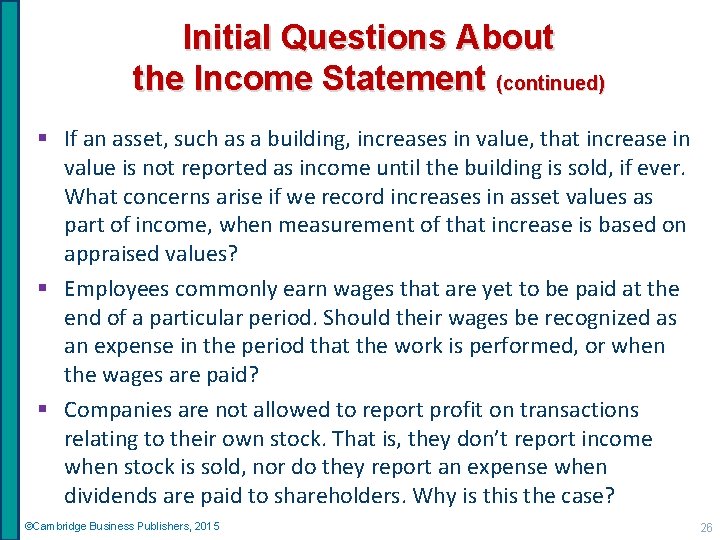
Initial Questions About the Income Statement (continued) § If an asset, such as a building, increases in value, that increase in value is not reported as income until the building is sold, if ever. What concerns arise if we record increases in asset values as part of income, when measurement of that increase is based on appraised values? § Employees commonly earn wages that are yet to be paid at the end of a particular period. Should their wages be recognized as an expense in the period that the work is performed, or when the wages are paid? § Companies are not allowed to report profit on transactions relating to their own stock. That is, they don’t report income when stock is sold, nor do they report an expense when dividends are paid to shareholders. Why is the case? ©Cambridge Business Publishers, 2015 26
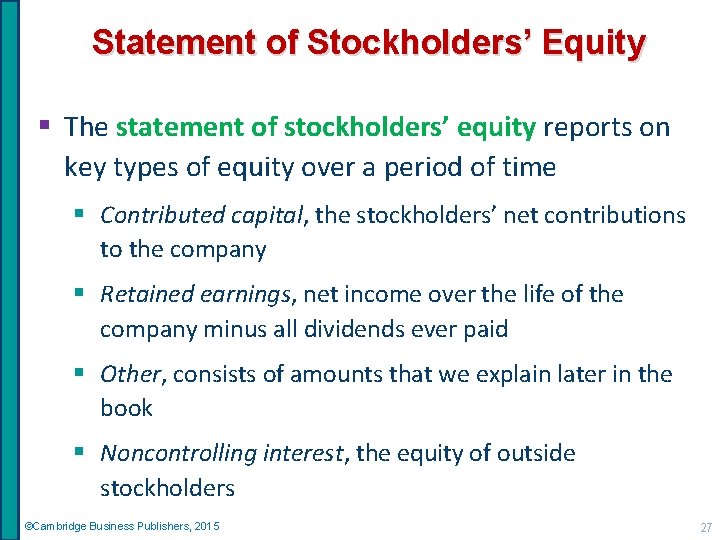
Statement of Stockholders’ Equity § The statement of stockholders’ equity reports on key types of equity over a period of time § Contributed capital, the stockholders’ net contributions to the company § Retained earnings, net income over the life of the company minus all dividends ever paid § Other, consists of amounts that we explain later in the book § Noncontrolling interest, the equity of outside stockholders ©Cambridge Business Publishers, 2015 27
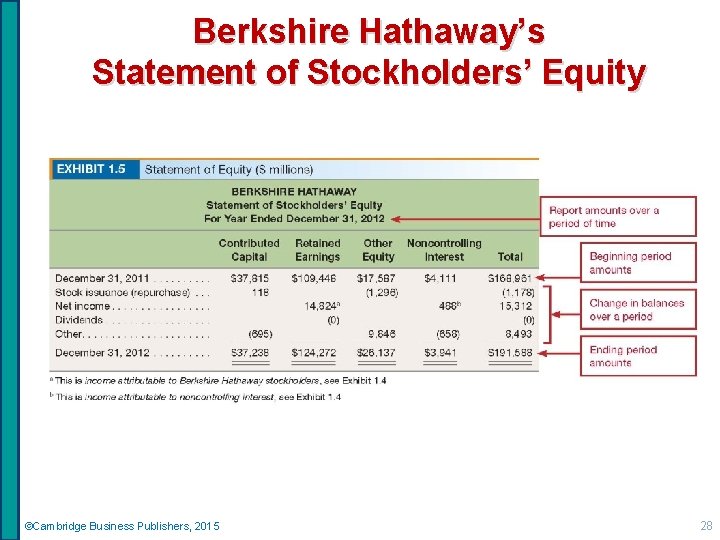
Berkshire Hathaway’s Statement of Stockholders’ Equity ©Cambridge Business Publishers, 2015 28
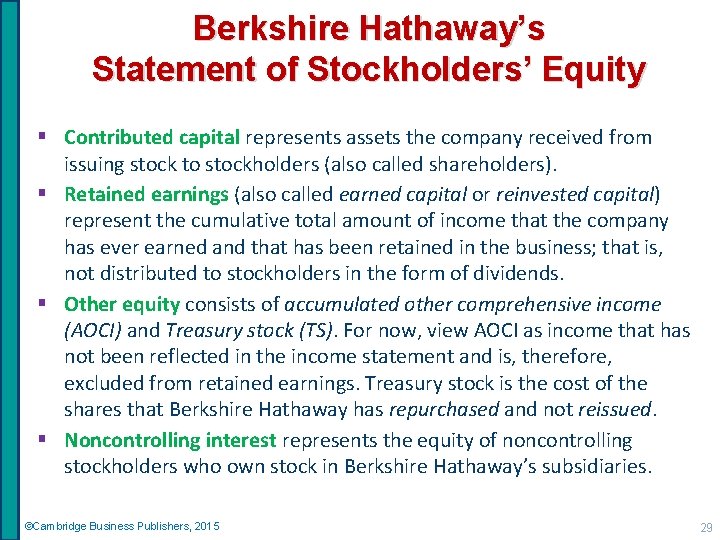
Berkshire Hathaway’s Statement of Stockholders’ Equity § Contributed capital represents assets the company received from issuing stock to stockholders (also called shareholders). § Retained earnings (also called earned capital or reinvested capital) represent the cumulative total amount of income that the company has ever earned and that has been retained in the business; that is, not distributed to stockholders in the form of dividends. § Other equity consists of accumulated other comprehensive income (AOCI) and Treasury stock (TS). For now, view AOCI as income that has not been reflected in the income statement and is, therefore, excluded from retained earnings. Treasury stock is the cost of the shares that Berkshire Hathaway has repurchased and not reissued. § Noncontrolling interest represents the equity of noncontrolling stockholders who own stock in Berkshire Hathaway’s subsidiaries. ©Cambridge Business Publishers, 2015 29
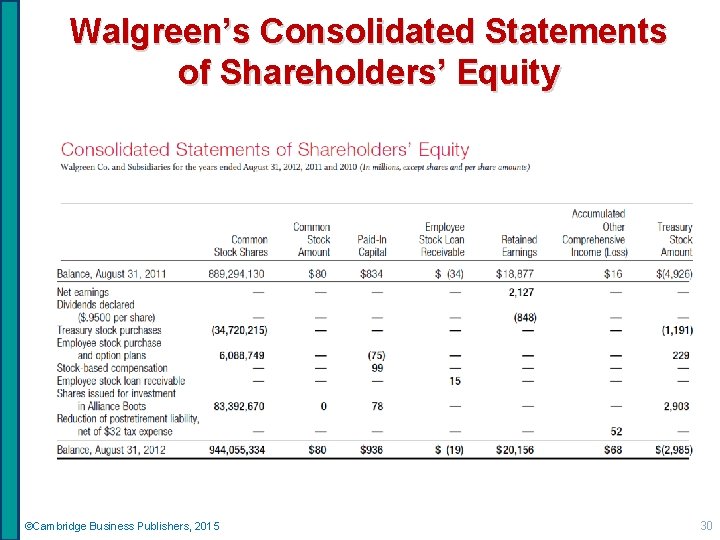
Walgreen’s Consolidated Statements of Shareholders’ Equity ©Cambridge Business Publishers, 2015 30
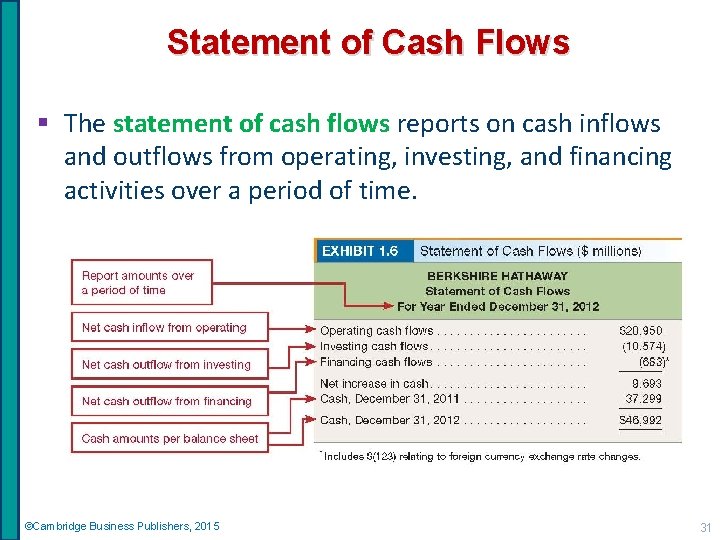
Statement of Cash Flows § The statement of cash flows reports on cash inflows and outflows from operating, investing, and financing activities over a period of time. ©Cambridge Business Publishers, 2015 31
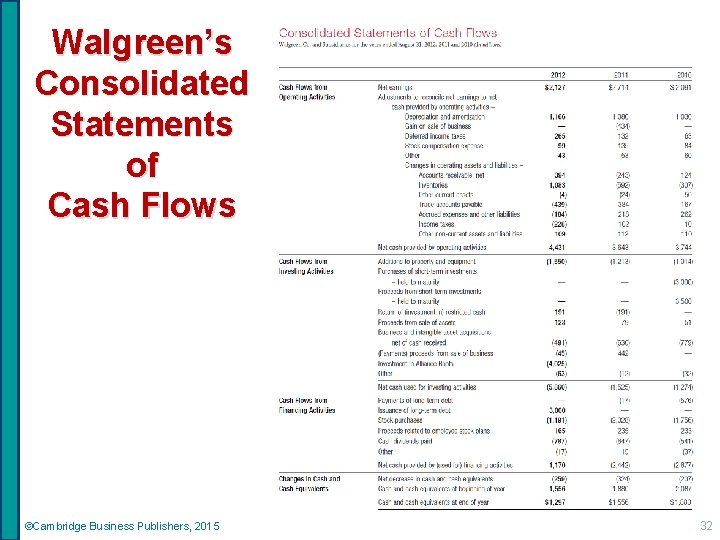
Walgreen’s Consolidated Statements of Cash Flows ©Cambridge Business Publishers, 2015 32
Initial Questions About the Statement of Cash Flows § What is the usefulness of the statement of cash flows? Do the balance sheet and income statement provide sufficient cash flow information? § What types of information are disclosed in the statement of cash flows and why are they important? § What kinds of activities are reported in each of the operating, investing and financing sections of the statement of cash flows? How is this information useful? § Is it important for a company to report net cash inflows (positive amounts) relating to operating activities over the longer term? What are the implications if operating cash flows are negative for an extended period of time? Continued next slide ©Cambridge Business Publishers, 2015 33
Initial Questions About the Statement of Cash Flows (continued) § Why is it important to know the composition of a company’s investment activities? What kind of information might we look for? Are positive investing cash flows favorable? § Is it important to know the sources of a company’s financing activities? What questions might that information help us answer? § How might the composition of operating, investing and financing cash flows change over a company’s life cycle? § Is the bottom line increase in cash flow the key number? Why or why not? ©Cambridge Business Publishers, 2015 34
Financial Statement Linkages § The income statement and the balance sheet are linked via retained earnings. § Retained earnings, contributed capital, and other equity balances appear both on the statement of stockholders’ equity and the balance sheet. § The statement of cash flows is linked to the income statement as net income is a component of operating cash flow. ©Cambridge Business Publishers, 2015 35
Financial Statement Linkages for Berkshire Hathaway § The income statement and the balance sheet are linked via retained earnings. For Berkshire Hathaway, the $14, 824 million increase in retained earnings (reported on the balance sheet) equals its net income (reported on the income statement). Berkshire Hathaway did not pay dividends in 2012. § Retained earnings, contributed capital, and other equity balances appear both on the statement of stockholders’ equity and the balance sheet. § The statement of cash flows is linked to the income statement as net income is a component of operating cash flow. The statement of cash flows is also linked to the balance sheet as the change in the balance sheet cash account reflects the net cash inflows and outflows for the period. ©Cambridge Business Publishers, 2015 36
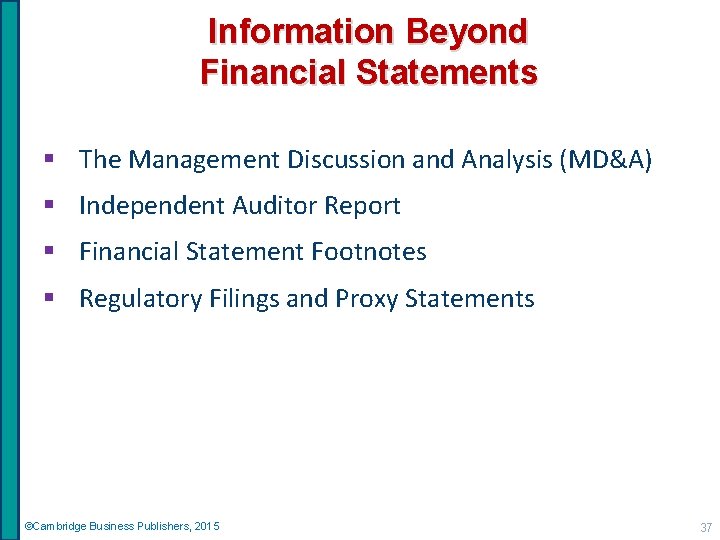
Information Beyond Financial Statements § The Management Discussion and Analysis (MD&A) § Independent Auditor Report § Financial Statement Footnotes § Regulatory Filings and Proxy Statements ©Cambridge Business Publishers, 2015 37
Learning Objective 3 Describe business analysis within the context of a competitive environment. ©Cambridge Business Publishers, 2015 38
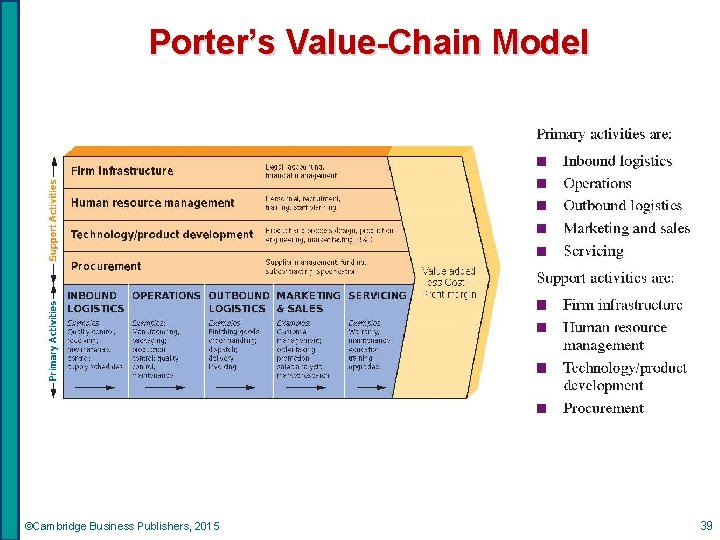
Porter’s Value-Chain Model ©Cambridge Business Publishers, 2015 39
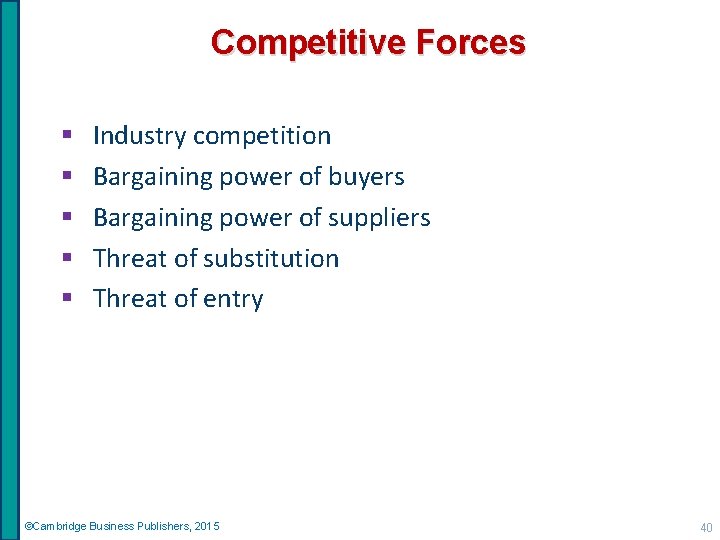
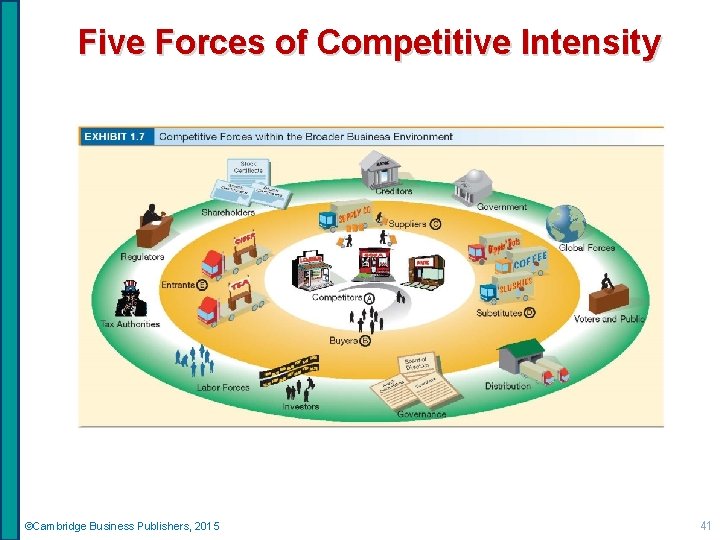
Competitive Forces § § § Industry competition Bargaining power of buyers Bargaining power of suppliers Threat of substitution Threat of entry ©Cambridge Business Publishers, 2015 40
Five Forces of Competitive Intensity ©Cambridge Business Publishers, 2015 41
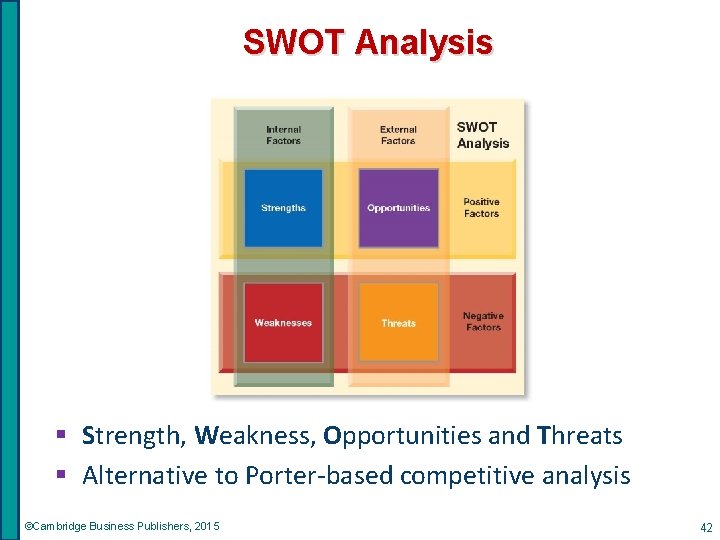
SWOT Analysis § Strength, Weakness, Opportunities and Threats § Alternative to Porter-based competitive analysis ©Cambridge Business Publishers, 2015 42
Learning Objective 4 Explain and apply the basics of profitability analysis. ©Cambridge Business Publishers, 2015 43
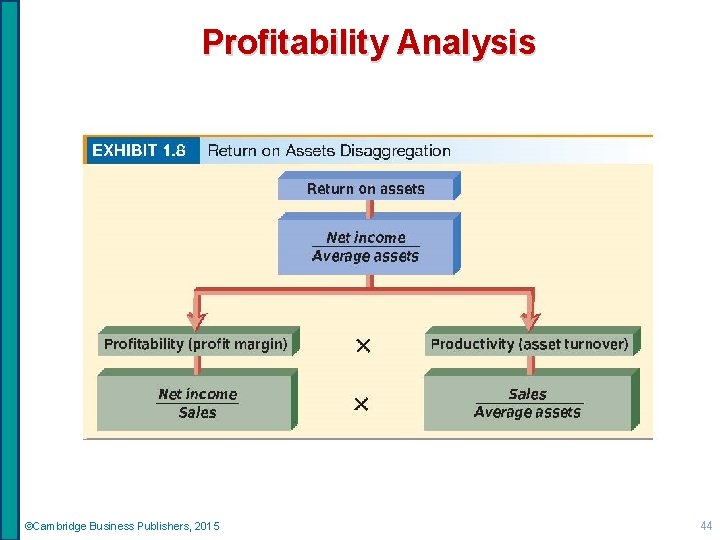
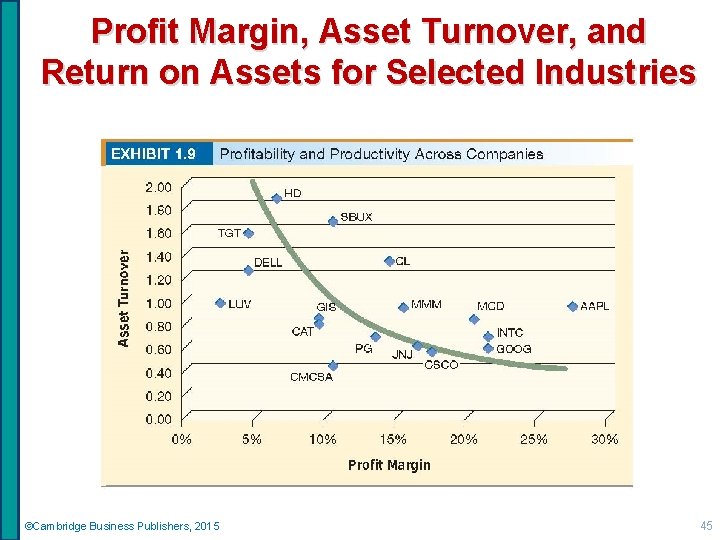
Profitability Analysis ©Cambridge Business Publishers, 2015 44
Profit Margin, Asset Turnover, and Return on Assets for Selected Industries ©Cambridge Business Publishers, 2015 45
Appendix 1 A Accessing SEC Filings ©Cambridge Business Publishers, 2015 46
Accessing SEC Filings ©Cambridge Business Publishers, 2015 47
Accessing SEC Filings ©Cambridge Business Publishers, 2015 48
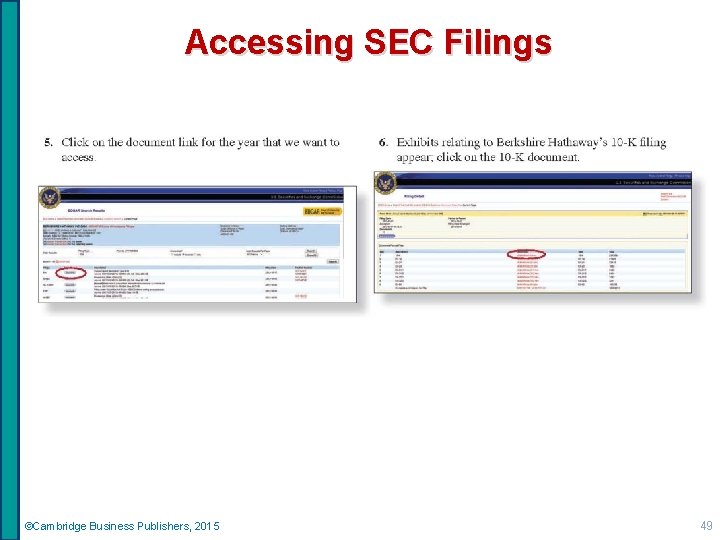
Accessing SEC Filings ©Cambridge Business Publishers, 2015 49
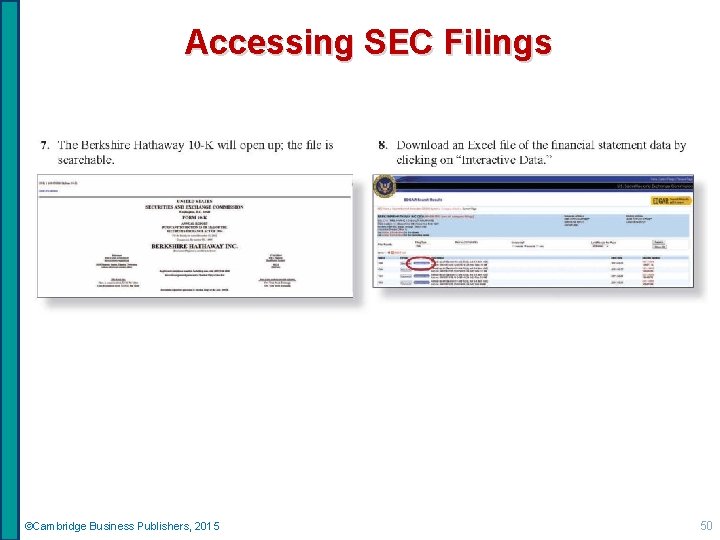
Accessing SEC Filings ©Cambridge Business Publishers, 2015 50
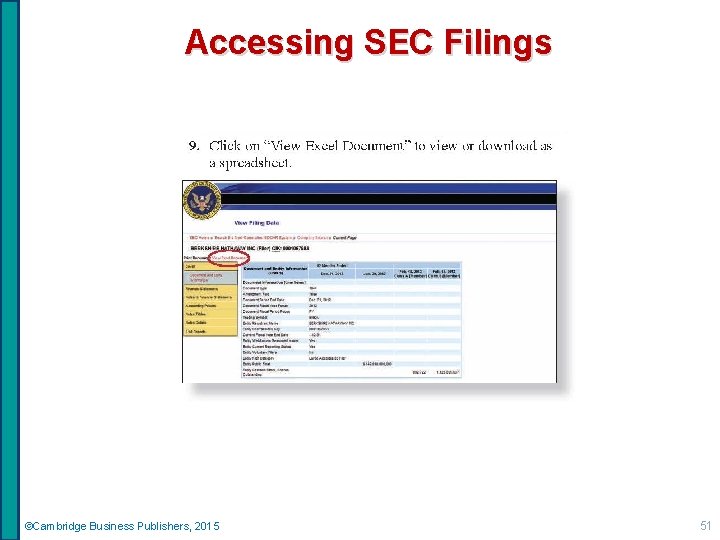
Accessing SEC Filings ©Cambridge Business Publishers, 2015 51
The End