
FINANCIAL STATEMENT ANALYSIS VALUATION EASTON Mc ANALLY 5


- Slides: 21
FINANCIAL STATEMENT ANALYSIS VALUATION & EASTON Mc. ANALLY 5 e SOMMERS ZHANG MODULE 13 Cash-Flow-Based Valuation © Cambridge Business Publishers, 2018
Learning Objective 1 Identify equity valuation models and explain the information required to value equity securities. © Cambridge Business Publishers, 2018 2
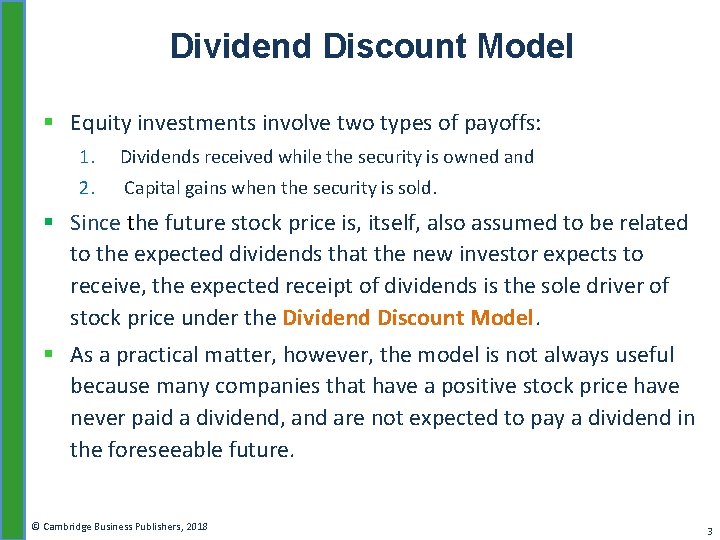
Dividend Discount Model § Equity investments involve two types of payoffs: 1. Dividends received while the security is owned and 2. Capital gains when the security is sold. § Since the future stock price is, itself, also assumed to be related to the expected dividends that the new investor expects to receive, the expected receipt of dividends is the sole driver of stock price under the Dividend Discount Model. § As a practical matter, however, the model is not always useful because many companies that have a positive stock price have never paid a dividend, and are not expected to pay a dividend in the foreseeable future. © Cambridge Business Publishers, 2018 3
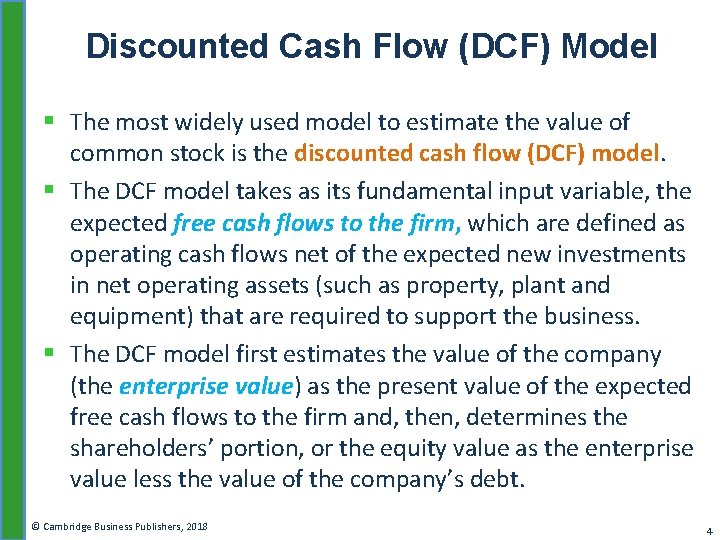
Discounted Cash Flow (DCF) Model § The most widely used model to estimate the value of common stock is the discounted cash flow (DCF) model. § The DCF model takes as its fundamental input variable, the expected free cash flows to the firm, which are defined as operating cash flows net of the expected new investments in net operating assets (such as property, plant and equipment) that are required to support the business. § The DCF model first estimates the value of the company (the enterprise value) as the present value of the expected free cash flows to the firm and, then, determines the shareholders’ portion, or the equity value as the enterprise value less the value of the company’s debt. © Cambridge Business Publishers, 2018 4
Residual Operating Income (ROPI) Model § The residual operating income (ROPI) model uses both net operating profits after tax (NOPAT) and the net operating assets (NOA) to determine equity value. § This approach highlights the importance of return on net operating assets (RNOA), and the disaggregation of RNOA into net operating profit margin and NOA turnover. © Cambridge Business Publishers, 2018 5
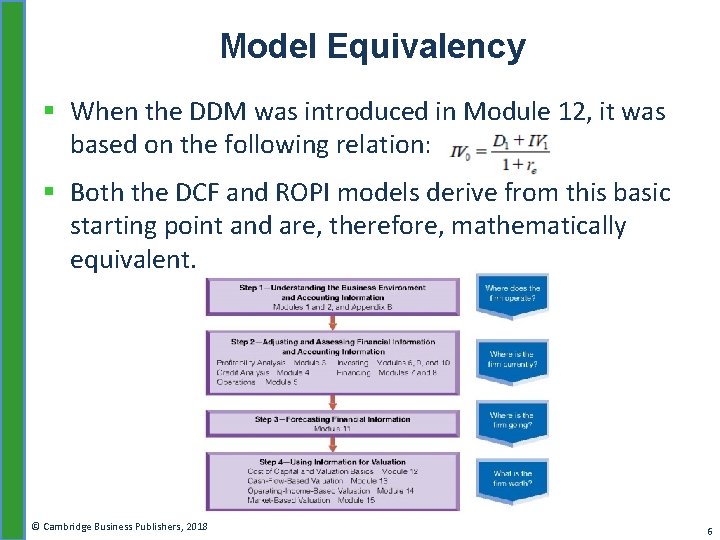
Model Equivalency § When the DDM was introduced in Module 12, it was based on the following relation: § Both the DCF and ROPI models derive from this basic starting point and are, therefore, mathematically equivalent. © Cambridge Business Publishers, 2018 6
Learning Objective 2 Describe and apply the discounted free cash flow model to value equity securities. © Cambridge Business Publishers, 2018 7
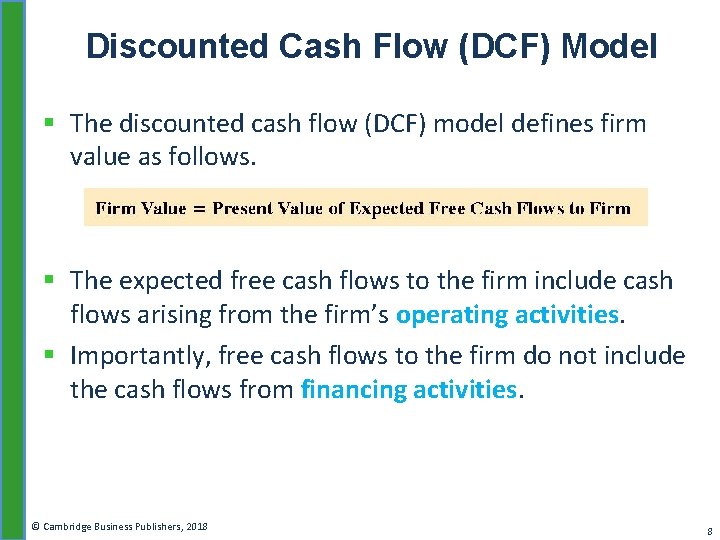
Discounted Cash Flow (DCF) Model § The discounted cash flow (DCF) model defines firm value as follows. § The expected free cash flows to the firm include cash flows arising from the firm’s operating activities. § Importantly, free cash flows to the firm do not include the cash flows from financing activities. © Cambridge Business Publishers, 2018 8
Free Cash Flows to the Firm (FCFF) § A common definition of free cash flow is operating cash flows less capital expenditures (CAPEX). § In this definition, “operating cash flows” is not equal to net cash flows from operating activities reported in the statement of cash flows because the latter begins with net income which includes both operating activities and nonoperating income and expense (like interest). © Cambridge Business Publishers, 2018 9
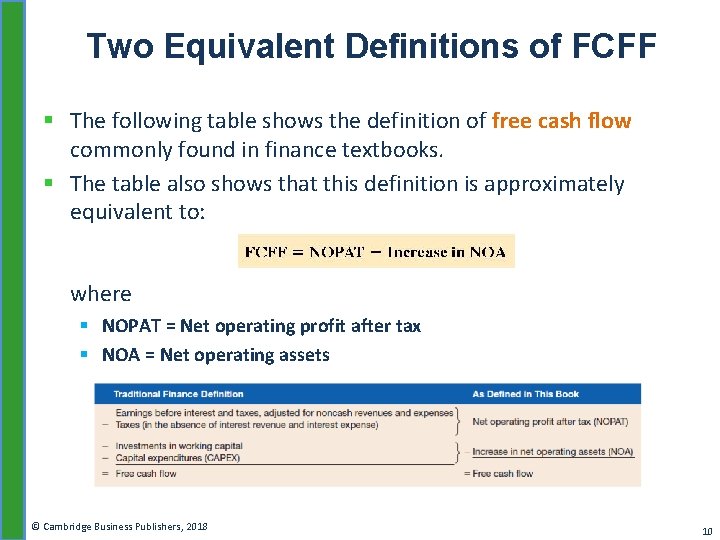
Two Equivalent Definitions of FCFF § The following table shows the definition of free cash flow commonly found in finance textbooks. § The table also shows that this definition is approximately equivalent to: where § NOPAT = Net operating profit after tax § NOA = Net operating assets © Cambridge Business Publishers, 2018 10
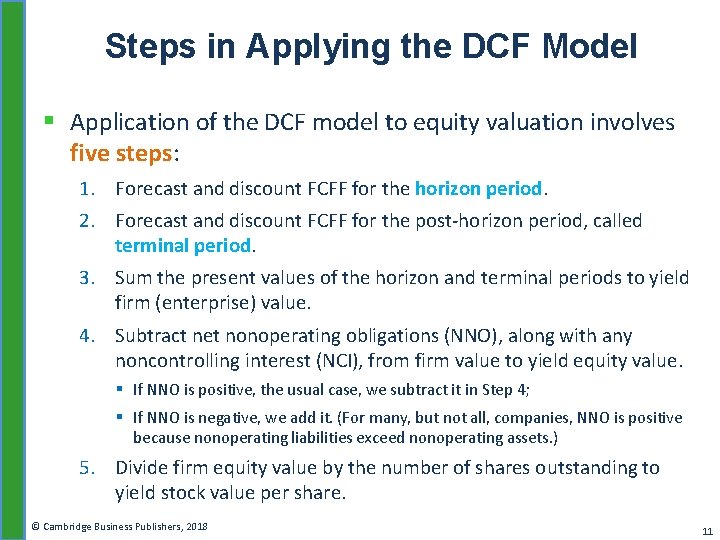
Steps in Applying the DCF Model § Application of the DCF model to equity valuation involves five steps: 1. Forecast and discount FCFF for the horizon period. 2. Forecast and discount FCFF for the post-horizon period, called terminal period. 3. Sum the present values of the horizon and terminal periods to yield firm (enterprise) value. 4. Subtract net nonoperating obligations (NNO), along with any noncontrolling interest (NCI), from firm value to yield equity value. § If NNO is positive, the usual case, we subtract it in Step 4; § If NNO is negative, we add it. (For many, but not all, companies, NNO is positive because nonoperating liabilities exceed nonoperating assets. ) 5. Divide firm equity value by the number of shares outstanding to yield stock value per share. © Cambridge Business Publishers, 2018 11
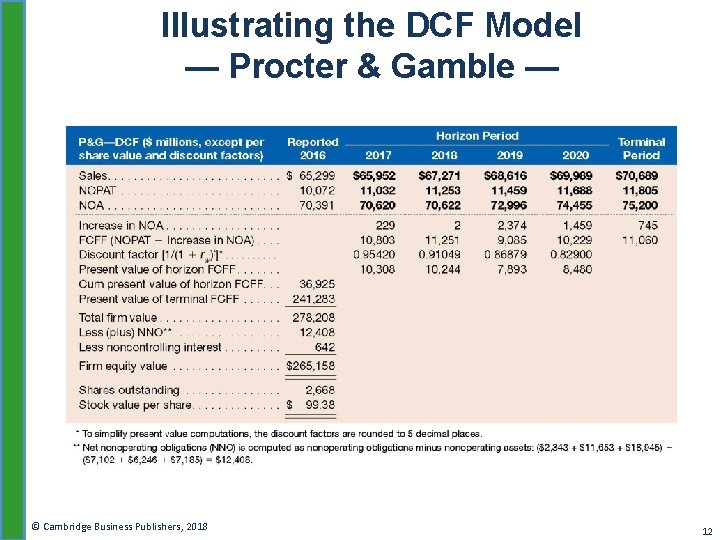
Illustrating the DCF Model — Procter & Gamble — © Cambridge Business Publishers, 2018 12
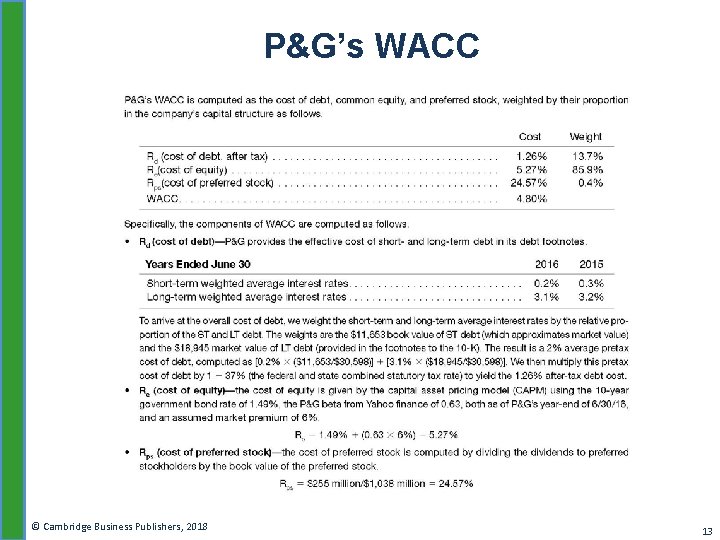
P&G’s WACC © Cambridge Business Publishers, 2018 13
Extending the DCF Model § The illustration makes several assumptions that can be refined to derive more precise stock values. § Horizon Period. The illustration uses a relatively short horizon period. It might be more reasonable to anticipate growth for longer than four years before the company settles into a long-term growth of 1%, as in our example. § Growth Rate. The illustration assumes that growth rate increases from 1% to 2% after the first year of the horizon period. As an alternative, we can alter these, even having different rates for each year. § Financial Statement Forecasts. The illustration uses a parsimonious method to multiyear forecasting to focus attention on the valuation process. As an alternative, we can prepare detailed year-by-year forecasts of the income statement and balance sheet to derive NOPAT and NOA, respectively. § Terminal Growth Rate. This rate reflects all future FCFF beyond the forecast horizon, which is captured in terminal value. and many valuations are sensitive to variations in terminal growth rate. © Cambridge Business Publishers, 2018 14
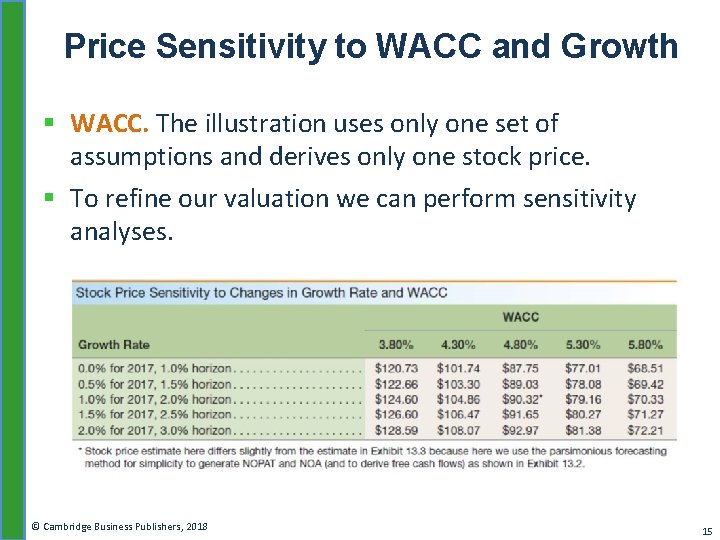
Price Sensitivity to WACC and Growth § WACC. The illustration uses only one set of assumptions and derives only one stock price. § To refine our valuation we can perform sensitivity analyses. © Cambridge Business Publishers, 2018 15
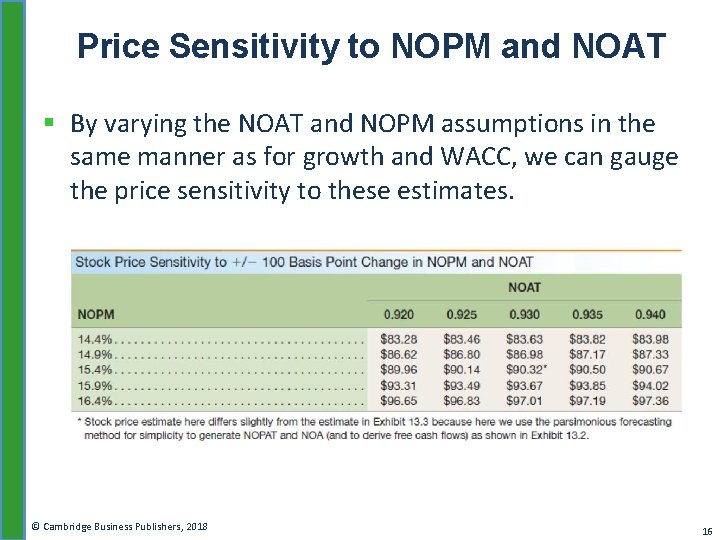
Price Sensitivity to NOPM and NOAT § By varying the NOAT and NOPM assumptions in the same manner as for growth and WACC, we can gauge the price sensitivity to these estimates. © Cambridge Business Publishers, 2018 16
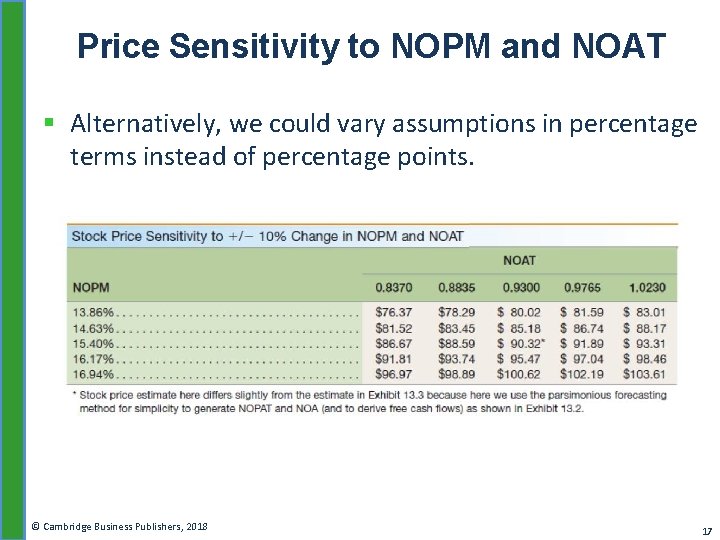
Price Sensitivity to NOPM and NOAT § Alternatively, we could vary assumptions in percentage terms instead of percentage points. © Cambridge Business Publishers, 2018 17
Mid-Year Adjustment § Payoffs in our valuation model are assumed to occur at year-end are discounted for the entire year. § An alternative is to assume that payoffs occur evenly during the year. © Cambridge Business Publishers, 2018 18
Reverse Engineering § One alternative to sensitivity analysis is to use reverse engineering in an attempt to “unlock” the market’s assumptions in determining price. § The process of reverse engineering uses observed price combined with valuation assumptions to solve for one of the valuation parameters such as WACC or terminal growth rate. © Cambridge Business Publishers, 2018 19
Summary of DCF Model § The DCF model is frequently used in valuation due to the appeal of relying on actual cash flows; a readily understandable concept. § However, it is not possible to forecast cash flows without also forecasting accounting numbers because cash flows and accounting accruals are simultaneously determined. § A serious implementation issue with DCF is the choice of forecast horizon and terminal growth rate. § The farther out the forecast horizon, the less reliable forecasts tend to be. § Still, we demand a long enough forecast horizon to reach steady state so we can identify an appropriate terminal growth rate. § This balance can make cash-flow-based valuation a difficult process to implement as FCFF often requires a very long horizon. © Cambridge Business Publishers, 2018 20
The End