
Financial Statement Analysis Financial Statement Analysis n Normal

- Slides: 24
Financial Statement Analysis
Financial Statement Analysis n Normal objectives of Course ¡ ¡ Develop ability to critically evaluate financial information and representations Analyse financial statements Prepare forecasts Value a company
Financial Statement Analysis n Comprehensive Analysis Analysts Objectives n Disclosure Standards n Challenges to disclosure n
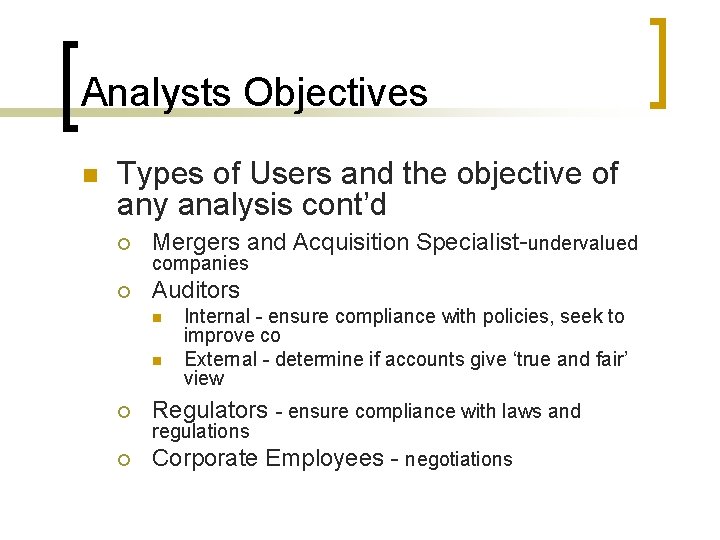
Analysts Objectives n Types of Users and the objective of any analysis cont’d ¡ Mergers and Acquisition Specialist-undervalued ¡ Auditors companies n n Internal - ensure compliance with policies, seek to improve co External - determine if accounts give ‘true and fair’ view ¡ Regulators - ensure compliance with laws and ¡ Corporate Employees - negotiations regulations
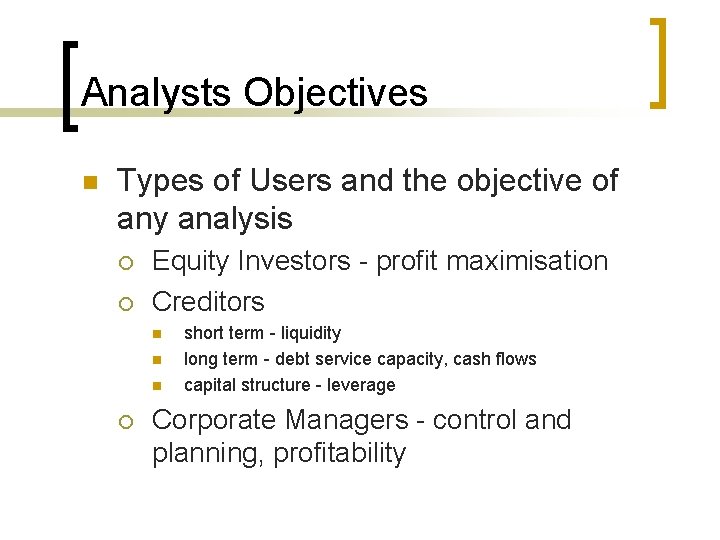
Analysts Objectives n Types of Users and the objective of any analysis ¡ ¡ Equity Investors - profit maximisation Creditors n n n ¡ short term - liquidity long term - debt service capacity, cash flows capital structure - leverage Corporate Managers - control and planning, profitability
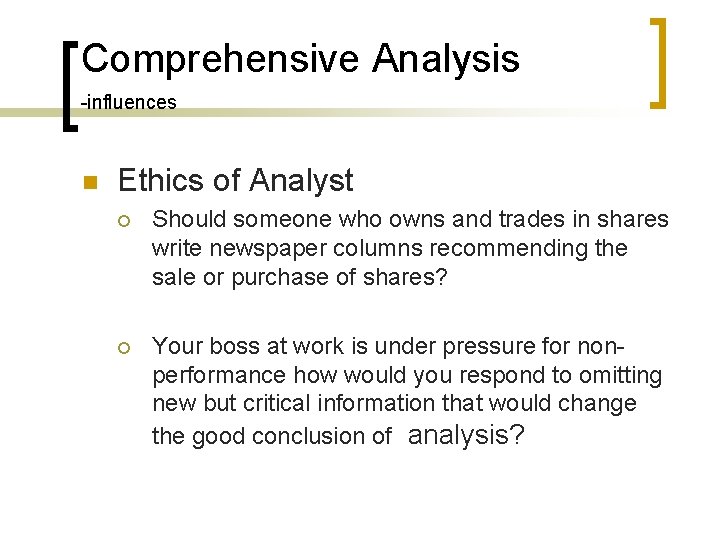
Comprehensive Analysis -influences n Ethics of Analyst ¡ Should someone who owns and trades in shares write newspaper columns recommending the sale or purchase of shares? ¡ Your boss at work is under pressure for nonperformance how would you respond to omitting new but critical information that would change the good conclusion of analysis?
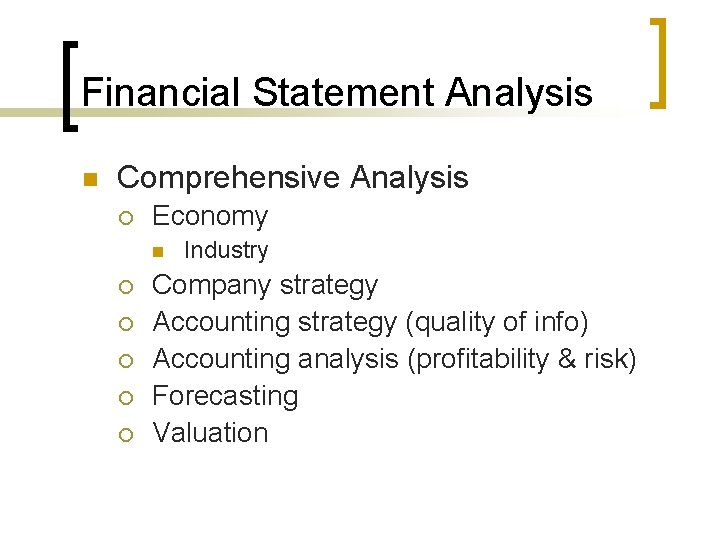
Financial Statement Analysis n Comprehensive Analysis ¡ Economy n ¡ ¡ ¡ Industry Company strategy Accounting strategy (quality of info) Accounting analysis (profitability & risk) Forecasting Valuation
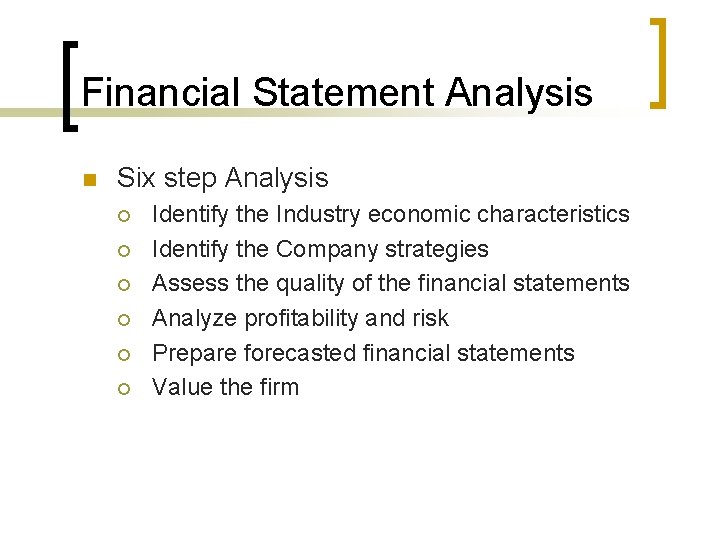
Financial Statement Analysis n Six step Analysis ¡ ¡ ¡ Identify the Industry economic characteristics Identify the Company strategies Assess the quality of the financial statements Analyze profitability and risk Prepare forecasted financial statements Value the firm
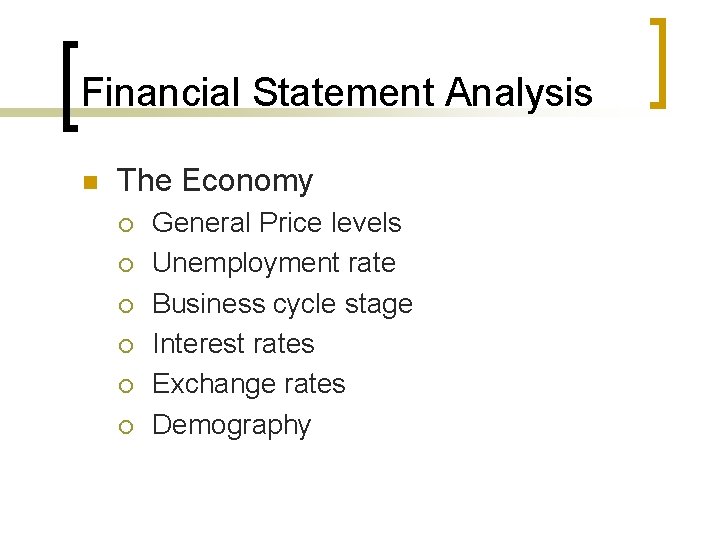
Financial Statement Analysis n The Economy ¡ ¡ ¡ General Price levels Unemployment rate Business cycle stage Interest rates Exchange rates Demography
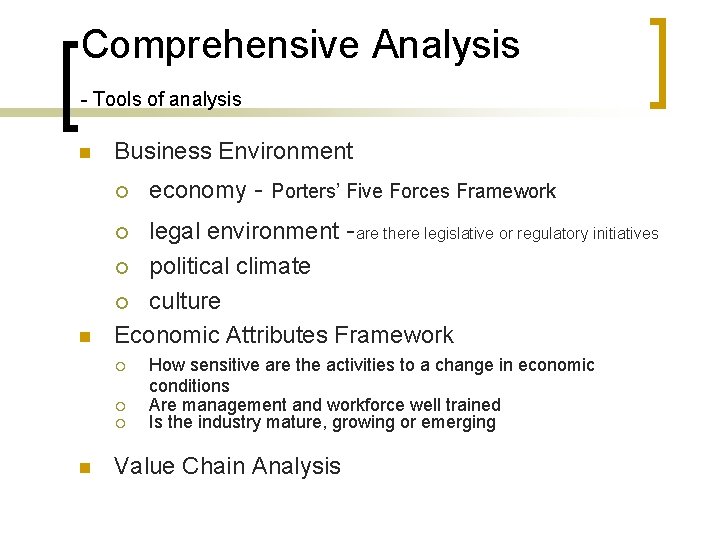
Comprehensive Analysis - Tools of analysis n Business Environment ¡ economy - Porters’ Five Forces Framework legal environment -are there legislative or regulatory initiatives ¡ political climate ¡ culture Economic Attributes Framework ¡ n ¡ ¡ ¡ n How sensitive are the activities to a change in economic conditions Are management and workforce well trained Is the industry mature, growing or emerging Value Chain Analysis
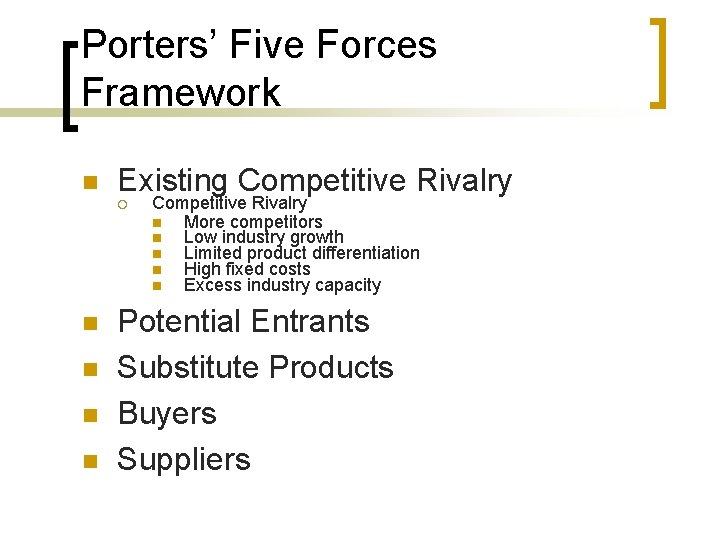
Porters’ Five Forces Framework n Existing Competitive Rivalry ¡ n n Competitive Rivalry n More competitors n Low industry growth n Limited product differentiation n High fixed costs n Excess industry capacity Potential Entrants Substitute Products Buyers Suppliers
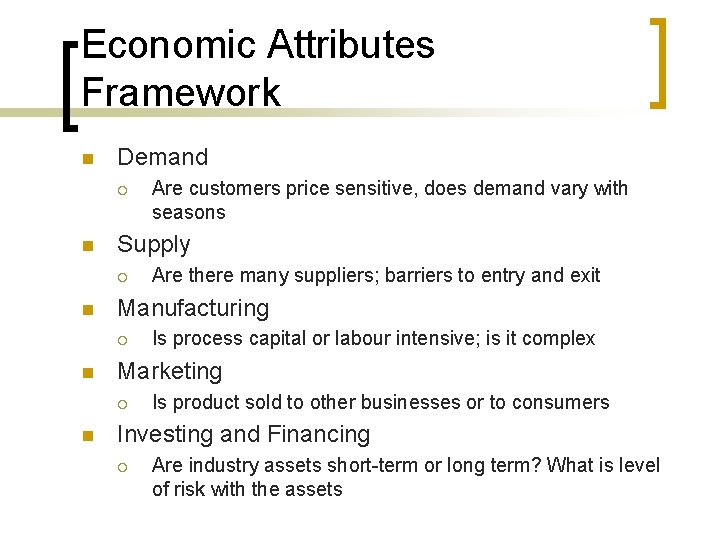
Economic Attributes Framework n Demand ¡ n Supply ¡ n Is process capital or labour intensive; is it complex Marketing ¡ n Are there many suppliers; barriers to entry and exit Manufacturing ¡ n Are customers price sensitive, does demand vary with seasons Is product sold to other businesses or to consumers Investing and Financing ¡ Are industry assets short-term or long term? What is level of risk with the assets
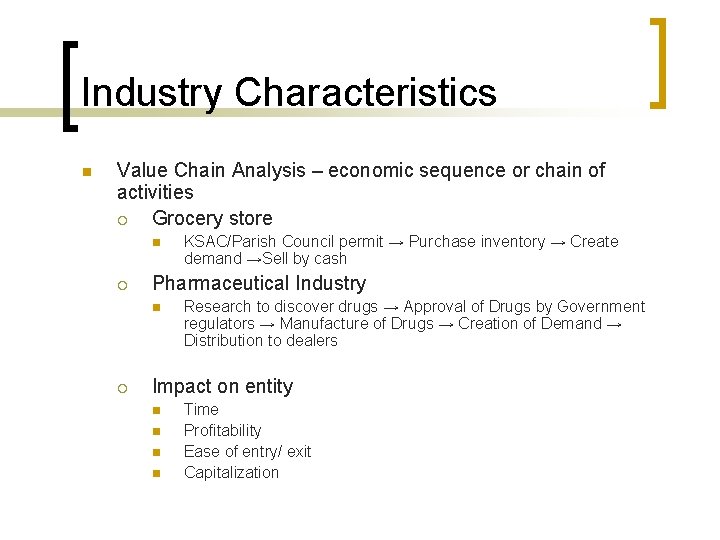
Industry Characteristics n Value Chain Analysis – economic sequence or chain of activities ¡ Grocery store n ¡ Pharmaceutical Industry n ¡ KSAC/Parish Council permit → Purchase inventory → Create demand →Sell by cash Research to discover drugs → Approval of Drugs by Government regulators → Manufacture of Drugs → Creation of Demand → Distribution to dealers Impact on entity n n Time Profitability Ease of entry/ exit Capitalization
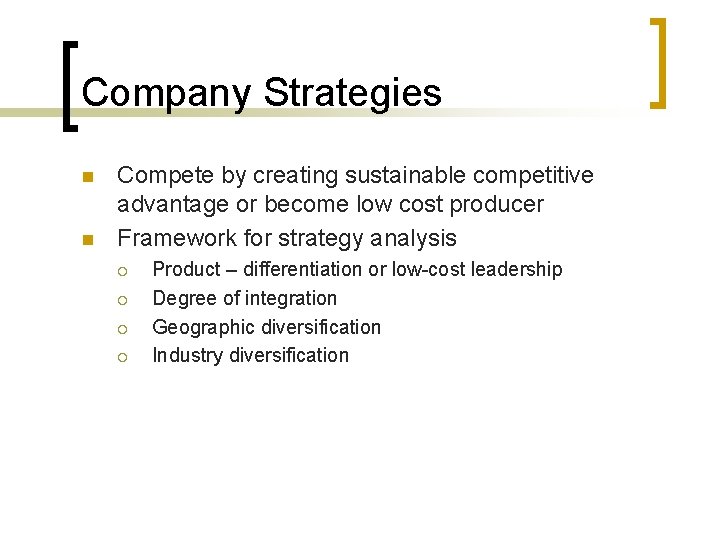
Company Strategies n n Compete by creating sustainable competitive advantage or become low cost producer Framework for strategy analysis ¡ ¡ Product – differentiation or low-cost leadership Degree of integration Geographic diversification Industry diversification
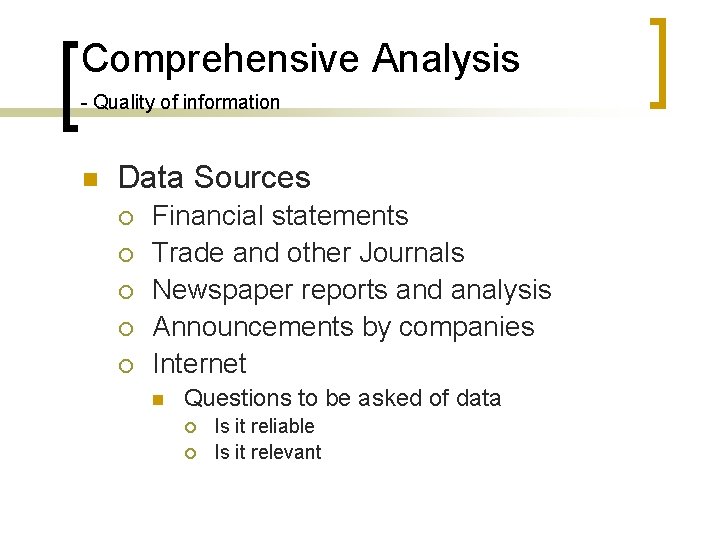
Comprehensive Analysis - Quality of information n Data Sources ¡ ¡ ¡ Financial statements Trade and other Journals Newspaper reports and analysis Announcements by companies Internet n Questions to be asked of data ¡ ¡ Is it reliable Is it relevant
Disclosure Standards n IFRS n US GAAP n Other - Degree of Disclosure and method of financing Regulatory requirements - JSE n
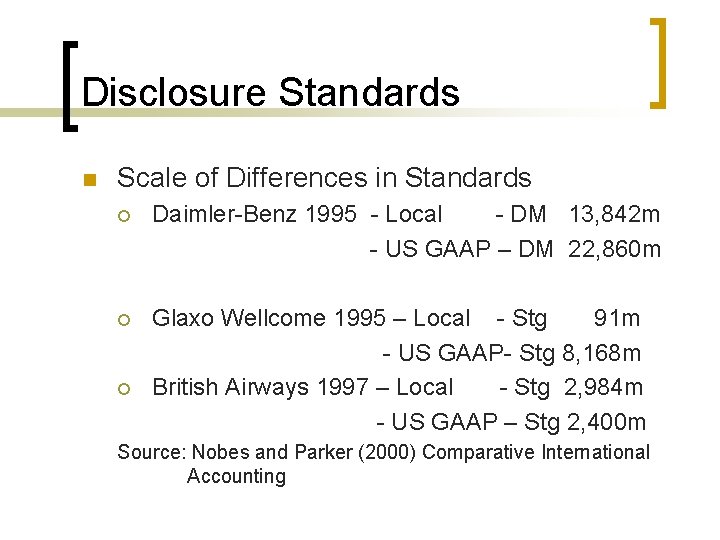
Disclosure Standards n Scale of Differences in Standards ¡ Daimler-Benz 1995 - Local - DM 13, 842 m - US GAAP – DM 22, 860 m ¡ Glaxo Wellcome 1995 – Local - Stg 91 m - US GAAP- Stg 8, 168 m British Airways 1997 – Local - Stg 2, 984 m - US GAAP – Stg 2, 400 m ¡ Source: Nobes and Parker (2000) Comparative International Accounting
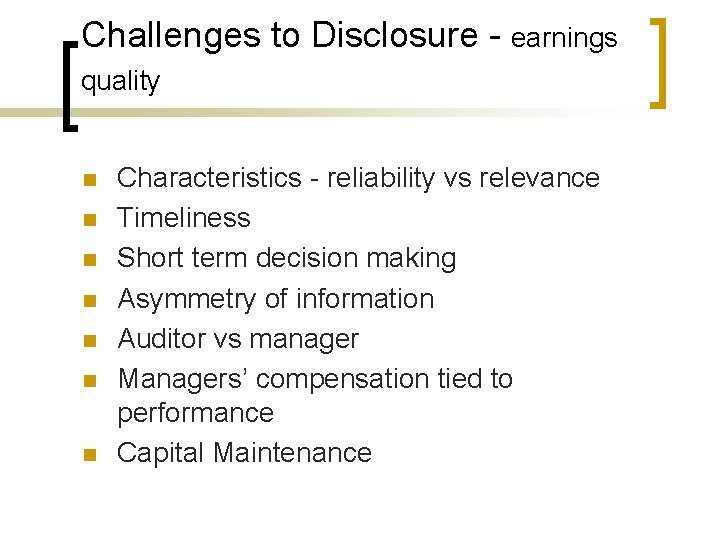
Challenges to Disclosure - earnings quality n n n n Characteristics - reliability vs relevance Timeliness Short term decision making Asymmetry of information Auditor vs manager Managers’ compensation tied to performance Capital Maintenance
Managing Information n Information Characteristics ¡ What is the source ¡ Is it reputable ¡ Does the information seem credible ¡ Can the information be verified elsewhere
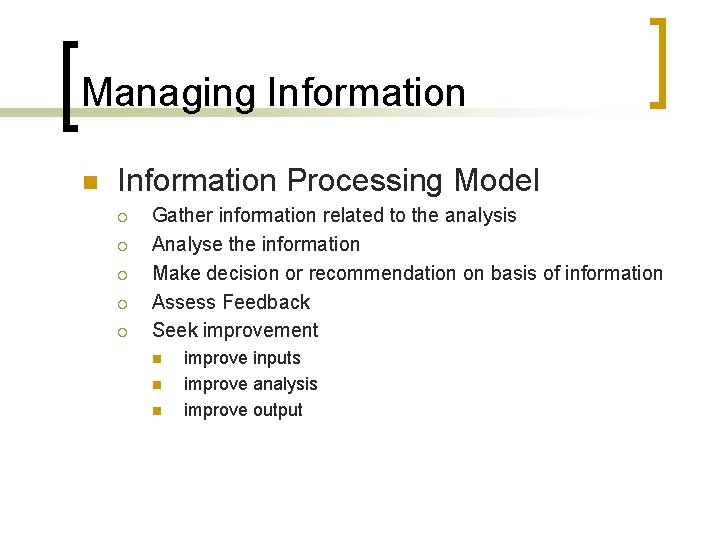
Managing Information n Information Processing Model ¡ ¡ ¡ Gather information related to the analysis Analyse the information Make decision or recommendation on basis of information Assess Feedback Seek improvement n n n improve inputs improve analysis improve output
Managing Information n Information Pyramid ¡ Economic conditions - inflation, unemployment rate, business cycle stage, interest rates, exchange rates (macroeconomic data) ¡ Industry considerations - connects macroeconomic to corporate, industry life cycle, growth rate, seasonality, industry inflation, benchmark ¡ Corporate Disclosures - annual reports, quarterly reports, investor briefings, announcements to the stock exchange
Managing Information Classifying Data Corporate Disclosure Industry Information Macroeconomic Data
Managing Information n The Internet ¡ Advantages - current and sometimes realtime information, convenient, generally cheap, plentiful ¡ Disadvantages - in many cases not vetted, can be a source of misinformation or disinformation
Managing Information n Other Influences of Information Supply ¡ ¡ The Stock Exchange The Companies Act Bank of Jamaica Financial Services Commission