
Financial Statement Analysis CHARLES H GIBSON 2013 Cengage
Financial Statement Analysis CHARLES H. GIBSON © 2013 Cengage Learning. All Rights Reserved. May not be copied, scanned, or duplicated, in whole or in part, except for use as permitted in a license distributed with a certain product or service or otherwise on a password-protected website for classroom use.
Chapter 3 Balance Sheet © 2013 Cengage Learning. All Rights Reserved. May not be copied, scanned, or duplicated, in whole or in part, except for use as permitted in a license distributed with a certain product or service or otherwise on a password-protected website for classroom use.
Balance Sheet • Also called as statement of financial position and statement of financial condition • Shows financial condition as of a specific date • The accounting equation expresses the relationship among elements of balance sheet Assets = Liabilities + Stockholders’ Equity • Format – Account form (side by side) – Report form (assets at top and liabilities and stockholders’ equity at bottom) dominant in the U. S. © 2013 Cengage Learning. All Rights Reserved. May not be copied, scanned, or duplicated, in whole or in part, except for use as permitted in a license distributed with a certain product or service or otherwise on a password-protected website for classroom use.
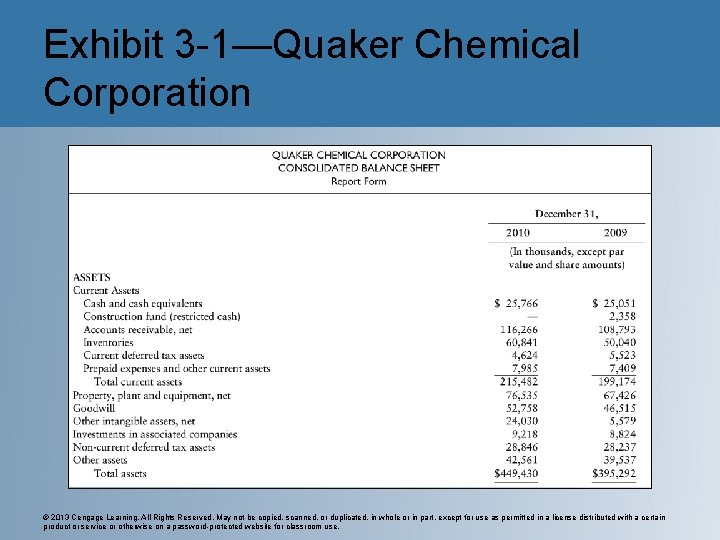
Exhibit 3 -1—Quaker Chemical Corporation © 2013 Cengage Learning. All Rights Reserved. May not be copied, scanned, or duplicated, in whole or in part, except for use as permitted in a license distributed with a certain product or service or otherwise on a password-protected website for classroom use.
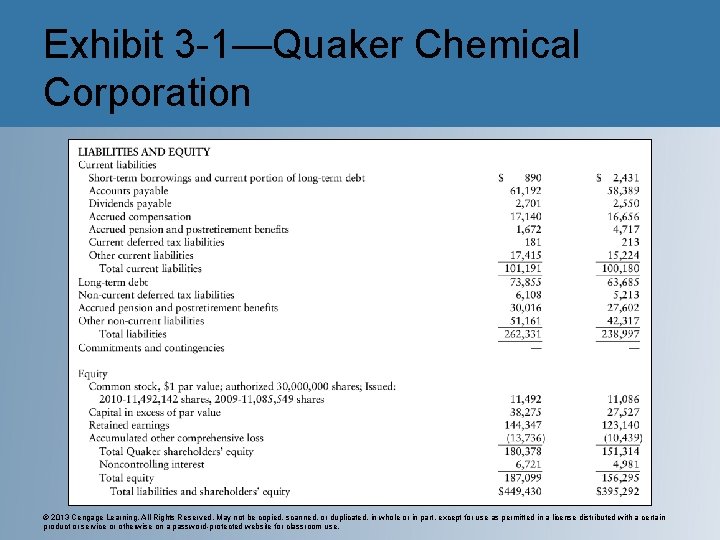
Exhibit 3 -1—Quaker Chemical Corporation © 2013 Cengage Learning. All Rights Reserved. May not be copied, scanned, or duplicated, in whole or in part, except for use as permitted in a license distributed with a certain product or service or otherwise on a password-protected website for classroom use.
Assets • Probable future economic benefits obtained or controlled by an entity as a result of past transactions or events • May be physical or intangible • Major categories – Current Assets • Includes cash, and assets that will be realized in cash during the operating cycle or one year which ever is longer – Noncurrent or Long-term Assets • Includes assets that take longer than one year or operating cycle to convert or to conserve cash © 2013 Cengage Learning. All Rights Reserved. May not be copied, scanned, or duplicated, in whole or in part, except for use as permitted in a license distributed with a certain product or service or otherwise on a password-protected website for classroom use.
Current Assets • Cash and assets that will be converted into cash during the operating cycle or within a year, whichever is longer • Presented in order of liquidity • Cash – Includes negotiable checks, unrestricted balance in checking accounts, cash on hand, savings accounts © 2013 Cengage Learning. All Rights Reserved. May not be copied, scanned, or duplicated, in whole or in part, except for use as permitted in a license distributed with a certain product or service or otherwise on a password-protected website for classroom use.
Current Assets—Continued • Marketable Securities—readily determinable market price – Debt or equity securities – Carried at fair value – To be converted into cash during the current period • Accounts Receivable – – Amounts due from sales or services rendered Carried at net realizable value (net of allowances) All allowances are carried in one allowance account Other receivables due from nontrade sources © 2013 Cengage Learning. All Rights Reserved. May not be copied, scanned, or duplicated, in whole or in part, except for use as permitted in a license distributed with a certain product or service or otherwise on a password-protected website for classroom use.
Current Assets—Continued • Inventories – Balance of goods on hand – Categories • • Merchandise on hand—retail or wholesale firms Raw materials Manufacturer Work in process Finished goods – Carried at the lower of cost or market – Supplies could include register tapes, pencils, or sewing machine needles for the shirt factory © 2013 Cengage Learning. All Rights Reserved. May not be copied, scanned, or duplicated, in whole or in part, except for use as permitted in a license distributed with a certain product or service or otherwise on a password-protected website for classroom use.
Current Assets—Continued • Prepaids – Expenditures made in advance of the use of the service or goods – Represent future benefits resulting from past transactions – Examples • • • Insurance Advertising Taxes Promotion costs Early payments on long-term contracts © 2013 Cengage Learning. All Rights Reserved. May not be copied, scanned, or duplicated, in whole or in part, except for use as permitted in a license distributed with a certain product or service or otherwise on a password-protected website for classroom use.
Long-Term Assets: Tangible • Land – Carried at acquisition cost – Not subject to depreciation – Natural resources are depleted • Buildings – Presented at cost plus permanent improvements – Depreciated over their estimated useful life © 2013 Cengage Learning. All Rights Reserved. May not be copied, scanned, or duplicated, in whole or in part, except for use as permitted in a license distributed with a certain product or service or otherwise on a password-protected website for classroom use.
Long-Term Assets: Tangible— Continued • Machinery – Historical cost, including costs of delivery, installation, and material improvements – Depreciated over its useful life • Construction in Progress – Assets under construction – Costs will be transferred to permanent asset account upon completion © 2013 Cengage Learning. All Rights Reserved. May not be copied, scanned, or duplicated, in whole or in part, except for use as permitted in a license distributed with a certain product or service or otherwise on a password-protected website for classroom use.
Long-Term Assets: Tangible— Continued • Accumulated Depreciation – Carries the to-date depreciation of plant assets – It is subtracted from the cost of the asset to determine the book value – Factors used in depreciation calculation • Asset cost • Length of the life of the asset • Estimated salvage (residual) value of asset when retired © 2013 Cengage Learning. All Rights Reserved. May not be copied, scanned, or duplicated, in whole or in part, except for use as permitted in a license distributed with a certain product or service or otherwise on a password-protected website for classroom use.
Long-Term Assets: Tangible— Continued • Depreciation Methods – – Straight-line Declining-balance Sum-of-the-years’-digits Units-of-production • Balance Sheet Presentation Less: Cost of the asset Accumulated depreciation Net book value © 2013 Cengage Learning. All Rights Reserved. May not be copied, scanned, or duplicated, in whole or in part, except for use as permitted in a license distributed with a certain product or service or otherwise on a password-protected website for classroom use.
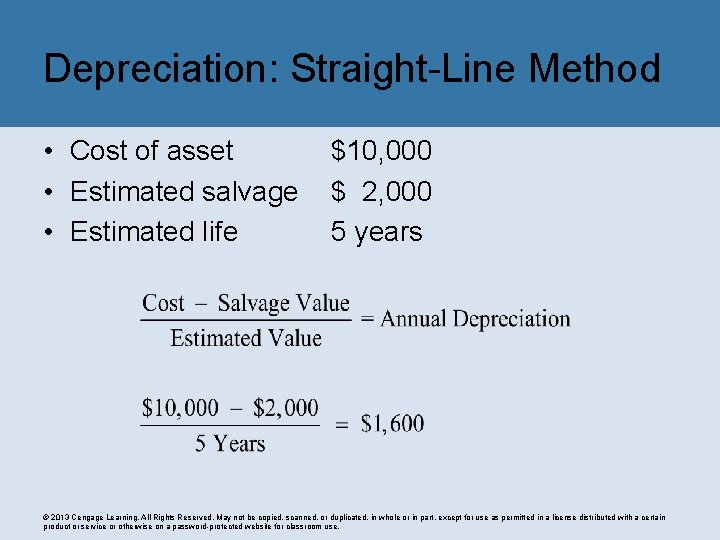
Depreciation: Straight-Line Method • Cost of asset • Estimated salvage • Estimated life $10, 000 $ 2, 000 5 years © 2013 Cengage Learning. All Rights Reserved. May not be copied, scanned, or duplicated, in whole or in part, except for use as permitted in a license distributed with a certain product or service or otherwise on a password-protected website for classroom use.
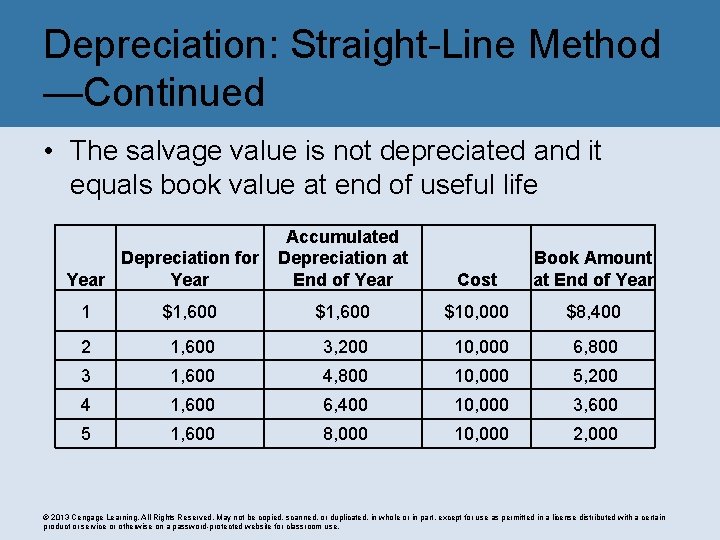
Depreciation: Straight-Line Method —Continued • The salvage value is not depreciated and it equals book value at end of useful life Depreciation for Year Accumulated Depreciation at End of Year Cost Book Amount at End of Year 1 $1, 600 $10, 000 $8, 400 2 1, 600 3, 200 10, 000 6, 800 3 1, 600 4, 800 10, 000 5, 200 4 1, 600 6, 400 10, 000 3, 600 5 1, 600 8, 000 10, 000 2, 000 © 2013 Cengage Learning. All Rights Reserved. May not be copied, scanned, or duplicated, in whole or in part, except for use as permitted in a license distributed with a certain product or service or otherwise on a password-protected website for classroom use.
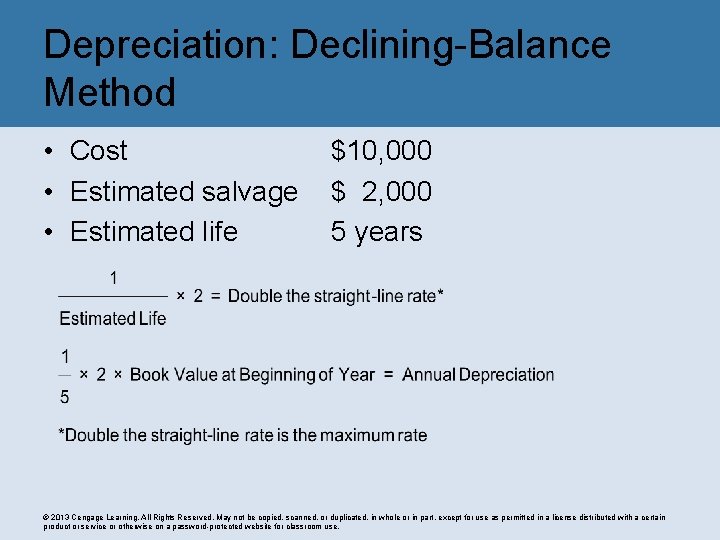
Depreciation: Declining-Balance Method • Cost • Estimated salvage • Estimated life $10, 000 $ 2, 000 5 years © 2013 Cengage Learning. All Rights Reserved. May not be copied, scanned, or duplicated, in whole or in part, except for use as permitted in a license distributed with a certain product or service or otherwise on a password-protected website for classroom use.
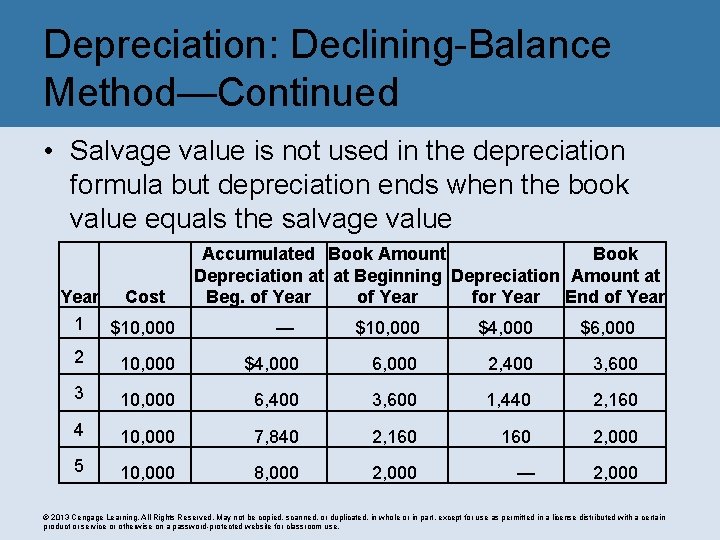
Depreciation: Declining-Balance Method—Continued • Salvage value is not used in the depreciation formula but depreciation ends when the book value equals the salvage value Year Cost 1 $10, 000 Accumulated Book Amount Book Depreciation at at Beginning Depreciation Amount at Beg. of Year for Year End of Year — $10, 000 $4, 000 $6, 000 2 10, 000 $4, 000 6, 000 2, 400 3, 600 3 10, 000 6, 400 3, 600 1, 440 2, 160 4 10, 000 7, 840 2, 160 2, 000 5 10, 000 8, 000 2, 000 — 2, 000 © 2013 Cengage Learning. All Rights Reserved. May not be copied, scanned, or duplicated, in whole or in part, except for use as permitted in a license distributed with a certain product or service or otherwise on a password-protected website for classroom use.
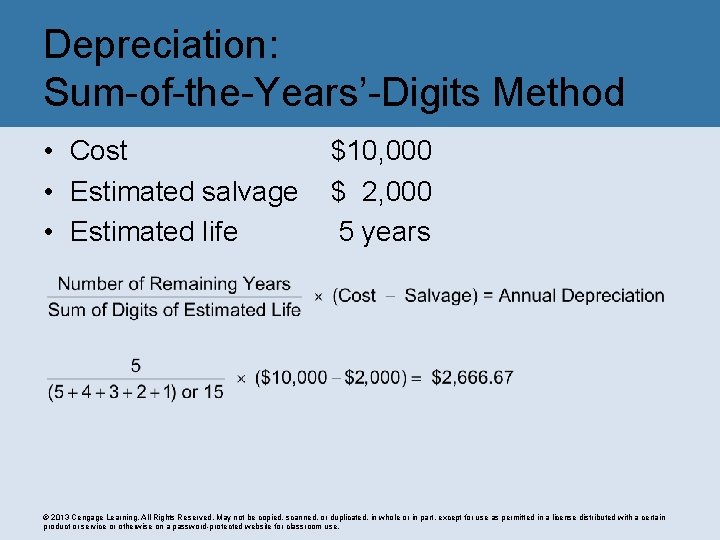
Depreciation: Sum-of-the-Years’-Digits Method • Cost • Estimated salvage • Estimated life $10, 000 $ 2, 000 5 years © 2013 Cengage Learning. All Rights Reserved. May not be copied, scanned, or duplicated, in whole or in part, except for use as permitted in a license distributed with a certain product or service or otherwise on a password-protected website for classroom use.
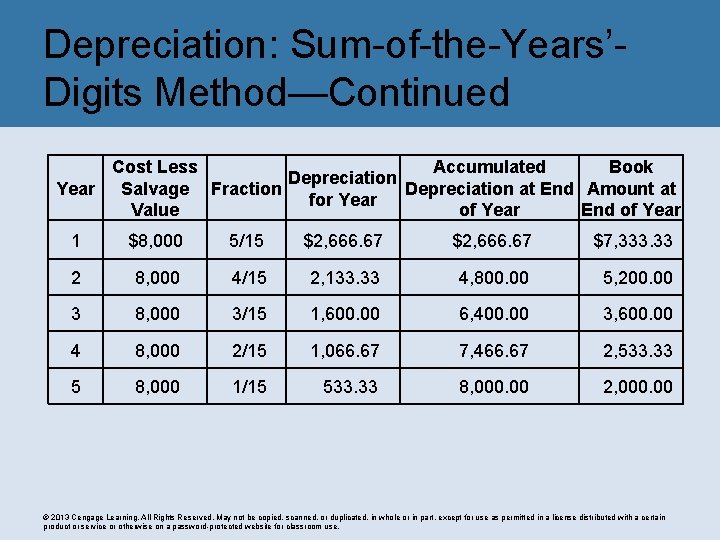
Depreciation: Sum-of-the-Years’Digits Method—Continued Cost Less Accumulated Book Depreciation Year Salvage Fraction Depreciation at End Amount at for Year Value of Year End of Year 1 $8, 000 5/15 $2, 666. 67 $7, 333. 33 2 8, 000 4/15 2, 133. 33 4, 800. 00 5, 200. 00 3 8, 000 3/15 1, 600. 00 6, 400. 00 3, 600. 00 4 8, 000 2/15 1, 066. 67 7, 466. 67 2, 533. 33 5 8, 000 1/15 533. 33 8, 000. 00 2, 000. 00 © 2013 Cengage Learning. All Rights Reserved. May not be copied, scanned, or duplicated, in whole or in part, except for use as permitted in a license distributed with a certain product or service or otherwise on a password-protected website for classroom use.
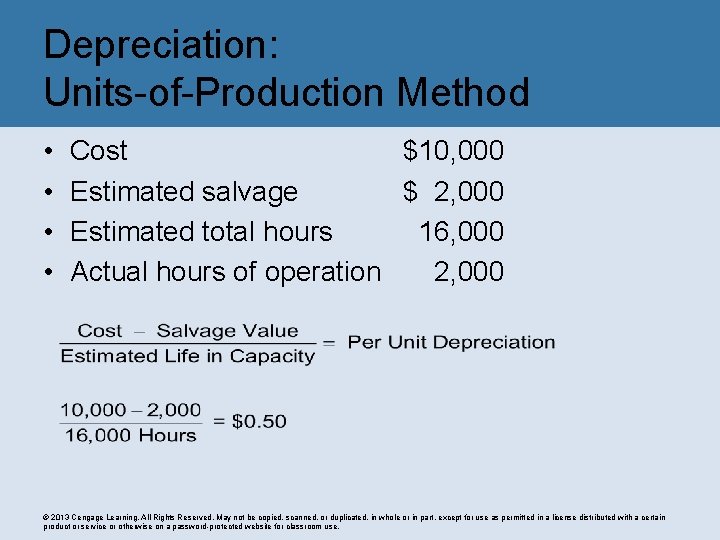
Depreciation: Units-of-Production Method • • Cost $10, 000 Estimated salvage $ 2, 000 Estimated total hours 16, 000 Actual hours of operation 2, 000 © 2013 Cengage Learning. All Rights Reserved. May not be copied, scanned, or duplicated, in whole or in part, except for use as permitted in a license distributed with a certain product or service or otherwise on a password-protected website for classroom use.
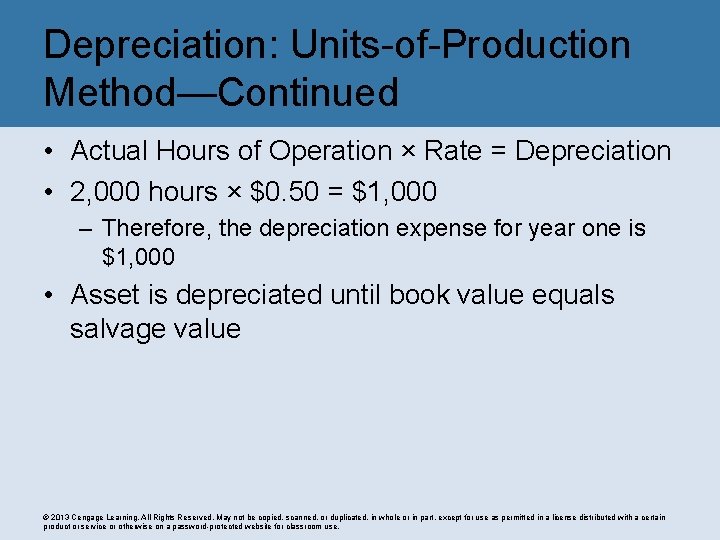
Depreciation: Units-of-Production Method—Continued • Actual Hours of Operation × Rate = Depreciation • 2, 000 hours × $0. 50 = $1, 000 – Therefore, the depreciation expense for year one is $1, 000 • Asset is depreciated until book value equals salvage value © 2013 Cengage Learning. All Rights Reserved. May not be copied, scanned, or duplicated, in whole or in part, except for use as permitted in a license distributed with a certain product or service or otherwise on a password-protected website for classroom use.
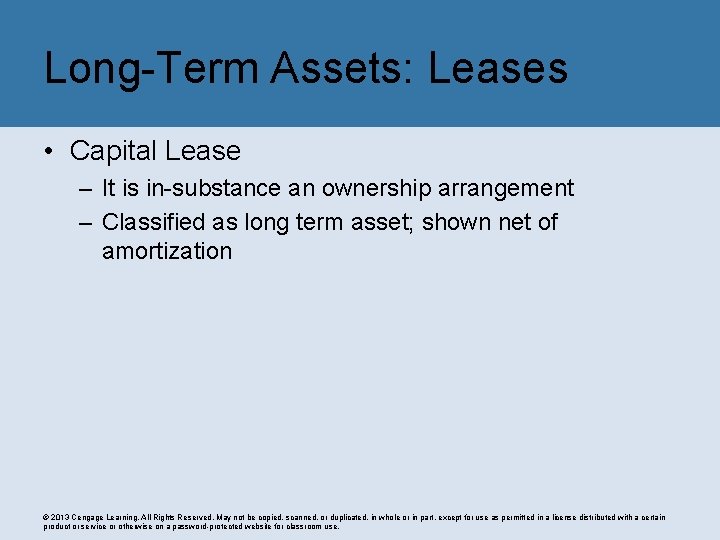
Long-Term Assets: Leases • Capital Lease – It is in-substance an ownership arrangement – Classified as long term asset; shown net of amortization © 2013 Cengage Learning. All Rights Reserved. May not be copied, scanned, or duplicated, in whole or in part, except for use as permitted in a license distributed with a certain product or service or otherwise on a password-protected website for classroom use.
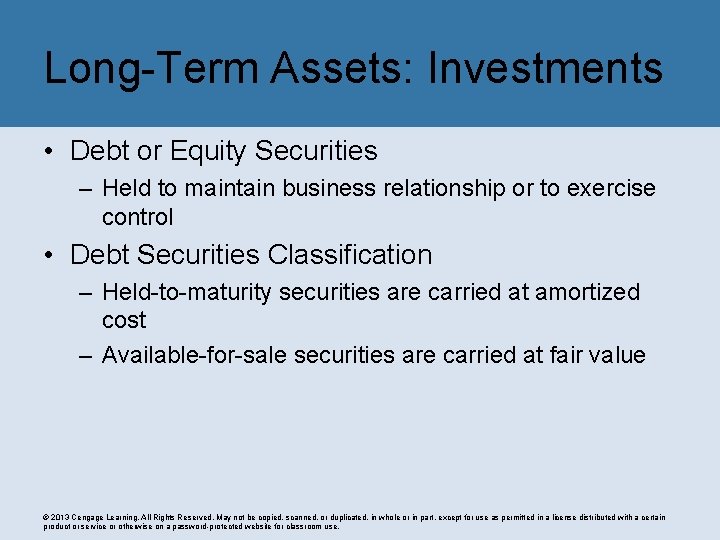
Long-Term Assets: Investments • Debt or Equity Securities – Held to maintain business relationship or to exercise control • Debt Securities Classification – Held-to-maturity securities are carried at amortized cost – Available-for-sale securities are carried at fair value © 2013 Cengage Learning. All Rights Reserved. May not be copied, scanned, or duplicated, in whole or in part, except for use as permitted in a license distributed with a certain product or service or otherwise on a password-protected website for classroom use.
Long-Term Assets: Investments— Continued • Equity Securities – Carried at fair value which have 3 levels for input • Level 1: Quoted price for identical item in active market • Level 2: Adjusted quoted price of similar asset (or liability) • Level 3: Present value of expected cash flows – Exception- Equity method is used where there is significant influence • Cost is adjusted for the proportionate share of the rise/fall in the retained profits of the subsidiary (investee) © 2013 Cengage Learning. All Rights Reserved. May not be copied, scanned, or duplicated, in whole or in part, except for use as permitted in a license distributed with a certain product or service or otherwise on a password-protected website for classroom use.
Long-Term Assets: Intangibles • Intangibles are nonphysical assets • They are recorded at historical cost • An intangible asset that has a finite life is amortized over its useful life • An intangible asset with an indefinite life are reviewed for impairment © 2013 Cengage Learning. All Rights Reserved. May not be copied, scanned, or duplicated, in whole or in part, except for use as permitted in a license distributed with a certain product or service or otherwise on a password-protected website for classroom use.
Long-Term Assets: Intangibles— Continued • Goodwill – Arises form the acquisition of a business where price paid exceeds the fair value of net assets – According to U. S. GAAP it is not amortized but tested annually for impairment • Patents – Exclusive legal rights granted to an inventor for a period of 20 years – Valued at their acquisition cost – Amortized over shorter of legal or useful life © 2013 Cengage Learning. All Rights Reserved. May not be copied, scanned, or duplicated, in whole or in part, except for use as permitted in a license distributed with a certain product or service or otherwise on a password-protected website for classroom use.
Long-Term Assets: Intangibles— Continued • Trademarks – Distinctive names or symbols – Indefinite legal life – Not amortized but tested for impairment annually • Franchises – Legal right to operate under a particular corporate name, providing trade-name products or services – Amortize over the life of the franchise © 2013 Cengage Learning. All Rights Reserved. May not be copied, scanned, or duplicated, in whole or in part, except for use as permitted in a license distributed with a certain product or service or otherwise on a password-protected website for classroom use.
Long-Term Assets: Intangibles— Continued • Copyrights – Rights that authors, painters, musicians, sculptors, and other artists have in their creations and expressions – It is granted for life of the creator, plus 70 years – Amortize over the period of expected benefit © 2013 Cengage Learning. All Rights Reserved. May not be copied, scanned, or duplicated, in whole or in part, except for use as permitted in a license distributed with a certain product or service or otherwise on a password-protected website for classroom use.
Other Noncurrent Assets • Few assets do not fit into any of the previously discussed classification – Include noncurrent receivables and noncurrent prepaids © 2013 Cengage Learning. All Rights Reserved. May not be copied, scanned, or duplicated, in whole or in part, except for use as permitted in a license distributed with a certain product or service or otherwise on a password-protected website for classroom use.
Liabilities • Probable future sacrifices of economic benefits arising from present obligations of a particular entity to transfer assets or provide services to other entities in the future as a result of past transactions or events – Current Liabilities – Long-term Liabilities © 2013 Cengage Learning. All Rights Reserved. May not be copied, scanned, or duplicated, in whole or in part, except for use as permitted in a license distributed with a certain product or service or otherwise on a password-protected website for classroom use.
Current Liabilities • Obligations whose liquidation is reasonably expected within one year or the operating cycle, whichever is longer • Require – Use of existing current assets – Creation of other current liabilities © 2013 Cengage Learning. All Rights Reserved. May not be copied, scanned, or duplicated, in whole or in part, except for use as permitted in a license distributed with a certain product or service or otherwise on a password-protected website for classroom use.
Current Liabilities—Continued • Payables – Short-term obligations created by the acquisition of goods or services • Unearned Income – Payments collected in advance of the performance of services or delivery of goods • Other Current Liabilities © 2013 Cengage Learning. All Rights Reserved. May not be copied, scanned, or duplicated, in whole or in part, except for use as permitted in a license distributed with a certain product or service or otherwise on a password-protected website for classroom use.
Long-Term Liabilities • Due in a period beyond one year or operating cycle, whichever is longer • Types – Financing arrangements of assets – Operational obligations © 2013 Cengage Learning. All Rights Reserved. May not be copied, scanned, or duplicated, in whole or in part, except for use as permitted in a license distributed with a certain product or service or otherwise on a password-protected website for classroom use.
Liabilities Relating to Financing Agreements • Notes Payable – Promissory notes – If secured by property, they are called mortgage notes • Credit Agreements – Ready lines of credit that may require a compensating balance – In return for giving a credit agreement, the bank or insurance company obtains a fee – Not a liability until funds are drawn © 2013 Cengage Learning. All Rights Reserved. May not be copied, scanned, or duplicated, in whole or in part, except for use as permitted in a license distributed with a certain product or service or otherwise on a password-protected website for classroom use.
Liabilities Relating to Financing Agreements—Continued • Bonds Payable – Sold at par, premium, or discount – Premium or discount is amortized into interest expense – Bond carrying value is amortized to par value – Convertible bonds can be converted into common stock – Conversion feature enhances the bond’s selling price © 2013 Cengage Learning. All Rights Reserved. May not be copied, scanned, or duplicated, in whole or in part, except for use as permitted in a license distributed with a certain product or service or otherwise on a password-protected website for classroom use.
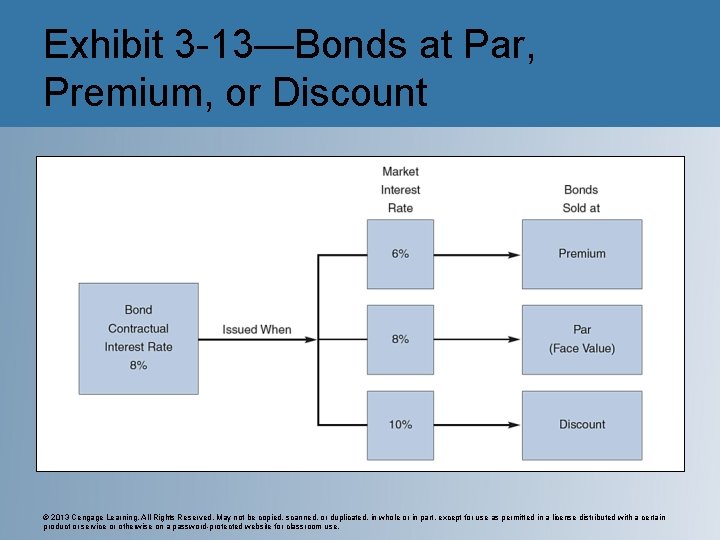
Exhibit 3 -13—Bonds at Par, Premium, or Discount © 2013 Cengage Learning. All Rights Reserved. May not be copied, scanned, or duplicated, in whole or in part, except for use as permitted in a license distributed with a certain product or service or otherwise on a password-protected website for classroom use.
Liabilities Relating to Operational Obligations • Deferred Taxes – Caused by using different accounting methods for tax and reporting purposes – It causes tax expense for reporting purposes to be higher than taxes payable according to the tax return • The difference is deferred tax • Warranty Obligations – Estimated obligations arising out of product warranties – Estimated to recognize the obligation at the balance sheet date and to charge expense © 2013 Cengage Learning. All Rights Reserved. May not be copied, scanned, or duplicated, in whole or in part, except for use as permitted in a license distributed with a certain product or service or otherwise on a password-protected website for classroom use.
Liabilities Relating to Operational Obligations—Continued • Noncontrolling Interest – Previously called “minority interest” – Reflects the ownership of noncontrolling shareholders in the equity of consolidated subsidiaries less than wholly owned – Reported on consolidated financial statements as equity, but separate from parents equity – If material, analysis can be performed twice • Once as a liability to be conservative and then as shareholders’ equity item © 2013 Cengage Learning. All Rights Reserved. May not be copied, scanned, or duplicated, in whole or in part, except for use as permitted in a license distributed with a certain product or service or otherwise on a password-protected website for classroom use.
Liabilities Relating to Operational Obligations—Continued • Other Noncurrent Liabilities • Redeemable Preferred Stock – Excluded from stockholders’ equity – For analysis, treated as a liability © 2013 Cengage Learning. All Rights Reserved. May not be copied, scanned, or duplicated, in whole or in part, except for use as permitted in a license distributed with a certain product or service or otherwise on a password-protected website for classroom use.
Stockholders’ Equity • Also called shareholders’ equity • The residual ownership interest in the assets of an entity that remains after deducting its liabilities – Paid-in capital – Retained earnings © 2013 Cengage Learning. All Rights Reserved. May not be copied, scanned, or duplicated, in whole or in part, except for use as permitted in a license distributed with a certain product or service or otherwise on a password-protected website for classroom use.
Stockholders’ Equity: Paid-In Capital • Two basic types of capital stock – Preferred – Common • Par value – – In some states, referred to as “stated value stock” Considered “legal capital” by many states Established by the articles of incorporation Usually a minimal value • Some states allow the issuance of no-par stock © 2013 Cengage Learning. All Rights Reserved. May not be copied, scanned, or duplicated, in whole or in part, except for use as permitted in a license distributed with a certain product or service or otherwise on a password-protected website for classroom use.
Stockholders’ Equity: Paid-in Capital—Continued • Additional Paid-In Capital – Issue price in excess of par (stated) value – Other sources • Treasury stock transactions • Stock dividend transactions • Donated capital © 2013 Cengage Learning. All Rights Reserved. May not be copied, scanned, or duplicated, in whole or in part, except for use as permitted in a license distributed with a certain product or service or otherwise on a password-protected website for classroom use.
Stockholders’ Equity: Common Stock • Shareholder ownership – Voting rights • Election of board of directors • Major corporate decisions – Liquidation rights secondary to • Creditors • Preferred stockholders’ © 2013 Cengage Learning. All Rights Reserved. May not be copied, scanned, or duplicated, in whole or in part, except for use as permitted in a license distributed with a certain product or service or otherwise on a password-protected website for classroom use.
Stockholders’ Equity: Preferred Stock • Does not normally convey voting rights – May carry any or all of these features: • • Preference as to dividends Accumulation of dividends Participation in excess of stated dividend rate Convertibility into common stock at holder’s discretion Callability by the corporation Redemption at future maturity date Preference in liquidation secondary to creditors © 2013 Cengage Learning. All Rights Reserved. May not be copied, scanned, or duplicated, in whole or in part, except for use as permitted in a license distributed with a certain product or service or otherwise on a password-protected website for classroom use.
Stockholders’ Equity: Donated Capital • May be included in the paid-in capital • Donated by outside entities • Example: Shareholder surrender of stock © 2013 Cengage Learning. All Rights Reserved. May not be copied, scanned, or duplicated, in whole or in part, except for use as permitted in a license distributed with a certain product or service or otherwise on a password-protected website for classroom use.
Stockholders’ Equity: Retained Earnings • Undistributed earnings of the corporation – Net income for all prior periods • Less dividends (both cash and stock) declared to shareholders © 2013 Cengage Learning. All Rights Reserved. May not be copied, scanned, or duplicated, in whole or in part, except for use as permitted in a license distributed with a certain product or service or otherwise on a password-protected website for classroom use.
Stockholders’ Equity: Others • Quasi-Reorganization – Eliminates a deficit balance of retained earnings and an equal amount from paid-in-capital – Retained earnings dated as of the readjustment date and disclosed in the financial statements for a period of five to ten years • Accumulated Other Comprehensive Income – Represents retained earnings from other comprehensive income – Disclosed as a separate component on the face of the balance sheet or in the notes © 2013 Cengage Learning. All Rights Reserved. May not be copied, scanned, or duplicated, in whole or in part, except for use as permitted in a license distributed with a certain product or service or otherwise on a password-protected website for classroom use.
Stockholders’ Equity: Others— Continued • Employee Stock Ownership Plans (ESOPs) – A qualified stock-bonus plan, or a combination of stock-bonus and money-purchase pension plan – Tax benefits for the employer and employee – Unearned compensation decreases stockholders’ equity © 2013 Cengage Learning. All Rights Reserved. May not be copied, scanned, or duplicated, in whole or in part, except for use as permitted in a license distributed with a certain product or service or otherwise on a password-protected website for classroom use.
Stockholders’ Equity: Others— Continued • Treasury Stock – Stock purchased and held by the issuing corporation – Record treasury stocks in two ways – Par-value method • Removes the paid-in capital in excess of par from the original issue • Appears as a reduction of paid-in capital – Cost method • Records treasury stock at the cost of the stock (presented as a reduction of stockholders’ equity) • Most firms record treasury stock at cost © 2013 Cengage Learning. All Rights Reserved. May not be copied, scanned, or duplicated, in whole or in part, except for use as permitted in a license distributed with a certain product or service or otherwise on a password-protected website for classroom use.
Statement of Stockholders’ Equity • Reconciles the beginning and ending balances of stockholders’ equity accounts • Changes in stockholders’ equity accounts – – Issuance of stock increases paid-in capital Acquisition of treasury stock increases treasury stock Net income increases retained earnings Dividends decreases retained earnings • This account is related to comprehensive income © 2013 Cengage Learning. All Rights Reserved. May not be copied, scanned, or duplicated, in whole or in part, except for use as permitted in a license distributed with a certain product or service or otherwise on a password-protected website for classroom use.
Problems in Balance Sheet Presentation • Financial analysis is complicated by – Many assets recorded at cost rather than fair (replacement) value – Varying valuation methods • Within a firm from product to product • Within an industry from firm to firm – Not all items of value are listed as assets – Certain contingent liabilities may be excluded © 2013 Cengage Learning. All Rights Reserved. May not be copied, scanned, or duplicated, in whole or in part, except for use as permitted in a license distributed with a certain product or service or otherwise on a password-protected website for classroom use.
International Consolidated Balance Sheet (IFRS) • Asset section – Usually noncurrent assets are presented first, followed by current assets • Liabilities and Owner’s Equity section – “Capital and reserves” are usually listed first, then noncurrent liabilities, and at last, current liabilities • The reserves sections of “capital and reserves” would not be part of U. S. GAAP © 2013 Cengage Learning. All Rights Reserved. May not be copied, scanned, or duplicated, in whole or in part, except for use as permitted in a license distributed with a certain product or service or otherwise on a password-protected website for classroom use.
Subsequent Events • Occur during the period between the balance sheet date and the date statements are issued • Types – Events requiring retroactive recognition • Relates to estimates that were made and subsequent events indicates estimates were incorrect – Events requiring disclosure in the notes to the financial statements • Does not affect the balance sheet, but is significant to the users of the financial statement © 2013 Cengage Learning. All Rights Reserved. May not be copied, scanned, or duplicated, in whole or in part, except for use as permitted in a license distributed with a certain product or service or otherwise on a password-protected website for classroom use.
- Slides: 54