
Financial Services INTRODUCTION 1 Background Financial Services sector

Financial Services INTRODUCTION 1

Background Financial Services sector is a major employer in Scotland l Employs 156, 700 l Edinburgh's finance sector employs 52, 800 people l And expected to grow over next few years l Financial Services is a global industry l 2
Scotsman article March 2016 l Of the almost 2. 2 million people working in the sector across the UK, 417, 000 are employed in banking, while insurance roles account for a further 309, 000. Across the professional services arena, management consultancy accounts for some 483, 000 roles, with accounting and legal services employing 319, 000 and 314, 000 respectively 3
Scotsman article March 2016 l Its report also shows there about 9, 000 bank branches in the UK and almost 70, 000 cash machines, which delivered about 2. 8 billion cash withdrawals in 2014. The UK has the most cash machines in the European Union, with more person than France, Germany or Italy. 4
Scotsman article March 2016 l Some 22. 9 million banking apps were downloaded in 2014, a rise of 8. 2 million in one year. Banking app log-ins now amount to more than 10 million a day. 5
Scotsman article March 2016 l Although cash remains a popular choice – accounting for 90 per cent of transactions worth less than £ 20 – The. City. UK predicts that cash payments are likely to decline over the coming decade “due to growth in mobile phone payment services, a continuing migration towards plastic cards and migration of spending from the high street to the internet”. 6
Aim of the Financial Services sector To safeguard funds (money) entrusted to the organisations within the sector, while increasing the value of those funds. l The industry is judged on how well it manages those funds. l Sector is split into sub sectors l 7
Banking Two main activities: l Taking deposits – from individuals and businesses l Making loans – to individuals and businesses l 8
Most banks will have a Head Office with branches spread throughout; l l Area offices – located in towns/cities offering full range of services Satellite offices – supplying reduced range of services IT has meant the introduction of: l l l Telephone banking 24/7 Call centres Internet banking 9
‘Big Name’ players l l l List of The Top & Biggest British Banks HSBC Holdings Barclays PLC Royal Bank of Scotland Group Lloyds Banking Group Standard Chartered PLC 10
Insurance and Pensions Many banks offer insurance products and many insurance companies provide banking services l This causes an overlap in services offered by both l INSURANCE IS A PROTECTION THAT YOU CAN BUY TO PROTECT YOURSELF FROM FINANCIAL LOSS 11
2 main categories of insurance are: l l GENERAL INSURANCE – home, car, holiday, health LIFE ASSURANCE – safeguards against financial loss incurred on death 12
How do insurance companies make money? They assess the amount of risk involved and calculate the likelihood of a claim being made and charge accordingly l Lower the risk the less you pay l Insurance company invests premiums received, usually in stocks/shares l 13
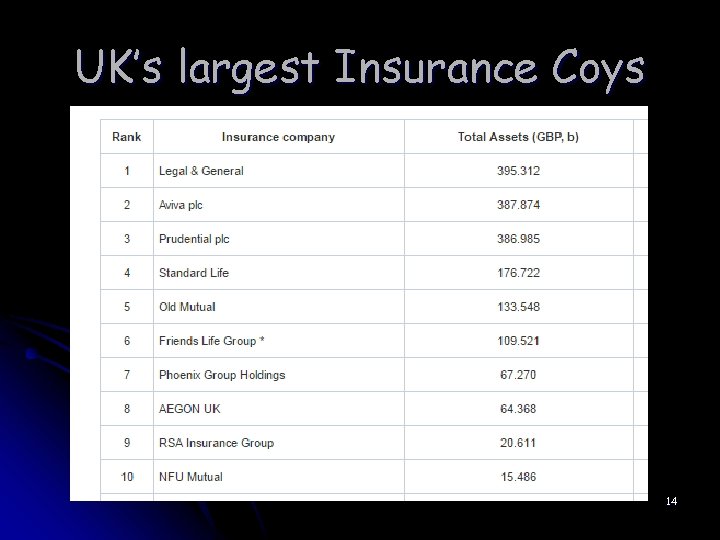
UK’s largest Insurance Coys 14
PENSIONS What is a Pension? A pension is a sum of money paid to you on retirement l l The money can be paid to you as a lump sum or a series of regular payments which are payable from retirement until death You can set up your own pension plan (personal pension) or if in employment you can join your employer’s pension scheme if they have one 15
Most schemes will provide both a cash lump sum on retirement and a monthly income l The sooner you start contributing towards your pension fund the better! l 16
Selling Insurance - Methods Direct selling by company’s own sales force l Direct selling through a call centre l Selling through an independent intermediary or broker l Selling through Independent Financial Advisers (IFA’s) l 17
Investment Management and Operations l l Banks and Insurance companies have funds to invest and some of these funds will be placed in the trust of an INVESTMENT INSTITUTION, who will manage the funds. Investment Institutions account for around 75% of the total value of share ownership in the UK. The companies in which they buy stocks/shares need these investments in order to grow. FUND MANAGERS play the key role. 18
Finance Companies Provide similar services to some banks like loans and mortgages. Sometimes used by people refused by the banks. l Eg l Lombard Finance l Norton Finance l Fowlers Finance l 19
Investment Operations l An investment company is a company whose main business is holding securities for investment purposes. Investment companies invest money on behalf of their clients who, in turn, share in the profits and losses. 20
Investment Operations Baillie Gifford l Hargreaves Landsdown l Aberdeen Asset Management l 21
Retail Financial Providers Some retail stores offer their own finance options to help customers buy their products. These services are usually outsourced to a credit provider. l Eg Portman Asset Finance l l The interest rates the customer pay are usually quite a bit higher than other providers. 22
l l Scotland is the 6 th largest fund management centre in Europe and 15 th in the world Our strengths lie in pensions and managing long term savings Investment operations requires highly skilled, professional staff This area is rapidly expanding in Scotland You could be part of it! 23
What activities does financial services include? There are 4 main areas of activity within financial services in the UK. These are: l Banking and Finance l Insurance l Professional Services (financial intermediation) l Professional Services (Accountancy) 24
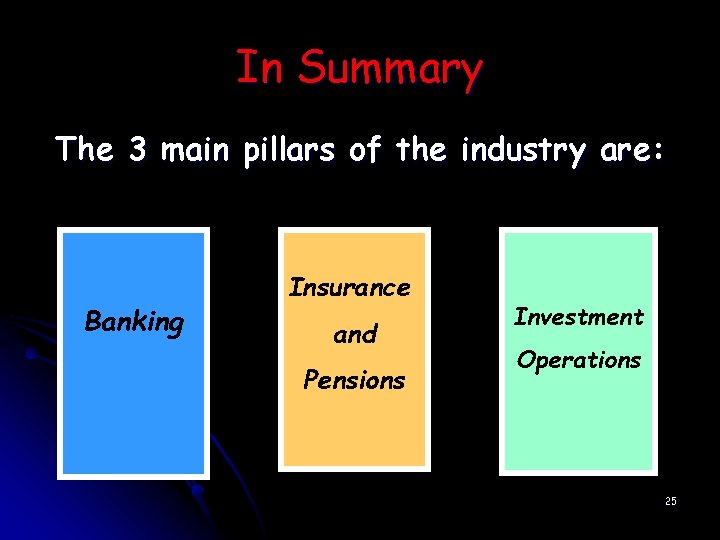
In Summary The 3 main pillars of the industry are: Banking Insurance and Pensions Investment Operations 25
The Financial Conduct Authority (FCA) Governed by the Financial Services Act (2012) 26
The main objectives of the FCA are: 1. 2. 3. 4. Maintain confidence in the UK financial system Promote public understanding of financial systems Secure protection for customers Reduce opportunities for financial crime 27
The Prudential Regulation Authority (PRA) l Created by the Financial Services Act (2012) and is responsible for the regulation and supervision of around 1, 700 banks, building societies, credit unions, insurers and major investment firms. 28
The FCA impacts the financial services sector by: Ensuring firms are authorised to offer financial products l Imposing rigorous compliance procedures l Promoting efficient, orderly and fair financial markets l 29
COMSUMER PROTECTION AND THE FCA l l Protect consumers against mis-selling of financial products due to poor advice Takes action against firms acting illegally New firms are vetted on honesty, competence and financial soundness Requires firms to set up their own complaints system 30
Laws which help the FCA protect consumers are: l Proceeds of Crime Act 2002 l Consumer Credit Act 1974 l Data Protection Act 1998 l Financial Services Act 2012 31
Regulating Mortgage Advice “Your home is at risk if you do not keep up repayments on your mortgage” l Most mortgage providers are signatories to the VOLUNTARY CODE which sets standards for mortgage advice l 32
FINANCIAL CRIME l l The FCA has rules on money laundering The FCA can prosecute under the MONEY LAUNDERING REGULATIONS 1983 33
What is Money Laundering? Money laundering is the practice of engaging in financial transactions in order to conceal the identity, source, and/or destination of money l l l Criminals have to make the money they receive ‘clean’ They launder their ‘dirty money’ into the financial system Once in, the money can be transferred between products in the UK or abroad This can be done in: l l Money exchange bureaus Antique dealers Providers of luxury goods Online gambling 34
PROOF OF IDENTITY l l Criminals will seldom use their own name to buy financial products. They use false names and addresses. Usually names and addresses of members of the public This is called IDENTITY THEFT Therefore, organisations must check your personal details thoroughly before they agree to you opening an account 35
What kind of ID is required? You will need to show that you ARE WHO YOU SAY YOU ARE and that YOU LIVE WHERE YOU SAY YOU LIVE l Under the PROCEEDS OF CRIME ACT 2002 every financial organisation must establish the identity of potential customers Checks may include: l Asking for 2 forms of ID eg, l Utility Bill l Driving License/Passport l OR a letter from a trusted individual (doctor, lawyer, teacher) l 36
Consumer Credit Act 1974 If you, l Buy goods on credit or l Borrow money from a financial services provider You will have protection under the CONSUMER CREDIT ACT 1974 The main provision of this Act is to: l Make sure anybody who signs a credit agreement knows exactly what they are entering into l It allows a ‘cooling off’ period of 5 days 37
DATA PROTECTION ACT 1988 Gives customers the right to ensure that data held on them is being used only for the purposes in which it was given 2 MAIN PROVISIONS: l Companies using data must register with the DATA COMMISSIONER. Must disclose how data is held, how they use it, obtain it and disclose it l Allows anyone who has details held to find out what information is being held about them 38
Who is covered by the act? The Act covers: l Adults l Children l Students l Employed l Unemployed l Homeless people BUT NOT: l Companies l Organisations l Dead people 39
Customer Rights under Data Protection Act CUSTOMERS HAVE THE RIGHT TO: l Access personal details held l Prevent those details being disclosed to 3 rd parties l Decline marketing material l Take action to rectify, block, erase or destroy inaccurate data l Sue for compensation if they suffer damage 40
CAREERS IN FINANCIAL SERVICES What is the difference between a job and a career? l JOB – earning a salary/wage l CAREER – seeking opportunities for personal and career development The FINANCIAL SERVICES SECTOR can provide an interesting, tempting and challenging range of options 41
l l l Each company in the Financial Services sector is different Each will have its own ORGANISATIONAL STRUCTURE The structure adopted will depend on: üSize üCustomers üLocation üAims ütechnology üstaff A structure provides an overview of where everyone ‘fits in’ within the organisation 42
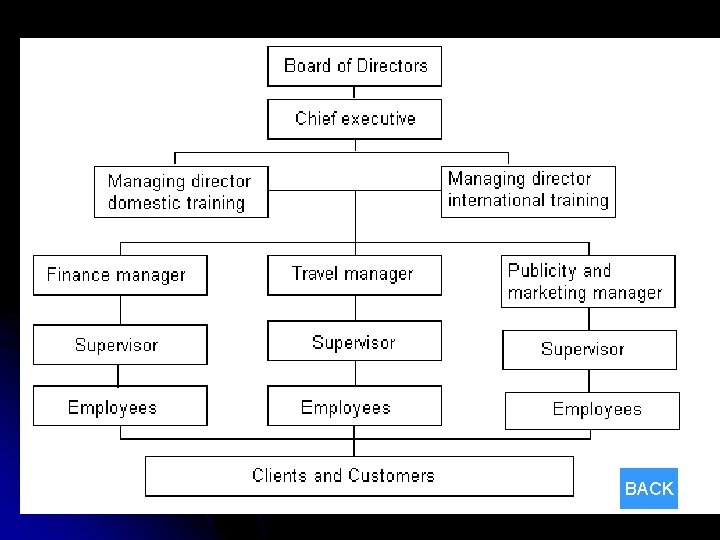
BACK 43
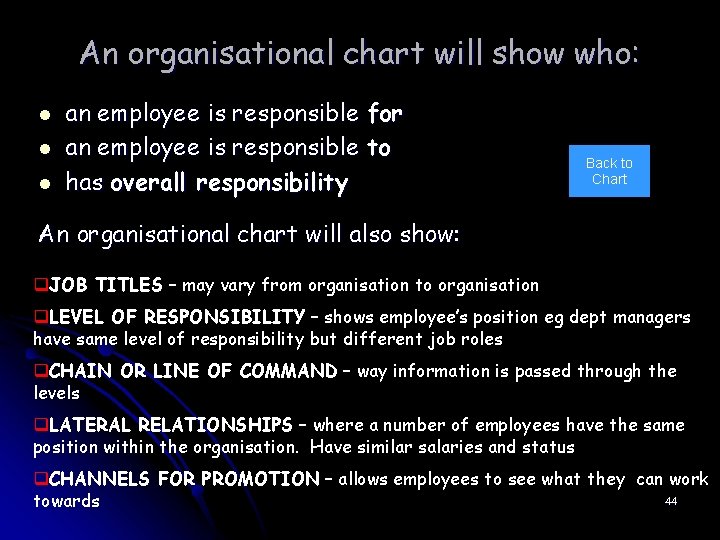
An organisational chart will show who: l l l an employee is responsible for an employee is responsible to has overall responsibility Back to Chart An organisational chart will also show: q. JOB TITLES – may vary from organisation to organisation q. LEVEL OF RESPONSIBILITY – shows employee’s position eg dept managers have same level of responsibility but different job roles q. CHAIN OR LINE OF COMMAND – way information is passed through the levels q. LATERAL RELATIONSHIPS – where a number of employees have the same position within the organisation. Have similar salaries and status q. CHANNELS FOR PROMOTION – allows employees to see what they can work 44 towards
Purpose of Organisational Charts There are 2 main users: 1. 2. Visitors – who can clearly see the size, structure and contacts within the organisation Employees – shows the chain of command levels of responsibility 45
Job titles will vary but the following are common to most organisations: l l Board of Directors – group of people with main responsibility Chief Executive – overall responsibility of company operations Managing Director – responsible for overall running of the organisation General Manager – day-today running of business. Delegates tasks to Dept Managers l l l Department Managers – responsible for running their own dept Supervisors – check staff, time-keeping, training Customer Services/Administrative Staff/Assistants – report to supervisor. Carry out duties assigned by supervisor 46
HEALTH & SAFETY Consider this… A practical joker works in your office. His antics have resulted in much hilarity. The other day he set off the extinguisher and sprayed foam over everyone. He could not understand why his employer was less than happy at this ‘joke’. Can you explain why? 47
Health & Safety in the Workplace The HEALTH & SAFETY AT WORK ACT requires that: q q EMPLOYEES protect themselves and others from dangers that may cause injury or sickness EMPLOYERS have legal obligations to ensure the safety and wellbeing of all employees 48
Accidents cost money To the INDIVIDUAL – may make you unfit to work, resulting in reduced pay and/or reliance on state benefits. May miss out on career opportunities: q Training, exams, rise in salary To the EMPLOYER costs include: q q Lost production time Damage to equipment by accident Compensation claims/payments/fines Recruitment & training of replacement 49
Duties of employee As an employee you must: q Take reasonable care to avoid injury to yourself and others q Co-operate with your employer q Not interfere or tamper with machinery/equipment 50
Duties of employers Employers with 5 or more employees must: q Produce a Health & Safety Policy q Ensure all machinery/equipment is in good working order q Provide adequate training 51
What is a Hazard? A hazard is a condition which is likely to cause injury, accident or illness Ø Ø Ø Slips, trips or falls Electric shock Burns or scalds Cuts and gashes Heavy lifting Computer workstations Ø Ø Ø Chemical burns Substances that can be inhaled, swallowed or exposed to skin or eyes Mental health and stress Activities E & F, then S 6 Activities 52
- Slides: 52