
Financial Planning for College Scott Seibring Director of
Financial Planning for College Scott Seibring Director of Financial Aid Illinois Wesleyan University
What we will discuss Financial Aid Terminology Factors used in determining eligibility Review some of the questions on the FAFSA Show a few financial aid scenarios Open up to question
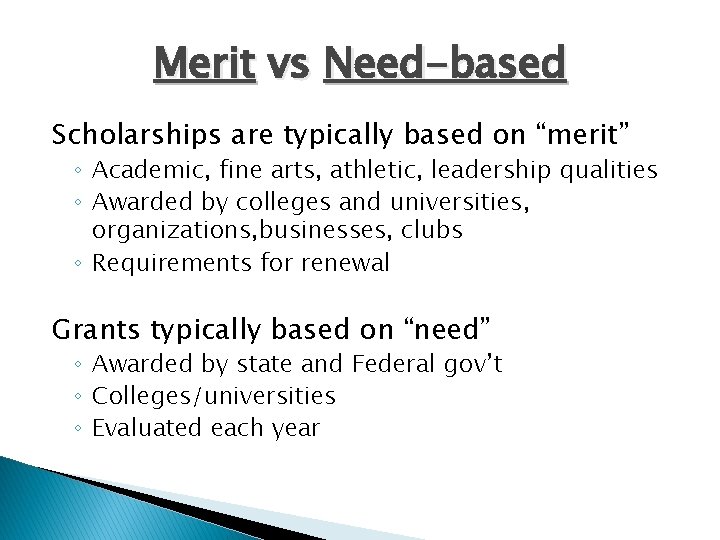
Merit vs Need-based Scholarships are typically based on “merit” ◦ Academic, fine arts, athletic, leadership qualities ◦ Awarded by colleges and universities, organizations, businesses, clubs ◦ Requirements for renewal Grants typically based on “need” ◦ Awarded by state and Federal gov’t ◦ Colleges/universities ◦ Evaluated each year
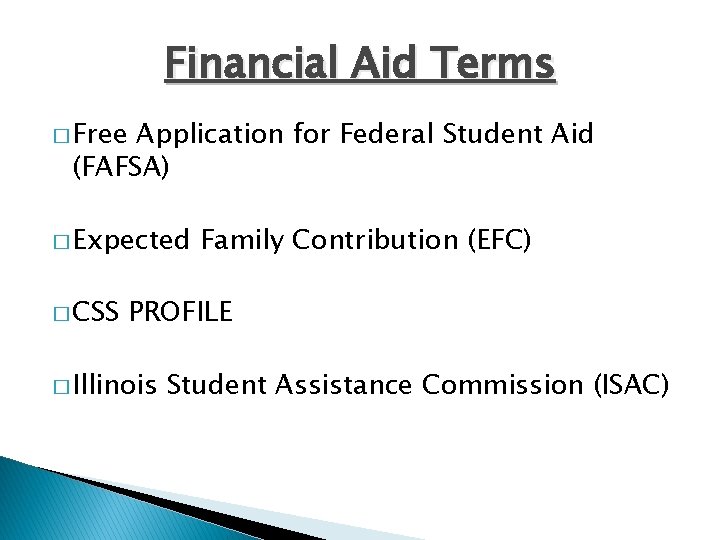
Financial Aid Terms � Free Application for Federal Student Aid (FAFSA) � Expected � CSS Family Contribution (EFC) PROFILE � Illinois Student Assistance Commission (ISAC)
Helpful Hints Read Instructions carefully Know institutional deadlines and applications Use a completed Tax Return if possible Carefully review all of your figures Make copies of all the forms you send

Problematic FAFSA Questions Student’s Social Security Number Dependency Questions Parent’s Marital Status Family Size Taxes Paid (not amount withheld on W-2)
FAFSA Questions Continued Investments carefully read what is included and excluded Business/Farm Additional Financial Information Untaxed Income College Selection Signatures
Determining the Family Contribution Parent Contribution + Student Contribution Family Contribution
Determining Financial Need Cost of Education - Family Contribution Financial Need
Determining Family Contribution Family Income (AGI plus untaxed income) Family Size Number of Children in College Parents Assets Age of Parents Student’s Income Student’s Assets Other…. .
Meeting the Need Gift Assistance ◦ ◦ Grant in Aid Scholarships State Funds (MAP Grant) Federal Funds - Pell, SEOG Loan Assistance ◦ Stafford Loans ◦ Perkins ◦ Private, PLUS, Home Equity loans Employment ◦ Campus Work Study (On/Off Campus)
Federal Stafford Loan Low-interest student loan The FAFSA must be completed Interest rate for 2015 -16 is 4. 66% Repayment begins 6 months after the student graduates or falls below half-time
Subsidized vs Unsubsidized Financial Need ◦ Subsidized = need based ◦ Unsubsidized = not based on need Payment of interest ◦ Subsidized- Federal Government pays while student is in college ◦ Unsubsidized - interest is accruing
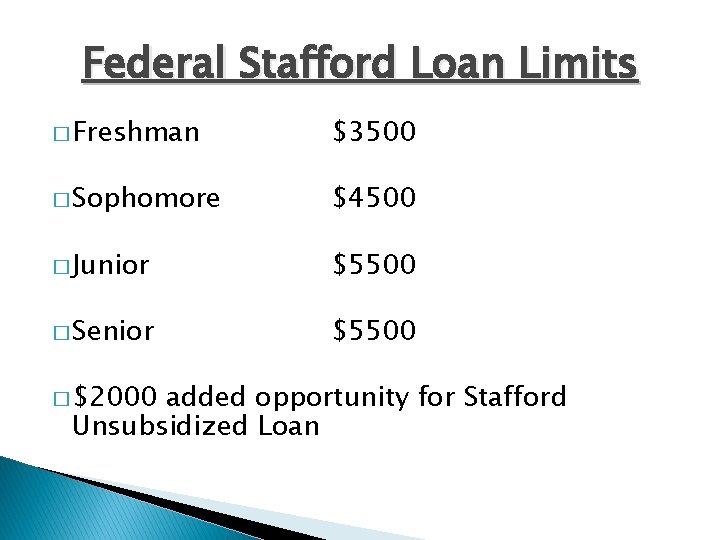
Federal Stafford Loan Limits � Freshman $3500 � Sophomore $4500 � Junior $5500 � Senior $5500 � $2000 added opportunity for Stafford Unsubsidized Loan
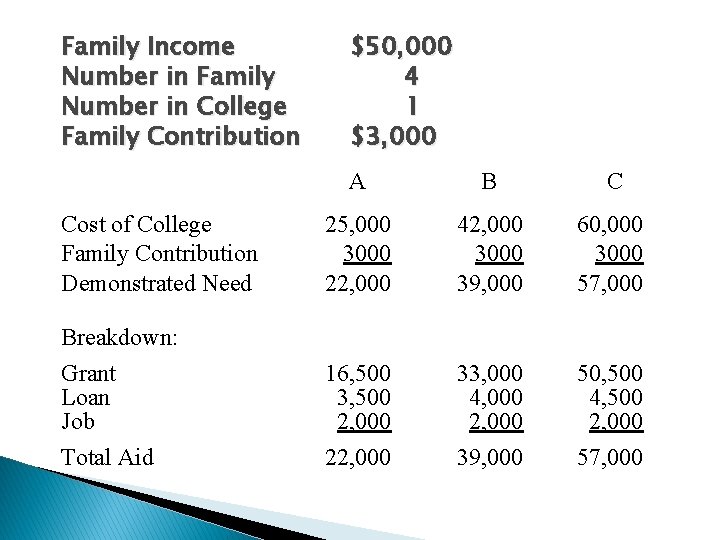
Family Income Number in Family Number in College Family Contribution $50, 000 4 1 $3, 000 A B C Cost of College Family Contribution Demonstrated Need 25, 000 3000 22, 000 42, 000 39, 000 60, 000 3000 57, 000 Breakdown: Grant Loan Job Total Aid 16, 500 3, 500 2, 000 22, 000 33, 000 4, 000 2, 000 39, 000 50, 500 4, 500 2, 000 57, 000
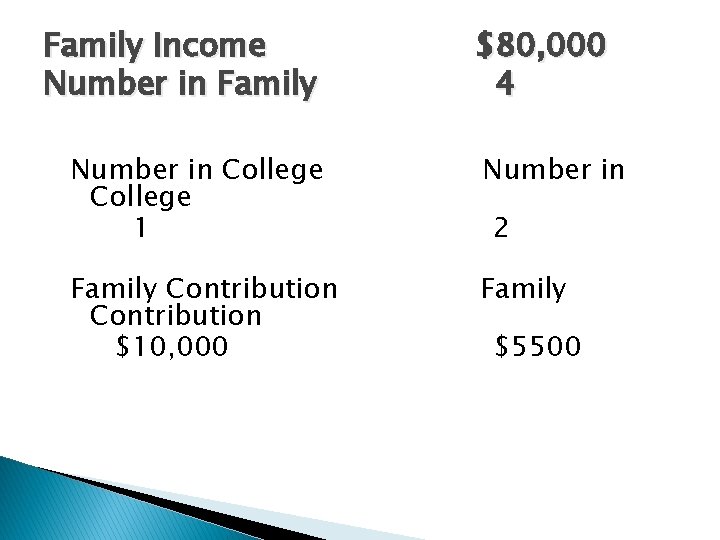
Family Income Number in Family $80, 000 4 Number in College 1 Number in Family Contribution $10, 000 Family 2 $5500
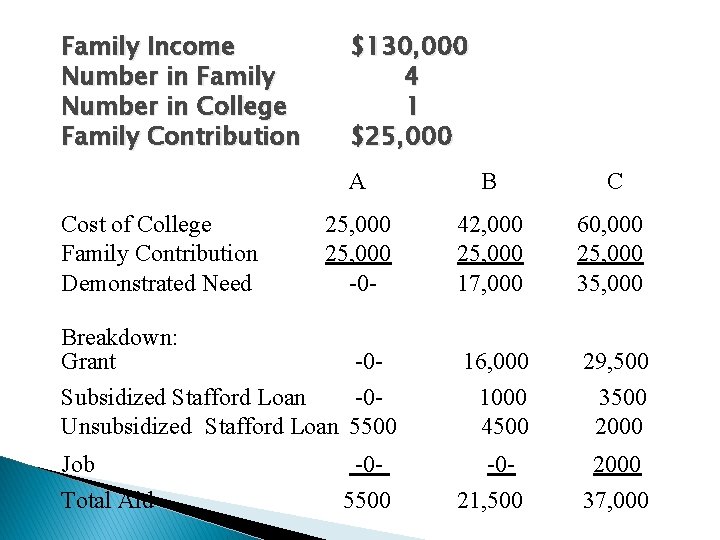
Family Income Number in Family Number in College Family Contribution $130, 000 4 1 $25, 000 A B C 25, 000 -0 - 42, 000 25, 000 17, 000 60, 000 25, 000 35, 000 Breakdown: Grant -0 Subsidized Stafford Loan -0 Unsubsidized Stafford Loan 5500 16, 000 1000 4500 29, 500 3500 2000 Job Total Aid -021, 500 2000 37, 000 Cost of College Family Contribution Demonstrated Need -05500
Discussion Points on Financial Aid Stafford and PLUS Interest Rates ◦ 10 year treasury note plus 2. 05 for Stafford and plus 4. 6 for PLUS. ◦ 2015 -16 rates were 4. 66% for Stafford and 6. 84% for PLUS. Cap of 8. 25% for Stafford and 10. 5% for PLUS IRS Data Retrieval Tool ◦ Pulls data from IRS into FAFSA Prior year income vs Prior year income Need based aid vs Merit based aid Institutional Methodology vs Federal Methodology
Special Circumstance: Appeals Professional Judgment - with factual and verifiable information ◦ ◦ ◦ Early retirement Divorce, separation, widowed Private school expenses Medical expenses not covered by insurance One-Time taxable income Elder care
Notes ◦ Can accept or reject any portion of a FA proposal ◦ Understand scholarship renewal qualifications ◦ Be aware of scams ◦ Juniors or younger – use Net Price Calculators on school website for estimates. Don’t file FAFSA. ◦ Consider possibility of graduation in 4 vs 5 years
Suggested Websites www. studentaid. ed. gov www. finaid. org www. collegeboard. org www. fastweb. com www. fafsa. ed. gov www. fsaid. gov www. studentloans. gov www. brightstartsavings. com www. collegeillinois. org www. privatecollege 529. com www. savingforcollege. com
Top 10 Financial aid revelations 10. Disappointed to learn that students record on Playstation Madden 2015 is not asked on most scholarship applications. 9. Getting a full tuition academic scholarship to your first choice college is as likely as the White Sox winning the World Series this year. 8. You realize the Brady’s must have been full-need by the time Bobby and Cindy went to school. 7 FAFSA does not stand for Frightfully Agonizing Form for Student Aid 6. EFC does not stand for Exhausted Family Can’t
Top 10 Continued 5. Having the college waive your tuition based on your students good looks and charm is as likely as North losing to West Chicago in football. 4. New Years Eve and Super Bowl parties are pale compared to the celebration of completing your first FAFSA. 3. Financial Aid phone number replace family members on speed dial. 2. Buying $100 of Powerball and Lotto tickets a week before school starts is not considered financially planning for college. 1. The Department of Education will not accept your suggestion to replace the 100 question FAFSA with one simple question…. “How much do you want to pay for college? ”

Good Luck!!
- Slides: 24