
FINANCIAL PLANNING AND CONTROL The information derived from
- Slides: 48
FINANCIAL PLANNING AND CONTROL • The information derived from financial statement analysis can be used to establish future operating goals (financial planning) and to determine how to meet established goals (financial control). • Developing pro forma (forecasted) financial statements is an important part of the planning and control processes. FINANCE 1
PRO FORMA FINANCIAL STATEMENTS • Primary goal of financial planning is to make arrangements forecasted cash flows—that is, for future funding needs or for investment of excess funds expected in the future. • Sales Forecast § Most important part of financial planning. § Generally based on the trend in sales in recent periods. § Inaccurate sales forecasts can have serious repercussions. FINANCE 2
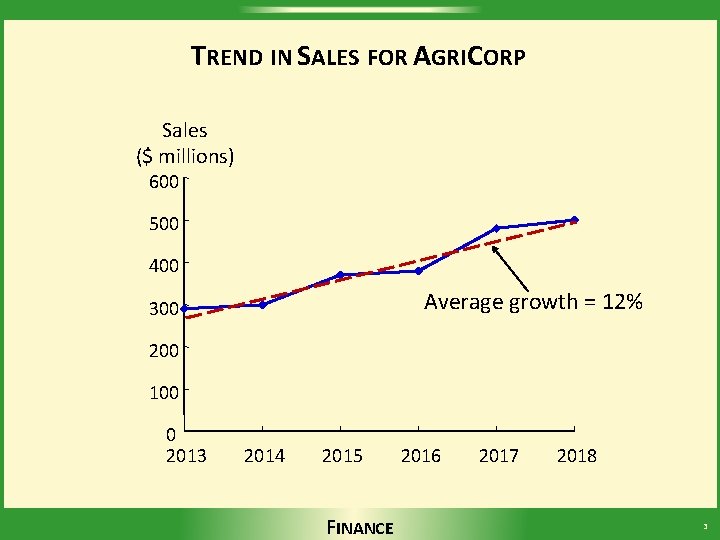
TREND IN SALES FOR AGRICORP Sales ($ millions) 600 500 400 Average growth = 12% 300 200 100 0 2013 2014 2015 FINANCE 2016 2017 2018 3
PROJECTED (PRO FORMA) FINANCIAL STATEMENTS • Help the firm determine what is needed to finance expected future operating activities. • These statements indicate how much financing will be generated internally and how much must be generated externally. FINANCE 4
PROJECTED (PRO FORMA) FINANCIAL STATEMENTS To construct a pro forma balance sheet and a pro forma income statement: • Step 1: Forecast next period’s income statement • Step 2: Forecast next period’s balance sheet • Step 3: Raising the additional funds needed • Step 4: Financing feedbacks FINANCE 5
STEP 1: CONSTRUCT A PRO FORMA INCOME STATEMENT • Estimate the percentage growth (increase or decrease) in sales, cost of goods sold, and other variable revenues and expenses. • Change appropriate current values by the estimates: § An easy way to approach this task is to apply a single growth rate to all revenue and expense categories that change when production changes. § To be more accurate, each category should be examined individually to determine the effect of any forecasted change. FINANCE 6
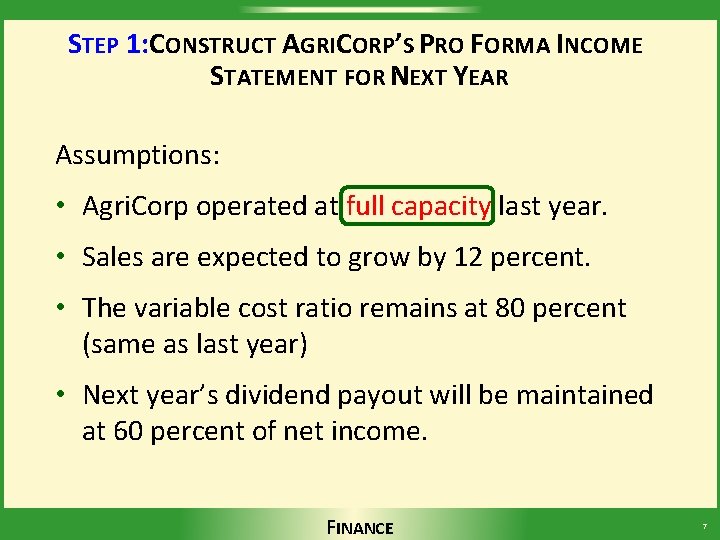
STEP 1: CONSTRUCT AGRICORP’S PRO FORMA INCOME STATEMENT FOR NEXT YEAR Assumptions: • Agri. Corp operated at full capacity last year. • Sales are expected to grow by 12 percent. • The variable cost ratio remains at 80 percent (same as last year) • Next year’s dividend payout will be maintained at 60 percent of net income. FINANCE 7
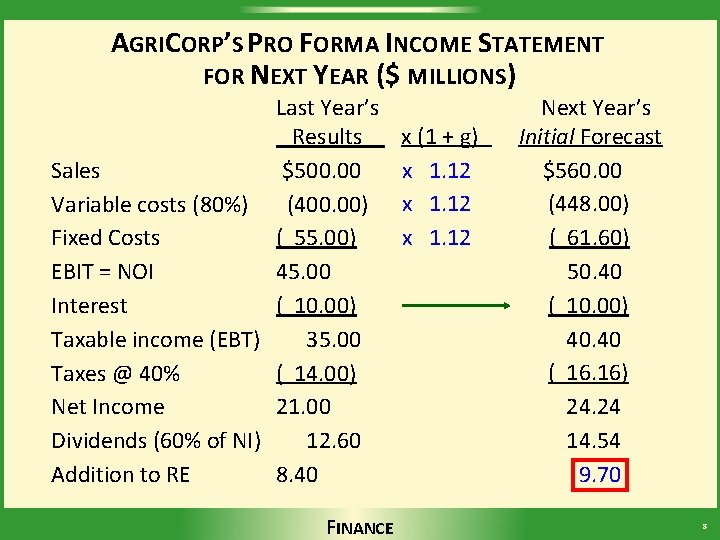
AGRICORP’S PRO FORMA INCOME STATEMENT FOR NEXT YEAR ($ MILLIONS) Last Year’s Results Sales $500. 00 Variable costs (80%) (400. 00) Fixed Costs ( 55. 00) EBIT = NOI 45. 00 Interest ( 10. 00) Taxable income (EBT) 35. 00 Taxes @ 40% ( 14. 00) Net Income 21. 00 Dividends (60% of NI) 12. 60 Addition to RE 8. 40 FINANCE x (1 + g) x 1. 12 Next Year’s Initial Forecast $560. 00 (448. 00) ( 61. 60) 50. 40 ( 10. 00) 40. 40 ( 16. 16) 24. 24 14. 54 9. 70 8
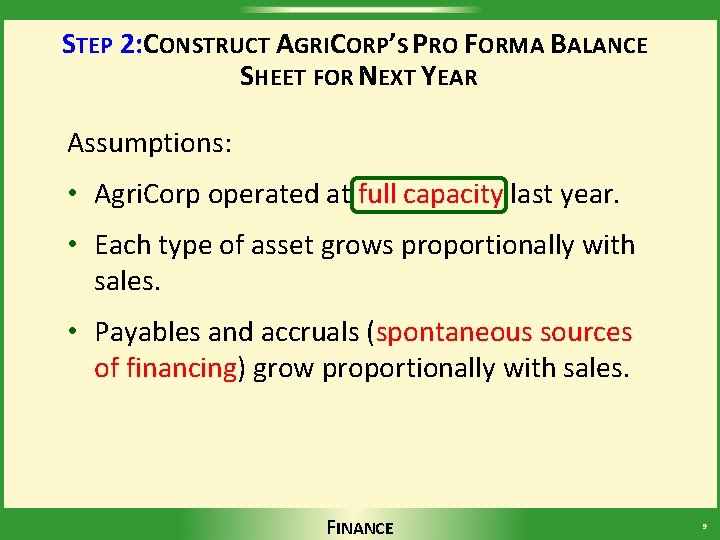
STEP 2: CONSTRUCT AGRICORP’S PRO FORMA BALANCE SHEET FOR NEXT YEAR Assumptions: • Agri. Corp operated at full capacity last year. • Each type of asset grows proportionally with sales. • Payables and accruals (spontaneous sources of financing) grow proportionally with sales. FINANCE 9
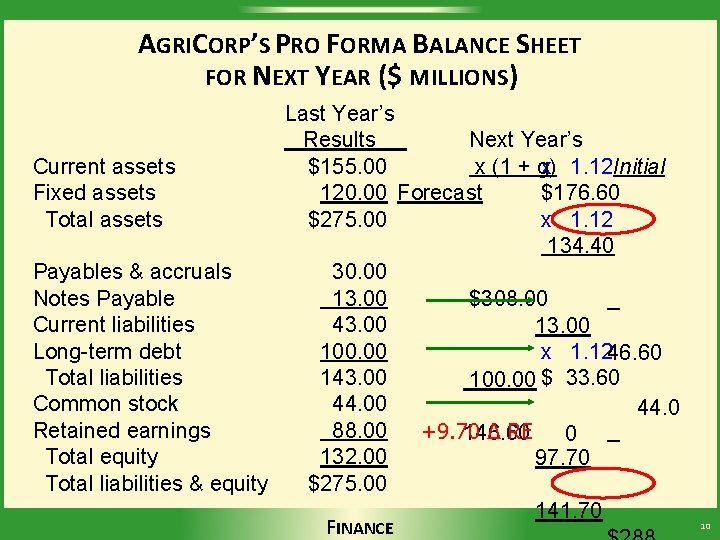
AGRICORP’S PRO FORMA BALANCE SHEET FOR NEXT YEAR ($ MILLIONS) Last Year’s Next Year’s Results x (1 + g) x 1. 12 Initial Current assets $155. 00 $176. 60 Fixed assets 120. 00 Forecast x 1. 12 Total assets $275. 00 134. 40 Payables & accruals 30. 00 $308. 00 Notes Payable 13. 00 Current liabilities 43. 00 13. 00 x 1. 1246. 60 Long-term debt 100. 00 Total liabilities 143. 00 100. 00 $ 33. 60 Common stock 44. 00 44. 0 Retained earnings 88. 00 +9. 70 Δ RE 0 146. 60 Total equity 132. 00 97. 70 Total liabilities & equity $275. 00 141. 70 FINANCE 10
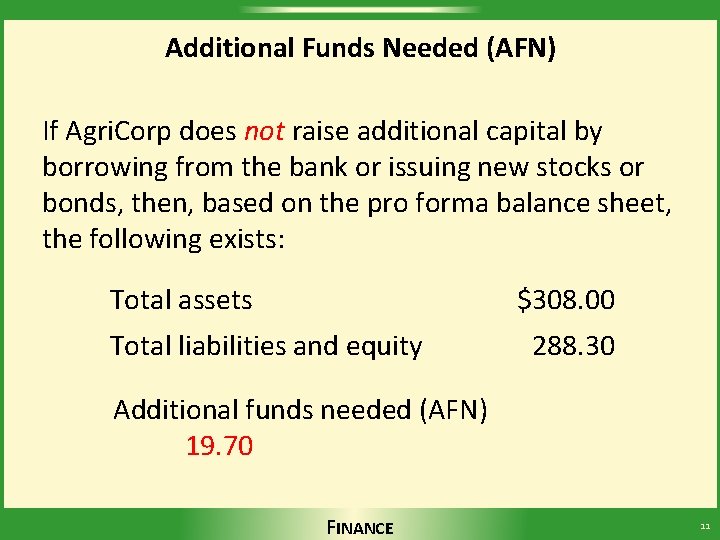
Additional Funds Needed (AFN) If Agri. Corp does not raise additional capital by borrowing from the bank or issuing new stocks or bonds, then, based on the pro forma balance sheet, the following exists: Total assets $308. 00 Total liabilities and equity 288. 30 Additional funds needed (AFN) 19. 70 FINANCE 11
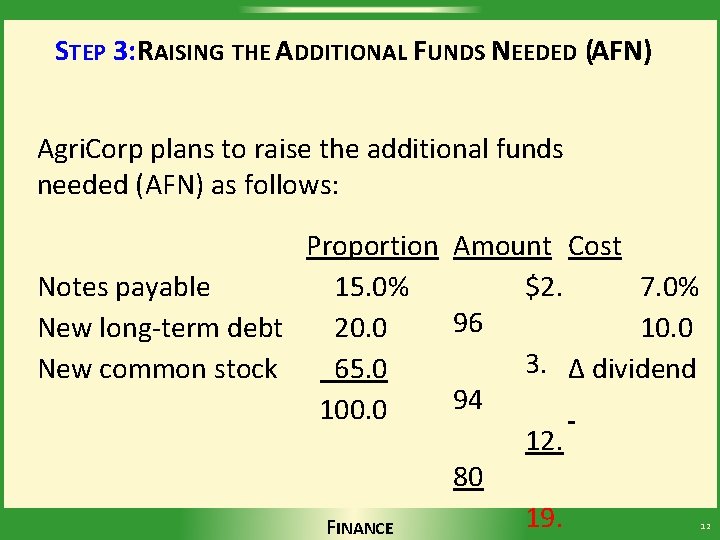
STEP 3: RAISING THE ADDITIONAL FUNDS NEEDED (AFN) Agri. Corp plans to raise the additional funds needed (AFN) as follows: Proportion Amount Cost Notes payable 15. 0% $2. 7. 0% 96 New long-term debt 20. 0 10. 0 3. Δ dividend New common stock 65. 0 94 100. 0 12. 80 19. FINANCE 12
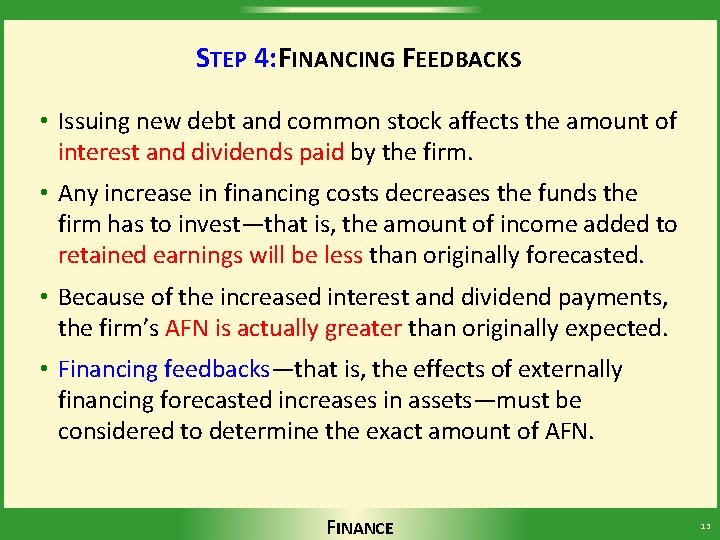
STEP 4: FINANCING FEEDBACKS • Issuing new debt and common stock affects the amount of interest and dividends paid by the firm. • Any increase in financing costs decreases the funds the firm has to invest—that is, the amount of income added to retained earnings will be less than originally forecasted. • Because of the increased interest and dividend payments, the firm’s AFN is actually greater than originally expected. • Financing feedbacks—that is, the effects of externally financing forecasted increases in assets—must be considered to determine the exact amount of AFN. FINANCE 13
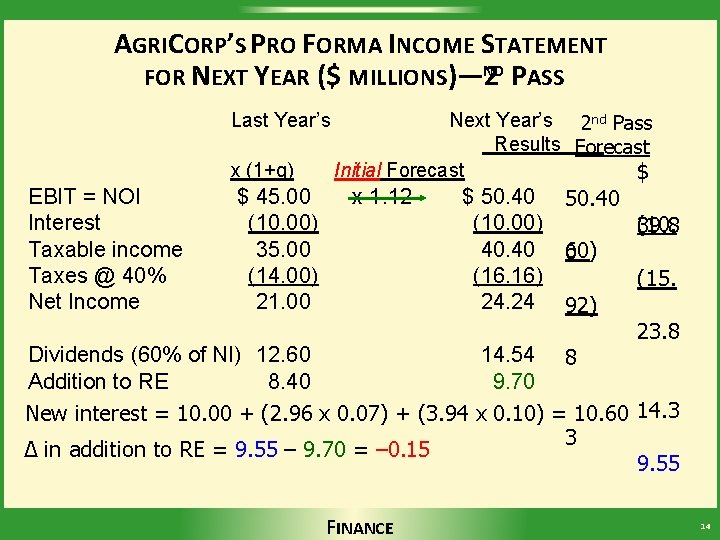
AGRICORP’S PRO FORMA INCOME STATEMENT ND FOR NEXT YEAR ($ MILLIONS)— 2 PASS Last Year’s x (1+g) EBIT = NOI Interest Taxable income Taxes @ 40% Net Income $ 45. 00 (10. 00) 35. 00 (14. 00) 21. 00 Next Year’s 2 nd Pass Results Forecast Initial Forecast $ x 1. 12 $ 50. 40 (10. 00) 40. 40 (16. 16) 24. 24 50. 40 60) 0 92) (10. 39. 8 (15. 23. 8 Dividends (60% of NI) 12. 60 14. 54 8 Addition to RE 8. 40 9. 70 New interest = 10. 00 + (2. 96 x 0. 07) + (3. 94 x 0. 10) = 10. 60 14. 3 3 Δ in addition to RE = 9. 55 – 9. 70 = – 0. 15 9. 55 FINANCE 14
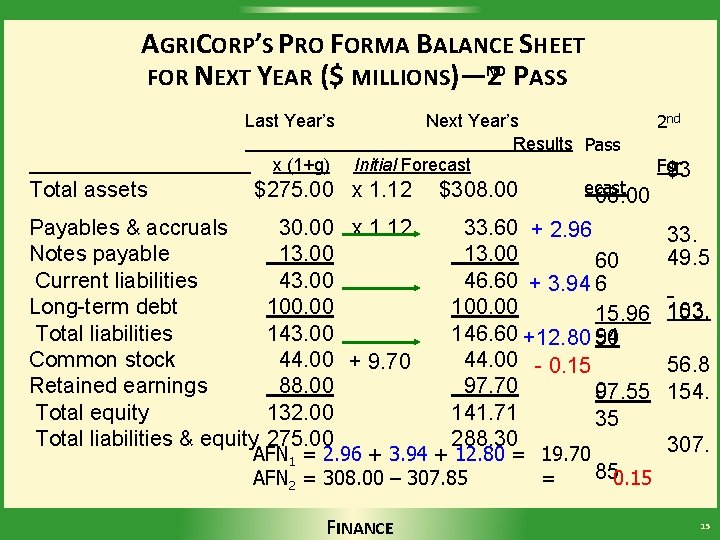
AGRICORP’S PRO FORMA BALANCE SHEET ND FOR NEXT YEAR ($ MILLIONS)— 2 PASS Last Year’s x (1+g) Total assets $275. 00 Payables & accruals Notes payable Current liabilities Long-term debt Total liabilities Common stock Retained earnings Total equity Total liabilities & equity Next Year’s Results Pass Initial Forecast x 1. 12 $308. 00 30. 00 x 1. 12 13. 00 43. 00 100. 00 143. 00 44. 00 + 9. 70 88. 00 132. 00 275. 00 2 nd For $3 08. 00 33. 60 + 2. 96 13. 00 60 46. 60 + 3. 94 6 100. 00 15. 96 146. 60 +12. 80 50 94 44. 00 - 0. 15 97. 70 0 97. 55 141. 71 35 288. 30 AFN 1 = 2. 96 + 3. 94 + 12. 80 = 19. 70 850. 15 AFN = 308. 00 – 307. 85 = 33. 49. 5 103. 153. 56. 8 154. 307. 2 FINANCE 15
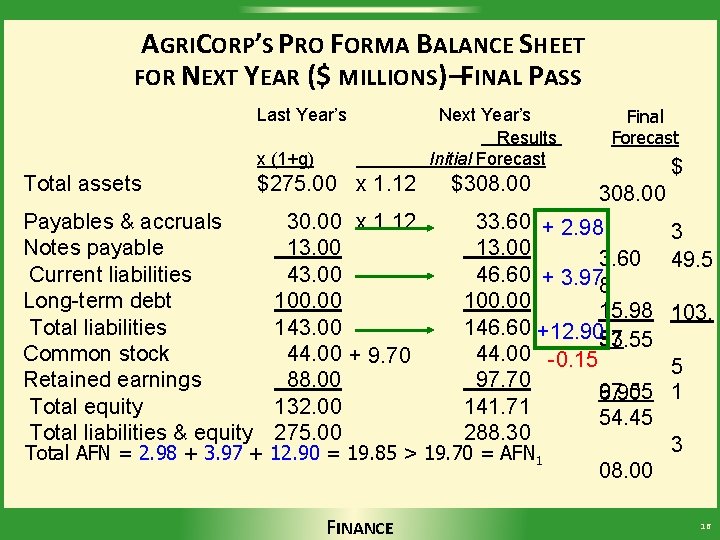
AGRICORP’S PRO FORMA BALANCE SHEET FOR NEXT YEAR ($ MILLIONS)— FINAL PASS Last Year’s x (1+g) Total assets Payables & accruals Notes payable Current liabilities Long-term debt Total liabilities Common stock Retained earnings Total equity Total liabilities & equity $275. 00 x 1. 12 30. 00 x 1. 12 13. 00 43. 00 100. 00 143. 00 44. 00 + 9. 70 88. 00 132. 00 275. 00 Next Year’s Results Initial Forecast $308. 00 $ 308. 00 33. 60 + 2. 98 13. 00 3. 60 46. 60 + 3. 97 8 100. 00 15. 98 146. 60 +12. 90 97 53. 55 44. 00 -0. 15 97. 70 97. 55 6. 90 141. 71 54. 45 288. 30 Total AFN = 2. 98 + 3. 97 + 12. 90 = 19. 85 > 19. 70 = AFN 1 FINANCE Final Forecast 3 49. 5 103. 1 5 1 3 08. 00 16
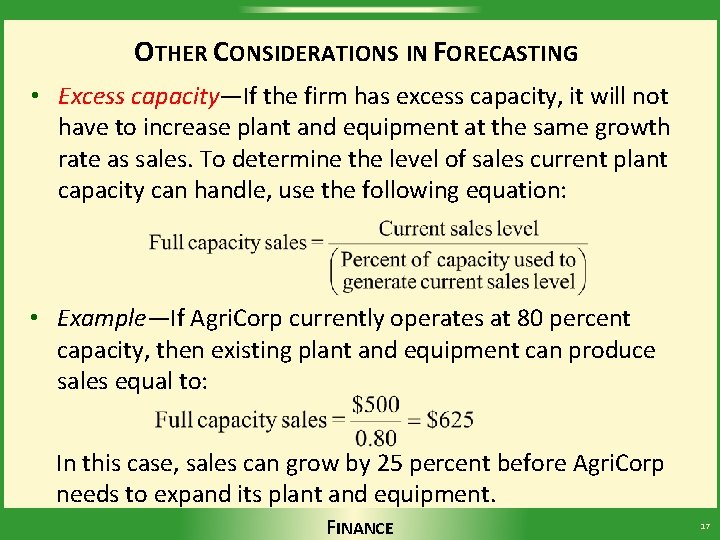
OTHER CONSIDERATIONS IN FORECASTING • Excess capacity—If the firm has excess capacity, it will not have to increase plant and equipment at the same growth rate as sales. To determine the level of sales current plant capacity can handle, use the following equation: • Example—If Agri. Corp currently operates at 80 percent capacity, then existing plant and equipment can produce sales equal to: In this case, sales can grow by 25 percent before Agri. Corp needs to expand its plant and equipment. FINANCE 17
OTHER CONSIDERATIONS IN FORECASTING • Excess capacity—If the firm has excess capacity, it will not have to increase plant and equipment at the same growth rate as sales. • Economies of scale—If economies of scale exist, the variable cost ratio might change with changes in production activity. • Lumpy assets—Many assets are not completely divisible § some assets might have to be purchased in larger increments than the firm would prefer § “lumpy assets” must be purchased in discrete increments, say, $10 million per addition, which means we cannot simply increase assets by a growth rate like 12 percent FINANCE 18
FINANCIAL CONTROL • Proper financial control helps to ensure the firm meets the expectations developed in the planning stage, and, when results fall short of expectations, helps management determine the reasons. FINANCE 19
BREAKEVEN ANALYSIS AND LEVERAGE ANALYSIS • Breakeven analysis—evaluation of the level of operations to determine the ability of the firm to generate profits • Leverage analysis—examination as to how well the firm can cover its fixed costs, both operating and financial; gives an indication of risk FINANCE 20
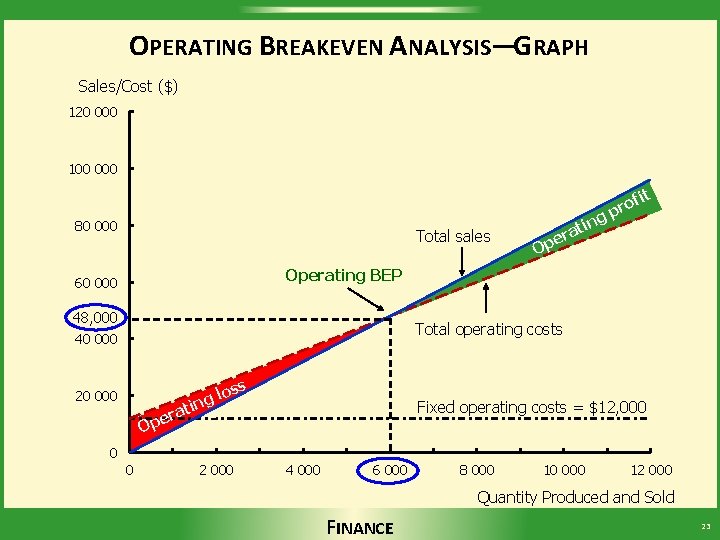
OPERATING BREAKEVEN ANALYSIS • Operating breakeven point is defined as the level of operations where the net operating income, NOI = EBIT, equals zero—that is, NOI = 0 • At the operating breakeven point: Total operating costs = sales revenues FINANCE 21
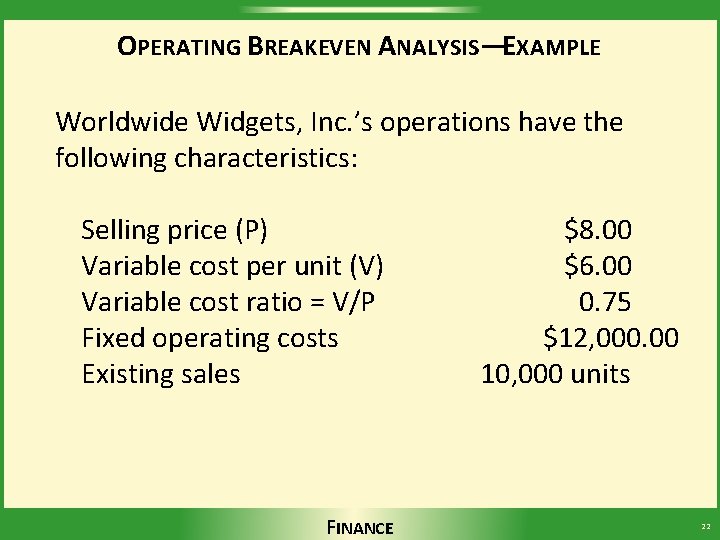
OPERATING BREAKEVEN ANALYSIS—EXAMPLE Worldwide Widgets, Inc. ’s operations have the following characteristics: Selling price (P) Variable cost per unit (V) Variable cost ratio = V/P Fixed operating costs Existing sales FINANCE $8. 00 $6. 00 0. 75 $12, 000. 00 10, 000 units 22
OPERATING BREAKEVEN ANALYSIS—GRAPH Sales/Cost ($) 120 000 100 000 it 80 000 Total sales ing t a er f pro Op Operating BEP 60 000 48, 000 Total operating costs 40 000 s 20 000 los g tin Fixed operating costs = $12, 000 a per O 0 0 2 000 4 000 6 000 8 000 10 000 12 000 Quantity Produced and Sold FINANCE 23
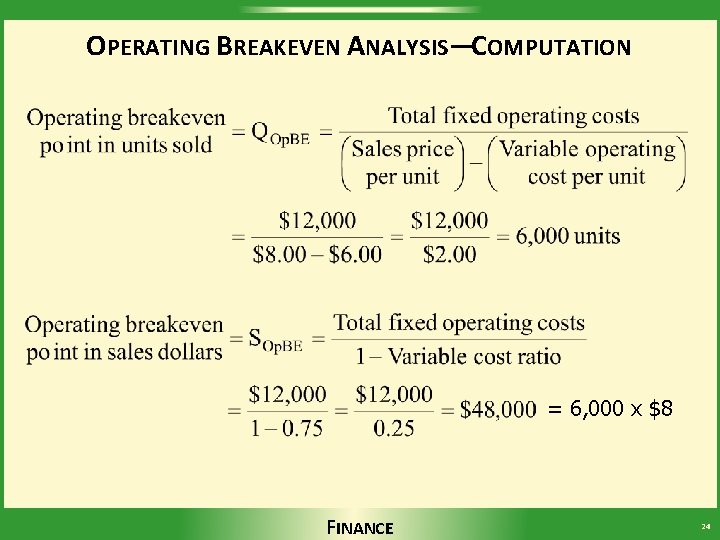
OPERATING BREAKEVEN ANALYSIS—COMPUTATION = 6, 000 x $8 FINANCE 24
OPERATING BREAKEVEN ANALYSIS—USES • Determine the level of sales a product must achieve to make a profit. • Indicate the impact of general growth on the cost structure of the firm. • Show modernization to improve efficiency affects fixed and variable costs, thus profitability of operations FINANCE 25
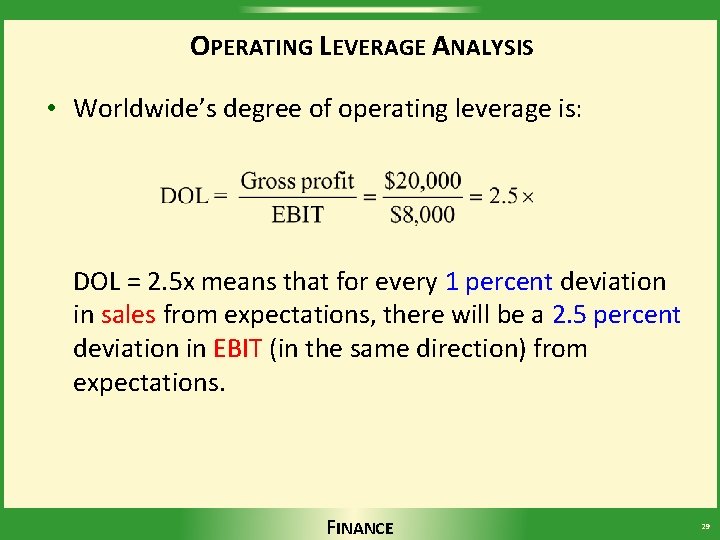
OPERATING LEVERAGE ANALYSIS • In business, leverage refers to the existence of fixed costs. • The presence of any leverage (operating or financial) means that a change in sales will result in a larger change in operating income (EBIT), net income, or both. • Operating leverage exists if fixed operating costs, such as depreciation, are present. • The degree of operating leverage (DOL) is defined as the percent change in net operating income, NOI, that results from a particular percent change in sales. FINANCE 26
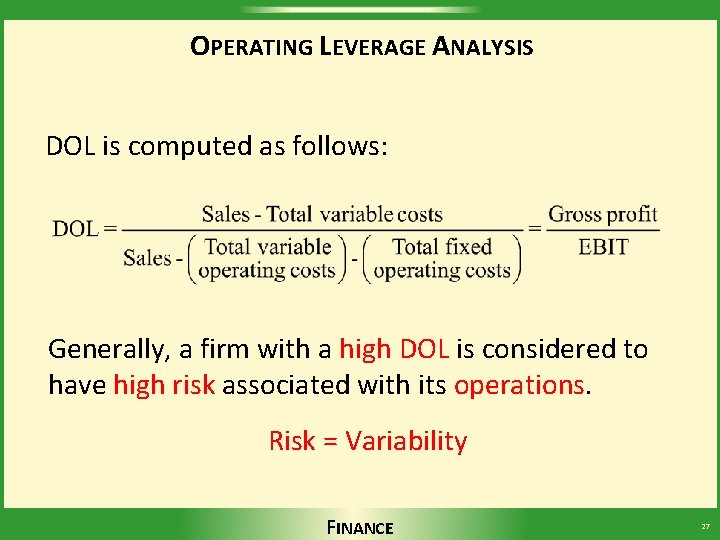
OPERATING LEVERAGE ANALYSIS DOL is computed as follows: Generally, a firm with a high DOL is considered to have high risk associated with its operations. Risk = Variability FINANCE 27
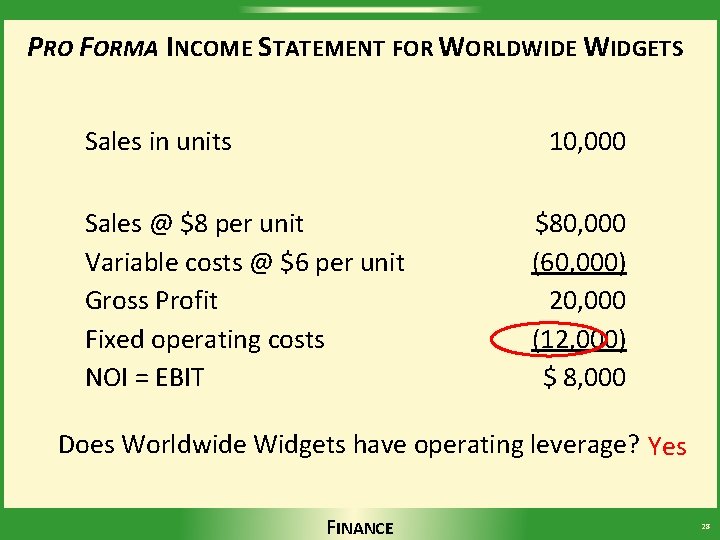
PRO FORMA INCOME STATEMENT FOR WORLDWIDE WIDGETS Sales in units 10, 000 Sales @ $8 per unit Variable costs @ $6 per unit Gross Profit Fixed operating costs NOI = EBIT $80, 000 (60, 000) 20, 000 (12, 000) $ 8, 000 Does Worldwide Widgets have operating leverage? Yes FINANCE 28
OPERATING LEVERAGE ANALYSIS • Worldwide’s degree of operating leverage is: DOL = 2. 5 x means that for every 1 percent deviation in sales from expectations, there will be a 2. 5 percent deviation in EBIT (in the same direction) from expectations. FINANCE 29
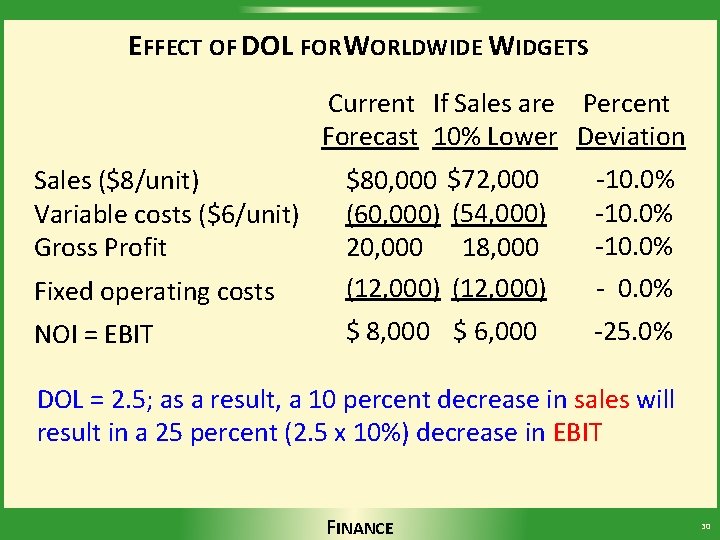
EFFECT OF DOL FOR WORLDWIDE WIDGETS Current If Sales are Percent Forecast 10% Lower Deviation -10. 0% Fixed operating costs $80, 000 $72, 000 (60, 000) (54, 000) 20, 000 18, 000 (12, 000) NOI = EBIT $ 8, 000 $ 6, 000 -25. 0% Sales ($8/unit) Variable costs ($6/unit) Gross Profit - 0. 0% DOL = 2. 5; as a result, a 10 percent decrease in sales will result in a 25 percent (2. 5 x 10%) decrease in EBIT FINANCE 30
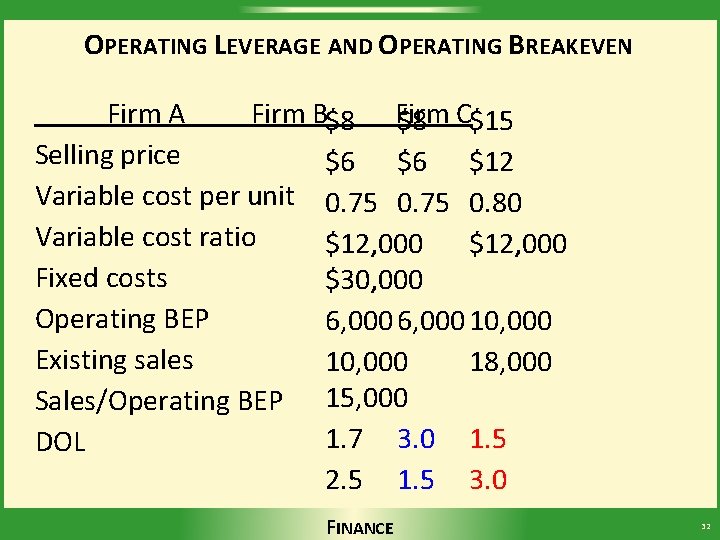
OPERATING LEVERAGE AND OPERATING BREAKEVEN • Generally, a higher degree of operating leverage (DOL) implies that greater risk is associated with the firm’s operations. • Risk is variability. • The closer the firm operates to its breakeven point, the riskier its operations are considered. • Everything else equal, firms with higher DOLs operate closer to their operating breakeven points, and thus cannot cover fixed operating costs as easily as firms with lower DOLs. FINANCE 31
OPERATING LEVERAGE AND OPERATING BREAKEVEN Firm A Firm B$8 Firm $8 C$15 Selling price $6 $6 $12 Variable cost per unit 0. 75 0. 80 Variable cost ratio $12, 000 Fixed costs $30, 000 Operating BEP 6, 000 10, 000 Existing sales 10, 000 18, 000 Sales/Operating BEP 15, 000 1. 7 3. 0 1. 5 DOL 2. 5 1. 5 3. 0 FINANCE 32
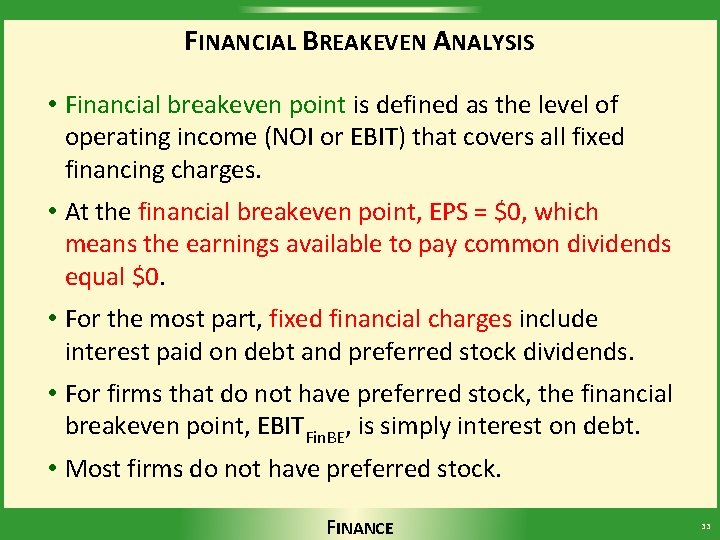
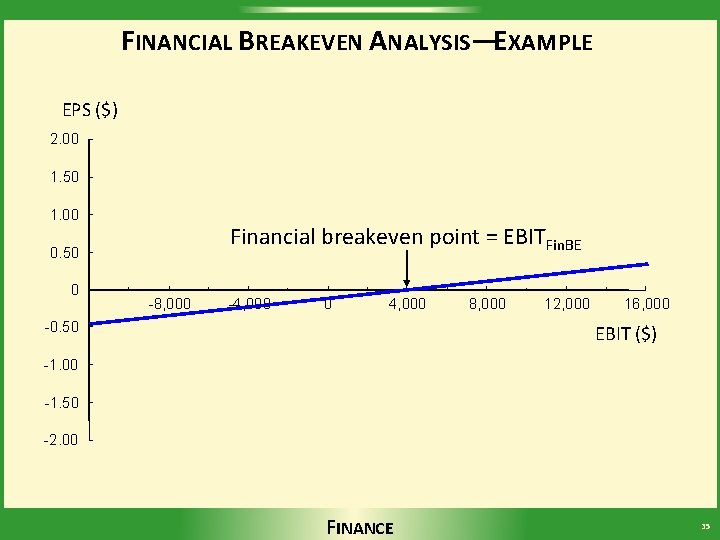
FINANCIAL BREAKEVEN ANALYSIS • Financial breakeven point is defined as the level of operating income (NOI or EBIT) that covers all fixed financing charges. • At the financial breakeven point, EPS = $0, which means the earnings available to pay common dividends equal $0. • For the most part, fixed financial charges include interest paid on debt and preferred stock dividends. • For firms that do not have preferred stock, the financial breakeven point, EBITFin. BE, is simply interest on debt. • Most firms do not have preferred stock. FINANCE 33
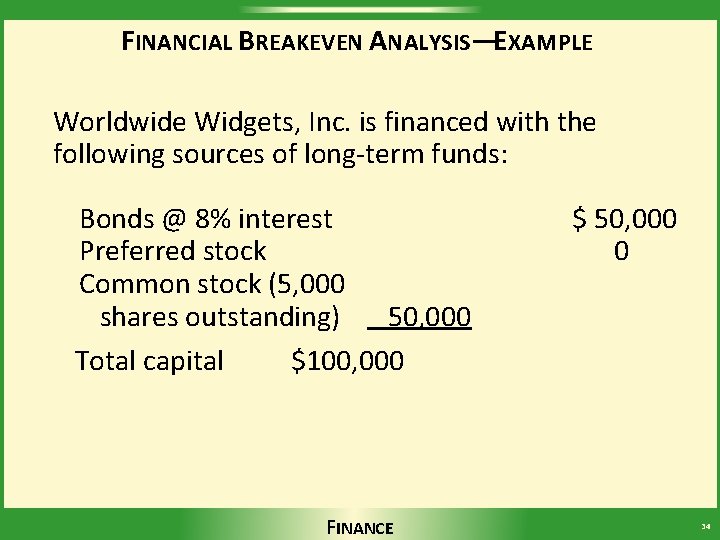
FINANCIAL BREAKEVEN ANALYSIS—EXAMPLE Worldwide Widgets, Inc. is financed with the following sources of long-term funds: Bonds @ 8% interest Preferred stock Common stock (5, 000 shares outstanding) 50, 000 Total capital $100, 000 FINANCE $ 50, 000 0 34
FINANCIAL BREAKEVEN ANALYSIS—EXAMPLE EPS ($) 2. 00 1. 50 1. 00 Financial breakeven point = EBITFin. BE 0. 50 0 -8, 000 -4, 000 0 4, 000 -0. 50 8, 000 12, 000 16, 000 EBIT ($) -1. 00 -1. 50 -2. 00 FINANCE 35
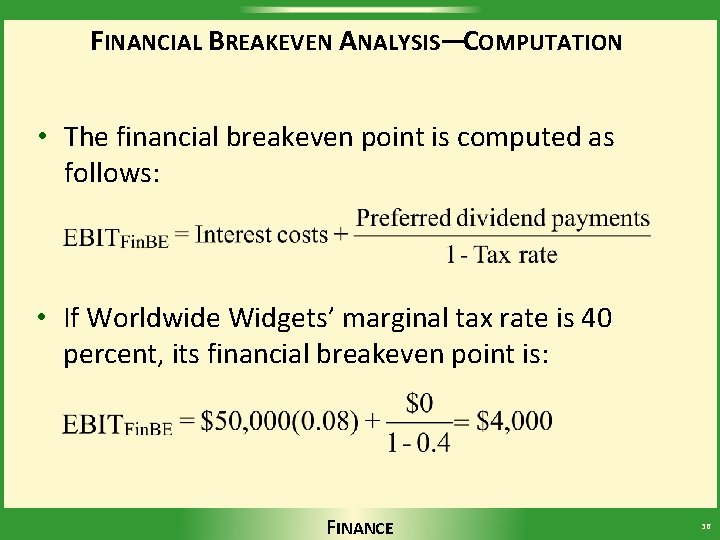
FINANCIAL BREAKEVEN ANALYSIS—COMPUTATION • The financial breakeven point is computed as follows: • If Worldwide Widgets’ marginal tax rate is 40 percent, its financial breakeven point is: FINANCE 36
FINANCIAL BREAKEVEN ANALYSIS—USES • Financial breakeven analysis gives an indication as to how the firm’s mix of debt and preferred stock (fixed financing) affects EPS (net income). FINANCE 37
FINANCIAL LEVERAGE ANALYSIS • Financial leverage exists if the firm has fixed financial charges: § interest on debt § preferred dividends • The degree of financial leverage (DFL) is the percent change in EPS that results from a particular percent change in net operating income. FINANCE 38
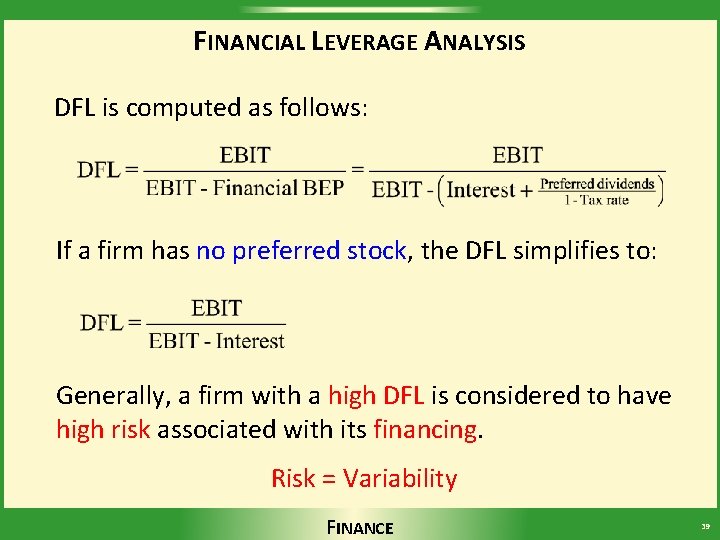
FINANCIAL LEVERAGE ANALYSIS DFL is computed as follows: If a firm has no preferred stock, the DFL simplifies to: Generally, a firm with a high DFL is considered to have high risk associated with its financing. Risk = Variability FINANCE 39
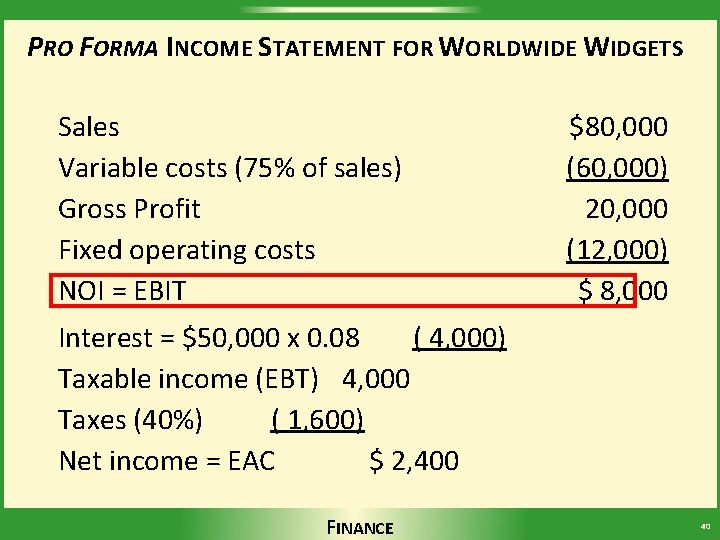
PRO FORMA INCOME STATEMENT FOR WORLDWIDE WIDGETS Sales Variable costs (75% of sales) Gross Profit Fixed operating costs NOI = EBIT $80, 000 (60, 000) 20, 000 (12, 000) $ 8, 000 Interest = $50, 000 x 0. 08 ( 4, 000) Taxable income (EBT) 4, 000 Taxes (40%) ( 1, 600) Net income = EAC $ 2, 400 FINANCE 40
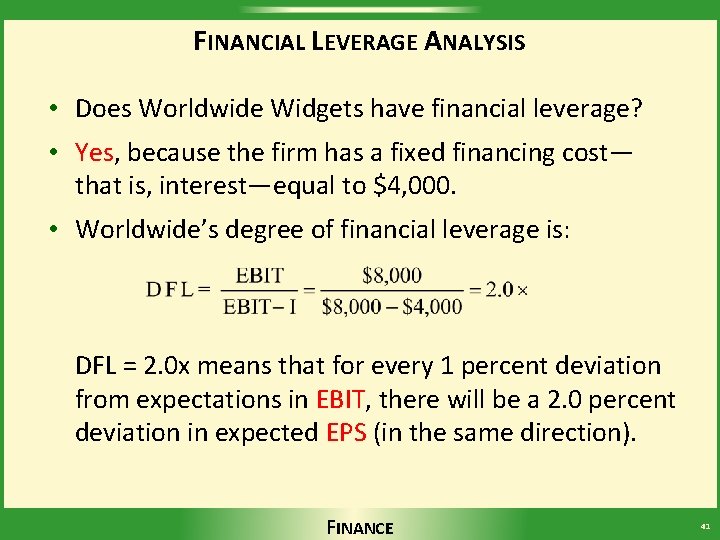
FINANCIAL LEVERAGE ANALYSIS • Does Worldwide Widgets have financial leverage? • Yes, because the firm has a fixed financing cost— that is, interest—equal to $4, 000. • Worldwide’s degree of financial leverage is: DFL = 2. 0 x means that for every 1 percent deviation from expectations in EBIT, there will be a 2. 0 percent deviation in expected EPS (in the same direction). FINANCE 41
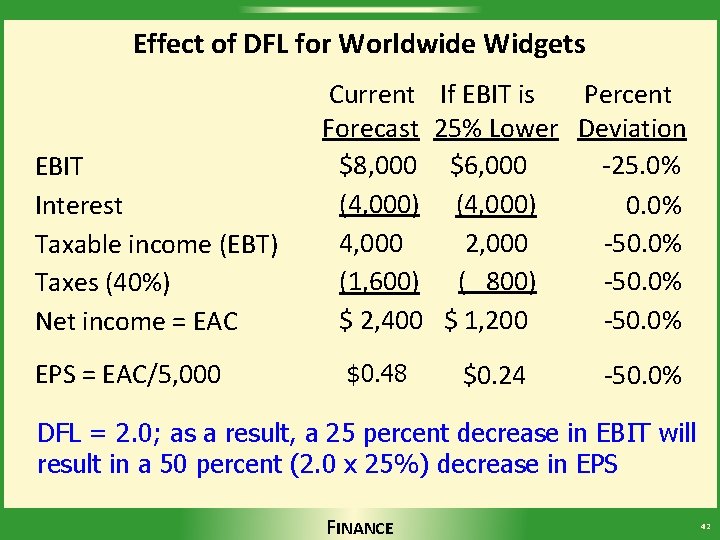
Effect of DFL for Worldwide Widgets EBIT Interest Taxable income (EBT) Taxes (40%) Net income = EAC EPS = EAC/5, 000 Current Forecast $8, 000 (4, 000) 4, 000 (1, 600) $ 2, 400 $0. 48 If EBIT is Percent 25% Lower Deviation -25. 0% $6, 000 (4, 000) 0. 0% -50. 0% 2, 000 -50. 0% ( 800) $ 1, 200 -50. 0% $0. 24 -50. 0% DFL = 2. 0; as a result, a 25 percent decrease in EBIT will result in a 50 percent (2. 0 x 25%) decrease in EPS FINANCE 42
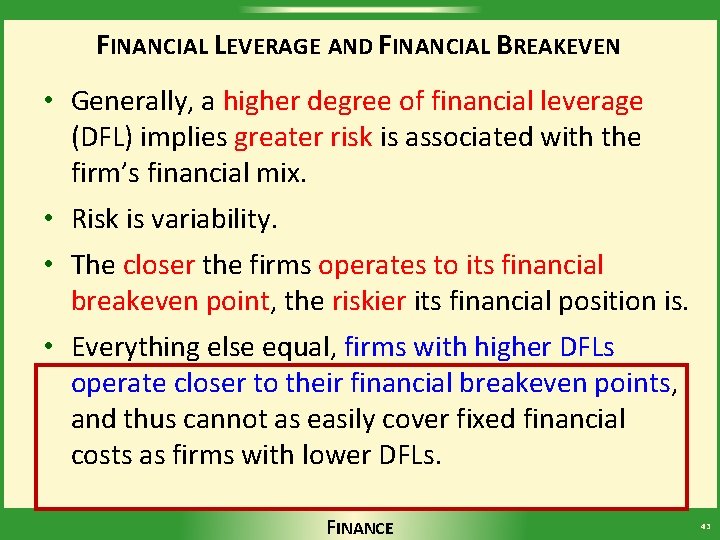
FINANCIAL LEVERAGE AND FINANCIAL BREAKEVEN • Generally, a higher degree of financial leverage (DFL) implies greater risk is associated with the firm’s financial mix. • Risk is variability. • The closer the firms operates to its financial breakeven point, the riskier its financial position is. • Everything else equal, firms with higher DFLs operate closer to their financial breakeven points, and thus cannot as easily cover fixed financial costs as firms with lower DFLs. FINANCE 43
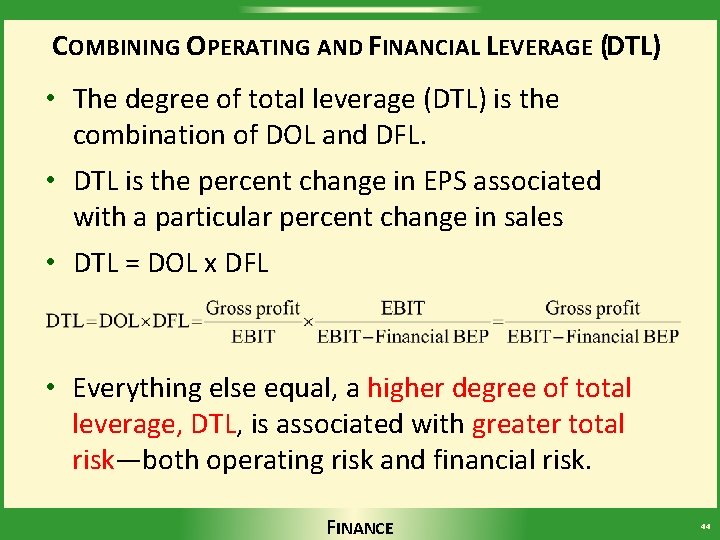
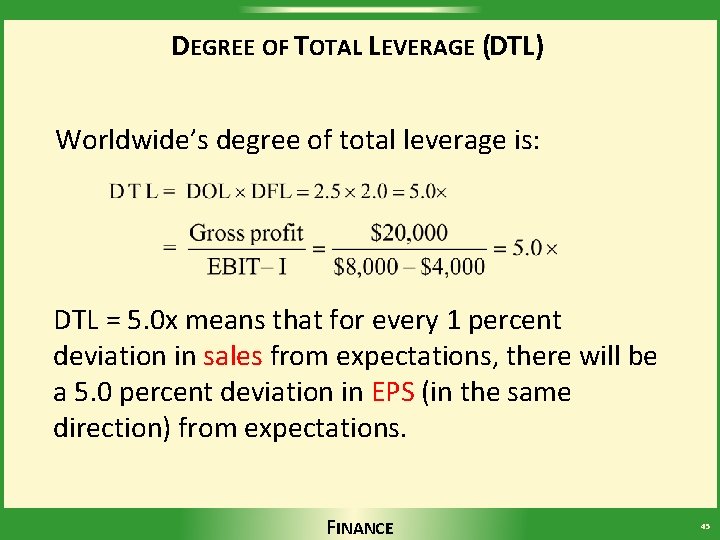
COMBINING OPERATING AND FINANCIAL LEVERAGE (DTL) • The degree of total leverage (DTL) is the combination of DOL and DFL. • DTL is the percent change in EPS associated with a particular percent change in sales • DTL = DOL x DFL • Everything else equal, a higher degree of total leverage, DTL, is associated with greater total risk—both operating risk and financial risk. FINANCE 44
DEGREE OF TOTAL LEVERAGE (DTL) Worldwide’s degree of total leverage is: DTL = 5. 0 x means that for every 1 percent deviation in sales from expectations, there will be a 5. 0 percent deviation in EPS (in the same direction) from expectations. FINANCE 45
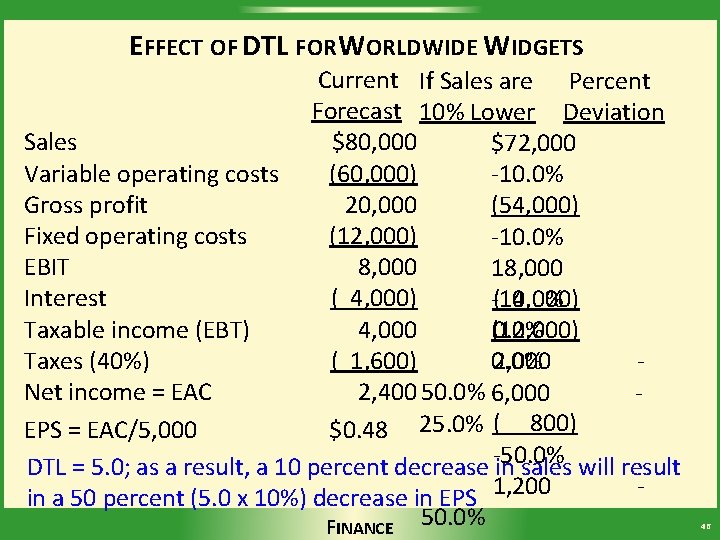
EFFECT OF DTL FOR WORLDWIDE WIDGETS Current If Sales are Percent Forecast 10% Lower Deviation Sales $80, 000 $72, 000 Variable operating costs (60, 000) -10. 0% Gross profit 20, 000 (54, 000) Fixed operating costs (12, 000) -10. 0% EBIT 8, 000 18, 000 Interest ( 4, 000) -10. 0% Taxable income (EBT) 4, 000 0. 0% (12, 000) Taxes (40%) ( 1, 600) 2, 000 0. 0% Net income = EAC 2, 400 50. 0% 6, 000 EPS = EAC/5, 000 $0. 48 25. 0% ( 800) DTL = 5. 0; as a result, a 10 percent decrease -50. 0% in sales will result in a 50 percent (5. 0 x 10%) decrease in EPS 1, 200 FINANCE 50. 0% 46
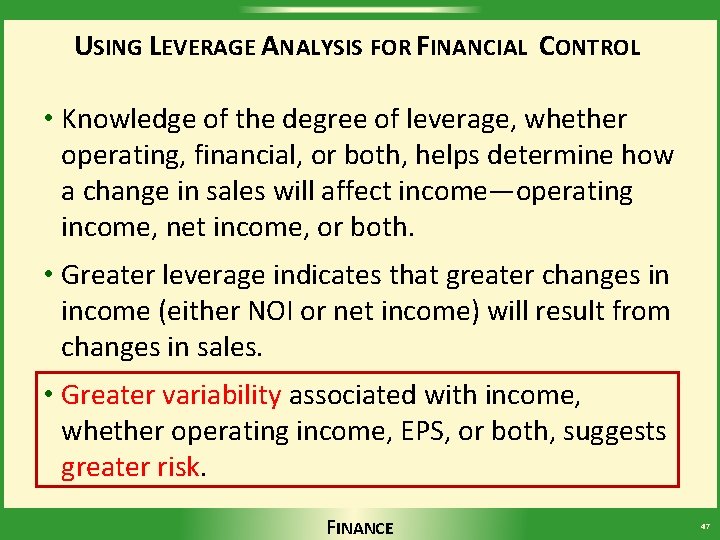
USING LEVERAGE ANALYSIS FOR FINANCIAL CONTROL • Knowledge of the degree of leverage, whether operating, financial, or both, helps determine how a change in sales will affect income—operating income, net income, or both. • Greater leverage indicates that greater changes in income (either NOI or net income) will result from changes in sales. • Greater variability associated with income, whether operating income, EPS, or both, suggests greater risk. FINANCE 47
CHAPTER 16 QUESTIONS 1. Why should firms construct pro forma (forecasted) financial statements? 2. How does a firm construct pro forma financial statements? 3. What are some other factors that should be considered when constructing pro forma financial statements? 4. Why is financial control an important ingredient in financial planning? 5. How are breakeven analysis and leverage analysis used in the financial control process? 6. Explain how profits or losses will be magnified for a firm with high leverage (operating, financial, or both) as opposed to a firm with low leverage. FINANCE 48