
Financial Planning and Control Chapter 8 Financial Planning





- Slides: 36
Financial Planning and Control Chapter 8
Financial Planning u The projection of sales, income, and assets based on alternative production and marketing strategies, as well as the determination of the resources needed to achieve these projections
Financial Control u The phase in which financial plans are implemented u Control deals with the feedback and adjustment process required to ensure adherence to plans and modification of plans because of unforeseen changes
Sales Forecasts u A forecast of a firm’s unit and dollar sales for some future period
Sales Forecasts u A forecast of a firm’s unit and dollar sales for some future period u Generally based on recent sales trends plus forecasts of the economic prospects for the nation, region, industry, and so forth
Projected (Pro Forma) Financial Statements u Project the asset requirements for the coming period, then project the liabilities and equity that will be generated under normal operations, and subtract the projected liabilities and equity from the required assets to estimate the additional funds needed (AFN) to support the level of forecasted operations
Projected Balance Sheet Method u A method of forecasting financial requirements based on forecasted financial statements F 1. Forecast the Income Statement F 2. Forecast the Balance Sheet v Adjust for spontaneously generated funds obtained from routine business transactions
Projected Balance Sheet Method u A method of forecasting financial requirements based on forecasted financial statements F 1. Forecast the Income Statement F 2. Forecast the Balance Sheet F 3. Determine how to raise the additional funds needed
Projected Balance Sheet Method u A method of forecasting financial requirements based on forecasted financial statements F 1. Forecast the Income Statement F 2. Forecast the Balance Sheet F 3. Determine how to raise the additional funds needed F 4. Financing feedbacks
Projected Balance Sheet Method u Financing feedbacks are the effects on the income statement and balance sheet of actions taken to finance forecasted increases in assets
Projected (Pro Forma) Financial Statements u Analysis of the forecast F determine if the forecast meets the firm’s financial targets F planned management changes must be incorporated into the forecasts F iterative process
Other Considerations in Forecasting u Excess capacity
Other Considerations in Forecasting u Economies of scale F variable cost of goods sold ratio changes with size of the firm F this affects the addition to retained earnings, and thus the AFN
Other Considerations in Forecasting u Lumpy assets F assets that cannot be acquired in small increments, but must be obtained in large, discrete amounts
Other Considerations in Forecasting u Lumpy assets F assets that cannot be acquired in small increments, but must be obtained in large, discrete amounts F small increase in sales can require significant increase in plant and equipment
Financial Control Budgeting and Leverage u Relationship between sales volume and profitability under different operating conditions u Control phase and process
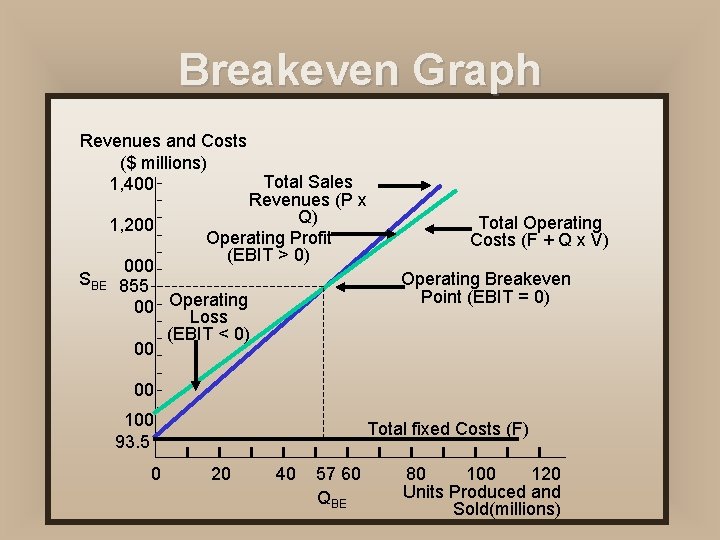
Operating Breakeven Analysis u An analytical technique for studying the relationship among sales revenues, operating costs, and profits u Only deals with the operating section of the income statement
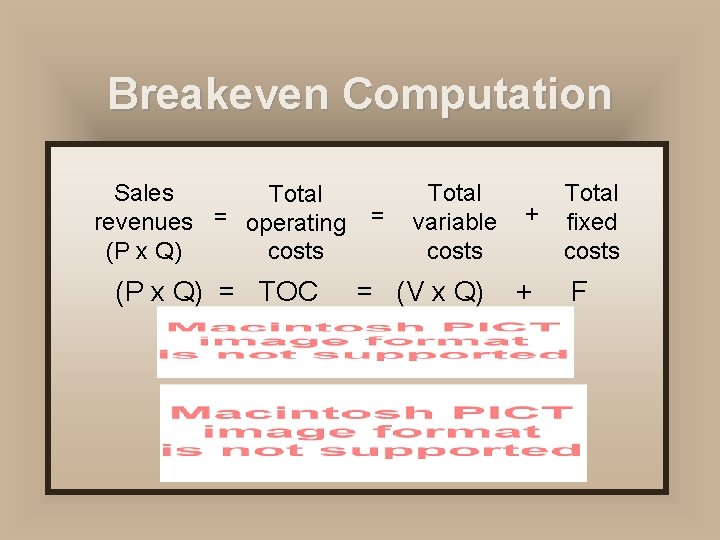
Operating Breakeven Analysis u Operating breakeven point F represents the level of production and sales where operating income is zero F the point where revenues from sales just equal total operating costs
Breakeven Graph Revenues and Costs ($ millions) Total Sales 1, 400 Revenues (P x Q) Total Operating 1, 200 Operating Profit Costs (F + Q x V) (EBIT > 0) 000 SBE 855 Operating Breakeven Point (EBIT = 0) 00 - Operating - Loss - (EBIT < 0) 00 00 100 Total fixed Costs (F) 93. 5 0 20 40 57 60 QBE 80 100 120 Units Produced and Sold(millions)
Breakeven Computation Sales Total revenues = operating (P x Q) costs (P x Q) = TOC = Total variable costs = (V x Q) + + Total fixed costs F
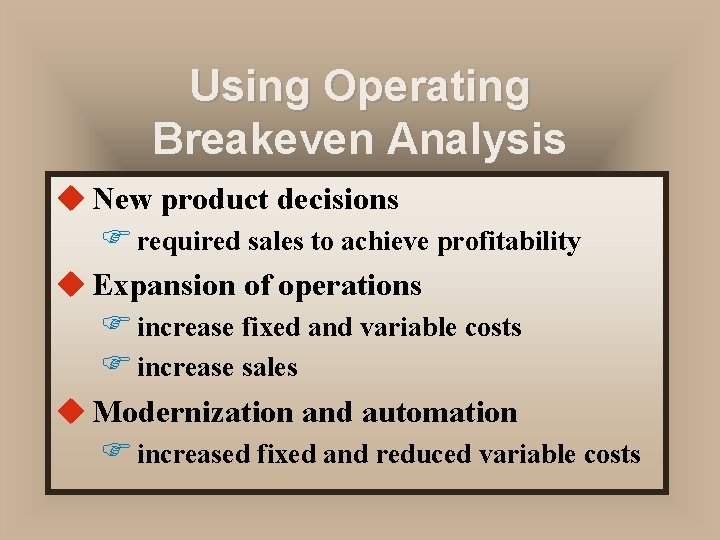
Using Operating Breakeven Analysis u New product decisions F required sales to achieve profitability u Expansion of operations F increase fixed and variable costs F increase sales u Modernization and automation F increased fixed and reduced variable costs
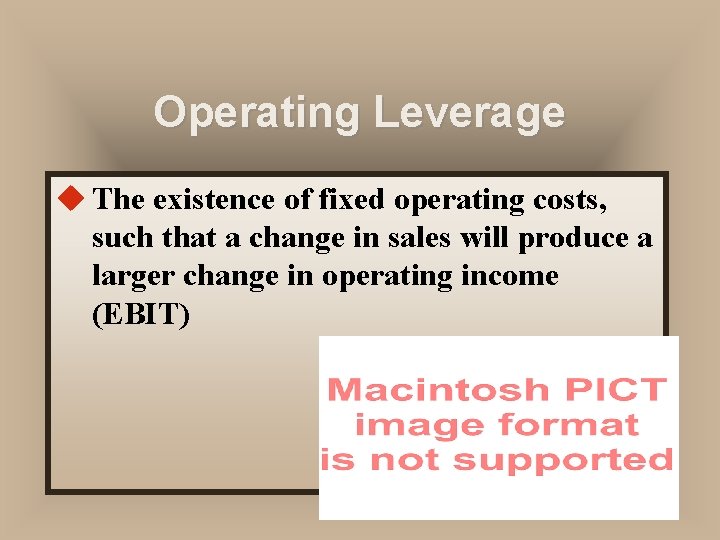
Operating Leverage u The existence of fixed operating costs, such that a change in sales will produce a larger change in operating income (EBIT)
Operating Leverage u Degree of operating leverage (DOL) F the percentage change in NOI (or EBIT) associated with a given percentage change in sales
Operating Leverage
Operating Leverage u Operating leverage and operating breakeven F higher operating leverage increases operating breakeven point
Financial Leverage u The existence of fixed financial costs such as interest u When a change in EBIT results in a larger change in EPS
Financial Leverage u Degree of financial leverage (DFL) F the percentage change in EPS that results from a given percentage change in EBIT
Financial Leverage
Combining Operating and Financial Leverage u The greater degree of operating leverage, or fixed operating costs for a particular level of operations, the more sensitive EBIT will be to changes in sales volume
Combining Operating and Financial Leverage u The greater degree of operating leverage, or fixed operating costs for a particular level of operations, the more sensitive EBIT will be to changes in sales volume u The greater the degree of financial leverage (or fixed financial costs for a particular level of operations), the more sensitive EPS will be to changes in EBIT
Combining Operating and Financial Leverage u If a firm has a considerable amount of both operating and financial leverage, then a small change in sales will lead to wide fluctuations in EPS u Degree of total leverage (DTL) F the percentage change in EPS resulting from a change in sales
Combining Operating and Financial Leverage
Using Leverage and Forecasting for Control u Changes in operations affect income, which impacts on the balance sheet and the financing needs of the firm u Forecasted results and their impact can be adjusted ahead of time u Feedback needs evaluated
Cash Budgeting u Cash budget F a schedule showing cash receipts, cash disbursements, and cash balances for a firm over a specified time period u Target (minimum) cash budget F the minimum cash balance a firm desires to maintain in order to conduct business
Cash Budgeting u Disbursements and receipts method (scheduling) F the net cash flow is determined by estimating the cash disbursements and the cash receipts expected to be generated each period
End of Chapter 8 Financial Planning and Control