
Financial Performance Mark FieldingPritchard 1 Objectives Drucker Market

Financial Performance Mark Fielding-Pritchard 1
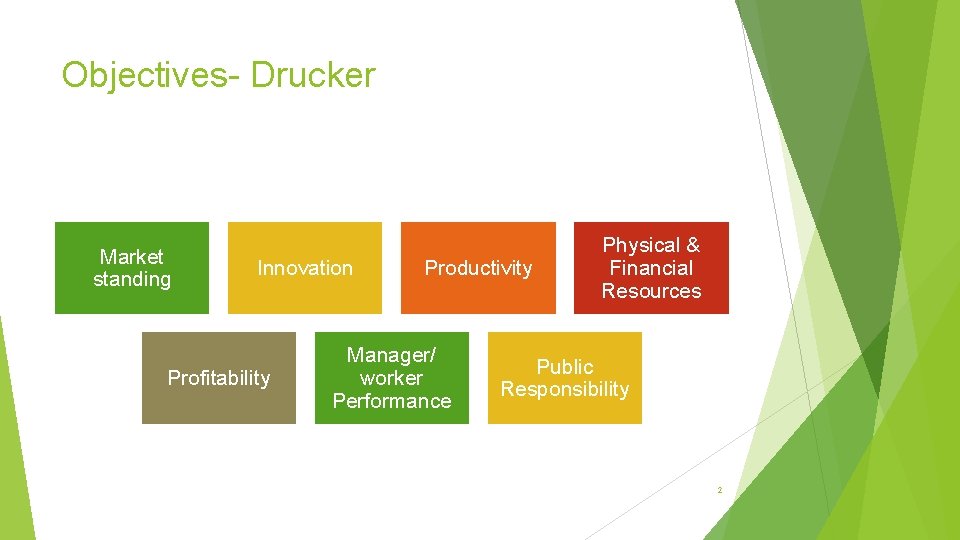
Objectives- Drucker Market standing Innovation Profitability Productivity Manager/ worker Performance Physical & Financial Resources Public Responsibility 2
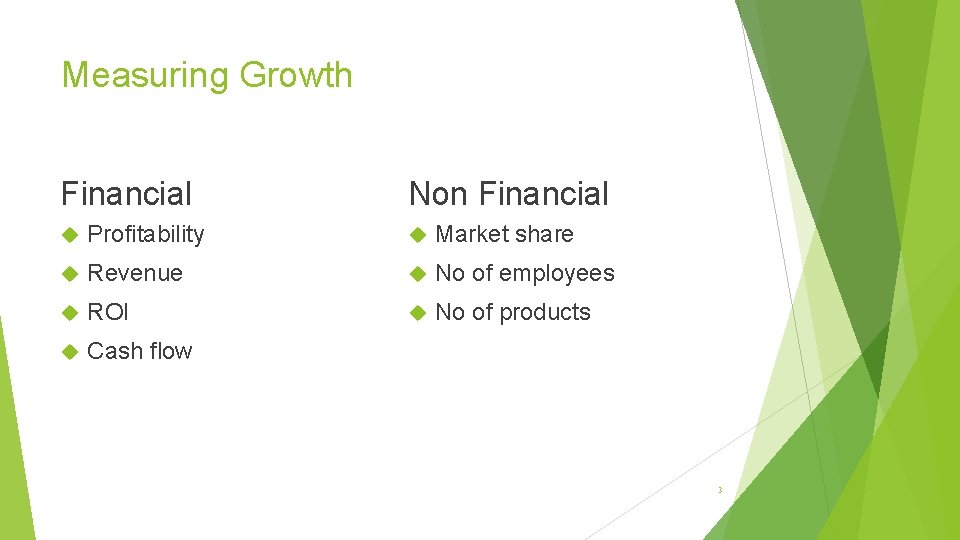
Measuring Growth Financial Non Financial Profitability Market share Revenue No of employees ROI No of products Cash flow 3
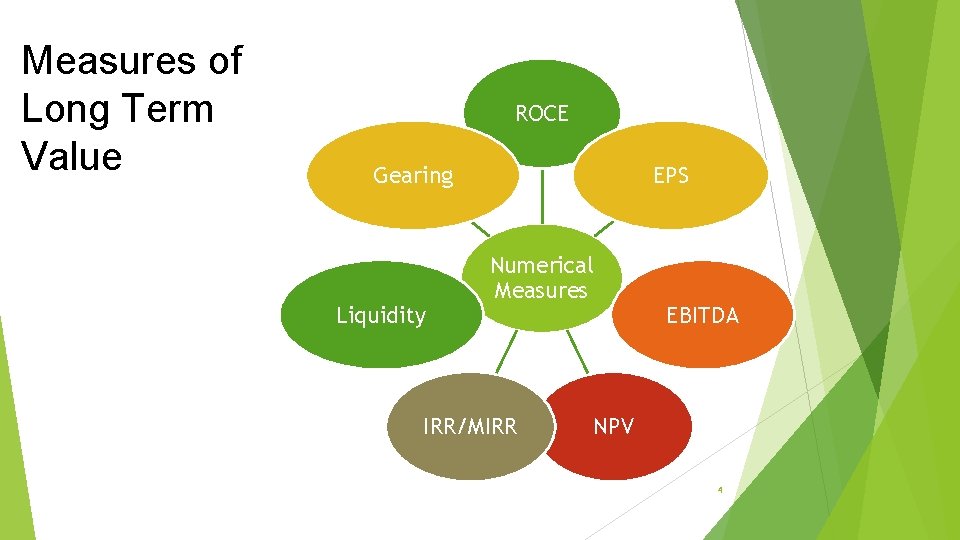
Measures of Long Term Value ROCE Gearing Liquidity EPS Numerical Measures IRR/MIRR EBITDA NPV 4
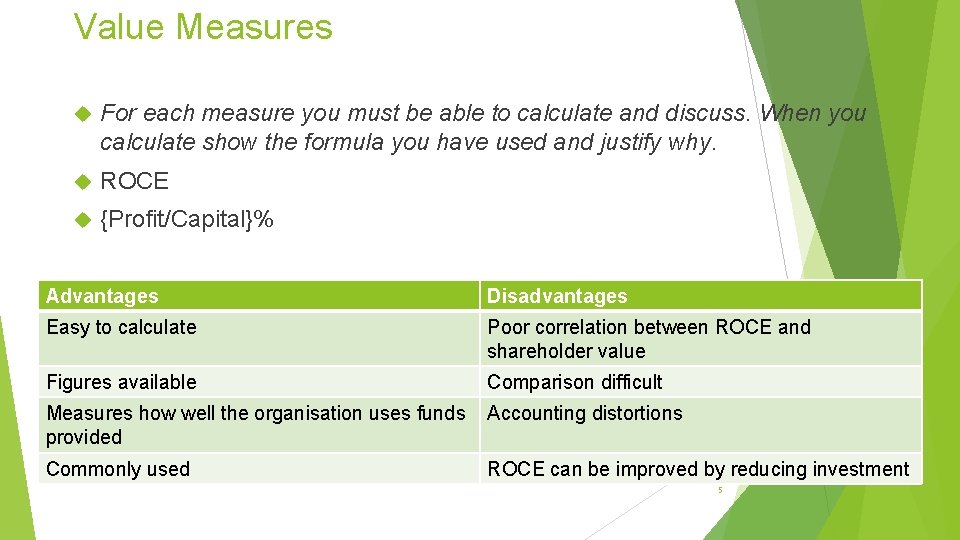
Value Measures For each measure you must be able to calculate and discuss. When you calculate show the formula you have used and justify why. ROCE {Profit/Capital}% Advantages Disadvantages Easy to calculate Poor correlation between ROCE and shareholder value Figures available Comparison difficult Measures how well the organisation uses funds provided Accounting distortions Commonly used ROCE can be improved by reducing investment 5
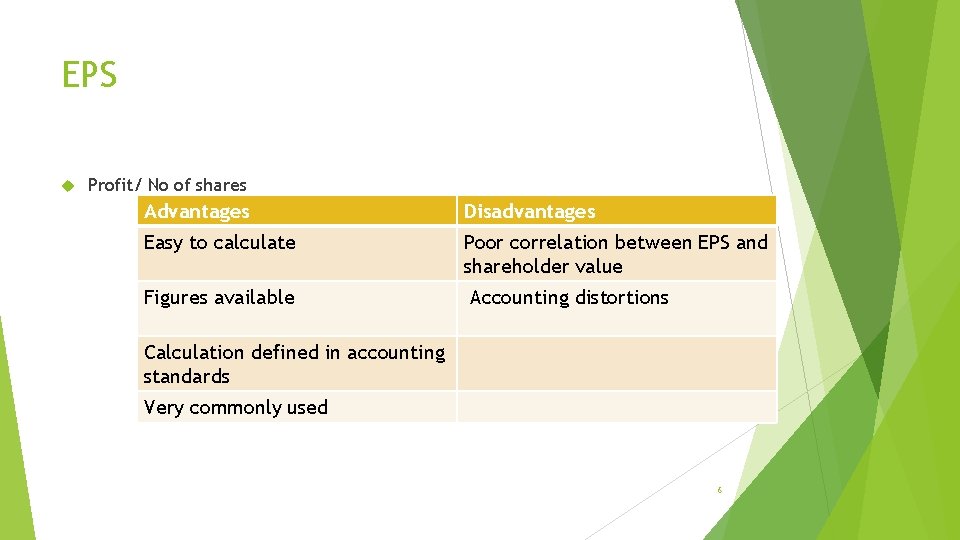
EPS Profit/ No of shares Advantages Disadvantages Easy to calculate Poor correlation between EPS and shareholder value Figures available Accounting distortions Calculation defined in accounting standards Very commonly used 6
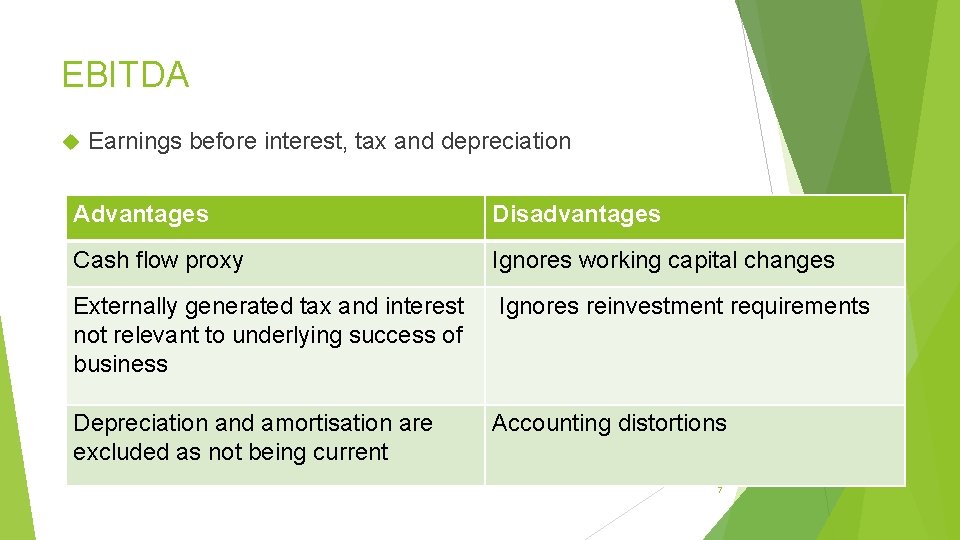
EBITDA Earnings before interest, tax and depreciation Advantages Disadvantages Cash flow proxy Ignores working capital changes Externally generated tax and interest not relevant to underlying success of business Ignores reinvestment requirements Depreciation and amortisation are excluded as not being current Accounting distortions 7
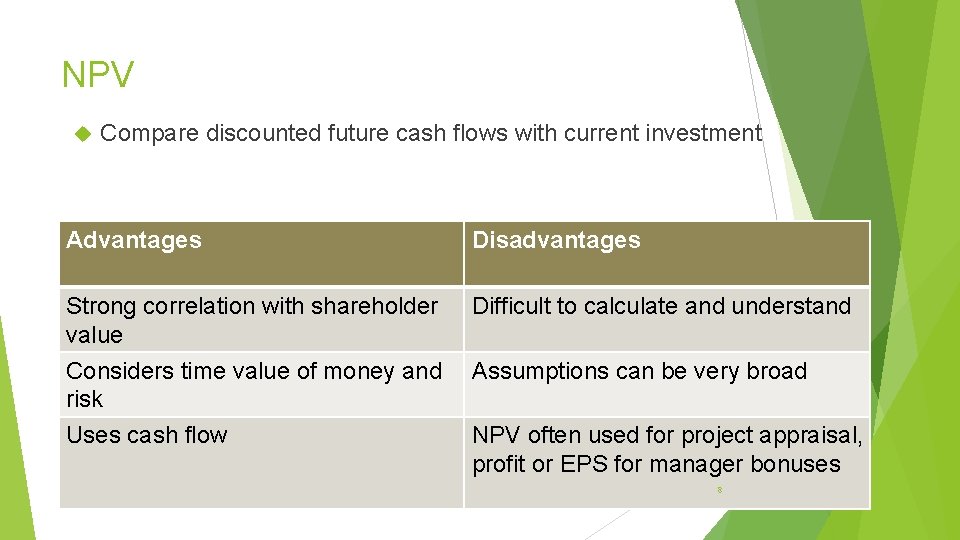
NPV Compare discounted future cash flows with current investment Advantages Disadvantages Strong correlation with shareholder value Difficult to calculate and understand Considers time value of money and risk Uses cash flow Assumptions can be very broad NPV often used for project appraisal, profit or EPS for manager bonuses 8
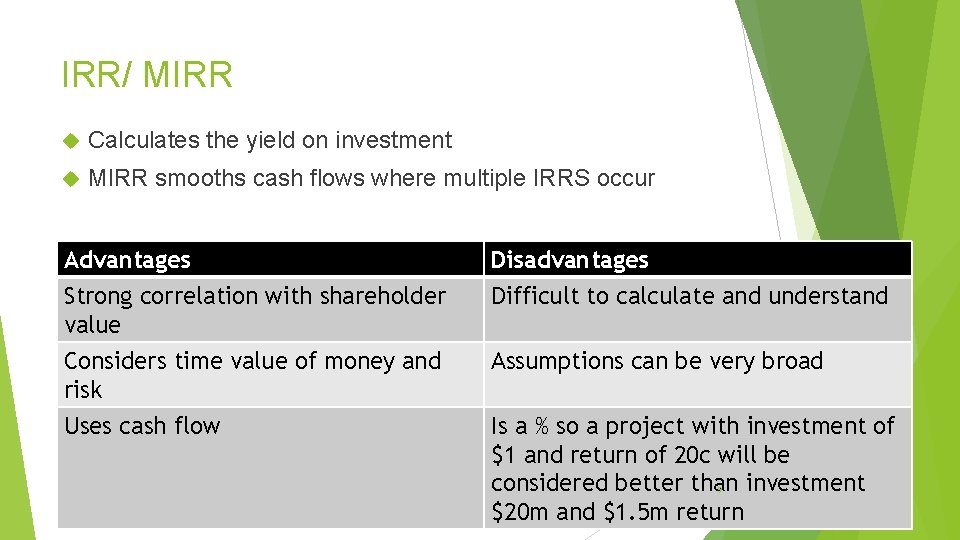
IRR/ MIRR Calculates the yield on investment MIRR smooths cash flows where multiple IRRS occur Advantages Strong correlation with shareholder value Disadvantages Difficult to calculate and understand Considers time value of money and risk Assumptions can be very broad Uses cash flow Is a % so a project with investment of $1 and return of 20 c will be considered better than investment $20 m and $1. 5 m return 9
Liquidity Ratios Current Acid ratio Interest cover Gearing Working capital management ratios 10
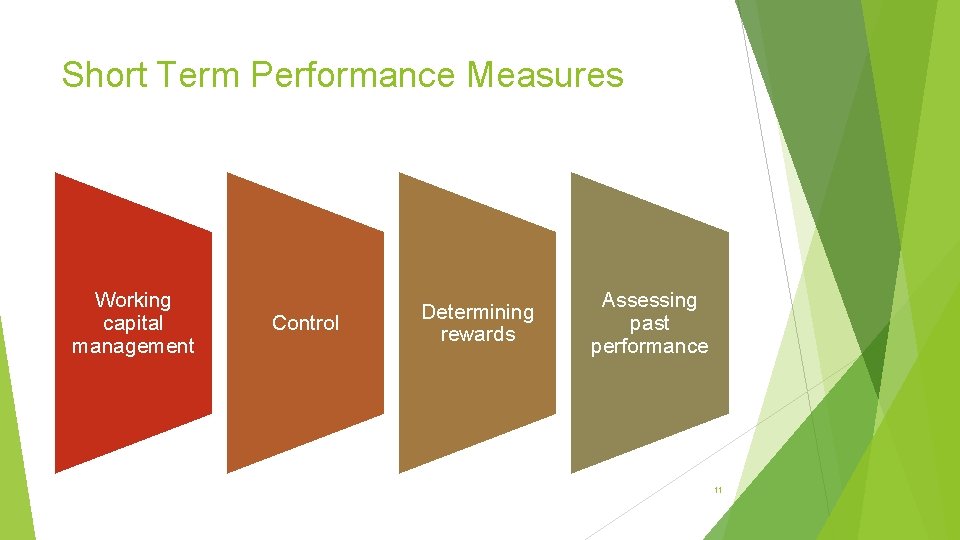
Short Term Performance Measures Working capital management Control Determining rewards Assessing past performance 11
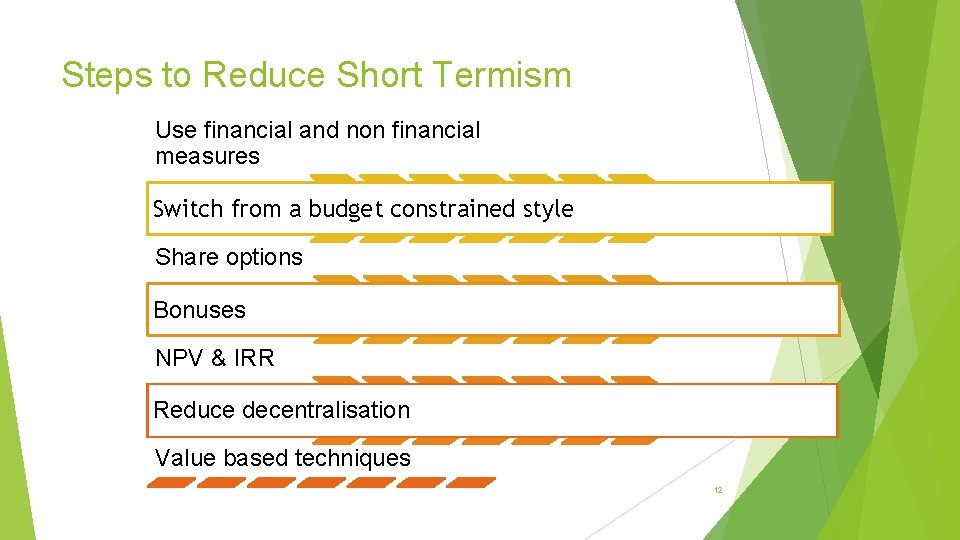
Steps to Reduce Short Termism Use financial and non financial measures Switch from a budget constrained style Share options Bonuses NPV & IRR Reduce decentralisation Value based techniques 12
Q 45 Bettaserve Mission Statement a formal summary of the aims and values of a company, organization, or individual "a mission statement to which all employees can subscribe“ Should be Succinct Memorable Enduring Guide for employees Addressed to all stakeholders 13
Mission Statement Examples BBC- inform, educate, entertain Pepsi, beat Coke Microsoft- to enable people and business throughout the world to realise their full potential 14

Q 45 Bettaserve Own Key concept & mission competitors Own strategies 15
Q 45 Bettaserve ii) Marketing We see market share increasing so the increase in quality is acting as a marketing tool in itself Financial The growth in sales is matched by a fall in total costs so profitability rises as does cycle time Sales rise from 30 m to 40 m, costs fall from 28. 2 m to 25. 1 m 16
Q 45 Bettaserve iii) Quality The whole project is driven by quality. The project is t provide not only the products customers require but to ensure that corrective work is reduced. We see this in services without rectification falling from 5% to 2% with a decline in costs from 0. 9 m to 0. 2 m Delivery is part of the quality function. We see delivery time met rising from 90% to 99% External effectiveness here means customer satisfaction 17
Q 45 Bettaserve iv) Internal Efficiencies Cycle Time CT reduces from 6 weeks to 5, that will only happen with increased efficiency. Increased efficiency will bing the cost reductions shown from 28. 2 m to 25. 1 m Waste The increased efficiencies result in sales enquiries not taken up falling from 7. 5% to 2. 5% and idle time falling from 10 to 2% 18
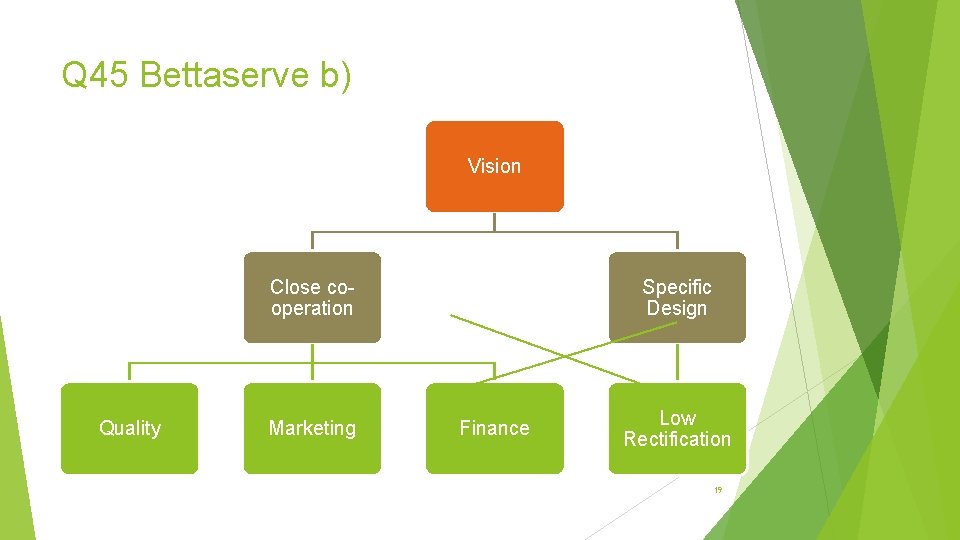
Q 45 Bettaserve b) Vision Close cooperation Quality Marketing Specific Design Finance Low Rectification 19
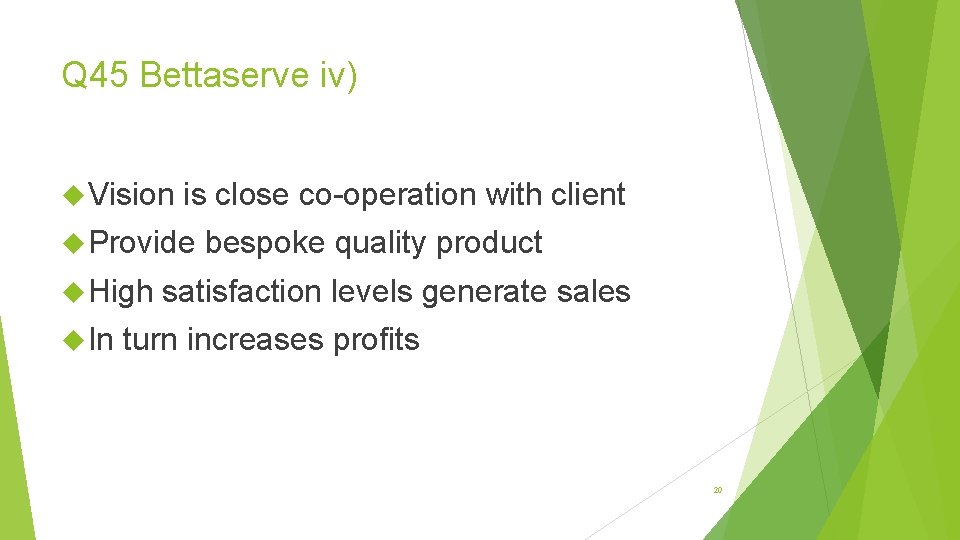
Q 45 Bettaserve iv) Vision is close co-operation with client Provide High In bespoke quality product satisfaction levels generate sales turn increases profits 20
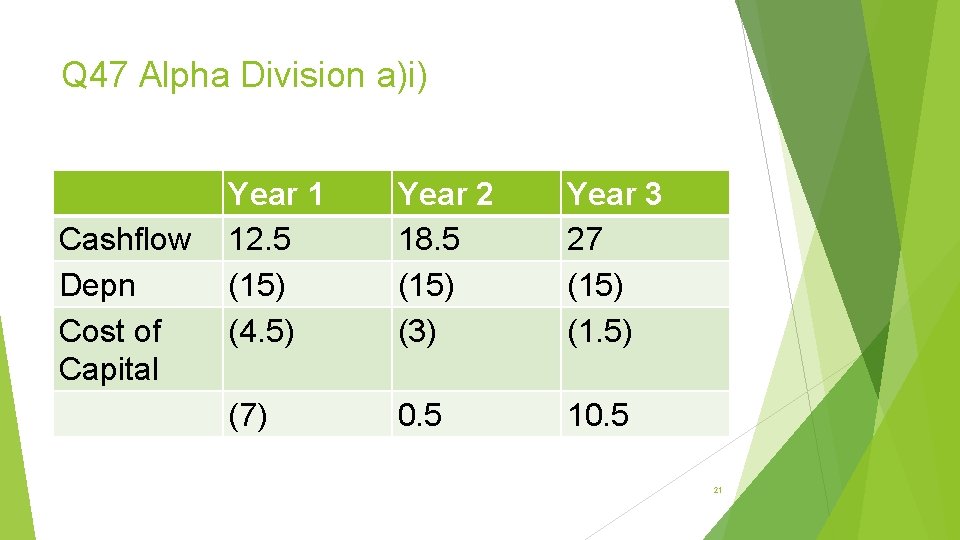
Q 47 Alpha Division a)i) Cashflow Depn Cost of Capital Year 1 12. 5 (15) (4. 5) Year 2 18. 5 (15) (3) Year 3 27 (15) (1. 5) (7) 0. 5 10. 5 21
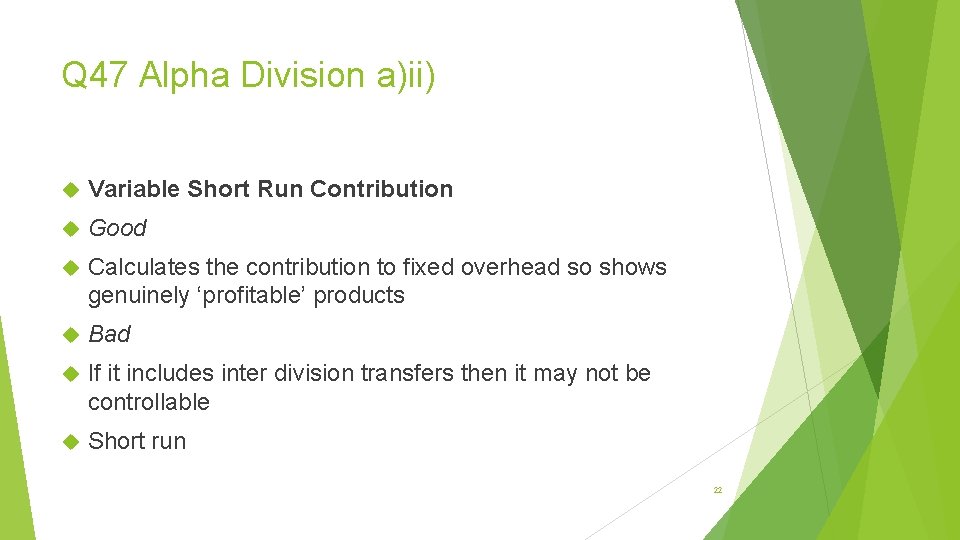
Q 47 Alpha Division a)ii) Variable Short Run Contribution Good Calculates the contribution to fixed overhead so shows genuinely ‘profitable’ products Bad If it includes inter division transfers then it may not be controllable Short run 22
Q 47 Alpha Division a)ii) Controllable Profit Good Controllable Bad What is controllable and what is not? If HQ order labour cost reductions are those costs controllable? Short run 23
Q 47 Alpha Division a)ii) Divisional Profit Good Includes all costs Bad Depreciation and legal department costs are not controllable There may be disagreements on allocations of overheads 24
EVA In corporate finance, Economic Value Added (EVA), is an estimate of a firm's economic profit – being the value created in excess of the required return of the company's investors (being shareholders and debt holders). Quite simply, EVA is the profit earned by the firm less the cost of financing the firm's capital. The formula for calculating EVA is as follows: = Net Operating Profit After Taxes (NOPAT) - (Capital * Cost of Capital) 25
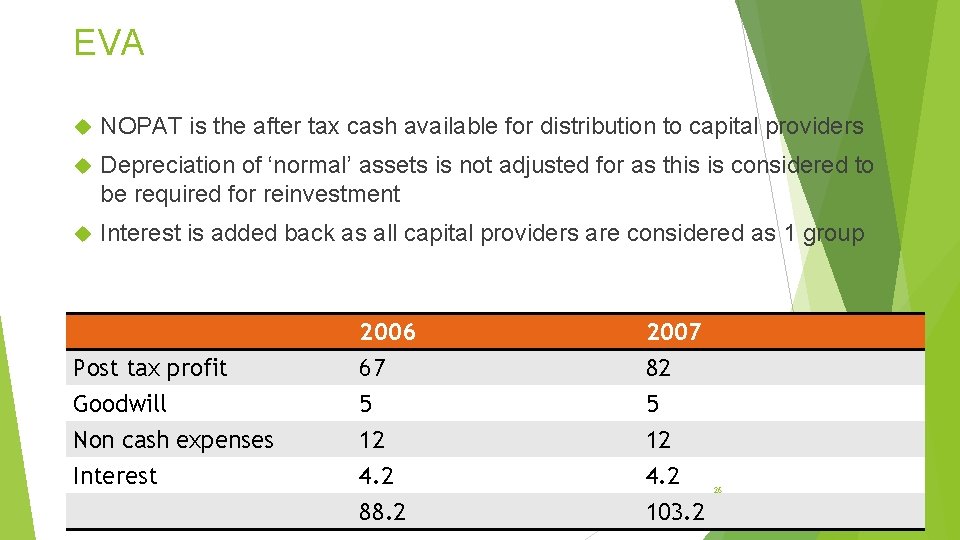
EVA NOPAT is the after tax cash available for distribution to capital providers Depreciation of ‘normal’ assets is not adjusted for as this is considered to be required for reinvestment Interest is added back as all capital providers are considered as 1 group Post tax profit Goodwill Non cash expenses Interest 2006 67 5 12 2007 82 5 12 4. 2 88. 2 4. 2 103. 2 26
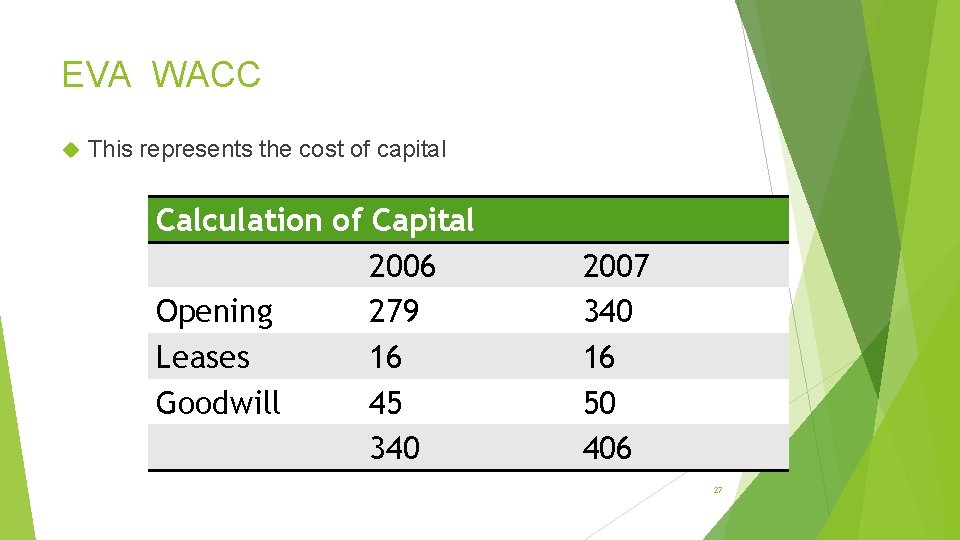
EVA WACC This represents the cost of capital Calculation of Capital 2006 Opening 279 Leases 16 Goodwill 45 340 2007 340 16 50 406 27
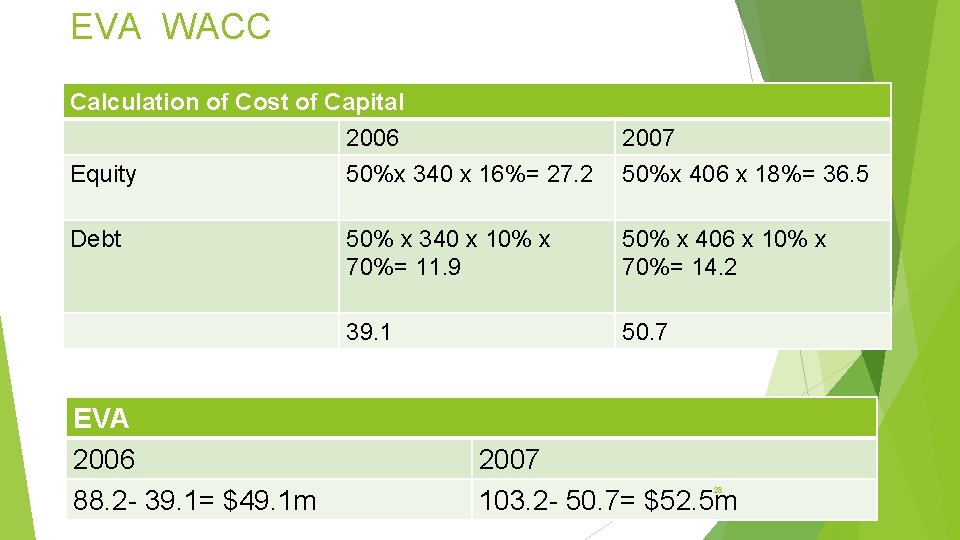
EVA WACC Calculation of Cost of Capital 2006 Equity 50%x 340 x 16%= 27. 2 Debt EVA 2006 88. 2 - 39. 1= $49. 1 m 2007 50%x 406 x 18%= 36. 5 50% x 340 x 10% x 70%= 11. 9 50% x 406 x 10% x 70%= 14. 2 39. 1 50. 7 2007 103. 2 - 50. 7= $52. 5 m 28
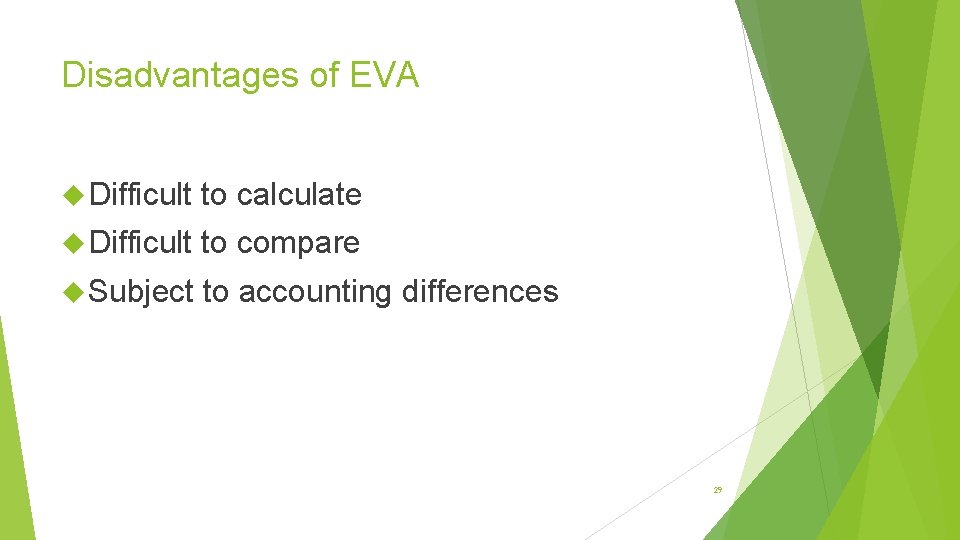
Disadvantages of EVA Difficult to calculate Difficult to compare Subject to accounting differences 29
- Slides: 29