
FINANCIAL MANAGERIAL ACCOUNTING for MBAs 5 e Peter
FINANCIAL & MANAGERIAL ACCOUNTING for MBAs 5 e Peter D. EASTON Robert F. HALSEY Mary Lea Mc. ANALLY Al L. HARTGRAVES Wayne J. MORSE MODULE 16 Cost-Volume-Profit Analysis and Planning © Cambridge Business Publishers, 2018
Learning Objective 1 Describe the uses and limitations of traditional -volume-profit analysis. © Cambridge Business Publishers, 2018 cost 2
Profitability Analysis § Involves examining the relationships among revenues, costs, and profits § Widely used in the economic evaluation of existing or proposed products or services § Performed before decisions are finalized What you need to understand to perform profitability analysis © Cambridge Business Publishers, 2018 § Selling prices § Behavior of activity cost drivers 3
Cost-Volume-Profit Analysis CVP A technique to examine the relationships among total volume of an independent variable, total costs, total revenues, and profits for a time period. § Useful in the early stages of planning § Provides an easily understood framework for discussing planning issues and organizing relevant data © Cambridge Business Publishers, 2018 4
CVP Use in For-Profit Companies § Provides answers to questions such as… § How many cappuccinos must Starbucks sell to earn total profit of $50, 000? § At what sales volume will Mc. Donald’s total revenues and total costs be equal? § What profit will Office Max earn at sales volume of $200 million? § What will happen to Disney’s profit if ticket selling prices are increased by 10% and fixed costs increase by 8%? © Cambridge Business Publishers, 2018 5
CVP Use in Not-For-Profit Companies § Used by not-for-profit entities to… § Establish service levels § Plan fund-raising events § Determine funding requirements § Answers questions such as… § How many homeless people can the Homeless Center house with a budget of $400, 000? § How much money must be raised from alumni at Princeton to provide 50 full scholarships? © Cambridge Business Publishers, 2018 6
CVP Assumptions 1. All costs are classified as fixed or variable. 2. The total cost function is linear within the relevant range. 3. The total revenue function is linear within the relevant range. 4. The analysis is for a single product, or the sales mix of multiple products is constant. 5. There is only one activity cost driver: unit or dollar sales volume. Accuracy decreases as the scope of operations being analyzed increases. © Cambridge Business Publishers, 2018 7
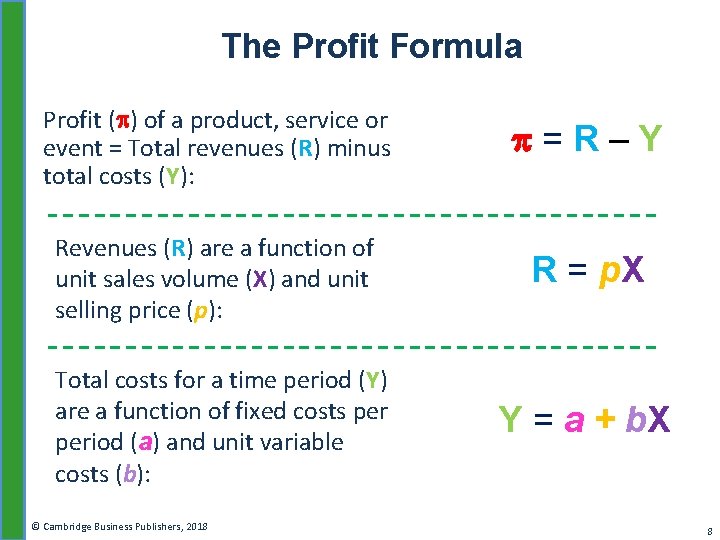
The Profit Formula Profit ( ) of a product, service or event = Total revenues (R) minus total costs (Y): =R–Y Revenues (R) are a function of unit sales volume (X) and unit selling price (p): R = p. X Total costs for a time period (Y) are a function of fixed costs period (a) and unit variable costs (b): Y = a + b. X © Cambridge Business Publishers, 2018 8
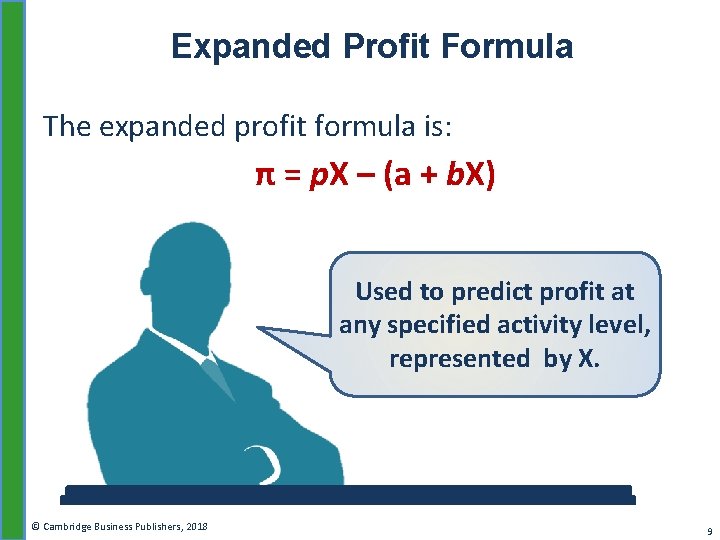
Expanded Profit Formula The expanded profit formula is: π = p. X – (a + b. X) Used to predict profit at any specified activity level, represented by X. © Cambridge Business Publishers, 2018 9
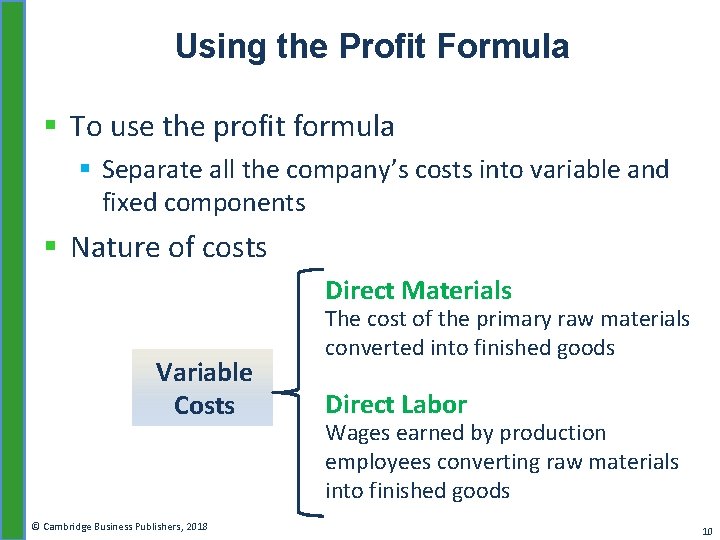
Using the Profit Formula § To use the profit formula § Separate all the company’s costs into variable and fixed components § Nature of costs Direct Materials Variable Costs © Cambridge Business Publishers, 2018 The cost of the primary raw materials converted into finished goods Direct Labor Wages earned by production employees converting raw materials into finished goods 10
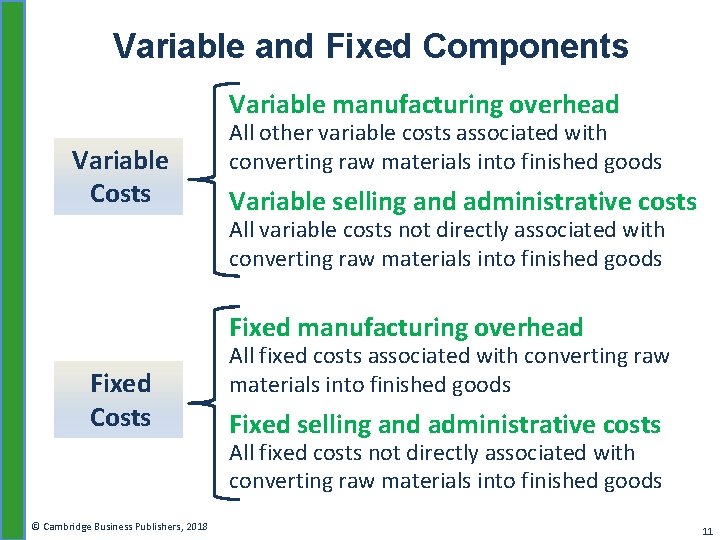
Variable and Fixed Components Variable manufacturing overhead Variable Costs All other variable costs associated with converting raw materials into finished goods Variable selling and administrative costs All variable costs not directly associated with converting raw materials into finished goods Fixed manufacturing overhead Fixed Costs All fixed costs associated with converting raw materials into finished goods Fixed selling and administrative costs All fixed costs not directly associated with converting raw materials into finished goods © Cambridge Business Publishers, 2018 11
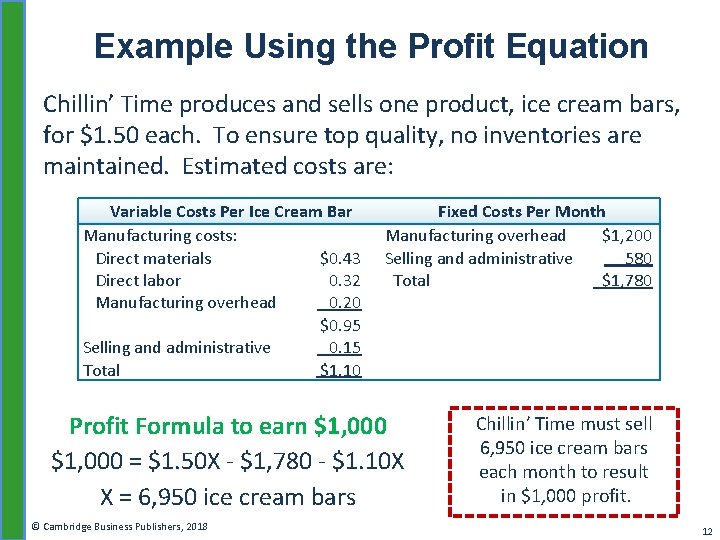
Example Using the Profit Equation Chillin’ Time produces and sells one product, ice cream bars, for $1. 50 each. To ensure top quality, no inventories are maintained. Estimated costs are: Variable Costs Per Ice Cream Bar Manufacturing costs: Direct materials $0. 43 Direct labor 0. 32 Manufacturing overhead 0. 20 $0. 95 Selling and administrative 0. 15 Total $1. 10 Fixed Costs Per Month Manufacturing overhead $1, 200 Selling and administrative 580 Total $1, 780 Profit Formula to earn $1, 000 = $1. 50 X - $1, 780 - $1. 10 X X = 6, 950 ice cream bars © Cambridge Business Publishers, 2018 Chillin’ Time must sell 6, 950 ice cream bars each month to result in $1, 000 profit. 12
Learning Objective 2 Prepare and contrast contribution and functional income statements. © Cambridge Business Publishers, 2018 13
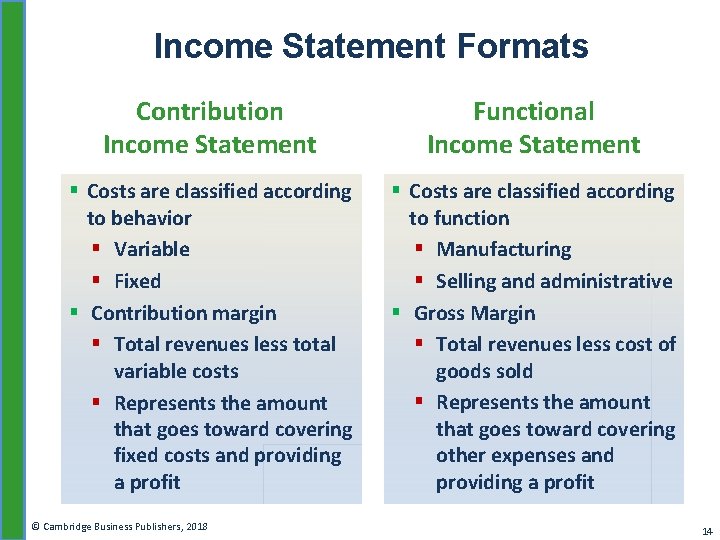
Income Statement Formats Contribution Income Statement Functional Income Statement § Costs are classified according to behavior § Variable § Fixed § Contribution margin § Total revenues less total variable costs § Represents the amount that goes toward covering fixed costs and providing a profit § Costs are classified according to function § Manufacturing § Selling and administrative § Gross Margin § Total revenues less cost of goods sold § Represents the amount that goes toward covering other expenses and providing a profit © Cambridge Business Publishers, 2018 14
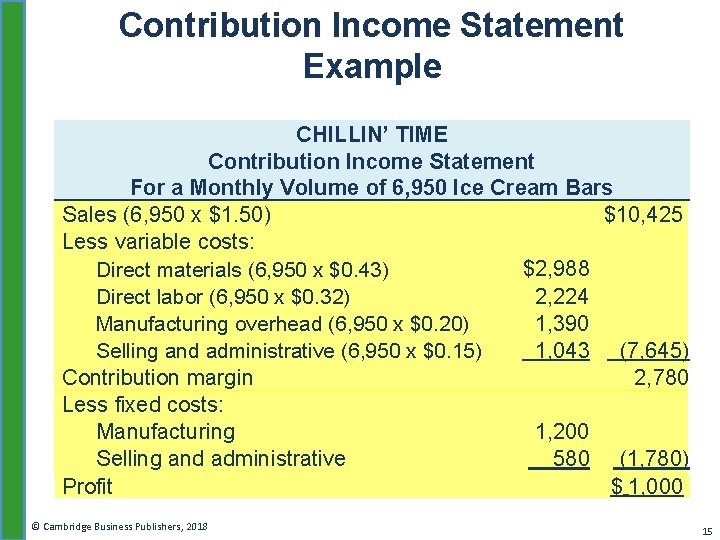
Contribution Income Statement Example CHILLIN’ TIME Contribution Income Statement For a Monthly Volume of 6, 950 Ice Cream Bars Sales (6, 950 x $1. 50) $10, 425. Less variable costs: $2, 988 Direct materials (6, 950 x $0. 43) 2, 224 Direct labor (6, 950 x $0. 32) 1, 390 Manufacturing overhead (6, 950 x $0. 20) 1, 043 (7, 645) Selling and administrative (6, 950 x $0. 15) Contribution margin 2, 780. Less fixed costs: Manufacturing 1, 200 Selling and administrative 580 (1, 780) Profit $ 1, 000. © Cambridge Business Publishers, 2018 15
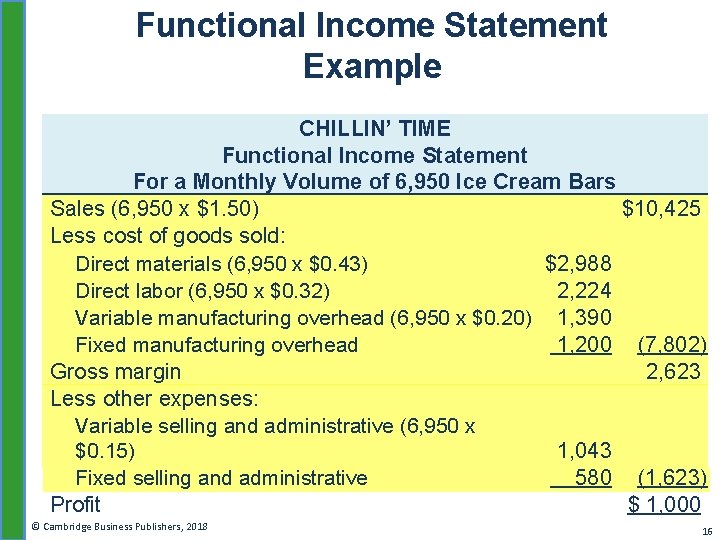
Functional Income Statement Example CHILLIN’ TIME Functional Income Statement For a Monthly Volume of 6, 950 Ice Cream Bars Sales (6, 950 x $1. 50) $10, 425. Less cost of goods sold: $2, 988 Direct materials (6, 950 x $0. 43) 2, 224 Direct labor (6, 950 x $0. 32) Variable manufacturing overhead (6, 950 x $0. 20) 1, 390 1, 200 (7, 802) Fixed manufacturing overhead Gross margin 2, 623. Less other expenses: Variable selling and administrative (6, 950 x 1, 043 $0. 15) 580 (1, 623) Fixed selling and administrative Profit $ 1, 000. © Cambridge Business Publishers, 2018 16
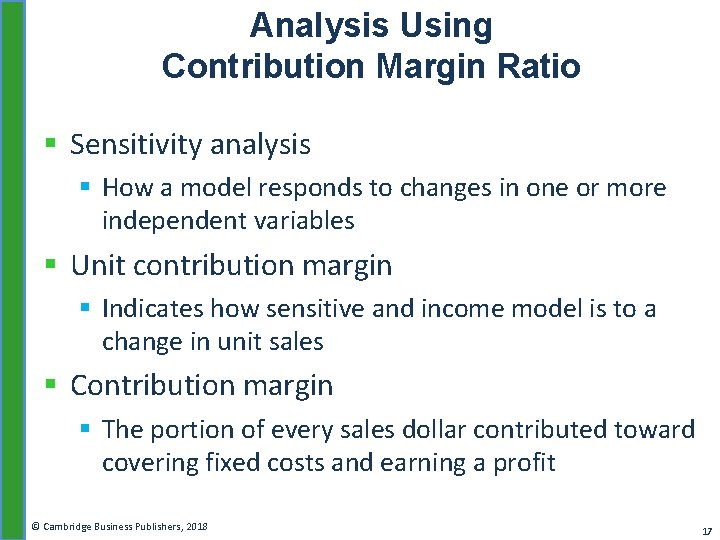
Analysis Using Contribution Margin Ratio § Sensitivity analysis § How a model responds to changes in one or more independent variables § Unit contribution margin § Indicates how sensitive and income model is to a change in unit sales § Contribution margin § The portion of every sales dollar contributed toward covering fixed costs and earning a profit © Cambridge Business Publishers, 2018 17
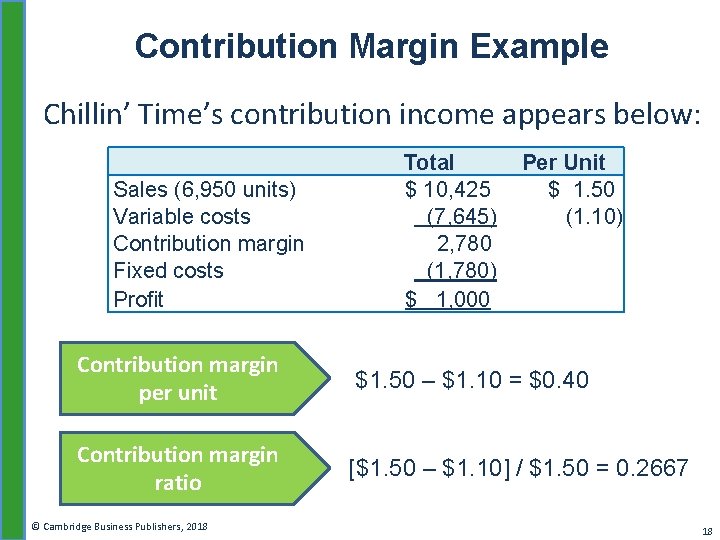
Contribution Margin Example Chillin’ Time’s contribution income appears below: Sales (6, 950 units) Variable costs Contribution margin Fixed costs Profit Total $ 10, 425 (7, 645) 2, 780 (1, 780) $ 1, 000 Per Unit $ 1. 50 (1. 10) Contribution margin per unit $1. 50 – $1. 10 = $0. 40 Contribution margin ratio [$1. 50 – $1. 10] / $1. 50 = 0. 2667 © Cambridge Business Publishers, 2018 18
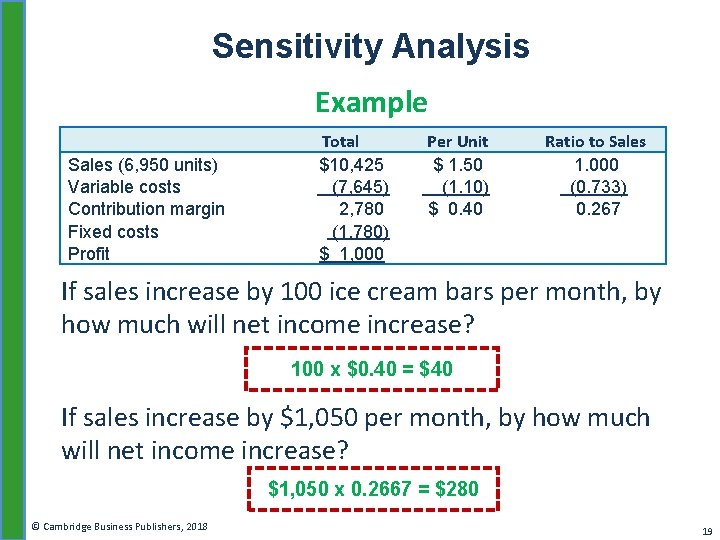
Sensitivity Analysis Example Sales (6, 950 units) Variable costs Contribution margin Fixed costs Profit Total $10, 425. (7, 645) 2, 780. (1, 780) $ 1, 000. Per Unit $ 1. 50 (1. 10) $ 0. 40 Ratio to Sales 1. 000 (0. 733) 0. 267 If sales increase by 100 ice cream bars per month, by how much will net income increase? 100 x $0. 40 = $40 If sales increase by $1, 050 per month, by how much will net income increase? $1, 050 x 0. 2667 = $280 © Cambridge Business Publishers, 2018 19
Learning Objective 3 Apply cost-volume-profit analysis to find a break-even point and for preliminary profit planning. © Cambridge Business Publishers, 2018 20
Break-Even Point § Occurs when total revenues equal total costs § Can be unit sales volume, or § Dollar sales volume § Operating below break-even § Company operates at a loss § Operating above break-even § Company operates at a profit © Cambridge Business Publishers, 2018 21
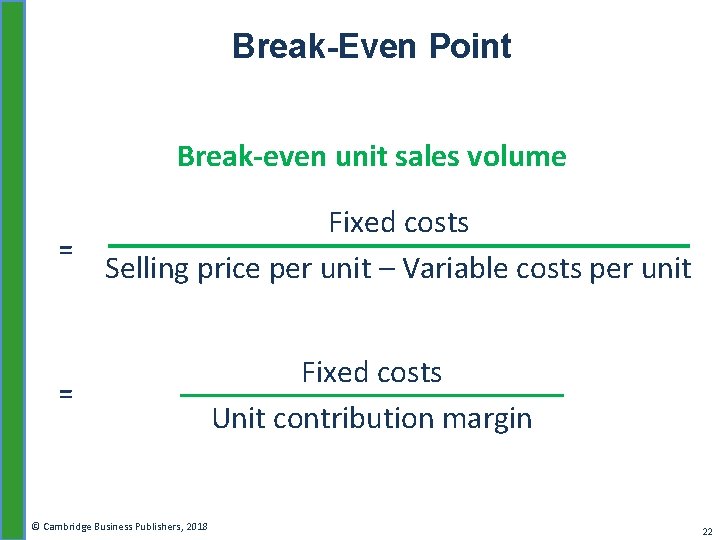
Break-Even Point Break-even unit sales volume = Fixed costs Selling price per unit – Variable costs per unit = © Cambridge Business Publishers, 2018 Fixed costs Unit contribution margin 22
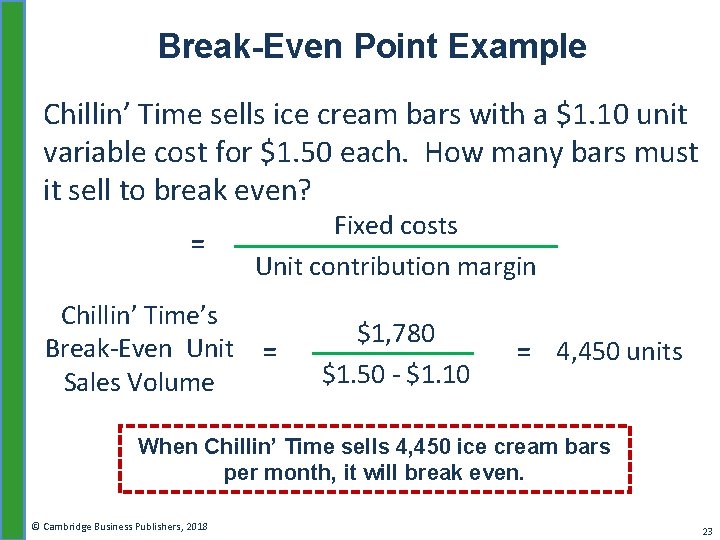
Break-Even Point Example Chillin’ Time sells ice cream bars with a $1. 10 unit variable cost for $1. 50 each. How many bars must it sell to break even? = Chillin’ Time’s Break-Even Unit Sales Volume Fixed costs Unit contribution margin = $1, 780 $1. 50 - $1. 10 = 4, 450 units When Chillin’ Time sells 4, 450 ice cream bars per month, it will break even. © Cambridge Business Publishers, 2018 23
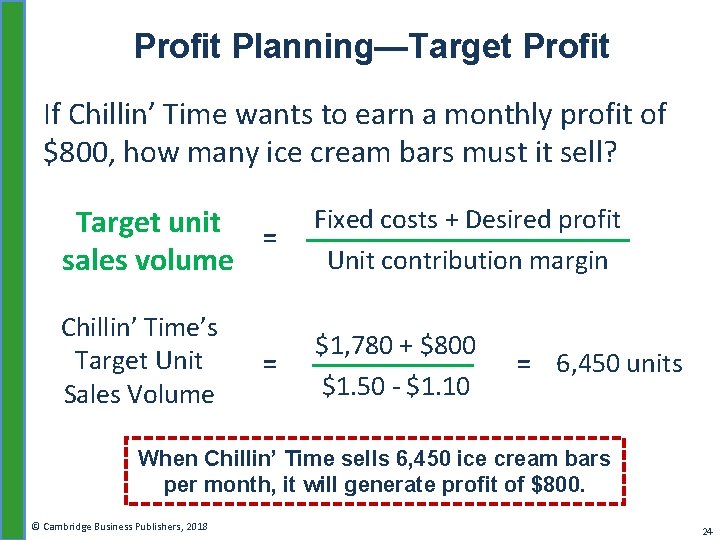
Profit Planning—Target Profit If Chillin’ Time wants to earn a monthly profit of $800, how many ice cream bars must it sell? Target unit = sales volume Fixed costs + Desired profit Unit contribution margin Chillin’ Time’s Target Unit Sales Volume $1, 780 + $800 $1. 50 - $1. 10 = = 6, 450 units When Chillin’ Time sells 6, 450 ice cream bars per month, it will generate profit of $800. © Cambridge Business Publishers, 2018 24
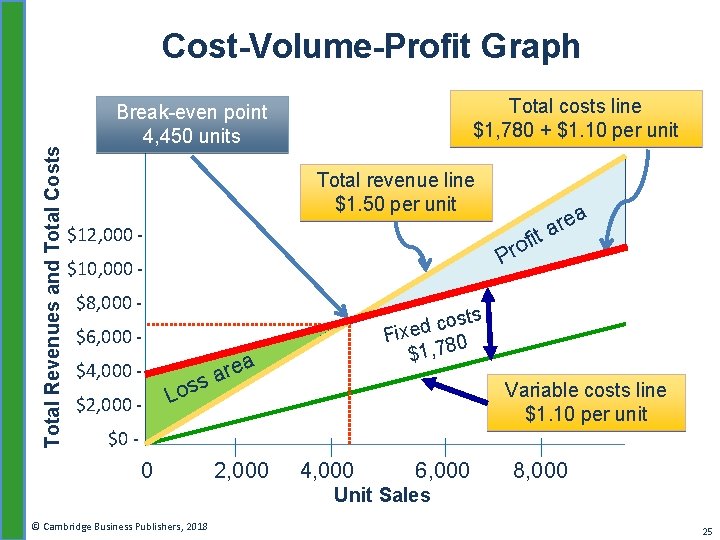
Total Revenues and Total Costs Cost-Volume-Profit Graph Total costs line $1, 780 + $1. 10 per unit Break-even point 4, 450 units Total revenue line $1. 50 per unit $12, 000 - t fi o r P $10, 000 $8, 000 - sts o c d Fixe 80 $1, 7 $6, 000 $4, 000 $2, 000 - re a s Los a e r a a Variable costs line $1. 10 per unit $0 - 0 2, 000 4, 000 6, 000 8, 000 Unit Sales © Cambridge Business Publishers, 2018 25
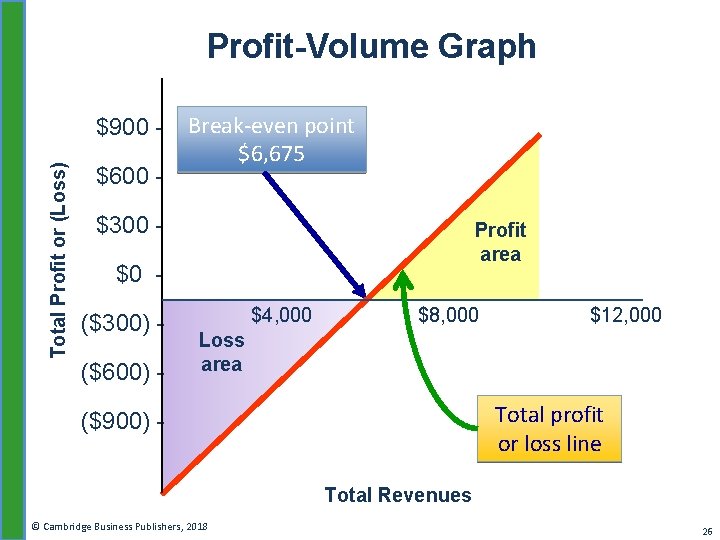
Profit-Volume Graph Total Profit or (Loss) $900 $600 - Break-even point $6, 675 $300 - Profit area $0 ($300) ($600) - $4, 000 $8, 000 $12, 000 Loss area Total profit or loss line ($900) Total Revenues © Cambridge Business Publishers, 2018 26
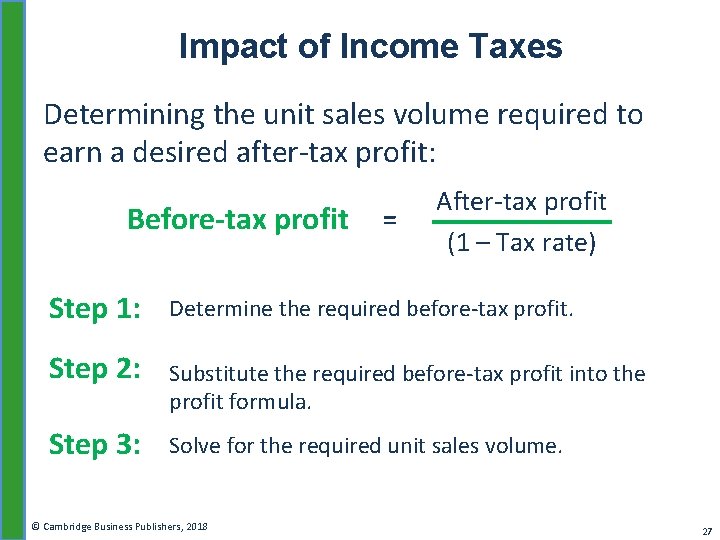
Impact of Income Taxes Determining the unit sales volume required to earn a desired after-tax profit: Before-tax profit = After-tax profit (1 – Tax rate) Step 1: Determine the required before-tax profit. Step 2: Substitute the required before-tax profit into the profit formula. Step 3: Solve for the required unit sales volume. © Cambridge Business Publishers, 2018 27
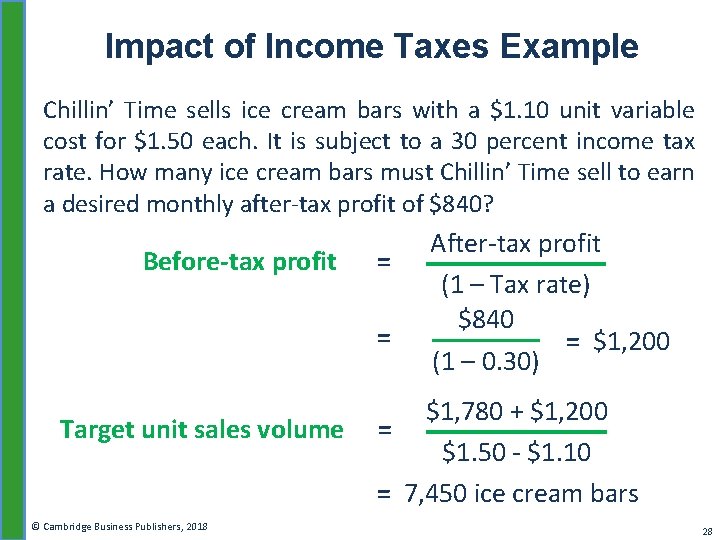
Impact of Income Taxes Example Chillin’ Time sells ice cream bars with a $1. 10 unit variable cost for $1. 50 each. It is subject to a 30 percent income tax rate. How many ice cream bars must Chillin’ Time sell to earn a desired monthly after-tax profit of $840? Before-tax profit = = Target unit sales volume © Cambridge Business Publishers, 2018 After-tax profit (1 – Tax rate) $840 = $1, 200 (1 – 0. 30) $1, 780 + $1, 200 = $1. 50 - $1. 10 = 7, 450 ice cream bars 28
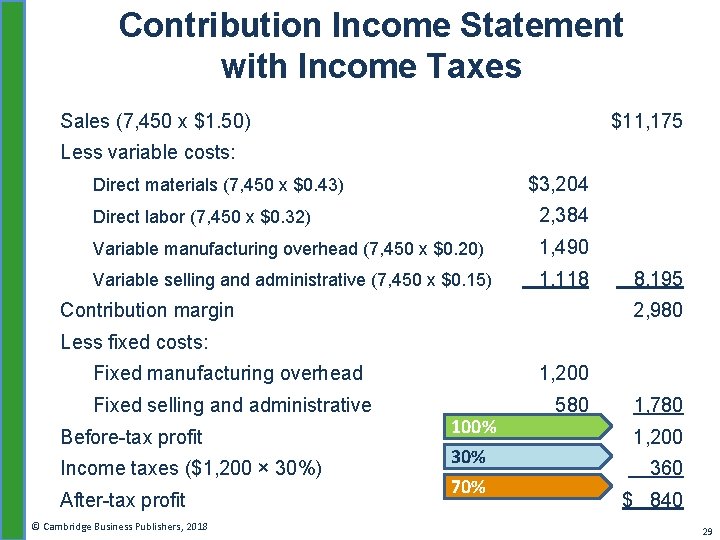
Contribution Income Statement with Income Taxes Sales (7, 450 x $1. 50) $11, 175 Less variable costs: $3, 204 Direct materials (7, 450 x $0. 43) Direct labor (7, 450 x $0. 32) 2, 384 Variable manufacturing overhead (7, 450 x $0. 20) 1, 490 Variable selling and administrative (7, 450 x $0. 15) 1, 118 Contribution margin 8, 195 2, 980 Less fixed costs: Fixed manufacturing overhead Fixed selling and administrative Before-tax profit Income taxes ($1, 200 × 30%) After-tax profit © Cambridge Business Publishers, 2018 1, 200 100% 30% 70% 580 1, 780 1, 200 360 $ 840 29
Learning Objective 4 Analyze the profitability and sales mix of a multiple-product firm. © Cambridge Business Publishers, 2018 30
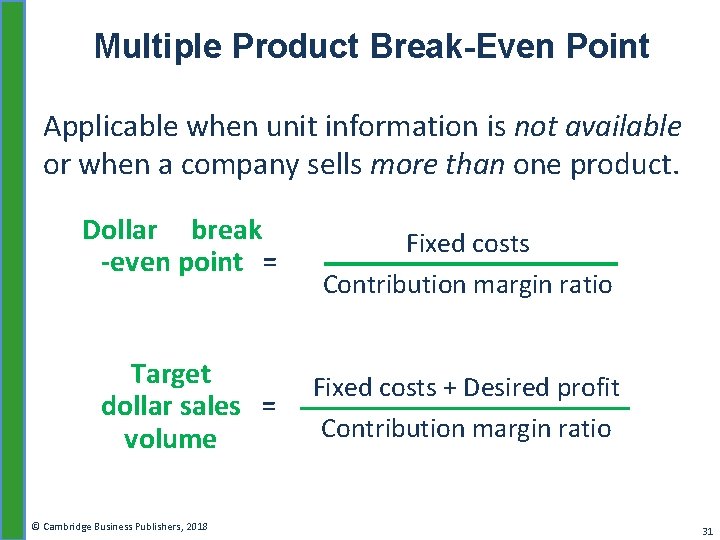
Multiple Product Break-Even Point Applicable when unit information is not available or when a company sells more than one product. Dollar break -even point = Target dollar sales = volume © Cambridge Business Publishers, 2018 Fixed costs Contribution margin ratio Fixed costs + Desired profit Contribution margin ratio 31
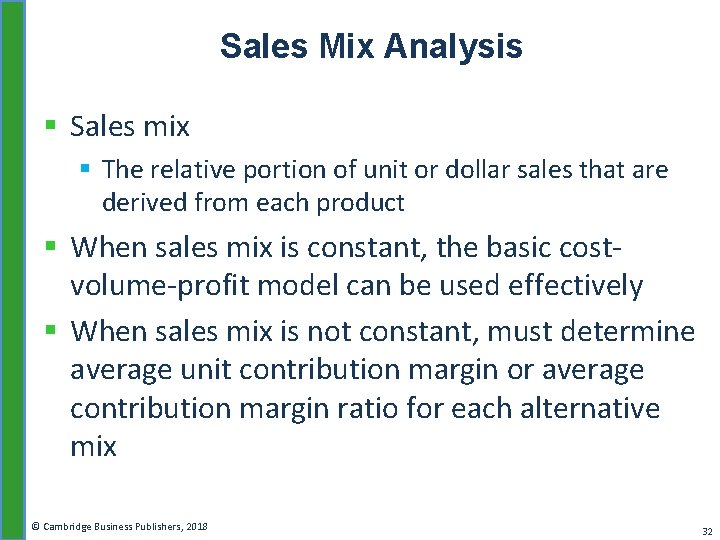
Sales Mix Analysis § Sales mix § The relative portion of unit or dollar sales that are derived from each product § When sales mix is constant, the basic costvolume-profit model can be used effectively § When sales mix is not constant, must determine average unit contribution margin or average contribution margin ratio for each alternative mix © Cambridge Business Publishers, 2018 32
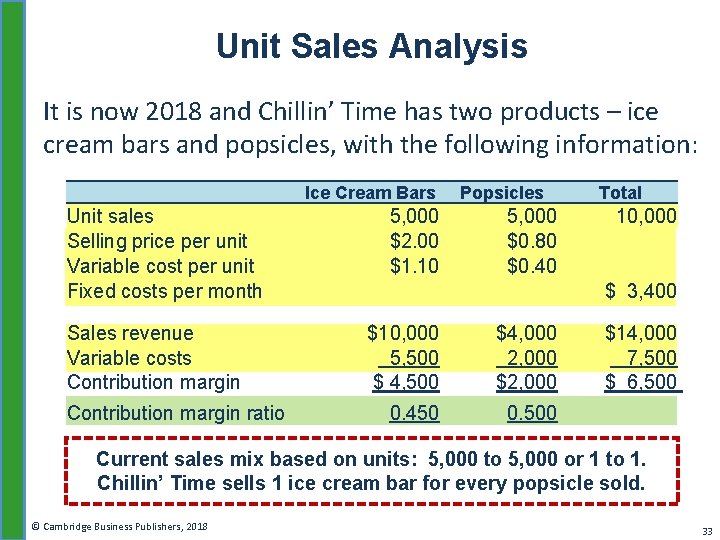
Unit Sales Analysis It is now 2018 and Chillin’ Time has two products – ice cream bars and popsicles, with the following information: Ice Cream Bars Unit sales Selling price per unit Variable cost per unit Fixed costs per month Sales revenue Variable costs Contribution margin ratio 5, 000 $2. 00 $1. 10 Popsicles 5, 000 $0. 80 $0. 40 Total 10, 000 $ 3, 400 $10, 000 5, 500 $ 4, 500 $4, 000 2, 000 $2, 000 0. 450 0. 500 $14, 000 7, 500 $ 6, 500 Current sales mix based on units: 5, 000 to 5, 000 or 1 to 1. Chillin’ Time sells 1 ice cream bar for every popsicle sold. © Cambridge Business Publishers, 2018 33
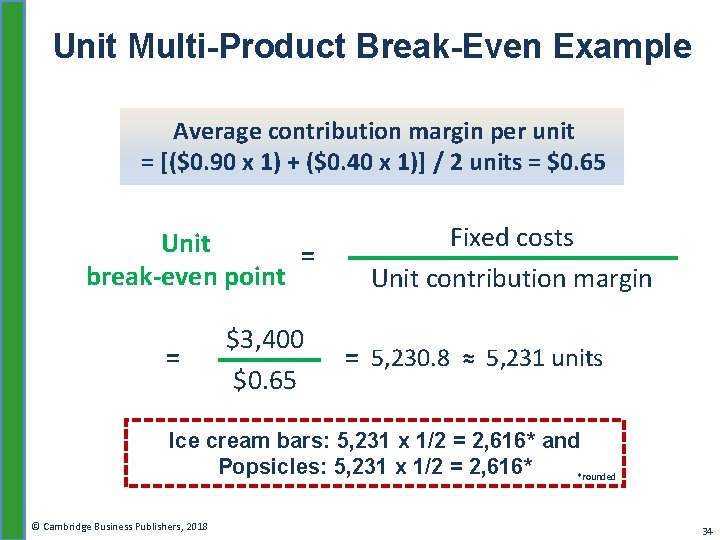
Unit Multi-Product Break-Even Example Average contribution margin per unit = [($0. 90 x 1) + ($0. 40 x 1)] / 2 units = $0. 65 Unit = break-even point = $3, 400 $0. 65 Fixed costs Unit contribution margin = 5, 230. 8 ≈ 5, 231 units Ice cream bars: 5, 231 x 1/2 = 2, 616* and Popsicles: 5, 231 x 1/2 = 2, 616* *rounded © Cambridge Business Publishers, 2018 34
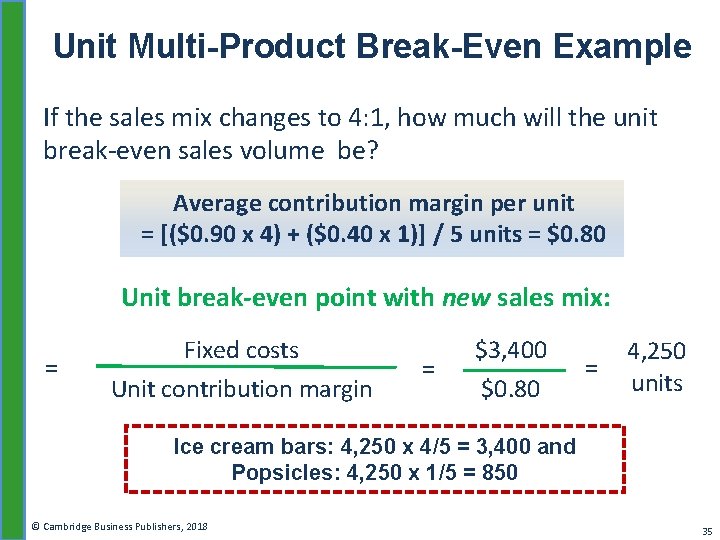
Unit Multi-Product Break-Even Example If the sales mix changes to 4: 1, how much will the unit break-even sales volume be? Average contribution margin per unit = [($0. 90 x 4) + ($0. 40 x 1)] / 5 units = $0. 80 Unit break-even point with new sales mix: = Fixed costs Unit contribution margin = $3, 400 $0. 80 = 4, 250 units Ice cream bars: 4, 250 x 4/5 = 3, 400 and Popsicles: 4, 250 x 1/5 = 850 © Cambridge Business Publishers, 2018 35
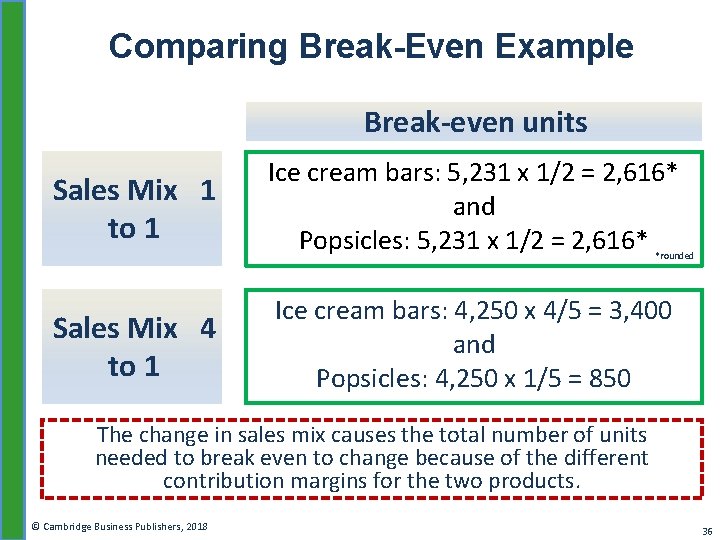
Comparing Break-Even Example Break-even units Sales Mix 1 to 1 Ice cream bars: 5, 231 x 1/2 = 2, 616* and Popsicles: 5, 231 x 1/2 = 2, 616* *rounded Sales Mix 4 to 1 Ice cream bars: 4, 250 x 4/5 = 3, 400 and Popsicles: 4, 250 x 1/5 = 850 The change in sales mix causes the total number of units needed to break even to change because of the different contribution margins for the two products. © Cambridge Business Publishers, 2018 36
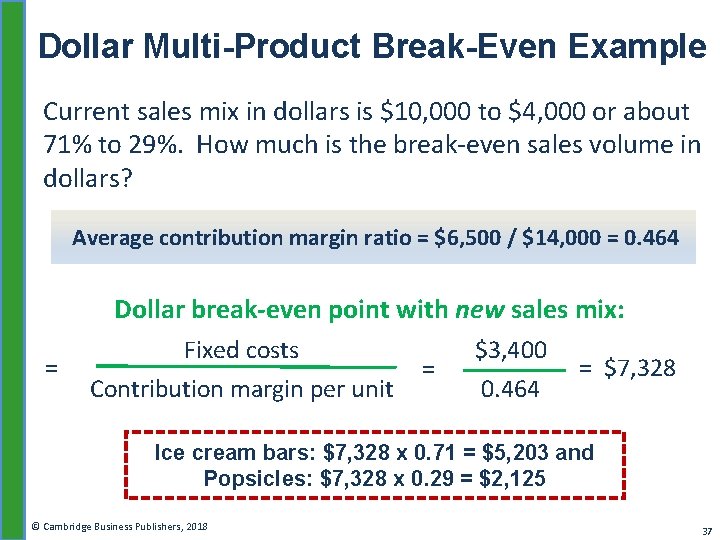
Dollar Multi-Product Break-Even Example Current sales mix in dollars is $10, 000 to $4, 000 or about 71% to 29%. How much is the break-even sales volume in dollars? Average contribution margin ratio = $6, 500 / $14, 000 = 0. 464 Dollar break-even point with new sales mix: = Fixed costs Contribution margin per unit = $3, 400 0. 464 = $7, 328 Ice cream bars: $7, 328 x 0. 71 = $5, 203 and Popsicles: $7, 328 x 0. 29 = $2, 125 © Cambridge Business Publishers, 2018 37
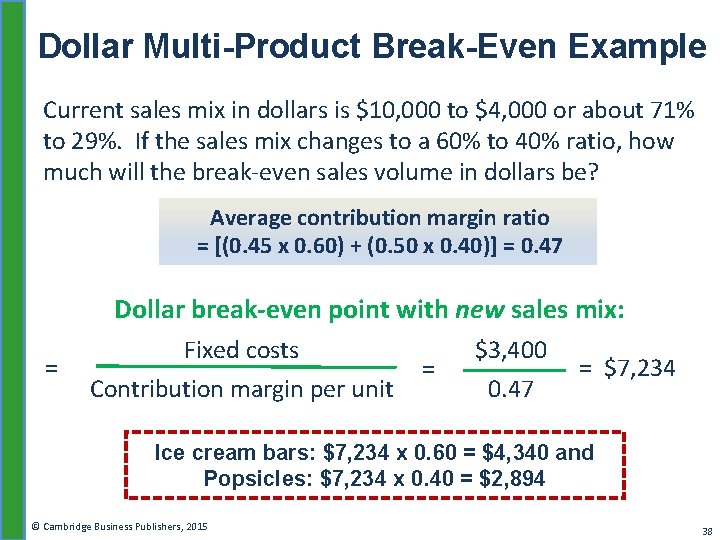
Dollar Multi-Product Break-Even Example Current sales mix in dollars is $10, 000 to $4, 000 or about 71% to 29%. If the sales mix changes to a 60% to 40% ratio, how much will the break-even sales volume in dollars be? Average contribution margin ratio = [(0. 45 x 0. 60) + (0. 50 x 0. 40)] = 0. 47 Dollar break-even point with new sales mix: = Fixed costs Contribution margin per unit = $3, 400 0. 47 = $7, 234 Ice cream bars: $7, 234 x 0. 60 = $4, 340 and Popsicles: $7, 234 x 0. 40 = $2, 894 © Cambridge Business Publishers, 2015 38
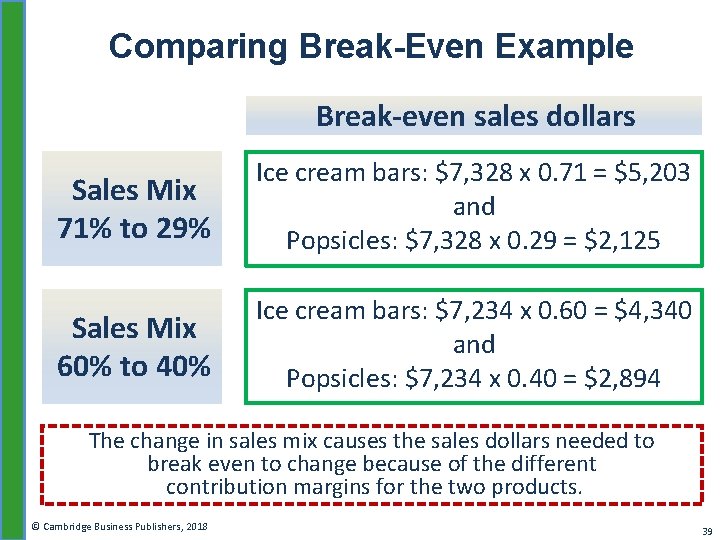
Comparing Break-Even Example Break-even sales dollars Sales Mix 71% to 29% Ice cream bars: $7, 328 x 0. 71 = $5, 203 and Popsicles: $7, 328 x 0. 29 = $2, 125 Sales Mix 60% to 40% Ice cream bars: $7, 234 x 0. 60 = $4, 340 and Popsicles: $7, 234 x 0. 40 = $2, 894 The change in sales mix causes the sales dollars needed to break even to change because of the different contribution margins for the two products. © Cambridge Business Publishers, 2018 39
Learning Objective 5 Apply operating leverage ratio to assess opportunities for profit and the risks of loss. © Cambridge Business Publishers, 2018 40
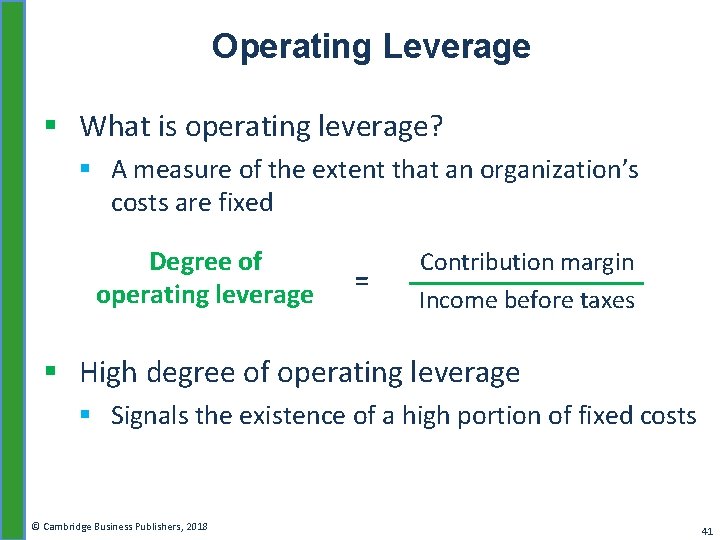
Operating Leverage § What is operating leverage? § A measure of the extent that an organization’s costs are fixed Degree of operating leverage = Contribution margin Income before taxes § High degree of operating leverage § Signals the existence of a high portion of fixed costs © Cambridge Business Publishers, 2018 41
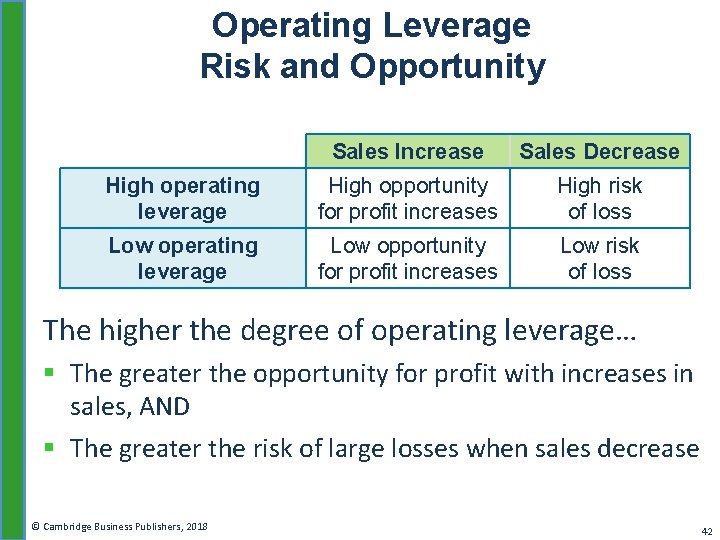
Operating Leverage Risk and Opportunity Sales Increase Sales Decrease High operating leverage High opportunity for profit increases High risk of loss Low operating leverage Low opportunity for profit increases Low risk of loss The higher the degree of operating leverage… § The greater the opportunity for profit with increases in sales, AND § The greater the risk of large losses when sales decrease © Cambridge Business Publishers, 2018 42
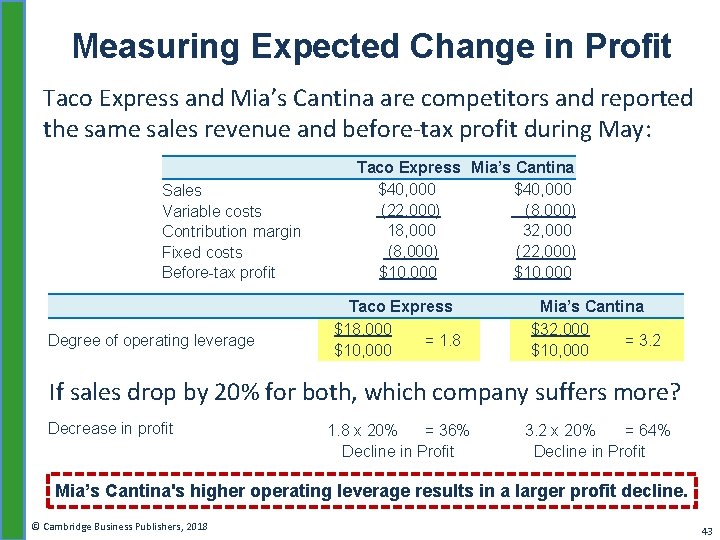
Measuring Expected Change in Profit Taco Express and Mia’s Cantina are competitors and reported the same sales revenue and before-tax profit during May: Sales Variable costs Contribution margin Fixed costs Before-tax profit Degree of operating leverage Taco Express Mia’s Cantina $40, 000. (22, 000) (8, 000) 18, 000 32, 000. (8, 000) (22, 000) $10, 000. Taco Express $18, 000 = 1. 8 $10, 000 Mia’s Cantina $32, 000 = 3. 2 $10, 000 If sales drop by 20% for both, which company suffers more? Decrease in profit 1. 8 x 20% = 36% Decline in Profit 3. 2 x 20% = 64% Decline in Profit Mia’s Cantina's higher operating leverage results in a larger profit decline. © Cambridge Business Publishers, 2018 43
Learning Objective 6 Appendix 16 A Perform profitability analysis with unit and nonunit cost drivers. © Cambridge Business Publishers, 2018 44
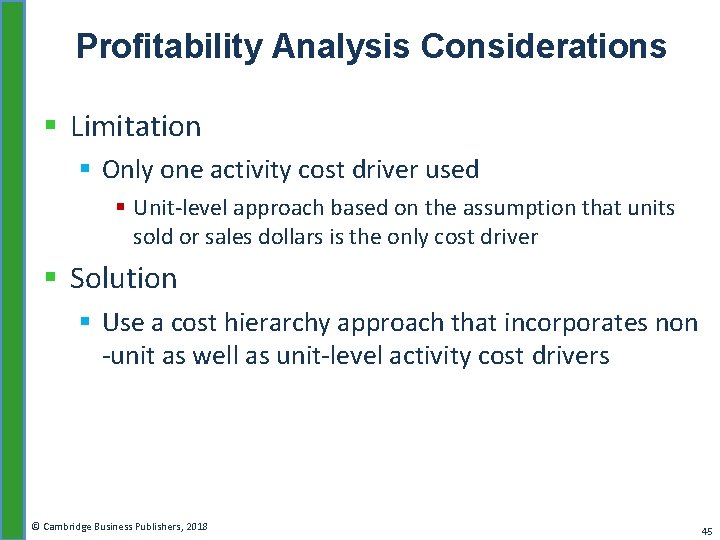
Profitability Analysis Considerations § Limitation § Only one activity cost driver used § Unit-level approach based on the assumption that units sold or sales dollars is the only cost driver § Solution § Use a cost hierarchy approach that incorporates non -unit as well as unit-level activity cost drivers © Cambridge Business Publishers, 2018 45
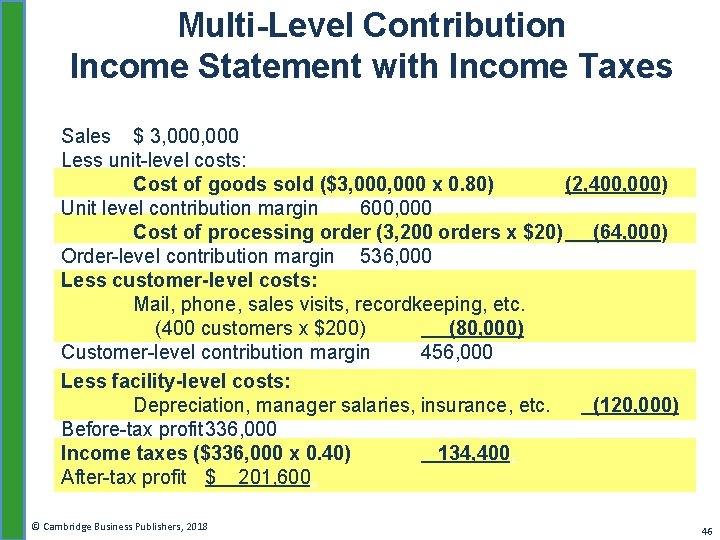
Multi-Level Contribution Income Statement with Income Taxes Sales $ 3, 000. Less unit-level costs: Cost of goods sold ($3, 000 x 0. 80) (2, 400, 000) Unit level contribution margin 600, 000. Cost of processing order (3, 200 orders x $20) (64, 000) Order-level contribution margin 536, 000. Less customer-level costs: Mail, phone, sales visits, recordkeeping, etc. (400 customers x $200) (80, 000) Customer-level contribution margin 456, 000. Less facility-level costs: Depreciation, manager salaries, insurance, etc. (120, 000) Before-tax profit 336, 000. Income taxes ($336, 000 x 0. 40) 134, 400. After-tax profit $ 201, 600. © Cambridge Business Publishers, 2018 46
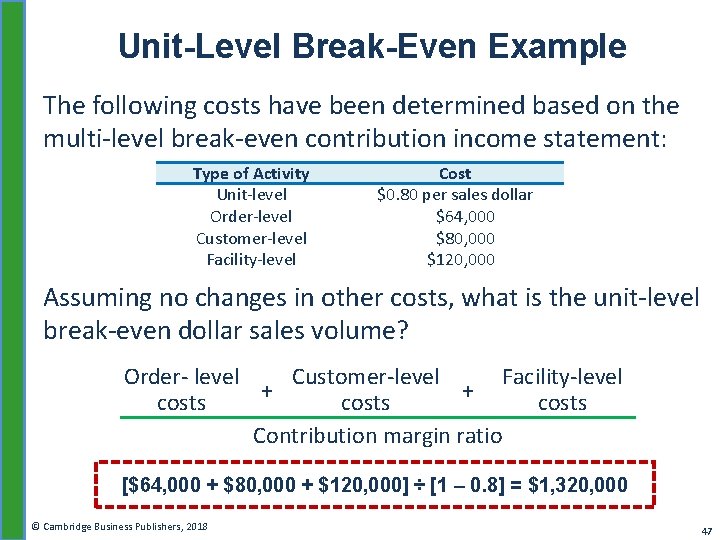
Unit-Level Break-Even Example The following costs have been determined based on the multi-level break-even contribution income statement: Type of Activity Unit-level Order-level Customer-level Facility-level Cost $0. 80 per sales dollar $64, 000 $80, 000 $120, 000 Assuming no changes in other costs, what is the unit-level break-even dollar sales volume? Customer-level Facility-level Order- level + + costs Contribution margin ratio [$64, 000 + $80, 000 + $120, 000] ÷ [1 ‒ 0. 8] = $1, 320, 000 © Cambridge Business Publishers, 2018 47
The End
- Slides: 48