
FINANCIAL MANAGEMENT SERIES Three Indispensable Tools for Good
FINANCIAL MANAGEMENT SERIES Three Indispensable Tools for Good Financial Management VITAL: Management Training and Technical Assistance Project Barbara Paradiso Barbara. paradiso@ucdenver. edu
Statement of Functional Expenses Nonprofits’ focus is not on the bottom line but on how resources are used to carry out the mission. So financial statements for non profits are designed to convey information about resources, the restrictions on them and how they have been used to achieve mission. NPO’s must file three basic financial statements: �The Statement of Financial Position (Balance Sheet) �Statement of Activities (Income Statement with expense restrictions identified) �The Statement of Cash Flow Voluntary health and welfare organizations are required to file a forth statement – the Statement of Functional Expense
Statement of Functional Expenses The Statement of Functional Expenses shows: • How expenses are allocated in natural classifications (line item) to significant program and supporting services functional categories. • It permits detailed analysis of the expense portion of the statement of activity
How to Classify Expenses • Classify expenses in two ways: • Natural classification indicating the type of expense – e. g. salaries, employee benefits, occupancy, postage • Functional classification – grouping natural expense classifications by function • The primary function classifications are: 1) Program Services and 2) Supporting Services. • Break down these primary functional classifications further into separate programs and separate supporting services.
Program Service Expenses Program services are activities you carry out to fulfill your mission that result in the distribution of goods or services to beneficiaries, customers or members. • The expenses include both direct and indirect costs of providing services. • They may also include cost of sales or of other revenue generating activities if the activities are program related, e. g. if a museum has a bookstore that sells merchandise, the bookstore’s sales costs may be treated as a program service
Supporting Service Expenses Supporting services include : • Management and General – relate to a NPO’s overall direction and are not identifiable with a particular program, membership development or fundraising activity. • Fundraising – getting potential donors to contribute cash, non cash assets, services or time • Membership Development – Assign expenses related to membership activities, e. g. soliciting new members and maintaining membership data
How to Classify Expenses Natural expense classifications often relate to more than one functional classification. Properly reporting expenses by function requires allocating the amounts in your natural expense classifications to the functions to which the relate. For Example: ED may spend time on service supervision, management and fundraising. In this case, the ED’s salary would be allocated to all three functions served.
Allocating Expenses to More than One Category Allocate your expense information by function. To do so: • Directly identify expenses • Properly allocate expenses relating to more than one function
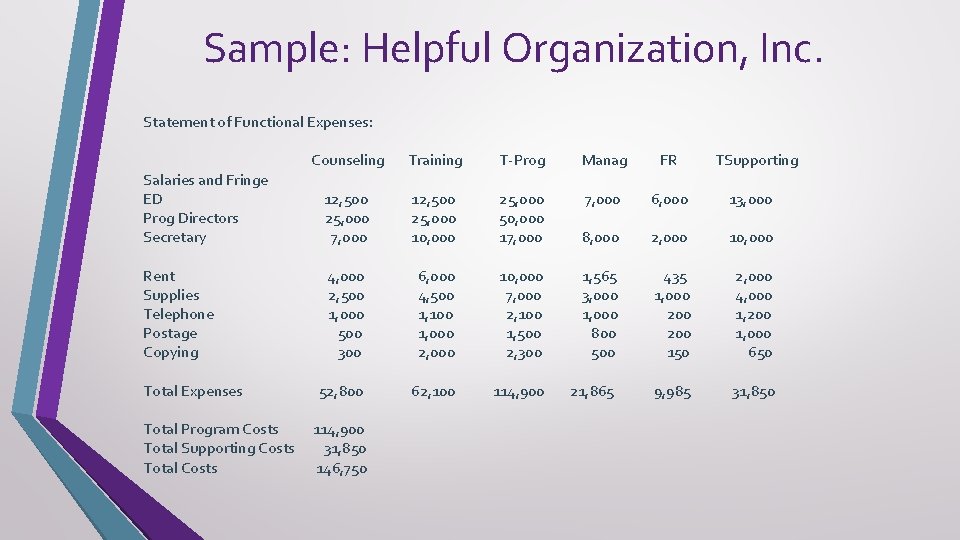
Sample: Helpful Organization, Inc. Statement of Functional Expenses: Counseling Salaries and Fringe ED 12, 500 Prog Directors 25, 000 Secretary 7, 000 Rent 4, 000 Supplies 2, 500 Telephone 1, 000 Postage 500 Copying 300 Total Expenses 52, 800 Total Program Costs 114, 900 Total Supporting Costs 31, 850 Total Costs 146, 750 Training T-Prog Manag FR TSupporting 12, 500 25, 000 50, 000 10, 000 17, 000 6, 000 13, 000 8, 000 2, 000 10, 000 1, 565 7, 000 3, 000 2, 100 1, 000 1, 500 800 2, 300 500 435 1, 000 200 150 2, 000 4, 000 1, 200 1, 000 650 62, 100 114, 900 21, 865 9, 985 31, 850 6, 000 4, 500 1, 100 1, 000 2, 000
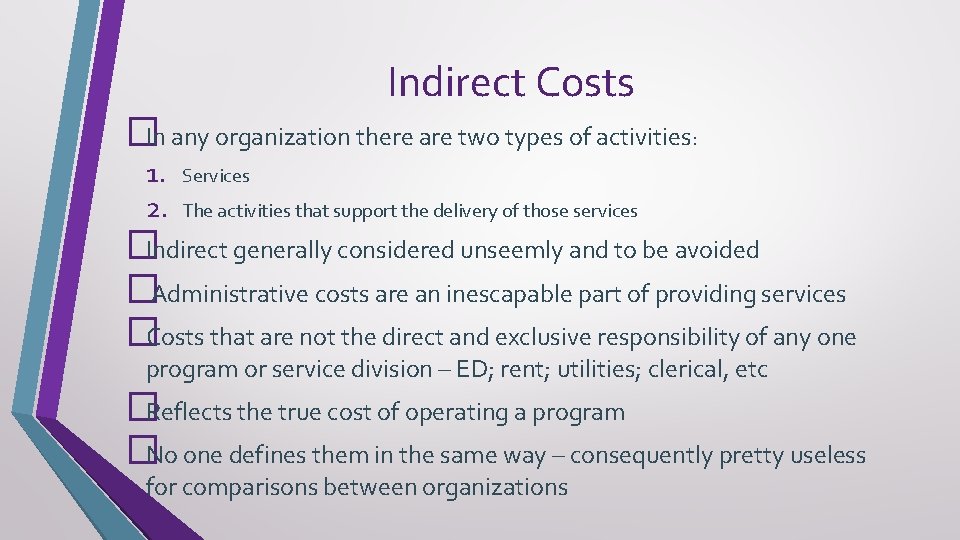
Indirect Costs �In any organization there are two types of activities: 1. 2. Services The activities that support the delivery of those services �Indirect generally considered unseemly and to be avoided � Administrative costs are an inescapable part of providing services �Costs that are not the direct and exclusive responsibility of any one program or service division – ED; rent; utilities; clerical, etc �Reflects the true cost of operating a program �No one defines them in the same way – consequently pretty useless for comparisons between organizations
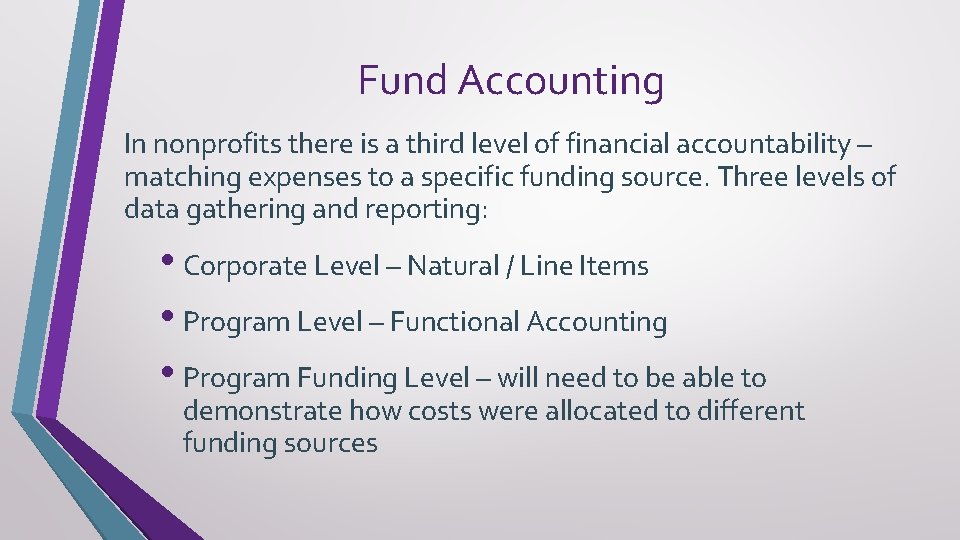
Fund Accounting In nonprofits there is a third level of financial accountability – matching expenses to a specific funding source. Three levels of data gathering and reporting: • Corporate Level – Natural / Line Items • Program Level – Functional Accounting • Program Funding Level – will need to be able to demonstrate how costs were allocated to different funding sources
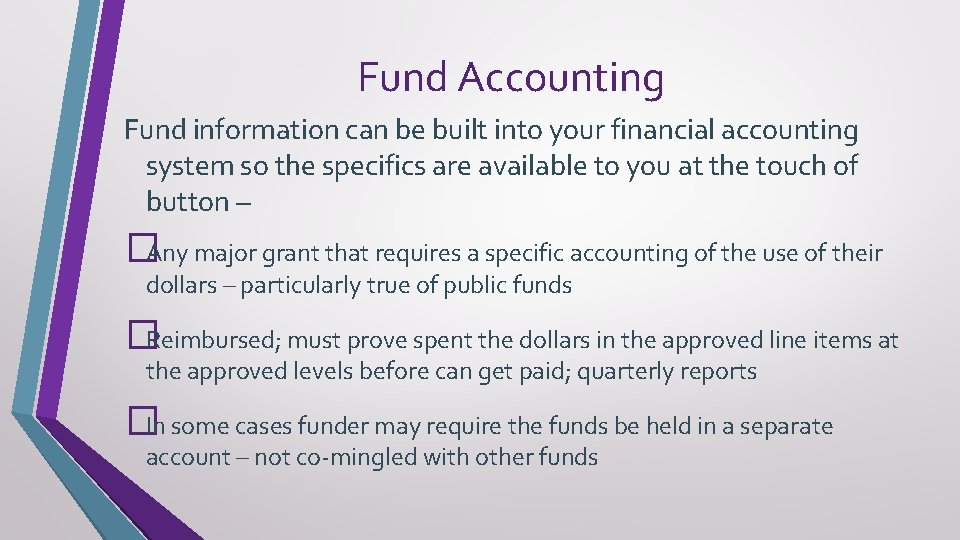
Fund Accounting Fund information can be built into your financial accounting system so the specifics are available to you at the touch of button – �Any major grant that requires a specific accounting of the use of their dollars – particularly true of public funds �Reimbursed; must prove spent the dollars in the approved line items at the approved levels before can get paid; quarterly reports �In some cases funder may require the funds be held in a separate account – not co-mingled with other funds
CASH FLOW • Cash is one of the most important resources an organization can have • With cash an organization can survive a crisis and take advantage of opportunities • To be a viable organization, cash must be available to cover debt/bills
Cash Flow There are two important Financial Management tools that concern cash: • Statement of Cash Flows (Reporting) Along with the Statement of Financial Position (Balance Sheet), Statement of Activities (Variance), and Statement of Functional Expenses it makes up the required financial statements for non profits • Cash Flow Budgets/Projections (Planning/Management )
Statement of Cash Flows - Purpose • To explain the differences in resource flow and cash in the bank. • Throughout the year, cash increases or decreases in the areas of Operations, Investments and Borrowing Activities. • The Statement of Cash Flows calculates all of these changes and arrives at a total change in cash from the first day of the fiscal year to the last.
Cash Flow Planning/Budgets • Planning for cash flow management is equally important to a NPO as organization wide budgeting. • Failure to manage cash well can cause severe operational problems • If your organization doesn’t have cash available it will go out of business • While fluctuations in cash cannot be controlled completely, it may be possible to predict which month a shortfall of cash is likely to occur, allowing managers the chance to plan ahead – acquire loans, plan for savings, delay certain expenditures, etc.
Cash Flow Projections �Provide information on the relationship between the amounts of cash an organization actually has available during a given period and the amount it needs to pay its bills during the same period. �Once an annual budget has been adopted, it can be converted into a cash flow budget to verify the availability of resources needed to cover the cost of the goals and objectives reflected in the budget. �Cash flow projections predict when cash will be received each month and compare the amount of cash expected with the amount of anticipated cash expenditures
Using the Cash Flow Budget • When a manager knows how much positive cash flow the organization will have they can maximize their investment opportunities • Managers can plan specific actions to avoid cash shortfalls when they know which months might produce a negative cash flow and so avoid a disruption in services. HINT: When projecting, identify the months when the income and expenses are nearly identical. Since figures will fluctuate from projections, it is likely that a negative cash flow will occur at these times. In other words – for these months, plan as though a negative cash flow will occur (conservative approach)
Responding to a Negative Cash Flow Options Include: • Postpone major purchases • Postpone hiring new staff • Postpone wage increase • Establish a payment schedule to handle costly purchases rather than pay for them all at once • Move up dates of fundraising events
Responding to a Negative Cash Flow More Options: • Seek cash advances from funders • Transfer funds from reserve accounts • Liquidate investments • Borrow on a short term basis (look into a line of credit during the positive months) • Actually reducing expenses (not just cash outlays)
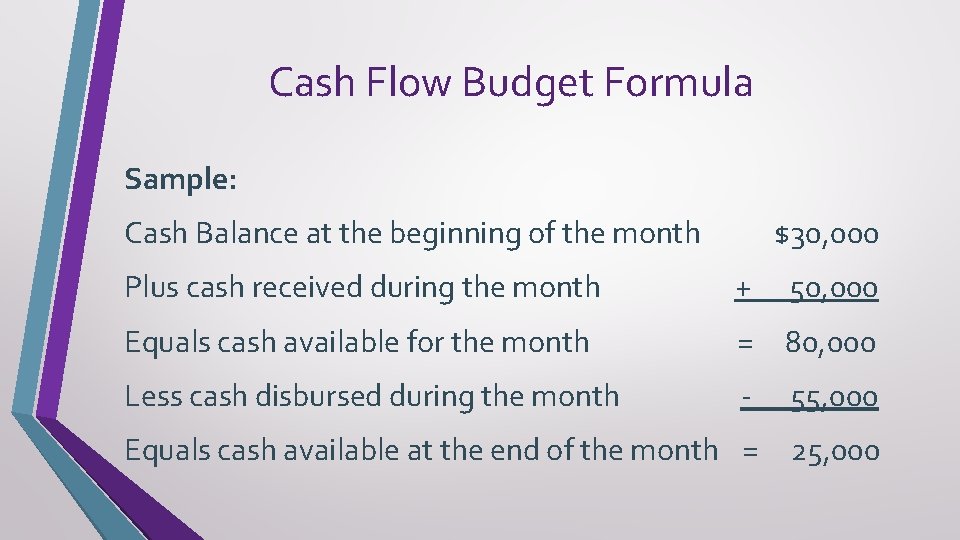
Cash Flow Budget Formula Sample: Cash Balance at the beginning of the month Plus cash received during the month Equals cash available for the month Less cash disbursed during the month $30, 000 + 50, 000 = 80, 000 - 55, 000 Equals cash available at the end of the month = 25, 000

EXERCISE
THE AUDIT • The Audit is a process for testing the accuracy and completeness of information presented in an organization’s financial statements. • The process enables an independent Certified Public Accountant to issue an opinion on how fairly the agency’s financial statements represent its financial position and whether they comply with generally accepted accounting principles (GAAP)
Why Choose an Audit? • Some NPO’s are legally required to obtain audits • Some states require audits when receiving contributions over a • certain dollar amount NPO’s receiving $25 K or more in direct or pass through federal dollars during a single year are usually required to have an audit • Even if not legally required • Commonly requested by funders • Boards may seek this assurance • Audit can be a valuable process for management
How is an Audit Done? Organization hires an independent reviewer/accountant to inspect its books and offer an opinion on: • Records are adequate to produce the financial statements generated by the organization • That the financial statements convey reliable information
Outcomes Upon completion, the auditor may offer one of 4 opinions: • Unqualified – the financial statements are “presented fairly”. • Qualified – suggests that there is a material problem with one or more aspects of the financial statements. • Adverse Opinion – the financial statements do not conform with GAAP standards and are not presented fairly. Exceptions in the statements are so serious as to be misleading. This is rare. • Disclaimer of Opinion – also unusual. Generally issued because of litigation, unavailability of records or other issues making the financial statements unreliable. Documents were reviewed but no analysis completed
What the Auditor will Need • The more complete and accurate management has prepared the requested documents the more quickly and smoothly the fieldwork will go – reducing emotional and financial costs!! • Stuff the auditor will typically will need: • Confirmations • Evidence of Internal Controls • Documentation • Other
Confirmations • A confirmation is an independent statement that supports the financial information in the organization’s records • Auditors will ask you to prepare confirmation letters on your letter head (they will provide the format) to your banks, funders, attorney, people and organizations you owe money to and who owe you money to confirm the amounts reflected in your books • Confirmations are mailed by and returned directly to your auditor to ensure their credibility
Evidence of Internal Controls • Auditor will meet with staff or request they complete a questionnaire • Purpose is to document procedures related to: • Spending and receiving money and other resources; • Compliance with laws, donor restrictions and regulations; • Maintaining property and equipment; • Recording financial information in the books

Documentation Auditor will request a number of schedules or lists (Many small NPO’s ask auditors to create these schedules based on information they provide) related to: Assets • Accounts receivable – who owes the organization money, how much, when it was due • Property and Equipment – when acquired, how much they cost, how long they are expected to last, how much they are depreciated each year, how much has been depreciated to date
Documentation (Continued) Liabilities • Payables – who the organization owes money to, how much, copies of invoices or loan agreements • Deferred Revenue – if the org. has deferred any revenue due to donor restrictions or conditions, provide names and addresses, amounts, etc. Expenses • Payroll records – including federal and state tax returns related to payroll, vacation records
Documentation (Continued) Revenue • Grants and contributions • List of donors – auditor will set parameters • Donated service and materials • Special events and benefits of the goods and services that donors received • Documents- contracts and invoices, names and addresses, registrations, etc. for fees from memberships, tuition, performances and other services • Inventory – Record of sales so that beginning of the year inventory can be reconciled with end of the year
Other Materials • Board minutes • Leases and other contracts • Bank statements, bank reconciliations, checkbooks and cancelled checks • Financial files for paid bills and deposits • Components of the accounting system like chart of accounts, journals and ledgers, printouts if the system is computerized, trial balance, etc. • Budgets for the fiscal year being examined
Post Fieldwork • Once the fieldwork is complete, the audit working papers are reviewed by senior CPA’s and partners of the CPA firm • Request a meeting with at minimum the audit committee of the Board to have the auditor review the final results of the audit and address the items identified in the management letter and management’s response

Audit Product • Documents in a completed audit: • Opinion Letter • Statement of Financial Position (Balance Sheet) • Statement of Activities • Statement of Cash Flows • Statement of Functional Expense • Notes to Financial Statements • Management Letter
Management Letter • A tool used by the auditing firm to address any concerns noted by the auditor regarding the organization’s internal accounting control system. • Letter should include both findings and recommendations for action. • Can be used by management to address issues with the Board • Get one! • Auditors gain lots of knowledge about your organization that is never reflected in the financial statements. Capture those insights.

OMB Circular A-133 Office of Management and Budget Circular A-133 (OMBA-133) defines audit requirements for NPO’s receiving over 25 K in federal funding (direct or pass through): • NPO’s with budgets under $25 K are not required to do a federal audit • $25 K to 99. 9 K – may combine a regular audit of the whole agency with a program specific A-133 audit of the program receiving federal funding • $100 K or more – One program funded, can do a Program Specific Audit; more than one program funded must do a single A-133 federal audit
What is the Form 990? • Form 990 is used by the IRS as the primary tax compliance tool for tax exempt organizations • Most states also use it for regulatory oversight – to satisfy state income tax filing requirements • It is a public document – key transparency tool used by public, funders, media, researchers, etc. to obtain information about NPO’s

QUESTIONS?

Thank You! Resources: • VITAL Website (www. vitalprojectcolorado. org ): • Webinar Power. Point and Recording • Technical Assistance • Barbara Paradiso: Barbara. paradiso@ucdenver. edu
- Slides: 40