
Financial Management in IB Investment Criteria 1 Investment
Financial Management in IB Investment Criteria 1
Investment Criteria STRATEGIC ASSET ALLOCATION • Any firm has a huge number of possible investments. • What fixed assets should we buy? • Each possible investment is an option available to the firm. • Some options are valuable and some are not. • Financial managers should be able to identify which are worth undertaking. 2
Investment Criteria Net Present Value • An investment is worth undertaking if it creates value for its owners • NPV is the difference between an investment’s market value and its costs. • It is a measure of how much value is created or added today by undertaking the investment. • To find present value of an investment we use discounted cash flow valuation. • An investment should be accepted if the net present value is positive and rejected if it is negative. 3
Investment Criteria EXAMPLE • Suppose we are asked to decide whether a new project should be undertaken. Based on projected sales and costs, we expect that the cash flows over the five-year life of the project will be $2, 000 in the first two years, $4, 000 in the next two, and $5, 000 in the last year. It will cost about $10, 000. We use a 10 percent discount rate. What should we do? 4
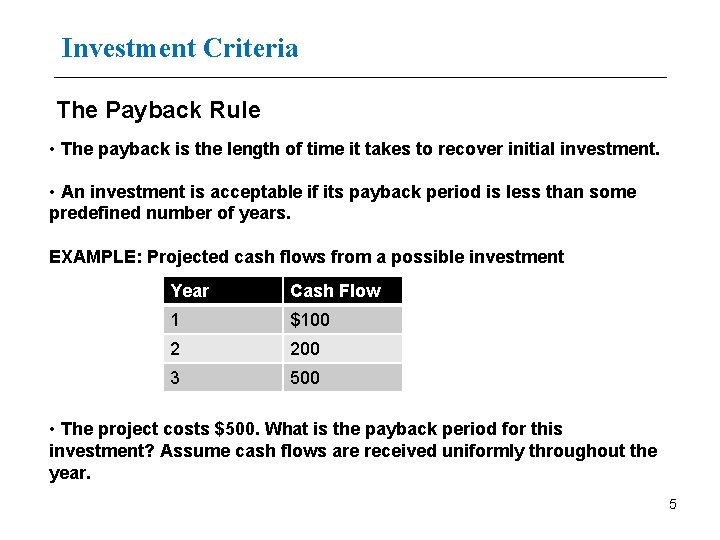
Investment Criteria The Payback Rule • The payback is the length of time it takes to recover initial investment. • An investment is acceptable if its payback period is less than some predefined number of years. EXAMPLE: Projected cash flows from a possible investment Year Cash Flow 1 $100 2 200 3 500 • The project costs $500. What is the payback period for this investment? Assume cash flows are received uniformly throughout the year. 5
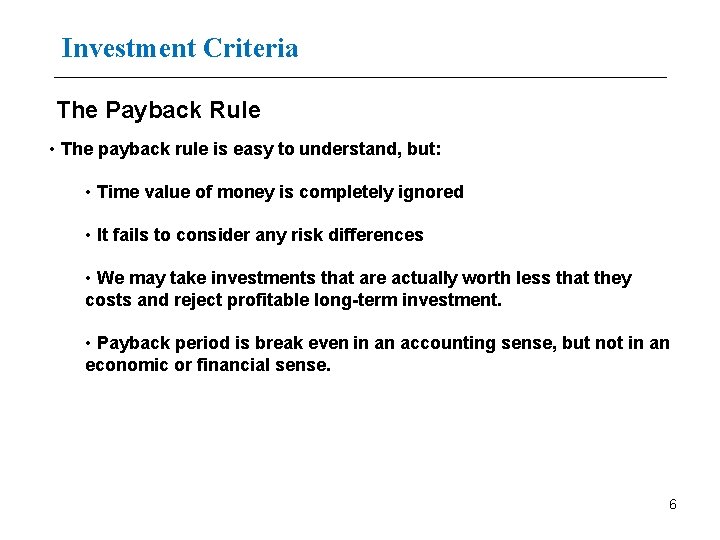
Investment Criteria The Payback Rule • The payback rule is easy to understand, but: • Time value of money is completely ignored • It fails to consider any risk differences • We may take investments that are actually worth less that they costs and reject profitable long-term investment. • Payback period is break even in an accounting sense, but not in an economic or financial sense. 6
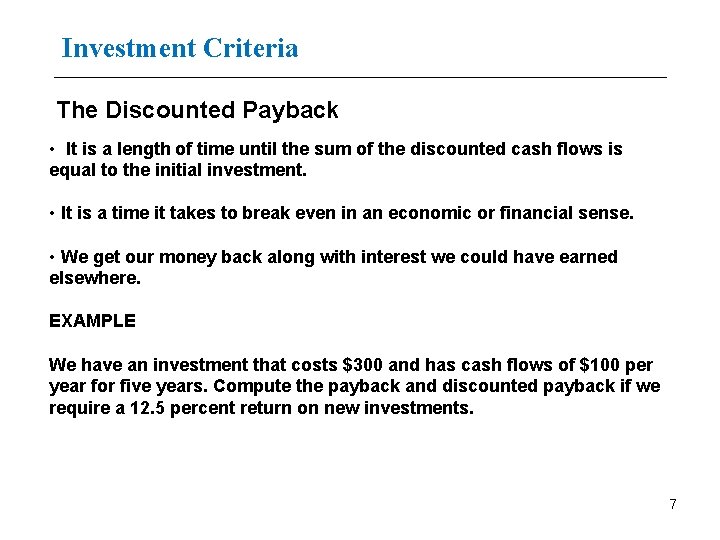
Investment Criteria The Discounted Payback • It is a length of time until the sum of the discounted cash flows is equal to the initial investment. • It is a time it takes to break even in an economic or financial sense. • We get our money back along with interest we could have earned elsewhere. EXAMPLE We have an investment that costs $300 and has cash flows of $100 per year for five years. Compute the payback and discounted payback if we require a 12. 5 percent return on new investments. 7
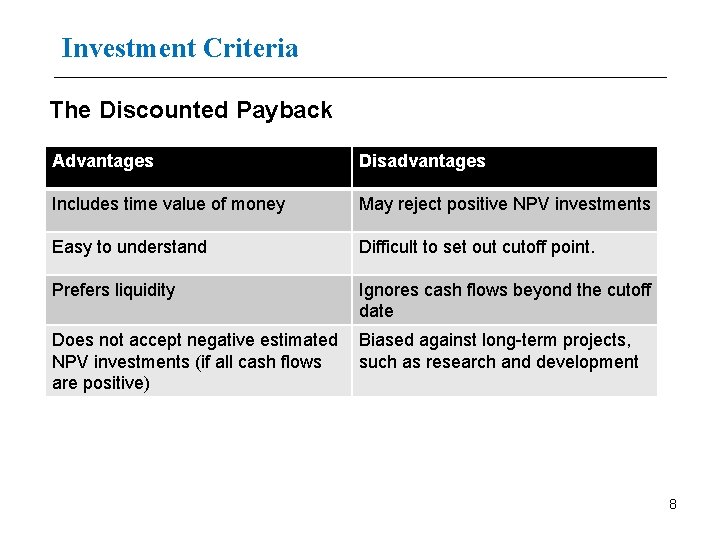
Investment Criteria The Discounted Payback Advantages Disadvantages Includes time value of money May reject positive NPV investments Easy to understand Difficult to set out cutoff point. Prefers liquidity Ignores cash flows beyond the cutoff date Does not accept negative estimated NPV investments (if all cash flows are positive) Biased against long-term projects, such as research and development 8
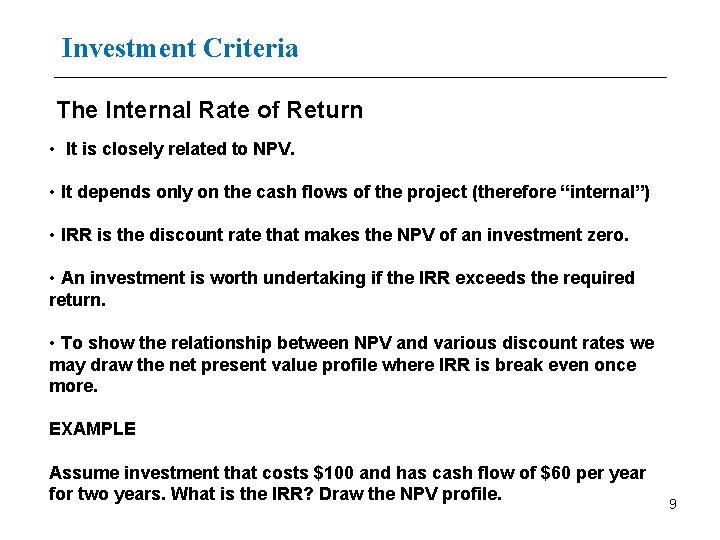
Investment Criteria The Internal Rate of Return • It is closely related to NPV. • It depends only on the cash flows of the project (therefore “internal”) • IRR is the discount rate that makes the NPV of an investment zero. • An investment is worth undertaking if the IRR exceeds the required return. • To show the relationship between NPV and various discount rates we may draw the net present value profile where IRR is break even once more. EXAMPLE Assume investment that costs $100 and has cash flow of $60 per year for two years. What is the IRR? Draw the NPV profile. 9

Investment Criteria The Internal Rate of Return – Nonconventional CF • If we have projects with more negative cash flows we may find more internal rate of returns and we do not know which one is correct. EXAMPLE Suppose we have a mining project that requires a $60 investment. Our cash flow in the first year will be $155. In the second year, the mine will be depleted, but we will have to spend $100 to restore the terrain. What is the IRR? • In this case the IRR does not provide good answer. • There are lot of projects with huge negative cash flows at the end of the project (for example plants). 10
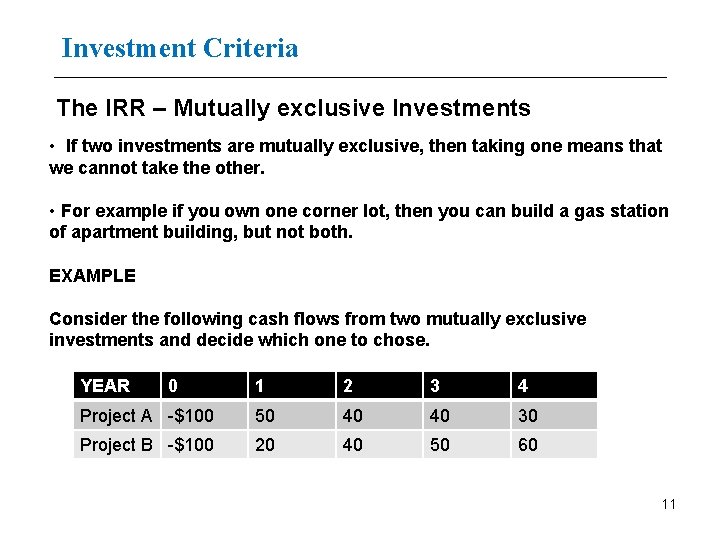
Investment Criteria The IRR – Mutually exclusive Investments • If two investments are mutually exclusive, then taking one means that we cannot take the other. • For example if you own one corner lot, then you can build a gas station of apartment building, but not both. EXAMPLE Consider the following cash flows from two mutually exclusive investments and decide which one to chose. YEAR 0 1 2 3 4 Project A -$100 50 40 40 30 Project B -$100 20 40 50 60 11
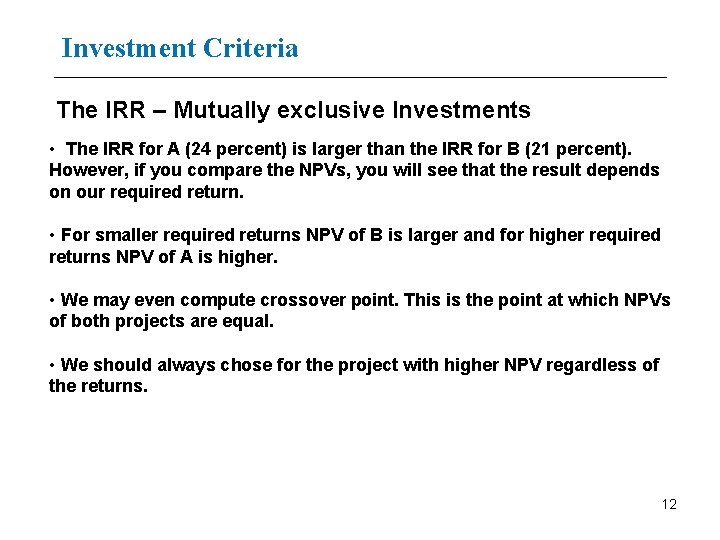
Investment Criteria The IRR – Mutually exclusive Investments • The IRR for A (24 percent) is larger than the IRR for B (21 percent). However, if you compare the NPVs, you will see that the result depends on our required return. • For smaller required returns NPV of B is larger and for higher required returns NPV of A is higher. • We may even compute crossover point. This is the point at which NPVs of both projects are equal. • We should always chose for the project with higher NPV regardless of the returns. 12
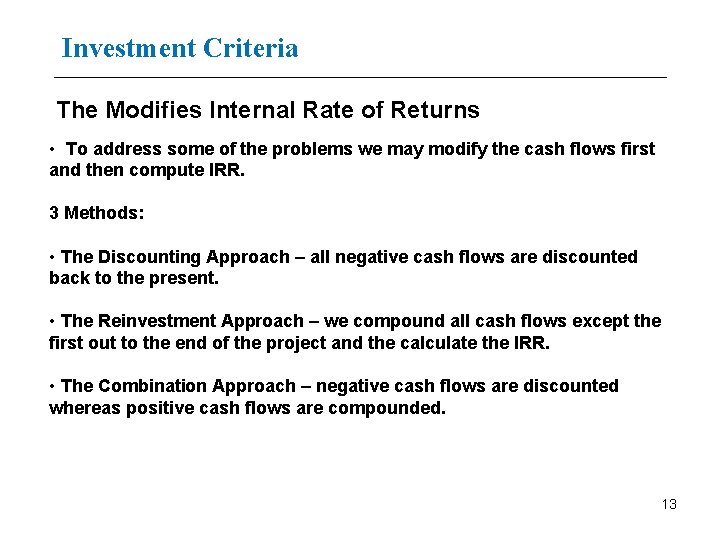
Investment Criteria The Modifies Internal Rate of Returns • To address some of the problems we may modify the cash flows first and then compute IRR. 3 Methods: • The Discounting Approach – all negative cash flows are discounted back to the present. • The Reinvestment Approach – we compound all cash flows except the first out to the end of the project and the calculate the IRR. • The Combination Approach – negative cash flows are discounted whereas positive cash flows are compounded. 13
Investment Criteria The Profitability Index • It is called benefit-cost ratio. • Present value of future cash flows divided by the initial investment. • It measure the value created per dollar invested. • If NPV is positive the PI is greater than 1. If NPV is negative the PI is lower than 1. 14
Investment Criteria Exercises 15
Investment Criteria Consider an investment that costs $400 and pays $100 per year forever. We use a 20 percent discount rate on this type of investment. What is the ordinary payback? What is the discounted payback? What is the NPV? 16
Investment Criteria What is the IRR of the following set of cash flows? Year Cash Flow 0 -$19, 500 1 9, 800 2 10, 300 3 8, 600 17
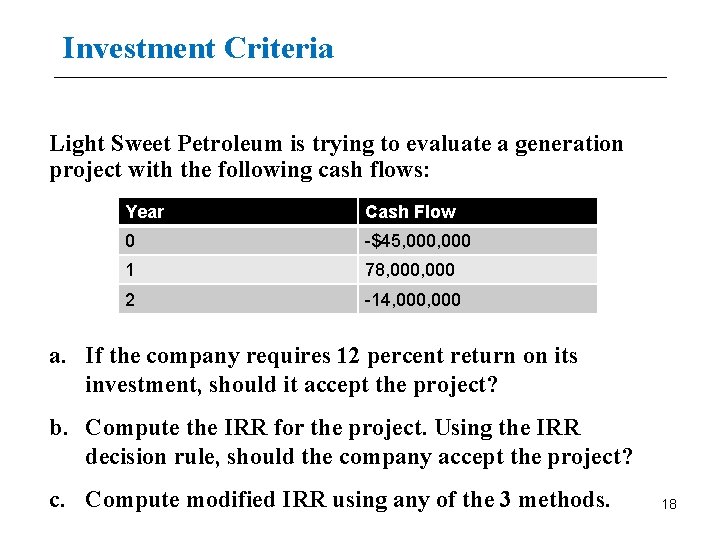
Investment Criteria Light Sweet Petroleum is trying to evaluate a generation project with the following cash flows: Year Cash Flow 0 -$45, 000 1 78, 000 2 -14, 000 a. If the company requires 12 percent return on its investment, should it accept the project? b. Compute the IRR for the project. Using the IRR decision rule, should the company accept the project? c. Compute modified IRR using any of the 3 methods. 18
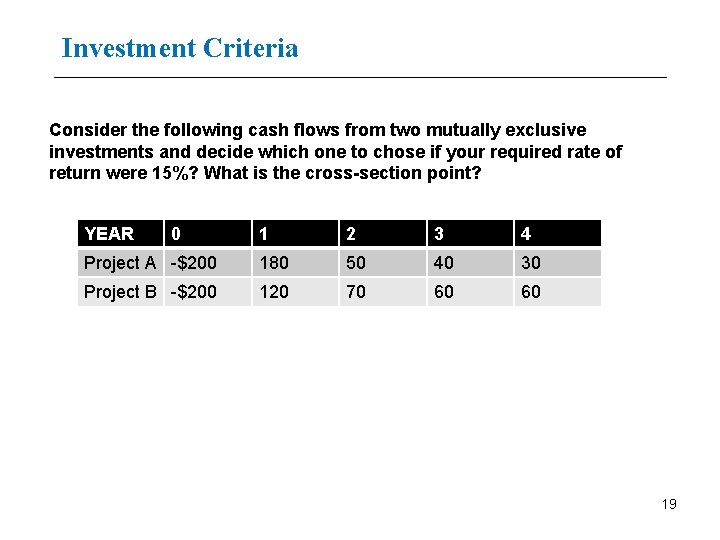
Investment Criteria Consider the following cash flows from two mutually exclusive investments and decide which one to chose if your required rate of return were 15%? What is the cross-section point? YEAR 0 1 2 3 4 Project A -$200 180 50 40 30 Project B -$200 120 70 60 60 19
- Slides: 19