
Financial Management and Control in the Dutch Public
Financial Management and Control in the Dutch Public Sector Prague, March 24, 2016 Manfred van Kesteren

Topics: 1. Introduction: administrative structure of the Netherlands 2. Characteristics Dutch Governance System: focus on Internal Control 3. Embedment of Internal Control in public institutions Prague, March 2016

Administrative Structure of The Netherlands Ø Dutch Constitution: decentralised unitary state Ø Three government layers: → central government (State): 11 ministries, 30 agencies, 200 subordinated executive organizations; → regional government: 12 provinces → local government: 403 municipalities Ø Each government layer has its own democratic structure (elected bodies) Ø Provinces and municipalities: decentralized budget responsibility and accountability and governance structure. Prague, March 2016
The Budget Code (Government Accounts Act) • Responsibilities of Ministers: Sound financial management Legality/compliance • Responsibilities and powers of Minister of Finance • Budget and accountability cycle • Organization of internal control and internal audit • Responsibilities and powers of the Court of Audit Prague, March 2016
1986 - 1992: Crucial developments in Internal Control and Internal Audit In 1980 s shortcomings in internal control pointed out by SAI: • Problems with producing annual accounts (far too late) • No separate internal audit units • SAI put problems on agenda of Parliament Prague, March 2016
Coordinated plan in 80’s Government Accounting Reform Operation Objectives: § § § Better accounting information systems Improvement internal control Introducing internal audit Mo. F as central department for coordination operation (CHU role) SAI reported about progress Prague, March 2016
Operation VBTB 1999: Operation: “From policy budget to policy accountability”: improving information value for Parliament and Dutch citizens link between performance, operations and budget performance indicators and policy evaluations from input to output/outcome Prague, March 2016
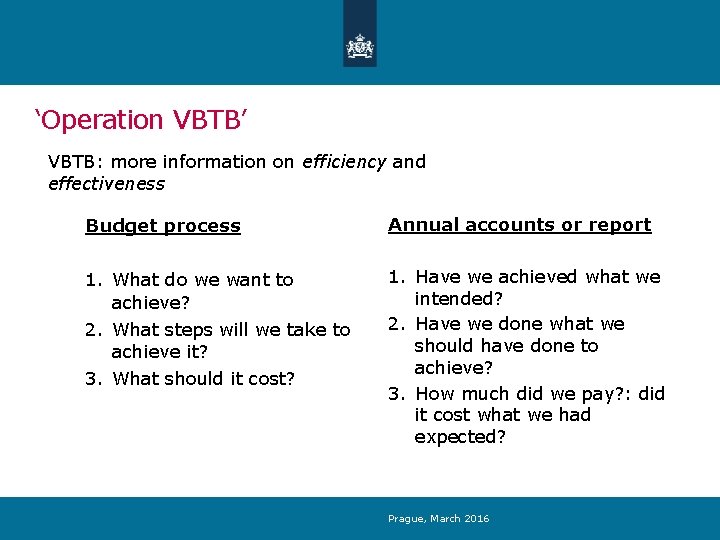
‘Operation VBTB’ VBTB: more information on efficiency and effectiveness Budget process Annual accounts or report 1. What do we want to achieve? 2. What steps will we take to achieve it? 3. What should it cost? 1. Have we achieved what we intended? 2. Have we done what we should have done to achieve? 3. How much did we pay? : did it cost what we had expected? Prague, March 2016
Characteristics of VBTB Ø central role of policy objectives, concrete operational priorities and performance indicators; Ø coherence between budget and accounting documents; Ø management gives “in control statement” about operational efficiency and effectiveness of processes within the Ministry concerned Prague, March 2016
Developments caused by the introduction of VBTB More explicit responsibilities and duties concerning: § Defining policy objectives, priorities and performance indicators § Management of financial and non financial processes § Efficiency and effectiveness of processes § Broader scope annual report (including “in control statement”) § New information needs of management § Changing role of financial control and audit function Prague, March 2016
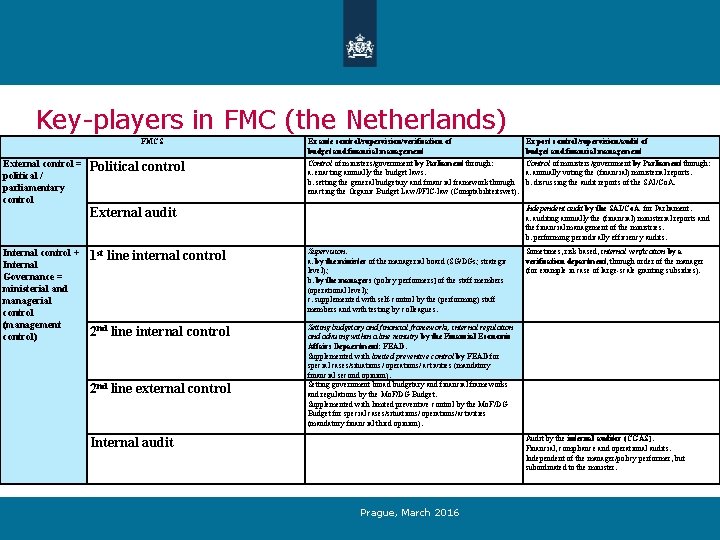
Key-players in FMC (the Netherlands) FMCS Ex ante control/supervision/verification of budget and financial management Control of ministers/government by Parliament through: a. enacting annually the budget laws. a. annually voting the (financial) ministerial reports. b. setting the general budgetary and financial framework through b. discussing the audit reports of the SAI/Co. A. enacting the Organic Budget Law/PFIC-law (Comptabiliteitswet). External control = political / parliamentary control Political control Internal control + Internal Governance = ministerial and managerial control (management control) 1 st line internal control Supervision: a. by the minister of the managerial board (SG/DGs; strategic level); b. by the managers (policy performers) of the staff members (operational level); c. supplemented with self-control by the (performing) staff members and with testing by colleagues. 2 nd line internal control Setting budgetary and financial frameworks, internal regulation and advising within a line ministry by the Financial Economic Affairs Depaertment: FEAD. Supplemented with limited preventive control by FEAD for special cases/situations/ operations/ activities (mandatory financial second opinion). Setting government broad budgetary and financial frameworks and regulations by the Mo. F/DG Budget. Supplemented with limited preventive control by the Mo. F/DG Budget for special cases/situations/ operations/activities (mandatory financial third opinion). Independent audit by the SAI/Co. A. for Parliament. a. auditing annually the (financial) ministerial reports and the financial management of the ministries. b. performing periodically efficiency audits. External audit 2 nd line external control Ex post control/supervision/audit of budget and financial management Sometimes, risk based, internal verification by a verification department, through order of the manager (for example in case of large-scale granting subsidies). Audit by the internal auditor (CGAS). Financial, compliance and operational audits. Independent of the manager/policy performer, but subordinated to the minister. Internal audit Prague, March 2016
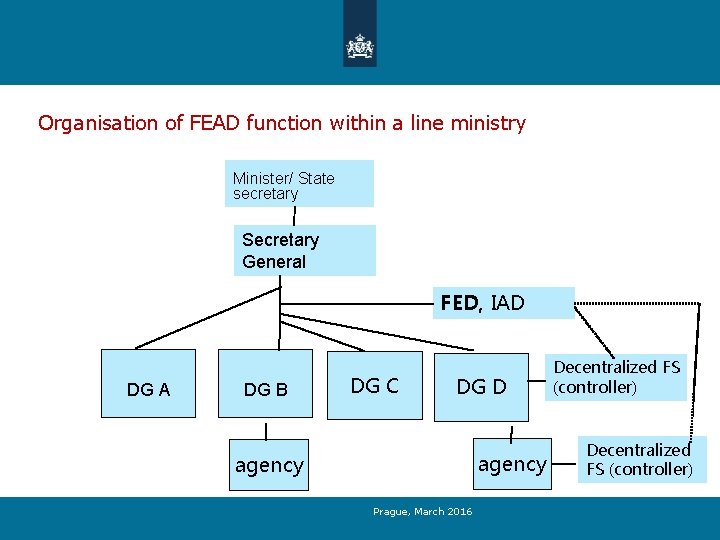
Organisation of FEAD function within a line ministry Minister/ State secretary Secretary General FED, IAD DG A DG B DG C DG D agency Prague, March 2016 Decentralized FS (controller)
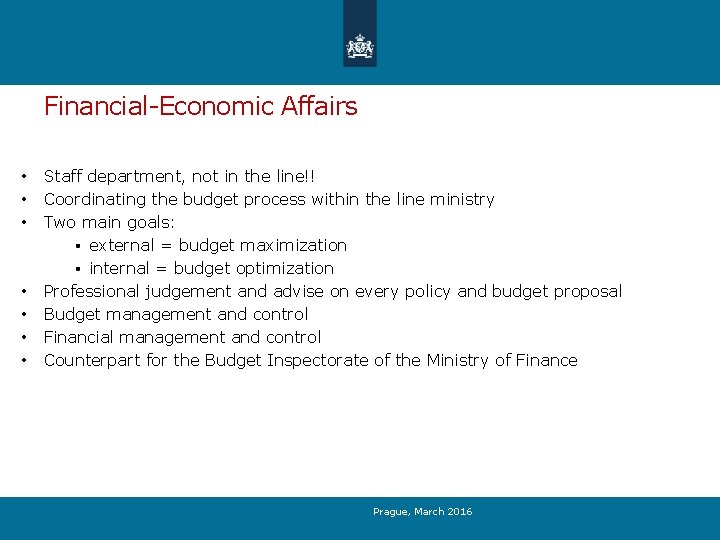
Financial-Economic Affairs • • Staff department, not in the line!! Coordinating the budget process within the line ministry Two main goals: external = budget maximization internal = budget optimization Professional judgement and advise on every policy and budget proposal Budget management and control Financial management and control Counterpart for the Budget Inspectorate of the Ministry of Finance Prague, March 2016
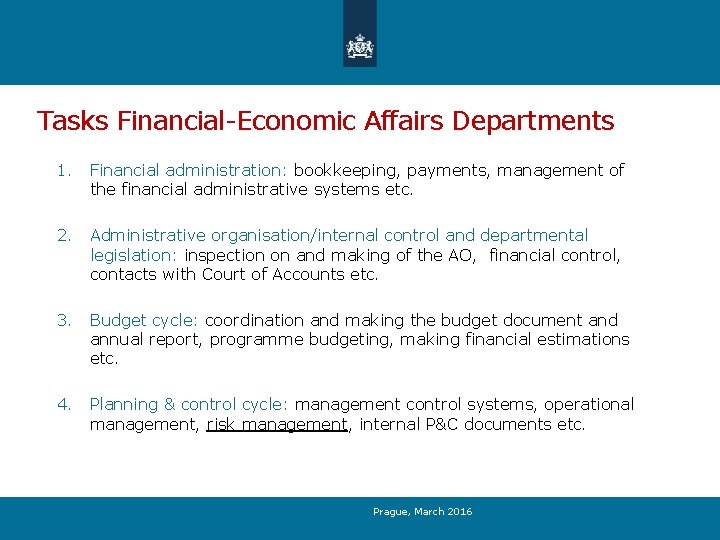
Tasks Financial-Economic Affairs Departments 1. Financial administration: bookkeeping, payments, management of the financial administrative systems etc. 2. Administrative organisation/internal control and departmental legislation: inspection on and making of the AO, financial control, contacts with Court of Accounts etc. 3. Budget cycle: coordination and making the budget document and annual report, programme budgeting, making financial estimations etc. 4. Planning & control cycle: management control systems, operational management, risk management, internal P&C documents etc. Prague, March 2016
Tasks Financial-Economic Affairs Departments 5. 6. 7. Policy control: financial check on policy proposals, Cost-Benefit Analyses, thinking of alternatives etc. Inspection of agencies: check on investment proposals, check on budget document and annual report etc. Evaluations: evaluations ex post, policy reviews etc. Prague, March 2016
Thank you for your attention!!!!! M. kesteren@minfin. nl
- Slides: 16