
Financial Leverage CHAPTER 8 Leverage A little consideration











- Slides: 39
Financial Leverage —CHAPTER 8—
Leverage A little consideration will lead us to the essential insight that “debt makes a good situation better, but a bad situation worse!” This is what we observed in Chapter 2, leading up to the global financial crisis, as firms and banks sought to enhance their profitability with cheaply available debt, before discovering to their costs that while higher levels of debt might indeed prove effective in the good times, such leverage would be responsible for strangling the company to bankruptcy or near bankruptcy when the economic cycle turned downward.
Leverage : Hyman Minsky We also saw in Chapter 2, how Hyman Minsky recognized the essential dynamic of higher levels of debt as fuelling growth on the up-cycle, before precipitating destructive declines in the down-cycle. So, clearly, debt is important in determining the outcome of a firm’s investment decisions. We might even go so far as to say that debt has the power to make or break both the economy and firm.
Modigliani and Miller In addition, we shall consider the equilibrium propositions of Modigliani and Miller. The propositions were articulated my Franco Modigliani and Merton Miller in the late 1950 s/early 1960 s, and are generally regarded as the foundation of modern capital structure theory.
Modigliani and Miller (cont) Apparently contradicting the dictate that “debt makes a good situation better, but a bad situation worse”, Modigliani and Miller’s proposition I states that the combined market value of the firm’s debt and equity is actually independent of its capital structure; while their proposition II states that shareholders’ required rate of return on equity responds to leverage as required to maintain the validity of their proposition I. The ability to reconcile these foundational theoretical arguments of Modigliani and Miller with the evidence of both intuition and history as summarized in our opening slides will represent the major challenge of this chapter.
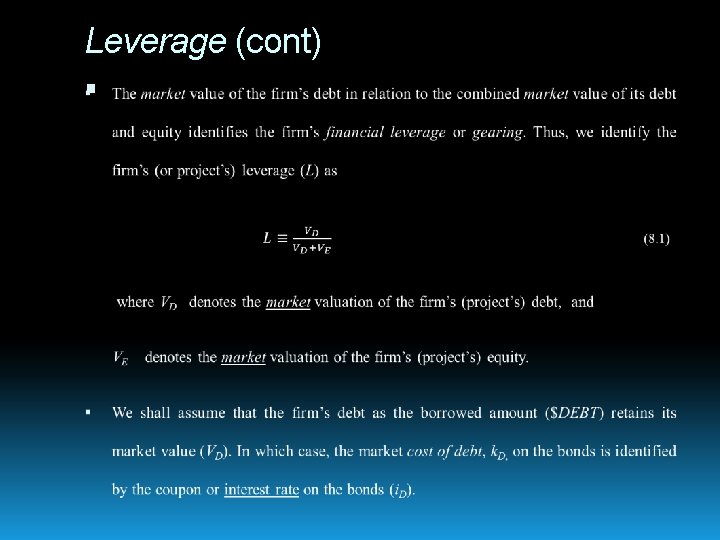
Leverage (cont)
Leverage (cont) The terms “leverage” and “gearing” are both descriptive words. A lever is that which on a fulcrum allows for a small force to move a greater force. A gear, in a car or bicycle, for example, is that which translates an input rate of revolution into a higher rate of revolution. To see why we use the words “lever” and “gear” to express a firm's level of debt, consider the following two alternatives by which we might choose to finance an investment.
Investment and Leverage For many of us, a house purchase with a mortgage represents our greatest exposure to financial leverage. Suppose, you see a property, which you believe presents a good investment opportunity. Suppose that the property can be purchased for $100, 000, but that you can afford only $10, 000. Conceptually, two strategies to raise the full $100, 000 present themselves:
Investment and Leverage (cont) Strategy A: Become heavily levered/geared by borrowing $90, 000 at, say, 10% interest per annum. In this case, you finance your investment with a combination of equity (your own cash investment, representing ownership, $10, 000) and debt (your mortgage, representing borrowing, $90, 000). Thus, you have achieved the additionally required funding in exchange for interest repayments ($9, 000 per annum) and the ultimate repayment for the principal amount borrowed ($90, 000).
Investment and Leverage (cont) Strategy B: Remain unlevered. You might achieve this by persuading your friends to become your partners, so that they collectively contribute the $90, 000 you require in return for joint ownership with you in the project. Each of your individual partners will own the property in proportion to his/her funding. In this way, you have achieved funding in exchange for ownership in your investment. You have avoided having any debt as you have financed your investment with equity only.
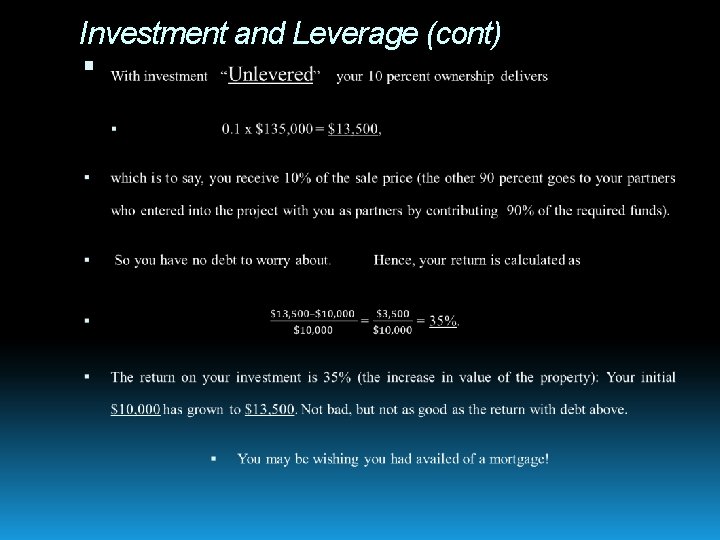
Investment and Leverage (cont) Note, that in both cases you invest the same amount ($10, 000) in the same asset (the same property). So does leverage make a difference? Let us see.
Investment and Leverage (cont)
Investment and Leverage (cont)
Investment and Leverage (cont)
Investment and Leverage (cont)
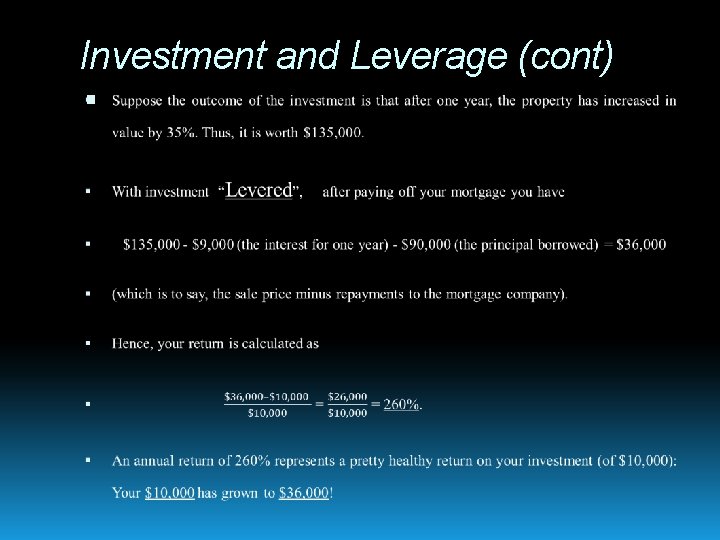
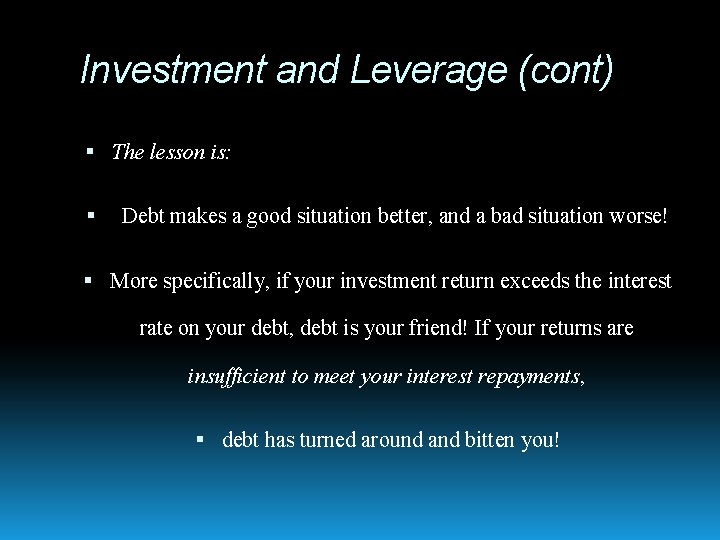
Investment and Leverage (cont) The lesson is: Debt makes a good situation better, and a bad situation worse! More specifically, if your investment return exceeds the interest rate on your debt, debt is your friend! If your returns are insufficient to meet your interest repayments, debt has turned around and bitten you!
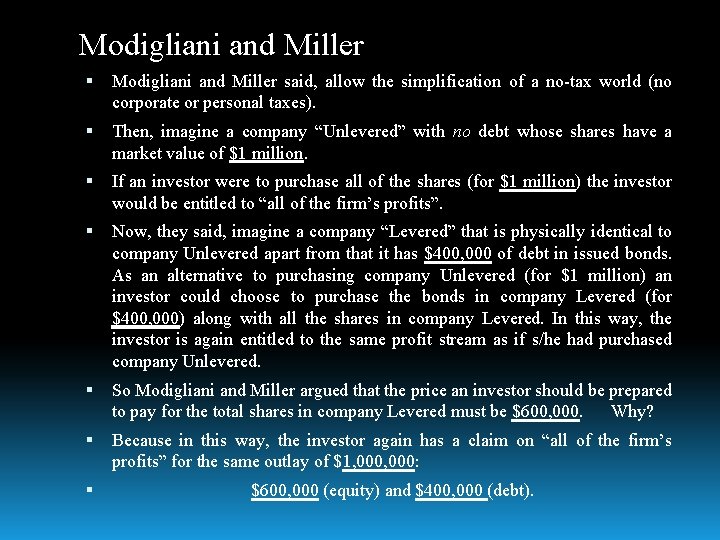
Modigliani and Miller said, allow the simplification of a no-tax world (no corporate or personal taxes). Then, imagine a company “Unlevered” with no debt whose shares have a market value of $1 million. If an investor were to purchase all of the shares (for $1 million) the investor would be entitled to “all of the firm’s profits”. Now, they said, imagine a company “Levered” that is physically identical to company Unlevered apart from that it has $400, 000 of debt in issued bonds. As an alternative to purchasing company Unlevered (for $1 million) an investor could choose to purchase the bonds in company Levered (for $400, 000) along with all the shares in company Levered. In this way, the investor is again entitled to the same profit stream as if s/he had purchased company Unlevered. So Modigliani and Miller argued that the price an investor should be prepared to pay for the total shares in company Levered must be $600, 000. Why? Because in this way, the investor again has a claim on “all of the firm’s profits” for the same outlay of $1, 000: $600, 000 (equity) and $400, 000 (debt).
Modigliani and Miller (cont) MM therefore argued that just as the amount of cake cannot depend on how the cake is distributed, so the value of the firm cannot depend on how its ownership is distributed between shareholders and debt holders. the market value of a firm, Vfirm Thus, they argued that : as the sum of the market value of its debt, V, D and equity, V E, claims on the firm is independent of its capital structure; which is to say, independent of whether the firm is funded more by debt financing or by equity financing. They thereby proposed: Vfirm ≡ VE + VD = VU where VU = the unlevered market value of the firm assuming no debt. Equation 8. 3 is Modigliani and Miller’s Proposition I (or, more simply, MM I). (8. 3)
Modigliani and Miller (cont)
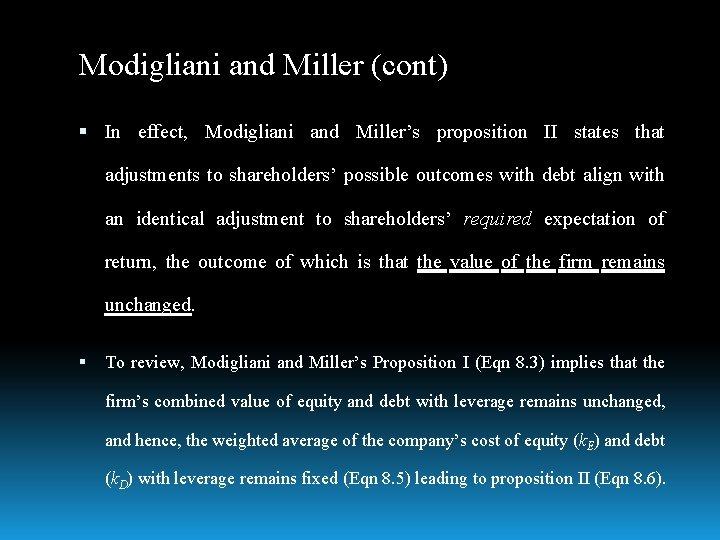
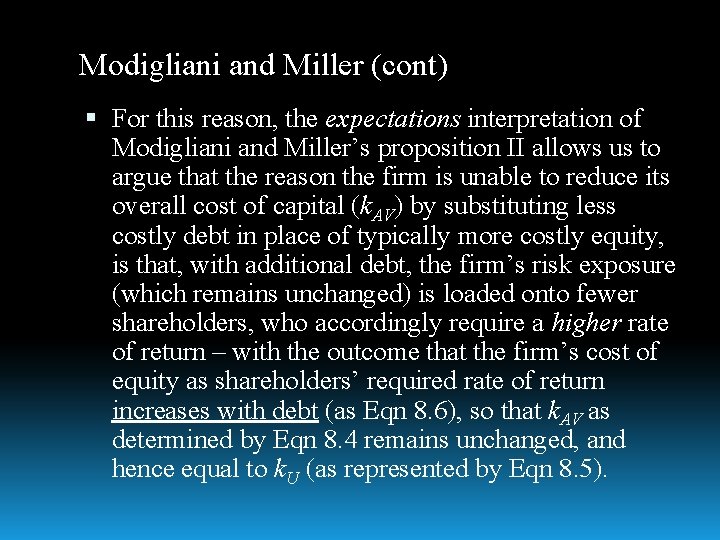
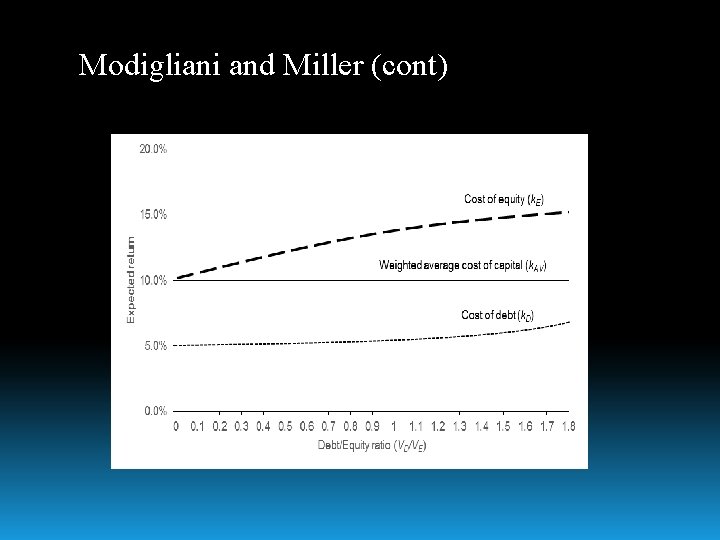
Modigliani and Miller (cont) In effect, Modigliani and Miller’s proposition II states that adjustments to shareholders’ possible outcomes with debt align with an identical adjustment to shareholders’ required expectation of return, the outcome of which is that the value of the firm remains unchanged. To review, Modigliani and Miller’s Proposition I (Eqn 8. 3) implies that the firm’s combined value of equity and debt with leverage remains unchanged, and hence, the weighted average of the company’s cost of equity (k. E) and debt (k. D) with leverage remains fixed (Eqn 8. 5) leading to proposition II (Eqn 8. 6).
Modigliani and Miller (cont)
Modigliani and Miller (cont) For this reason, the expectations interpretation of Modigliani and Miller’s proposition II allows us to argue that the reason the firm is unable to reduce its overall cost of capital (k. AV) by substituting less costly debt in place of typically more costly equity, is that, with additional debt, the firm’s risk exposure (which remains unchanged) is loaded onto fewer shareholders, who accordingly require a higher rate of return – with the outcome that the firm’s cost of equity as shareholders’ required rate of return increases with debt (as Eqn 8. 6), so that k. AV as determined by Eqn 8. 4 remains unchanged, and hence equal to k. U (as represented by Eqn 8. 5).
Modigliani and Miller (cont)
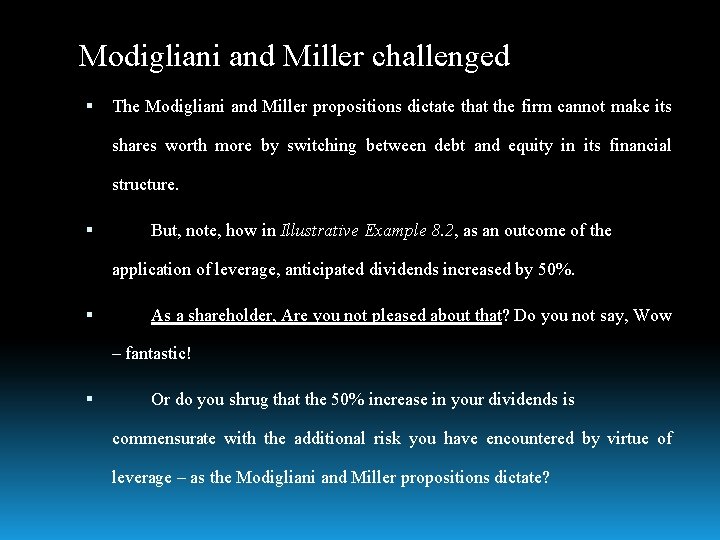
Modigliani and Miller challenged The Modigliani and Miller propositions dictate that the firm cannot make its shares worth more by switching between debt and equity in its financial structure. But, note, how in Illustrative Example 8. 2, as an outcome of the application of leverage, anticipated dividends increased by 50%. As a shareholder, Are you not pleased about that? Do you not say, Wow – fantastic! Or do you shrug that the 50% increase in your dividends is commensurate with the additional risk you have encountered by virtue of leverage – as the Modigliani and Miller propositions dictate?
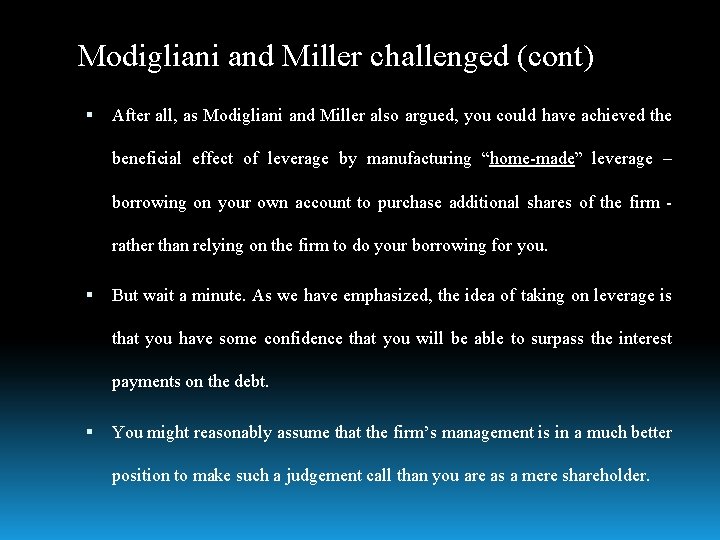
Modigliani and Miller challenged (cont) After all, as Modigliani and Miller also argued, you could have achieved the beneficial effect of leverage by manufacturing “home-made” leverage – borrowing on your own account to purchase additional shares of the firm rather than relying on the firm to do your borrowing for you. But wait a minute. As we have emphasized, the idea of taking on leverage is that you have some confidence that you will be able to surpass the interest payments on the debt. You might reasonably assume that the firm’s management is in a much better position to make such a judgement call than you are as a mere shareholder.
Modigliani and Miller challenged (cont) In fact, you might argue, that you are as a shareholder paying the firm’s management stock options and bonuses exactly to make such judgement calls. Thus, if the firm appears able to sustain a 50% increase in dividends, you might not be at all surprised to see that the market value of your shares actually does increase! – directly contradicting, let us be clear about this, Modigliani and Miller! – as captured in the final part of Illustrative Example 8. 2.
An optimal debt leverage: financial distress As we have discussed, the trick of boosting profits with leverage must not be overdone to the point that the firm is destroyed by bankruptcy when the economic cycle turns. As well as the losses to the firm’s shareholders as an outcome of the transfer of assets to bondholders, the process of bankruptcy invariably leads to an absolute destruction of value due to legal costs, administration costs, fire-sales of assets, compensation following redundancies of personnel, and the loss of the firm’s intangible assets such as goodwill and the intellectual property of its personnel, which are simply lost forever.
An optimal debt leverage: financial distress(cont) Even the perceived threat of bankruptcy (when a firm is suspected of having over extended itself with debt) is typically destructive of the firm as, under financial stress, both suppliers and clients, when they consider that the firm cannot be relied on to either deliver negotiated goods or to honour payment on its invoices, are made to be wary of dealing with the firm. In addition, the firm’s employees become restless and are looking out for alternative employment. And just when it requires it most, the firm has difficulty in raising additional finance. Which is what we observed for Bear Stearns in the GFC in Chapter 2).
An optimal debt leverage: Agency Another aspect of debt – and a reason why the market “likes to see debt” in a firm’s capital structure - is that when the firm takes on debt, the imposition on management to maintain regular visible cash flows in the form of interest payments on the debt is viewed as mitigating what is referred to as the firm’s agency problem. As introduced in Chapter 5, the agency problem is that of the firm’s owners (shareholders) wish to be assured that the firm’s management team is acting in the shareholders’ - as opposed to managements’ - best interests. Failure to meet the interest payments on the firm’s debt would lead very quickly to consternation (in the press and media, for example) as to the firm’s predicament, and a likely “no confidence” vote in the firm’s management team. The imposition of debt may therefore be viewed as disciplining the firm’s management to perform in the best interests of shareholders.
An optimal debt leverage: the market takes a view In practice, if the firm takes on more debt, the market is keen to observe whether the bond issue is “defensive” – motivated, for example, by the need to shore up the firm’s failing finances; in which case the market response to the firm’s issue of debt may be negative. If however, the issue is interpreted as having been motivated by the firm’s strength and managerial ambitions and as a solid foundation for expansion requiring additional finance with an effective (at reasonably safe) leveraging of profits, the market response is likely to be positive.
An optimal debt leverage: the tax advantage of debt Modigliani and Miller themselves later advocated an argument in favor of debt in their 1963 paper, Corporate Income Taxes and the Cost of Capital: A Correction. In this paper, they pointed out that their Propositions I and II – and the above derivations - ignore a firm’s corporate tax liability. At this stage, we should remind ourselves that three groups have a claim on the firm’s profits at the end of each financial year: the holders of the firm’s debt, the tax authorities, and the holders of the firm’s equity, – in that order.
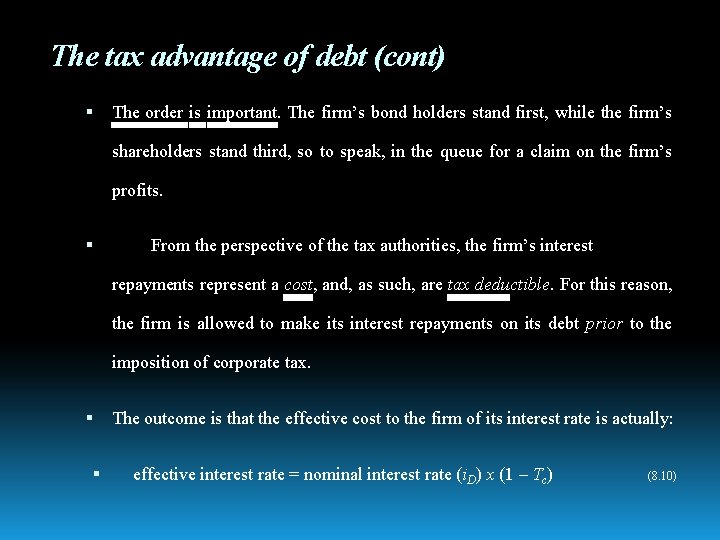
The tax advantage of debt (cont) The order is important. The firm’s bond holders stand first, while the firm’s shareholders stand third, so to speak, in the queue for a claim on the firm’s profits. From the perspective of the tax authorities, the firm’s interest repayments represent a cost, and, as such, are tax deductible. For this reason, the firm is allowed to make its interest repayments on its debt prior to the imposition of corporate tax. The outcome is that the effective cost to the firm of its interest rate is actually: effective interest rate = nominal interest rate (i. D) x (1 – Tc) (8. 10)
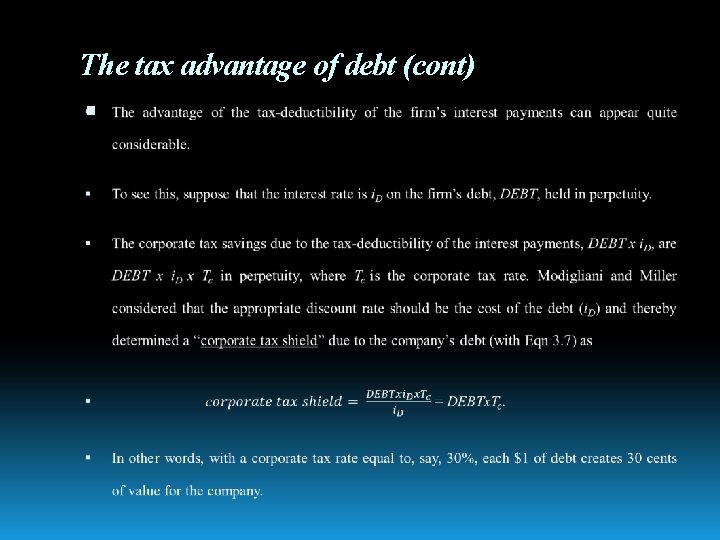
The tax advantage of debt (cont)
The tax advantage of debt (cont) Nevertheless, Merton Miller (1977) himself argued that at the margin of new debt entering the market, the firm must have increased its borrowing rate to attract the marginal lender, such that the tax benefits at this point are shared with the firm’s new debt holders. In this case, for the firm bringing new debt to market, it is possible to consider that the advantage of the tax deductibility of the interest payments effectively cancels with the firm’s increased cost of borrowing.
Review On a simplified level, the propositions of Modigliani and Miller appear entirely rational. The propositions commence with the “irrelevancy of financial leverage” theorem assuming no corporate tax. Nevertheless, as we have demonstrated, the propositions cannot be taken literally. By advocating the irrelevancy of debt, the MM propositions suppress the dynamic of leverage as “making a good situation better and a bad situation worse”. The limitation of the MM propositions is that they capture an essentially static view of the firm’s optimal leverage, when, in fact, the phenomenon of leverage is a dynamic one. Hyman Minsky is the economist who most clearly anticipated the importance of debt in the economic cycle and the attendant dangers of speculative bubbles in asset prices.
Review (cont) We have observed that the market “likes to see debt” in a firm’s capital structure as an indicator that its management is up to the task of maximizing shareholder returns. The firm must seek to ensure, however, that it does not burden itself with debt to the point that it is “caught out” by a decline in its profitability. As final considerations: Franco Modigliani and Merton Miller considered that the tax deductibility of the firm’s interest repayments implies a lower effective cost of debt to the firm. Nevertheless, Merton Miller later considered that at the margin of additional debt, theoretical tax benefits are likely to cancel with the firm’s increased cost of borrowing.
Review (cont) Putting it all together, firms are generally under pressure to maximize returns to shareholders, balancing tax benefits of debt as well as employing debt to leverage profitability, while guarding against the destructive downside potential of leverage if the economy – and thereby the firm’s prospects - should turn downward.