
FINANCIAL DEVELOPMENT AND THE PROCESS OF MONEY MULTIPLICATION

- Slides: 20
FINANCIAL DEVELOPMENT AND THE PROCESS OF MONEY MULTIPLICATION IN THE EUROPEAN TRANSITION COUNTRIES Sead KRESO, Selena BEGOVIĆ
Content • The main goals of the presentation • Money multipliers • Determinants of (and limitations to) the money multiplication process – Type of monetary/exchange rate regime – Level of financial development • Financial sitem Bi. H-perspective from foreign capital flows – Presence of foreign banks • Conclusions and suggestions 2
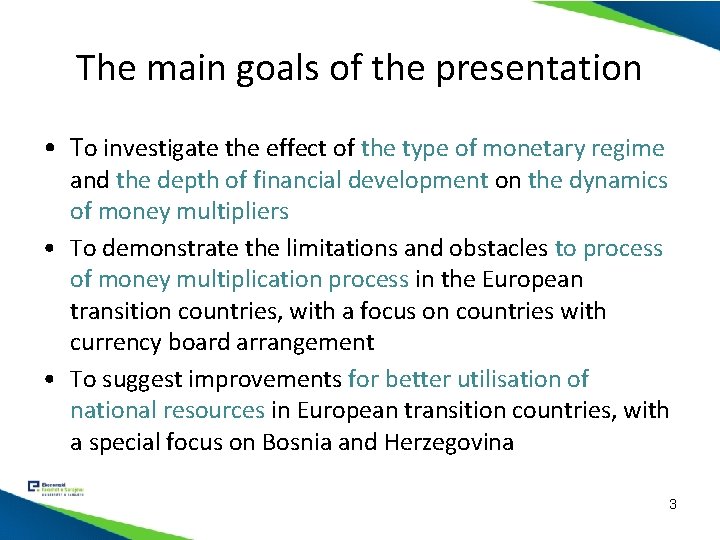
The main goals of the presentation • To investigate the effect of the type of monetary regime and the depth of financial development on the dynamics of money multipliers • To demonstrate the limitations and obstacles to process of money multiplication process in the European transition countries, with a focus on countries with currency board arrangement • To suggest improvements for better utilisation of national resources in European transition countries, with a special focus on Bosnia and Herzegovina 3
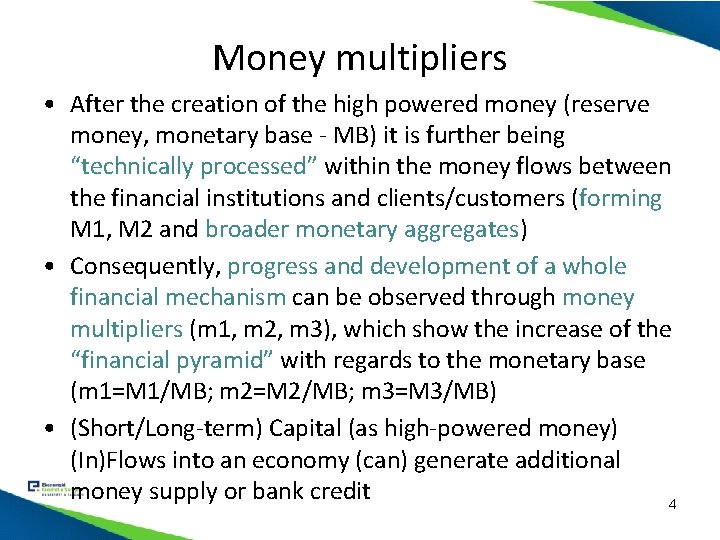
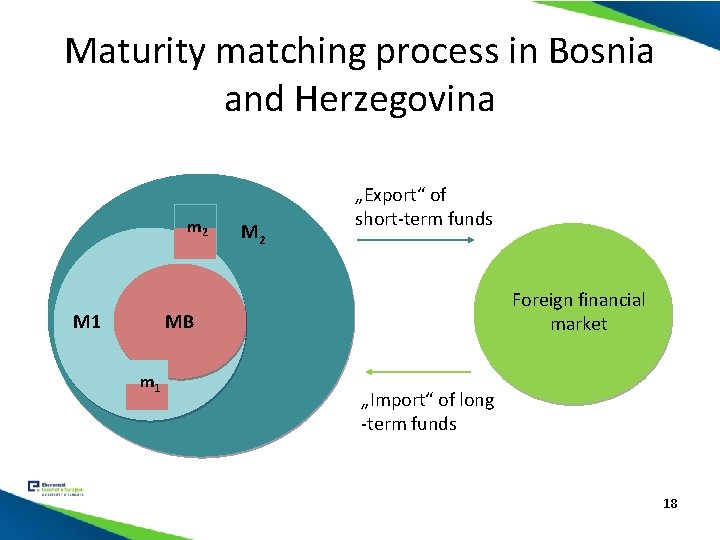
Money multipliers • After the creation of the high powered money (reserve money, monetary base - MB) it is further being “technically processed” within the money flows between the financial institutions and clients/customers (forming M 1, M 2 and broader monetary aggregates) • Consequently, progress and development of a whole financial mechanism can be observed through money multipliers (m 1, m 2, m 3), which show the increase of the “financial pyramid” with regards to the monetary base (m 1=M 1/MB; m 2=M 2/MB; m 3=M 3/MB) • (Short/Long-term) Capital (as high-powered money) (In)Flows into an economy (can) generate additional money supply or bank credit 4
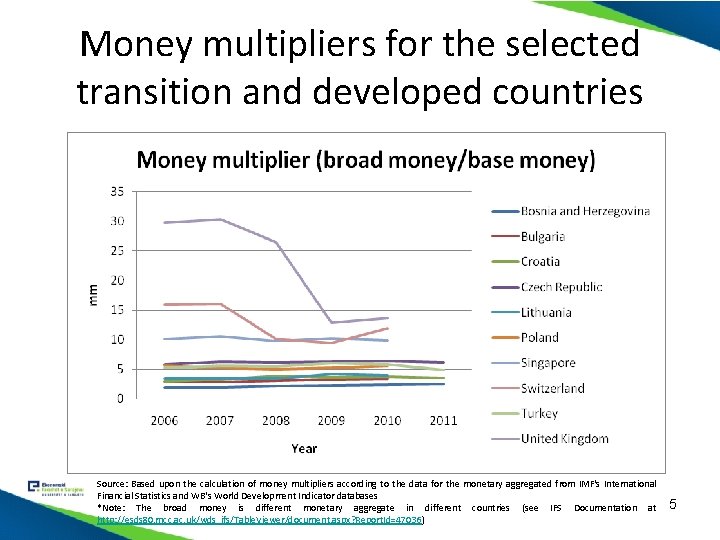
Money multipliers for the selected transition and developed countries Source: Based upon the calculation of money multipliers according to the data for the monetary aggregated from IMF's International Financial Statistics and WB's World Development Indicator databases *Note: The broad money is different monetary aggregate in different countries (see IFS Documentation at http: //esds 80. mcc. ac. uk/wds_ifs/Table. Viewer/document. aspx? Report. Id=47036) 5
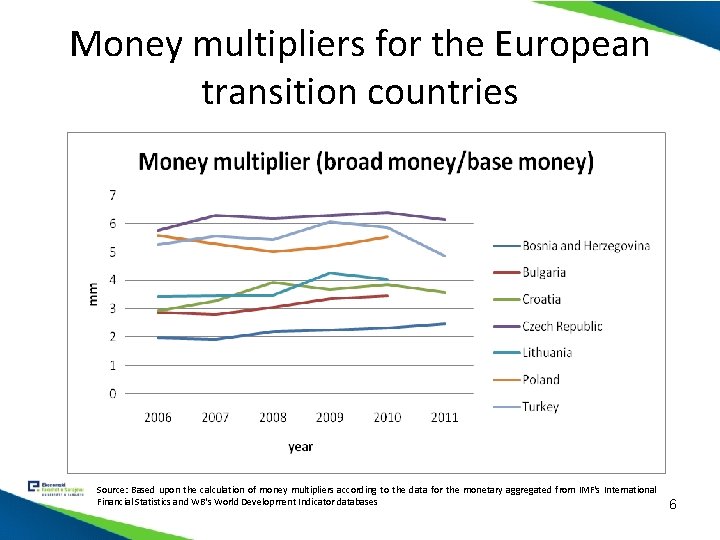
Money multipliers for the European transition countries Source: Based upon the calculation of money multipliers according to the data for the monetary aggregated from IMF's International Financial Statistics and WB's World Development Indicator databases 6
The main determinants of the money multiplication process • Level of discretion of monetary/exchange rate regime (ability to affect money multiplication process) • Level of development of financial markets and institutions • An asset share of foreign-owned banks and the dependence of money multiplication process on foreign financial markets 7
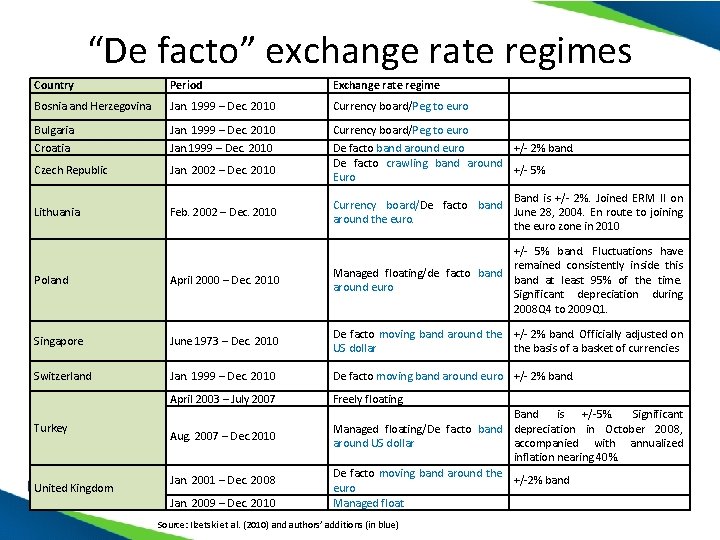
“De facto” exchange rate regimes Country Period Exchange rate regime Bosnia and Herzegovina Jan. 1999 – Dec. 2010 Currency board/Peg to euro Bulgaria Croatia Jan. 1999 – Dec. 2010 Czech Republic Jan. 2002 – Dec. 2010 Currency board/Peg to euro De facto band around euro +/- 2% band. De facto crawling band around +/- 5% Euro Lithuania Feb. 2002 – Dec. 2010 Band is +/- 2%. Joined ERM II on Currency board/De facto band June 28, 2004. En route to joining around the euro zone in 2010 Poland April 2000 – Dec. 2010 +/- 5% band. Fluctuations have remained consistently inside this Managed floating/de facto band at least 95% of the time. around euro Significant depreciation during 2008 Q 4 to 2009 Q 1. Singapore June 1973 – Dec. 2010 De facto moving band around the +/- 2% band. Officially adjusted on US dollar the basis of a basket of currencies Switzerland Jan. 1999 – Dec. 2010 De facto moving band around euro +/- 2% band. April 2003 – July 2007 Freely floating Turkey United Kingdom Aug. 2007 – Dec. 2010 Jan. 2001 – Dec. 2008 Jan. 2009 – Dec. 2010 Band is +/-5%. Significant Managed floating/De facto band depreciation in October 2008, around US dollar accompanied with annualized inflation nearing 40%. De facto moving band around the +/-2% band euro Managed float Source: Ilzetski et al. (2010) and authors’ additions (in blue)
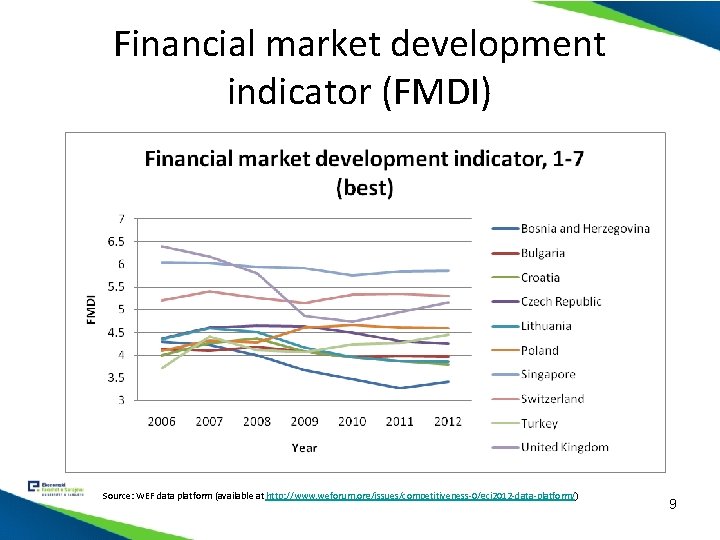
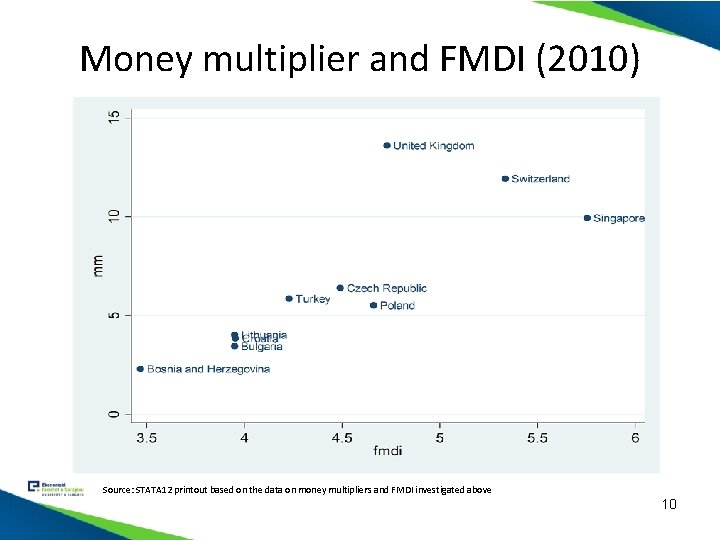
Financial market development indicator (FMDI) Source: WEF data platform (available at http: //www. weforum. org/issues/competitiveness-0/gci 2012 -data-platform/) 9
Money multiplier and FMDI (2010) Source: STATA 12 printout based on the data on money multipliers and FMDI investigated above 10
Financial sitem Bi. H, perspective from foreign capital flows • Fitz. Gerald (QEHWPS 08) – „Short-term capital flow instability arises from the desire of investors to hold liquid assets in the face of uncertainty“ – „The volatility of short-term capital flows (or ‘capital surges’) is now recognized as a major problem for macroeconomic management in developing countries“ • Firat Demir (2007) – „. . the volatility of short term capital inflows such that increasing volatility by disrupting market activities, domestic investment and growth increases socio-political risk, which further feeds into the volatility of such flows“ 11
• Firat Demir (2007) – „Between 1990 and 2003, gross inflows increased 50 times in Argentina, 21 times in Mexico and 42 times in Turkey compared to the 1984 -1989 period. . . While gross inflows stand around $592, $553 and $188 billion in AMT, the net inflows remained at $5, $27 and $7 billion respectively between 1990 and 2003“ • Chee-Keong Choong, Siew-Yong Lam, Zulkornain Yusop (2010) – “. . . private capital flows have a positive impact on growth in low-income countries with welldeveloped financial sector“ 12
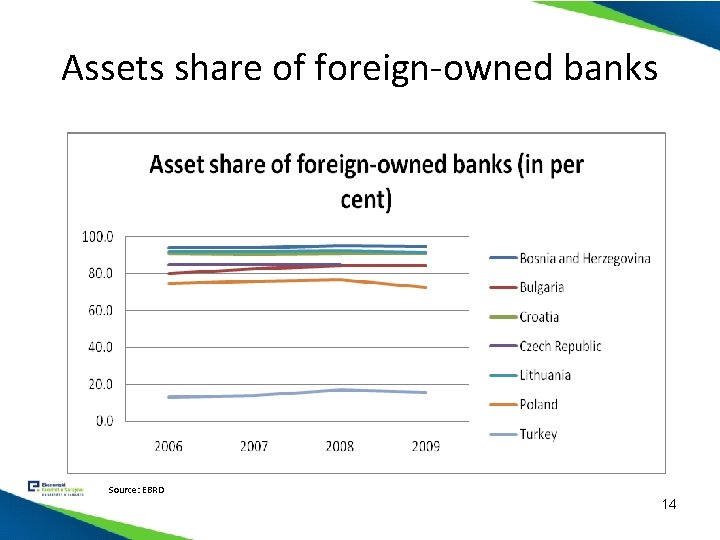
• Bosnia and Herzegovina/region - Financial system strongly dominated by commercial banks established by foreign capital • The Development strategy for Bi. H (Internetional comunity, WB) - to build the economic structure based on SMEs • Rodric (1999) – “Small enterprises. . . are vulnerable to the business cycle because they rely on sub-contracts from larger firms or the expenditure of wages by their employees” 13
Assets share of foreign-owned banks Source: EBRD 14
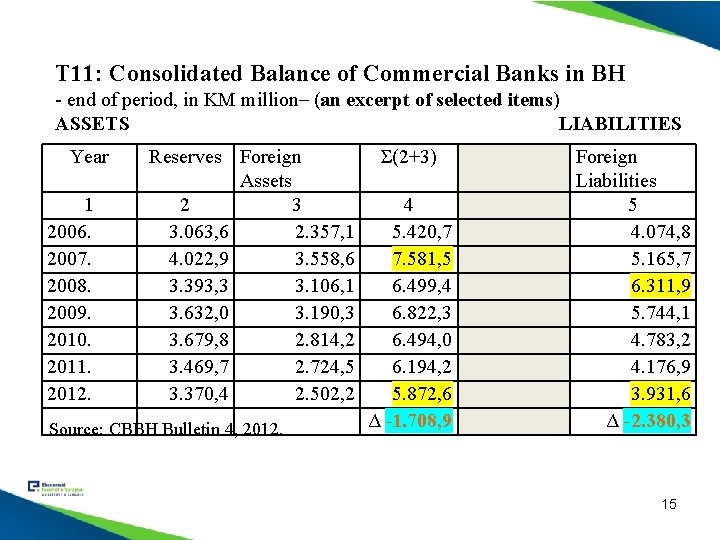
T 11: Consolidated Balance of Commercial Banks in BH - end of period, in KM million– (an excerpt of selected items) ASSETS LIABILITIES Year 1 2006. 2007. 2008. 2009. 2010. 2011. 2012. Reserves Foreign Assets 2 3 3. 063, 6 2. 357, 1 4. 022, 9 3. 558, 6 3. 393, 3 3. 106, 1 3. 632, 0 3. 190, 3 3. 679, 8 2. 814, 2 3. 469, 7 2. 724, 5 3. 370, 4 2. 502, 2 Source: CBBH Bulletin 4, 2012. Σ(2+3) 4 5. 420, 7 7. 581, 5 6. 499, 4 6. 822, 3 6. 494, 0 6. 194, 2 5. 872, 6 Δ -1. 708, 9 Foreign Liabilities 5 4. 074, 8 5. 165, 7 6. 311, 9 5. 744, 1 4. 783, 2 4. 176, 9 3. 931, 6 Δ -2. 380, 3 15
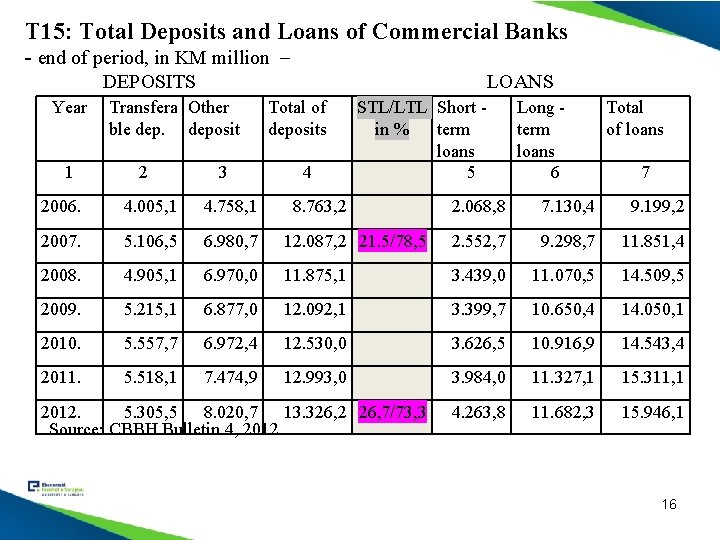
T 15: Total Deposits and Loans of Commercial Banks - end of period, in KM million – DEPOSITS Year 1 Transfera Other ble deposit 2 3 2006. 4. 005, 1 4. 758, 1 2007. 5. 106, 5 6. 980, 7 2008. 4. 905, 1 2009. LOANS Total of deposits 4 STL/LTL Short in % term loans 5 8. 763, 2 Long term loans 6 Total of loans 7 2. 068, 8 7. 130, 4 9. 199, 2 12. 087, 2 21. 5/78, 5 2. 552, 7 9. 298, 7 11. 851, 4 6. 970, 0 11. 875, 1 3. 439, 0 11. 070, 5 14. 509, 5 5. 215, 1 6. 877, 0 12. 092, 1 3. 399, 7 10. 650, 4 14. 050, 1 2010. 5. 557, 7 6. 972, 4 12. 530, 0 3. 626, 5 10. 916, 9 14. 543, 4 2011. 5. 518, 1 7. 474, 9 12. 993, 0 3. 984, 0 11. 327, 1 15. 311, 1 4. 263, 8 11. 682, 3 15. 946, 1 2012. 5. 305, 5 8. 020, 7 13. 326, 2 26, 7/73, 3 Source: CBBH Bulletin 4, 2012. 16
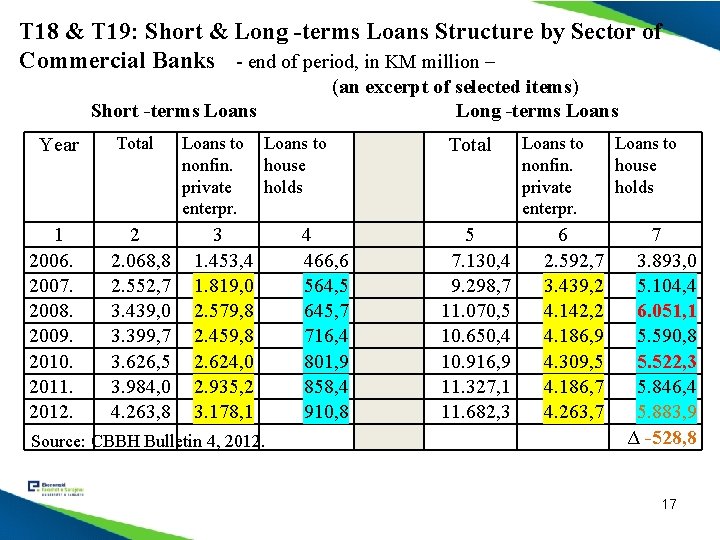
T 18 & T 19: Short & Long -terms Loans Structure by Sector of Commercial Banks - end of period, in KM million – (an excerpt of selected items) Long -terms Loans Short -terms Loans Year 1 2006. 2007. 2008. 2009. 2010. 2011. 2012. Total 2 2. 068, 8 2. 552, 7 3. 439, 0 3. 399, 7 3. 626, 5 3. 984, 0 4. 263, 8 Loans to nonfin. private enterpr. Loans to house holds 3 1. 453, 4 1. 819, 0 2. 579, 8 2. 459, 8 2. 624, 0 2. 935, 2 3. 178, 1 Source: CBBH Bulletin 4, 2012. 4 466, 6 564, 5 645, 7 716, 4 801, 9 858, 4 910, 8 Total 5 7. 130, 4 9. 298, 7 11. 070, 5 10. 650, 4 10. 916, 9 11. 327, 1 11. 682, 3 Loans to nonfin. private enterpr. 6 2. 592, 7 3. 439, 2 4. 142, 2 4. 186, 9 4. 309, 5 4. 186, 7 4. 263, 7 Loans to house holds 7 3. 893, 0 5. 104, 4 6. 051, 1 5. 590, 8 5. 522, 3 5. 846, 4 5. 883, 9 Δ -528, 8 17
Maturity matching process in Bosnia and Herzegovina m 2 M 1 M 2 „Export“ of short-term funds Foreign financial market MB m 1 „Import“ of long -term funds 18
Conclusions and suggestions • The level of financial market development is rather low in European transition countries (particularly in Bosnia and Herzegovina) • A high asset share of foreign-owned banks and the dependence of money multiplication process on foreign financial markets – This foreign dependence does not allow complete utilisation of national resources and is rather expensive • Even though money multipliers are lower in countries with the most restrictive monetary policies - this is also consequence of low level of financial development and the dependence on foreign markets 19
Conclusions and suggestions • Since the restrictive monetary policies are increasing credibility and stability in a transition countries available financial resources should be increased through other channels • The introduction of new channels of money multiplication through domestic finacial markets, which could use scarce financial resources more effectively for developing national economies and could be utilised as a buffer against the shocks – creation and development of the appropriate debt-securities market for investment of short (and longer) term funds – establishment of, for example, the development bank, which could be used by government to: initiate and attract development funding; implement a selective credit policy for some strategic area of 20 development, affect the interest rate and to buffer shocks