
Financial Consumer Protection Edoardo Rulli edoardo rulligmail com





- Slides: 33
Financial Consumer Protection Edoardo Rulli edoardo. rulli@gmail. com
• The rationale behind consumer protection • Consumers are the weaker party; • In order to guarantee the parties to be equal standing in terms of their conferred rights and obligations irrespective of their bargaining power, consumers must be protected.
• The legal framework • Broadly speaking, the pillar of the consumer protection is the Unfair Terms Directive (Directive 1993/13); • With respect to the protection afforded to a consumer acquiring services or goods in the financial sector, the relevant legal provisions are mainly provided by: Ø Markets in Financial Instruments Directive II; Ø Markets in Financial Instruments Regulation; Ø European authorities “soft law” powers.
• The Unfair Terms Directive defines the consumer as the “natural person who … is acting for purposes that are outside his trade, business or profession”; • “Natural person” means that an entity (e. g. a company) falls outside of the scope of such definition; • A natural person acting for purposes connected with his professional or business activities is not considered as a “weak party” as well. • Do the provisions of the Unfair Terms Directive, as long as all the above mentioned conditions are met, apply to financial contracts? Yes
• The Unfair Terms Directive - Main Provisions Art. 3 • The contractual terms should be the outcome of a specific precontractual discussion. Therefore, they shall be “individually negotiated”; • When a term or a condition is not “individually negotiated” (i. e. has been drafted in advance and the consumer has not been able to influence the substance of the term, might be considered as unfair;
• The Unfair Terms Directive - Main Provisions • A term is not binding upon the consumer provided that it has not been “individually negotiated” and it is (1) “contrary to the requirement of good faith”, while, (2) in the contractual equilibrium, causes imbalances. More specifically • (1) the seller should not take advantage of the lack of experience of the consumer and the terms and conditions should be written in a clear way; • (2) The imbalance should be serious and exceptional, otherwise it will not be material; • (3) The consumer to be considered in order to assess the unfairness of the term is a general consumer in the position of the one affected.
• The Unfair Terms Directive • The Annex of the Directive provides a list of terms which are presumed to be unfair ! This rule does not apply to financial contacts • Therefore, for instance, a supplier of financial services may reserve the right to alter the rate of the interest payable, even though the consumer is entitled to terminate the contract.
• Distance Contracts • From a consumer’s perspective, contracts negotiated without the physical presence of the counterparty may be even more dangerous • Distance financial services are regulated by the Distance Financial Services Directive (2002/65/EC); • A “distance contract” for financial services is defined as: “any contract concerning financial services concluded … under an organized distance sales or service-provision scheme run by the supplier, who, for the purpose of that contract, makes exclusive use of one or more means of distance communication up to and including the time at which the contract is concluded”
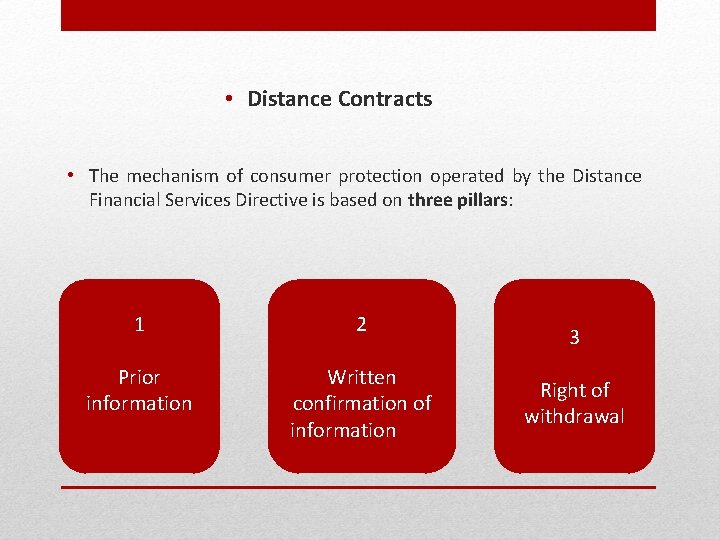
• Distance Contracts • The mechanism of consumer protection operated by the Distance Financial Services Directive is based on three pillars: 1 2 Prior information Written confirmation of information 3 Right of withdrawal
• Distance Contracts - The Three Pillars • (1) Information that must be provided to the consumer, shall include the main characteristics and risks of the financial services, also communicating the consumer the right of withdrawal (Art. 3); • (2) Such information shall be provided “on paper or another durable medium available and accessible to the consumer in good time before he is bound …” (Art. 5); • (3) the time by which the consumer is entitled to exercise his withdrawal right shall be equal to (at least) 14 days – Member States are allowed to fix a longer period of withdrawal.
• Markets in Financial Instruments Legislation Why a specific legal framework for investment products? Ø Because they are characterized by a high level of complexity which calls for specific rules and protection; Ø Because of a growing knowledge gap – given the information asymmetry – between the sellers and the buyers of financial products.
The issue Investors usually carry out the acquisition and sale of financial products (e. g. shares, bonds) with the assistance of banks (or other financial firms) which generally acquire the financial products in their on name on behalf of another (commission). It is also possible for a bank to acquire the financial products for its own account (proprietary trading) and then resell them to its clients. Therefore, financial intermidiaries (banks, investment firms) also offer a number of further securities-related services (e. g. investment advice)
Financial intermediaries and their pivotal function Ø Financial intermediaries, such as investment firms, fulfill a pivotal function to long-term growth, … because they channel the savings of a substantial part of the investor community into the real economy. Ø But … investors are dependent on their services for two major reasons. … One reason is intermediation. Ø Investors usually do not have direct access to the professional market and rely on their services for the purchase and sale of financial instrument The European legislator differentiates here between: (1) investment advice and portfolio management, (2) services without advisory contents and (3) services within an execution-only situation
Ø The other reason is that, in particular, retail investors typically Ø neither possess the expertise Ø nor the time to process the available market information and choose a suitable form of investment
Specific rules for investment law: investors – even if retail i. – are not considered “consumers” Ø That is because Ø even if the term 'retail investor' is taken to mean a nonsophisticated, non-institutional investor … (something apparently close to a consumer…) Ø and even if the primary focus is the individual or Ø the policy issues discussed may also be relevant to SMEs and municipalities.
• Markets in Financial Instruments Legislation • Rules for the investors’ protection were initially laid down in 1993 with the Investment Services Directive (1993/22/EC) (“ISD”). Main principles of the ISD at a glance: 1 - Loyalty Principle (any investment firm must act honestly and fairly in the best interest of its clients); 2 - Informed Consent Principle (any investment firm must disclose any material information on the nature, risks and costs of the services); 3 - Know Your Customer Rule (any investment firm must seek from its clients information regarding their financial situation, the investment experience and the financial goals of the client);
• Markets in Financial Instruments Legislation • The Markets in Financial Instruments Directive (2004/39/EC) (“Mi. FID”) – recently repealed by the Mi. FID II (2014/65/EU) create a new system of protection for investors. • The Mi. FID is based on a different categorisation of clients structured on a tripartite approach: • Retail clients; • Professional clients; • Eligible counterparties.
Retail clients • Retail clients represent a class of clients who, being neither professional nor eligible counterparties, deserve the maximum level of protection available. • Generally retail clients are individuals, but this category may also include entities which have failed to meet the definition of professional client. • Retail clients shall alsoinclude those classified as “elective” (i. e. , those who, although considered to be professionals, asked for the maximum level of protection – “the elevator” mechanism.
Professional clients • This category comprises customers who have “the experience, the knowledge and expertise to make its own investment decisions and properly assess the risks that it incurs” (Annex II, Mi. FID II). • Usually investment firms, pension funds and institutions are considered as professional clients. • Among the category of professional clients are also those who should be considered as retail clients but who have opted out for the protection granted to the category of retail clients (“elective professional clients”) – “the elevator” mechanism.
Eligible counterparty • Specific entities identified by Art. 30(2) of the Mi. FID II (e. g. national governments, central banks, credit institutions etc. ). • In case of investment services with an “eligible counterparty” some rules of conduct under Mi. FID II shall not apply – even though Member States shall ensure that basic principles (such as honesty and fairness) shall apply in any case.
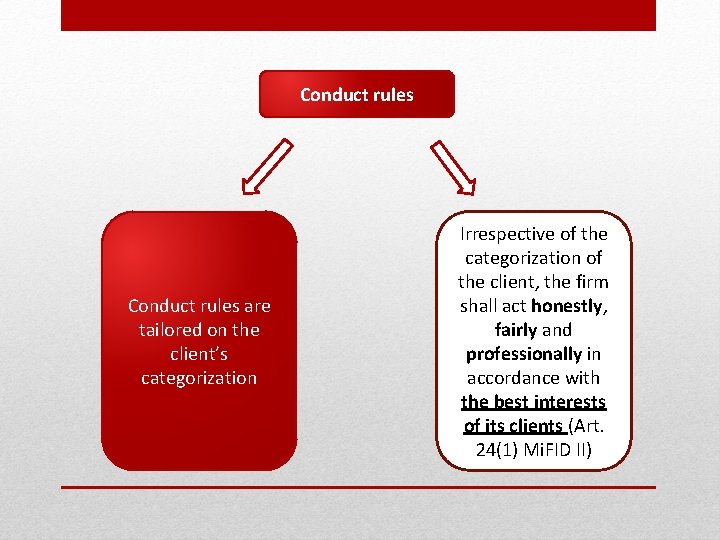
Conduct rules are tailored on the client’s categorization Irrespective of the categorization of the client, the firm shall act honestly, fairly and professionally in accordance with the best interests of its clients (Art. 24(1) Mi. FID II)
Suitability assessment (Art. 25) Member States shall require investment firms to ensure and demonstrate to competent authorities on request that natural persons giving investment advice or information about financial instruments, investment services or ancillary services to clients on behalf of the investment firm possess the necessary knowledge and competence to fulfil their obligations.
Suitability assessment (Art. 25) When providing investment advice or portfolio management the investment firm shall obtain the necessary information regarding the client’s or potential client’s knowledge and experience in the investment field relevant to the specific type of product or service, that person’s financial situation including his ability to bear losses, and his investment objectives including his risk tolerance so as to enable the investment firm to recommend to the client or potential client the investment services and financial instruments that are suitable for him and, in particular, are in accordance with his risk tolerance and ability to bear losses.
When needs a suitability test be done? • The rules apply to firms that provide: • investment advice (whether independent or not) to clients; or • portfolio management to behalf of clients • Firms must obtain the following information from a client or a potential client before providing the above services: • its knowledge and experience of the investment field in which the investment advice or portfolio management is to be offered; • its financial situation including his ability to bear losses; and • its investment objectives including the risk tolerance.
Suitability report • Firms must provide retail advisory clients with a suitability report with outline of the advice given specifying how the advice is suitable, including how it meets client’s objectives and personal circumstances with reference to investment term required client’s knowledge and experience
Appropriateness (Art. 25) Member States shall ensure that investment firms, when providing investment services other than investment advice or portfolio management, ask the client or potential client to provide information regarding that person’s knowledge and experience in the investment field relevant to the specific type of product or service offered or demanded so as to enable the investment firm to assess whether the investment service or product envisaged is appropriate for the client.
When needs a appropriateness test be done? • The rules apply to firms that: • • Receive and transmit orders Execute orders Deal on own account Underwrite and place financial instruments • Firms must obtain information regarding their clients’ experience and knowledge in order to enable the firm to determine if the products and services envisaged are appropriate • the types of financial service, transaction and regulated financial instruments the client is familiar with; • the nature, volume and frequency of the client’s transactions in regulated financial instruments; and • the level of education, profession or former profession of the client.
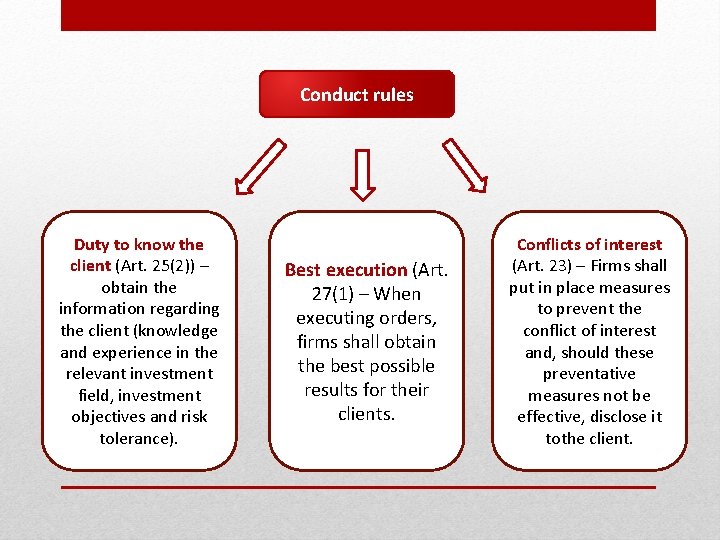
Conduct rules Duty to know the client (Art. 25(2)) – obtain the information regarding the client (knowledge and experience in the relevant investment field, investment objectives and risk tolerance). Best execution (Art. 27(1) – When executing orders, firms shall obtain the best possible results for their clients. Conflicts of interest (Art. 23) – Firms shall put in place measures to prevent the conflict of interest and, should these preventative measures not be effective, disclose it tothe client.
More issues addressed by Mifid II • it introduces rules on high frequency trading; • it improves the transparency and oversight of financial markets – including derivatives markets - and addresses the issue of price volatility in commodity derivatives markets; • it improves conditions for competition in the trading and clearing of financial instruments; • building on the rules already in place, the revised Mi. FID rules strengthen the protection of investors by introducing robust organisational and conduct requirements • it ensures that trading takes place on regulated platforms
• Consumer Credit Directive (2008/48/EU) • Credit agreements for consumers fall within the scope of a specific piece of legislation, the Consumer Credit Directive (2008/48/EU) • The transactions falling under the Consumer Credit Directive rules are those defined as “credit agreements”, i. e. “an agreement whereby a creditor grants or promises to grant to a consumer credit in the form of a deferred payment, loan or other similar financial accommodation, except for the agreements for the provision on a continuing basis of services” (Art. 3(c)).
• Consumer Credit Directive • The main pillars of the Consumer Credit Directive are: • (1) detailed information that the creditor shall include while advertising the products; • (2) pre-contractualinformation to be provided to the consumer before the credit contract can be concluded; • (3) adequate assessment of the creditworthiness of the client; and • (4) the right of withdrawal.
• Mortgage Credit Directive (2014/17/EU) • Scope of the Directive: to address the adverse consequences of irresponsible lending and borrowing by market-participants including redit intermediaries and non credit institutions. • The Directive applies only to “credit agreements which are secured by a mortgage or another comparable security commonly used in a Member State on residential immovable property or secured by a right related to residential immovable property” or “credit agreements the purpose of which is to acquire or retain property rights in land or in an existing or projected building”.
• Mortgage Credit Directive (2014/17/EU) • Main principles and rules: • (1) Information: shall be “clear and comprensible” (Art. 13) and any advertising concerning credit agreements shall refer to “an interest rate or any figure relating to the cost of the credit” (Art. 11(1)). • (2) Pre-contractual information: the creditor is under the obligation to provide the consumer with “a personalised information needed to compare the credits available on the market, assess their implication and make an informed decision on whether to conlcude a credit agreement” (Art. 14). • (3) Adequate explanations: the credito shall provide adequate explanations to the consumer on the proposed credit agreement and ancillary services (Art. 16).