
Financial Capability and Asset Building FCAB for All

Financial Capability and Asset Building (FCAB) for All Margaret Sherraden, Ph. D Social Work’s Grand Challenges: Economic Inequality and Financial Capability University of Denver, October 25, 2018

The financial struggles of vulnerable families • A worldwide context of rising economic inequality (Alvaredo et al. , 2013; Piketty & Saez, 2003) • Household finances are increasingly complex (not cash-based) (Lusardi, Mitchell & Curto 2009; Martin, 2002) • Growing financialization creates barriers for the poor and vulnerable (Mader, 2017; Martin, 2002) • Financially struggling, families feel stressed, ashamed, and uncertain about the future (APA, 2017; Atwood, 2012)
Millions are not just money poor, they are also credit poor • An estimated 45 million people do not have a credit history or have unscoreable credit records (CFPB, 2015 a). • Higher rates for Blacks and Hispanics, and people in poor neighborhoods. • They cannot obtain loans at reasonable rates • They also have difficulty simply surviving. They are, for example: o Turned down for jobs o Have trouble renting an apartment o Are ineligible for cellphone contracts • They are both money poor and credit poor.
Where do the money- and credit-poor turn for help? • Well-to-do families buy financial and legal advice o They benefit from job benefits and tax policies that build their family’s financial security • Meanwhile, disadvantaged families mostly make do on their own or turn to family and friends • Many fall prey to “late night television” financial and legal advisors, and predatory schemes that promise financial relief • Some get help from a patchwork of organizations, such as: o Consumer credit counseling, financial empowerment centers, community credit unions, and others
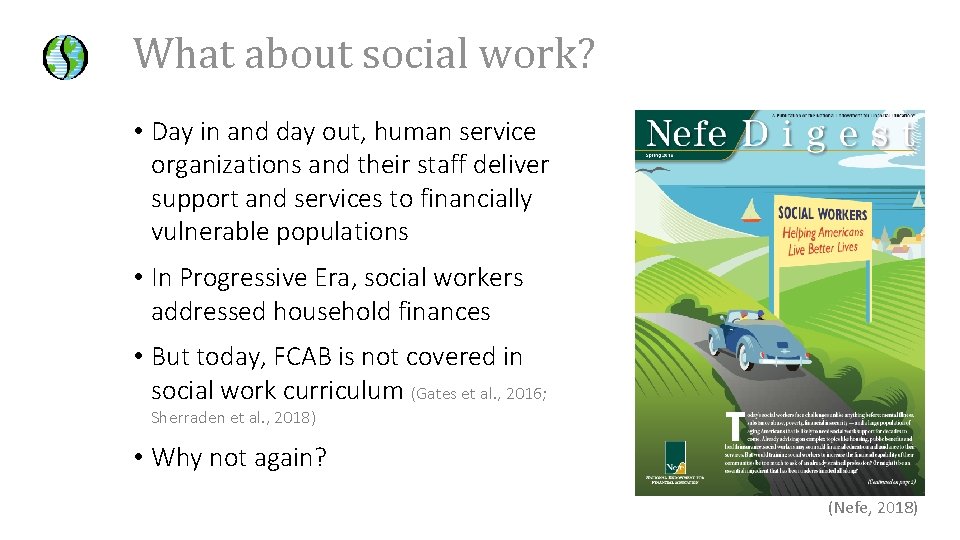
What about social work? • Day in and day out, human service organizations and their staff deliver support and services to financially vulnerable populations • In Progressive Era, social workers addressed household finances • But today, FCAB is not covered in social work curriculum (Gates et al. , 2016; Sherraden et al. , 2018) • Why not again? (Nefe, 2018)

Financial capability: * Ability and opportunity to act Financial Capability Ability to Act Financial knowledge & skills Financial Well-Being Income, assets, spending, credit, and protection Opportunity to Act Financial inclusion • Based on capability theory and person-inenvironment perspective (Kondrat, 2013; Sen, 1999; Nussbaum, 2011)
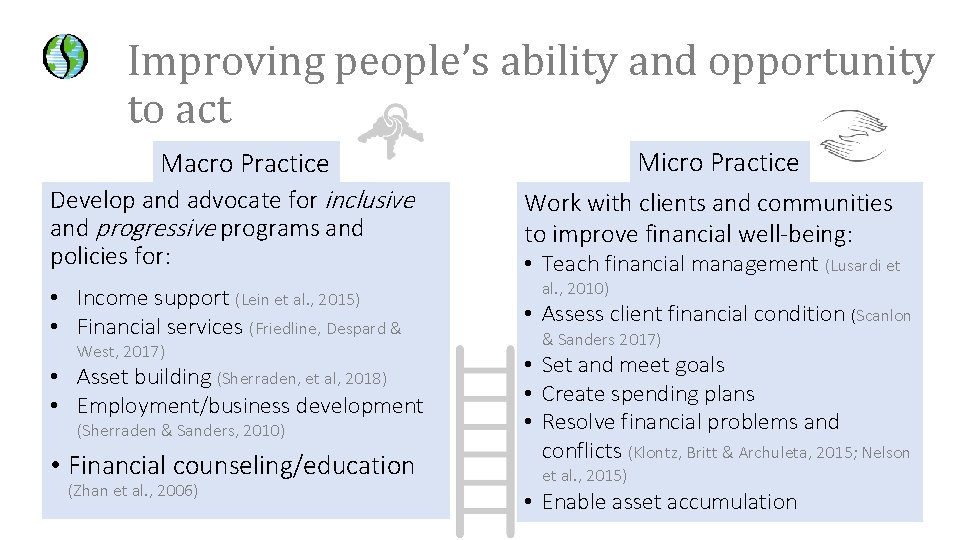
Improving people’s ability and opportunity to act Macro Practice Develop and advocate for inclusive and progressive programs and policies for: • Income support (Lein et al. , 2015) • Financial services (Friedline, Despard & West, 2017) • Asset building (Sherraden, et al, 2018) • Employment/business development (Sherraden & Sanders, 2010) • Financial counseling/education (Zhan et al. , 2006) Micro Practice Work with clients and communities to improve financial well-being: • Teach financial management (Lusardi et al. , 2010) • Assess client financial condition (Scanlon & Sanders 2017) • Set and meet goals • Create spending plans • Resolve financial problems and conflicts (Klontz, Britt & Archuleta, 2015; Nelson et al. , 2015) • Enable asset accumulation

Develop a financial capability delivery system that reaches everyone • Embed financial capability services in human service organizations and practices that already exist (e. g. , the Change Machine) • Integrate FCAB into human services: Financial assessment alongside health and psychological assessments • Financial education, financial accounts, and savings accounts for everyone • A financial capability gateway
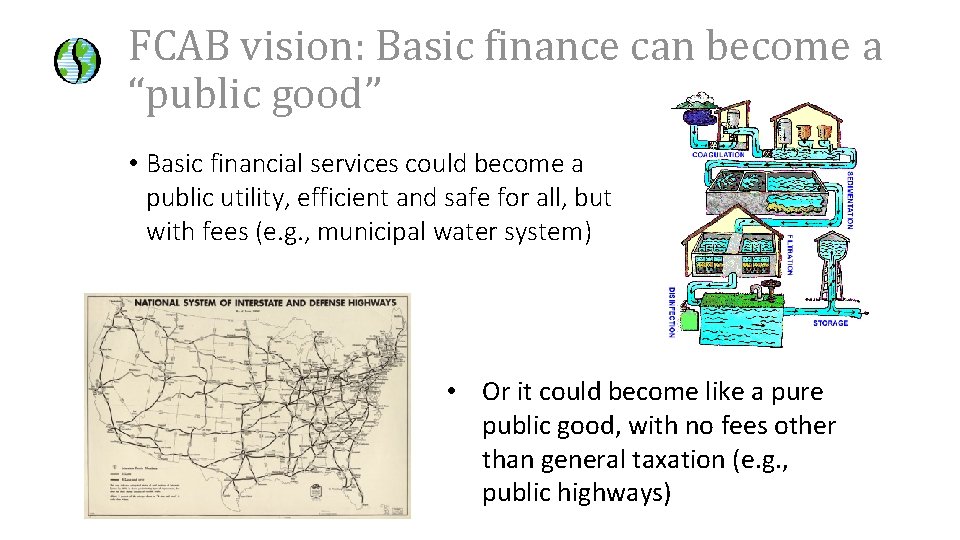
FCAB vision: Basic finance can become a “public good” • Basic financial services could become a public utility, efficient and safe for all, but with fees (e. g. , municipal water system) • Or it could become like a pure public good, with no fees other than general taxation (e. g. , public highways)

FCAB: A unique opportunity for social work • Social workers can take leadership in developing approaches, developing collaborations, and delivering services to help the financially vulnerable gain a secure economic foothold • In this way, social workers can build on their historical commitment to improving people’s financial well-being (Stuart, 2013) • While social workers show interest, they lack preparation (Despard & Chowa, 2010; Fenge, 2012; Gillen & Loeffler 2012; Kindle, 2013; Loke et al. , 2013) • To take up this opportunity, social workers must take up the challenge. . .
http: //aaswsw. org/grand-challenges-initiative A Grand Challenge for Social Work / Financial Capability and Asset Building for All

FCAB Grand Challenge Efforts A Sampling Education and Practice: Research: Education: • Survey of student perspectives on FCAB • • Surveys of faculty perspectives on FCAB • (Birkenmaier et al. , 2016; Loke et al. , 2017) (Gates et al. , 2016; Sherraden et al. , 2018) • Mapping financial services (Friedline, Despard & West, 2017) CSWE curricular guide for economic well-being practice (CSWE, 2017) • FCAB continuing education for social work (Frey, et al. , 2017) • Webinars for social work faculty and practitioners (De. Vaan, et al. , 2017, 2018; Sherraden et al. , 2018) FCAB curriculum (Doran & Bagdasaryan, 2018; Horwitz & Briar-Lawson, 2017; Sherraden, et al. , 2017) • • FCAB textbook (Sherraden, FCAB Community Outreach Center and Field Education Supervisor Training (Elizabeth State College & University) Birkenmaier, & Collins, 2018) • On the Rise Financial Center (Clark-Atlanta University)
FCAB for All: Going Global China • CSD’s Jin Huang, Li Zou and others are working with colleagues in China to introduce FCAB in social work • Article on the U. S. FCAB Grand Challenge published in China Social Work Magazine 中国社会 作杂志 (Huang, et al. , 2018) o Disseminated to 300, 000 in China
FCAB Training: Going Global Singapore • Project of the Next Age Institute (NAI) o Collaboration between Washington University in St. Louis and the National University of Singapore (NUS) • Focus groups with practitioners; Interviews with administrators (2017) • Adapt FCAB curriculum to Singapore context and go online (2018 -19) • Pilot curriculum with social work undergraduate students (2018) • Train practitioners to disseminate (2018 -19) • Integrate FCAB in continuing education (2019)
Thank You! To join the FCAB Grand Challenge or for more information: FCAB Initiative Center for Social Development Brown School of Social Work Washington University in St. Louis http: //csd. wustl. edu/Pages/default. aspx +1. 314. 935. 7433 Gena G Mc. Clendon: ggunn@wustl. edu Margaret Sherraden: msherraden@wustl. edu Oxford University Press 2018
References • Addams, J. (1912, c. 1910). Twenty Years at Hull-House with Autobiographical Notes. New York: The Mac. Millan Company. http: //digital. library. upenn. edu/women/addams/hullhouse. html • Alvaredo, F. , Atkinson, A. B. , Piketty, T. , & Saez, E. (2013). The top 1 percent in international and historical perspective. The Journal of Economic Perspectives, 27(3), 3– 20. • American Psychological Association (2017). Stress in America: The State of Our Nation. https: //www. apa. org/news/press/releases/stress/2017/state-nation. pdf • Atwood, J. D. (2012). Couples and money: The last taboo. The American Journal of Family Therapy, 40 (1), 119, DOI: 10. 1080/01926187. 2011. 600674 • Birkenmaier, J. M. , Loke, V. , & Hageman, S. A. (2016). Are graduating students ready for financial aspects of social work practice? Journal of Teaching in Social Work, 36(5), 519 -536. • Collins, J. M. , & O’Rourke, C. (2009). Financial education and counseling: Still holding promise. Journal of Consumer Affairs, 44(3), 483– 498. • Consumer Financial Protection Bureau (2015 a). Data Point: Credit Invisible. Washington, DC: CFPB. https: //files. consumerfinance. gov/f/201505_cfpb_data-point-credit-invisibles. pdf • Consumer Financial Protection Bureau. (2015 b). Measuring financial well-being: A guide to using the CFPB Financial Well-Being Scale. Retrieved from http: //files. consumerfinance. gov/f/201512_cfpb_financial-wellbeing-user-guide-scale. pdf • Council on Social Work Education (2017). Curricular guide for economic well-being practice. Washington, DC: CSWE https: //www. cswe. org/CMSPages/Get. File. aspx? guid=77 de 3 a 0 d-8 f 9 d-45 e 5 -b 48 e-7 a 57 f 241945 f
References (continued) • Despard, M. R. , & Chowa, G. A. (2010). Social workers’ Interest in building individuals’ financial capabilities. Journal of Financial Therapy, 1 (1) 8. https: //doi. org/10. 4148/jft. v 1 i 1. 257 • Fenge, L. (2012). Economic well-being and ageing: The need for financial education for social workers. Social Work Education, 31(4) 498. • De. Vaan, D. , Sherraden, M. S. , & Mc. Clendon, G. G. , “Household Finances in Social Work: Tools for Educators. ” Webinar, Center for Social Development, in collaboration with the Consumer Financial Protection Bureau and the Council on Social Work Education, April 19 & September 2017. https: //csd. wustl. edu/Our. Work/Fin. Incl/Fin. Cap-Access. Abilities/Pages/FCABEducational. Tools. aspx • Doran, J. K. , & Bagdasaryan, S. (2018). Infusing financial capability and asset building content into a community organizing class. Journal of Social Work Education, 54(1), 122 -134. • Frey, J. J. , Hopkins, K. , Osteen, P. , Callahan, C. , Hageman, S. , & Ko, J. (2017). Training social workers and human service professionals to address the complex financial needs of clients. Journal of Social Work Education, 53(1), 118 -131. • Friedline, T. , Despard, M. , & West, S. (2017). Navigating day-to-day finances: A geographic investigation of brick-and-mortar financial services and individuals’ financial health. Lawrence, KS: University of Kansas, Center on Assets, Education, & Inclusion (AEDI). • Gates, L. B. , Koza, J. , & Akabas, S. H. (2016). Social work’s response to poverty: From benefits dependence to economic self-sufficiency, Journal of Social Work Education, 53: 1, 99 -17. DOI: 10. 1080/10437797. 2016. 1212752.
References (continued) • Gillen, M. , & Loeffler, D. N. (2012). Financial literacy and social work students: Knowledge is power. Journal of Financial Therapy, 3 (2) 4. https: //doi. org/10. 4148/jft. v 3 i 2. 1692 • Horwitz, S. , & Briar-Lawson, K. (2017). A multi-university economic capability-building collaboration. Journal of Social Work Education, 53(1), 149 -158. • Huang, J. , Sherraden, M. S. , & Zou, L. (2018, October). 【� 野】普惠金融与金融能力:美国社会 作的大挑 � [From financial inclusion to financial capability: A grand challenge of social work in the United States]. China Social Work Magazine. https: //mp. weixin. qq. com/s/z 15 GHMa 00 dxgok. Si. X 2 TU 9 A • Kindle, P. A. (2013). The financial literacy of social work students. Journal of Social Work Education, 49(3), 397 -407. • Klontz, B. T. , Britt, S. L. , & Archuleta, K. (2015). Financial therapy. New York: Springer. • Kondrat, M. E. (2013). Person-in-Environment. Encyclopedia of Social Work. DOI: 10. 1093/acrefore/9780199975839. 013. 285 • Lein, L. , Romich, J. , & Sherraden, M. (2015). Reversing extreme economic inequality (Grand Challenges for Social Work Initiative Working Paper No. 16). Cleveland, OH: American Academy of Social Work and Social Welfare. http: //aaswsw. org/wp-content/uploads/2016/01/WP 16 -with-cover-2. pdf • Loke, V. , Birkenmaier, J. M. , & Hageman, S. A. (2017). Financial capability and asset building in the curricula: Student perceptions. Journal of Social Work Education, 53 (1), 84– 98. • Loke, V. , Watts, J. L. , & Kakoti, S. A. (2013). Financial capabilities of service providers in the asset-building field. In Birkenmaier, J. , Curley, J. , & Sherraden, M. (Eds. ), Financial Capability and Asset Development: Research, Education, Policy, and Practice (pp. 251 -277). New York: Oxford University Press.
References (continued) • Lusardi, A. , Clark, R. L. , Fox, J. , Grable, J. , & Taylor, E. (2010). Promising learning strategies, interventions, and delivery methods in financial literacy education: What techniques, venues, tactics, mechanisms, etc. , show the most promise to promote and achieve financial well-being? Paper presented at the 2010 National Endowment for Financial Education Colloquium, Denver, CO • Lusardi, A. , O. Mitchell, & V. Curto (2009). Financial literacy and financial sophistication among older Americans. NBER Working Paper (15469). • Mader, P. (2017). Contesting financial inclusion. Development and Change 49(2): 1– 23. DOI: 10. 1111/dech. 12368 Martin, R. (2002). Financialization of daily life. Philadelpia: Temple University Press. • National Endowment for Financial Education (NEFE). (2018). Nefe Digest: Social Workers Helping Americans Live Better Lives. Denver, CO: NEFE. • Nelson, R. J. , Smith, T. E. , Shelton, V. M. , & Richards, K. V. (2015). Three interventions for financial therapy: Fostering an examination of financial behaviors and beliefs. Journal of Financial Therapy, 6(1), 33 -43. • Nussbaum, M. C. (2011). Creating capabilities: The human development approach. Cambridge, MA: Belknap Press of Harvard University Press. • Piketty, T. , & Saez, E. (2003). Income inequality in the United States, 1913– 1998. The Quarterly journal of economics, 118(1), 1– 41. • Saleebey, D. (1996). The strengths perspective in social work practice: extensions and cautions. Social Work, 41(3): 296 -305.
References (continued) • Scanlon, E. , & Sanders, C. K. (2017). Financial capability and asset building: A transformational practice framework. Advances in Social Work 18 (2), 543 -562. DOI: 10. 18060/21245 • Sen, A. (1993). Capability and well-being. In M. Nussbaum & A. Sen (Eds. ), The quality of life (pp. 30 -53). New York, NY: Oxford University Press. • Sherraden, M. , Clancy, M. , Nam, Y. , Huang, J. , Kim, Y. , Beverly, S. G. , … Purnell, J. Q. (2018). Universal and progressive Child Development Accounts: A policy innovation to reduce educational disparity. Urban Education, 53(6), 803– 833. doi: 10. 1177/0042085916682573 • Sherraden, M. S. (2013). Building blocks of financial capability. In J. M. Birkenmaier, M. S. Sherraden, & J. C. Curley, J. (Eds. ) Financial Capability and Asset Building: Research, Education, Policy, and Practice. New York & Oxford: Oxford University Press. • Sherraden, M. S. , Birkenmaier, J. , Mc. Clendon, G. , & Rochelle, M. (2017). Financial capability and asset building in social work education: Is it “the Big Piece Missing”? Journal of Social Work Education, 53(1), 132 -148. • Sherraden, M. S. , Huang, J. , Frey, J. J. , Birkenmaier, J. , Callahan, C. , Clancy, M. , & Sherraden, M. (2016). Financial Capability and Asset Building for All. Working Paper 13. Grand Challenges Initiative, American Academy of Social Work and Social Welfare. • Stuart, P. H. (2016). Financial capability in early social work practice: Lessons for today. Social Work, 61(4), 297 – 304. doi: 10. 1093/sw/sww 047 • Zhan, M. , Anderson, S. G. , & Scott, J. (2006). Financial knowledge of the low-income population: Effects of a financial education program. Journal of Sociology & Social Welfare, 33, 53– 74.
FCAB is an initiative of the Center for Social Development at Washington University in St. Louis, and has received support from: WELLS FARGO ADVISORS Singapore FCAB is a collaboration with the Next Age Institute at the National University of Singapore, and has received funding support from:
- Slides: 22