
Financial Bootcamp Module 3 The Golden Ratios Objectives

Financial Bootcamp – Module 3 “The Golden Ratios”
Objectives • Introduce the five “Golden Ratios” of not-for-profits • Explain why these five ratios are valuable • Explain how to obtain these ratios for your affiliate
Purpose of the Ratios • To evaluate affiliate performance • To convey successes to Board, staff, donors, etc. • To identify and alleviate financial issues
Uses of the Ratios • Reporting to the Board on the financial health of the organization • Developing a strategic plan • Soliciting donors for contributions

The Five Ratios • Working Capital Ratio • Debt-to-Equity Ratio • Fund Mix Ratio • Growth Ratio • Program Emphasis Ratio
Working Capital Ratio • Determines how much money is available relative to money owed • Capital is the readily available assets an affiliate has that can be turned into cash • Answers: “Does the organization have enough money to pay its bills on time? ”
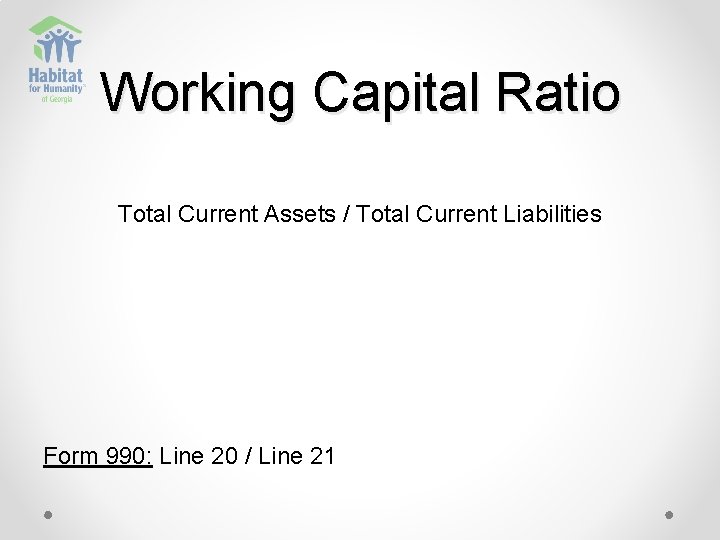
Working Capital Ratio Total Current Assets / Total Current Liabilities Form 990: Line 20 / Line 21
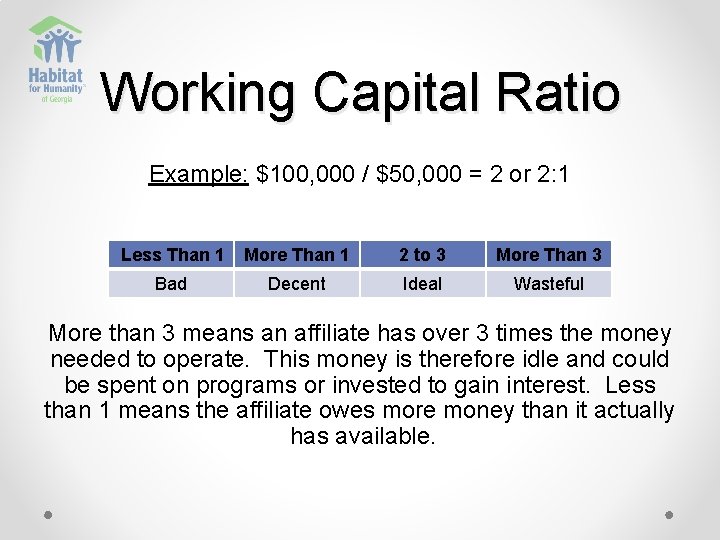
Working Capital Ratio Example: $100, 000 / $50, 000 = 2 or 2: 1 Less Than 1 More Than 1 2 to 3 More Than 3 Bad Decent Ideal Wasteful More than 3 means an affiliate has over 3 times the money needed to operate. This money is therefore idle and could be spent on programs or invested to gain interest. Less than 1 means the affiliate owes more money than it actually has available.
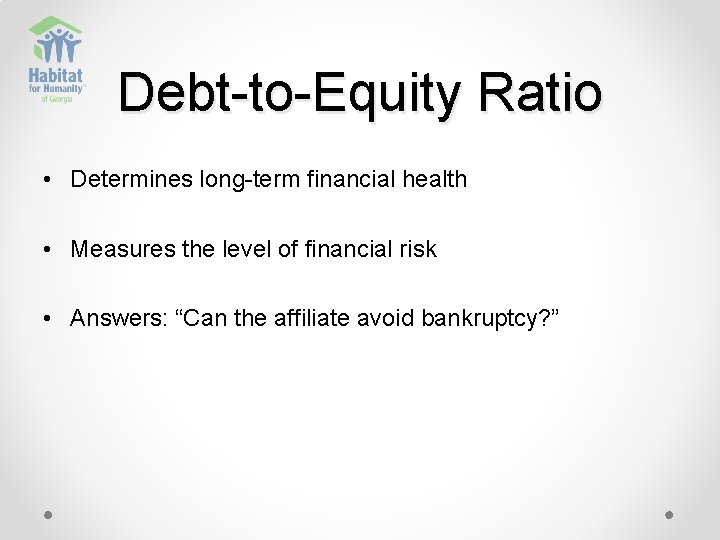
Debt-to-Equity Ratio • Determines long-term financial health • Measures the level of financial risk • Answers: “Can the affiliate avoid bankruptcy? ”
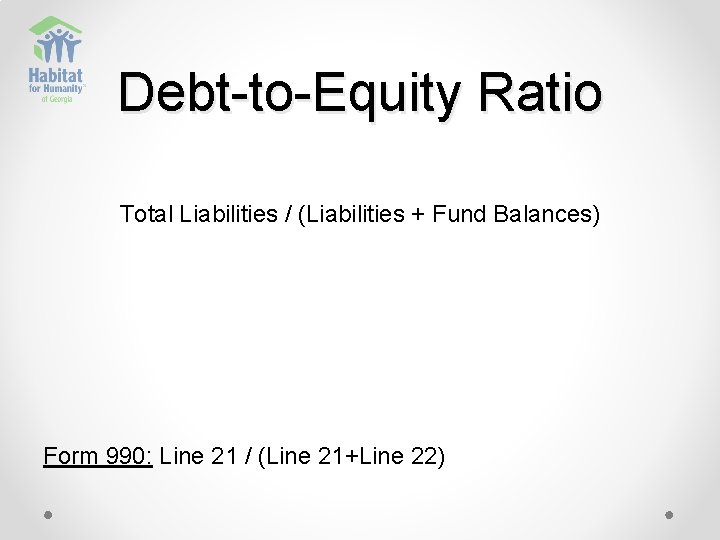
Debt-to-Equity Ratio Total Liabilities / (Liabilities + Fund Balances) Form 990: Line 21 / (Line 21+Line 22)
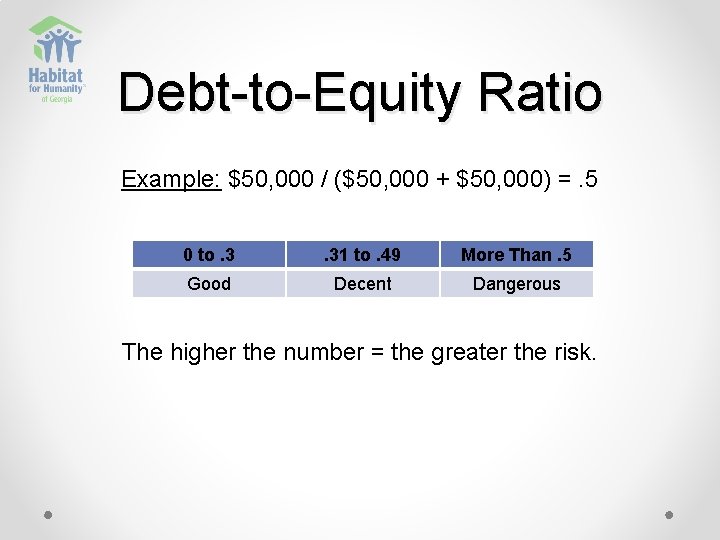
Debt-to-Equity Ratio Example: $50, 000 / ($50, 000 + $50, 000) =. 5 0 to. 3 . 31 to. 49 More Than. 5 Good Decent Dangerous The higher the number = the greater the risk.
Fund Mix Ratio • Evaluates the flexibility of an affiliate to spend its money • Puts the Working Capital and Debt-to-Equity ratios in proper perspective • Answers: “How restricted is the affiliate’s cash? ”
![Fund Mix Ratio Total Unrestricted Funds / Total Assets Form 990: [Part X] Line](http://slidetodoc.com/presentation_image_h2/00e95694b6a445e506f5b61397b55bf0/image-13.jpg "Fund Mix Ratio Total Unrestricted Funds / Total Assets Form 990: [Part X] Line")
Fund Mix Ratio Total Unrestricted Funds / Total Assets Form 990: [Part X] Line 27 / Line 16
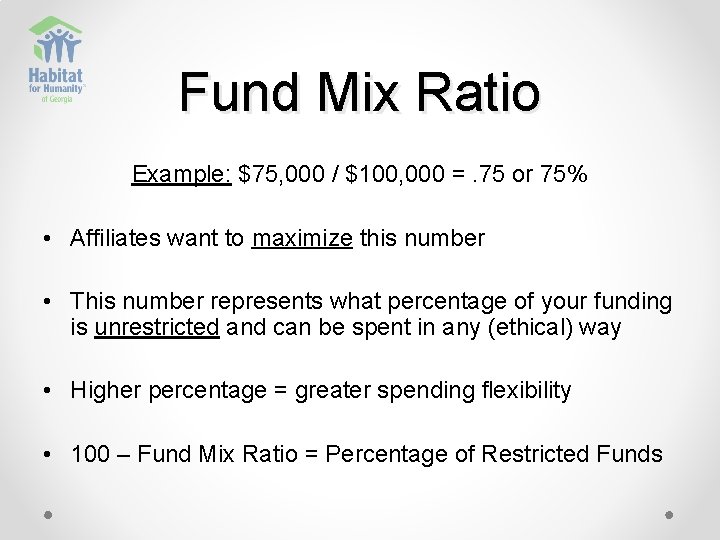
Fund Mix Ratio Example: $75, 000 / $100, 000 =. 75 or 75% • Affiliates want to maximize this number • This number represents what percentage of your funding is unrestricted and can be spent in any (ethical) way • Higher percentage = greater spending flexibility • 100 – Fund Mix Ratio = Percentage of Restricted Funds
Restricted Funds • There is nothing wrong with restricted funds • Restricted funds must be spent in a particular way (i. e. , on a particular project) • A high percentage of restricted funds limits your affiliate’s ability to spend money on necessary or unexpected expenses (e. g. , vehicle repairs, training, etc. )
Growth Ratio • Compares financial growth across multiple years • Useful for taking a “big picture” perspective of the affiliate’s financial health • Answers: “How much are we growing, financially? ”
Growth Ratio Current Fund Balance – Previous Fund Balance / Previous Fund Balance Form 990: Line 22 [Year 2] – Line 22 [Year 1] / Line 22 [Year 1]
Growth Ratio Example: ($150, 000 - $100, 000) / $100, 000 =. 5 or 50% Negative Number Positive Number Organizational Decline Organizational Growth The best method of evaluation is to perform a growth ratio for a 3 -5 year period to evaluate overall trends.
Program Emphasis Ratio • Compares how much the affiliate spends on providing services versus sustaining itself • Looks at affiliate overhead and administrative costs • Should never be more than 25% • Answers: “How much are we spending on the mission? ”
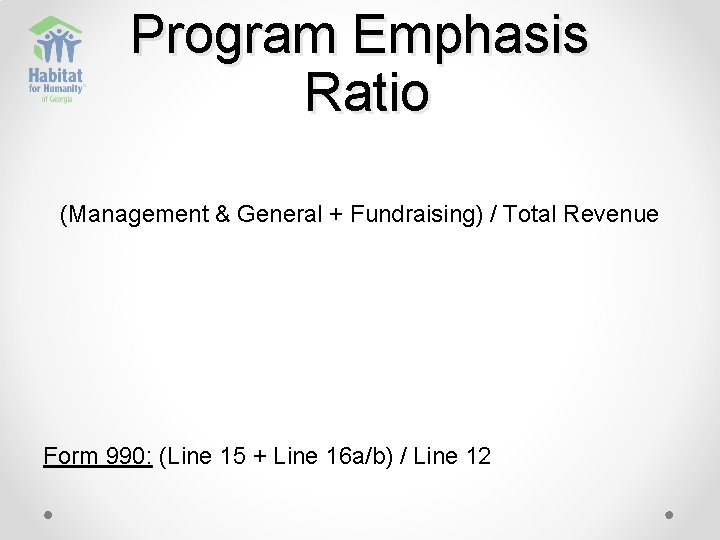
Program Emphasis Ratio (Management & General + Fundraising) / Total Revenue Form 990: (Line 15 + Line 16 a/b) / Line 12
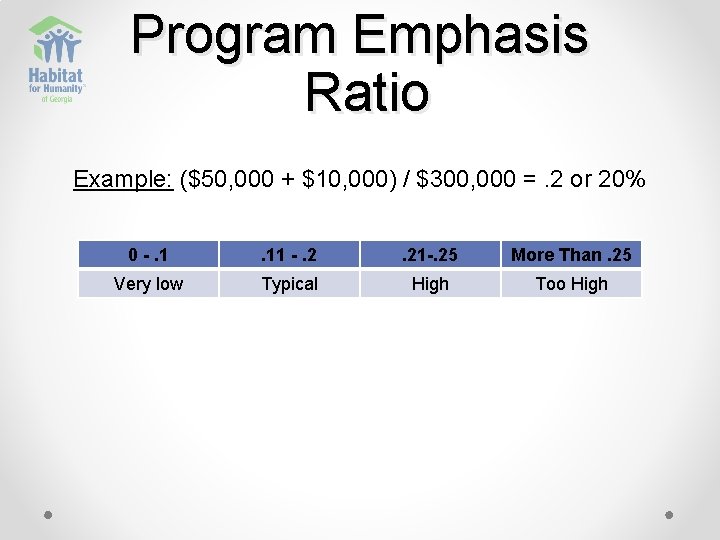
Program Emphasis Ratio Example: ($50, 000 + $10, 000) / $300, 000 =. 2 or 20% 0 -. 1 . 11 -. 2 . 21 -. 25 More Than. 25 Very low Typical High Too High
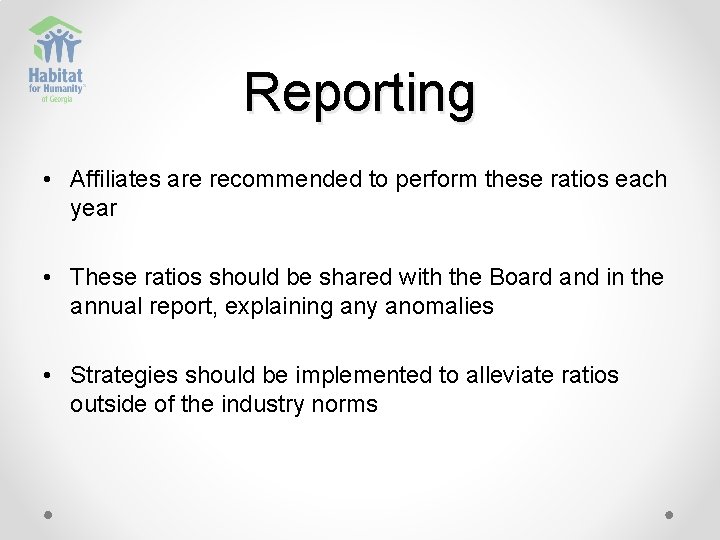
Reporting • Affiliates are recommended to perform these ratios each year • These ratios should be shared with the Board and in the annual report, explaining any anomalies • Strategies should be implemented to alleviate ratios outside of the industry norms
- Slides: 22