
Financial and Cost Assessment Model FICAM User Guide




- Slides: 44
Financial and Cost Assessment Model (FICAM) User Guide
The FICAM model has been developed as a part of the GEF funded TNA project. The tool helps to evaluate contribution of any technology or practice towards mitigation of GHG gases and carry a comprehensive financial analysis. The model helps in providing objective information which can help in decision making by the stakeholders who are supposed to prioritise various technologies / practices within a given sector. The model runs on an Excel platform with which many users are quite well versed. The model has been developed with an open source format so that users can make changes based on their needs. For protected sheets the password to un-protect is URCD BACKGROUND Background
The model can within a given sector achieve the following objectives • Evaluate contribution of the alternative technology /practice /program towards mitigation of GHG gases in terms emissions reduced and unit cost of mitigation • Do a comprehensive financial analysis which can come up with capital requirements, financial ratios (e. g. , NPV, IRR, etc) OBJECTIVES Objectives of the model
• Falls in a class of models like RETSCREEN, HOMER etc. • Expected to assist users in arriving at an indicative mitigation cost and financial parameters. • Model can run alternative scenarios for policy analysis • Not an alternative to multi criterion decision making • The data in model is only indicative and users to input their own data CONTEXT Context
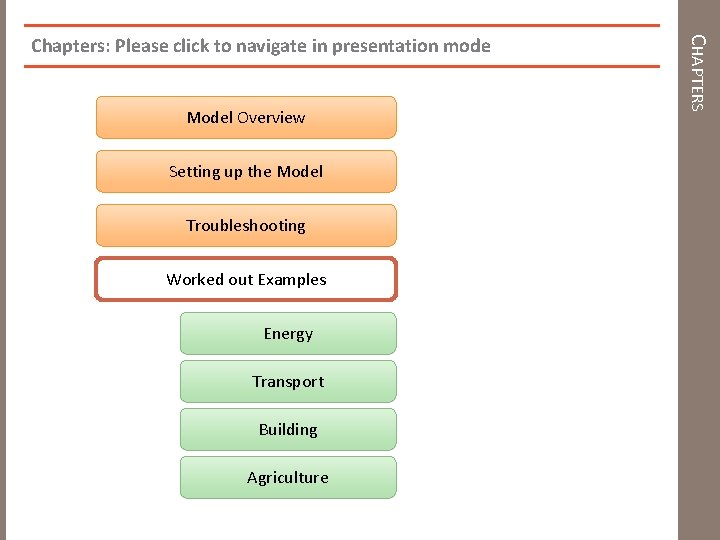
Model Overview Setting up the Model Troubleshooting Worked out Examples Energy Transport Building Agriculture CHAPTERS Chapters: Please click to navigate in presentation mode
MODEL OVERVIEW
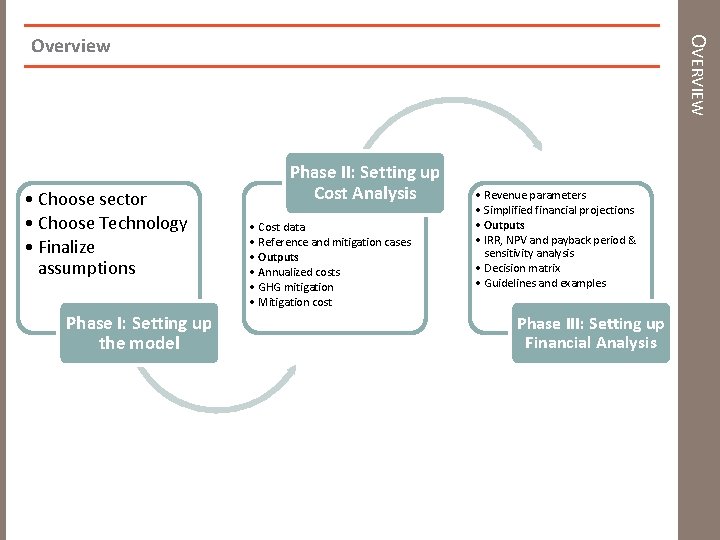
• Choose sector • Choose Technology • Finalize assumptions Phase I: Setting up the model OVERVIEW Overview Phase II: Setting up Cost Analysis • Cost data • Reference and mitigation cases • Outputs • Annualized costs • GHG mitigation • Mitigation cost • Revenue parameters • Simplified financial projections • Outputs • IRR, NPV and payback period & sensitivity analysis • Decision matrix • Guidelines and examples Phase III: Setting up Financial Analysis
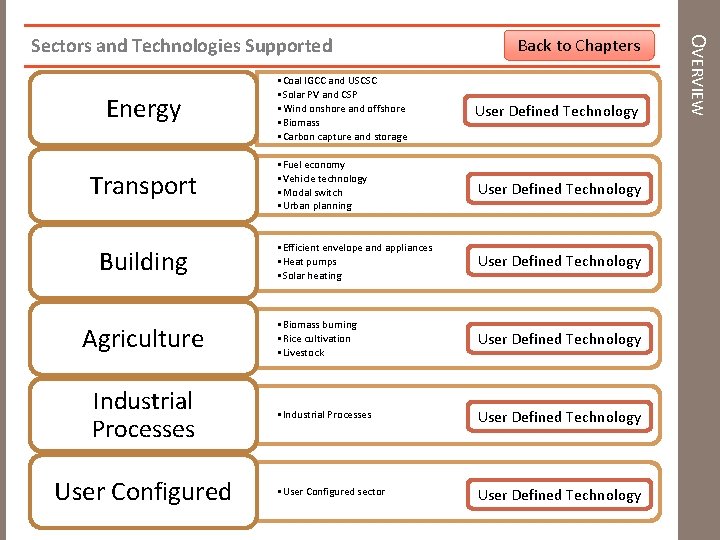
Energy Transport Building Agriculture Industrial Processes User Configured Back to Chapters • Coal IGCC and USCSC • Solar PV and CSP • Wind onshore and offshore • Biomass • Carbon capture and storage User Defined Technology • Fuel economy • Vehicle technology • Modal switch • Urban planning User Defined Technology • Efficient envelope and appliances • Heat pumps • Solar heating User Defined Technology • Biomass burning • Rice cultivation • Livestock User Defined Technology • Industrial Processes User Defined Technology • User Configured sector User Defined Technology OVERVIEW Sectors and Technologies Supported
SETTING UP THE MODEL
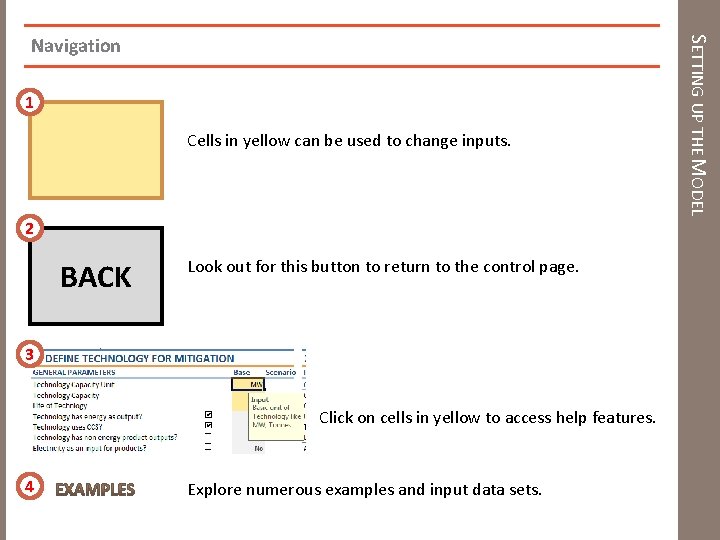
1 Cells in yellow can be used to change inputs. 2 BACK Look out for this button to return to the control page. 3 Click on cells in yellow to access help features. 4 Explore numerous examples and input data sets. SETTING UP THE MODEL Navigation
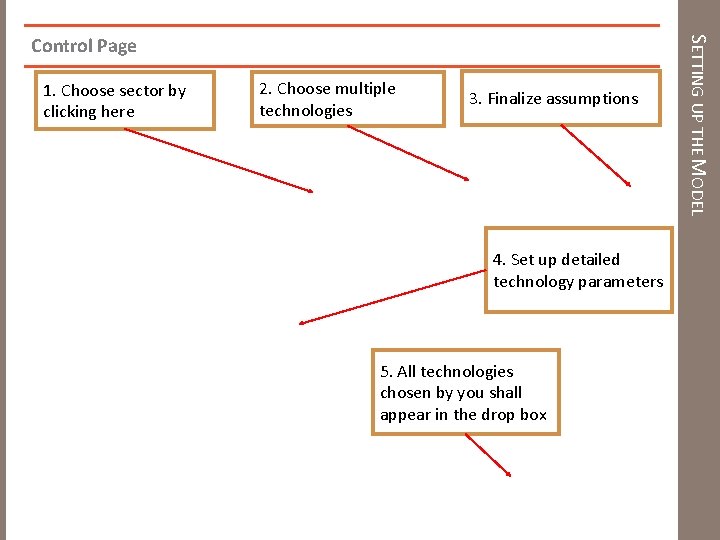
1. Choose sector by clicking here 2. Choose multiple technologies 3. Finalize assumptions 4. Set up detailed technology parameters 5. All technologies chosen by you shall appear in the drop box SETTING UP THE MODEL Control Page
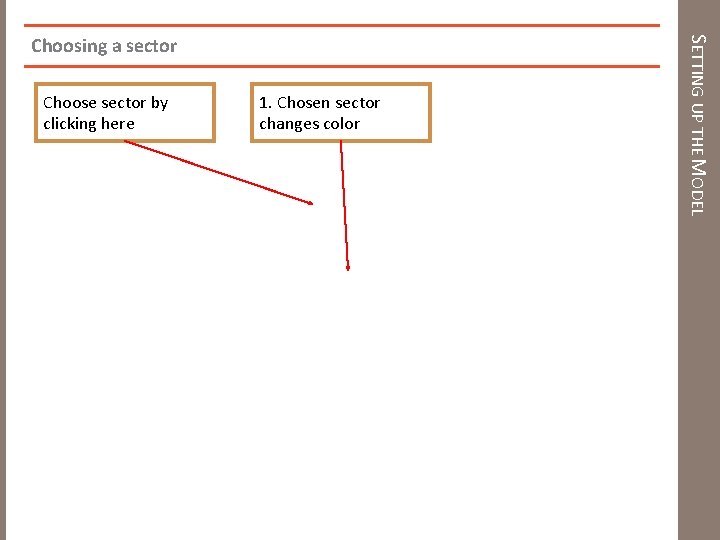
Choose sector by clicking here 1. Chosen sector changes color SETTING UP THE MODEL Choosing a sector
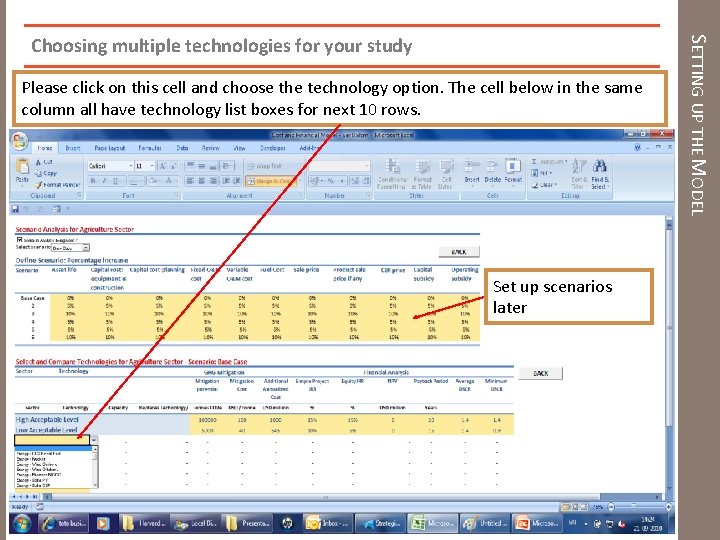
Please click on this cell and choose the technology option. The cell below in the same column all have technology list boxes for next 10 rows. Set up scenarios later SETTING UP THE MODEL Choosing multiple technologies for your study
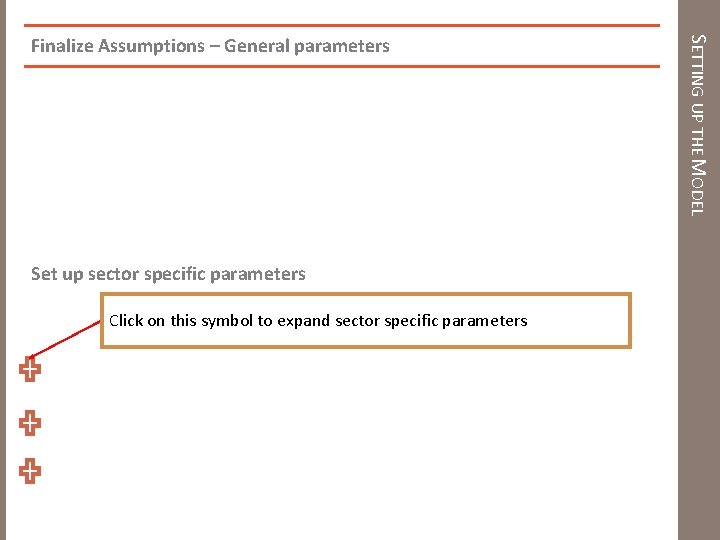
Set up sector specific parameters Click on this symbol to expand sector specific parameters SETTING UP THE MODEL Finalize Assumptions – General parameters
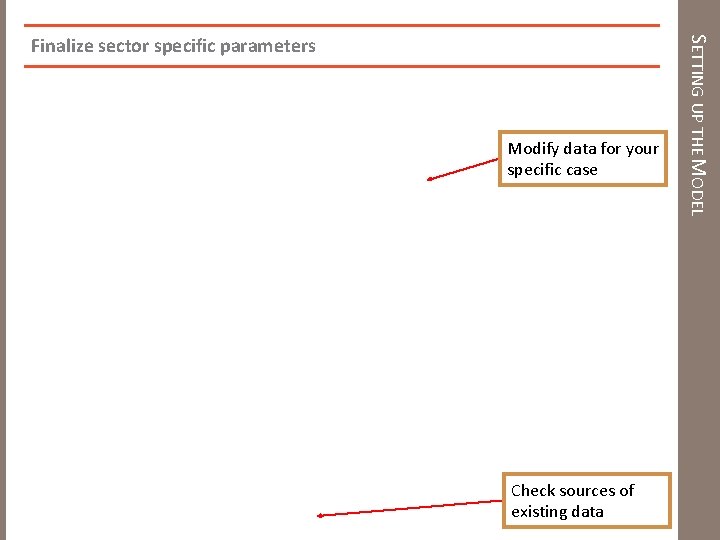
Modify data for your specific case Check sources of existing data SETTING UP THE MODEL Finalize sector specific parameters
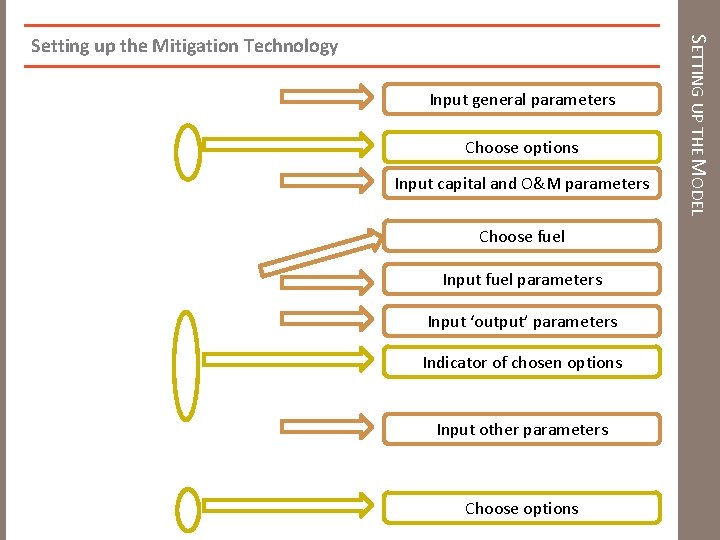
Input general parameters Choose options Input capital and O&M parameters Choose fuel Input fuel parameters Input ‘output’ parameters Indicator of chosen options Input other parameters Choose options SETTING UP THE MODEL Setting up the Mitigation Technology
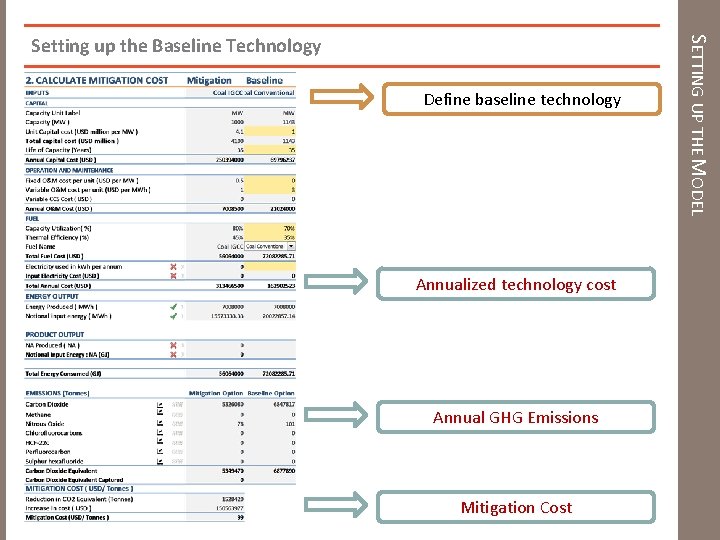
Define baseline technology Annualized technology cost Annual GHG Emissions Mitigation Cost SETTING UP THE MODEL Setting up the Baseline Technology
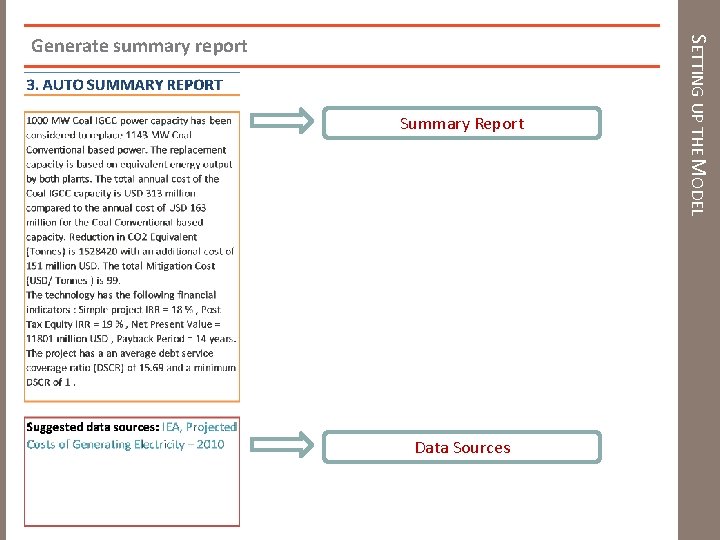
Summary Report Data Sources SETTING UP THE MODEL Generate summary report
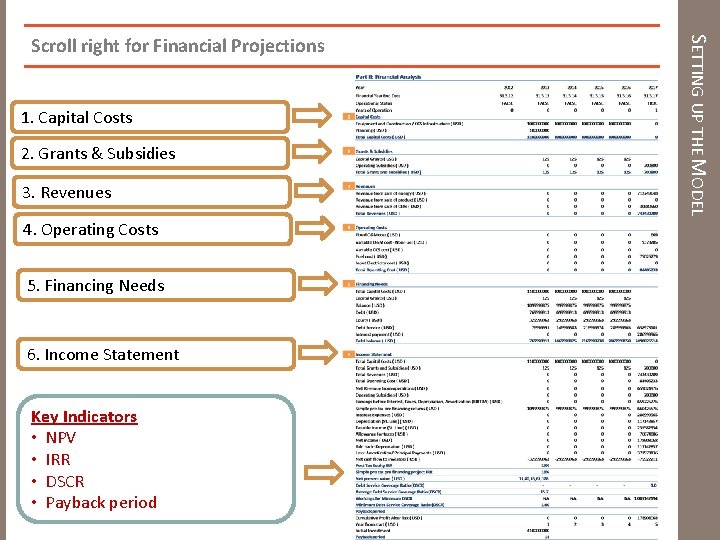
1. Capital Costs 2. Grants & Subsidies 3. Revenues 4. Operating Costs 5. Financing Needs 6. Income Statement Key Indicators • NPV • IRR • DSCR • Payback period SETTING UP THE MODEL Scroll right for Financial Projections
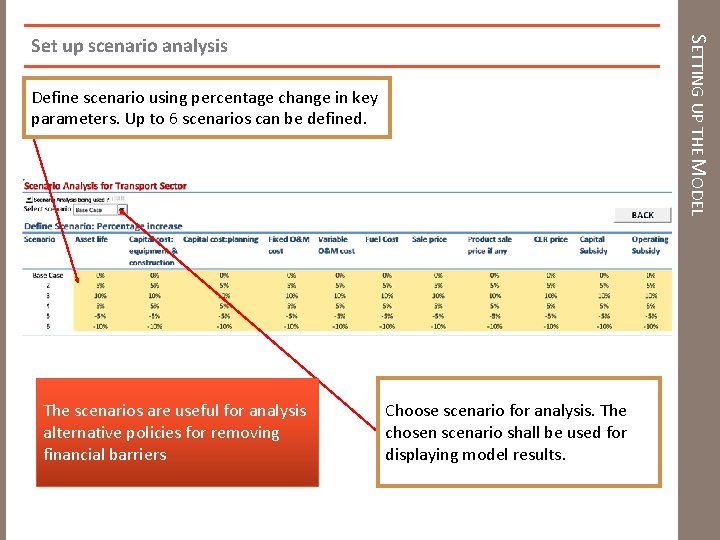
SETTING UP THE MODEL Set up scenario analysis Define scenario using percentage change in key parameters. Up to 6 scenarios can be defined. The scenarios are useful for analysis alternative policies for removing financial barriers Choose scenario for analysis. The chosen scenario shall be used for displaying model results.
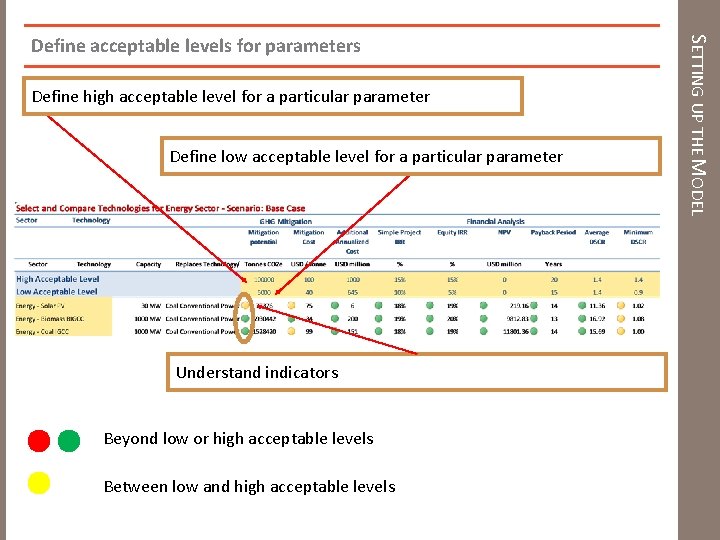
Define high acceptable level for a particular parameter Define low acceptable level for a particular parameter Understand indicators Beyond low or high acceptable levels Between low and high acceptable levels SETTING UP THE MODEL Define acceptable levels for parameters
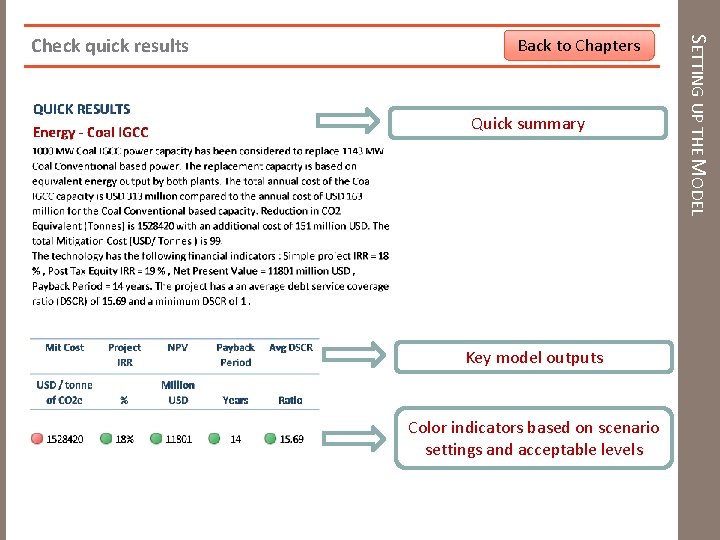
Back to Chapters Quick summary Key model outputs Color indicators based on scenario settings and acceptable levels SETTING UP THE MODEL Check quick results
TROUBLESHOOTING
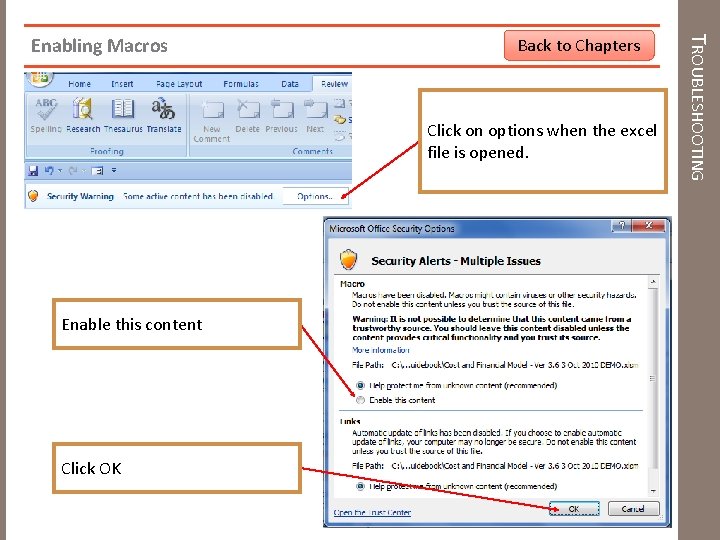
Back to Chapters Click on options when the excel file is opened. Enable this content Click OK TROUBLESHOOTING Enabling Macros
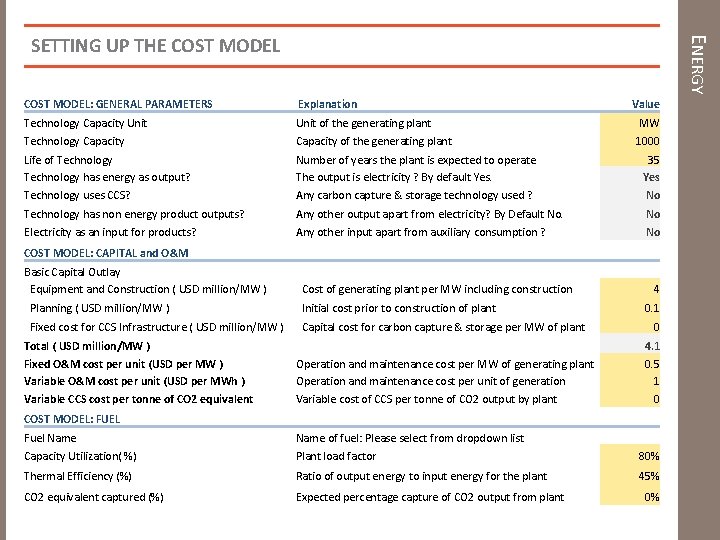
WORKED OUT EXAMPLES - ENERGY In this example coal IGCC based plant is compared with conventional coal technology.
ENERGY SETTING UP THE COST MODEL: GENERAL PARAMETERS Explanation Value Technology Capacity Unit of the generating plant Capacity of the generating plant Life of Technology has energy as output? Technology uses CCS? Number of years the plant is expected to operate The output is electricity ? By default Yes. Any carbon capture & storage technology used ? 35 Yes No Technology has non energy product outputs? Any other output apart from electricity? By Default No. No Electricity as an input for products? Any other input apart from auxiliary consumption ? No MW 1000 COST MODEL: CAPITAL and O&M Basic Capital Outlay Equipment and Construction ( USD million/MW ) Cost of generating plant per MW including construction Planning ( USD million/MW ) Initial cost prior to construction of plant Fixed cost for CCS Infrastructure ( USD million/MW ) Capital cost for carbon capture & storage per MW of plant Total ( USD million/MW ) Fixed O&M cost per unit (USD per MW ) Variable O&M cost per unit (USD per MWh ) Variable CCS cost per tonne of CO 2 equivalent Operation and maintenance cost per MW of generating plant Operation and maintenance cost per unit of generation Variable cost of CCS per tonne of CO 2 output by plant 4 0. 1 0 4. 1 0. 5 1 0 COST MODEL: FUEL Fuel Name of fuel: Please select from dropdown list Capacity Utilization( %) Plant load factor 80% Thermal Efficiency (%) Ratio of output energy to input energy for the plant 45% CO 2 equivalent captured (%) Expected percentage capture of CO 2 output from plant 0%
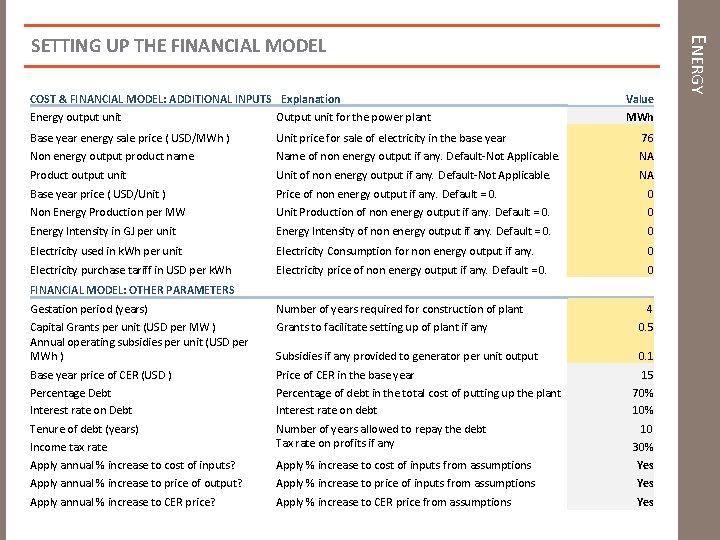
COST & FINANCIAL MODEL: ADDITIONAL INPUTS Explanation Value Energy output unit Output unit for the power plant MWh Base year energy sale price ( USD/MWh ) Unit price for sale of electricity in the base year 76 Non energy output product name Name of non energy output if any. Default-Not Applicable. NA Product output unit Unit of non energy output if any. Default-Not Applicable. NA Base year price ( USD/Unit ) Price of non energy output if any. Default = 0. 0 Non Energy Production per MW Unit Production of non energy output if any. Default = 0. 0 Energy Intensity in GJ per unit Energy Intensity of non energy output if any. Default = 0. 0 Electricity used in k. Wh per unit Electricity Consumption for non energy output if any. 0 Electricity purchase tariff in USD per k. Wh Electricity price of non energy output if any. Default = 0. 0 Gestation period (years) Number of years required for construction of plant 4 Capital Grants per unit (USD per MW ) Annual operating subsidies per unit (USD per MWh ) Grants to facilitate setting up of plant if any 0. 5 Subsidies if any provided to generator per unit output 0. 1 Base year price of CER (USD ) Percentage Debt Interest rate on Debt Price of CER in the base year Percentage of debt in the total cost of putting up the plant Interest rate on debt 15 70% 10% Tenure of debt (years) Income tax rate Number of years allowed to repay the debt Tax rate on profits if any 10 30% Apply annual % increase to cost of inputs? Apply annual % increase to price of output? Apply % increase to cost of inputs from assumptions Apply % increase to price of inputs from assumptions Yes Apply annual % increase to CER price? Apply % increase to CER price from assumptions Yes FINANCIAL MODEL: OTHER PARAMETERS ENERGY SETTING UP THE FINANCIAL MODEL
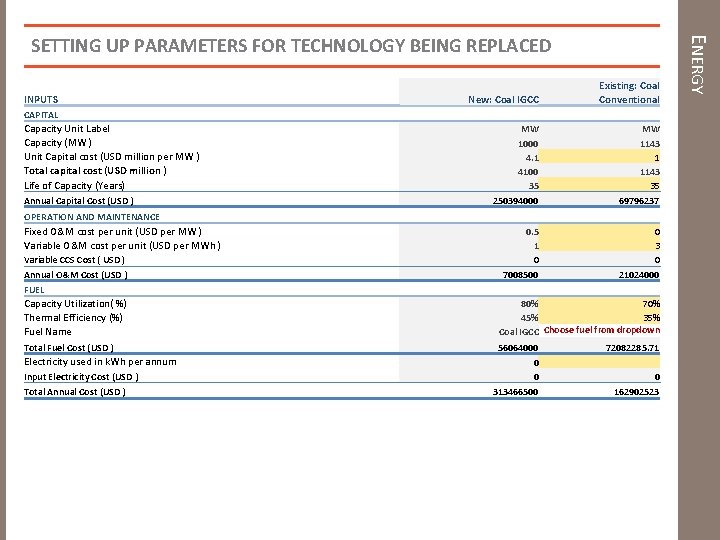
INPUTS New: Coal IGCC Existing: Coal Conventional MW 1000 4. 1 4100 35 250394000 MW 1143 1 1143 35 69796237 0. 5 1 0 7008500 0 3 0 21024000 CAPITAL Capacity Unit Label Capacity (MW ) Unit Capital cost (USD million per MW ) Total capital cost (USD million ) Life of Capacity (Years) Annual Capital Cost (USD ) OPERATION AND MAINTENANCE Fixed O&M cost per unit (USD per MW ) Variable O&M cost per unit (USD per MWh ) Variable CCS Cost ( USD ) Annual O&M Cost (USD ) FUEL Capacity Utilization( %) Thermal Efficiency (%) Fuel Name 80% 70% 45% 35% Coal IGCC Choose fuel from dropdown Total Fuel Cost (USD ) 56064000 0 0 72082285. 71 313466500 162902523 Electricity used in k. Wh per annum Input Electricity Cost (USD ) Total Annual Cost (USD ) -1 -1 0 ENERGY SETTING UP PARAMETERS FOR TECHNOLOGY BEING REPLACED
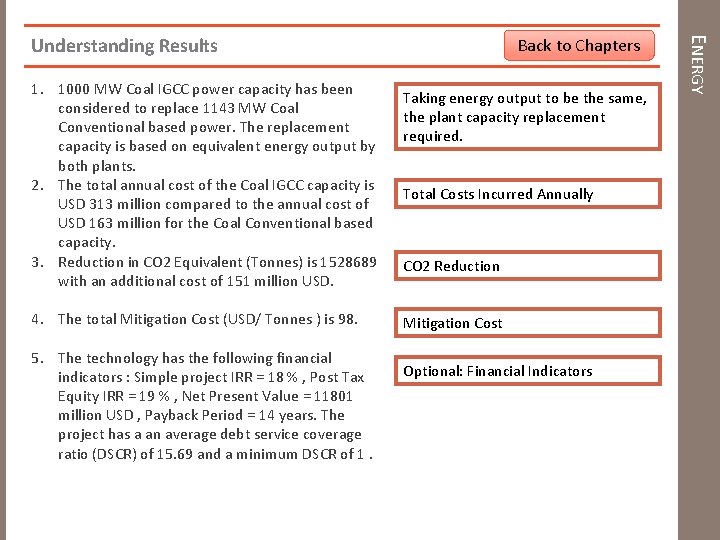
1. 1000 MW Coal IGCC power capacity has been considered to replace 1143 MW Coal Conventional based power. The replacement capacity is based on equivalent energy output by both plants. 2. The total annual cost of the Coal IGCC capacity is USD 313 million compared to the annual cost of USD 163 million for the Coal Conventional based capacity. 3. Reduction in CO 2 Equivalent (Tonnes) is 1528689 with an additional cost of 151 million USD. 4. The total Mitigation Cost (USD/ Tonnes ) is 98. 5. The technology has the following financial indicators : Simple project IRR = 18 % , Post Tax Equity IRR = 19 % , Net Present Value = 11801 million USD , Payback Period = 14 years. The project has a an average debt service coverage ratio (DSCR) of 15. 69 and a minimum DSCR of 1. Back to Chapters Taking energy output to be the same, the plant capacity replacement required. Total Costs Incurred Annually CO 2 Reduction Mitigation Cost Optional: Financial Indicators ENERGY Understanding Results
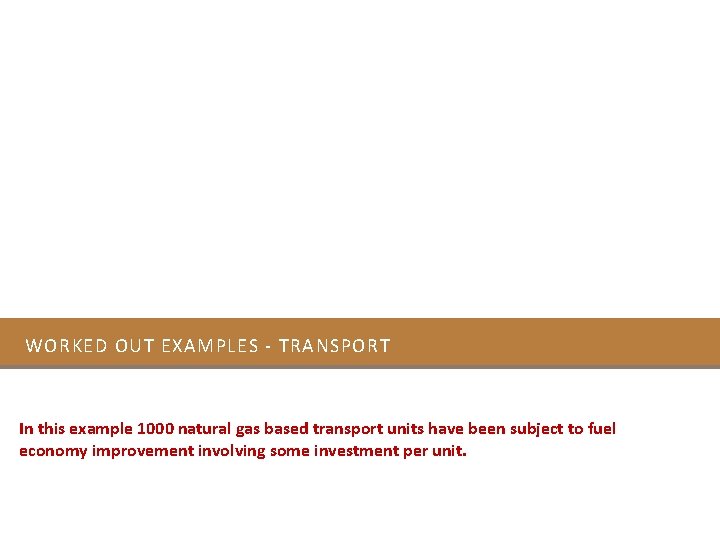
WORKED OUT EXAMPLES - TRANSPORT In this example 1000 natural gas based transport units have been subject to fuel economy improvement involving some investment per unit.
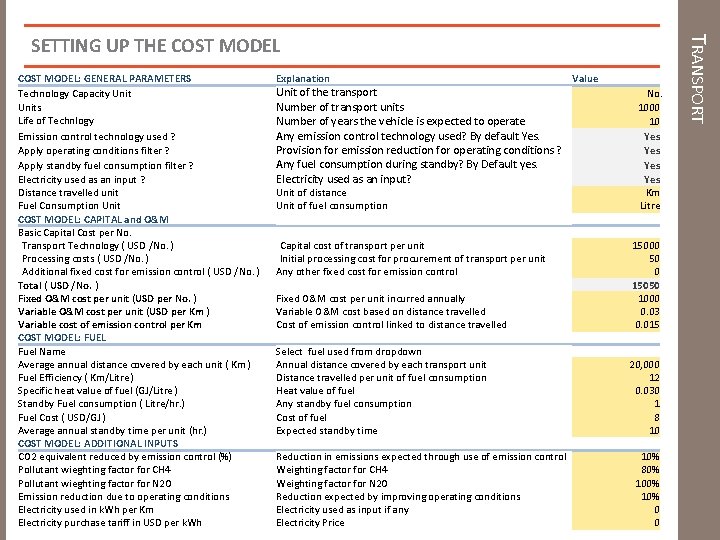
COST MODEL: GENERAL PARAMETERS Technology Capacity Units Life of Technlogy Emission control technology used ? Apply operating conditions filter ? Apply standby fuel consumption filter ? Electricity used as an input ? Distance travelled unit Fuel Consumption Unit COST MODEL: CAPITAL and O&M Basic Capital Cost per No. Transport Technology ( USD /No. ) Processing costs ( USD /No. ) Additional fixed cost for emission control ( USD /No. ) Total ( USD /No. ) Fixed O&M cost per unit (USD per No. ) Variable O&M cost per unit (USD per Km ) Variable cost of emission control per Km COST MODEL: FUEL Fuel Name Average annual distance covered by each unit ( Km ) Fuel Efficiency ( Km/Litre ) Specific heat value of fuel (GJ/Litre ) Standby Fuel consumption ( Litre/hr. ) Fuel Cost ( USD/GJ ) Average annual standby time per unit (hr. ) COST MODEL: ADDITIONAL INPUTS CO 2 equivalent reduced by emission control (%) Pollutant wieghting factor for CH 4 Pollutant wieghting factor for N 2 O Emission reduction due to operating conditions Electricity used in k. Wh per Km Electricity purchase tariff in USD per k. Wh Explanation Unit of the transport Number of transport units Number of years the vehicle is expected to operate Any emission control technology used? By default Yes. Provision for emission reduction for operating conditions ? Any fuel consumption during standby? By Default yes. Electricity used as an input? Unit of distance Unit of fuel consumption Capital cost of transport per unit Initial processing cost for procurement of transport per unit Any other fixed cost for emission control Value No. 1000 10 Yes Yes Km Litre Fixed O&M cost per unit incurred annually Variable O&M cost based on distance travelled Cost of emission control linked to distance travelled 15000 50 0 15050 1000 0. 03 0. 015 Select fuel used from dropdown Annual distance covered by each transport unit Distance travelled per unit of fuel consumption Heat value of fuel Any standby fuel consumption Cost of fuel Expected standby time 20, 000 12 0. 030 1 8 10 Reduction in emissions expected through use of emission control Weighting factor for CH 4 Weighting factor for N 2 O Reduction expected by improving operating conditions Electricity used as input if any Electricity Price 10% 80% 10% 0 0 TRANSPORT SETTING UP THE COST MODEL
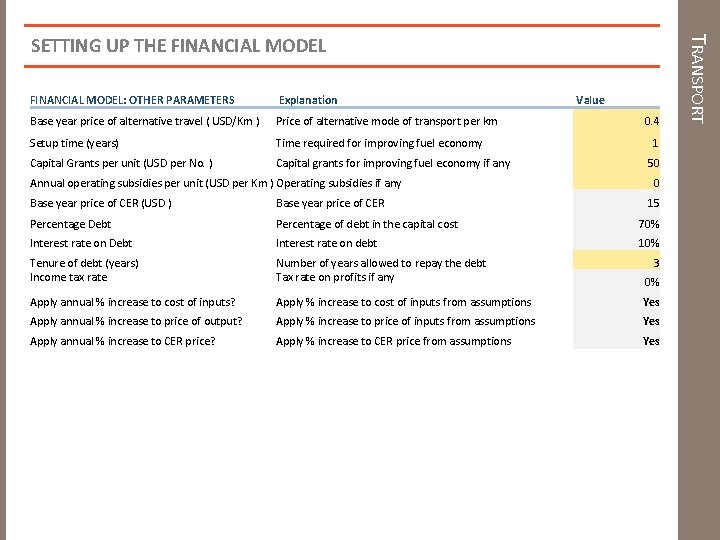
FINANCIAL MODEL: OTHER PARAMETERS Explanation Base year price of alternative travel ( USD/Km ) Price of alternative mode of transport per km Setup time (years) Time required for improving fuel economy Capital Grants per unit (USD per No. ) Capital grants for improving fuel economy if any Annual operating subsidies per unit (USD per Km ) Operating subsidies if any Value 0. 4 1 50 0 Base year price of CER (USD ) Base year price of CER 15 Percentage Debt Percentage of debt in the capital cost 70% Interest rate on Debt Interest rate on debt 10% Tenure of debt (years) Income tax rate Number of years allowed to repay the debt Tax rate on profits if any 0% Apply annual % increase to cost of inputs? Apply % increase to cost of inputs from assumptions Yes Apply annual % increase to price of output? Apply % increase to price of inputs from assumptions Yes Apply annual % increase to CER price? Apply % increase to CER price from assumptions Yes 3 TRANSPORT SETTING UP THE FINANCIAL MODEL
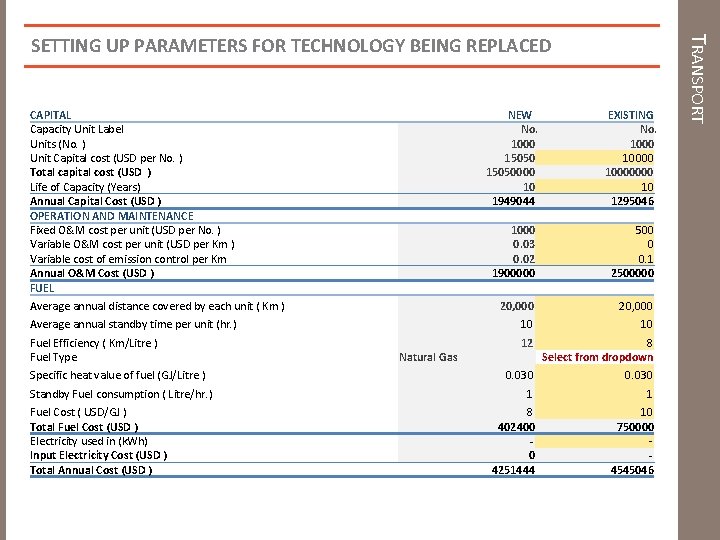
CAPITAL Capacity Unit Label Units (No. ) Unit Capital cost (USD per No. ) Total capital cost (USD ) Life of Capacity (Years) Annual Capital Cost (USD ) OPERATION AND MAINTENANCE Fixed O&M cost per unit (USD per No. ) Variable O&M cost per unit (USD per Km ) Variable cost of emission control per Km Annual O&M Cost (USD ) FUEL NEW No. 1000 15050000 10 1949044 EXISTING No. 10000000 10 1295046 1000 0. 03 0. 02 1900000 500 0 0. 1 2500000 20, 000 Average annual standby time per unit (hr. ) 10 10 Fuel Efficiency ( Km/Litre ) Fuel Type 12 8 Select from dropdown 0. 030 1 1 8 402400 0 4251444 10 750000 4545046 Average annual distance covered by each unit ( Km ) Specific heat value of fuel (GJ/Litre ) Standby Fuel consumption ( Litre/hr. ) Fuel Cost ( USD/GJ ) Total Fuel Cost (USD ) Electricity used in (k. Wh) Input Electricity Cost (USD ) Total Annual Cost (USD ) Natural Gas TRANSPORT SETTING UP PARAMETERS FOR TECHNOLOGY BEING REPLACED
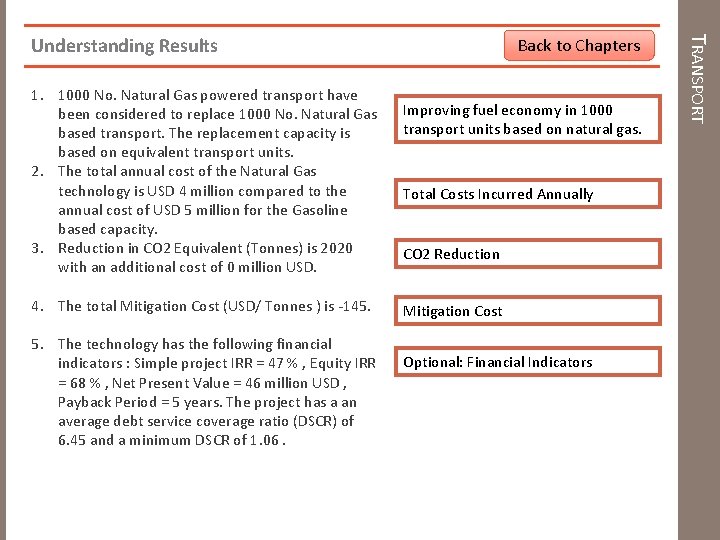
1. 1000 No. Natural Gas powered transport have been considered to replace 1000 No. Natural Gas based transport. The replacement capacity is based on equivalent transport units. 2. The total annual cost of the Natural Gas technology is USD 4 million compared to the annual cost of USD 5 million for the Gasoline based capacity. 3. Reduction in CO 2 Equivalent (Tonnes) is 2020 with an additional cost of 0 million USD. 4. The total Mitigation Cost (USD/ Tonnes ) is -145. 5. The technology has the following financial indicators : Simple project IRR = 47 % , Equity IRR = 68 % , Net Present Value = 46 million USD , Payback Period = 5 years. The project has a an average debt service coverage ratio (DSCR) of 6. 45 and a minimum DSCR of 1. 06. Back to Chapters Improving fuel economy in 1000 transport units based on natural gas. Total Costs Incurred Annually CO 2 Reduction Mitigation Cost Optional: Financial Indicators TRANSPORT Understanding Results
WORKED OUT EXAMPLES - BUILDING In this example solar water heating technology is replacing electrical water heating technology involving some investment per unit.
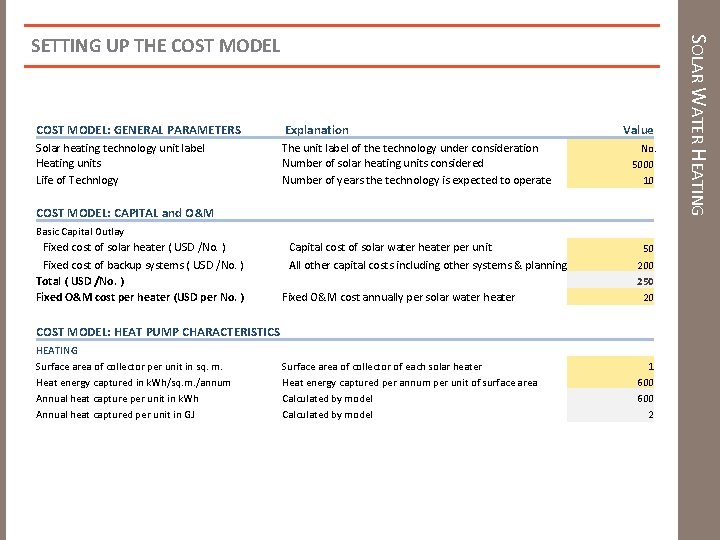
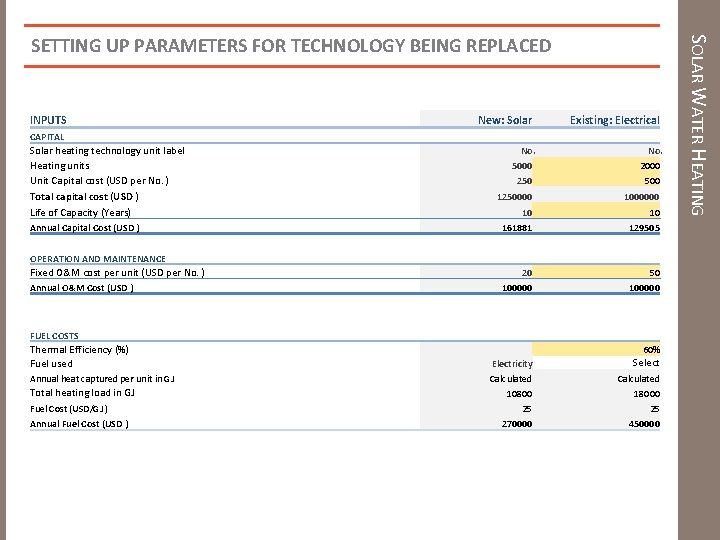
COST MODEL: GENERAL PARAMETERS Explanation Solar heating technology unit label Heating units Life of Technlogy The unit label of the technology under consideration Number of solar heating units considered Number of years the technology is expected to operate Value No. 5000 10 COST MODEL: CAPITAL and O&M Basic Capital Outlay Fixed cost of solar heater ( USD /No. ) Fixed cost of backup systems ( USD /No. ) Total ( USD /No. ) Fixed O&M cost per heater (USD per No. ) Capital cost of solar water heater per unit All other capital costs including other systems & planning 50 Fixed O&M cost annually per solar water heater 200 250 20 Surface area of collector of each solar heater Heat energy captured per annum per unit of surface area Calculated by model 1 600 2 COST MODEL: HEAT PUMP CHARACTERISTICS HEATING Surface area of collector per unit in sq. m. Heat energy captured in k. Wh/sq. m. /annum Annual heat capture per unit in k. Wh Annual heat captured per unit in GJ SOLAR WATER HEATING SETTING UP THE COST MODEL
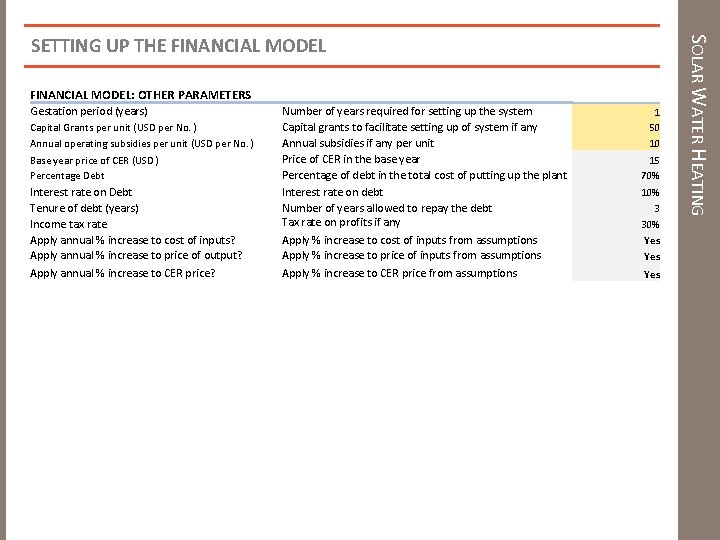
FINANCIAL MODEL: OTHER PARAMETERS Gestation period (years) Capital Grants per unit (USD per No. ) Annual operating subsidies per unit (USD per No. ) Base year price of CER (USD ) Percentage Debt Interest rate on Debt Tenure of debt (years) Income tax rate Apply annual % increase to cost of inputs? Apply annual % increase to price of output? Apply annual % increase to CER price? Number of years required for setting up the system Capital grants to facilitate setting up of system if any Annual subsidies if any per unit Price of CER in the base year Percentage of debt in the total cost of putting up the plant Interest rate on debt Number of years allowed to repay the debt Tax rate on profits if any Apply % increase to cost of inputs from assumptions Apply % increase to price of inputs from assumptions Apply % increase to CER price from assumptions 1 50 10 15 70% 10% 3 30% Yes Yes SOLAR WATER HEATING SETTING UP THE FINANCIAL MODEL
INPUTS New: Solar Existing: Electrical No. 5000 250 2000 500 1250000 1000000 10 10 161881 129505 20 50 100000 Electricity Select Calculated 10800 Calculated 18000 25 25 270000 450000 CAPITAL Solar heating technology unit label Heating units Unit Capital cost (USD per No. ) Total capital cost (USD ) Life of Capacity (Years) Annual Capital Cost (USD ) OPERATION AND MAINTENANCE Fixed O&M cost per unit (USD per No. ) Annual O&M Cost (USD ) FUEL COSTS Thermal Efficiency (%) Fuel used Annual heat captured per unit in GJ Total heating load in GJ Fuel Cost (USD/GJ ) Annual Fuel Cost (USD ) 60% SOLAR WATER HEATING SETTING UP PARAMETERS FOR TECHNOLOGY BEING REPLACED
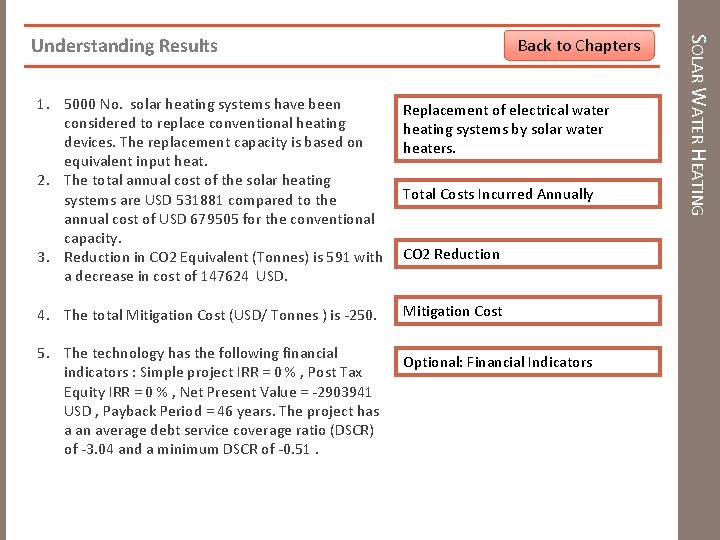
Back to Chapters 1. 5000 No. solar heating systems have been considered to replace conventional heating devices. The replacement capacity is based on equivalent input heat. 2. The total annual cost of the solar heating systems are USD 531881 compared to the annual cost of USD 679505 for the conventional capacity. 3. Reduction in CO 2 Equivalent (Tonnes) is 591 with a decrease in cost of 147624 USD. Replacement of electrical water heating systems by solar water heaters. 4. The total Mitigation Cost (USD/ Tonnes ) is -250. Mitigation Cost 5. The technology has the following financial indicators : Simple project IRR = 0 % , Post Tax Equity IRR = 0 % , Net Present Value = -2903941 USD , Payback Period = 46 years. The project has a an average debt service coverage ratio (DSCR) of -3. 04 and a minimum DSCR of -0. 51. Total Costs Incurred Annually CO 2 Reduction Optional: Financial Indicators SOLAR WATER HEATING Understanding Results
WORKED OUT EXAMPLES - AGRICULTURE In this example, emissions from rice cultivation under various conditions is considered.
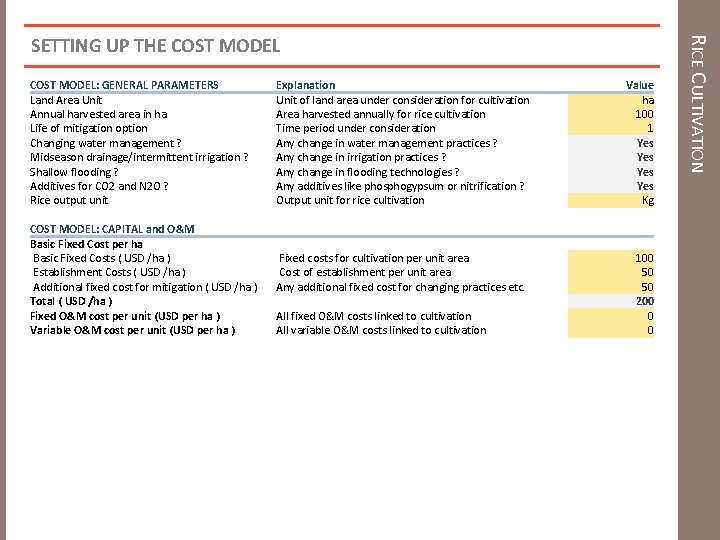
COST MODEL: GENERAL PARAMETERS Land Area Unit Annual harvested area in ha Life of mitigation option Changing water management ? Midseason drainage/intermittent irrigation ? Shallow flooding ? Additives for CO 2 and N 2 O ? Rice output unit COST MODEL: CAPITAL and O&M Basic Fixed Cost per ha Basic Fixed Costs ( USD /ha ) Establishment Costs ( USD /ha ) Additional fixed cost for mitigation ( USD /ha ) Total ( USD /ha ) Fixed O&M cost per unit (USD per ha ) Variable O&M cost per unit (USD per ha ) Explanation Unit of land area under consideration for cultivation Area harvested annually for rice cultivation Time period under consideration Any change in water management practices ? Any change in irrigation practices ? Any change in flooding technologies ? Any additives like phosphogypsum or nitrification ? Output unit for rice cultivation Value ha 100 1 Yes Yes Kg Fixed costs for cultivation per unit area Cost of establishment per unit area Any additional fixed cost for changing practices etc. 100 50 50 200 0 0 All fixed O&M costs linked to cultivation All variable O&M costs linked to cultivation RICE CULTIVATION SETTING UP THE COST MODEL
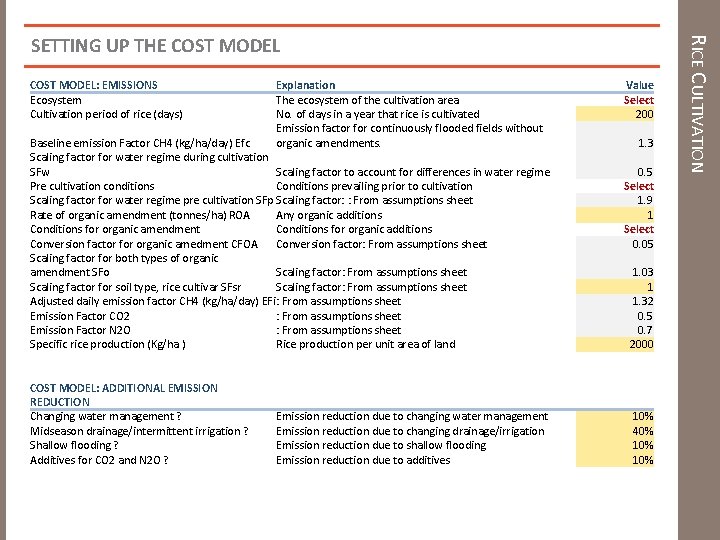
COST MODEL: EMISSIONS Ecosystem Cultivation period of rice (days) Explanation The ecosystem of the cultivation area No. of days in a year that rice is cultivated Emission factor for continuously flooded fields without organic amendments. Baseline emission Factor CH 4 (kg/ha/day) Efc Scaling factor for water regime during cultivation SFw Scaling factor to account for differences in water regime Pre cultivation conditions Conditions prevailing prior to cultivation Scaling factor for water regime pre cultivation SFp Scaling factor: : From assumptions sheet Rate of organic amendment (tonnes/ha) ROA Any organic additions Conditions for organic amendment Conditions for organic additions Conversion factor for organic amedment CFOA Conversion factor: From assumptions sheet Scaling factor for both types of organic amendment SFo Scaling factor: From assumptions sheet Scaling factor for soil type, rice cultivar SFsr Scaling factor: From assumptions sheet Adjusted daily emission factor CH 4 (kg/ha/day) EFi: From assumptions sheet Emission Factor CO 2 : From assumptions sheet Emission Factor N 2 O : From assumptions sheet Specific rice production (Kg/ha ) Rice production per unit area of land COST MODEL: ADDITIONAL EMISSION REDUCTION Changing water management ? Midseason drainage/intermittent irrigation ? Shallow flooding ? Additives for CO 2 and N 2 O ? Emission reduction due to changing water management Emission reduction due to changing drainage/irrigation Emission reduction due to shallow flooding Emission reduction due to additives Value Select 200 1. 3 0. 5 Select 1. 9 1 Select 0. 05 1. 03 1 1. 32 0. 5 0. 7 2000 10% 40% 10% RICE CULTIVATION SETTING UP THE COST MODEL
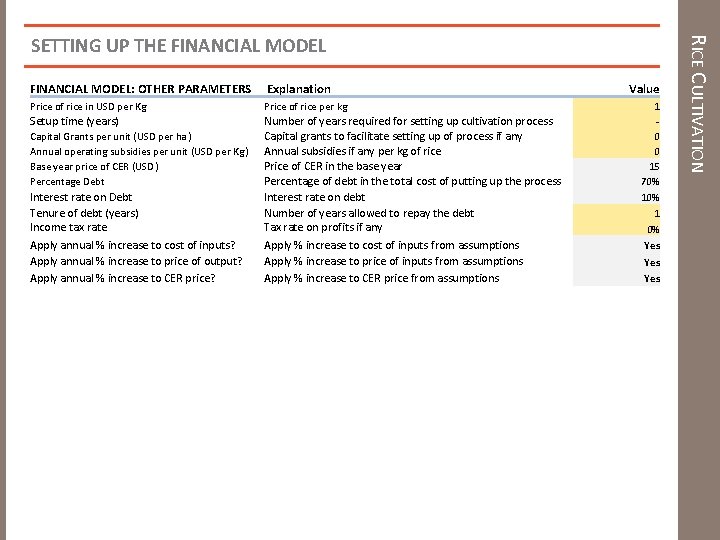
FINANCIAL MODEL: OTHER PARAMETERS Explanation Price of rice in USD per Kg Price of rice per kg Setup time (years) Number of years required for setting up cultivation process Capital grants to facilitate setting up of process if any Annual subsidies if any per kg of rice Price of CER in the base year Percentage of debt in the total cost of putting up the process Interest rate on debt Number of years allowed to repay the debt Tax rate on profits if any Apply % increase to cost of inputs from assumptions Apply % increase to price of inputs from assumptions Apply % increase to CER price from assumptions Capital Grants per unit (USD per ha ) Annual operating subsidies per unit (USD per Kg ) Base year price of CER (USD ) Percentage Debt Interest rate on Debt Tenure of debt (years) Income tax rate Apply annual % increase to cost of inputs? Apply annual % increase to price of output? Apply annual % increase to CER price? Value 1 0 0 15 70% 1 0% Yes Yes RICE CULTIVATION SETTING UP THE FINANCIAL MODEL
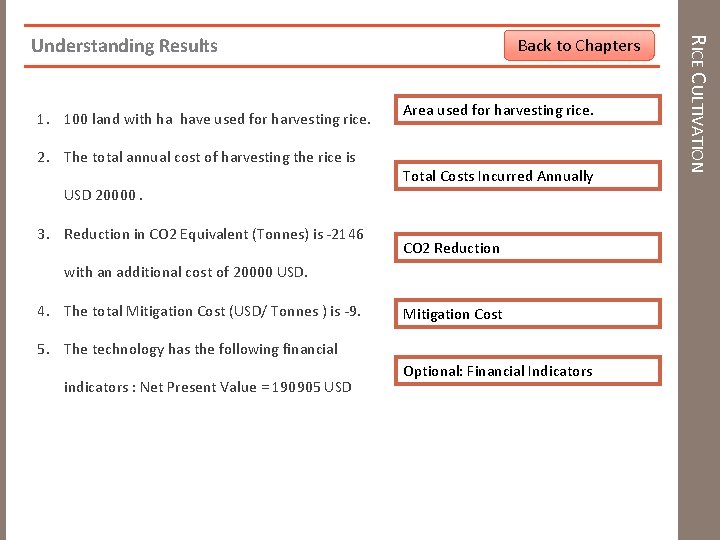
1. 100 land with ha have used for harvesting rice. 2. The total annual cost of harvesting the rice is Back to Chapters Area used for harvesting rice. Total Costs Incurred Annually USD 20000. 3. Reduction in CO 2 Equivalent (Tonnes) is -2146 CO 2 Reduction with an additional cost of 20000 USD. 4. The total Mitigation Cost (USD/ Tonnes ) is -9. Mitigation Cost 5. The technology has the following financial indicators : Net Present Value = 190905 USD Optional: Financial Indicators RICE CULTIVATION Understanding Results