
Financial Analysis Planning and Forecasting Theory and Application

- Slides: 44
Financial Analysis, Planning and Forecasting Theory and Application Chapter 11 Option Pricing Theory and Firm Valuation By Alice C. Lee San Francisco State University John C. Lee J. P. Morgan Chase Cheng F. Lee Rutgers University 1
Outline 11. 1 • 11. 2 • 11. 3 • 11. 4 • • • Introduction Basic Concepts of Options Factors Affecting Option Value Determining the Value of Options 11. 4. 1 Expected Value Estimation 11. 4. 2 The Black-Scholes Option Pricing Model 11. 4. 3 Taxation of Options 11. 4. 4 American Options 11. 5 Option Pricing Theory and Capital Structure • • • 11. 5. 1 Proportion of Debt in Capital Structure 11. 5. 2 Riskiness of Business Operations 11. 5. 3 Option Pricing Approach to Determine the Optimal Capital Structure 11. 6 Warrants • 11. 7 Summary • 2
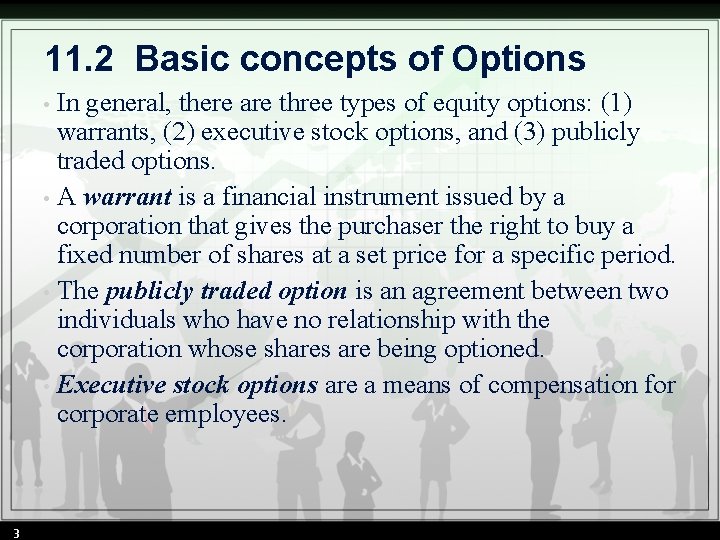
11. 2 Basic concepts of Options In general, there are three types of equity options: (1) warrants, (2) executive stock options, and (3) publicly traded options. • A warrant is a financial instrument issued by a corporation that gives the purchaser the right to buy a fixed number of shares at a set price for a specific period. • The publicly traded option is an agreement between two individuals who have no relationship with the corporation whose shares are being optioned. • Executive stock options are a means of compensation for corporate employees. • 3
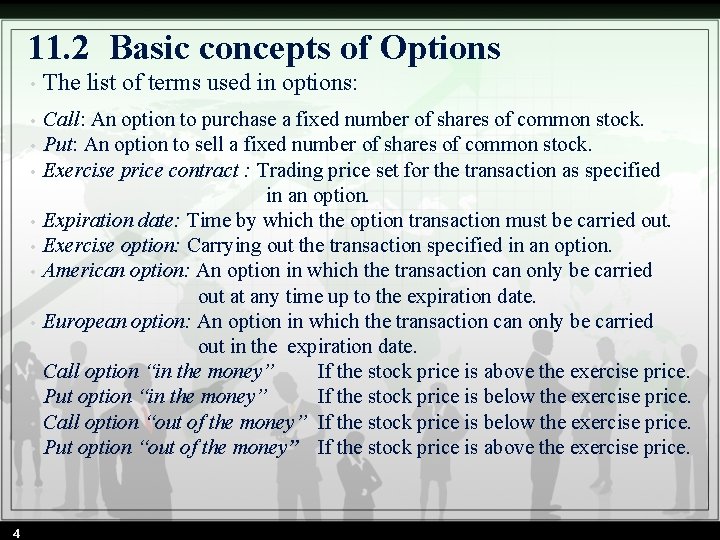
11. 2 Basic concepts of Options • The list of terms used in options: • Call: An option to purchase a fixed number of shares of common stock. Put: An option to sell a fixed number of shares of common stock. Exercise price contract : Trading price set for the transaction as specified in an option. Expiration date: Time by which the option transaction must be carried out. Exercise option: Carrying out the transaction specified in an option. American option: An option in which the transaction can only be carried out at any time up to the expiration date. European option: An option in which the transaction can only be carried out in the expiration date. Call option “in the money” If the stock price is above the exercise price. Put option “in the money” If the stock price is below the exercise price. Call option “out of the money” If the stock price is below the exercise price. Put option “out of the money” If the stock price is above the exercise price. • • • 4
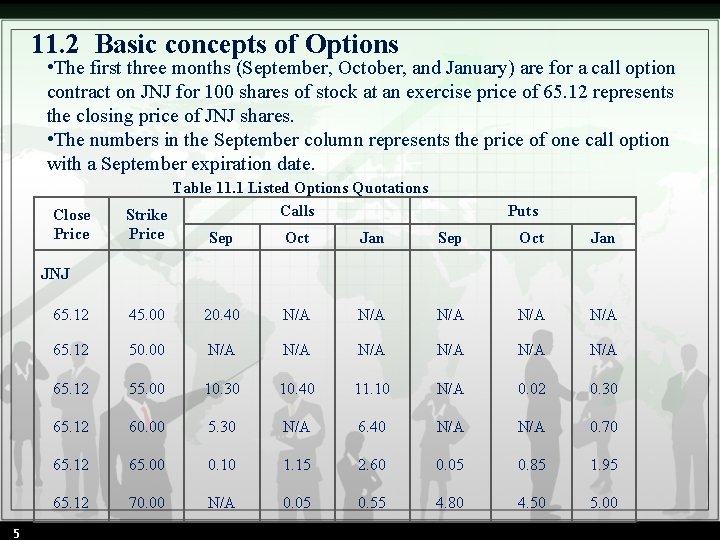
11. 2 Basic concepts of Options • The first three months (September, October, and January) are for a call option contract on JNJ for 100 shares of stock at an exercise price of 65. 12 represents the closing price of JNJ shares. • The numbers in the September column represents the price of one call option with a September expiration date. Close Price Table 11. 1 Listed Options Quotations Calls Strike Price Sep Oct Jan Sep Puts Oct Jan JNJ 5 65. 12 45. 00 20. 40 N/A N/A N/A 65. 12 50. 00 N/A N/A N/A 65. 12 55. 00 10. 30 10. 40 11. 10 N/A 0. 02 0. 30 65. 12 60. 00 5. 30 N/A 6. 40 N/A 0. 70 65. 12 65. 00 0. 10 1. 15 2. 60 0. 05 0. 85 1. 95 65. 12 70. 00 N/A 0. 05 0. 55 4. 80 4. 50 5. 00
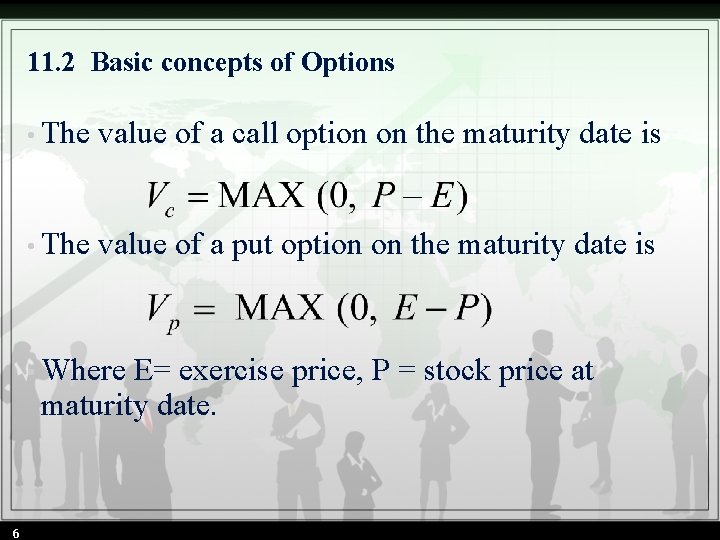
11. 2 Basic concepts of Options • The value of a call option on the maturity date is • The value of a put option on the maturity date is • Where E= exercise price, P = stock price at maturity date. 6
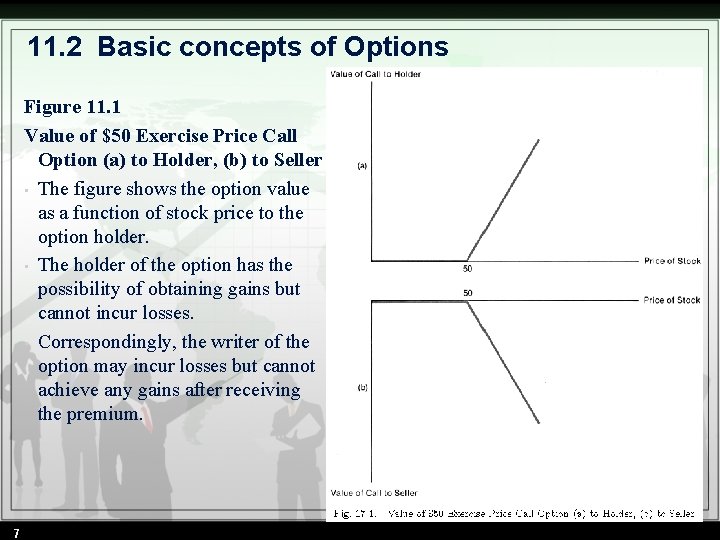
11. 2 Basic concepts of Options Figure 11. 1 Value of $50 Exercise Price Call Option (a) to Holder, (b) to Seller • The figure shows the option value as a function of stock price to the option holder. • The holder of the option has the possibility of obtaining gains but cannot incur losses. • Correspondingly, the writer of the option may incur losses but cannot achieve any gains after receiving the premium. 7
11. 3 Factors affecting option value There are five factors that influence the value of a call option: 1. 2. 3. 4. 5. Market price of the stock The exercise price The risk-free interest rule The volatility of the stock price Time remaining to expiration date The mathematical derivations of the sensitivity between the factors and the option value are discussed in Chapter 20. 8
11. 3 Factors affecting option value Lower bound: The value of a call cannot be less than the payoff that would accrue if it were exercised immediately. Upper bound: The value of a call cannot be more than the market price of the stock. Figure 11. 2 Value of Call Option 9
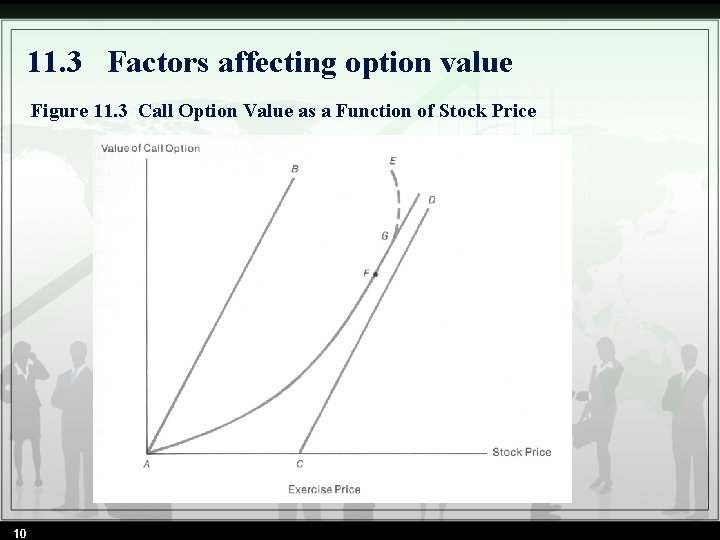
11. 3 Factors affecting option value Figure 11. 3 Call Option Value as a Function of Stock Price 10
11. 3 Factors affecting option value The following considerations should help in forming the appropriate picture of Figure 11. 3: 1) If the market price of the stock 0, the call value will also be 0, as indicated by point A. 2) All other things equal, as the stock price increases, so does the call value (see lines AB and CD). 3) If the price of the stock is high in relation to the exercise price, each dollar increase in price induces an increase of very nearly the same amount in the call value (shown by the slope of the line at point F). 4) The call value rises at an increasing rate as the value of the stock price rises, as shown by curvature AFG. • 11
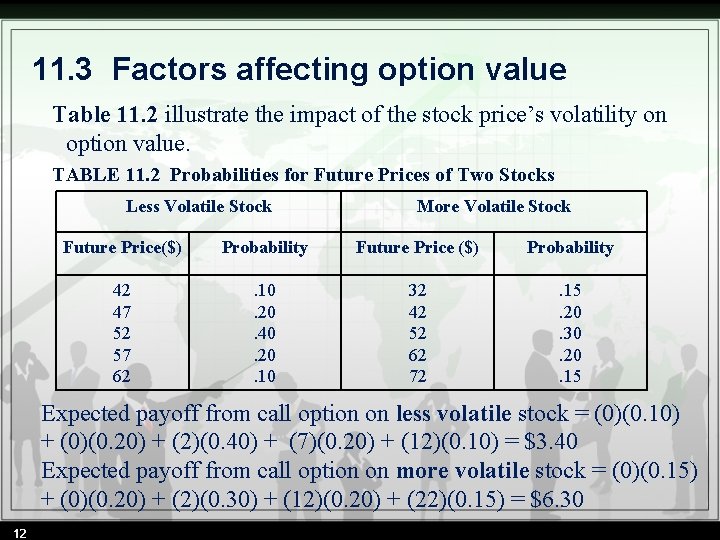
11. 3 Factors affecting option value Table 11. 2 illustrate the impact of the stock price’s volatility on option value. TABLE 11. 2 Probabilities for Future Prices of Two Stocks Less Volatile Stock More Volatile Stock Future Price($) Probability Future Price ($) Probability 42 47 52 57 62 . 10. 20. 40. 20. 10 32 42 52 62 72 . 15. 20. 30. 20. 15 Expected payoff from call option on less volatile stock = (0)(0. 10) + (0)(0. 20) + (2)(0. 40) + (7)(0. 20) + (12)(0. 10) = $3. 40 Expected payoff from call option on more volatile stock = (0)(0. 15) + (0)(0. 20) + (2)(0. 30) + (12)(0. 20) + (22)(0. 15) = $6. 30 12
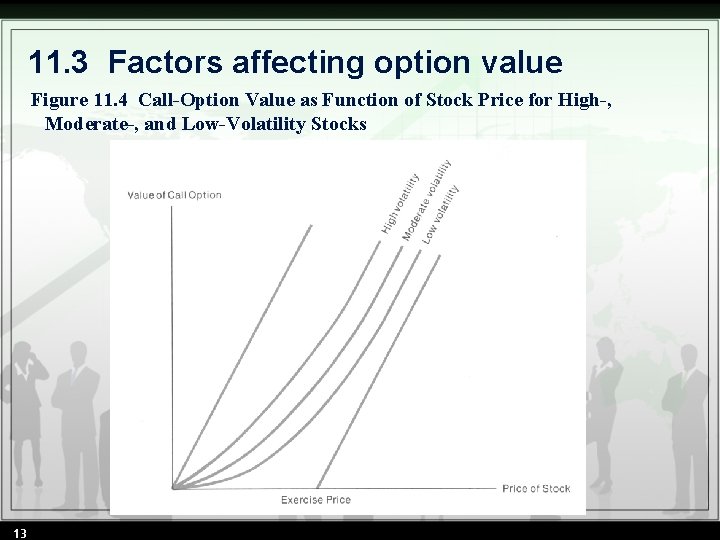
11. 3 Factors affecting option value Figure 11. 4 Call-Option Value as Function of Stock Price for High-, Moderate-, and Low-Volatility Stocks 13
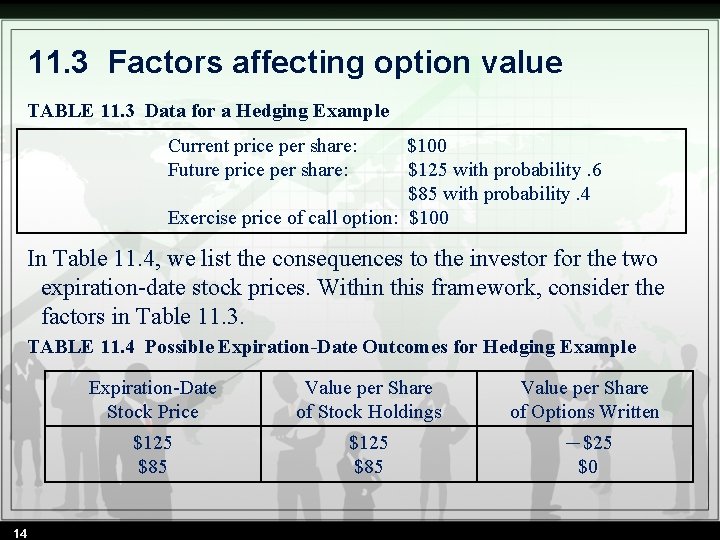
11. 3 Factors affecting option value TABLE 11. 3 Data for a Hedging Example Current price per share: Future price per share: $100 $125 with probability. 6 $85 with probability. 4 Exercise price of call option: $100 In Table 11. 4, we list the consequences to the investor for the two expiration-date stock prices. Within this framework, consider the factors in Table 11. 3. TABLE 11. 4 Possible Expiration-Date Outcomes for Hedging Example 14 Expiration-Date Stock Price Value per Share of Stock Holdings Value per Share of Options Written $125 $85 -$25 $0
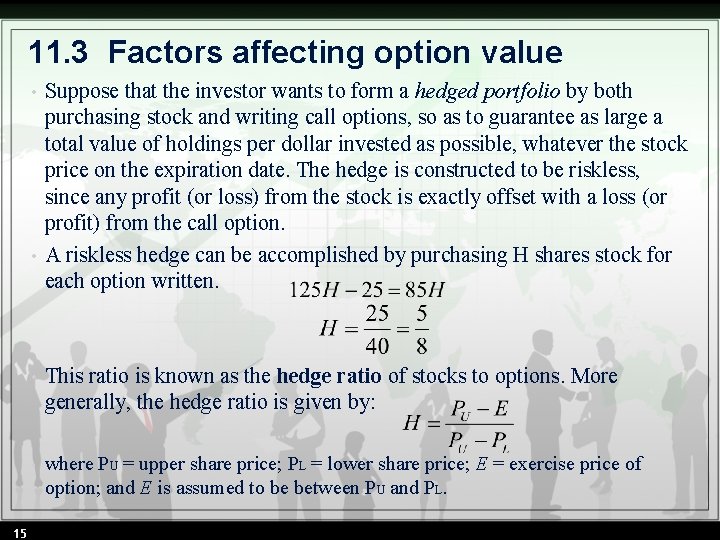
11. 3 Factors affecting option value • • 15 Suppose that the investor wants to form a hedged portfolio by both purchasing stock and writing call options, so as to guarantee as large a total value of holdings per dollar invested as possible, whatever the stock price on the expiration date. The hedge is constructed to be riskless, since any profit (or loss) from the stock is exactly offset with a loss (or profit) from the call option. A riskless hedge can be accomplished by purchasing H shares stock for each option written. • This ratio is known as the hedge ratio of stocks to options. More generally, the hedge ratio is given by: • where PU = upper share price; PL = lower share price; E = exercise price of option; and E is assumed to be between PU and PL.
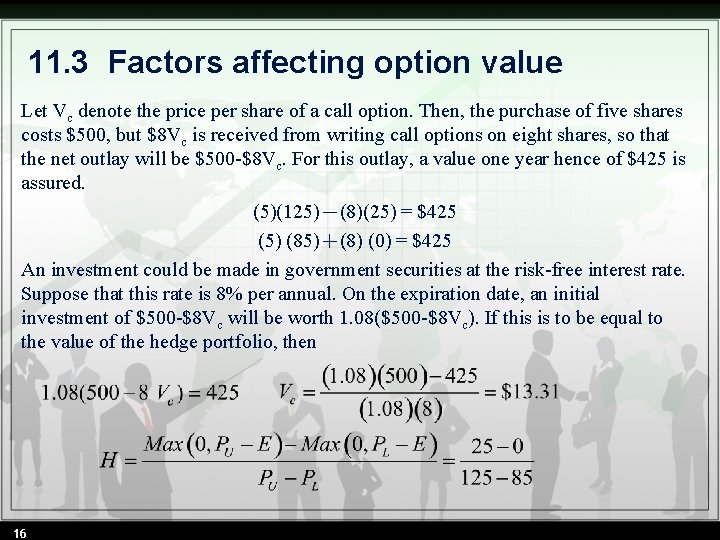
11. 3 Factors affecting option value Let Vc denote the price per share of a call option. Then, the purchase of five shares costs $500, but $8 Vc is received from writing call options on eight shares, so that the net outlay will be $500 -$8 Vc. For this outlay, a value one year hence of $425 is assured. (5)(125)-(8)(25) = $425 (5) (85)+(8) (0) = $425 An investment could be made in government securities at the risk-free interest rate. Suppose that this rate is 8% per annual. On the expiration date, an initial investment of $500 -$8 Vc will be worth 1. 08($500 -$8 Vc). If this is to be equal to the value of the hedge portfolio, then 16
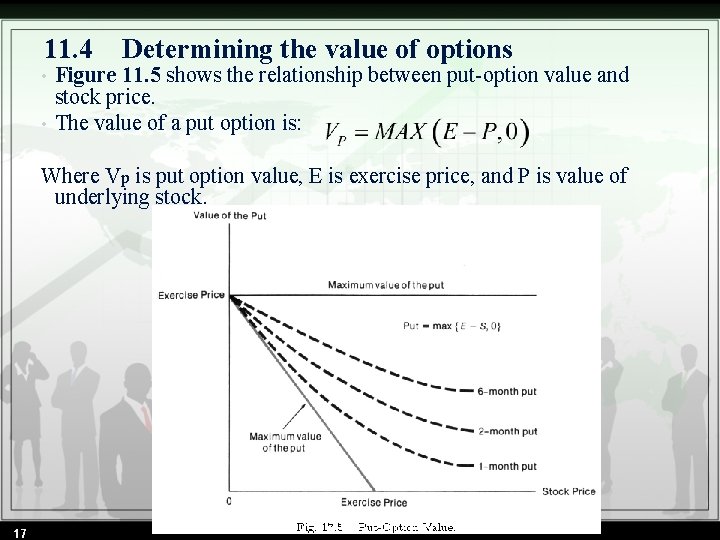
11. 4 • • Determining the value of options Figure 11. 5 shows the relationship between put-option value and stock price. The value of a put option is: Where Vp is put option value, E is exercise price, and P is value of underlying stock. 17
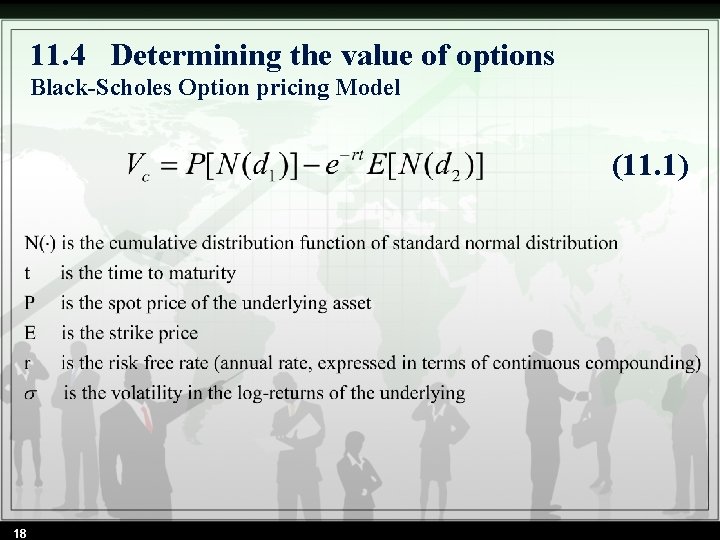
11. 4 Determining the value of options Black-Scholes Option pricing Model (11. 1) 18
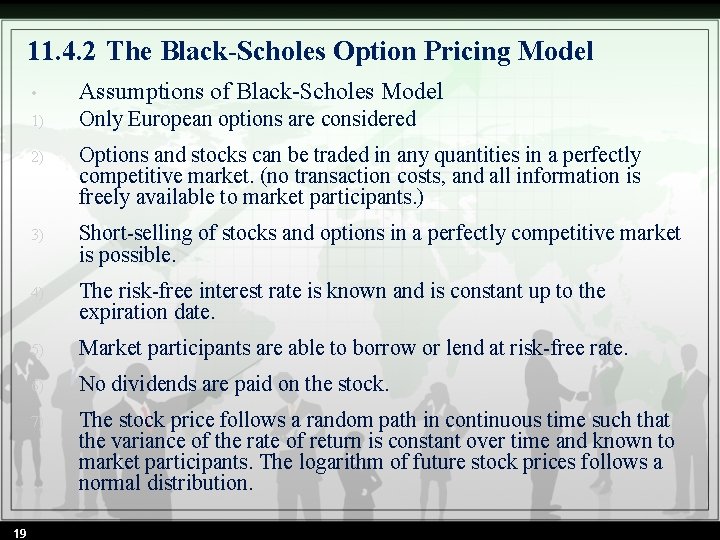
11. 4. 2 The Black-Scholes Option Pricing Model 19 • Assumptions of Black-Scholes Model 1) Only European options are considered 2) Options and stocks can be traded in any quantities in a perfectly competitive market. (no transaction costs, and all information is freely available to market participants. ) 3) Short-selling of stocks and options in a perfectly competitive market is possible. 4) The risk-free interest rate is known and is constant up to the expiration date. 5) Market participants are able to borrow or lend at risk-free rate. 6) No dividends are paid on the stock. 7) The stock price follows a random path in continuous time such that the variance of the rate of return is constant over time and known to market participants. The logarithm of future stock prices follows a normal distribution.
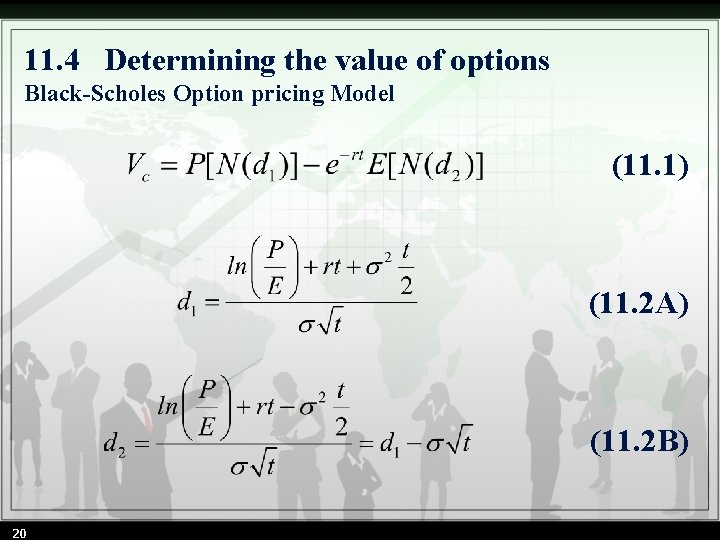
11. 4 Determining the value of options Black-Scholes Option pricing Model (11. 1) (11. 2 A) (11. 2 B) 20
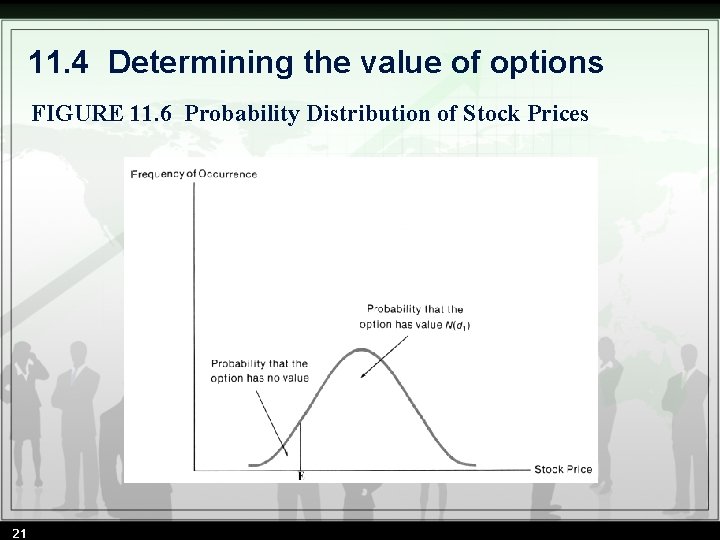
11. 4 Determining the value of options FIGURE 11. 6 Probability Distribution of Stock Prices 21
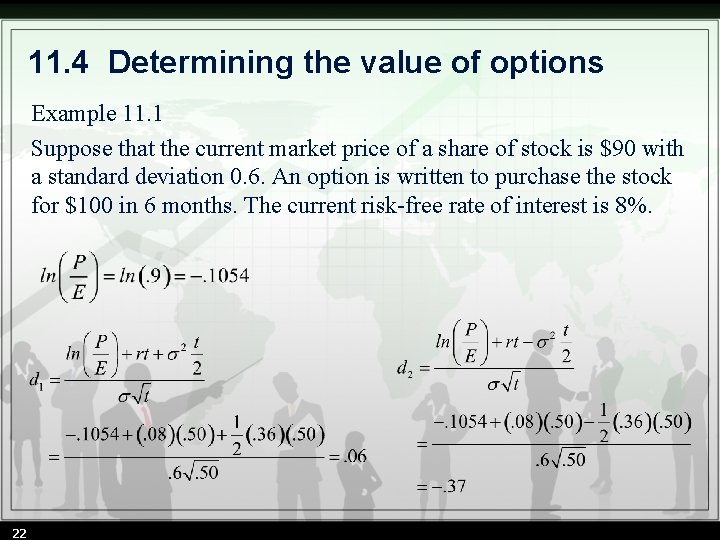
11. 4 Determining the value of options Example 11. 1 Suppose that the current market price of a share of stock is $90 with a standard deviation 0. 6. An option is written to purchase the stock for $100 in 6 months. The current risk-free rate of interest is 8%. 22
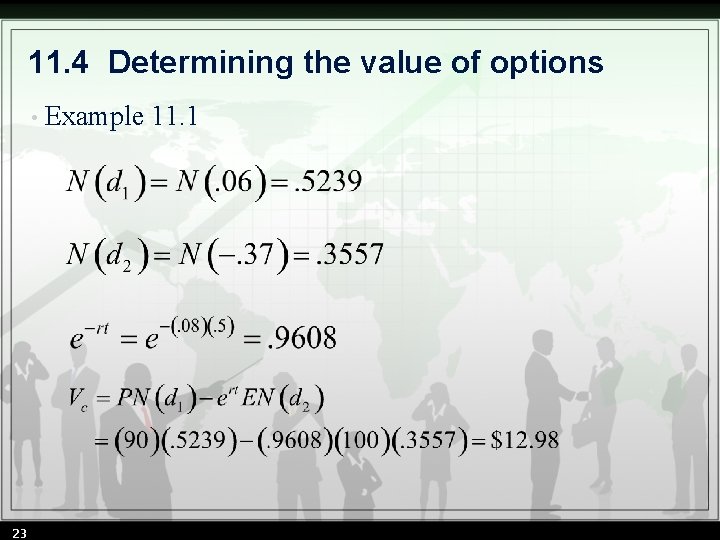
11. 4 Determining the value of options • 23 Example 11. 1
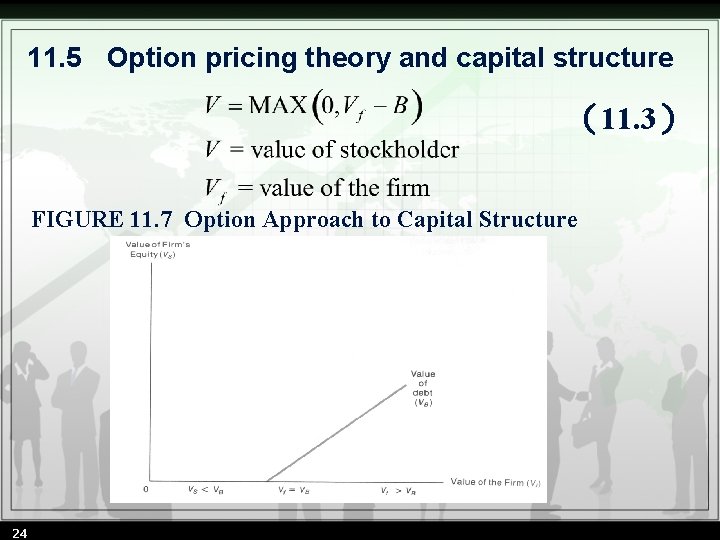
11. 5 Option pricing theory and capital structure (11. 3) FIGURE 11. 7 Option Approach to Capital Structure 24
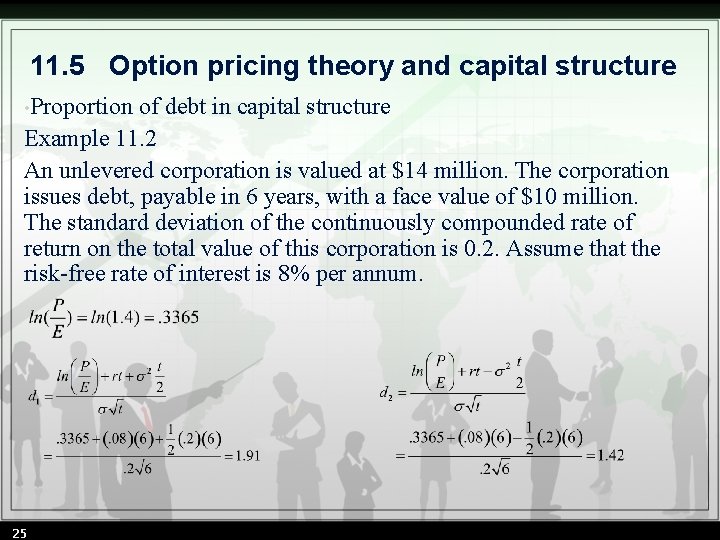
11. 5 Option pricing theory and capital structure • Proportion of debt in capital structure Example 11. 2 An unlevered corporation is valued at $14 million. The corporation issues debt, payable in 6 years, with a face value of $10 million. The standard deviation of the continuously compounded rate of return on the total value of this corporation is 0. 2. Assume that the risk-free rate of interest is 8% per annum. 25
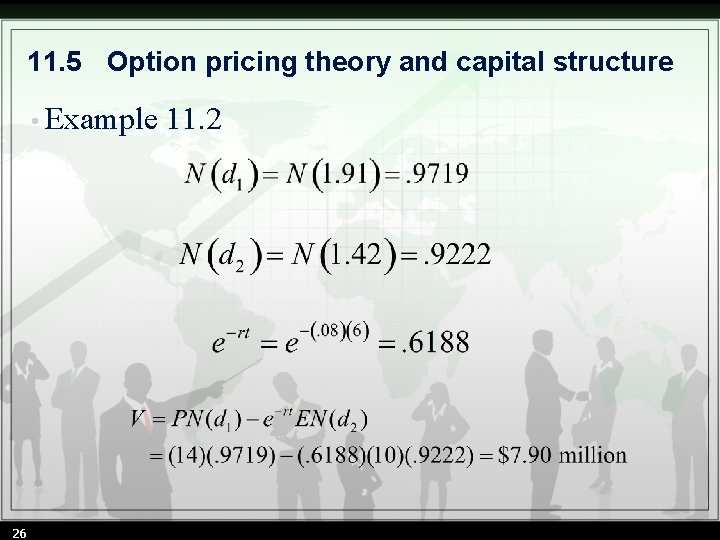
11. 5 Option pricing theory and capital structure • Example 26 11. 2
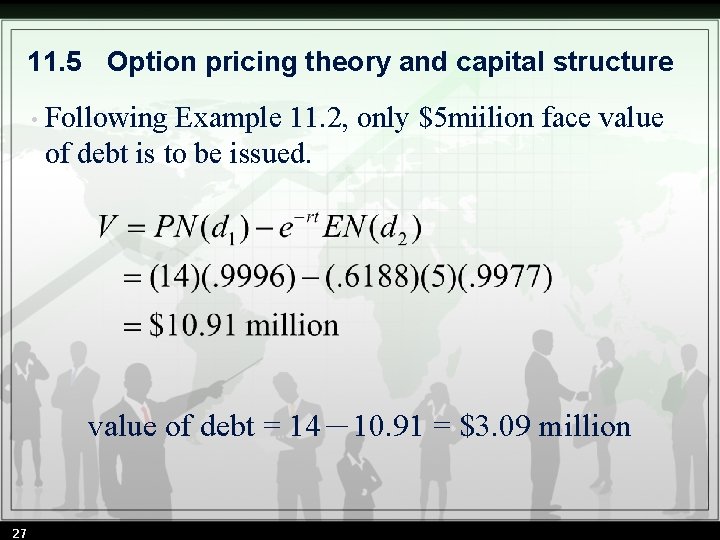
11. 5 Option pricing theory and capital structure • Following Example 11. 2, only $5 miilion face value of debt is to be issued. value of debt = 14-10. 91 = $3. 09 million 27
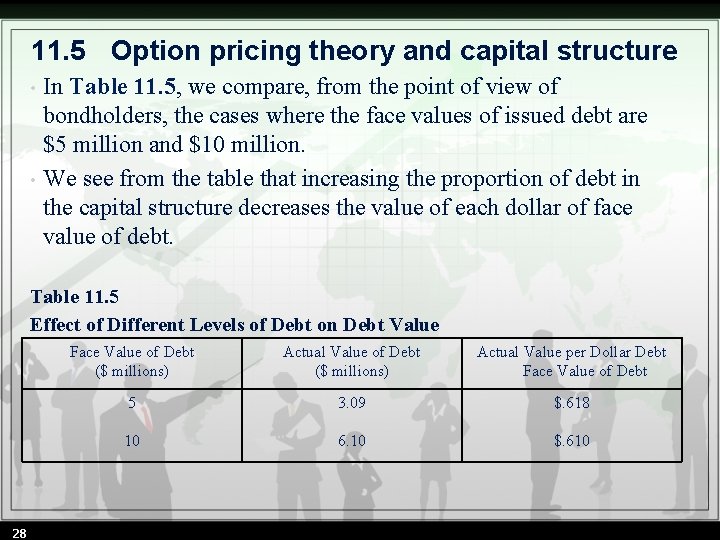
11. 5 Option pricing theory and capital structure • • In Table 11. 5, we compare, from the point of view of bondholders, the cases where the face values of issued debt are $5 million and $10 million. We see from the table that increasing the proportion of debt in the capital structure decreases the value of each dollar of face value of debt. Table 11. 5 Effect of Different Levels of Debt on Debt Value 28 Face Value of Debt ($ millions) Actual Value per Dollar Debt Face Value of Debt 5 3. 09 $. 618 10 6. 10 $. 610
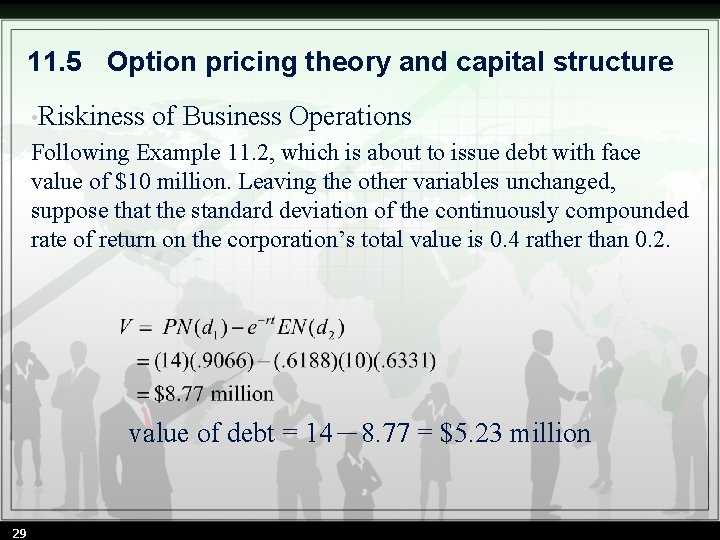
11. 5 Option pricing theory and capital structure • Riskiness of Business Operations Following Example 11. 2, which is about to issue debt with face value of $10 million. Leaving the other variables unchanged, suppose that the standard deviation of the continuously compounded rate of return on the corporation’s total value is 0. 4 rather than 0. 2. value of debt = 14-8. 77 = $5. 23 million 29
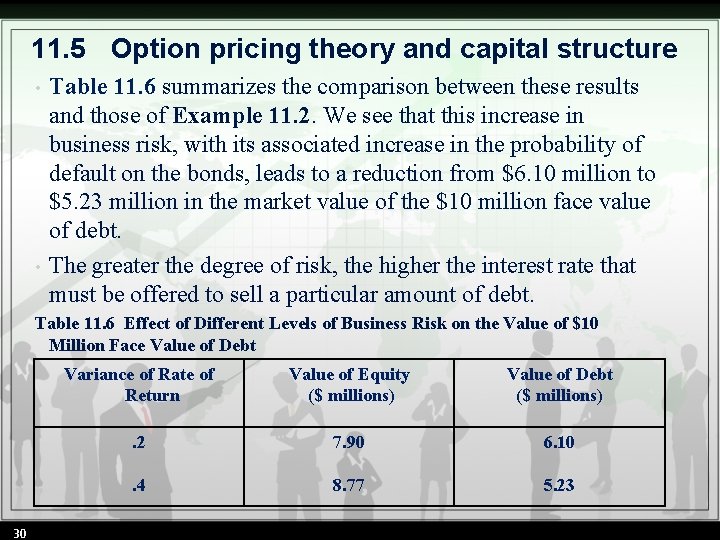
11. 5 Option pricing theory and capital structure • • Table 11. 6 summarizes the comparison between these results and those of Example 11. 2. We see that this increase in business risk, with its associated increase in the probability of default on the bonds, leads to a reduction from $6. 10 million to $5. 23 million in the market value of the $10 million face value of debt. The greater the degree of risk, the higher the interest rate that must be offered to sell a particular amount of debt. Table 11. 6 Effect of Different Levels of Business Risk on the Value of $10 Million Face Value of Debt 30 Variance of Rate of Return Value of Equity ($ millions) Value of Debt ($ millions) . 2 7. 90 6. 10 . 4 8. 77 5. 23
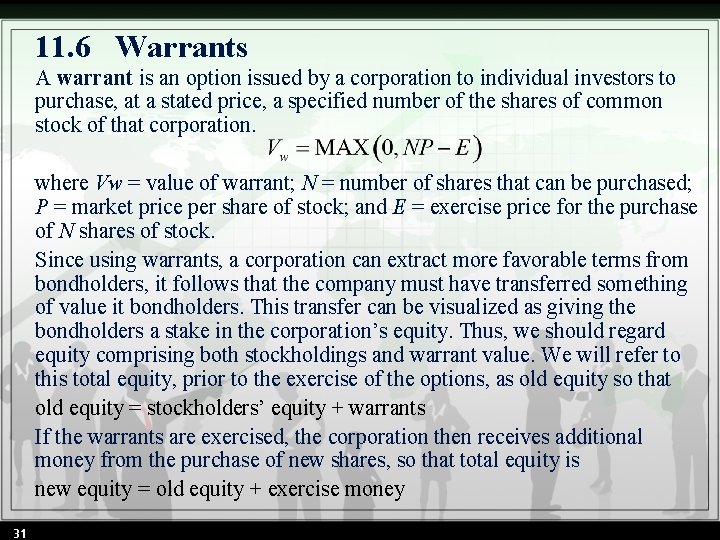
11. 6 Warrants A warrant is an option issued by a corporation to individual investors to purchase, at a stated price, a specified number of the shares of common stock of that corporation. where Vw = value of warrant; N = number of shares that can be purchased; P = market price per share of stock; and E = exercise price for the purchase of N shares of stock. Since using warrants, a corporation can extract more favorable terms from bondholders, it follows that the company must have transferred something of value it bondholders. This transfer can be visualized as giving the bondholders a stake in the corporation’s equity. Thus, we should regard equity comprising both stockholdings and warrant value. We will refer to this total equity, prior to the exercise of the options, as old equity so that old equity = stockholders’ equity + warrants If the warrants are exercised, the corporation then receives additional money from the purchase of new shares, so that total equity is new equity = old equity + exercise money 31
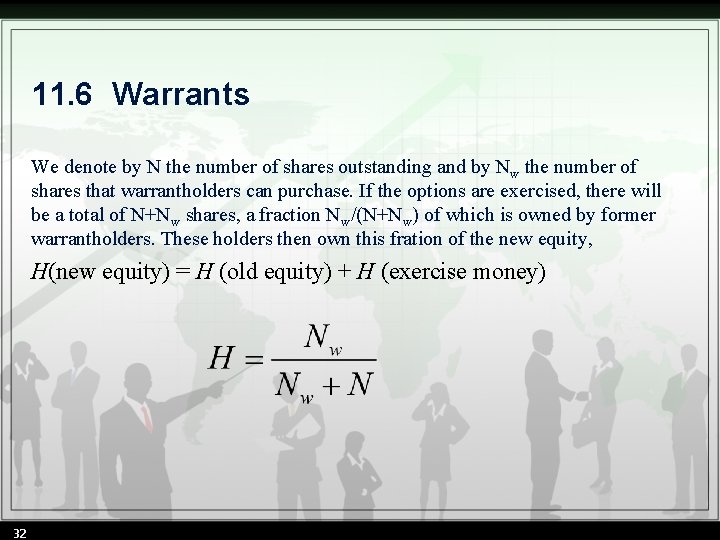
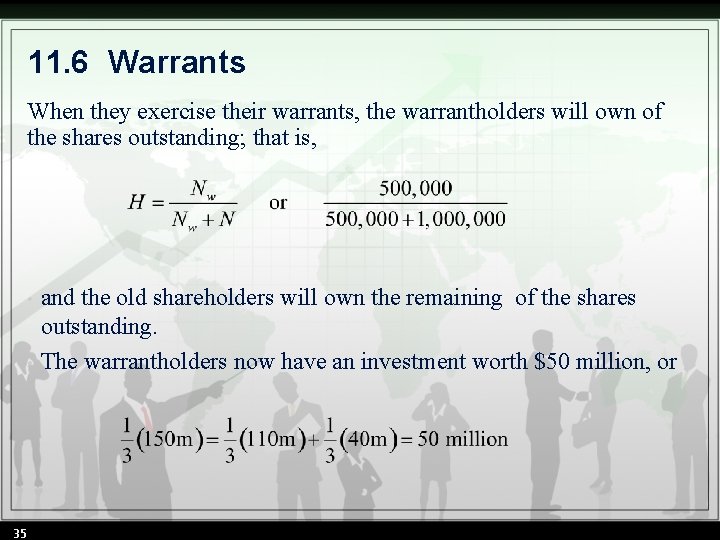
11. 6 Warrants We denote by N the number of shares outstanding and by Nw the number of shares that warrantholders can purchase. If the options are exercised, there will be a total of N+Nw shares, a fraction Nw/(N+Nw) of which is owned by former warrantholders. These holders then own this fration of the new equity, H(new equity) = H (old equity) + H (exercise money) 32
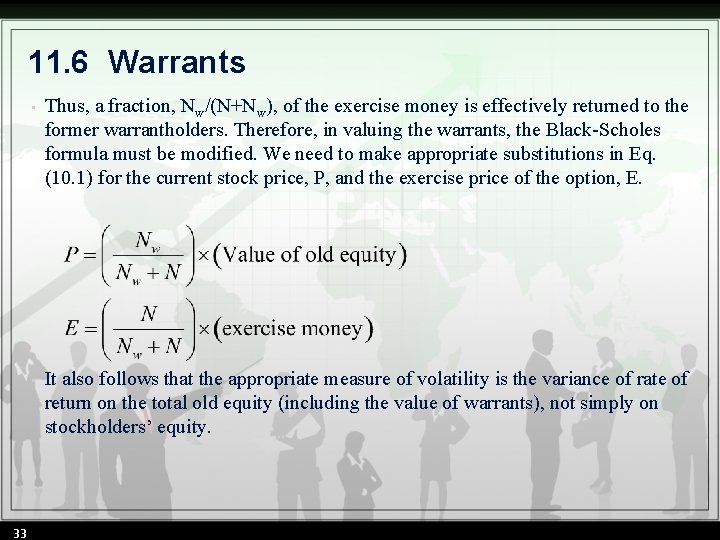
11. 6 Warrants 33 • Thus, a fraction, Nw/(N+Nw), of the exercise money is effectively returned to the former warrantholders. Therefore, in valuing the warrants, the Black-Scholes formula must be modified. We need to make appropriate substitutions in Eq. (10. 1) for the current stock price, P, and the exercise price of the option, E. • It also follows that the appropriate measure of volatility is the variance of rate of return on the total old equity (including the value of warrants), not simply on stockholders’ equity.
11. 6 Warrants Suppose that a firm has one million shares outstanding, currently selling at $100 per share. There also 500, 000 warrants with an exercise price of$80 per share. The warrants are worth $20, or the current stock price, $100, less the exercise price of $80. The value of the old equity is • old equity = 100(lm) + 20(. 5 m) = $110 million If the warrants are exercised, the firm will receive $40 million ($80×. 5 m) of new equity, so that the new equity is • 34 new equity = $110 m + $40 m = $150 million
11. 6 Warrants When they exercise their warrants, the warrantholders will own of the shares outstanding; that is, • • 35 and the old shareholders will own the remaining of the shares outstanding. The warrantholders now have an investment worth $50 million, or
11. 6 Warrants It makes sense for the warrantholders to exercise their warrant; they spend $40 million for shares that are worth $50 million. In terms of the warrant value, the market should be willing to pay $20 per warrant for 500, 000 warrants, or $10 million. In Chapter 7, we discuss convertible bonds. A convertible bond is a security that gives its owner the right to exchange it for a given number of shares of common stock any time before the maturity date of the bond. Hence, a convertible bond is actually a portfolio of two securities: a bond a warrant. The value of a convertible bond is the value of the bond portion of the portfolio plus the value of the warrant. 36
11. 6 Warrants 11. 6. 2 EARNINGS PER SHARE WITH WARRANTS AND CONVERTIBLES Warrants and convertible securities can change a firm’s earnings per share (EPS) and number of shares outstanding. Investors, managers, accountants, and federal and state government agencies all watch the earnings per share of a corporation. Earnings per share generally means net income after taxes, less preferred stock dividends, divided by the weighted average number of shares of common stock outstanding. In 1969, the Accounting Principles Board, a forerunner of the FASB, issued APB Opinion No. 15, “Earnings per Share. ” This ruling laid down the rules for calculating the earnings per share for financial reporting purposes. In 1982, the FASB issued Statement No. 55, “Determining Whether a Convertible Security Is a Common Stock Equivalent. ” The accounting requirements set out in these rulings provide alternative ways of calculating earnings per share if a company has outstanding convertible securities, warrants, stock options, or other contracts that permit it to increase the number of shares of common stock. 37
11. 6 Warrants The EPS for a firm with a simple capital structure is called basic EPS. A simple capital structure has only one form of voting capital and includes no potential equity, such as warrants or convertibles. The existence of nonconvertible preferred stock does not create a complex capital structure. A corporation that has warrants, convertibles, or options outstanding is said to have a complex capital structure. The complexity comes from the difficulty of measuring the number of shares outstanding. This is a function of a known amount of common shares currently outstanding plus an estimate of the number of shares that may be issued to satisfy the holders of warrants, convertibles, and options should they decide to exercise their rights and receive new common shares. 38
11. 6 Warrants Because of the possible dilution in EPS represented by securities that have the potential to become new shares of common stock, the EPS calculation must account for common stock equivalents (CSEs). CSEs are securities that are not common stock, but are equivalent to common stock because they are likely to be converted into common stock in the future. Convertible debt, convertible preferred stock, stock rights, stock options, and stock warrants all are securities that can create new common shares and thus dilute (or reduce) the firm’s earnings per share. APB No. 15 mandates the calculation of two types of EPS for a firm with a complex capital structure: primary EPS and fully diluted EPS. It is useful to review the basic accounting concepts dealing with income recognition and ownership at this point. 39
11. 6 Warrants 1. Basic EPS. The earnings available to stockholders are divided by the average number of shares actually outstanding during the period. 2. Primary EPS. The earnings available to stockholders are divided by average number of common shares plus the common stock equivalents (CSEs). 3. Fully diluted EPS. Earnings are handled in a manner similar to primary EPS, but all warrants and convertibles are assumed to be exercised or converted. In other words, EPS is assumed to be at maximum dilution. 40
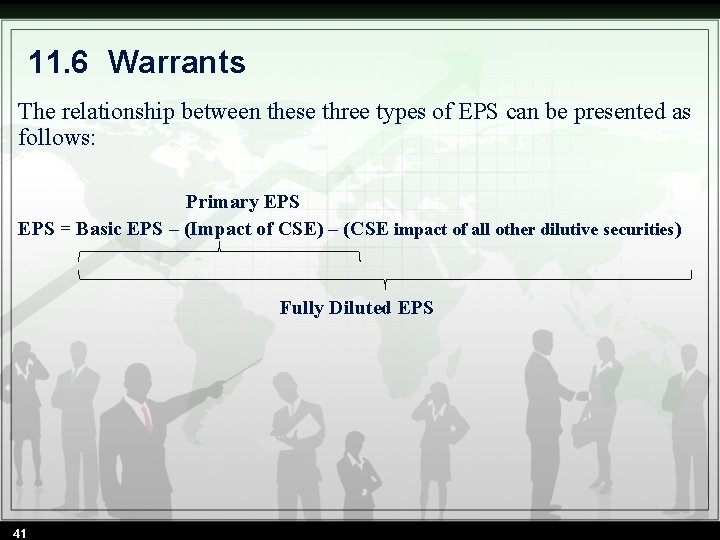
11. 6 Warrants The relationship between these three types of EPS can be presented as follows: Primary EPS = Basic EPS – (Impact of CSE) – (CSE impact of all other dilutive securities) Fully Diluted EPS 41
11. 6 Warrants • • 42 It is interesting to speculate on whether the market will use primary EPS or fully diluted EPS in valuing shares of stock. If the market expects holders of common stock equivalents to convert them into new equity, then fully diluted EPS is likely to be more meaningful. If the market does not expect conversion, then it is likely to treat convertible bonds like straight debt and focus on primary EPS with no adjustment for new shares. In other words, the market is likely to use basic EPS in such cases.
11. 6 Warrants • Convertible bonds that have no chance of being converted are called hung convertibles. The idea here is that if investors don’t wish to convert their bonds into the firm’s equity, the conversion price is hung. The bond is worth more as a bond than it is worth converted into equity. APB No. 15 and FASB No. 55 require a firm to provide EPS information under either circumstance and let the market participant choose which measure is more meaningful. • • 43 The financial analyst needs to identify the difference between two firms with a similar primary EPS value and markedly different fully diluted EPS values. In general, hybrid securities in the capital structure cause the difference.
11. 7 Summary In this chapter, we have discussed the basic concepts of call and put options and have examined the factors that determine the value of an option. One procedure used in option valuation is the Black. Scholes model, which allows us to estimate option value as a function of stock price, option-exercise price, time-to-expiration date, and risk-free interest rate. The option pricing approach to investigating capital structure is also discussed, as is the value of warrants. 44