
Financial Aid Night Priscilla Salas Financial Aid Counselor



- Slides: 34
Financial Aid Night! Priscilla Salas Financial Aid Counselor Wharton County Junior College www. fafsa. gov
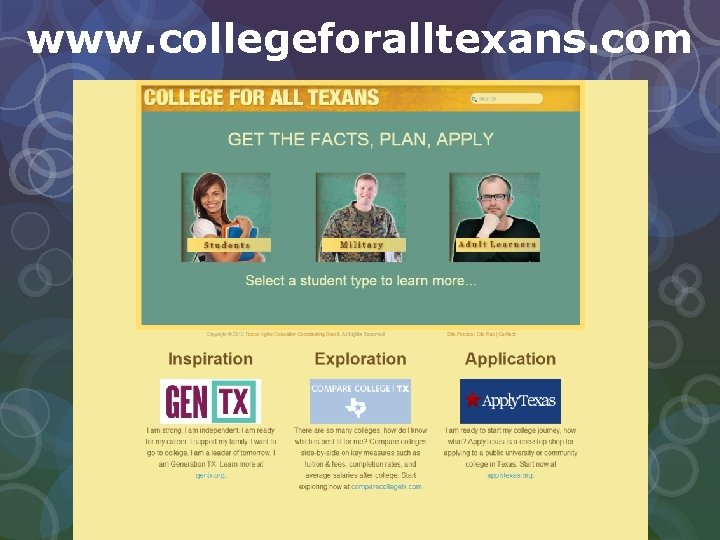
Financial Aid. What is it? Financial Aid is funds provided to students and families to help pay for postsecondary educational expenses and consists of: Grants (Federal/State - Pell, SEOG, TPEG/TEG, Top 10%, Texas Grant) Loans (Federal and Private) Scholarships (Merit and Need Based) Employment (Work Study Program) State Exemptions www. collegeforalltexans. com Veterans Benefits www. va. gov
General Eligibility Not be enrolled simultaneously in high school Have a high school diploma or equivalent Enroll as a regular student in a degree or certificate program Be a citizen, national or permanent resident of the U. S. or other eligible non-citizen Provide a valid social security number Undocumented students are not eligible for federal aid (may apply for state aid through TASFA) Register with Selective Service if required Maintain satisfactory academic progress
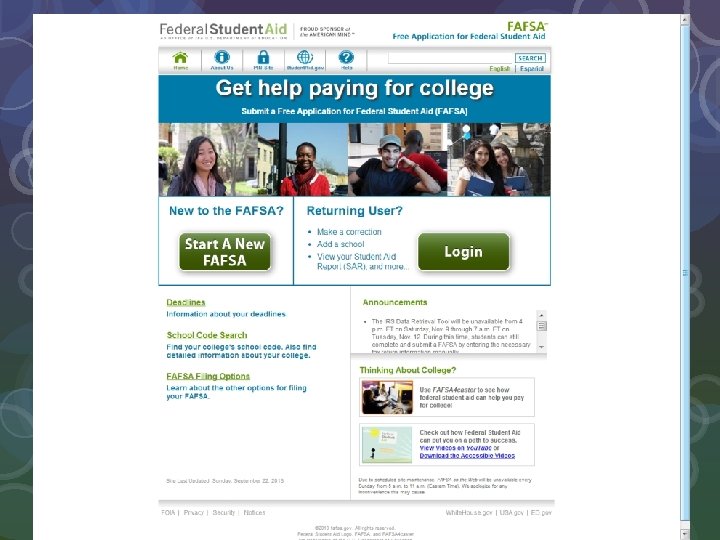
The Application (FAFSA) (Free Application for Federal Student Aid) Ø Available January 1 at www. fafsa. gov. Apply annually. Turn in TASFA directly to institution of choice. Ø Requires prior year income (i. e. 2015 -2016 based on 2014 income for student and parent). Use Data Retrieval Tool which saves time and reduces the chances of being selected for verification! Ø Available in English and Spanish Ø Used to determine eligibility for state and federal aid
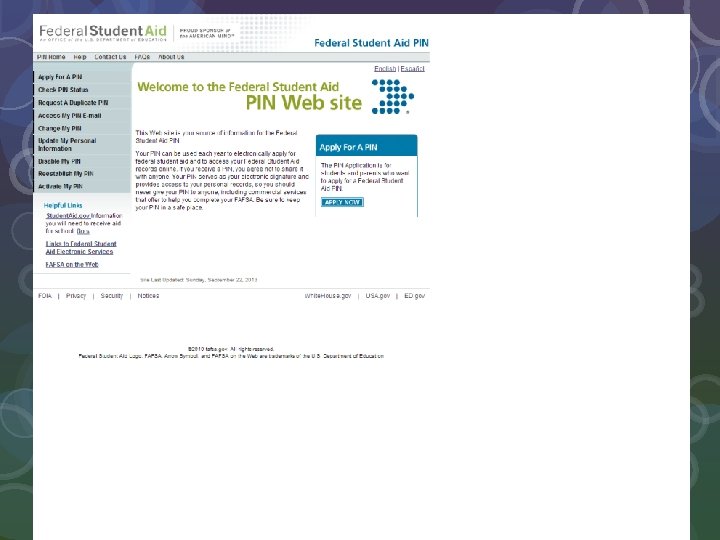
FAFSA continued q Students are allowed to list up to 10 colleges/universities that will receive his/her student and parent information q Personal Identification Number is needed to electronically sign application (student and one parent) www. pin. ed. gov
FAFSA continued Determining Dependency Born before January 1, 1992? Is the student married (at the time of the FAFSA submission)? Working on a degree beyond a bachelor’s degree? Active duty in the U. S. Armed Forces? Is the student a Veteran? Children for whom you provide more than half the support? Parents deceased? Foster Care? Ward of Court? Emancipated Minor? Legal Guardianship? Homeless? Does the student have legal dependents (other than spouse and children) for whom they provide more than half the support?
FAFSA continued Dependency Ultimately determined by institution Use only Biological or Adoptive Parent Information Not based on who ‘claimed’ the student on the income tax return
Completing the process School contacts student regarding missing/needed information (tax return, asset information) School reviews student’s file to determine eligibility (based on federal guidelines) School notifies student of eligibility/offer
Factors in determining eligibility Parent and student income Family Size Age of older parent Number of family members attending college Parent and student assets
What is Cost of Attendance (COA)? q Direct and indirect costs combined into cost of attendance (tuition, fees, room & board, books, supplies, transportation) q Vary widely from college to college
What is Expected Family Contribution (EFC)? Student and school receives Student Aid Report (SAR-response from FAFSA) with Expected Family Contribution (EFC) Amount family can reasonably be expected to contribute Stays the same regardless of college Two components Parent contribution Student contribution Calculated using FAFSA data and a federal formula
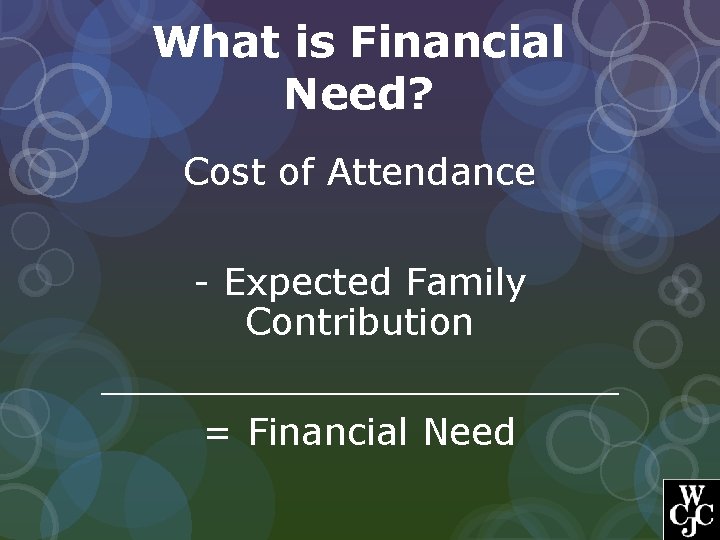
What is Financial Need? Cost of Attendance - Expected Family Contribution ___________ = Financial Need
Grants Money that does not have to be repaid Awarded on the basis of financial need Federal/State – Pell, SEOG, TPEG/TEG, Top 10%, Texas Grant
Loans Money students and parents borrow to help pay educational expenses Federal and Private Repayment usually begins after education is finished Only borrow what is really needed Look at loans as an investment for the future
Types of Loans Ø Federal Direct Loan Program (FDLP) § Stafford Loans Subsidized Unsubsidized § PLUS Loans § Consolidated Loans
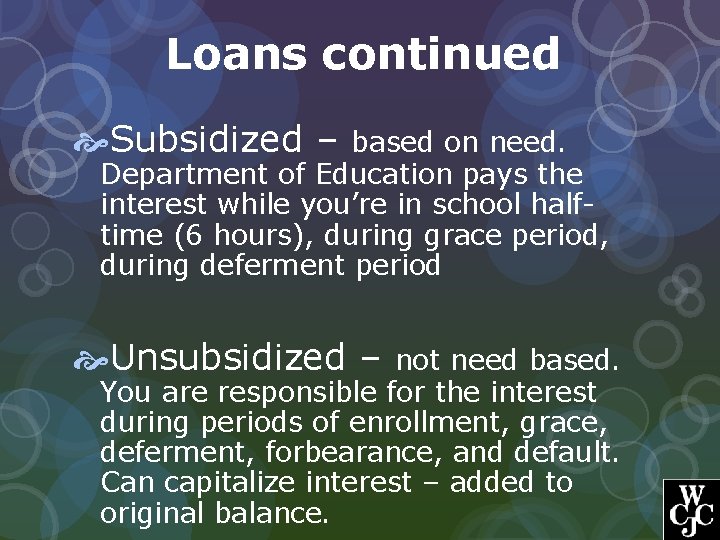
Loans continued Subsidized – based on need. Department of Education pays the interest while you’re in school halftime (6 hours), during grace period, during deferment period Unsubsidized – not need based. You are responsible for the interest during periods of enrollment, grace, deferment, forbearance, and default. Can capitalize interest – added to original balance.
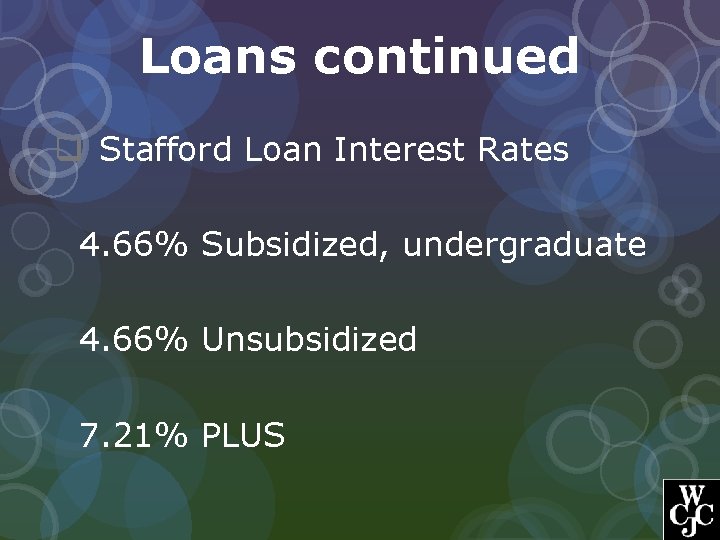
Loans continued q Stafford Loan Interest Rates 4. 66% Subsidized, undergraduate 4. 66% Unsubsidized 7. 21% PLUS
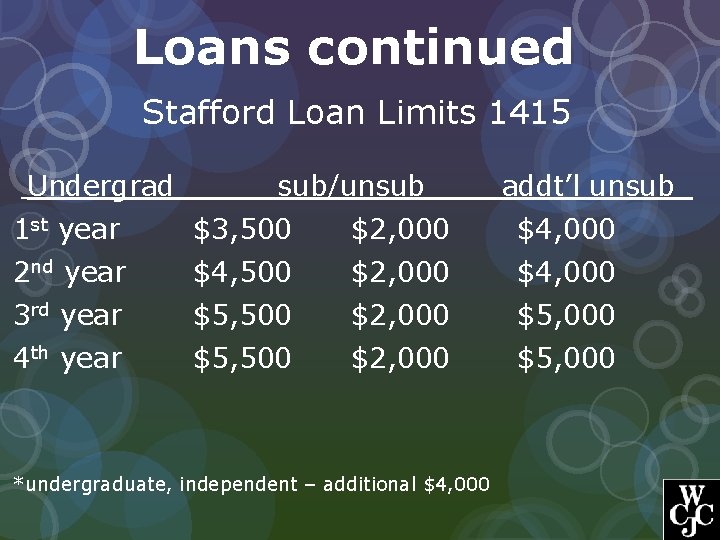
Loans continued Stafford Loan Limits 1415 Undergrad ___ sub/unsub _ addt’l unsub_ 1 st year $3, 500 $2, 000 $4, 000 2 nd year $4, 500 $2, 000 $4, 000 3 rd year $5, 500 $2, 000 $5, 000 4 th year $5, 500 $2, 000 $5, 000 *undergraduate, independent – additional $4, 000
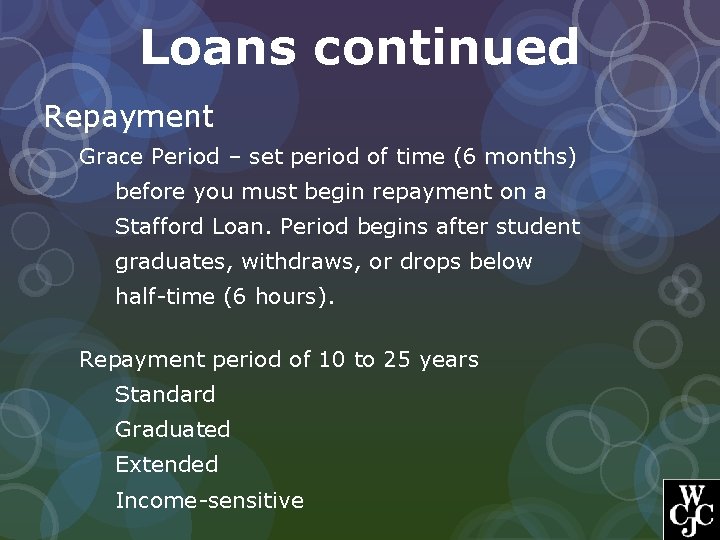
Loans continued Repayment Grace Period – set period of time (6 months) before you must begin repayment on a Stafford Loan. Period begins after student graduates, withdraws, or drops below half-time (6 hours). Repayment period of 10 to 25 years Standard Graduated Extended Income-sensitive
Loans continued Deferment – period of time during which no payments are required and interest does not accrue (subsidized only). Half-time enrollment, unable to find full-time employment, economic hardship. Forbearance – not eligible for a deferment but are unable to meet repayment schedule. Servicer agrees to reduce/postpone payments for a period of time. Interest continues to accrue (subsidized and unsubsidized). Contact servicer for more information about these options.
Texas B-On-Time Loan Program Ø www. hhloans. com Ø Have completed a FAFSA and be eligible to receive federal aid Ø Be enrolled full time in an undergraduate degree or certificate program at an eligible institution AND Ø Be a Texas resident or be entitled to pay resident tuition rates as a dependent child of a member of the U. S. Armed Forces AND Ø Graduated in 2002 -2003 or later from a high school operated by U. S. Department of Defense or under the recommended high school program from a public or accredited private high school in Texas Ø Have earned an associate’s degree from an eligible institution no earlier than May 1, 2005 Ø Can not have earned a bachelor’s degree
Scholarships q Money that does not have to be paid back q Awarded on the basis of merit, skill, or a unique characteristic q Can be need based q Small scholarships add up! q Some colleges use the FAFSA to find recipients q Opportunities: Community Organizations, Churches, Employers Financial Aid Office High School Counselors
Free Scholarship Search www. fastweb. com
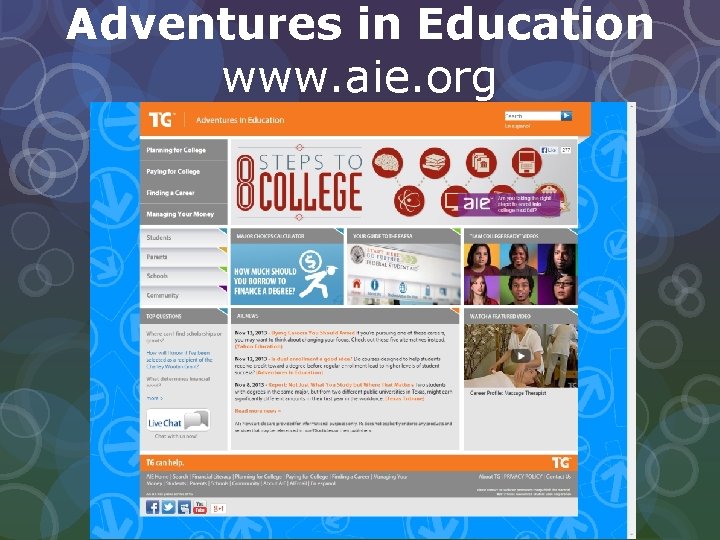
Adventures in Education www. aie. org
Employment Work Study Program Allows students to earn money to help pay educational costs A paycheck
Veterans Benefits Ø Hazlewood Act § Legacy Program § www. collegeforalltexans. com § Dependent 25 years or younger Ø Armed Forces Education Plans www. va. gov
www. collegeforalltexans. com
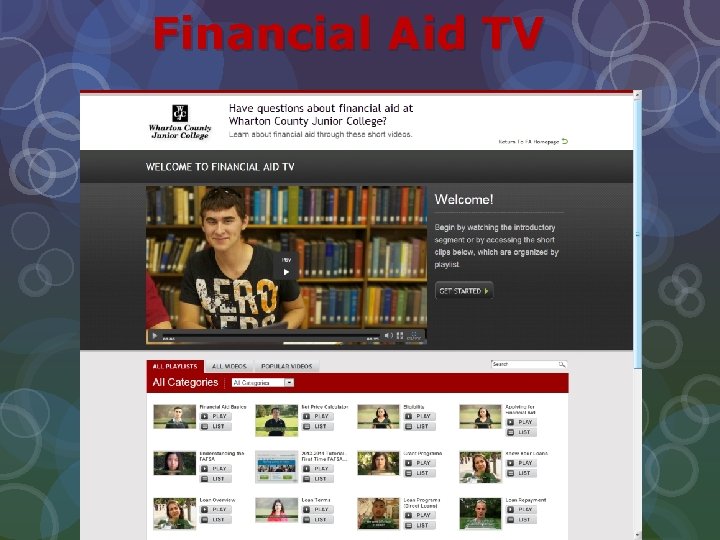
Financial Aid TV
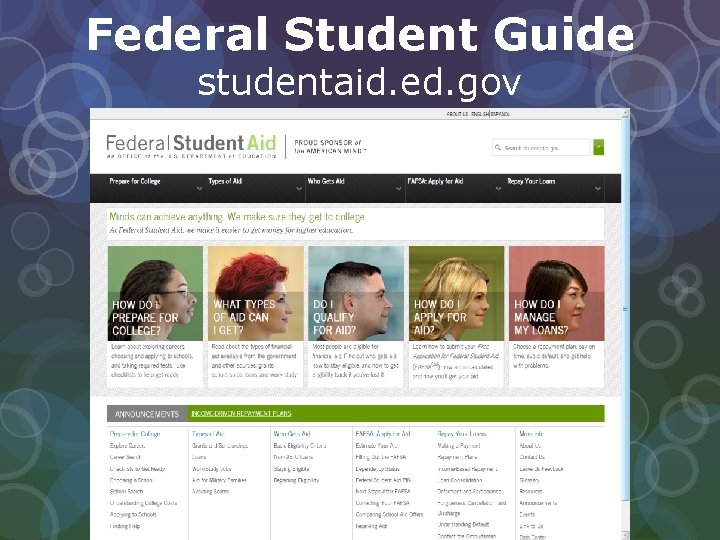
Federal Student Guide studentaid. ed. gov
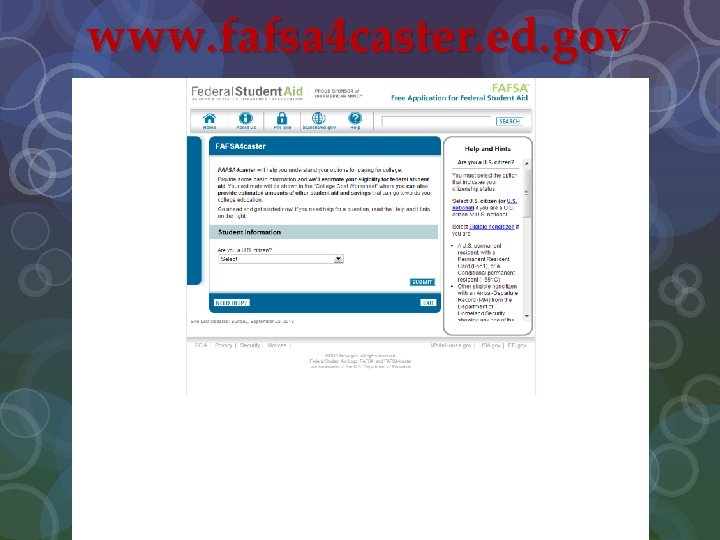
www. fafsa 4 caster. ed. gov
Important! Ø Check deadlines Admissions, financial aid, & scholarships Ø Complete the FAFSA as soon after January 1 as possible Ø Submit all documents requested by the school as soon as possible
Questions? q Priscilla Salas Financial Aid Counselor 281/239 -1539 Salas. P@wcjc. edu q Kristie Sulak Financial Aid Counselor 281/239 -1540 Sulak. K@wcjc. edu