
Financial Aid Basics Canyon Crest Academy September 25

Financial Aid Basics Canyon Crest Academy September 25 th, 2018 Presenter: Michael Soudmand Financial Aid Advisor msoudmand@sandiego. edu *please feel free to email me about ANY financial aid questions you may have now or in the future
Why Apply for Financial Aid? • Required for documentation of eligibility for many grants and scholarships • Access to federal student loans and work-study • Access to more college choices • Streamlines appeal process if the family’s financial situation changes during the academic year.
Financial Aid Myths Myth: Good grades + high SAT scores = financial aid. Fact: While achievement does account for a lot of aid, most of the $185 Billion in financial aid awarded annually to undergraduate students is need-based. Myth: I make too much money to be eligible for financial aid. Fact: Eligibility varies from college to college. Myth: If I save for college I won’t get any financial aid. Fact: Income (and family size) is a larger factor than assets in determining eligibility for financial aid.
Types of Financial Aid • Financial Aid is any type of funding provided to students and families to help pay for postsecondary educational expenses, including: - Grants (need/merit) - Scholarships (need/merit; outside; institutional) - Employment (Federal Work Study = Need; CWO) - Loans Direct = Feds Alternative = Private Institutional = From USD/College Departmental = From College department
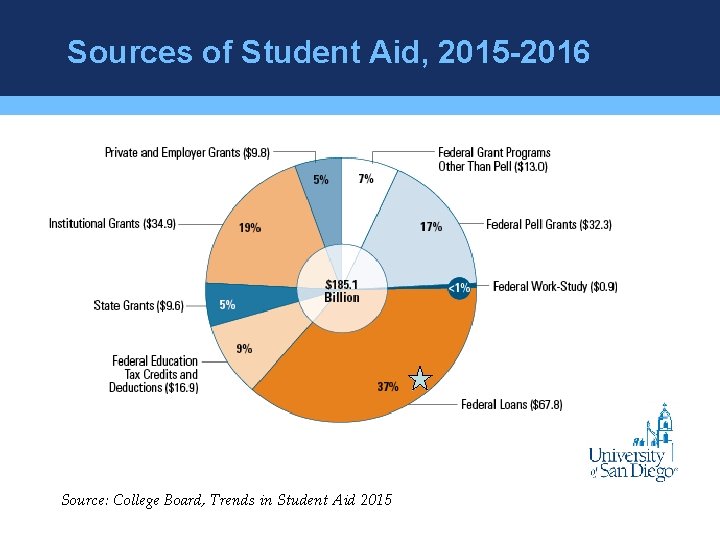
Sources of Student Aid, 2015 -2016 Source: College Board, Trends in Student Aid 2015
Cost of Attendance (COA) The Cost of Attendance is calculated by adding: • Costs charged by university i. e. direct costs (tuition, fees, on -campus housing), plus • Standard allowances for expenses associated with attendance, but not charged by the university (books, transportation, personal expenses, off-campus housing) i. e indirect costs
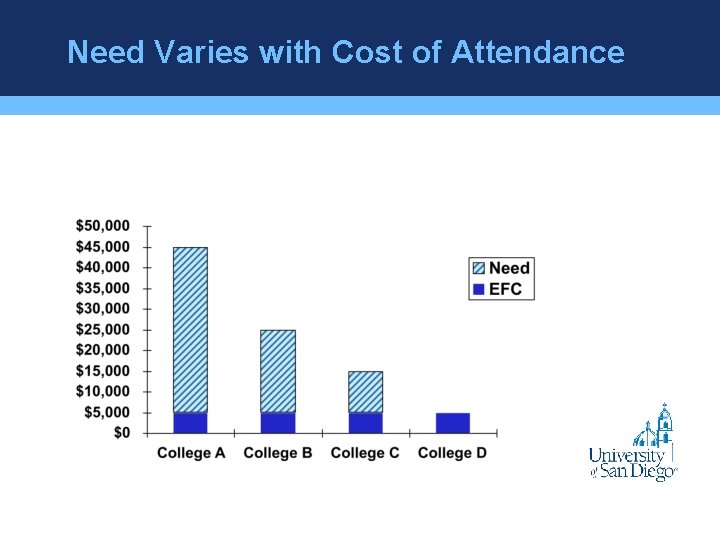
Need Varies with Cost of Attendance
How to Apply for Financial Aid • Submit the Free Application for Federal Student Aid (FAFSA): priority deadline set by each college • Dream act application: www. caldreamact. org • Submit Cal Grant GPA Verification to California Student Aid Commission by March 2 • CSS Profile (if required by the school)—deadline varies • Institutional Financial Aid Application (if required)— deadline varies
FAFSA Tip Submit the FAFSA by the earliest of the priority deadlines for the schools to which your student will apply • Use your best estimate of your prior year income to complete the FAFSA (18/19 = 2016 tax data) • Don’t wait until tax returns have been filed • Don’t wait until student has been admitted to the college • Use your name as it appears on Social Security Card!!! • APPLY EARLY!!!
Applying for a Cal Grant California State Grant Program • FAFSA must be submitted by March 2 • GPA Verification Form, submitted by student’s high school to the California Student Aid Commission (CSAC) by March 2
After Submitting the FAFSA • View your “Processed Information” (also called Student Aid Report, or SAR) to confirm that submission is complete and correct, and that Expected Family Contribution (EFC) has been calculated. • Colleges may request additional information—be sure you know how those requests will be communicated (mail or electronic). • CHECK YOUR PORTAL/ONLINE STUDENT PLATFORM!!!!
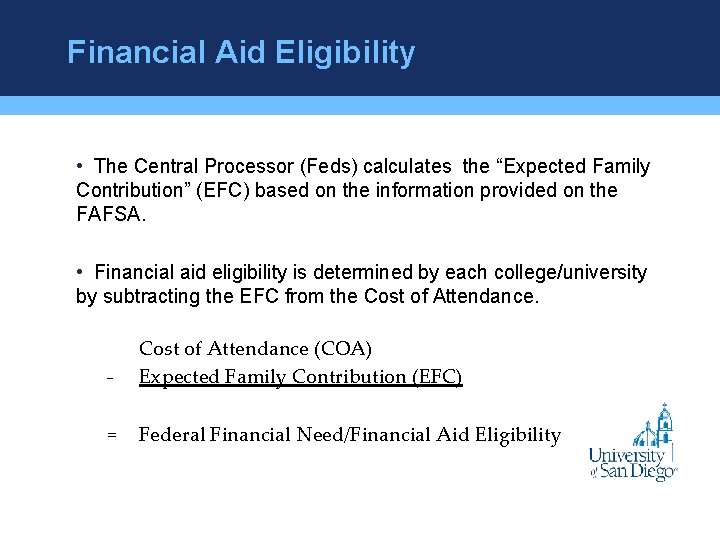
Financial Aid Eligibility • The Central Processor (Feds) calculates the “Expected Family Contribution” (EFC) based on the information provided on the FAFSA. • Financial aid eligibility is determined by each college/university by subtracting the EFC from the Cost of Attendance. - Cost of Attendance (COA) Expected Family Contribution (EFC) = Federal Financial Need/Financial Aid Eligibility
Expected Family Contribution (EFC) The Expected Family Contribution is an assessment of the relative financial strength of the student’s family. • It is calculated using a federal formula that evaluates the student and parents’ taxed and untaxed income and assets, as well as the family size and number of siblings in the household currently enrolled in college. • All colleges receive the same EFC from the Central Processor at the time the FAFSA is filed. • The EFC may change if additional information received from the family updates the initial data provided.
How is the EFC Calculated? Both the parents and student will report their 2014 income on the FAFSA • Taxable income • W-2 income = “income from work” • Adjusted Gross Income • Untaxed income • Child support received • Voluntary retirement contributions (NOT the value of the account) • Untaxed interest income • Living allowances paid to military or clergy • Veteran’s non-education benefits • Other untaxed income
How is the EFC Calculated? In addition to parent and student income and assets, the calculation includes • Household size and number in college - How many people will your parents support in aid year? (grandparents, lingering older siblings, etc. ) - How many will be attending college? • Does not include parents • Allowances - Income and asset protection allowances - Employment expense - Taxes (income and Social Security)
Special Circumstances Any special circumstances related to a family’s ability to pay for higher education that are not reflected by the information collected on the FAFSA should be communicated in writing to colleges. These include: • Changes in employment status • Medical expenses not covered by insurance • Change in parent marital status • Unusual dependent care expenses • Student cannot obtain parent information
Financial Aid Award Delivery of the Financial Aid award usually follows the offer of admission to the college • Delivery method: mailed or online? • May, or may not, reflect consideration of special circumstances or verification—if in doubt, ask! • A Financial Aid Award based on estimated financial information is an estimated award
Categories of Financial Aid Need-based financial aid • Awarded based on EFC/IFC • Federal and state grants, many institutional grants and scholarships, Federal Work-Study and Federal student loans • May not exceed the difference between a student’s Cost of Attendance and the Expected Family Contribution Non-need-based financial aid • Unsubsidized Direct Loan, Federal PLUS Loan, Federal TEACH Grant • merit/athletic/special talent scholarships
Compare Award Letters • Higher cost of attendance may be offset by higher proportion of need-based aid. • Compare total aid awarded in student’s name with total university charges to determine share of expenses paid by family. • Compare total amount offered through student loans.
How is Financial Aid Awarded? • Award need-based aid first • Grants and scholarships • Subsidized student loans • Federal Work-Study • There may not be sufficient federal, state or university resources available to meet full need • Award non-need-based aid after all need-based aid • Unsubsidized student loans • Federal Direct Parent Loan • Total aid awarded may not exceed student’s COA
Verification Required confirmation of information provided on the FAFSA • Application may be selected by the Central Processor, or by a college • Documentation of • Household information • Tax information— must use IRS Data Retrieval (on FAFSA) or provide a copy of an IRS tax transcript • Untaxed income/Additional Resources • May occur before or after student is admitted by university • So awards are conditional until verification is complete
Parent and Student Assets (FAFSA) Assets • Cash/Savings/Checking • Equity in rental properties • Stocks/bonds/mutual funds/trusts Not an Asset • Equity in family home • Qualified retirement plans • Court-restricted medical trusts
Federal Aid Programs • • Federal Pell Grant Federal Supplemental Educational Opportunity Grant Federal Work-Study Federal Direct Loan (student) • Maximum of loan limits set for student by Feds • Exception if Parent PLUS application is denied • Student may borrow additional $4000 Unsubsidized • Federal TEACH Grant
Federal Pell Grant • Maximum award set by congress • Based on EFC • Verification/Follow-Up • Funds are refundable
Cal Grant Students who meet the GPA requirement, have family income and assets below the established levels, and graduate from a California high school are entitled to receive a Cal Grant if they attend college in California. • The amount of the grant depends on the type of 4 -year college the student attends, and the level of need • Income/asset ceilings for a new recipient are set each year by the State of California • Sliding scales based on income, assets, and family size
Search for Scholarships • High School Counseling office • Online Scholarship search engines • www. fastweb. com • University Financial Aid web sites • www. sandiego. edu/financialaid/scholarships • Community organizations • www. sdfoundation. org DO NOT PAY TO GET ACCESS TO SCHOLARSHIPS!!!!!!
Payment of Educational Costs Past Income Savings Other Assets (529 accounts) Current Income Salary Institutional Payment Plans Future Income Loans
Estimating Financial Aid Resources • Net Price Calculator - Tool to assist families in determining likely eligibility for institutional and federal financial aid prior to application— and thus to calculate what they would be required to pay if student enrolled • FAFSA 4 caster - Estimate EFC - www. fafsa. ed. gov
Need Help? • Offers of help are everywhere: • Mail/Newspaper/Internet/Phone • Often charge a fee professional services • FREE help is available: • FAFSA on the Web Worksheet • Interactive help within online application • Cash for College Workshops (February) • Federal Processor: 1 -800 -433 -3243 • Call college Office of Financial Aid

Michael’s Secrets…. • Lean on your college’s OFA people who work in FA find it fulfilling to assist students and parents with making college a reality • Spend 1 hour a week looking for outside scholarships prior to starting college and 1 hour per month looking for outside scholarships while attending college • TAKE A STUDY ABROAD TRIP! Look for a job on campus for extra income, to network on campus, and build your resume • Consider working at a university after undergrad if you want to go to graduate school tuition remission • Appeal your award decision at your final choice school if tax info does not truly describe your family’s financial situation • Parents…. financial Aid policy is a political issue set at the federal and state level. Consider your child’s academic and financial future when in the voting booth • (Adult) students…Assume responsibility for your own academic and financial future

Questions? Michael Soudmand Financial Aid Advisor Office of Financial Aid University of San Diego msoudmand@sandiego. edu Feel Free to Lean on Me Even if USD is Not Your School of Choice!
- Slides: 31