
Financial Aid Basics An Overview of Financial Aid
Financial Aid Basics An Overview of Financial Aid and the Cost of College Zelotes Smith, M. S. Director of Financial Aid Fall 2019
Agenda What is Financial Aid? FAFSA How Eligibility is Determined Types of Aid Final Tips Frequently Asked Questions Who to Contact
Preface All information is accurate to current financial aid laws The Higher Education Act (HEA) is past due for reauthorization When reauthorization occurs, financial aid may be different for future years Information will be forthcoming following reauthorization for major changes Reauthorization is unlikely to occur as election season approaches
What is Financial Aid? Any monies given to students to meet educational costs and expenses Aid is an umbrella term for scholarships, grants, loans, and work-study Students/Parents are also responsible for contributing towards educational costs Financial Aid is designed to supplement the student’s resources Helps bridge the gap between the cost of education and what the family can afford

FAFSA: Applying for Aid Free Application for Federal Student Aid Submit FAFSA on www. fafsa. gov or on the my. Student. Aid app The Student and Parent must create FSA IDs to sign the FAFSA Submission for the 2020 -2021 Academic Year begins October 1 FAFSA must be submitted by March 2 for Cal Grant eligibility Deadlines can vary by school or state!
What does FAFSA do? FAFSA determines a student’s Expected Family Contribution (EFC) EFC is a measure of a student’s/family’s financial strength The EFC is calculated using demographic and financial information The 2020 -2021 FAFSA will use 2018 income and tax data The FAFSA sends the information only to designated schools
Expected Family Contribution Measure of relative financial strength expressed as a dollar value The EFC is not a measure of how much a student will pay Takes into account the size of the family and number of children in college The EFC calculation contains protection allowances for income and assets
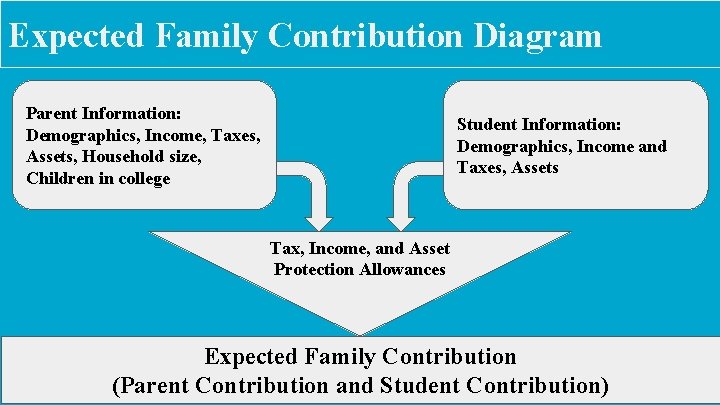
Expected Family Contribution Diagram Parent Information: Demographics, Income, Taxes, Assets, Household size, Children in college Student Information: Demographics, Income and Taxes, Assets Tax, Income, and Asset Protection Allowances Expected Family Contribution (Parent Contribution and Student Contribution)
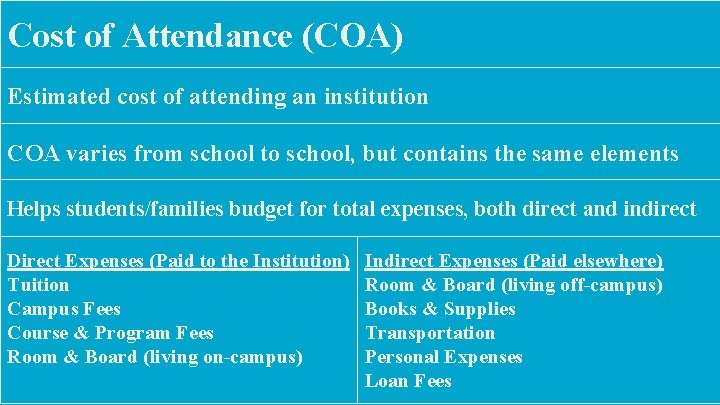
Cost of Attendance (COA) Estimated cost of attending an institution COA varies from school to school, but contains the same elements Helps students/families budget for total expenses, both direct and indirect Direct Expenses (Paid to the Institution) Tuition Campus Fees Course & Program Fees Room & Board (living on-campus) Indirect Expenses (Paid elsewhere) Room & Board (living off-campus) Books & Supplies Transportation Personal Expenses Loan Fees
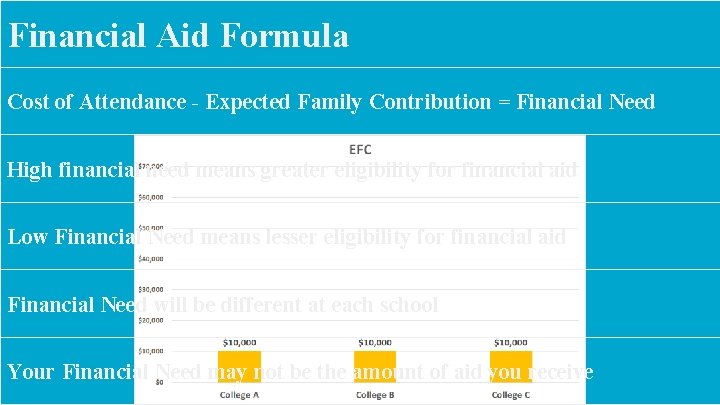
Financial Aid Formula Cost of Attendance - Expected Family Contribution = Financial Need High financial need means greater eligibility for financial aid Low Financial Need means lesser eligibility for financial aid Financial Need will be different at each school Your Financial Need may not be the amount of aid you receive
Net Price Calculator (NPC) Tool which the school provides that estimates the out-of-pocket cost Federal Government requires all schools to provide this on their website Requests student’s/parent’s tax information to estimate an EFC The NPC provides projected Federal, State, and Institutional awards NPC estimates are not guaranteed and only as accurate as the info used
CSS Profile Institutional aid application used by some schools in addition to FAFSA Fee-based: $25 for the initial application, $16 for each report thereafter Information requested can vary by school/program Information requested goes more in depth than FAFSA Deadlines vary by college/program Usually requested by schools that can meet a student’s full Financial Need
Types of Financial Aid Federal and State Grants Federal Student Loans Private Student Loans Federal Work-Study Institutional Grants and Scholarships Private Grants and Scholarships
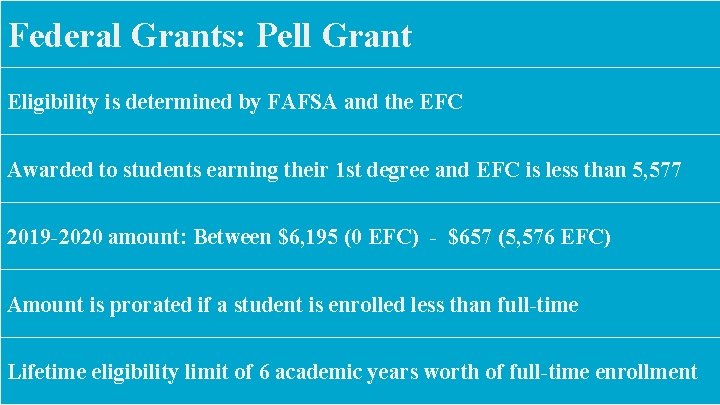
Federal Grants: Pell Grant Eligibility is determined by FAFSA and the EFC Awarded to students earning their 1 st degree and EFC is less than 5, 577 2019 -2020 amount: Between $6, 195 (0 EFC) - $657 (5, 576 EFC) Amount is prorated if a student is enrolled less than full-time Lifetime eligibility limit of 6 academic years worth of full-time enrollment
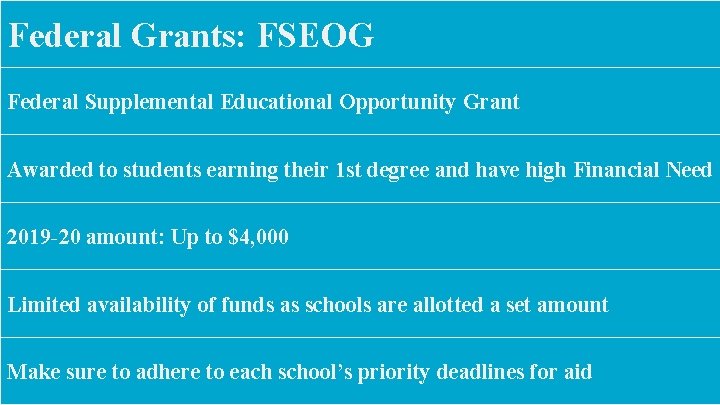
Federal Grants: FSEOG Federal Supplemental Educational Opportunity Grant Awarded to students earning their 1 st degree and have high Financial Need 2019 -20 amount: Up to $4, 000 Limited availability of funds as schools are allotted a set amount Make sure to adhere to each school’s priority deadlines for aid
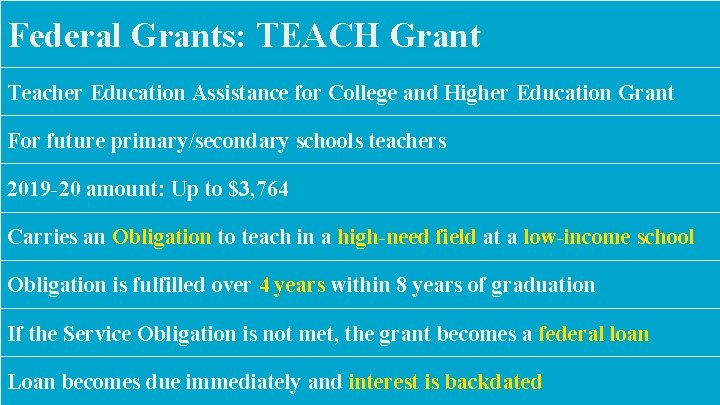
Federal Grants: TEACH Grant Teacher Education Assistance for College and Higher Education Grant For future primary/secondary schools teachers 2019 -20 amount: Up to $3, 764 Carries an Obligation to teach in a high-need field at a low-income school Obligation is fulfilled over 4 years within 8 years of graduation If the Service Obligation is not met, the grant becomes a federal loan Loan becomes due immediately and interest is backdated
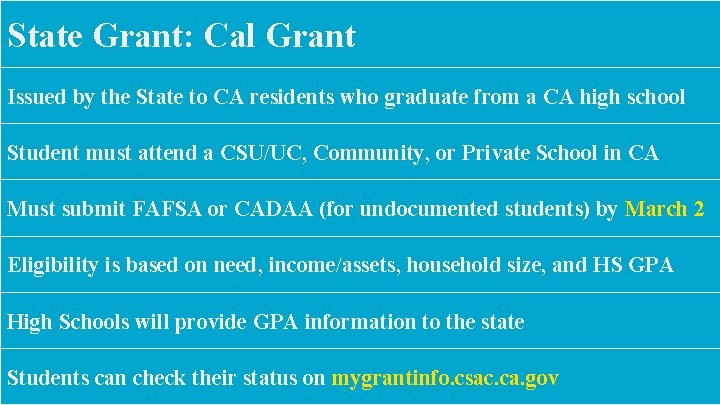
State Grant: Cal Grant Issued by the State to CA residents who graduate from a CA high school Student must attend a CSU/UC, Community, or Private School in CA Must submit FAFSA or CADAA (for undocumented students) by March 2 Eligibility is based on need, income/assets, household size, and HS GPA High Schools will provide GPA information to the state Students can check their status on mygrantinfo. csac. ca. gov
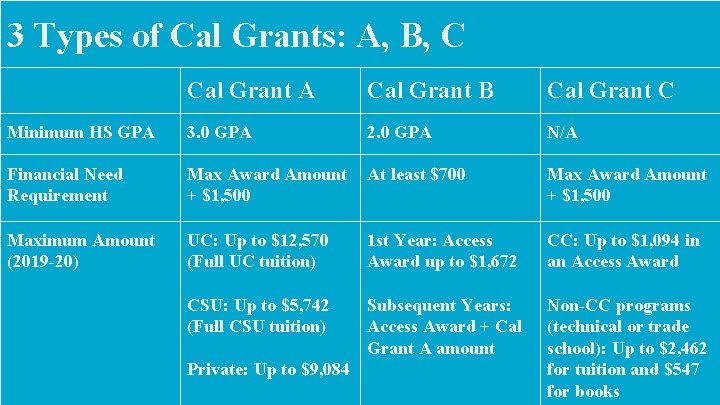
3 Types of Cal Grants: A, B, C Cal Grant A Cal Grant B Cal Grant C Minimum HS GPA 3. 0 GPA 2. 0 GPA N/A Financial Need Requirement Max Award Amount + $1, 500 At least $700 Max Award Amount + $1, 500 Maximum Amount (2019 -20) UC: Up to $12, 570 (Full UC tuition) 1 st Year: Access Award up to $1, 672 CC: Up to $1, 094 in an Access Award CSU: Up to $5, 742 (Full CSU tuition) Subsequent Years: Access Award + Cal Grant A amount Non-CC programs (technical or trade school): Up to $2, 462 for tuition and $547 for books Private: Up to $9, 084
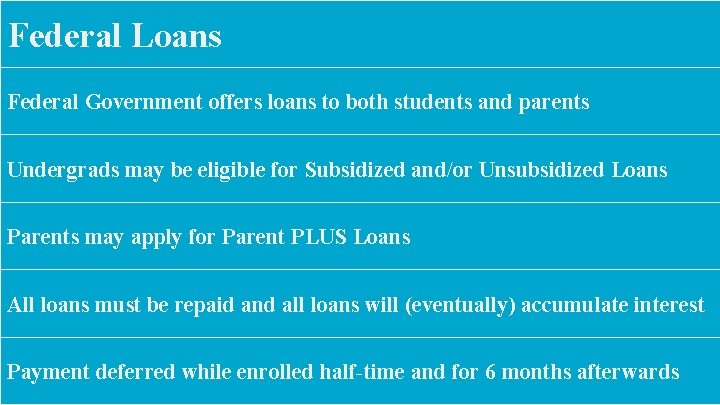
Federal Loans Federal Government offers loans to both students and parents Undergrads may be eligible for Subsidized and/or Unsubsidized Loans Parents may apply for Parent PLUS Loans All loans must be repaid and all loans will (eventually) accumulate interest Payment deferred while enrolled half-time and for 6 months afterwards
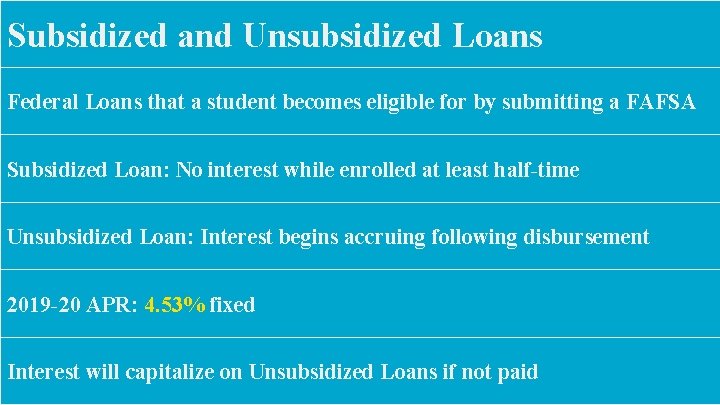
Subsidized and Unsubsidized Loans Federal Loans that a student becomes eligible for by submitting a FAFSA Subsidized Loan: No interest while enrolled at least half-time Unsubsidized Loan: Interest begins accruing following disbursement 2019 -20 APR: 4. 53% fixed Interest will capitalize on Unsubsidized Loans if not paid
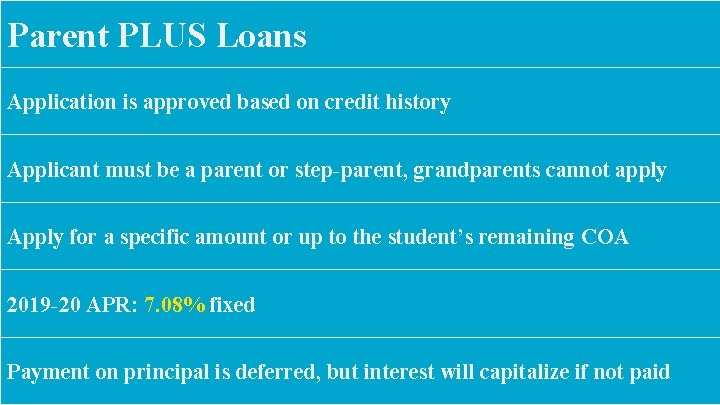
Parent PLUS Loans Application is approved based on credit history Applicant must be a parent or step-parent, grandparents cannot apply Apply for a specific amount or up to the student’s remaining COA 2019 -20 APR: 7. 08% fixed Payment on principal is deferred, but interest will capitalize if not paid
Private Student Loans Can obtain a loan from any lender that offers student loans Approval and APR are based on the applicant’s credit rating and history Student or parent/third party can be the applicant depending on the lender Lender may offer fixed and/or variable rate options Terms and conditions will vary between lenders Maximize federal loan usage first as terms and conditions may be better
Federal Work-Study (FWS) Opportunity for Students to work on-campus to earn money Must have Financial Need in order to be eligible May get paid directly or it may go towards tuition depending on the school Income earned through FWS does not increase the EFC in later years Amount listed on an award is an estimate of what the student may earn May have to apply for a job or may get placed in a position
Institutional Grants and Scholarships are different names for the same thing Aid awarded by the school based on merit, need, or other criteria Some schools may require an additional application with a deadline Some schools may not require anything beyond the FAFSA and GPA info Future eligibility may require meeting other requirements
Private Grants and Scholarships Aid offered by third party organizations (non-profits, businesses, etc) The organization will determine eligibility criteria Focus on scholarships that require an essay Avoid scholarship applications that require a fee Ask any local civic or community organizations if they offer scholarships
Final Tips Award Notifications are not standard, make sure to compare net costs Read any correspondence from schools carefully Some schools require students to actively accept awards Filing a FAFSA is FREE and help is available from Financial Aid Offices FAFSA must be filed for each academic year to renew federal aid eligibility Meet all deadlines: Cal Grant’s FAFSA deadline is March 2 Contact the school if you have any unusual financial circumstances
Frequently Asked Questions Will my financial aid be the same every year? Not necessarily. Aid is based on the FAFSA for each year and if the information is different from one year to the next, then aid may change.
Frequently Asked Questions We have a lot of consumer debt, can we put that in FAFSA? No, the FAFSA does not consider outstanding consumer debt.
Frequently Asked Questions My parents are divorced, with whom should I file my FAFSA? FAFSA requires the custodial parent’s information. If that parent has remarried, then the step-parent’s information must be included.
Frequently Asked Questions My parents don’t claim me as a dependent on their taxes or provide any financial support to me, am I considered independent? No, you are still considered as dependent for financial aid purposes.

- Slides: 31