
Financial Accounting The Basis for Business Decisions THIRTEENTH

Financial Accounting The Basis for Business Decisions THIRTEENTH EDITION Williams Mc. Graw-Hill/Irwin Haka Bettner Carcello © The Mc. Graw-Hill Companies, Inc. , 2008
Chapter 1 Accounting Information for Decision Making Mc. Graw-Hill/Irwin © The Mc. Graw-Hill Companies, Inc. , 2008
Learning Objective To discuss accounting as the language of business and the role of accounting information in making economic decisions. LO 1 Mc. Graw-Hill/Irwin © The Mc. Graw-Hill Companies, Inc. , 2008
Financial Reporting What is Financial Reporting ? Financial Reporting is way of recording, analyzing and summarizing financial data. Financial data is the name given to the actual transactions carried out by a business. Mc. Graw-Hill/Irwin © The Mc. Graw-Hill Companies, Inc. , 2008
Business & Types of Business What is business? Businesses of whatever sizes or nature exist to make a profit. Commercial or Industrial concern deals in manufacture and resale of goods ad services. Organizations which uses economic resources to create goods and services Organization providing jobs for people Invests money in resources to generate more for owners. (Profit) Measuring Profit, Revenues and Expenses Etc. Mc. Graw-Hill/Irwin © The Mc. Graw-Hill Companies, Inc. , 2008
Types of Business Sole Proprietor (Sole Traders) Partnerships Corporations (Limited Liability Companies) Mc. Graw-Hill/Irwin © The Mc. Graw-Hill Companies, Inc. , 2008
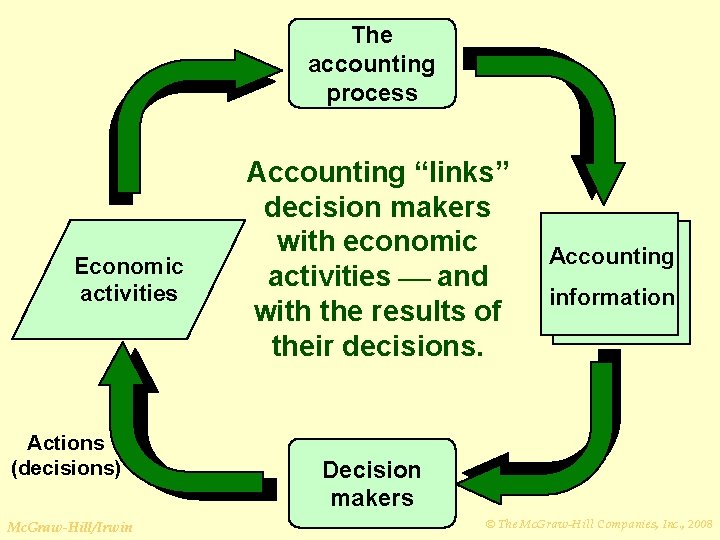
The accounting process Economic activities Actions (decisions) Mc. Graw-Hill/Irwin Accounting “links” decision makers with economic activities ¾ and with the results of their decisions. Accounting information Decision makers © The Mc. Graw-Hill Companies, Inc. , 2008
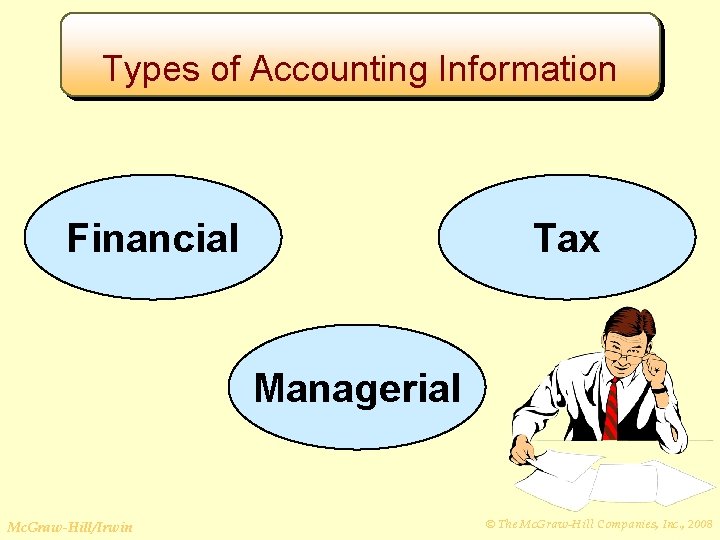
Types of Accounting Information Financial Tax Managerial Mc. Graw-Hill/Irwin © The Mc. Graw-Hill Companies, Inc. , 2008
Learning Objective To discuss the significance of accounting systems in generating reliable accounting information, and understand the five components of internal control per COSO’s Internal Control— Integrated Framework. LO 2 Mc. Graw-Hill/Irwin © The Mc. Graw-Hill Companies, Inc. , 2008
Accounting Systems An accounting system consists of the personnel, procedures, technology, and records used by an organization to develop accounting information and to communicate this information to decision makers. Mc. Graw-Hill/Irwin © The Mc. Graw-Hill Companies, Inc. , 2008
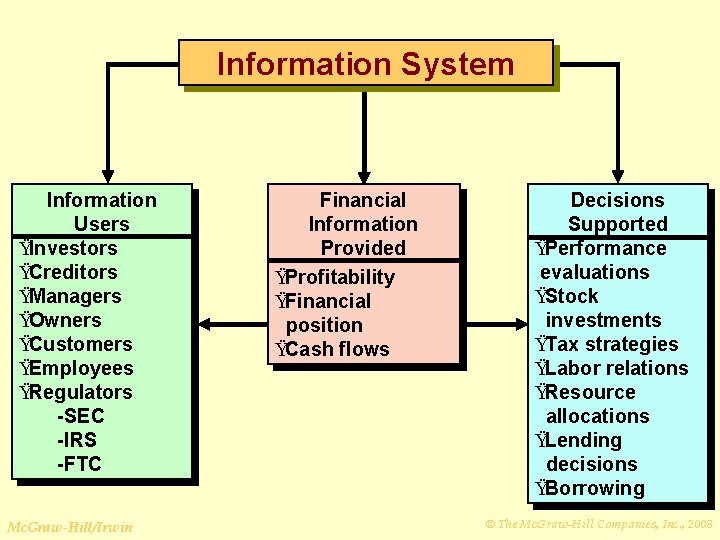
Information System Information Users ŸInvestors ŸCreditors ŸManagers ŸOwners ŸCustomers ŸEmployees ŸRegulators -SEC -IRS -FTC Mc. Graw-Hill/Irwin Financial Information Provided ŸProfitability ŸFinancial position ŸCash flows Decisions Supported ŸPerformance evaluations ŸStock investments ŸTax strategies ŸLabor relations ŸResource allocations ŸLending decisions ŸBorrowing © The Mc. Graw-Hill Companies, Inc. , 2008
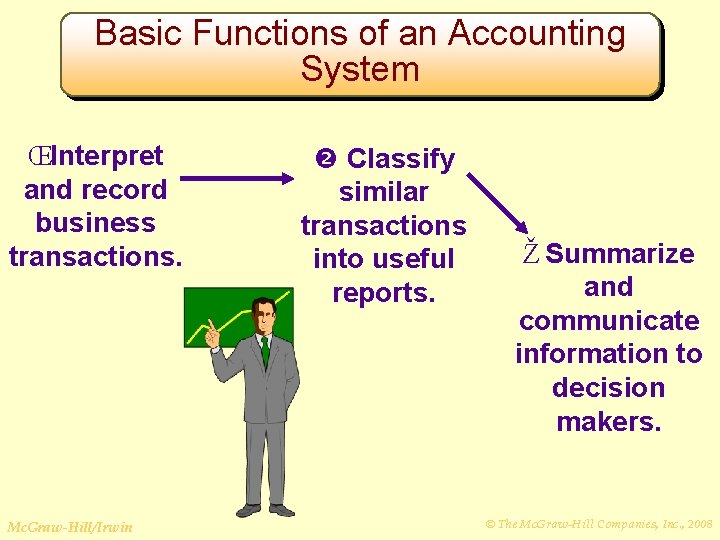
Basic Functions of an Accounting System ŒInterpret and record business transactions. Mc. Graw-Hill/Irwin Classify similar transactions into useful reports. Ž Summarize and communicate information to decision makers. © The Mc. Graw-Hill Companies, Inc. , 2008
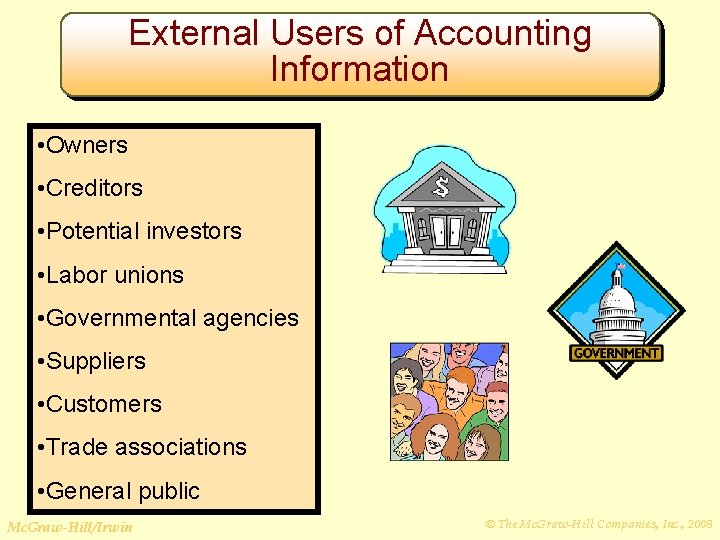
External Users of Accounting Information • Owners • Creditors • Potential investors • Labor unions • Governmental agencies • Suppliers • Customers • Trade associations • General public Mc. Graw-Hill/Irwin © The Mc. Graw-Hill Companies, Inc. , 2008
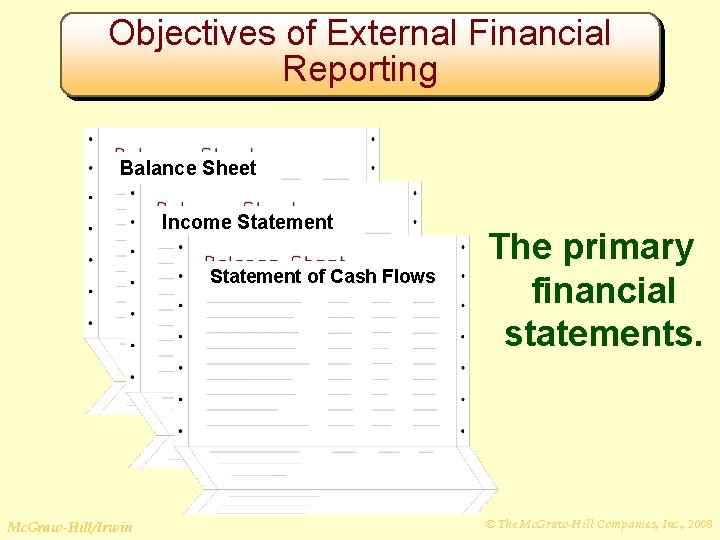
Objectives of External Financial Reporting Balance Sheet Income Statement of Cash Flows Mc. Graw-Hill/Irwin The primary financial statements. © The Mc. Graw-Hill Companies, Inc. , 2008
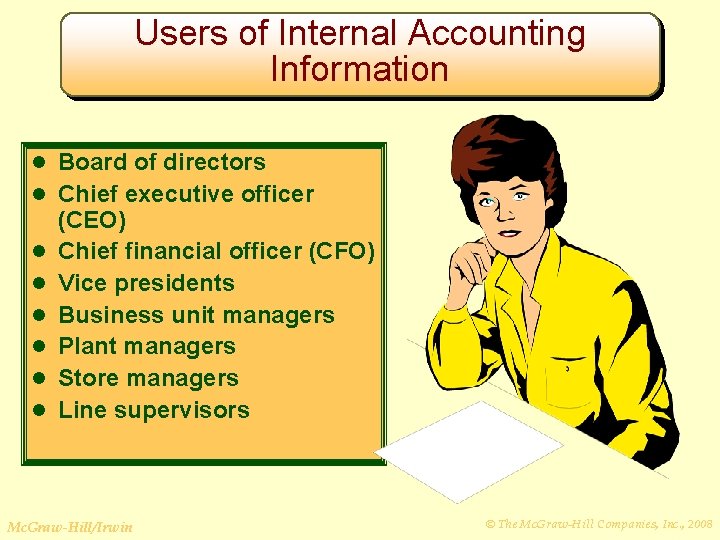
Users of Internal Accounting Information l Board of directors l Chief executive officer l l l (CEO) Chief financial officer (CFO) Vice presidents Business unit managers Plant managers Store managers Line supervisors Mc. Graw-Hill/Irwin © The Mc. Graw-Hill Companies, Inc. , 2008
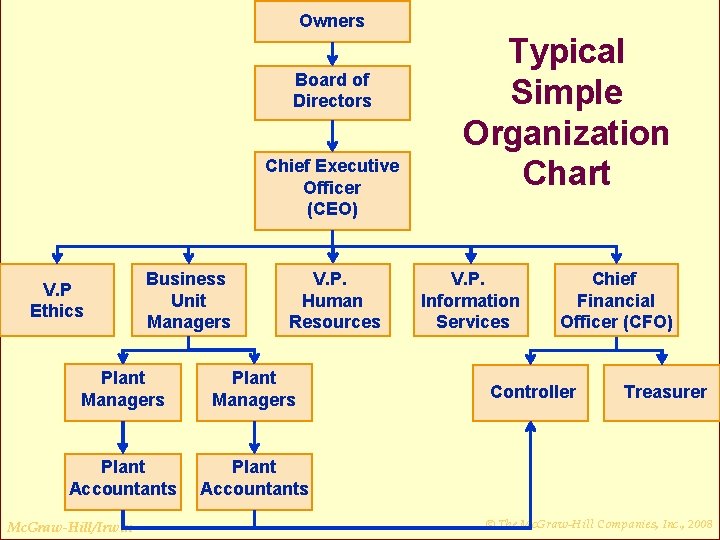
Owners Board of Directors Chief Executive Officer (CEO) V. P Ethics Business Unit Managers V. P. Human Resources Plant Managers Plant Accountants Mc. Graw-Hill/Irwin Typical Simple Organization Chart V. P. Information Services Chief Financial Officer (CFO) Controller Treasurer © The Mc. Graw-Hill Companies, Inc. , 2008
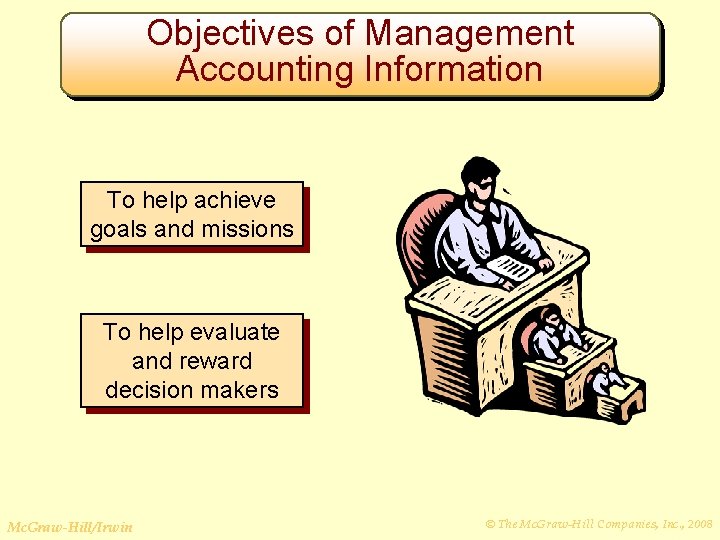
Objectives of Management Accounting Information To help achieve goals and missions To help evaluate and reward decision makers Mc. Graw-Hill/Irwin © The Mc. Graw-Hill Companies, Inc. , 2008
The Regulatory System l A number of factors have shaped the development of financial accounting, few are: £ National / Local legislation £ Accounting Concepts and Individual judgement £ Accounting Standards (IASs and IFRSs) • National and International Standards £ Other International Influences – SAC, IFRIC, IASCF £ Generally Accepted Accounting Principles (GAAP) £ Fair presentation Mc. Graw-Hill/Irwin © The Mc. Graw-Hill Companies, Inc. , 2008
Introduction to Accounting Principles and GAAP l There are general rules and concepts that govern the field of accounting. These general rules—referred to as basic accounting principles and guidelines—form the groundwork on which more detailed, complicated, and legalistic accounting rules are based. l For example, the Financial Accounting Standards Board (FASB) uses the basic accounting principles and guidelines as a basis for their own detailed and comprehensive set of accounting rules and standards. l Both the company's management and the independent accountants must certify that the financial statements and the related notes to the financial statements have been prepared in accordance with GAAP. Mc. Graw-Hill/Irwin © The Mc. Graw-Hill Companies, Inc. , 2008
Basic Accounting Principles and Guidelines l Since GAAP is founded on the basic accounting principles and guidelines, we can better understand GAAP if we understand those accounting principles. l Following are the ten main accounting principles and guidelines together with a highly condensed explanation of each. Mc. Graw-Hill/Irwin © The Mc. Graw-Hill Companies, Inc. , 2008
Basic Accounting Principles 1. Business Entity Assumption The accountant keeps all of the business transactions of a sole proprietorship separate from the business owner's personal transactions. For legal purposes, a sole proprietorship and its owner are considered to be one entity, but for accounting purposes they are considered to be two separate entities. l Owner is separate from business l Mc. Graw-Hill/Irwin © The Mc. Graw-Hill Companies, Inc. , 2008
Basic Accounting Principles 2. Stable Dollar Assumption Economic activity is measured in U. S. dollars, and only transactions that can be expressed in U. S. dollars are recorded. l This principle assumes that the dollar units being used as the basis for recording economic events is stable and that no price-level fluctuations are large enough to have a material effect. l Mc. Graw-Hill/Irwin © The Mc. Graw-Hill Companies, Inc. , 2008
Basic Accounting Principles 3. Time Period Assumption l This accounting principle assumes that it is possible to report the complex and ongoing activities of a business in relatively short, distinct time intervals. The shorter the time interval, the more likely the need for the accountant to estimate amounts relevant to that period. l Complete financial statements are prepared at regular intervals - normally a year. Mc. Graw-Hill/Irwin © The Mc. Graw-Hill Companies, Inc. , 2008
Basic Accounting Principles 4. Cost Principle l From an accountant's point of view, the term "cost" refers to the amount spent when an item was originally obtained, whether that purchase happened last year or thirty years ago. For this reason, the amounts shown on financial statements are referred to as historical cost amounts. l Because of this accounting principle asset amounts are not adjusted upward for inflation. In fact, as a general rule, asset amounts are not adjusted to reflect any type of increase in value. Mc. Graw-Hill/Irwin © The Mc. Graw-Hill Companies, Inc. , 2008
Basic Accounting Principles 5. Full Disclosure l If certain information is important to an investor or lender using the financial statements, that information should be disclosed within the statement or in the notes to the statement. It is because of this basic accounting principle that numerous pages of "footnotes" are often attached to financial statements. l A company usually lists its significant accounting policies as the first note to its financial statements. Any events subsequent to the year-end but prior to reporting should be described in the notes to the financial statements. © The Mc. Graw-Hill Companies, Inc. , 2008 Mc. Graw-Hill/Irwin l
Basic Accounting Principles 6. l Going Concern Principle This accounting principle assumes that a company will continue to exist long enough to carry out its objectives and commitments and will not liquidate in the foreseeable future. If the company's financial situation is such that the accountant believes the company will not be able to continue on, the accountant is required to disclose this assessment. Mc. Graw-Hill/Irwin © The Mc. Graw-Hill Companies, Inc. , 2008
Basic Accounting Principles 7. Matching Principle l This accounting principle requires companies to use the accrual basis of accounting. The matching principle requires that expenses be matched with revenues. For example, sales commissions expense should be reported in the period when the sales were made (and not reported in the period when the commissions were paid). Wages to employees are reported as an expense in the week when the employees worked and not in the week when the employees are paid. l Record all the necessary expenses that are incurred for generating Revenue of one accounting period Mc. Graw-Hill/Irwin © The Mc. Graw-Hill Companies, Inc. , 2008
Basic Accounting Principles 8. l Realisation Principle Under the accrual basis of accounting (as opposed to the cash basis of accounting), revenues are recognized as soon as a product has been sold or a service has been performed, regardless of when the money is actually received. Under this basic accounting principle, a company could earn and report $20, 000 of revenue in its first month of operation but receive $0 in actual cash in that month. Mc. Graw-Hill/Irwin © The Mc. Graw-Hill Companies, Inc. , 2008
What is GAAP? 9. Materiality l Because of this basic accounting principle or guideline, an accountant might be allowed to violate another accounting principle if an amount is insignificant. Professional judgment is needed to decide whether an amount is insignificant or immaterial. l An item small enough in value as to have no effect on decisions need not follow generally accepted accounting principles Mc. Graw-Hill/Irwin © The Mc. Graw-Hill Companies, Inc. , 2008
Basic Accounting Principles 10. Conservatism l If a situation arises where there are two acceptable alternatives for reporting an item, conservatism directs the accountant to choose the alternative that will result in less net income and/or less asset amount. Conservatism does not direct accountants to be conservative. Accountants are expected to be unbiased and objective. l Conservatism leads accountants to anticipate or disclose losses, but it does not allow a similar action for gains. For example, potential losses from lawsuits will be reported on the financial statements or in the notes, but potential gains will not be reported. Mc. Graw-Hill/Irwin © The Mc. Graw-Hill Companies, Inc. , 2008
Other Characteristics of Accounting Information When financial reports are generated by professional accountants, we have certain expectations of the information they present to us: 1. We expect the accounting information to be reliable, verifiable, and objective. 2. We expect consistency in the accounting information. 3. We expect comparability in the accounting information. Mc. Graw-Hill/Irwin © The Mc. Graw-Hill Companies, Inc. , 2008
Learning Objective To discuss elements of the system of external and internal financial reporting that create integrity in the reported information. LO 5 Mc. Graw-Hill/Irwin © The Mc. Graw-Hill Companies, Inc. , 2008
Integrity of Accounting Information Institutional Features ŸGenerally Accepted Accounting Principles (GAAP) ŸFinancial Accounting Standards Board ŸInternational Accounting Standards Board ŸSecurities and Exchange Commission ŸPublic Company Accounting Oversight Board ŸAudits of Financial Statements ŸLegislation Mc. Graw-Hill/Irwin © The Mc. Graw-Hill Companies, Inc. , 2008
Learning Objective To identify and discuss several professional organizations that play important roles in preparing and communicating accounting information. LO 6 Mc. Graw-Hill/Irwin © The Mc. Graw-Hill Companies, Inc. , 2008
Integrity of Accounting Information Professional Organizations ŸAmerican Institute of Certified Public Accountants ŸInstitute of Management Accountants ŸInstitute of Internal Auditors ŸAmerican Accounting Association ŸCommittee of Sponsoring Organizations of the Treadway Commission (COSO) Mc. Graw-Hill/Irwin © The Mc. Graw-Hill Companies, Inc. , 2008
Learning Objective To discuss the importance of personal competence, professional judgment, and ethical behavior on the part of accounting professionals. LO 7 Mc. Graw-Hill/Irwin © The Mc. Graw-Hill Companies, Inc. , 2008
Integrity of Accounting Information Competence, Judgment and Ethical Behavior ŸCertified Public Accountants (CPAs) ŸCertificate in Management Accounting (CMA) ŸCertificate in Internal Auditing (CIA) Mc. Graw-Hill/Irwin © The Mc. Graw-Hill Companies, Inc. , 2008
Learning Objective To discuss various career opportunities in accounting. LO 8 Mc. Graw-Hill/Irwin © The Mc. Graw-Hill Companies, Inc. , 2008
Careers in Accounting ŸPublic Accounting ŸManagement Accounting ŸGovernmental Accounting ŸAccounting Education Mc. Graw-Hill/Irwin © The Mc. Graw-Hill Companies, Inc. , 2008

End of Chapter 1 Mc. Graw-Hill/Irwin © The Mc. Graw-Hill Companies, Inc. , 2008
- Slides: 40