
Financial Accounting Module 8 Inventory Valuation Methods Module

- Slides: 26
Financial Accounting Module 8: Inventory Valuation Methods
Module Learning Outcomes Module 8: Describe the accounting and reporting of inventory 8. 1: Establish the cost of items in inventory 8. 2: Apply the conservatism principle to inventory costing 8. 3: Demonstrate proper financial statement presentation of inventory and cost of goods sold
Inventory Cost Flow Assumptions
Learning Outcomes: Inventory Cost Flow Assumptions 8. 1: Establish the cost of items in inventory 8. 1. 1: Illustrate the use of specific identification cost flow assumption 8. 1. 2: Illustrate the use of weighted average cost flow assumption 8. 1. 3: Illustrate the use of FIFO cost flow assumption 8. 1. 4: Illustrate the use of LIFO cost flow assumption 8. 1. 5: Compare and contrast the effect of different cost flow assumptions on gross profit and net income
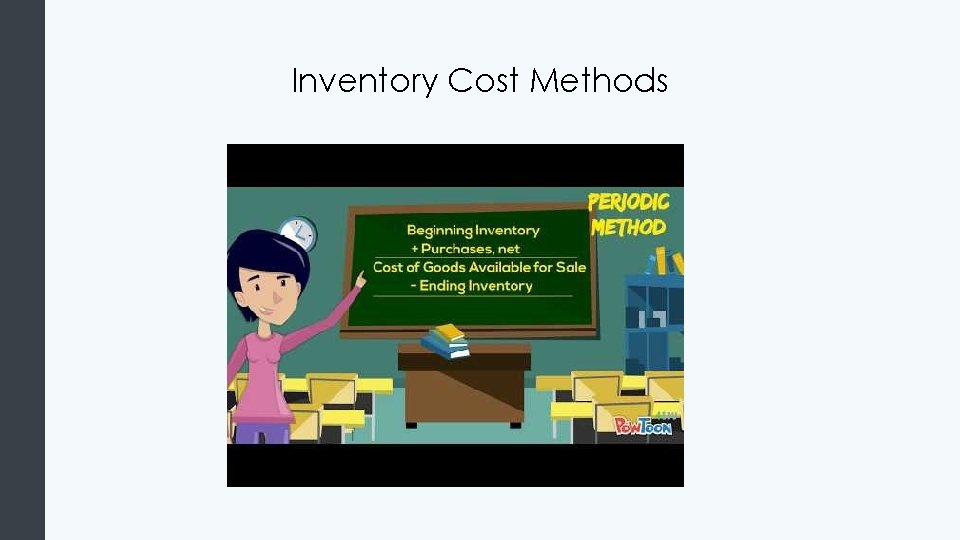
Inventory Cost Methods
Illustrate the Use of Specific Identification Cost Flow Assumption Technically, the specific identification method of assigning costs to items in inventory isn’t an assumption because it is a direct assignment of the cost of the item purchased to the item. Normally, this system of specific identification would be used for unique items, like luxury yachts, construction jobs, custom motorcycles, even autos and smaller boats, but normally for baseball bats, although with the increased sophistication of our computer programs, it’s not impossible to use specific identification for a wide variety of items.
Illustrate the Use of Weighted Average Cost Flow Assumption Total Purchases / Total Units = Weighted Average Cost This method may look easier than the other methods, but it is not ideal for large ticket items like cars, boats, yachts, or even appliances and anything one of a kind or unique in some way. If you had a boutique store that sold fancy olive oil from 5 -gallon jugs with spigots, this method could be ideal since the oils get mixed together in the jug. It would be really hard to use specific identification with oils and other fungible items. However, there is no rule that says you have to use a cost flow assumption that matches the physical flow of goods.
Illustrate the Use of First-in, First-out (FIFO) Cost Flow Assumption • First-in, First-out (FIFO) could also be called “last in still here. ” The first purchases we made are assumed to be the first items sold, so the most recent purchases are the ones left in ending inventory. • The FIFO method assumes the oldest products in a company's inventory have been sold first. The costs paid for those oldest products are the ones used in the calculation.
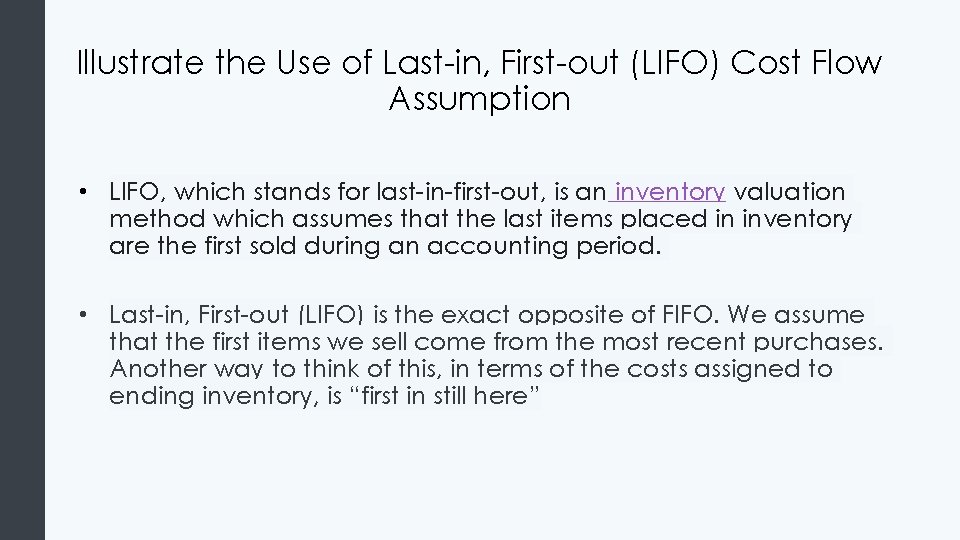
Illustrate the Use of Last-in, First-out (LIFO) Cost Flow Assumption • LIFO, which stands for last-in-first-out, is an inventory valuation method which assumes that the last items placed in inventory are the first sold during an accounting period. • Last-in, First-out (LIFO) is the exact opposite of FIFO. We assume that the first items we sell come from the most recent purchases. Another way to think of this, in terms of the costs assigned to ending inventory, is “first in still here”
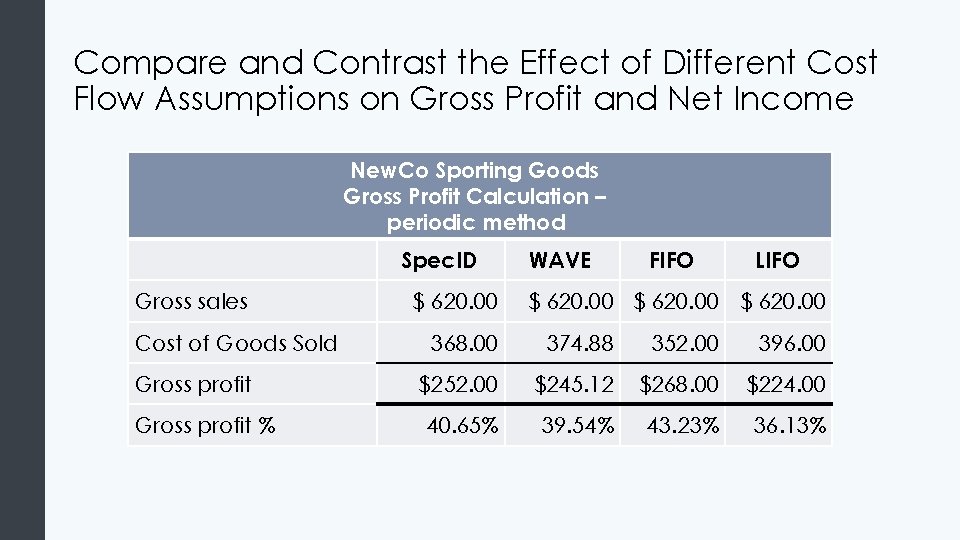
Compare and Contrast the Effect of Different Cost Flow Assumptions on Gross Profit and Net Income New. Co Sporting Goods Gross Profit Calculation – periodic method Spec. ID Gross sales Cost of Goods Sold Gross profit % $ 620. 00 WAVE FIFO LIFO $ 620. 00 368. 00 374. 88 352. 00 396. 00 $252. 00 $245. 12 $268. 00 $224. 00 40. 65% 39. 54% 43. 23% 36. 13%
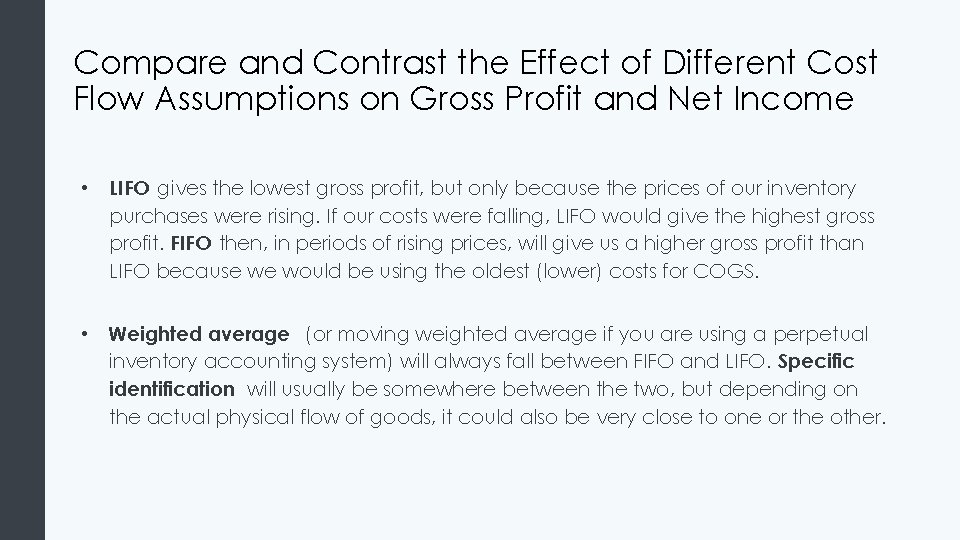
Compare and Contrast the Effect of Different Cost Flow Assumptions on Gross Profit and Net Income • LIFO gives the lowest gross profit, but only because the prices of our inventory purchases were rising. If our costs were falling, LIFO would give the highest gross profit. FIFO then, in periods of rising prices, will give us a higher gross profit than LIFO because we would be using the oldest (lower) costs for COGS. • Weighted average (or moving weighted average if you are using a perpetual inventory accounting system) will always fall between FIFO and LIFO. Specific identification will usually be somewhere between the two, but depending on the actual physical flow of goods, it could also be very close to one or the other.
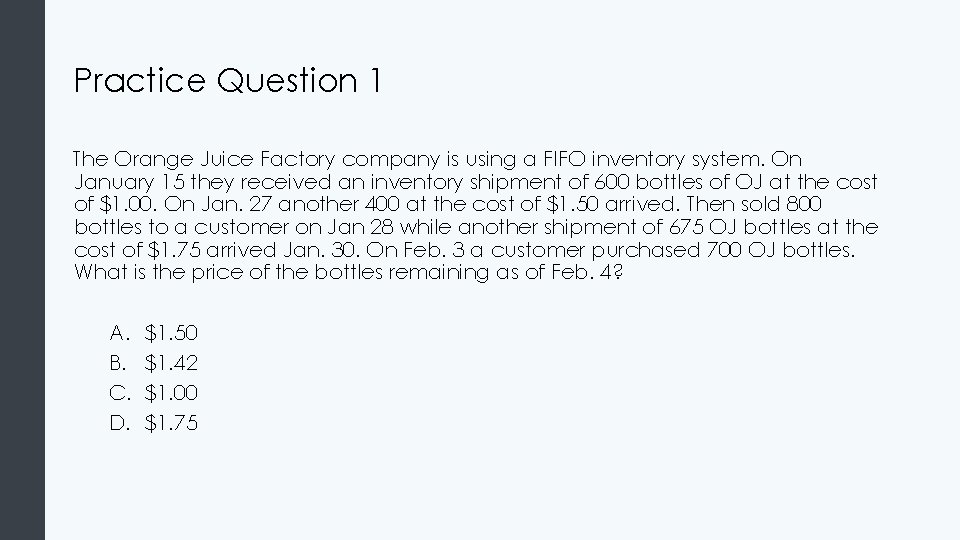
Practice Question 1 The Orange Juice Factory company is using a FIFO inventory system. On January 15 they received an inventory shipment of 600 bottles of OJ at the cost of $1. 00. On Jan. 27 another 400 at the cost of $1. 50 arrived. Then sold 800 bottles to a customer on Jan 28 while another shipment of 675 OJ bottles at the cost of $1. 75 arrived Jan. 30. On Feb. 3 a customer purchased 700 OJ bottles. What is the price of the bottles remaining as of Feb. 4? A. B. C. D. $1. 50 $1. 42 $1. 00 $1. 75
Conservatism in Reporting Inventory
Learning Outcomes: Conservatism in Reporting Inventory 8. 2: Apply the conservatism principle to inventory costing 8. 2. 1: Compare methods of computing lower of cost or net realizable value 8. 2. 2: Apply the lower of cost or net realizable value rule to merchandise inventory 8. 2. 3: Create journal entries to adjust inventory to net realizable value
Compare Methods of Computing Lower of Cost or Net Realizable Value • Net realizable value (NRV) sounds complicated, and a lot of accountants may still use the old term: Lower of Cost of Market (LCM). However, in July 2015, the Financial Accounting Standards Board (FASB) adopted ASU 2015 -11, FASB’s Accounting Standards Codification (ASC) Topic 330, Inventory, (https: //asc. fasb. org/image. Root/22/66710722. pdf, accessed July 7, 2020) that replaced LCM with LCNRV. • The old rule (that still applies to entities that use LIFO or a retail method of inventory measurement) required entities to measure inventory at the LCM. The term market referred to either replacement cost, net realizable value (commonly called “the ceiling”), or net realizable value (NRV) less an approximately normal profit margin (commonly called “the floor”). • In other words, market was the price at which you could currently buy it from your suppliers. Except, when you were doing the LCM calculation, if that market price was higher than net realizable value (NRV), you had to use NRV. If the market price was lower than NRV minus a normal profit margin, you had to use NRV minus a normal profit margin.
Compare Methods of Computing Lower of Cost or Net Realizable Value • The new rule, LCNRV , was designed to simplify this calculation. NRV is the estimated selling price in the ordinary course of business, minus costs of completion, disposal, and transportation. • Inventory measured using any method other than LIFO or the retail inventory method (for example, inventory measured using first-in, first-out (FIFO) or average cost) shall be measured at the lower of cost and net realizable value. When evidence exists that the net realizable value of inventory is lower than its cost, the difference shall be recognized as a loss in earnings in the period in which it occurs. That loss may be required, for example, due to damage, physical deterioration, obsolescence, changes in price levels, or other causes. • One final note: ASU 2015 -11, FASB’s Accounting Standards Codification (ASC) Topic 330 carved out an exception to the new rule for LIFO and retail inventory methods. One of the simplest versions of the retail inventory method calculates ending inventory by totaling the value of goods available for sale, which includes beginning inventory and any new purchases of inventory. Total sales are multiplied by the cost-to-retail ratio (or the percentage by which goods are marked up from their wholesale purchase price to their retail sales price) in order to get an estimate of COGS.
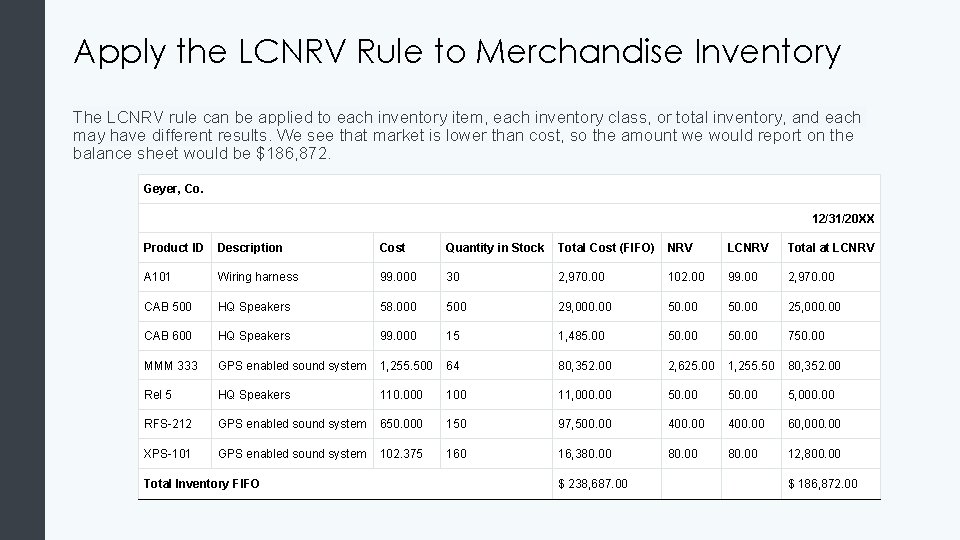
Apply the LCNRV Rule to Merchandise Inventory The LCNRV rule can be applied to each inventory item, each inventory class, or total inventory, and each may have different results. We see that market is lower than cost, so the amount we would report on the balance sheet would be $186, 872. Geyer, Co. 12/31/20 XX Product ID Description Cost Quantity in Stock Total Cost (FIFO) NRV LCNRV Total at LCNRV A 101 Wiring harness 99. 000 30 2, 970. 00 102. 00 99. 00 2, 970. 00 CAB 500 HQ Speakers 58. 000 500 29, 000. 00 50. 00 25, 000. 00 CAB 600 HQ Speakers 99. 000 15 1, 485. 00 50. 00 750. 00 MMM 333 GPS enabled sound system 1, 255. 500 64 80, 352. 00 2, 625. 00 1, 255. 50 80, 352. 00 Rel 5 HQ Speakers 110. 000 11, 000. 00 50. 00 5, 000. 00 RFS-212 GPS enabled sound system 650. 000 150 97, 500. 00 400. 00 60, 000. 00 XPS-101 GPS enabled sound system 102. 375 160 16, 380. 00 12, 800. 00 Total Inventory FIFO $ 238, 687. 00 $ 186, 872. 00
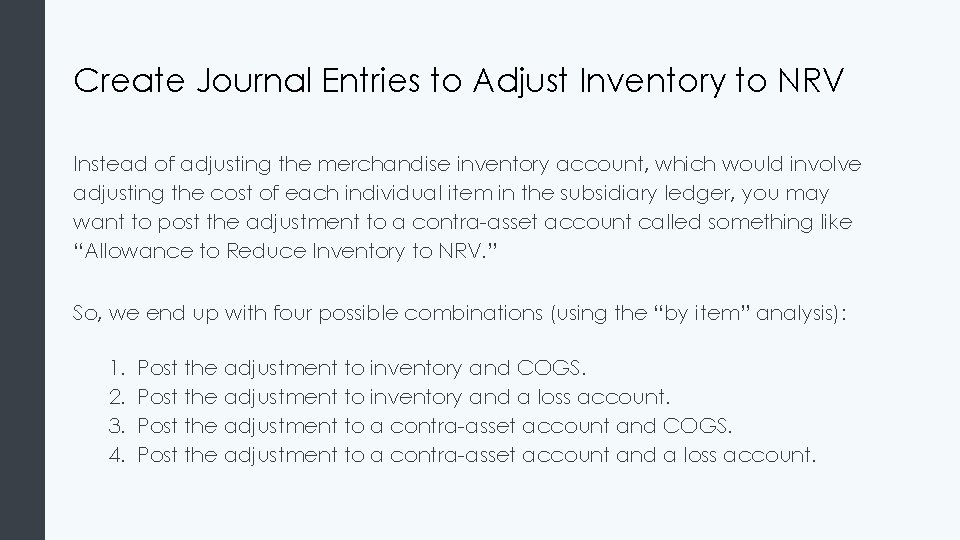
Create Journal Entries to Adjust Inventory to NRV Instead of adjusting the merchandise inventory account, which would involve adjusting the cost of each individual item in the subsidiary ledger, you may want to post the adjustment to a contra-asset account called something like “Allowance to Reduce Inventory to NRV. ” So, we end up with four possible combinations (using the “by item” analysis): 1. 2. 3. 4. Post the adjustment to inventory and COGS. Post the adjustment to inventory and a loss account. Post the adjustment to a contra-asset account and COGS. Post the adjustment to a contra-asset account and a loss account.
Financial Statement Presentation
Learning Outcomes: Financial Statement Presentation 8. 3: Demonstrate proper financial statement presentation of inventory and cost of goods sold 8. 3. 1: Prepare a multi-step income statement 8. 3. 2: Identify the effects of common inventory errors on the financial statements 8. 3. 3: Discuss common financial statement disclosures with regard to inventory
Prepare a Multi-Step Income Statement A merchandising company uses the same four financial statements we learned before: 1. 2. 3. 4. income statement of retained earnings balance sheet statement of cash flows The income statement for a merchandiser is expanded to include groupings and subheadings necessary to make it easier for investors to read and understand. We will look at the income statement only as the other statements have been discussed previously.
Prepare a Multi-Step Income Statement
Identify the Effects of Common Inventory Errors on the Financial Statements • First, a merchandising company must be sure that it has properly valued its ending inventory. If the ending inventory is overstated, COGS is understated, resulting in an overstatement of gross margin and net income. Also, the overstatement of ending inventory causes current assets, total assets, and retained earnings to be overstated. Thus, any change in the calculation of ending inventory is reflected (ignoring any income tax effects) dollar for dollar in net income, current assets, total assets, and retained earnings. • Second , when a company misstates its ending inventory in the current year, the company carries forward that misstatement into the next year. This misstatement occurs because the ending inventory amount of the current year is the beginning inventory amount for the next year. • Third, an error in one period’s ending inventory automatically causes an error in net income in the opposite direction in the next period. After two years, however, the error washes out, and assets and retained earnings are properly stated.
Discuss Common Financial Statement Disclosures with Regard to Inventory makes up a substantial portion of total assets, second only to property, plant, and equipment. But the number on the face of the financials is only part of the story. GAAP requires additional disclosures with regard to inventory that cover the following financial accounting principles and policies: ● ● Conservatism (using LCM or LCNRV) Estimates Internal controls Materiality
Practice Question 2 XYZ merchandising company conducted a physical inventory at the end of the year. One of the sheets of paper with the physical count ended up being duplicated and the inventory was recorded incorrectly, as an overstatement of inventory. This inventory overstatement showed up on the Balance Sheet as well. What happens to the gross profit with an overstated ending inventory? A. B. C. D. Gross Profit is also overstated. Gross Profit is then understated. Gross Profit is unaffected. Gross Profit is increased by 25%.
Quick Review • How is the specific identification cost flow assumption used? • How is the weighted average cost flow assumption used? • How is the FIFO cost flow assumption used? • How is the LIFO cost flow assumption used? • What is the effect of different cost flow assumptions on gross profit and net income? • What are the differences between computing lower of cost or net realizable value? • How is the lower of cost or net realizable value rule applied to merchandise inventory? • How are journal entries created to adjust inventory to net realizable value? • What is the process for preparing a multi-step income statement? • What are the effects of common inventory errors on the financial statements? • What common financial statement disclosures are needed for inventory?