
Financial Accounting Lesson 3 The Income Statement Ben
Financial Accounting Lesson 3: The Income Statement Ben Trnka/Boz Bostrom www. benandboz. com
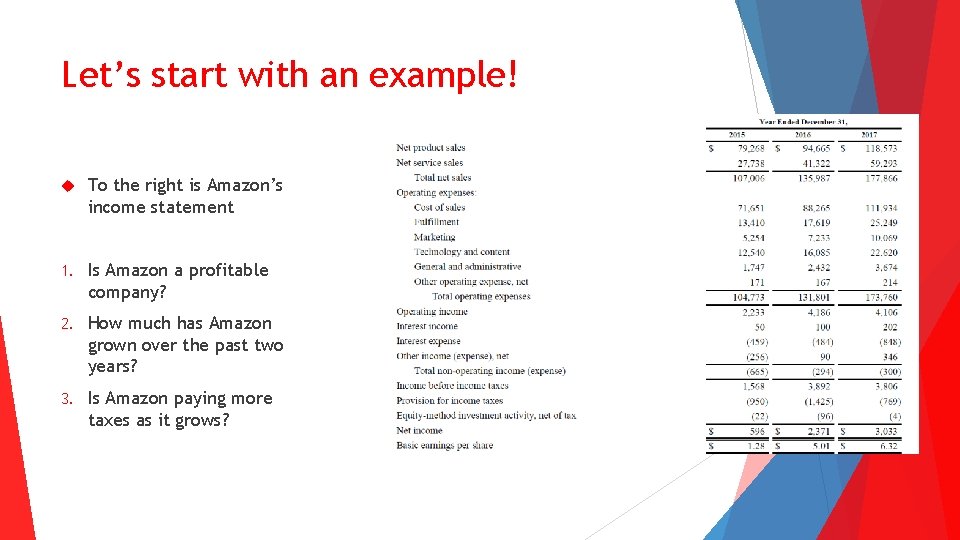
Let’s start with an example! To the right is Amazon’s income statement 1. Is Amazon a profitable company? 2. How much has Amazon grown over the past two years? 3. Is Amazon paying more taxes as it grows?
Overview: 1. Understand cash vs. accrual accounting 2. Understand revenues, expenses, and net income 3. Learn how to prepare journal entries for income statement accounts 4. Learn how to prepare an income statement
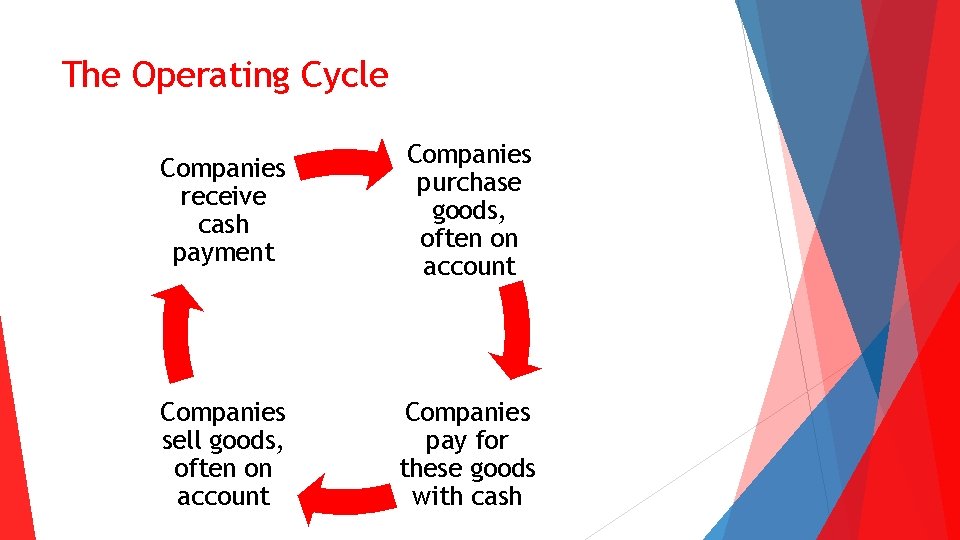
The Operating Cycle Companies receive cash payment Companies purchase goods, often on account Companies sell goods, often on account Companies pay for these goods with cash
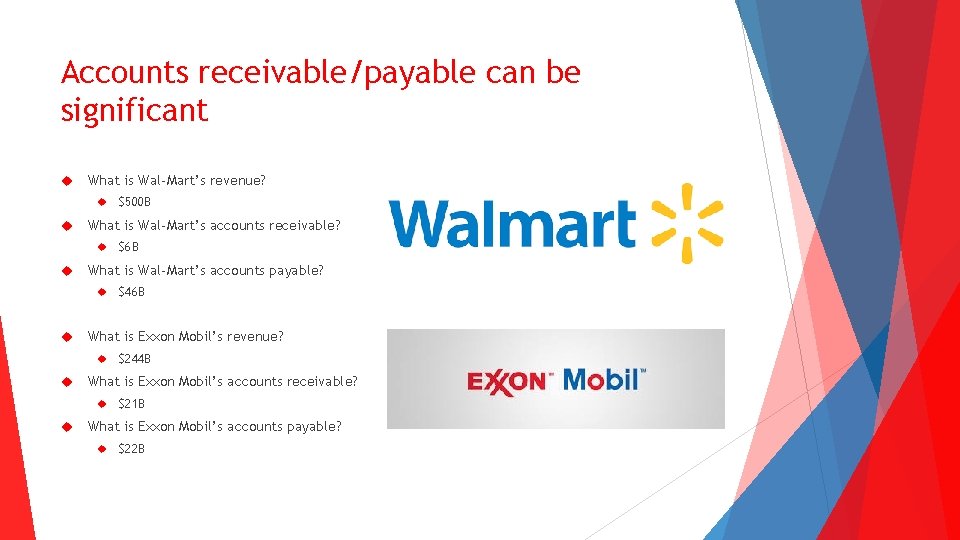
Accounts receivable/payable can be significant What is Wal-Mart’s revenue? What is Wal-Mart’s accounts receivable? $244 B What is Exxon Mobil’s accounts receivable? $46 B What is Exxon Mobil’s revenue? $6 B What is Wal-Mart’s accounts payable? $500 B $21 B What is Exxon Mobil’s accounts payable? $22 B
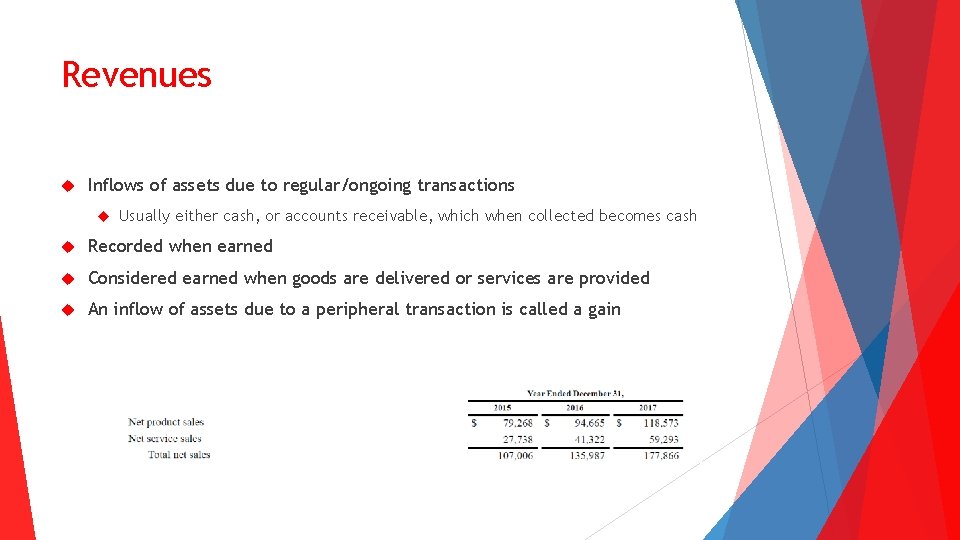
Revenues Inflows of assets due to regular/ongoing transactions Usually either cash, or accounts receivable, which when collected becomes cash Recorded when earned Considered earned when goods are delivered or services are provided An inflow of assets due to a peripheral transaction is called a gain
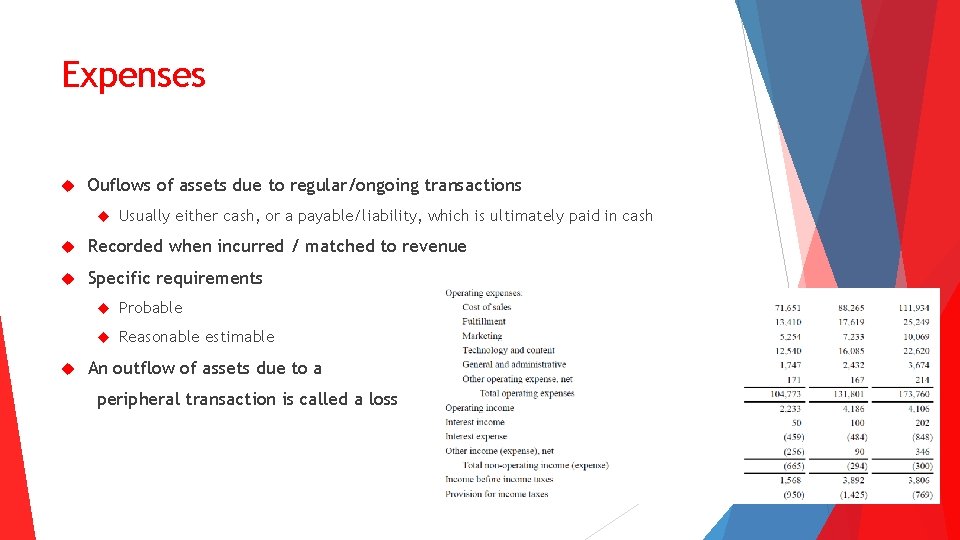
Expenses Ouflows of assets due to regular/ongoing transactions Usually either cash, or a payable/liability, which is ultimately paid in cash Recorded when incurred / matched to revenue Specific requirements Probable Reasonable estimable An outflow of assets due to a peripheral transaction is called a loss
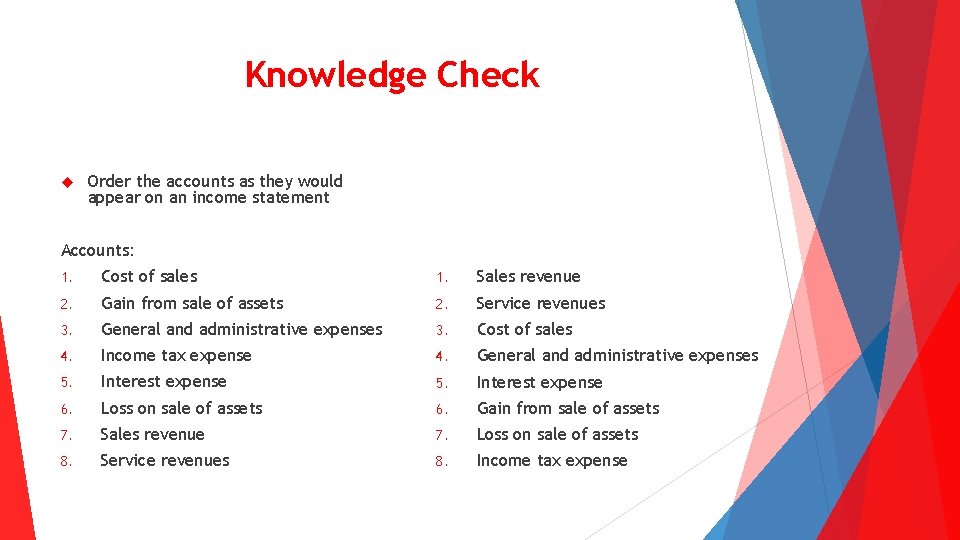
Knowledge Check Order the accounts as they would appear on an income statement Accounts: 1. Cost of sales 1. Sales revenue 2. Gain from sale of assets 2. Service revenues 3. General and administrative expenses 3. Cost of sales 4. Income tax expense 4. General and administrative expenses 5. Interest expense 6. Loss on sale of assets 6. Gain from sale of assets 7. Sales revenue 7. Loss on sale of assets 8. Service revenues 8. Income tax expense
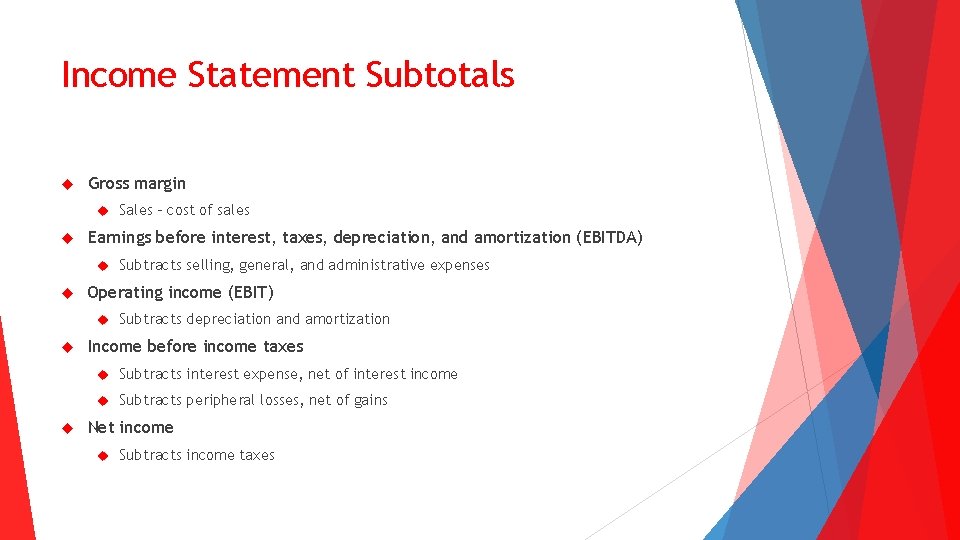
Income Statement Subtotals Gross margin Earnings before interest, taxes, depreciation, and amortization (EBITDA) Subtracts selling, general, and administrative expenses Operating income (EBIT) Sales – cost of sales Subtracts depreciation and amortization Income before income taxes Subtracts interest expense, net of interest income Subtracts peripheral losses, net of gains Net income Subtracts income taxes
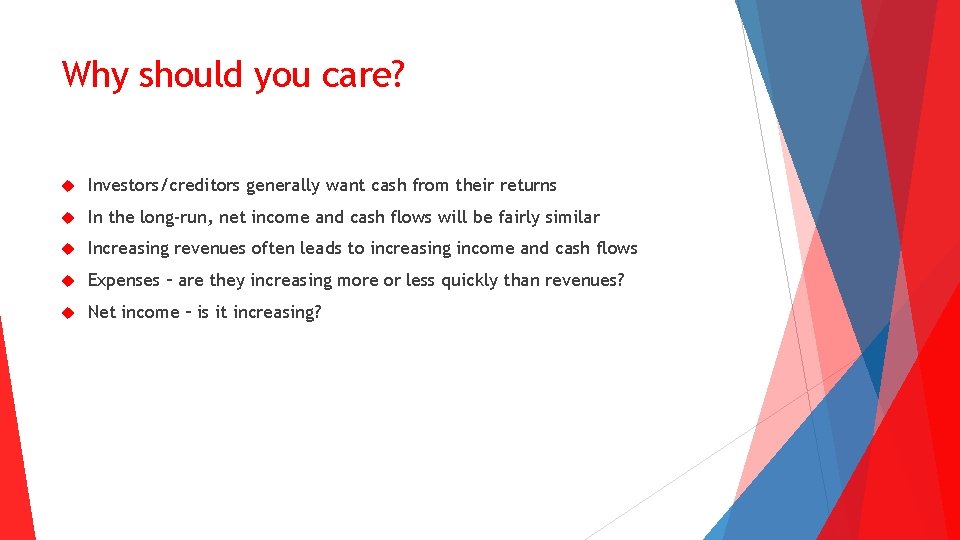
Why should you care? Investors/creditors generally want cash from their returns In the long-run, net income and cash flows will be fairly similar Increasing revenues often leads to increasing income and cash flows Expenses – are they increasing more or less quickly than revenues? Net income – is it increasing?
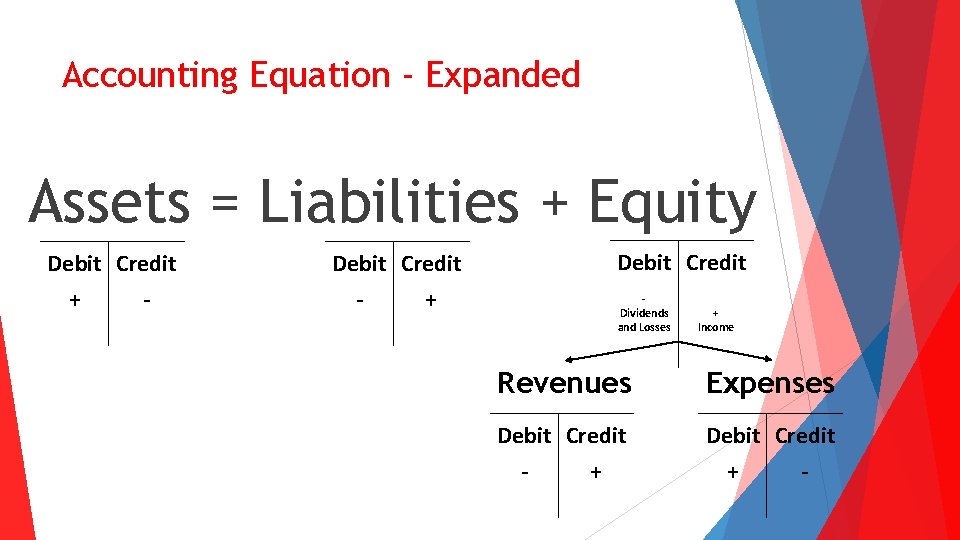
Accounting Equation - Expanded Assets = Liabilities + Equity Debit Credit + - Debit Credit + Debit Credit Dividends and Losses + Income Revenues Expenses Debit Credit + -
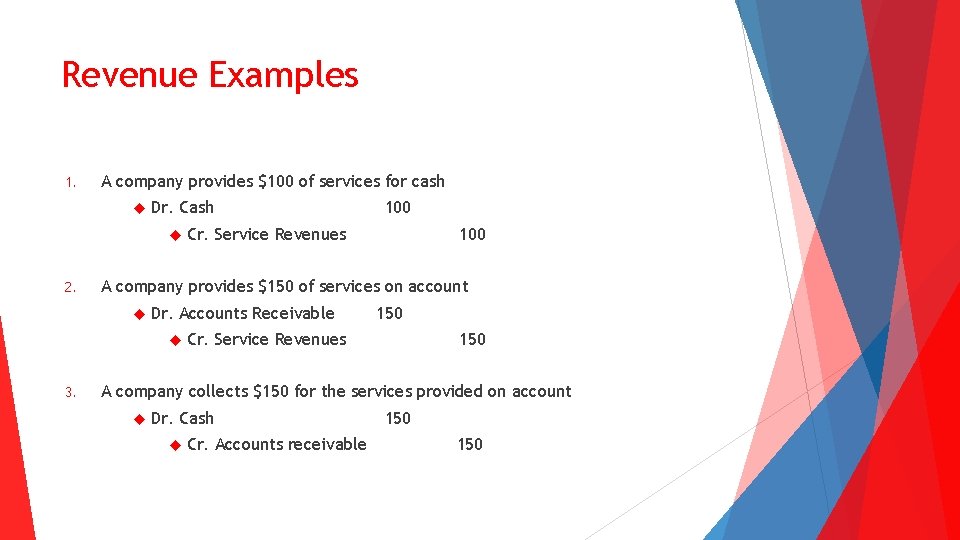
Revenue Examples 1. A company provides $100 of services for cash Dr. Cash Cr. 2. Service Revenues 100 A company provides $150 of services on account Dr. Accounts Receivable Cr. 3. 100 150 Service Revenues 150 A company collects $150 for the services provided on account Dr. Cash Cr. 150 Accounts receivable 150
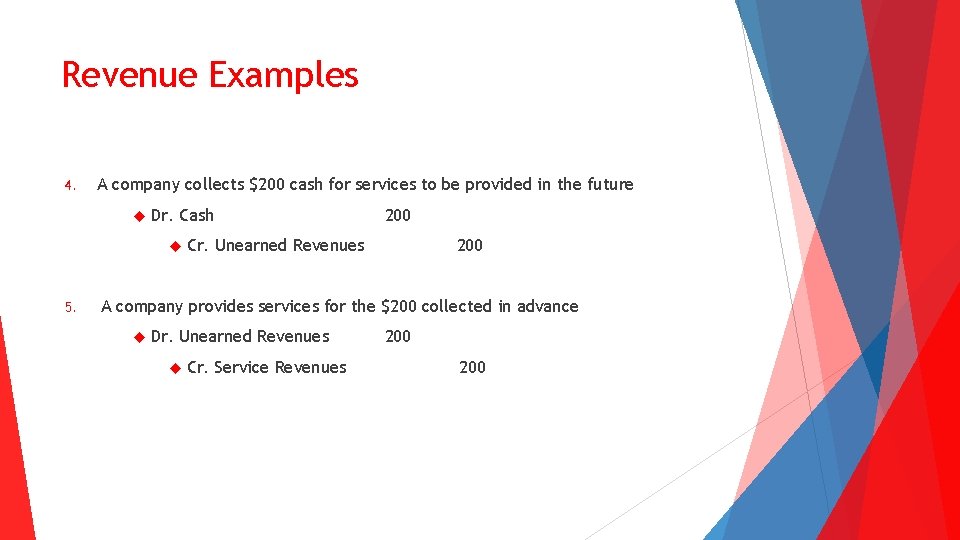
Revenue Examples 4. A company collects $200 cash for services to be provided in the future Dr. Cash Cr. 5. 200 Unearned Revenues 200 A company provides services for the $200 collected in advance Dr. Unearned Revenues Cr. Service Revenues 200
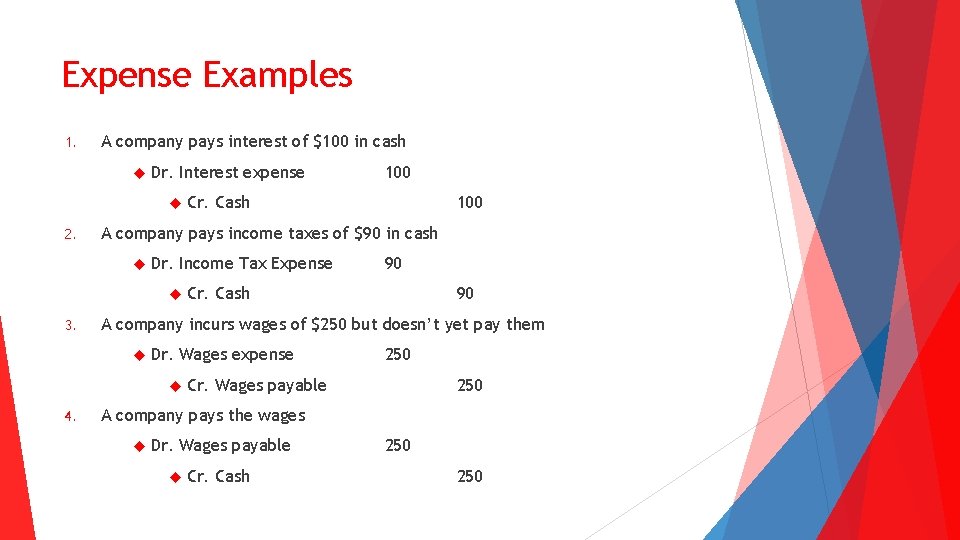
Expense Examples 1. A company pays interest of $100 in cash Dr. Interest expense Cr. 2. Income Tax Expense Cr. 100 90 Cash 90 A company incurs wages of $250 but doesn’t yet pay them Dr. Wages expense Cr. 4. Cash A company pays income taxes of $90 in cash Dr. 3. 100 250 Wages payable 250 A company pays the wages Dr. Wages payable Cr. Cash 250
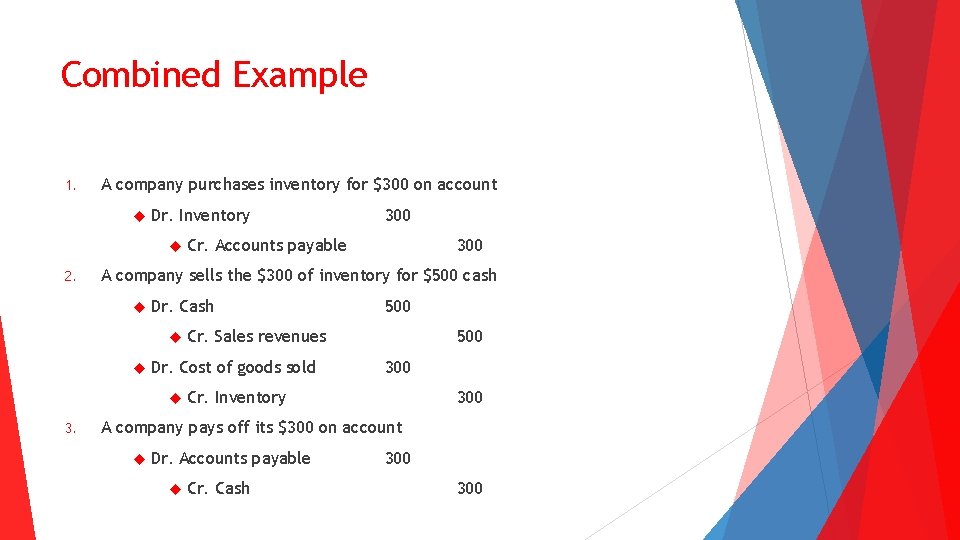
Combined Example 1. A company purchases inventory for $300 on account Dr. Inventory Cr. 2. Accounts payable 300 A company sells the $300 of inventory for $500 cash Dr. Cash Cr. Dr. 500 Sales revenues Cost of goods sold Cr. 3. 300 500 300 Inventory 300 A company pays off its $300 on account Dr. Accounts payable Cr. Cash 300
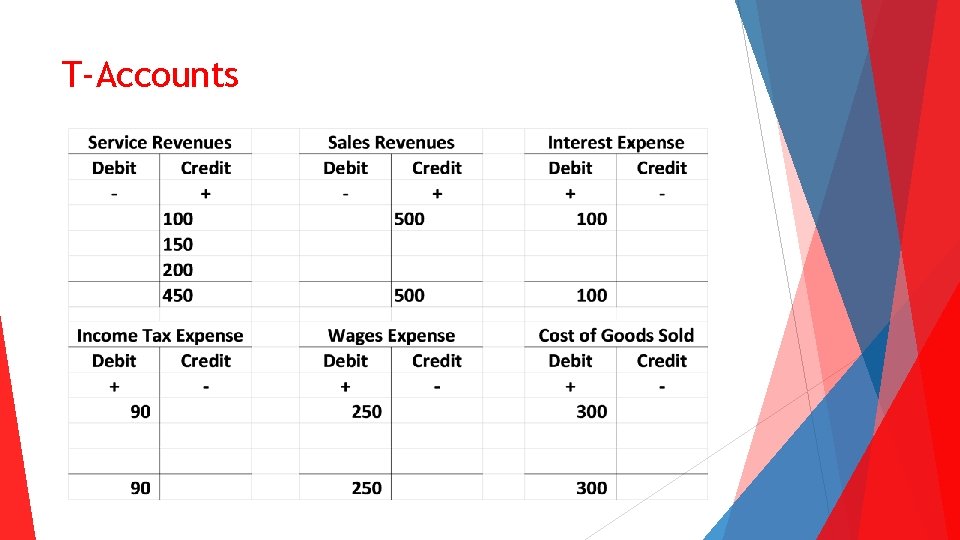
T-Accounts
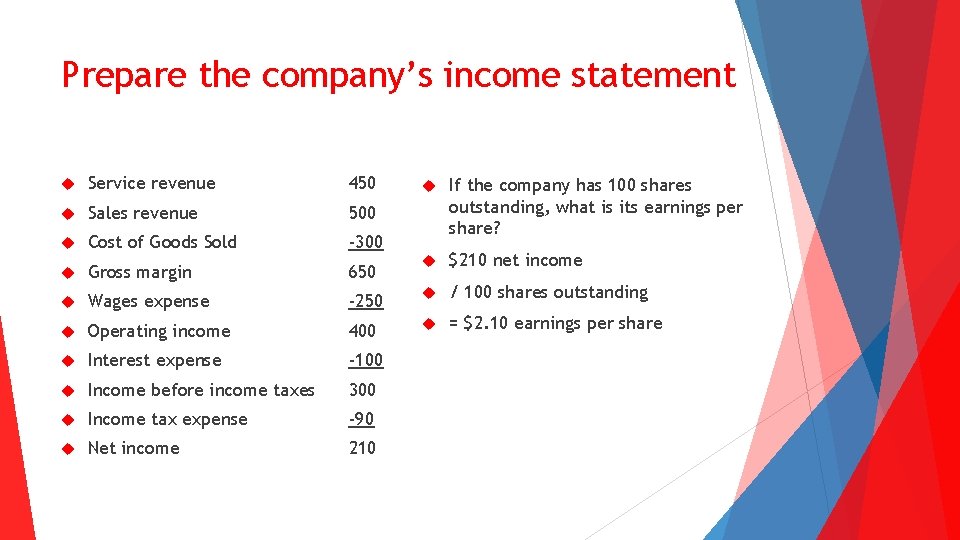
Prepare the company’s income statement Service revenue 450 Sales revenue 500 Cost of Goods Sold -300 Gross margin 650 Wages expense If the company has 100 shares outstanding, what is its earnings per share? $210 net income -250 / 100 shares outstanding Operating income 400 = $2. 10 earnings per share Interest expense -100 Income before income taxes 300 Income tax expense -90 Net income 210
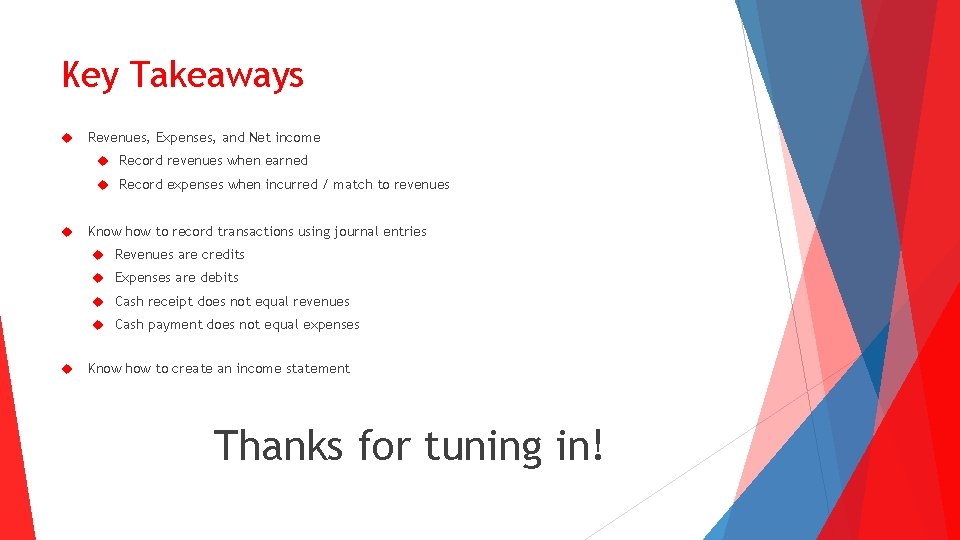
Key Takeaways Revenues, Expenses, and Net income Record revenues when earned Record expenses when incurred / match to revenues Know how to record transactions using journal entries Revenues are credits Expenses are debits Cash receipt does not equal revenues Cash payment does not equal expenses Know how to create an income statement Thanks for tuning in!
- Slides: 18