
Financial Accounting Lecture 06 Learning Objective This lecture
Financial Accounting Lecture – 06 Learning Objective • This lecture will cover following areas: An overview of the flow of transactions. n An introduction to the basic books of accounts. n The General Ledger, and n The ledger balance n 1
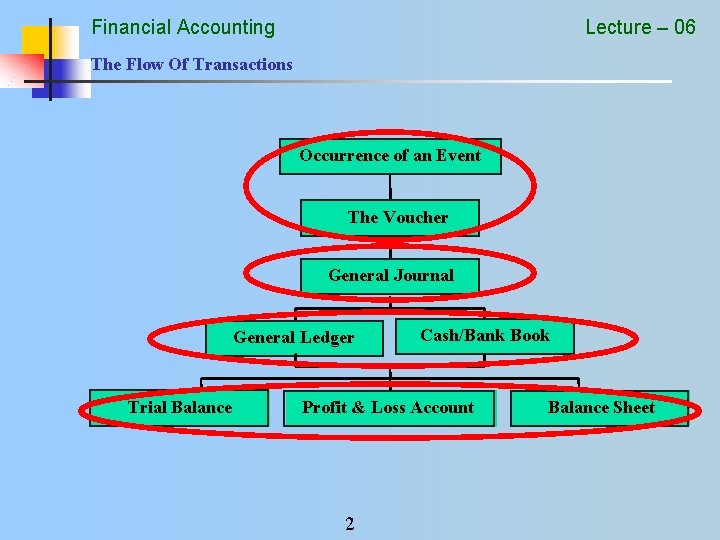
Financial Accounting Lecture – 06 The Flow Of Transactions Occurrence of an Event The Voucher General Journal General Ledger Trial Balance Cash/Bank Book Profit & Loss Account 2 Balance Sheet
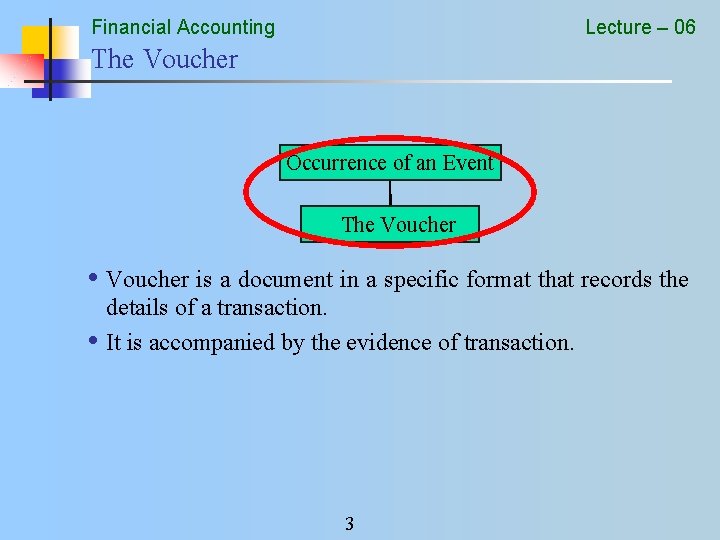
Financial Accounting Lecture – 06 The Voucher Occurrence of an Event The Voucher • Voucher is a document in a specific format that records the details of a transaction. • It is accompanied by the evidence of transaction. 3

Financial Accounting Lecture – 06 A Sample Voucher Name Of Company Type Of Voucher Date: 1 -1 -20 -- No: Description Code # Cash 01 Capital 100, 000 Capital Introduced in Cash by Owner Prepared By: Checked by: 4 Credit Amount 100, 000 02 Total: Narration: Debit Amount 01 100, 000
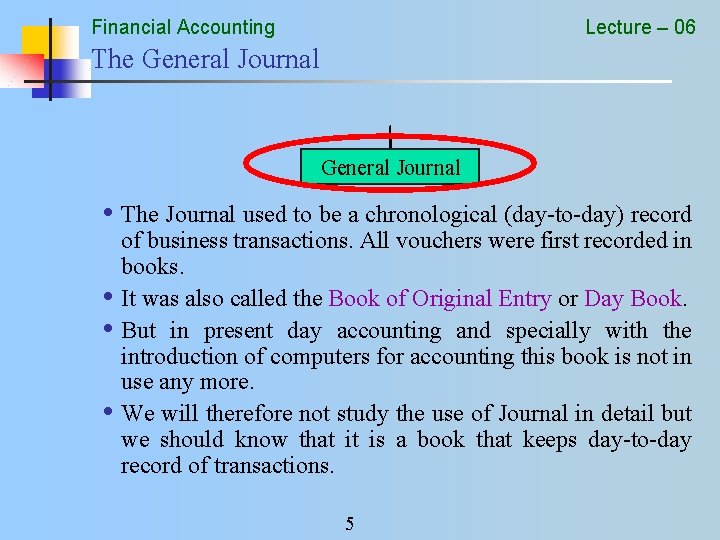
Financial Accounting Lecture – 06 The General Journal • The Journal used to be a chronological (day-to-day) record of business transactions. All vouchers were first recorded in books. • It was also called the Book of Original Entry or Day Book. • But in present day accounting and specially with the introduction of computers for accounting this book is not in use any more. • We will therefore not study the use of Journal in detail but we should know that it is a book that keeps day-to-day record of transactions. 5
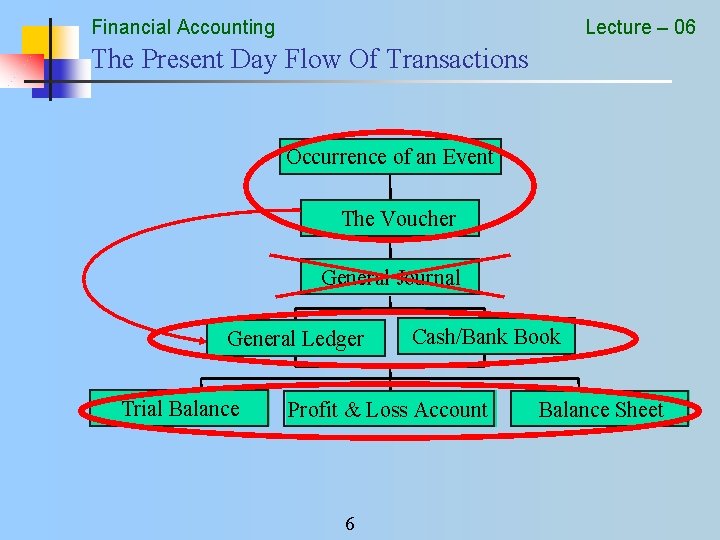
Financial Accounting Lecture – 06 The Present Day Flow Of Transactions Occurrence of an Event The Voucher General Journal General Ledger Trial Balance Cash/Bank Book Profit & Loss Account 6 Balance Sheet
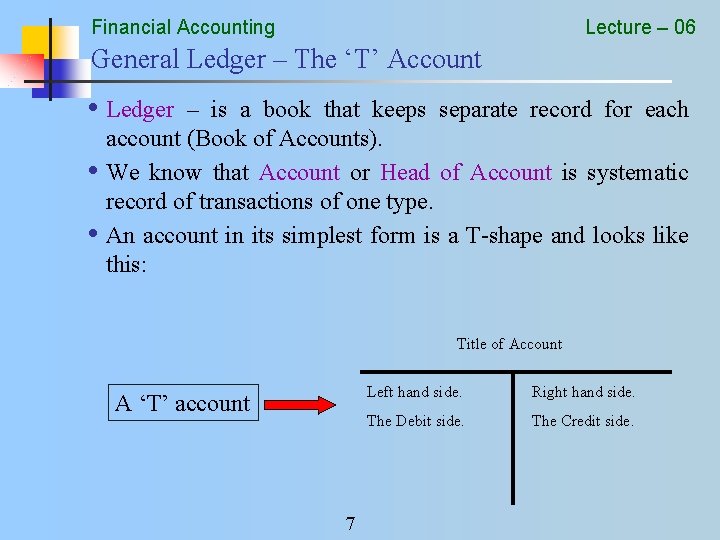
Financial Accounting Lecture – 06 General Ledger – The ‘T’ Account • Ledger – is a book that keeps separate record for each account (Book of Accounts). • We know that Account or Head of Account is systematic record of transactions of one type. • An account in its simplest form is a T-shape and looks like this: Title of Account A ‘T’ account 7 Left hand side. Right hand side. The Debit side. The Credit side.
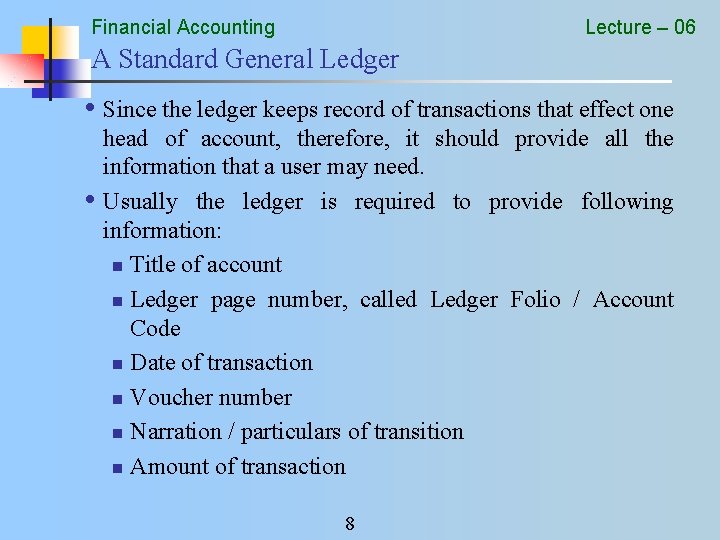
Financial Accounting Lecture – 06 A Standard General Ledger • Since the ledger keeps record of transactions that effect one head of account, therefore, it should provide all the information that a user may need. • Usually the ledger is required to provide following information: n Title of account n Ledger page number, called Ledger Folio / Account Code n Date of transaction n Voucher number n Narration / particulars of transition n Amount of transaction 8

Financial Accounting Lecture – 06 A Standard General Ledger Capital Account (Title of Account) Date Voucher Number Particulars / Narration 01 Capital Introduced in cash by Owner Account Code 02 Debit Credit Amount 20 -Jan 01 9 100, 000
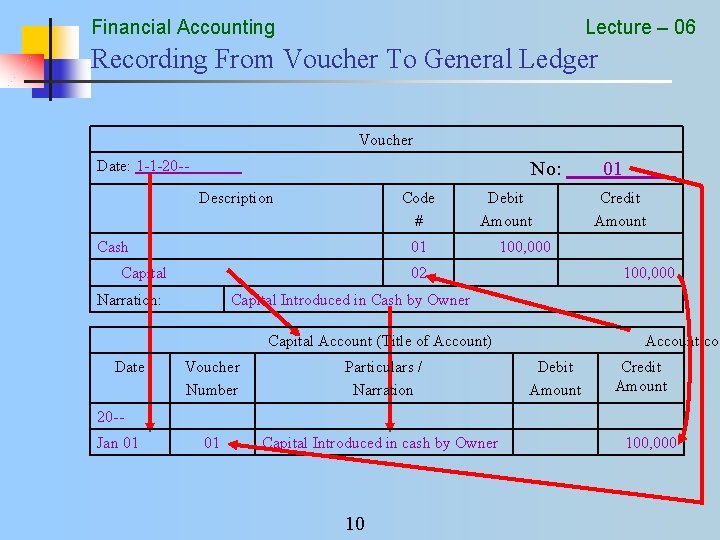
Financial Accounting Lecture – 06 Recording From Voucher To General Ledger Voucher Date: 1 -1 -20 -- No: Description Code # Cash Debit Amount 01 Capital 100, 000 Capital Introduced in Cash by Owner Capital Account (Title of Account) Date Credit Amount 100, 000 02 Narration: 01 Voucher Number Particulars / Narration 01 Capital Introduced in cash by Owner Account cod Debit Amount Credit Amount 20 -Jan 01 10 100, 000
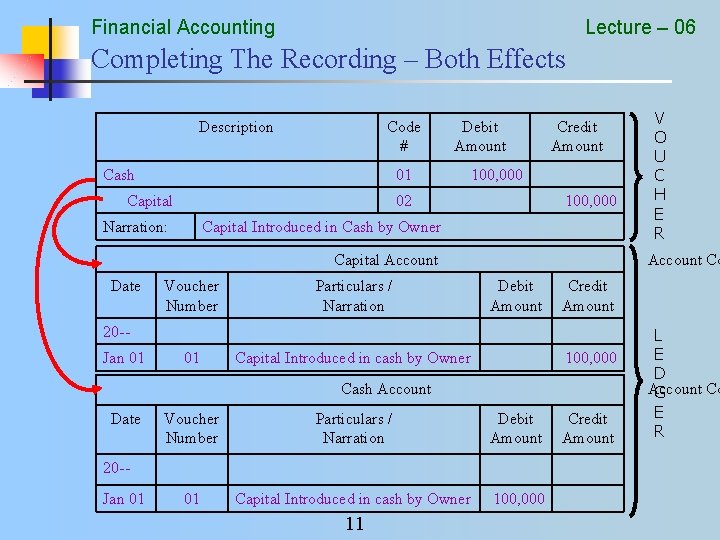
Financial Accounting Lecture – 06 Completing The Recording – Both Effects Description Code # Cash 01 Capital Debit Amount 100, 000 02 Narration: Credit Amount 100, 000 Capital Introduced in Cash by Owner Capital Account Date Voucher Number Particulars / Narration Account Co Debit Amount Credit Amount 20 -Jan 01 01 Capital Introduced in cash by Owner 100, 000 Cash Account Date Voucher Number Particulars / Narration Debit Amount 01 Capital Introduced in cash by Owner 100, 000 20 -Jan 01 11 V O U C H E R Credit Amount L E D Account Co G E R
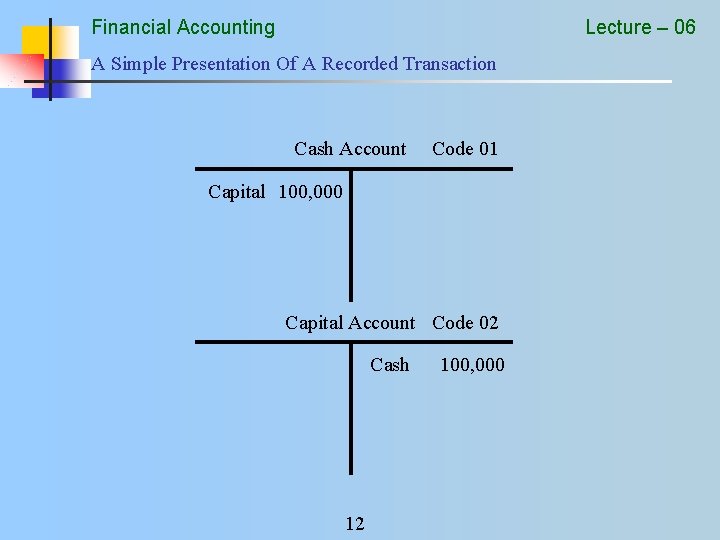
Financial Accounting Lecture – 06 A Simple Presentation Of A Recorded Transaction Cash Account Code 01 Capital 100, 000 Capital Account Code 02 Cash 12 100, 000
Financial Accounting Lecture – 06 The Ledger Balance • In the earlier lecture we discussed that in order to have the total figure in respect of each head of expense/income, asset/liability we need to maintain different accounts. • We had also said that each account may have figures on the debit as well as the credit side. • Therefore, the difference between the debit and the credit sides, known as the BALANCE, would represent the required total of the particular account. • The total all balances on the Debit side is ALWAYS equal to the total of all balances on the Credit side. This is called the balancing of books of accounts. We will study about this concept at a later stage. • The balance may be written out after every transaction in a third column or calculated at the end of a specific time period (an accounting period). 13
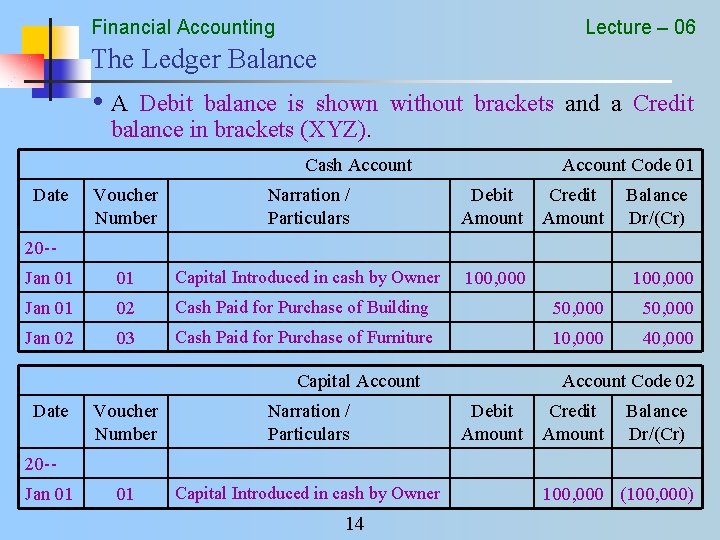
Financial Accounting Lecture – 06 The Ledger Balance • A Debit balance is shown without brackets and a Credit balance in brackets (XYZ). Cash Account Date Account Code 01 Voucher Number Narration / Particulars Debit Credit Amount Balance Dr/(Cr) Jan 01 01 Capital Introduced in cash by Owner Jan 01 02 Cash Paid for Purchase of Building 50, 000 Jan 02 03 Cash Paid for Purchase of Furniture 10, 000 40, 000 20 -- Capital Account Date Voucher Number Narration / Particulars 01 Capital Introduced in cash by Owner 100, 000 Account Code 02 Debit Credit Amount Balance Dr/(Cr) 20 -Jan 01 14 100, 000 (100, 000)
- Slides: 14