
FINANCIAL ACCOUNTING II BACT 304 CASH FLOW STATEMENT
FINANCIAL ACCOUNTING II BACT 304 CASH FLOW STATEMENT LECTURERS: DR. JOHN MACCARTHY & MR. LEXIS TETTEH 1
Statement of Cash Flow The cash flow statements is an essential tool for making economic decision: • It shows the company’s ability to generate cash for running the business. • It shows how the company utilise cash in achieving the objective of the company. Difference between Cash-flow and Profitability • Cash-flows show cash movements in terms of cash receipts and payments for any economic activities within the company. • Profit is the difference between revenue and expenses paid within a specific period. • A company can be profitable and still be bankrupt because of cash-flows difficulties 2
Statement of Cash Flow (cont. ) Financial Statements: • Statement of Comprehensive Income • Statement of Financial Position • Statement of Cash Flow How to prepare cash flow statement? • Statement of Cash flow is prepared from the SOCI and SOFP • That is Statement of Cash-flow translates earnings (incomes) from the SOCI and SOFP to finance the operations of the business. 3
Statement of Cash Flow (cont. ) Definition of Cash? • The definition of cash include cash and cash equivalent. • Cash includes notes, coins and bank account balances. Cash equivalent includes: • Call money • Treasury bills (T-bills). • Short-term certificate of deposit (CDs) • Commercial Paper (CPs) 4
Statement of Cash Flow (cont. ) The importance of liquidity in a business: • It shows the company’s ability to generate cash for running the business. • It shows how the company utilise cash in achieving the objective of the company. • It reveals how much can be generated within and how does the business needed to finance from outside sources. • Assessing the liquidity of a business is a means of determining the financial “health” of a business. • Liquid assets can be converted easily to cash within a short period of time. 5
Statement of Cash Flow (cont. ) Difference between Cash-flow and Profitability • Cash-flow shows cash movements in terms of cash receipts and payments for any economic activities within the company. • Profit is the difference between revenue and expenses paid within a specific period. • A company can be profitable and still be bankrupt because of cash-flows difficulties 6
Statement of Cash Flow (cont. ) • Components of Cash-flow statement: Operating activities; investing activities and financing activities. – Cash-flow from operating activities: This shows how the company generates cash through business operations (i. e. , selling product or delivery service to customers). – Cash-flow from investing activities: This shows the extent to which the company invests into new assets in order to generate future profits and cash-flows. – Cash-flow from financing activities: This shows how long term capital is provided for financing business activities (i. e. , either through equity or debt capital). 7
Statement of Cash Flow (cont. ) • Methods for preparing cash-flows: Indirect and direct methods • Indirect method: The net cash-flows from operating activities is arrived at, by starting from company’s operating profit and then adjusting for the non-cash charges and credits. • Direct method: The components of operating cash-flows (i. e. , cash receipts from customers, payments to suppliers and other cash movements. 8
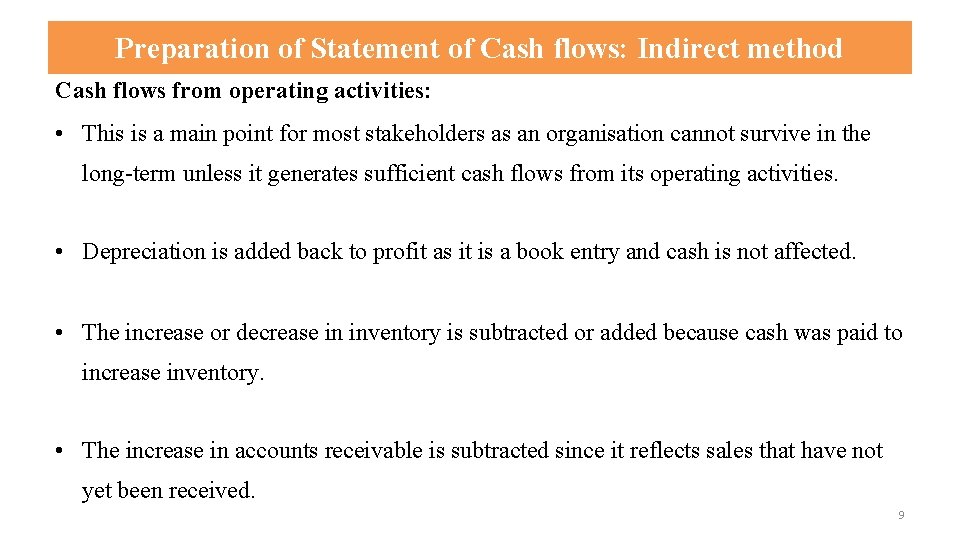
Preparation of Statement of Cash flows: Indirect method Cash flows from operating activities: • This is a main point for most stakeholders as an organisation cannot survive in the long-term unless it generates sufficient cash flows from its operating activities. • Depreciation is added back to profit as it is a book entry and cash is not affected. • The increase or decrease in inventory is subtracted or added because cash was paid to increase inventory. • The increase in accounts receivable is subtracted since it reflects sales that have not yet been received. 9
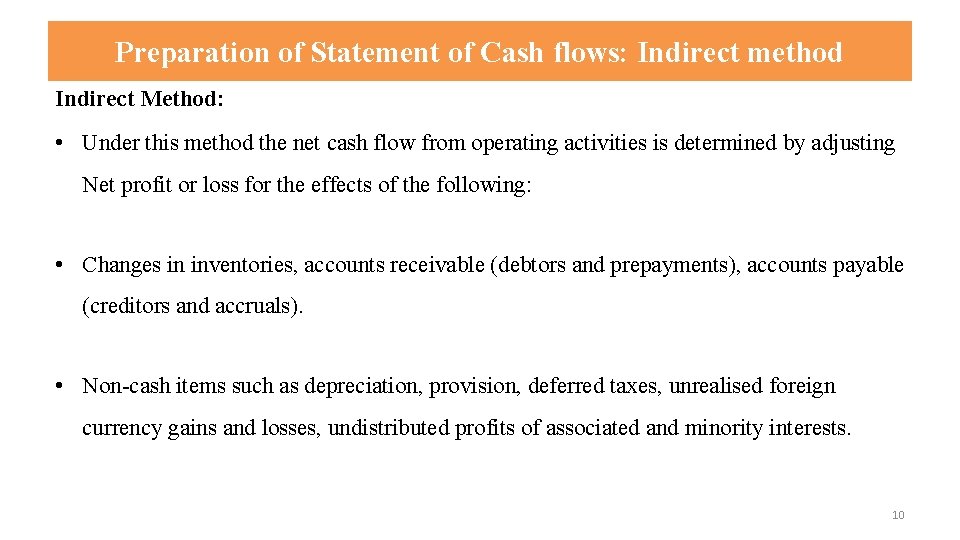
Preparation of Statement of Cash flows: Indirect method Indirect Method: • Under this method the net cash flow from operating activities is determined by adjusting Net profit or loss for the effects of the following: • Changes in inventories, accounts receivable (debtors and prepayments), accounts payable (creditors and accruals). • Non-cash items such as depreciation, provision, deferred taxes, unrealised foreign currency gains and losses, undistributed profits of associated and minority interests. 10
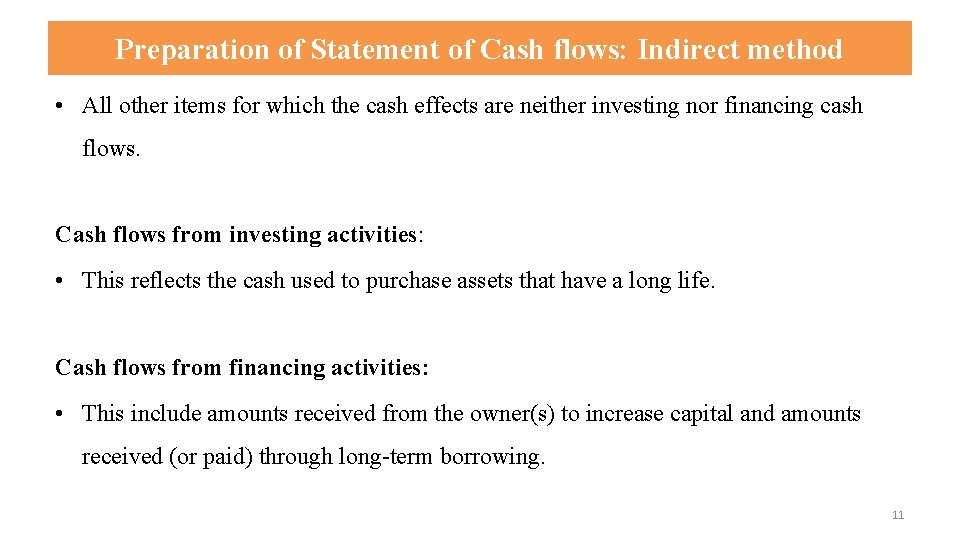
Preparation of Statement of Cash flows: Indirect method • All other items for which the cash effects are neither investing nor financing cash flows. Cash flows from investing activities: • This reflects the cash used to purchase assets that have a long life. Cash flows from financing activities: • This include amounts received from the owner(s) to increase capital and amounts received (or paid) through long-term borrowing. 11
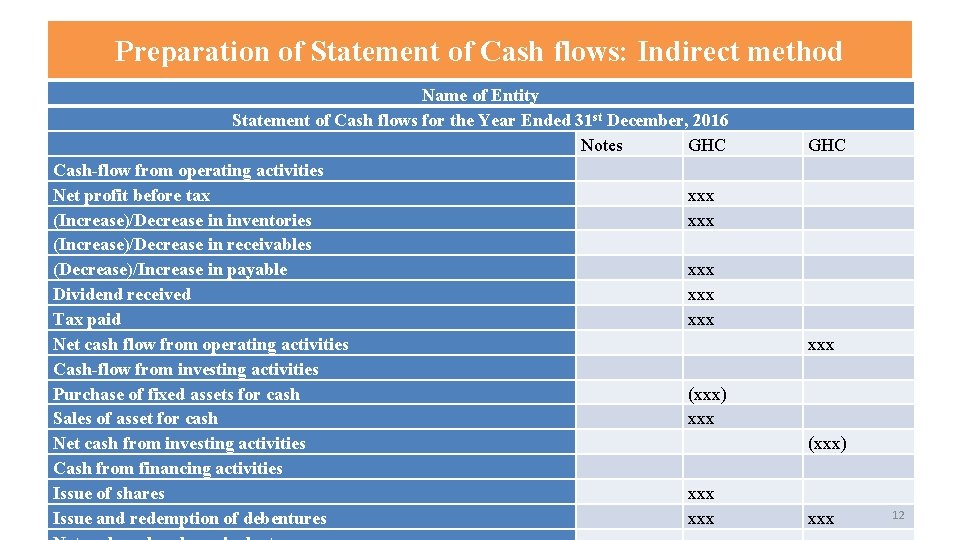
Preparation of Statement of Cash flows: Indirect method Name of Entity Statement of Cash flows for the Year Ended 31 st December, 2016 Notes GHC Cash-flow from operating activities Net profit before tax xxx (Increase)/Decrease in inventories xxx (Increase)/Decrease in receivables (Decrease)/Increase in payable xxx Dividend received xxx Tax paid xxx Net cash flow from operating activities Cash-flow from investing activities Purchase of fixed assets for cash (xxx) Sales of asset for cash xxx Net cash from investing activities Cash from financing activities Issue of shares xxx Issue and redemption of debentures xxx GHC xxx (xxx) xxx 12
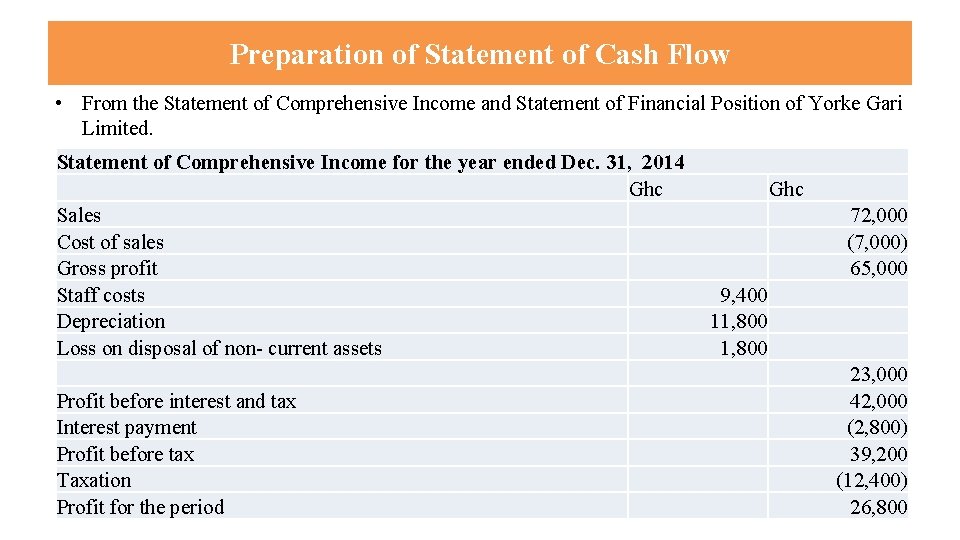
Preparation of Statement of Cash Flow • From the Statement of Comprehensive Income and Statement of Financial Position of Yorke Gari Limited. Statement of Comprehensive Income for the year ended Dec. 31, 2014 Ghc Sales Cost of sales Gross profit Staff costs Depreciation Loss on disposal of non- current assets Profit before interest and tax Interest payment Profit before tax Taxation Profit for the period Ghc 72, 000 (7, 000) 65, 000 9, 400 11, 800 23, 000 42, 000 (2, 800) 39, 200 (12, 400) 26, 800 13
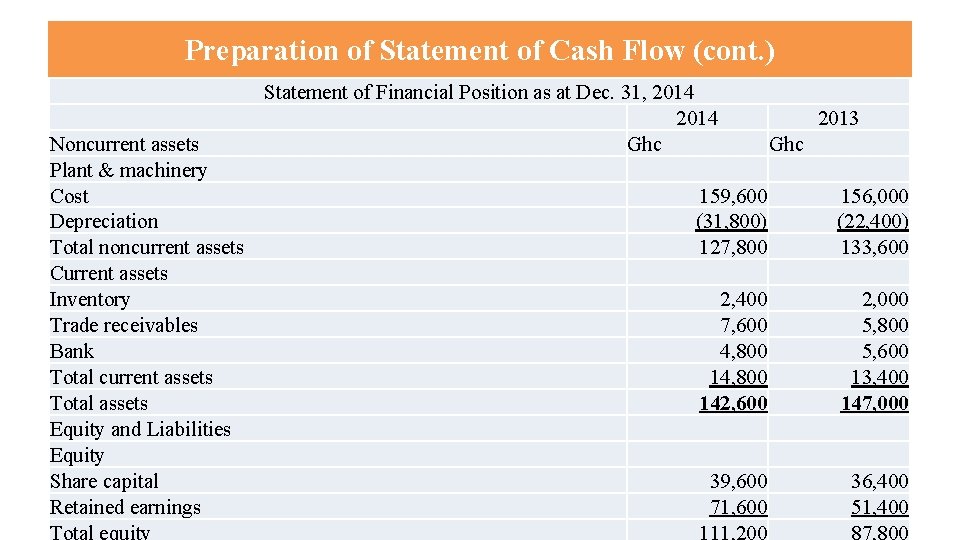
Preparation of Statement of Cash Flow (cont. ) Noncurrent assets Plant & machinery Cost Depreciation Total noncurrent assets Current assets Inventory Trade receivables Bank Total current assets Total assets Equity and Liabilities Equity Share capital Retained earnings Total equity Statement of Financial Position as at Dec. 31, 2014 Ghc 2013 Ghc 159, 600 (31, 800) 127, 800 156, 000 (22, 400) 133, 600 2, 400 7, 600 4, 800 142, 600 2, 000 5, 800 5, 600 13, 400 147, 000 39, 600 71, 600 111, 200 36, 400 51, 400 14 87, 800
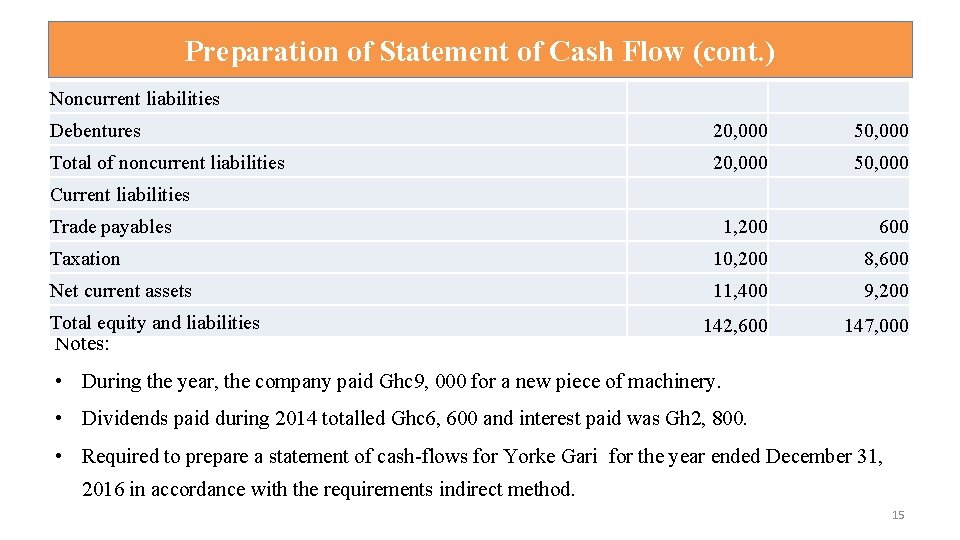
Preparation of Statement of Cash Flow (cont. ) Noncurrent liabilities Debentures 20, 000 50, 000 Total of noncurrent liabilities 20, 000 50, 000 1, 200 600 Taxation 10, 200 8, 600 Net current assets 11, 400 9, 200 142, 600 147, 000 Current liabilities Trade payables Total equity and liabilities Notes: • During the year, the company paid Ghc 9, 000 for a new piece of machinery. • Dividends paid during 2014 totalled Ghc 6, 600 and interest paid was Gh 2, 800. • Required to prepare a statement of cash-flows for Yorke Gari for the year ended December 31, 2016 in accordance with the requirements indirect method. 15
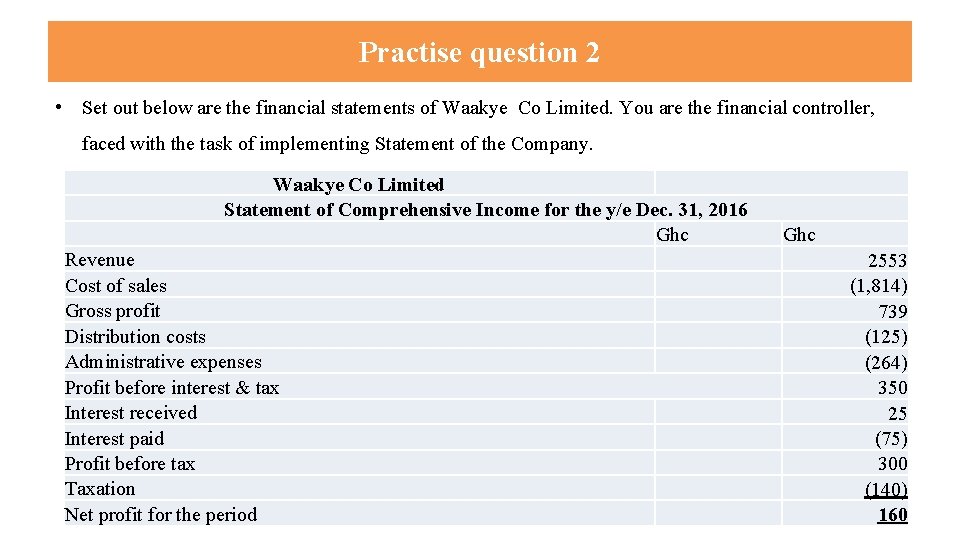
Practise question 2 • Set out below are the financial statements of Waakye Co Limited. You are the financial controller, faced with the task of implementing Statement of the Company. Waakye Co Limited Statement of Comprehensive Income for the y/e Dec. 31, 2016 Ghc Revenue Cost of sales Gross profit Distribution costs Administrative expenses Profit before interest & tax Interest received Interest paid Profit before tax Taxation Net profit for the period Ghc 2553 (1, 814) 739 (125) (264) 350 25 (75) 300 (140) 16 160
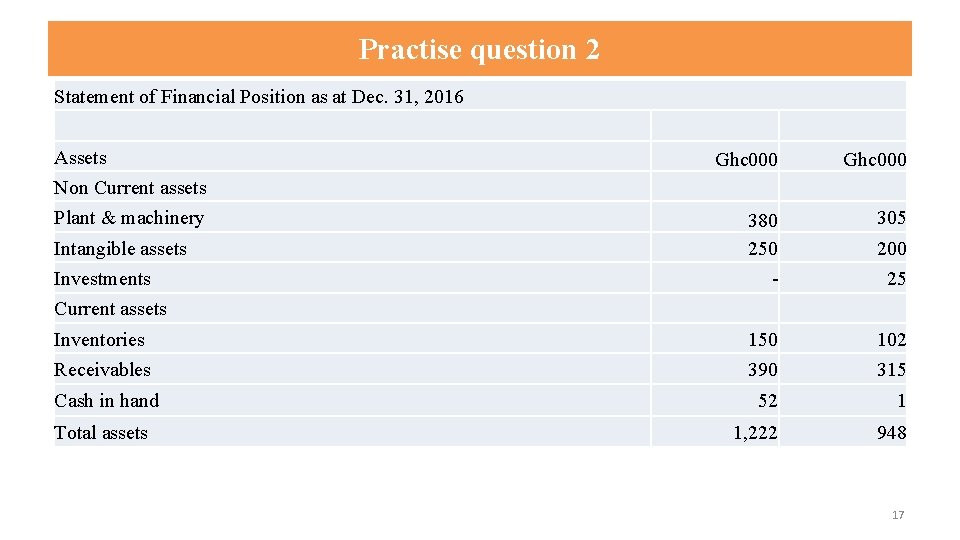
Practise question 2 Statement of Financial Position as at Dec. 31, 2016 Assets Ghc 000 380 250 305 - 25 Inventories 150 102 Receivables 390 315 Cash in hand 52 1 1, 222 948 Non Current assets Plant & machinery Intangible assets Investments 200 Current assets Total assets 17
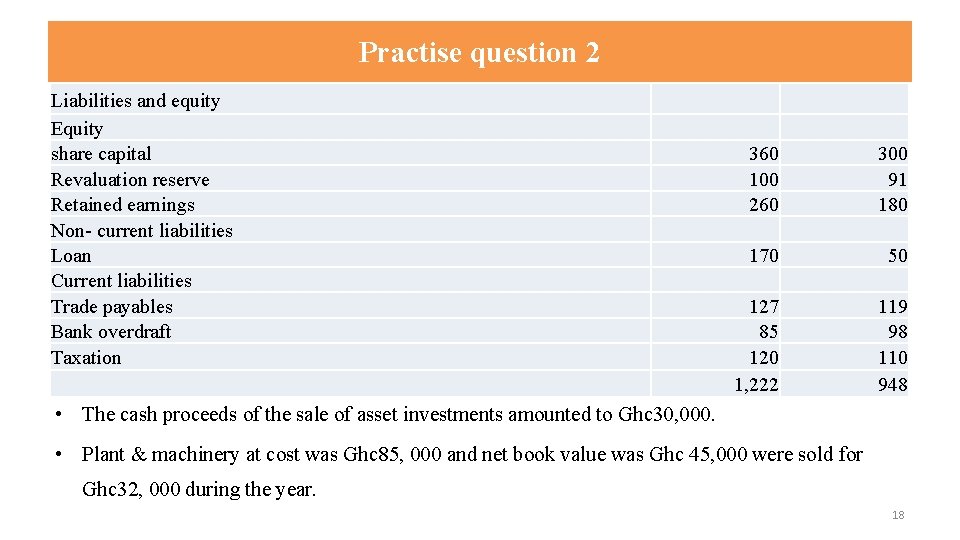
Practise question 2 Liabilities and equity Equity share capital Revaluation reserve Retained earnings Non- current liabilities Loan Current liabilities Trade payables Bank overdraft Taxation 360 100 260 300 91 180 170 50 127 85 120 1, 222 119 98 110 948 • The cash proceeds of the sale of asset investments amounted to Ghc 30, 000. • Plant & machinery at cost was Ghc 85, 000 and net book value was Ghc 45, 000 were sold for Ghc 32, 000 during the year. 18
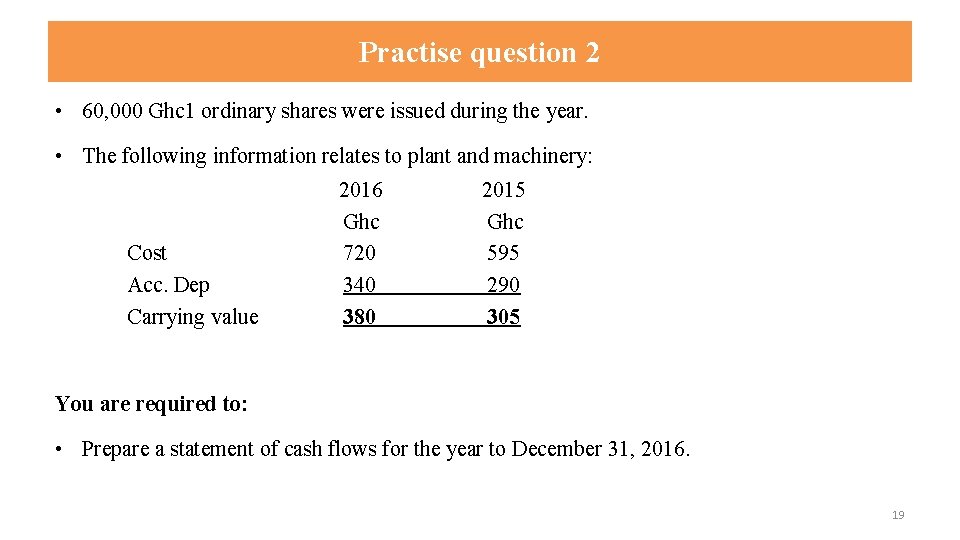
Practise question 2 • 60, 000 Ghc 1 ordinary shares were issued during the year. • The following information relates to plant and machinery: Cost Acc. Dep Carrying value 2016 Ghc 720 340 380 2015 Ghc 595 290 305 You are required to: • Prepare a statement of cash flows for the year to December 31, 2016. 19
- Slides: 19