
FINANCIAL ACCOUNTING Fifth Edition Thomas Dyckman Robert Magee
FINANCIAL ACCOUNTING Fifth Edition Thomas Dyckman Robert Magee Michelle Hanlon Glenn Pfeiffer CHAPTER 8 Reporting and Analyzing Long-Term Operating Assets ©Cambridge Business Publishers, 2017
2 Learning Objective 1 Describe and distinguish between tangible and intangible assets. ©Cambridge Business Publishers, 2017
3 Long-Term Operating Assets Two common characteristics: § Acquired for the purpose of producing and delivering products and services that generate revenues § Help produce revenues for multiple periods ©Cambridge Business Publishers, 2017
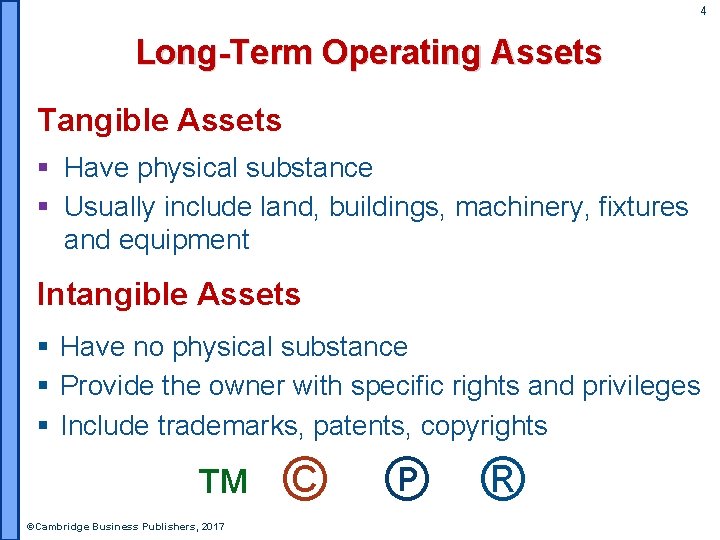
4 Long-Term Operating Assets Tangible Assets § Have physical substance § Usually include land, buildings, machinery, fixtures and equipment Intangible Assets § Have no physical substance § Provide the owner with specific rights and privileges § Include trademarks, patents, copyrights ™ © ℗ ® ©Cambridge Business Publishers, 2017
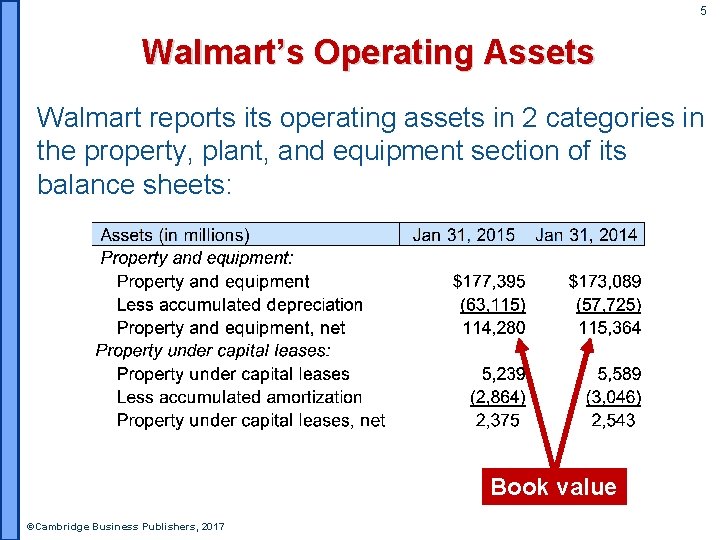
5 Walmart’s Operating Assets Walmart reports its operating assets in 2 categories in the property, plant, and equipment section of its balance sheets: Book value ©Cambridge Business Publishers, 2017

6 Learning Objective 2 Determine which costs to capitalize and report as assets and which costs to expense. ©Cambridge Business Publishers, 2017
7 Capitalized Costs § Reported as assets on the balance sheet § Called capital expenditures § Must include all costs necessary to acquire an asset and prepare it for its intended use § Includes § § § Installation costs Taxes Shipping costs Legal fees Setup and calibration costs Asset retirement obligations ©Cambridge Business Publishers, 2017
8 Capital Expenditure Characteristics that expenditures must possess to be capitalized: 1. The asset must be owned or controlled by the company. 2. The asset must be expected to provide future benefits. § Must be directly linked to future benefits Capitalized costs cannot exceed the expected future benefits to be derived from the use of the asset. ©Cambridge Business Publishers, 2017
9 Constructed Assets When assets are constructed by a company for its own use, capitalized costs should include: § All direct material and labor costs, and § A reasonable amount of overhead costs, and § Capitalized interest § Interest expenses associated with debt incurred to finance the construction § Only if specific criteria are met ©Cambridge Business Publishers, 2017
10 Costs Subsequent to Acquisition Additional costs incurred after an asset is placed in service: § Improvement or betterment § Consist of outlays that enhance the usefulness of the asset or extend the asset’s useful life beyond the original expectation § Costs should be capitalized § Routine repairs and maintenance § Expensed in the period incurred ©Cambridge Business Publishers, 2017
11 Depreciation § Cost of PPE assets is allocated systematically to expense over the time period that the assets are expected to help produce revenue § Cost allocation process is known as depreciation § Cost transferred from the balance sheet to the income statement Depreciation is a systematic allocation of the cost of an asset to expense over time. ©Cambridge Business Publishers, 2017
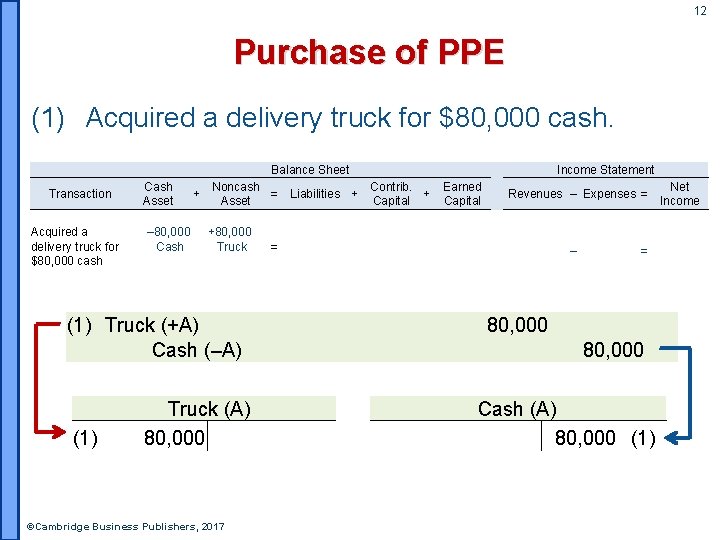
12 Purchase of PPE (1) Acquired a delivery truck for $80, 000 cash. Balance Sheet Transaction Acquired a delivery truck for $80, 000 cash Cash Asset – 80, 000 Cash + Noncash = Asset +80, 000 Truck (1) Truck (+A) Cash (–A) (1) Truck (A) 80, 000 ©Cambridge Business Publishers, 2017 Liabilities + Income Statement Contrib. + Capital Earned Capital Revenues – Expenses = = – = 80, 000 Cash (A) 80, 000 (1) Net Income
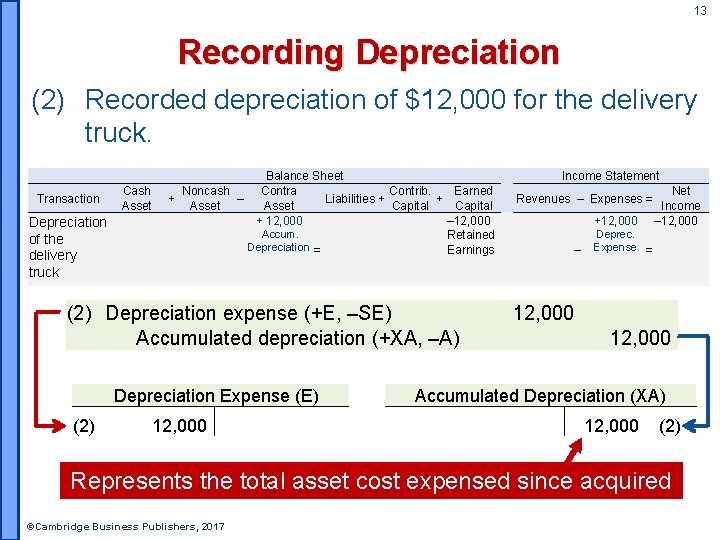
13 Recording Depreciation (2) Recorded depreciation of $12, 000 for the delivery truck. Transaction Cash Asset Noncash + ‒ Asset Depreciation of the delivery truck Balance Sheet Contra Contrib. Earned Liabilities + + Asset Capital + 12, 000 – 12, 000 Accum. Retained Depreciation = Earnings (2) Depreciation expense (+E, –SE) Accumulated depreciation (+XA, –A) Depreciation Expense (E) (2) 12, 000 Income Statement Revenues – Expenses = +12, 000 – Net Income – 12, 000 Deprec. Expense = 12, 000 Accumulated Depreciation (XA) 12, 000 (2) Represents the total asset cost expensed since acquired ©Cambridge Business Publishers, 2017
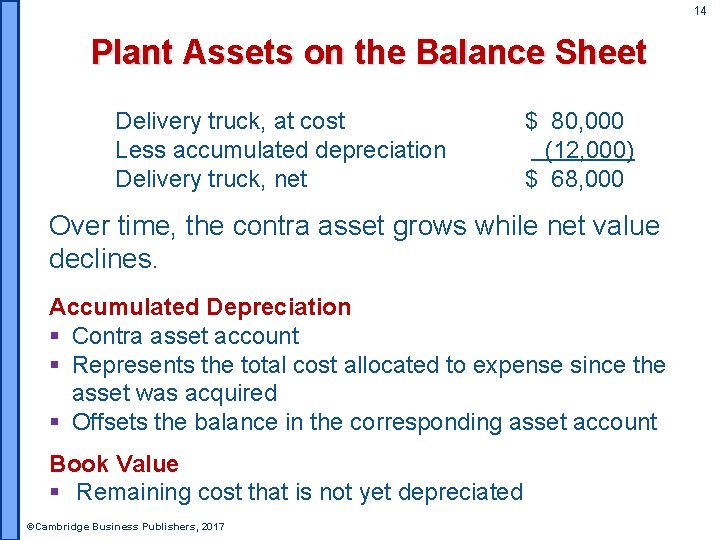
14 Plant Assets on the Balance Sheet Delivery truck, at cost Less accumulated depreciation Delivery truck, net $ 80, 000 (12, 000) $ 68, 000 Over time, the contra asset grows while net value declines. Accumulated Depreciation § Contra asset account § Represents the total cost allocated to expense since the asset was acquired § Offsets the balance in the corresponding asset account Book Value § Remaining cost that is not yet depreciated ©Cambridge Business Publishers, 2017
15 Learning Objective 3 Apply different depreciation methods to allocate the cost of assets over time. ©Cambridge Business Publishers, 2017
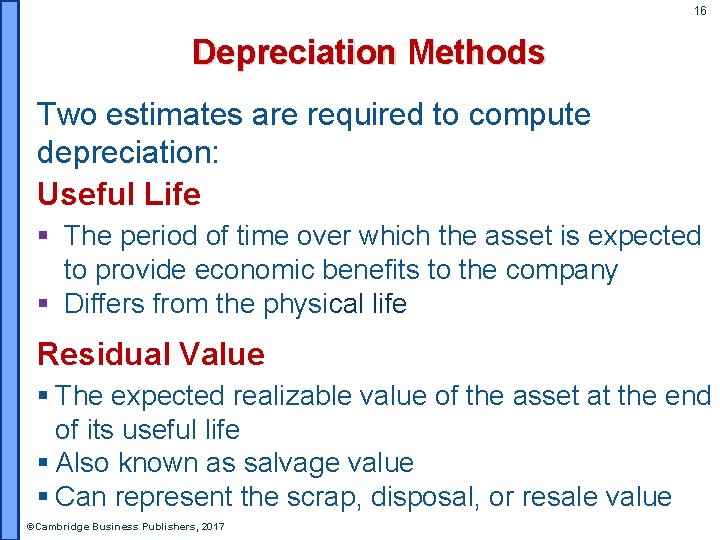
16 Depreciation Methods Two estimates are required to compute depreciation: Useful Life § The period of time over which the asset is expected to provide economic benefits to the company § Differs from the physical life Residual Value § The expected realizable value of the asset at the end of its useful life § Also known as salvage value § Can represent the scrap, disposal, or resale value ©Cambridge Business Publishers, 2017
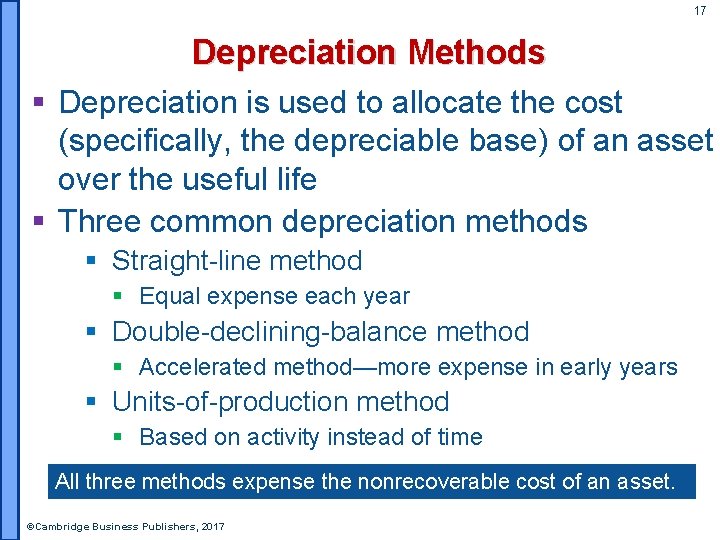
17 Depreciation Methods § Depreciation is used to allocate the cost (specifically, the depreciable base) of an asset over the useful life § Three common depreciation methods § Straight-line method § Equal expense each year § Double-declining-balance method § Accelerated method—more expense in early years § Units-of-production method § Based on activity instead of time All three methods expense the nonrecoverable cost of an asset. ©Cambridge Business Publishers, 2017
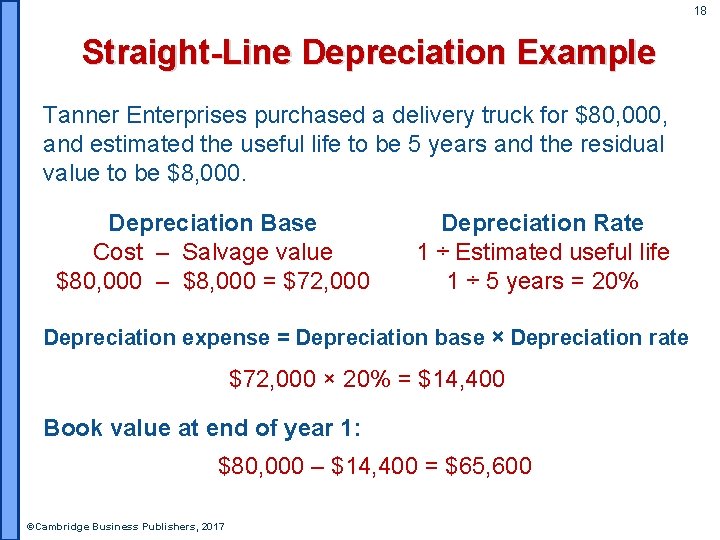
18 Straight-Line Depreciation Example Tanner Enterprises purchased a delivery truck for $80, 000, and estimated the useful life to be 5 years and the residual value to be $8, 000. Depreciation Base Cost – Salvage value $80, 000 – $8, 000 = $72, 000 Depreciation Rate 1 ÷ Estimated useful life 1 ÷ 5 years = 20% Depreciation expense = Depreciation base × Depreciation rate $72, 000 × 20% = $14, 400 Book value at end of year 1: $80, 000 – $14, 400 = $65, 600 ©Cambridge Business Publishers, 2017
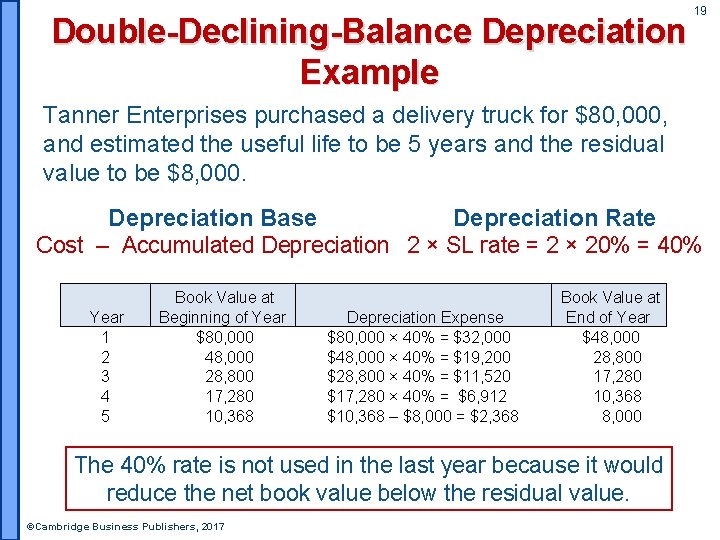
Double-Declining-Balance Depreciation Example 19 Tanner Enterprises purchased a delivery truck for $80, 000, and estimated the useful life to be 5 years and the residual value to be $8, 000. Depreciation Base Depreciation Rate Cost – Accumulated Depreciation 2 × SL rate = 2 × 20% = 40% Year 1 2 3 4 5 Book Value at Beginning of Year $80, 000 48, 000 28, 800 17, 280 10, 368 Depreciation Expense $80, 000 × 40% = $32, 000 $48, 000 × 40% = $19, 200 $28, 800 × 40% = $11, 520 $17, 280 × 40% = $6, 912 $10, 368 – $8, 000 = $2, 368 Book Value at End of Year $48, 000 28, 800 17, 280 10, 368 8, 000 The 40% rate is not used in the last year because it would reduce the net book value below the residual value. ©Cambridge Business Publishers, 2017
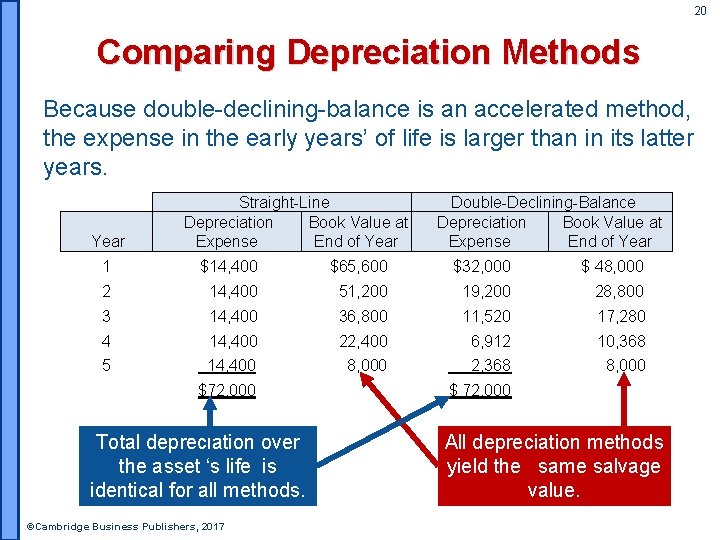
20 Comparing Depreciation Methods Because double-declining-balance is an accelerated method, the expense in the early years’ of life is larger than in its latter years. Year Straight-Line Depreciation Book Value at Expense End of Year Double-Declining-Balance Depreciation Book Value at Expense End of Year 1 $14, 400 $65, 600 $32, 000 $ 48, 000 2 14, 400 51, 200 19, 200 28, 800 3 14, 400 36, 800 11, 520 17, 280 4 14, 400 22, 400 6, 912 10, 368 5 14, 400 8, 000 2, 368 8, 000 $72, 000 Total depreciation over the asset ‘s life is identical for all methods. ©Cambridge Business Publishers, 2017 $ 72, 000 All depreciation methods yield the same salvage value.
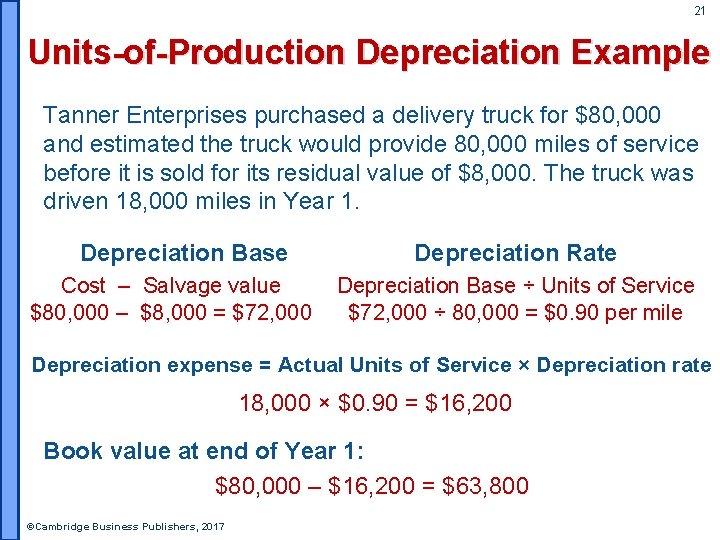
21 Units-of-Production Depreciation Example Tanner Enterprises purchased a delivery truck for $80, 000 and estimated the truck would provide 80, 000 miles of service before it is sold for its residual value of $8, 000. The truck was driven 18, 000 miles in Year 1. Depreciation Base Cost – Salvage value $80, 000 – $8, 000 = $72, 000 Depreciation Rate Depreciation Base ÷ Units of Service $72, 000 ÷ 80, 000 = $0. 90 per mile Depreciation expense = Actual Units of Service × Depreciation rate 18, 000 × $0. 90 = $16, 200 Book value at end of Year 1: $80, 000 – $16, 200 = $63, 800 ©Cambridge Business Publishers, 2017
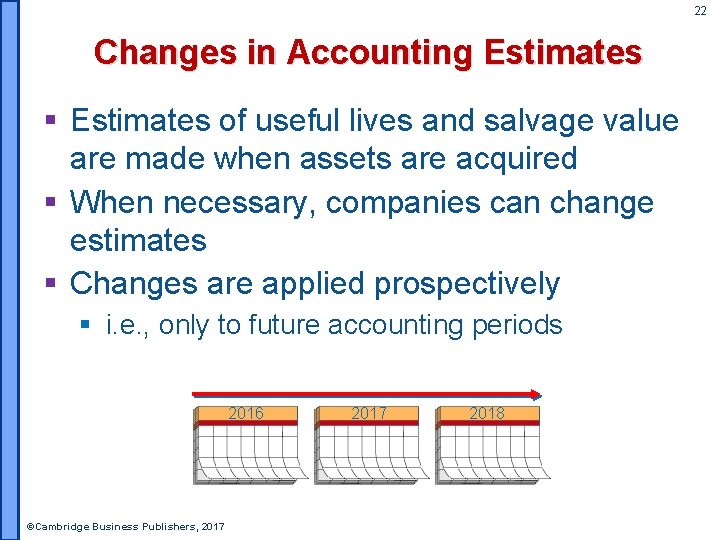
22 Changes in Accounting Estimates § Estimates of useful lives and salvage value are made when assets are acquired § When necessary, companies can change estimates § Changes are applied prospectively § i. e. , only to future accounting periods 2016 ©Cambridge Business Publishers, 2017 2018
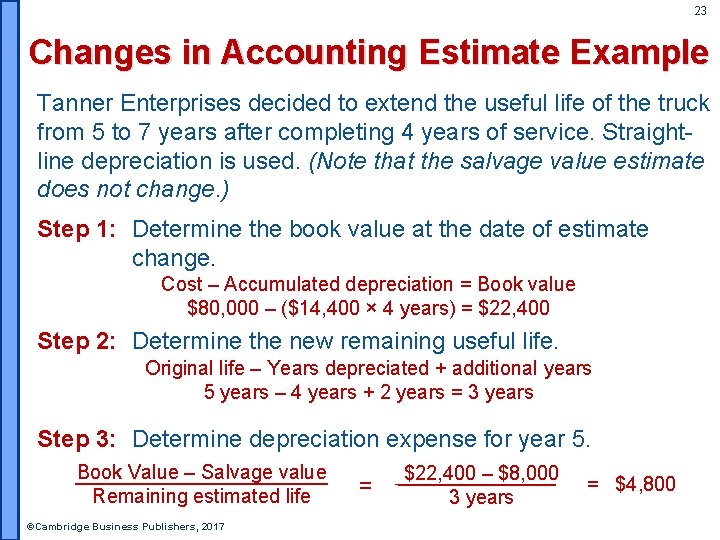
23 Changes in Accounting Estimate Example Tanner Enterprises decided to extend the useful life of the truck from 5 to 7 years after completing 4 years of service. Straightline depreciation is used. (Note that the salvage value estimate does not change. ) Step 1: Determine the book value at the date of estimate change. Cost – Accumulated depreciation = Book value $80, 000 – ($14, 400 × 4 years) = $22, 400 Step 2: Determine the new remaining useful life. Original life – Years depreciated + additional years 5 years – 4 years + 2 years = 3 years Step 3: Determine depreciation expense for year 5. Book Value – Salvage value Remaining estimated life ©Cambridge Business Publishers, 2017 = $22, 400 – $8, 000 3 years = $4, 800
24 Learning Objective 4 Determine the effects of asset sales and impairments on financial statements. ©Cambridge Business Publishers, 2017
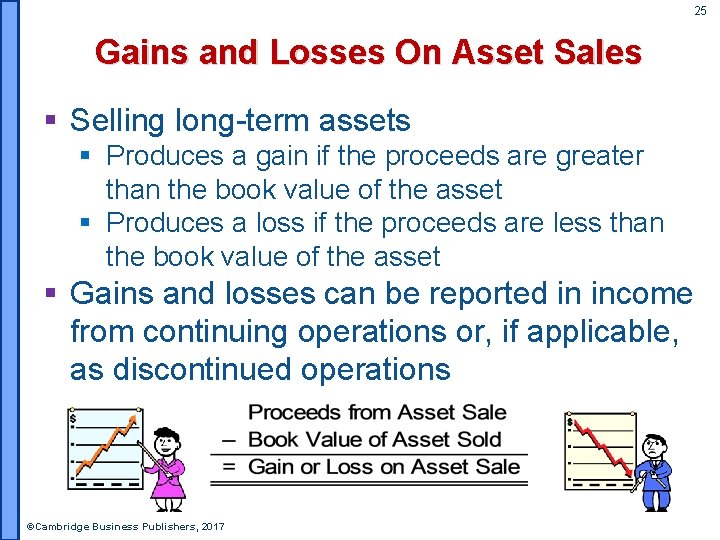
25 Gains and Losses On Asset Sales § Selling long-term assets § Produces a gain if the proceeds are greater than the book value of the asset § Produces a loss if the proceeds are less than the book value of the asset § Gains and losses can be reported in income from continuing operations or, if applicable, as discontinued operations ©Cambridge Business Publishers, 2017
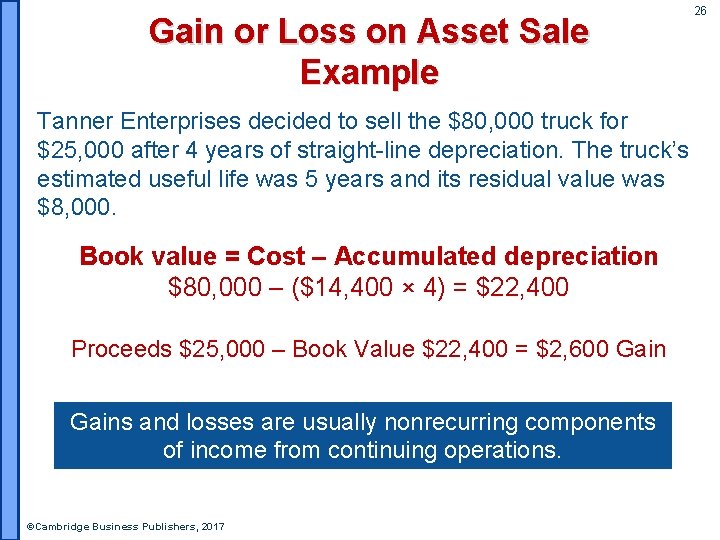
Gain or Loss on Asset Sale Example Tanner Enterprises decided to sell the $80, 000 truck for $25, 000 after 4 years of straight-line depreciation. The truck’s estimated useful life was 5 years and its residual value was $8, 000. Book value = Cost – Accumulated depreciation $80, 000 – ($14, 400 × 4) = $22, 400 Proceeds $25, 000 – Book Value $22, 400 = $2, 600 Gains and losses are usually nonrecurring components of income from continuing operations. ©Cambridge Business Publishers, 2017 26
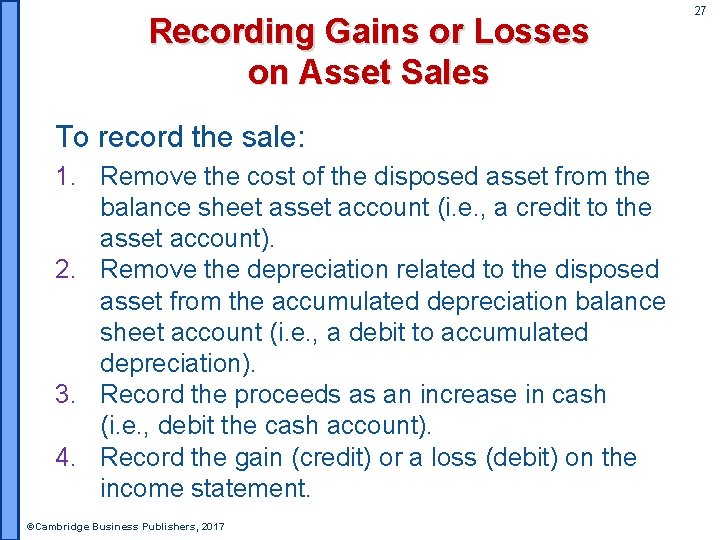
Recording Gains or Losses on Asset Sales To record the sale: 1. Remove the cost of the disposed asset from the balance sheet asset account (i. e. , a credit to the asset account). 2. Remove the depreciation related to the disposed asset from the accumulated depreciation balance sheet account (i. e. , a debit to accumulated depreciation). 3. Record the proceeds as an increase in cash (i. e. , debit the cash account). 4. Record the gain (credit) or a loss (debit) on the income statement. ©Cambridge Business Publishers, 2017 27
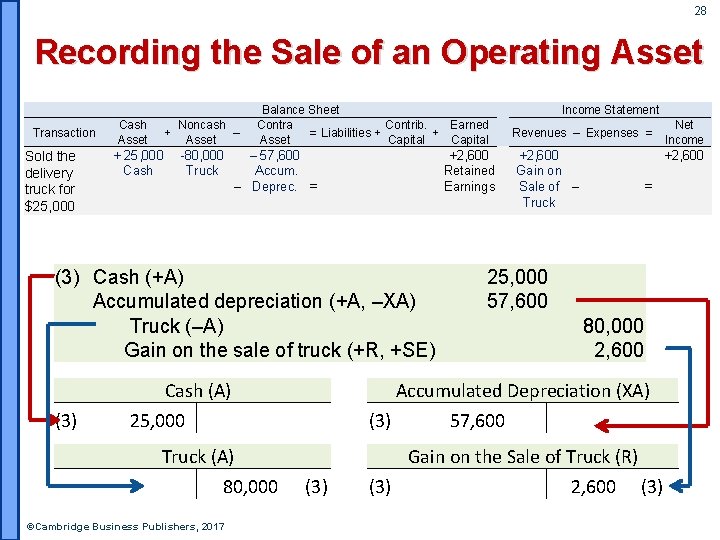
28 Recording the Sale of an Operating Asset Transaction Sold the delivery truck for $25, 000 Cash Asset + + 25, 000 Cash Noncash ‒ Asset -80, 000 Truck Balance Sheet Contra Contrib. Earned = Liabilities + + Asset Capital ‒ 57, 600 Accum. ‒ Deprec. = +2, 600 Retained Earnings (3) Cash (+A) Accumulated depreciation (+A, –XA) Truck (–A) Gain on the sale of truck (+R, +SE) (3) Cash (A) 25, 000 Truck (A) 80, 000 ©Cambridge Business Publishers, 2017 Income Statement Revenues – Expenses = +2, 600 Gain on Sale of – Truck +2, 600 = 25, 000 57, 600 80, 000 2, 600 Accumulated Depreciation (XA) (3) 57, 600 (3) Net Income Gain on the Sale of Truck (R) (3) 2, 600 (3)

29 Asset Impairments Companies must recognize losses on assets if impairment exists. When does impairment exist? § When market values of long-term assets decline to less than book value, and § It can be determined that the asset’s value is permanently impaired ©Cambridge Business Publishers, 2017
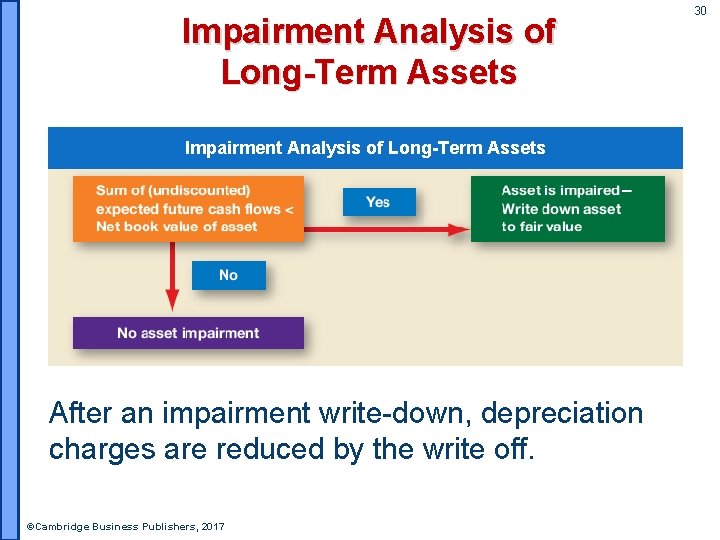
Impairment Analysis of Long-Term Assets After an impairment write-down, depreciation charges are reduced by the write off. ©Cambridge Business Publishers, 2017 30
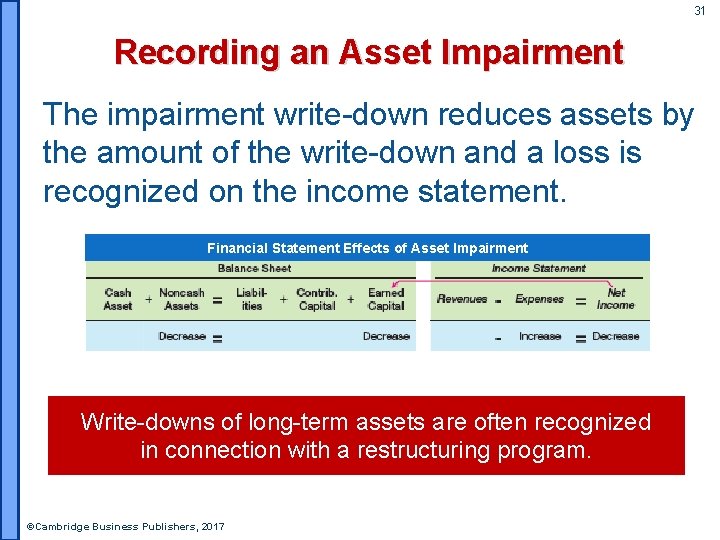
31 Recording an Asset Impairment The impairment write-down reduces assets by the amount of the write-down and a loss is recognized on the income statement. Financial Statement Effects of Asset Impairment Write-downs of long-term assets are often recognized in connection with a restructuring program. ©Cambridge Business Publishers, 2017

Potential Challenges of Asset Impairments Analysis of asset write-downs present two potential challenges: Insufficient Write-Down Assets sometimes are impaired to a larger degree than is actually recognized. Aggressive Write-Down The “big bath” scenario can arise if income is currently and severely depressed. ©Cambridge Business Publishers, 2017 32

33 IFRS Reporting Insight A Single-step process is used. § Compare asset’s balance-sheet carrying value to the asset’s recoverable amount § Recoverable amount is the higher of its fair value or the asset’s value in current use (present value of its future cash flows from current use) § Excess is the amount of impairment § Impairment loss is included in income § Asset can be revalued upward to fair value if fair value can be reliably measured ©Cambridge Business Publishers, 2017
34 Walmart’s Footnote Disclosure Walmart reported the following disclosure for its property and equipment for its year ending January 31, 2015: Depreciation Method Estimated Useful Lives Property and equipment are stated at cost. Gains or losses on disposition are recognized as earned or incurred. Costs of major improvements are capitalized, while costs of normal repairs and maintenance are charged to expense as incurred. The following table summarizes the Company’s property and equipment balances and includes the estimated useful lives that are generally used to depreciate the assets on a straight-line basis: ©Cambridge Business Publishers, 2017
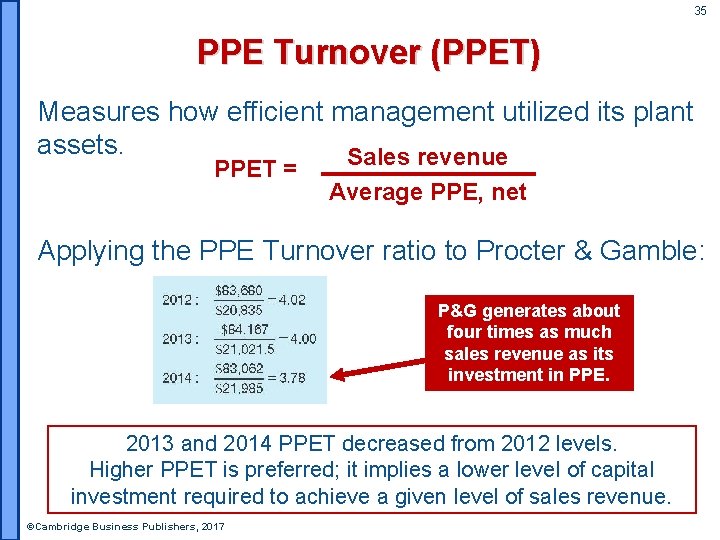
35 PPE Turnover (PPET) Measures how efficient management utilized its plant assets. Sales revenue PPET = Average PPE, net Applying the PPE Turnover ratio to Procter & Gamble: P&G generates about four times as much sales revenue as its investment in PPE. 2013 and 2014 PPET decreased from 2012 levels. Higher PPET is preferred; it implies a lower level of capital investment required to achieve a given level of sales revenue. ©Cambridge Business Publishers, 2017

36 Comparison of PPE Turnover at P&G and a Competitor ©Cambridge Business Publishers, 2017
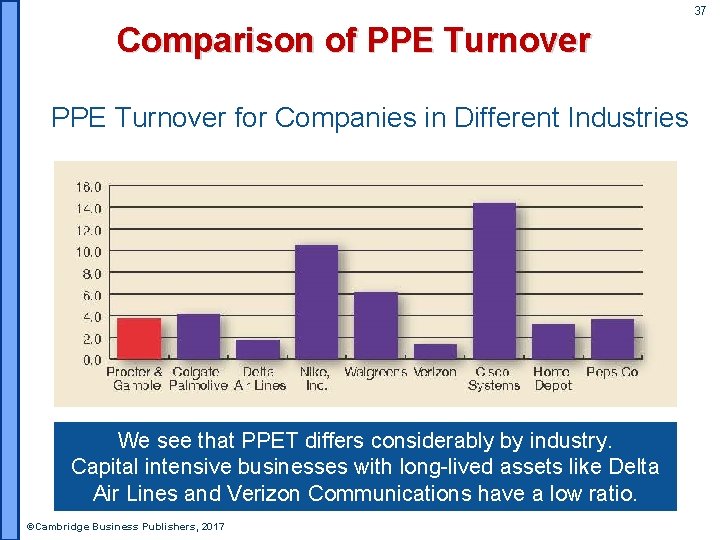
37 Comparison of PPE Turnover for Companies in Different Industries We see that PPET differs considerably by industry. Capital intensive businesses with long-lived assets like Delta Air Lines and Verizon Communications have a low ratio. ©Cambridge Business Publishers, 2017
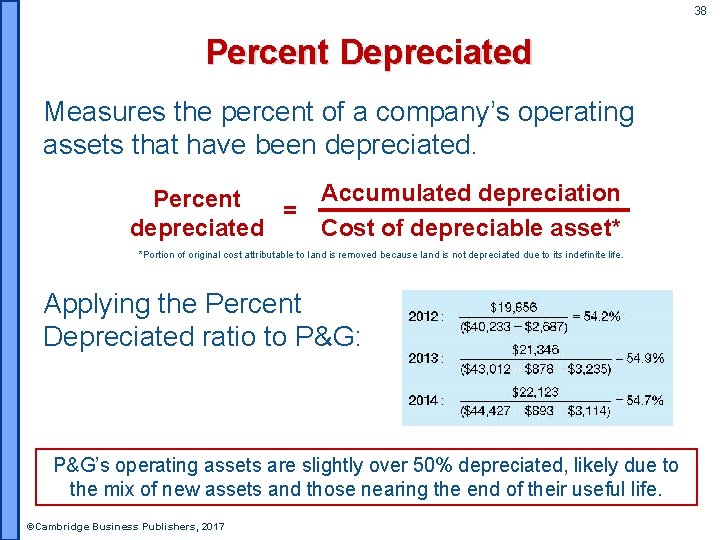
38 Percent Depreciated Measures the percent of a company’s operating assets that have been depreciated. Percent = depreciated Accumulated depreciation Cost of depreciable asset* *Portion of original cost attributable to land is removed because land is not depreciated due to its indefinite life. Applying the Percent Depreciated ratio to P&G: P&G’s operating assets are slightly over 50% depreciated, likely due to the mix of new assets and those nearing the end of their useful life. ©Cambridge Business Publishers, 2017
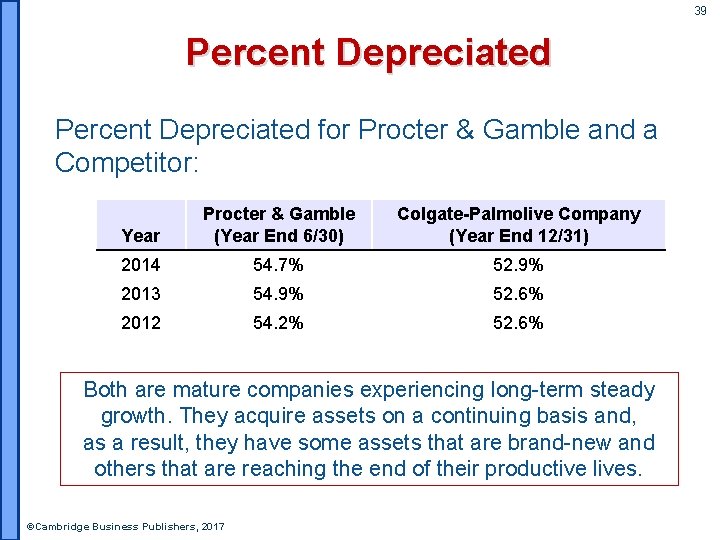
39 Percent Depreciated for Procter & Gamble and a Competitor: Year Procter & Gamble (Year End 6/30) Colgate-Palmolive Company (Year End 12/31) 2014 54. 7% 52. 9% 2013 54. 9% 52. 6% 2012 54. 2% 52. 6% Both are mature companies experiencing long-term steady growth. They acquire assets on a continuing basis and, as a result, they have some assets that are brand-new and others that are reaching the end of their productive lives. ©Cambridge Business Publishers, 2017
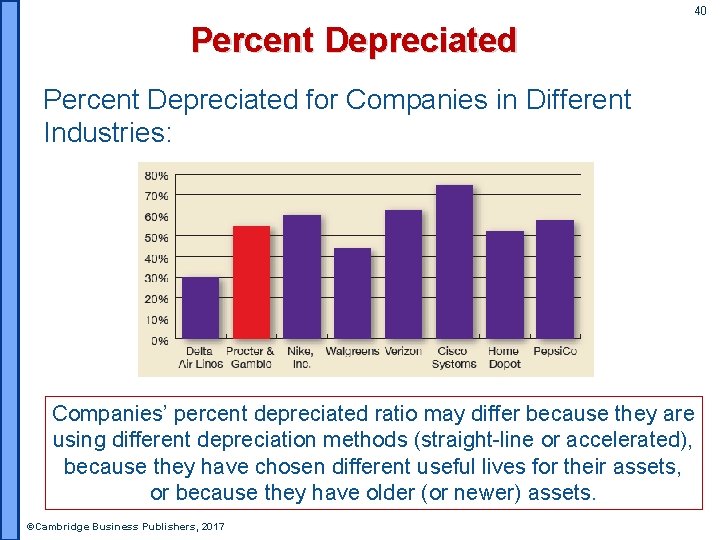
40 Percent Depreciated for Companies in Different Industries: Companies’ percent depreciated ratio may differ because they are using different depreciation methods (straight-line or accelerated), because they have chosen different useful lives for their assets, or because they have older (or newer) assets. ©Cambridge Business Publishers, 2017
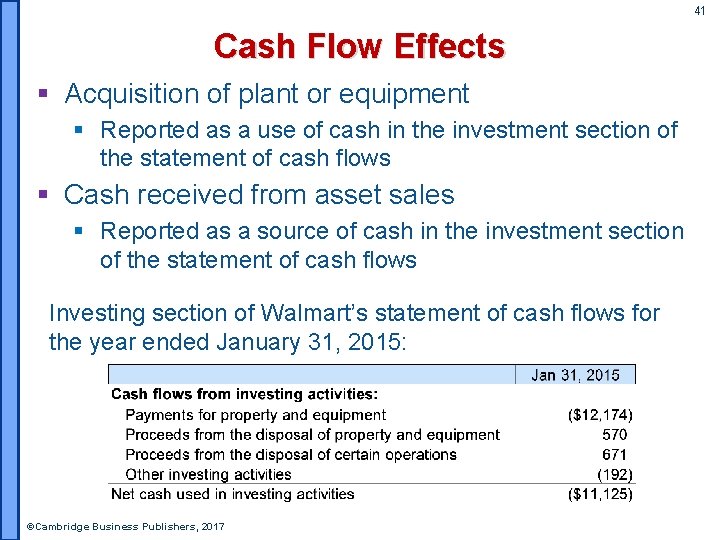
41 Cash Flow Effects § Acquisition of plant or equipment § Reported as a use of cash in the investment section of the statement of cash flows § Cash received from asset sales § Reported as a source of cash in the investment section of the statement of cash flows Investing section of Walmart’s statement of cash flows for the year ended January 31, 2015: ©Cambridge Business Publishers, 2017
42 Learning Objective 5 Describe the accounting and reporting for intangible assets. ©Cambridge Business Publishers, 2017
43 Intangible Assets Two Categories of Intangible Assets: § Separately Transferable Intangibles § § Those that are the product of contractual or other legal rights Those that are not contractually or legally defined, but can be separated from the company and sold, transferred, or exchanged § Not Separately Transferable Intangibles (Goodwill) § The excess of cost over the fair value of net assets acquired in a business combination ©Cambridge Business Publishers, 2017 ℗ © ™ ®
44 Accounting for Intangible Assets § Can be purchased from another company or individual, or internally developed § Purchase cost is capitalized § Internally developed costs (e. g. , research and development costs) are generally expensed as incurred § Problems with accounting for intangibles § Benefits provided by intangibles are uncertain and difficult to quantify § Useful life often impossible to estimate with confidence ©Cambridge Business Publishers, 2017

45 Patents § What is a patent? § An exclusive right to produce a product or use a technology § Granted to protect the inventor by preventing other companies from copying the innovation § Accounting for costs of patents § If purchased from another company § Capitalized and amortized § If developed internally ℗ § Only legal costs and registration fees are capitalized and amortized ©Cambridge Business Publishers, 2017

46 Copyrights § What is a copyright? § An exclusive right granted by the government to an individual author, composer, play writer, or similar individual § For the life of the creator plus 70 years § Can be acquired § Cost is capitalized and amortized over the expected remaining economic life ©Cambridge Business Publishers, 2017 ©
47 Trademarks § What is a trademark? § A registered name, logo, package design, image, jingle, or slogan that is associated with a product § Accounting for costs of trademarks § If purchased from another company § Capitalize the cost and amortize § If developed internally § Expense as incurred All advertising costs are expensed as incurred, even if the value of a trademark is enhanced by the advertising. ©Cambridge Business Publishers, 2017 ™ ®

48 The Nike Trademark ® In the early 1970’s, Carolyn Davidson, a graduate student studying graphic design, created the Nike swoosh for Phil Knight, owner of Blue Ribbon Sports. Phil was seeking a new logo and asked Carolyn to create a design. Phil chose the now popular ‘swoosh’ logo and paid Carolyn’s invoice of approximately $35 for her work. * Source: Nikebiz: Company Overview: History, 1970 s. “The Birth of the Nike Brand, and Company. ” http: //www. nikebiz. com/company_overview/history/1970 s. html ©Cambridge Business Publishers, 2017
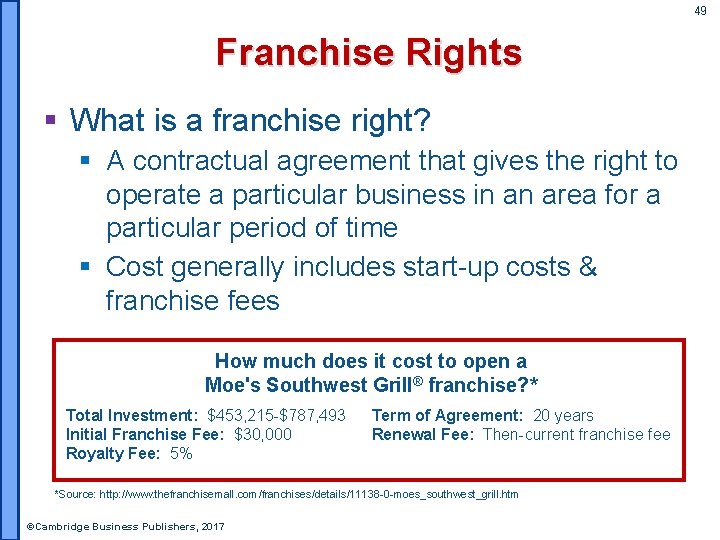
49 Franchise Rights § What is a franchise right? § A contractual agreement that gives the right to operate a particular business in an area for a particular period of time § Cost generally includes start-up costs & franchise fees How much does it cost to open a Moe's Southwest Grill® franchise? * Total Investment: $453, 215 -$787, 493 Initial Franchise Fee: $30, 000 Royalty Fee: 5% Term of Agreement: 20 years Renewal Fee: Then-current franchise fee *Source: http: //www. thefranchisemall. com/franchises/details/11138 -0 -moes_southwest_grill. htm ©Cambridge Business Publishers, 2017
50 Amortization of Intangible Assets § Amortization for intangible assets that have a definite life § Capitalized cost is amortized over the expected useful life of the intangible § Amortization is a systematic allocation of the cost of an intangible asset over its useful life § Straight-line method used most often § Amortization expense reported on the income statement as part of operating income § Often included with selling, general, and administrative expenses ©Cambridge Business Publishers, 2017
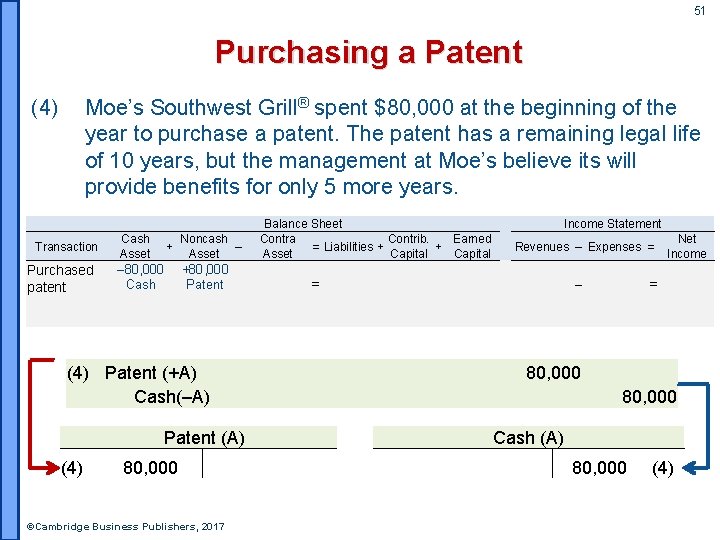
51 Purchasing a Patent (4) Moe’s Southwest Grill® spent $80, 000 at the beginning of the year to purchase a patent. The patent has a remaining legal life of 10 years, but the management at Moe’s believe its will provide benefits for only 5 more years. Transaction Purchased patent Cash Asset Noncash + ‒ Asset ‒ 80, 000 Cash +80, 000 Patent (4) Patent (+A) Cash(–A) Patent (A) (4) 80, 000 ©Cambridge Business Publishers, 2017 Balance Sheet Contra Contrib. Earned = Liabilities + + Asset Capital Income Statement Revenues – Expenses = = – Net Income = 80, 000 Cash (A) 80, 000 (4)
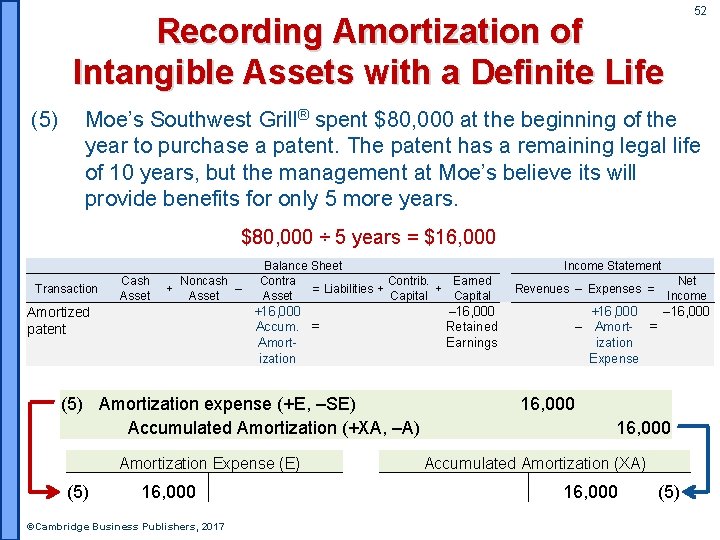
52 Recording Amortization of Intangible Assets with a Definite Life (5) Moe’s Southwest Grill® spent $80, 000 at the beginning of the year to purchase a patent. The patent has a remaining legal life of 10 years, but the management at Moe’s believe its will provide benefits for only 5 more years. $80, 000 ÷ 5 years = $16, 000 Transaction Cash Asset + Noncash ‒ Asset Balance Sheet Contra Contrib. Earned = Liabilities + + Asset Capital +16, 000 Accum. = Amortization Amortized patent (5) Amortization expense (+E, –SE) Accumulated Amortization (+XA, –A) Amortization Expense (E) (5) 16, 000 ©Cambridge Business Publishers, 2017 ‒ 16, 000 Retained Earnings Income Statement Revenues – Expenses = Net Income +16, 000 ‒ 16, 000 – Amort- = ization Expense 16, 000 Accumulated Amortization (XA) 16, 000 (5)
53 Intangibles with Indefinite Lives § Expected useful life of some intangibles extends far enough into the future that it is impossible for management to estimate § Not amortized until the useful life can be specified § Must be tested for impairment annually § Considered to be impaired if the book value of the asset exceeds its fair value § Write-down equal to: Book value – Fair value ©Cambridge Business Publishers, 2017
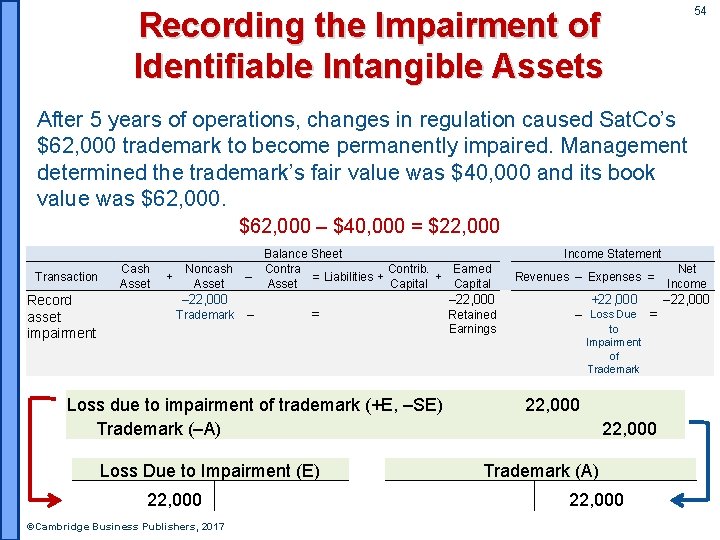
54 Recording the Impairment of Identifiable Intangible Assets After 5 years of operations, changes in regulation caused Sat. Co’s $62, 000 trademark to become permanently impaired. Management determined the trademark’s fair value was $40, 000 and its book value was $62, 000 – $40, 000 = $22, 000 Transaction Record asset impairment Cash Asset + Noncash Asset ‒ Balance Sheet Contra Contrib. Earned = Liabilities + + Asset Capital ‒ 22, 000 Trademark ‒ = Loss due to impairment of trademark (+E, –SE) Trademark (–A) Loss Due to Impairment (E) 22, 000 ©Cambridge Business Publishers, 2017 Income Statement Revenues – Expenses = ‒ 22, 000 +22, 000 Retained Earnings – Loss Due = to Impairment of Trademark 22, 000 Trademark (A) 22, 000 Net Income ‒ 22, 000
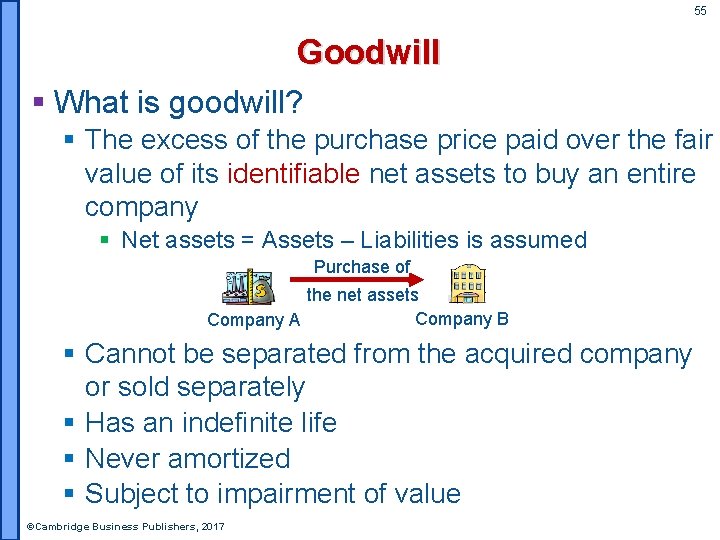
55 Goodwill § What is goodwill? § The excess of the purchase price paid over the fair value of its identifiable net assets to buy an entire company § Net assets = Assets – Liabilities is assumed Purchase of the net assets Company B Company A § Cannot be separated from the acquired company or sold separately § Has an indefinite life § Never amortized § Subject to impairment of value ©Cambridge Business Publishers, 2017
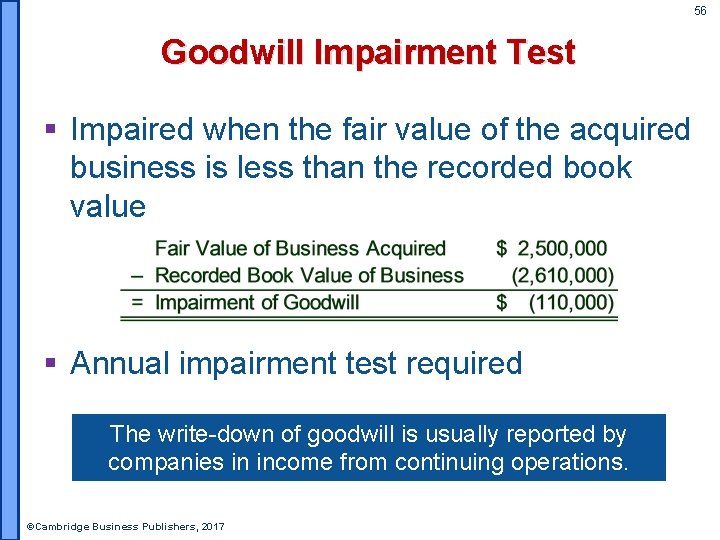
56 Goodwill Impairment Test § Impaired when the fair value of the acquired business is less than the recorded book value § Annual impairment test required The write-down of goodwill is usually reported by companies in income from continuing operations. ©Cambridge Business Publishers, 2017
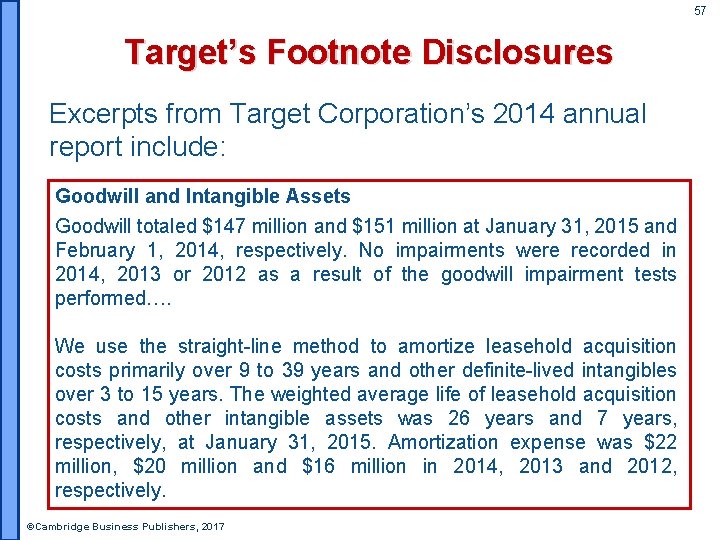
57 Target’s Footnote Disclosures Excerpts from Target Corporation’s 2014 annual report include: Goodwill and Intangible Assets Goodwill totaled $147 million and $151 million at January 31, 2015 and February 1, 2014, respectively. No impairments were recorded in 2014, 2013 or 2012 as a result of the goodwill impairment tests performed…. We use the straight-line method to amortize leasehold acquisition costs primarily over 9 to 39 years and other definite-lived intangibles over 3 to 15 years. The weighted average life of leasehold acquisition costs and other intangible assets was 26 years and 7 years, respectively, at January 31, 2015. Amortization expense was $22 million, $20 million and $16 million in 2014, 2013 and 2012, respectively. ©Cambridge Business Publishers, 2017
58 IFRS Reporting Insight § Recognition of internally developed intangibles § Development costs can be capitalized as intangible assets when specific criteria are met § Company must be able to complete the development process and to produce an intangible asset that will generate future benefits through use or sale § Goodwill must be periodically evaluated for impairment § Once impaired, cannot be revalued upward ©Cambridge Business Publishers, 2017
59 Learning Objective 6 Analyze the effects of tangible and intangible assets on key performance measures. ©Cambridge Business Publishers, 2017
60 Analysis Implications § Hidden assets § Internally generated intangible assets are not capitalized § Uncapitalized assets do not appear on financial statements § Analysis of financial statements can be distorted § Creates an upward bias in asset turnover ratios and ROE § Makes comparison of companies difficult for users ©Cambridge Business Publishers, 2017
The End ©Cambridge Business Publishers, 2017
- Slides: 61