
FINANCIAL ACCOUNTING Fifth Edition Thomas Dyckman Robert Magee
FINANCIAL ACCOUNTING Fifth Edition Thomas Dyckman Robert Magee Michelle Hanlon Glenn Pfeiffer CHAPTER 3 Adjusting Accounts for Financial Statements ©Cambridge Business Publishers, 2017
2 Learning Objective 1 Identify the major steps in accounting cycle. ©Cambridge Business Publishers, 2017 the
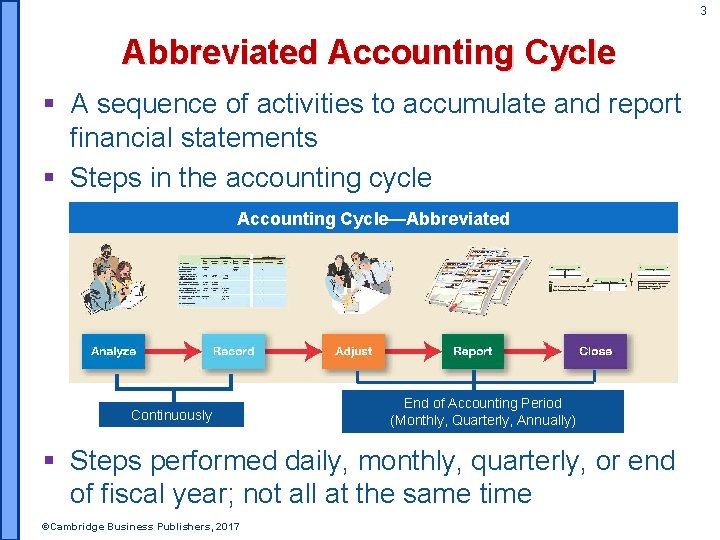
3 Abbreviated Accounting Cycle § A sequence of activities to accumulate and report financial statements § Steps in the accounting cycle Accounting Cycle—Abbreviated Continuously End of Accounting Period (Monthly, Quarterly, Annually) § Steps performed daily, monthly, quarterly, or end of fiscal year; not all at the same time ©Cambridge Business Publishers, 2017
4 Learning Objective 2 Review the process of journalizing and posting transactions. ©Cambridge Business Publishers, 2017
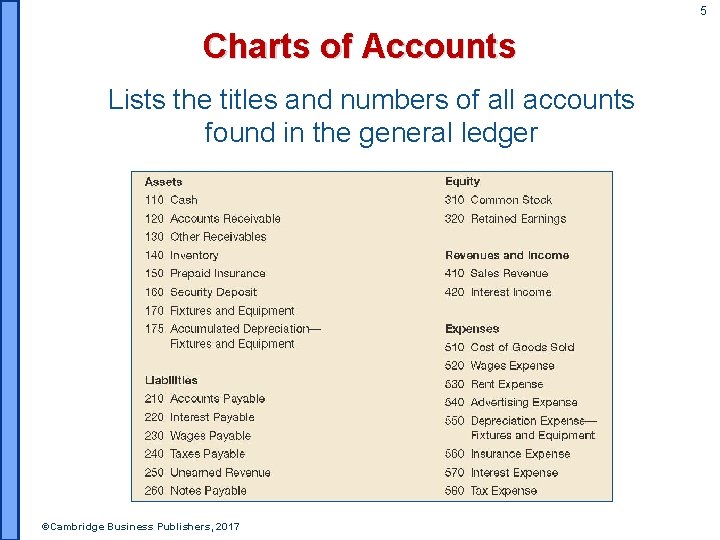
5 Charts of Accounts Lists the titles and numbers of all accounts found in the general ledger ©Cambridge Business Publishers, 2017
6 Review of Accounting Documents § General journal § Tabular, chronological record where business activities are captured in debits and credits § General ledger § Listing of all accounts and their balances § Accounts are grouped in five elements § Assets § Liabilities § Equity § Revenues § Expenses ©Cambridge Business Publishers, 2017
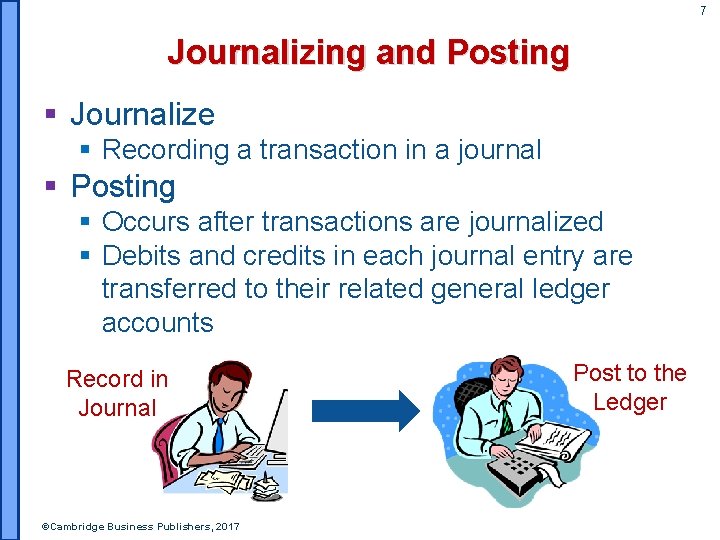
7 Journalizing and Posting § Journalize § Recording a transaction in a journal § Posting § Occurs after transactions are journalized § Debits and credits in each journal entry are transferred to their related general ledger accounts Record in Journal ©Cambridge Business Publishers, 2017 Post to the Ledger
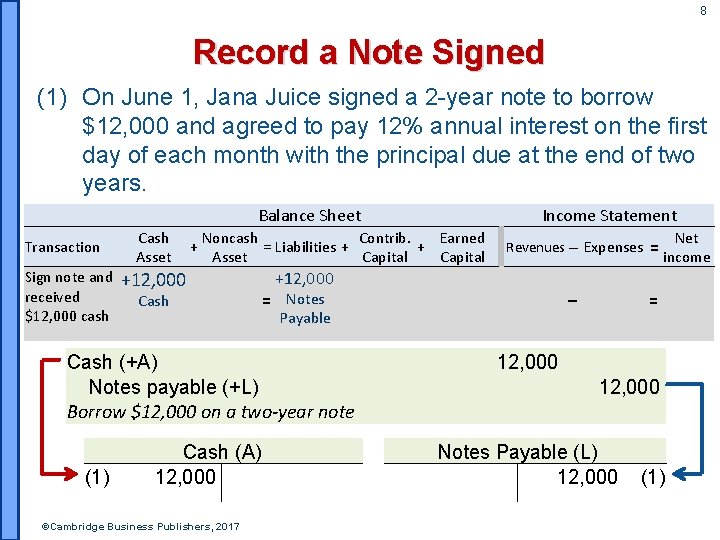
8 Record a Note Signed (1) On June 1, Jana Juice signed a 2 -year note to borrow $12, 000 and agreed to pay 12% annual interest on the first day of each month with the principal due at the end of two years. Balance Sheet Transaction Sign note and received $12, 000 cash Cash Asset + Income Statement Noncash Contrib. Earned = Liabilities + + Asset Capital +12, 000 Cash Revenues – Expenses +12, 000 = Notes – Payable = Cash (+A) Notes payable (+L) Borrow $12, 000 on a two-year note 12, 000 Cash (A) 12, 000 Notes Payable (L) 12, 000 (1) ©Cambridge Business Publishers, 2017 Net = income 12, 000 (1)
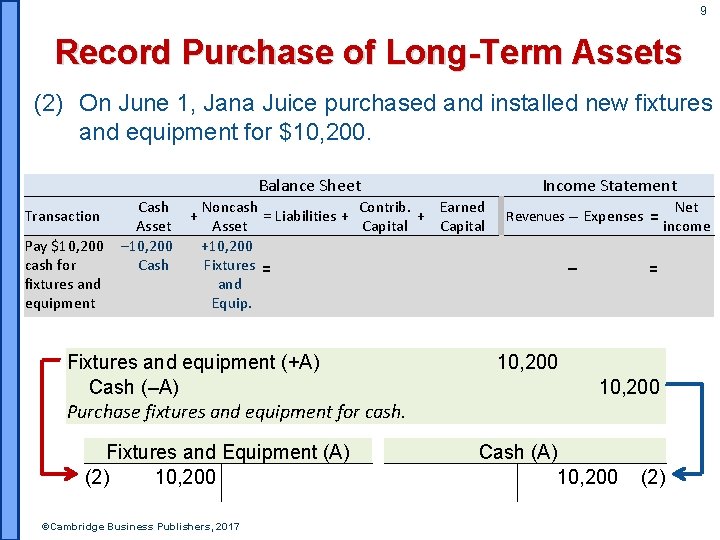
9 Record Purchase of Long-Term Assets (2) On June 1, Jana Juice purchased and installed new fixtures and equipment for $10, 200. Balance Sheet Transaction Pay $10, 200 cash for fixtures and equipment Cash Asset ‒ 10, 200 Cash + Income Statement Noncash Contrib. Earned = Liabilities + + Asset Capital +10, 200 Fixtures = and Equip. Fixtures and equipment (+A) Cash (‒A) Purchase fixtures and equipment for cash. Fixtures and Equipment (A) (2) 10, 200 ©Cambridge Business Publishers, 2017 Revenues – Expenses – Net = income = 10, 200 Cash (A) 10, 200 (2)
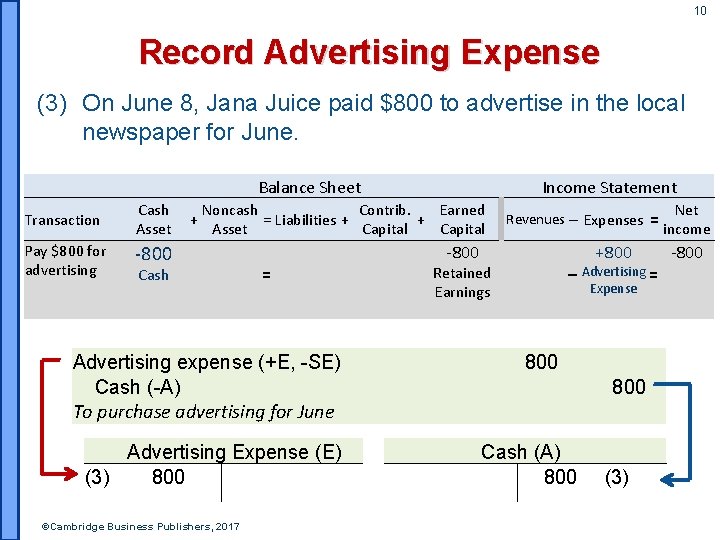
10 Record Advertising Expense (3) On June 8, Jana Juice paid $800 to advertise in the local newspaper for June. Balance Sheet Transaction Cash Asset Pay $800 for advertising -800 + Income Statement Noncash Contrib. Earned = Liabilities + + Asset Capital Cash = Advertising expense (+E, -SE) Cash (-A) To purchase advertising for June Advertising Expense (E) (3) 800 ©Cambridge Business Publishers, 2017 Revenues – Expenses -800 +800 – Advertising = Retained Earnings Expense 800 Cash (A) 800 (3) Net = income -800
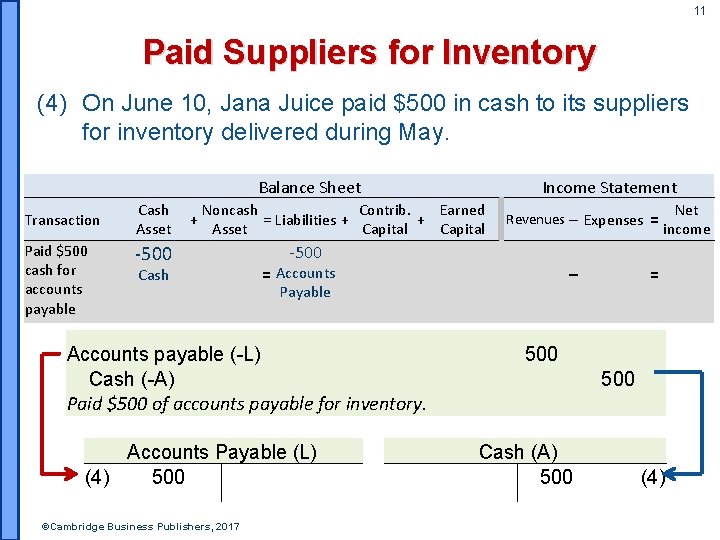
11 Paid Suppliers for Inventory (4) On June 10, Jana Juice paid $500 in cash to its suppliers for inventory delivered during May. Balance Sheet Transaction Paid $500 cash for accounts payable Cash Asset + Income Statement Noncash Contrib. Earned = Liabilities + + Asset Capital -500 Cash -500 = Accounts – Payable Accounts payable (-L) Cash (-A) Paid $500 of accounts payable for inventory. Accounts Payable (L) (4) 500 ©Cambridge Business Publishers, 2017 Revenues – Expenses Net = income = 500 Cash (A) 500 (4)
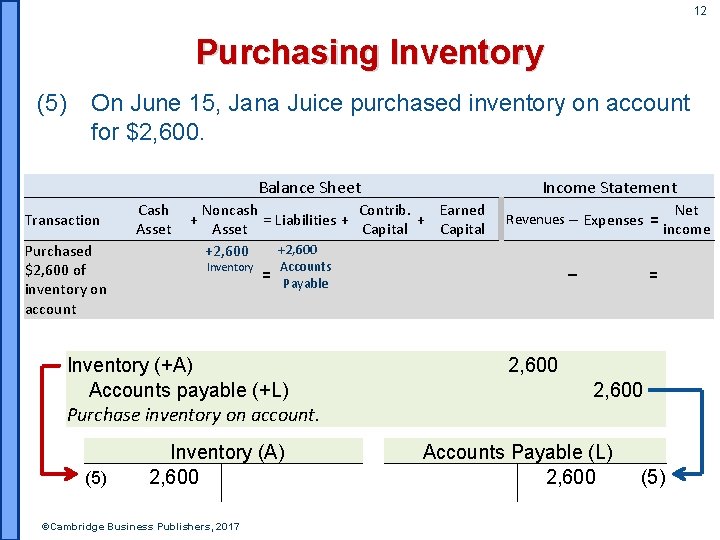
12 Purchasing Inventory (5) On June 15, Jana Juice purchased inventory on account for $2, 600. Balance Sheet Transaction Purchased $2, 600 of inventory on account Cash Asset + Noncash Contrib. Earned = Liabilities + + Asset Capital +2, 600 Inventory = Inventory (A) 2, 600 ©Cambridge Business Publishers, 2017 Revenues – Expenses Accounts Payable Inventory (+A) Accounts payable (+L) Purchase inventory on account. (5) Income Statement – Net = income = 2, 600 Accounts Payable (L) 2, 600 (5)
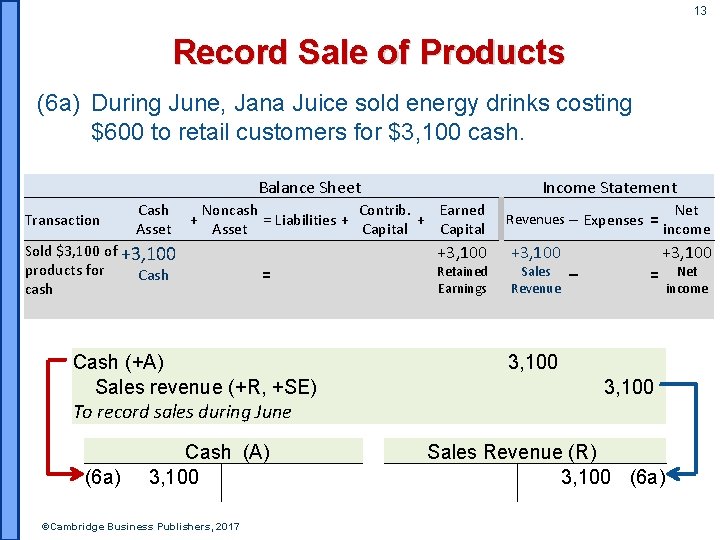
13 Record Sale of Products (6 a) During June, Jana Juice sold energy drinks costing $600 to retail customers for $3, 100 cash. Balance Sheet Transaction Cash Asset + Noncash Contrib. Earned = Liabilities + + Asset Capital Sold $3, 100 of +3, 100 products for Cash cash = Cash (+A) Sales revenue (+R, +SE) To record sales during June (6 a) Income Statement Cash (A) 3, 100 ©Cambridge Business Publishers, 2017 +3, 100 Retained Earnings Revenues – Expenses +3, 100 Sales Revenue – Net = income = +3, 100 Sales Revenue (R) 3, 100 (6 a) Net income
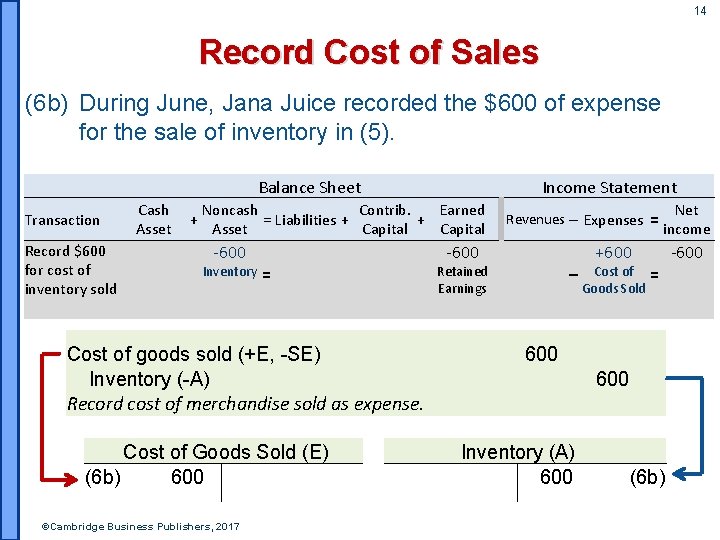
14 Record Cost of Sales (6 b) During June, Jana Juice recorded the $600 of expense for the sale of inventory in (5). Balance Sheet Transaction Record $600 for cost of inventory sold Cash Asset + Income Statement Noncash Contrib. Earned = Liabilities + + Asset Capital -600 Inventory = Cost of goods sold (+E, -SE) Inventory (-A) Record cost of merchandise sold as expense. Cost of Goods Sold (E) (6 b) 600 ©Cambridge Business Publishers, 2017 Revenues – Expenses -600 – Retained Earnings +600 Cost of = Goods Sold 600 Inventory (A) 600 Net = income (6 b) -600
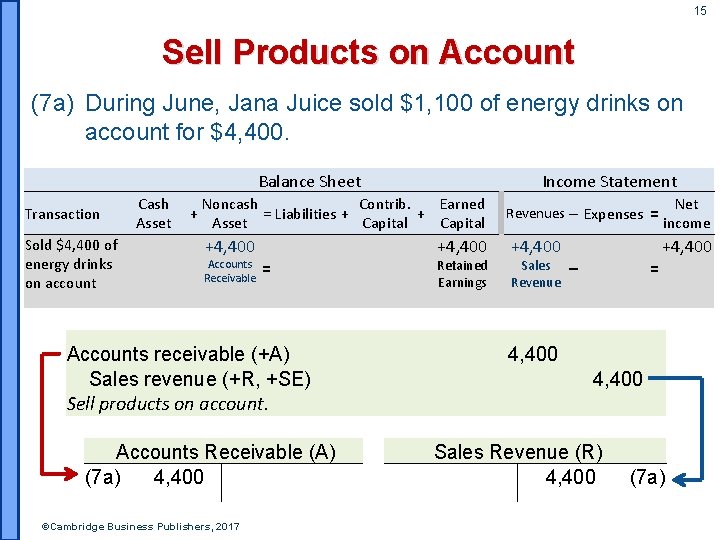
15 Sell Products on Account (7 a) During June, Jana Juice sold $1, 100 of energy drinks on account for $4, 400. Balance Sheet Transaction Sold $4, 400 of energy drinks on account Cash Asset + Income Statement Noncash Contrib. Earned = Liabilities + + Asset Capital Revenues – Expenses +4, 400 Accounts Receivable = Accounts receivable (+A) Sales revenue (+R, +SE) Sell products on account. Accounts Receivable (A) (7 a) 4, 400 ©Cambridge Business Publishers, 2017 +4, 400 Retained Earnings Sales Revenue – Net = income = +4, 400 Sales Revenue (R) 4, 400 (7 a)
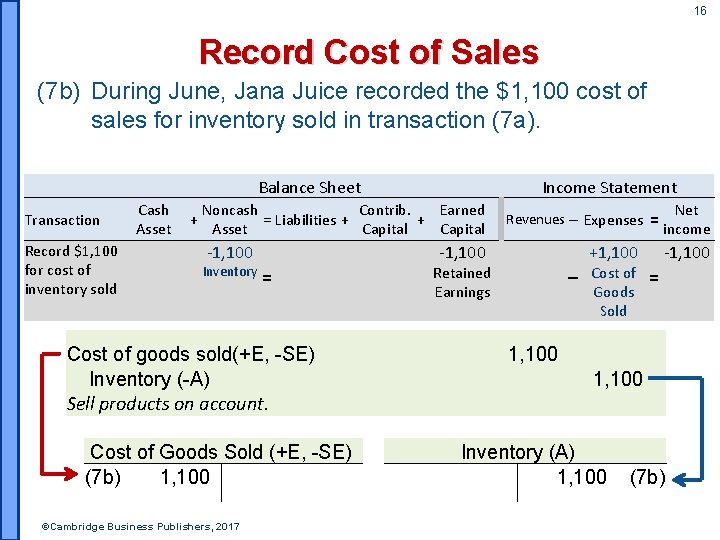
16 Record Cost of Sales (7 b) During June, Jana Juice recorded the $1, 100 cost of sales for inventory sold in transaction (7 a). Balance Sheet Transaction Record $1, 100 for cost of inventory sold Cash Asset + Income Statement Noncash Contrib. Earned = Liabilities + + Asset Capital -1, 100 Inventory -1, 100 = Cost of goods sold(+E, -SE) Inventory (-A) Sell products on account. Cost of Goods Sold (+E, -SE) (7 b) 1, 100 ©Cambridge Business Publishers, 2017 Revenues – Expenses Net = income +1, 100 Retained Earnings – Cost of Goods Sold -1, 100 = 1, 100 Inventory (A) 1, 100 (7 b)
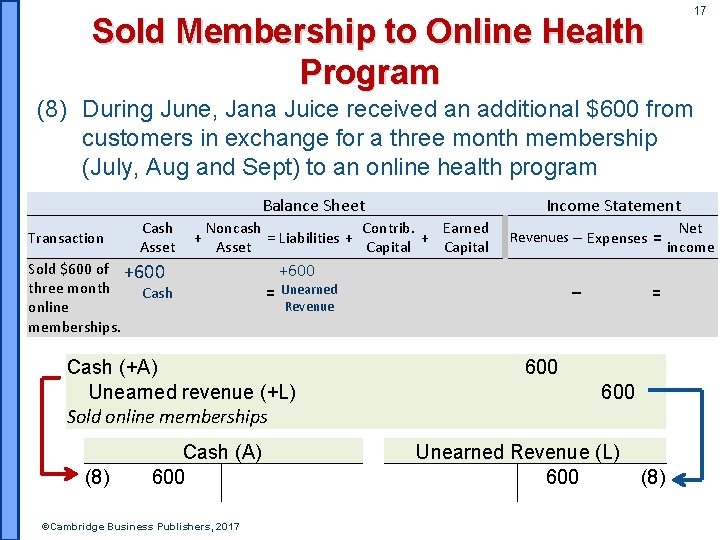
17 Sold Membership to Online Health Program (8) During June, Jana Juice received an additional $600 from customers in exchange for a three month membership (July, Aug and Sept) to an online health program Balance Sheet Transaction Cash Asset + Noncash Contrib. Earned = Liabilities + + Asset Capital Sold $600 of +600 three month Cash online memberships. = Cash (A) 600 ©Cambridge Business Publishers, 2017 Revenues – Expenses +600 – Unearned Revenue Cash (+A) Unearned revenue (+L) Sold online memberships (8) Income Statement Net = income = 600 Unearned Revenue (L) 600 (8)
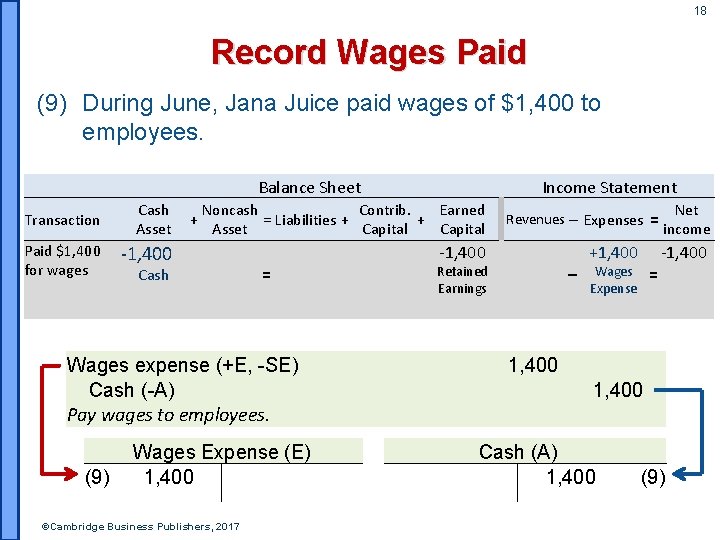
18 Record Wages Paid (9) During June, Jana Juice paid wages of $1, 400 to employees. Balance Sheet Transaction Cash Asset Paid $1, 400 for wages -1, 400 + Noncash Contrib. Earned = Liabilities + + Asset Capital Cash = Wages expense (+E, -SE) Cash (-A) Pay wages to employees. (9) Income Statement Wages Expense (E) 1, 400 ©Cambridge Business Publishers, 2017 Revenues – Expenses -1, 400 – Retained Earnings +1, 400 Net = income = Wages Expense -1, 400 Cash (A) 1, 400 (9)
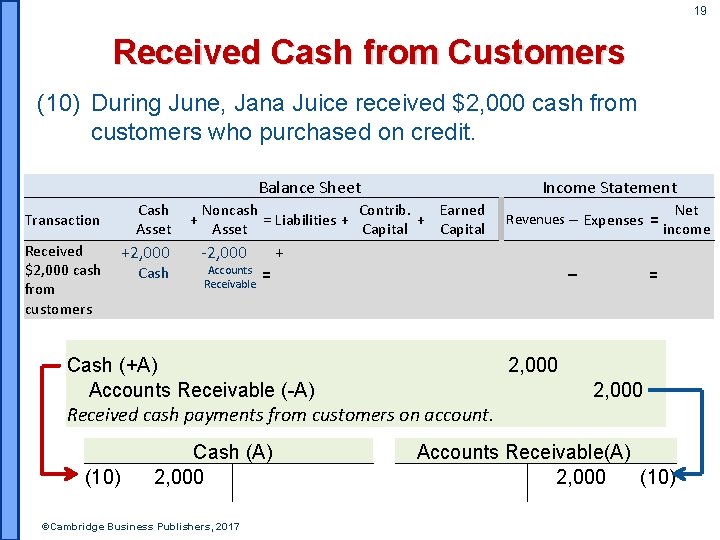
19 Received Cash from Customers (10) During June, Jana Juice received $2, 000 cash from customers who purchased on credit. Balance Sheet Transaction Received $2, 000 cash from customers Cash Asset +2, 000 Cash + Income Statement Noncash Contrib. Earned = Liabilities + + Asset Capital -2, 000 Accounts Receivable = Revenues – Expenses + – Cash (+A) 2, 000 Accounts Receivable (-A) Received cash payments from customers on account. (10) Cash (A) 2, 000 ©Cambridge Business Publishers, 2017 Net = income = 2, 000 Accounts Receivable(A) 2, 000 (10)
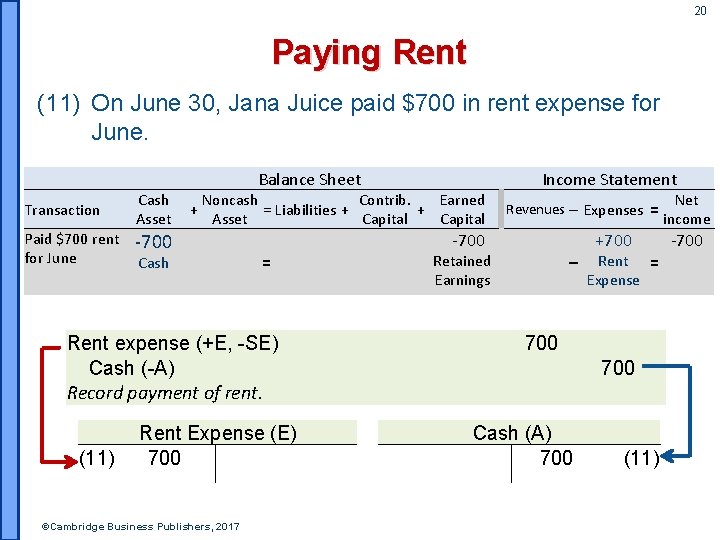
20 Paying Rent (11) On June 30, Jana Juice paid $700 in rent expense for June. Balance Sheet Transaction Cash Asset Paid $700 rent for June -700 + Noncash Contrib. Earned = Liabilities + + Asset Capital Cash = Rent expense (+E, -SE) Cash (-A) Record payment of rent. (11) Income Statement Rent Expense (E) 700 ©Cambridge Business Publishers, 2017 Revenues – Expenses -700 – Retained Earnings +700 Rent = Expense 700 Cash (A) 700 Net = income (11) -700
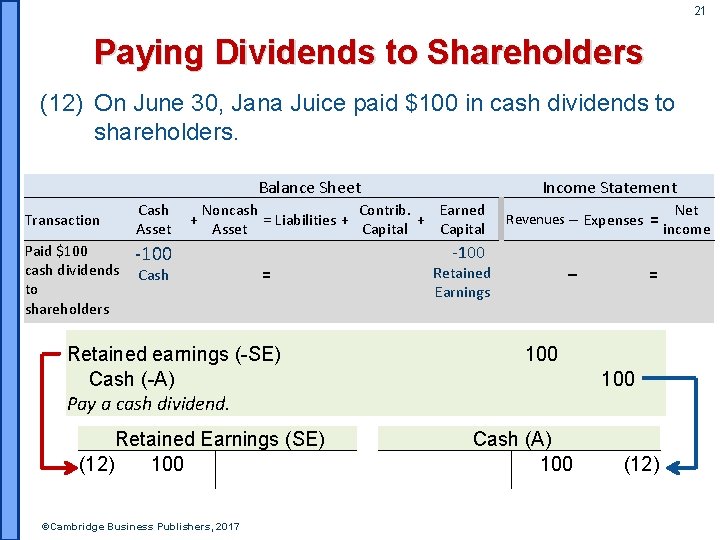
21 Paying Dividends to Shareholders (12) On June 30, Jana Juice paid $100 in cash dividends to shareholders. Balance Sheet Transaction Paid $100 cash dividends to shareholders Cash Asset + Income Statement Noncash Contrib. Earned = Liabilities + + Asset Capital -100 Cash = Retained earnings (-SE) Cash (-A) Pay a cash dividend. Retained Earnings (SE) (12) 100 ©Cambridge Business Publishers, 2017 Revenues – Expenses -100 – Retained Earnings Net = income = 100 Cash (A) 100 (12)
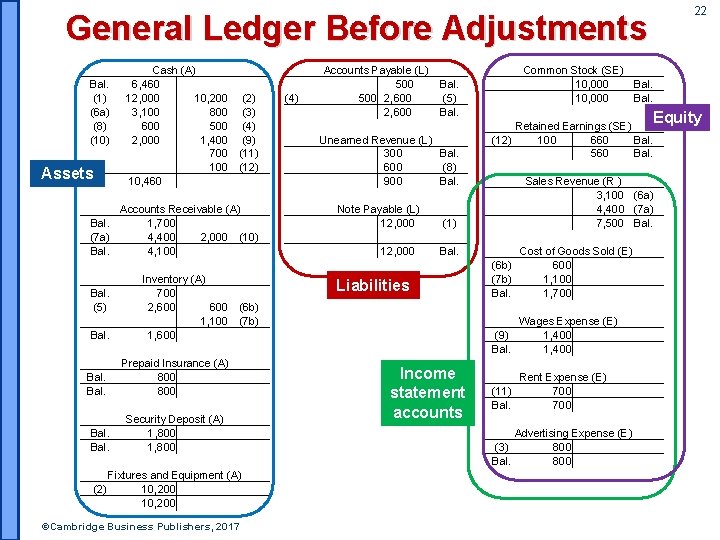
22 General Ledger Before Adjustments Bal. (1) (6 a) (8) (10) Assets Bal. (7 a) Bal. (5) Bal. Cash (A) 6, 460 12, 000 10, 200 3, 100 800 600 500 2, 000 1, 400 700 10, 460 (2) (3) (4) (9) (11) (12) Accounts Receivable (A) 1, 700 4, 400 2, 000 (10) 4, 100 Inventory (A) 700 2, 600 1, 100 1, 600 (4) Accounts Payable (L) 500 2, 600 Unearned Revenue (L) 300 Bal. 600 (8) 900 Bal. Note Payable (L) 12, 000 Common Stock (SE) 10, 000 Bal. (5) Bal. Equity Retained Earnings (SE) (12) 100 660 Bal. 560 Bal. Sales Revenue (R ) 3, 100 (6 a) 4, 400 (7 a) 7, 500 Bal. (1) Bal. Liabilities Cost of Goods Sold (E) (6 b) 600 (7 b) 1, 100 Bal. 1, 700 (6 b) (7 b) Prepaid Insurance (A) 800 Security Deposit (A) 1, 800 Fixtures and Equipment (A) (2) 10, 200 ©Cambridge Business Publishers, 2017 Income statement accounts (9) Bal. Wages Expense (E) 1, 400 (11) Bal. Rent Expense (E) 700 (3) Bal. Advertising Expense (E) 800
23 Learning Objective 3 Describe the adjusting process and illustrate adjusting entries. ©Cambridge Business Publishers, 2017
24 The Adjusting Process § Account balances must be reviewed to determine if adjustments are required § Caused by accrual accounting § Adjusting occurs before the financial statements are prepared § After all regular transactions have been recorded and posted ADJUSTING ENTRIES § Almost never affect Cash, and § Usually affect at least 1 balance sheet and 1 income statement account ©Cambridge Business Publishers, 2017
25 Unadjusted Trial Balance First Step in adjusting process § What is a trial balance? § A list of all general ledger accounts with their respective balances § Unadjusted means prior to completing the adjusting entries § Purpose § To be sure the general ledger is in balance before adjusting the accounts § Listing all accounts in one place eases the review of accounts in determining which need adjustment ©Cambridge Business Publishers, 2017
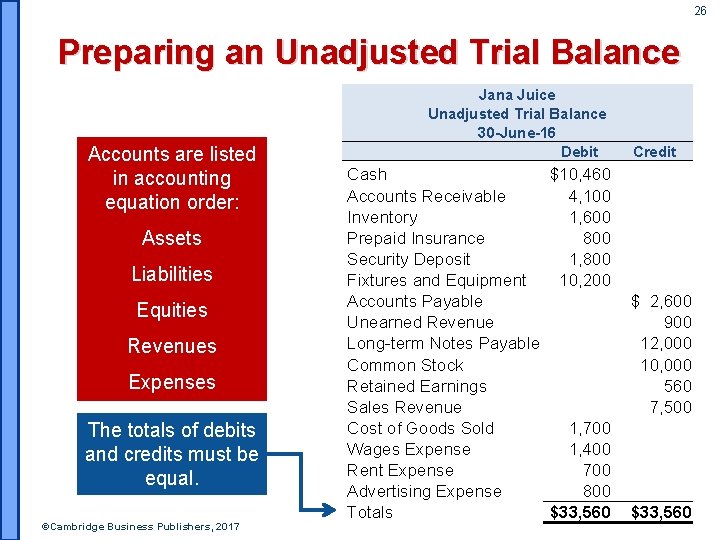
26 Preparing an Unadjusted Trial Balance Accounts are listed in accounting equation order: Assets Liabilities Equities Revenues Expenses The totals of debits and credits must be equal. ©Cambridge Business Publishers, 2017 Jana Juice Unadjusted Trial Balance 30 -June-16 Debit Cash $10, 460 Accounts Receivable 4, 100 Inventory 1, 600 Prepaid Insurance 800 Security Deposit 1, 800 Fixtures and Equipment 10, 200 Accounts Payable Unearned Revenue Long-term Notes Payable Common Stock Retained Earnings Sales Revenue Cost of Goods Sold 1, 700 Wages Expense 1, 400 Rent Expense 700 Advertising Expense 800 Totals $33, 560 Credit $ 2, 600 900 12, 000 10, 000 560 7, 500 $33, 560
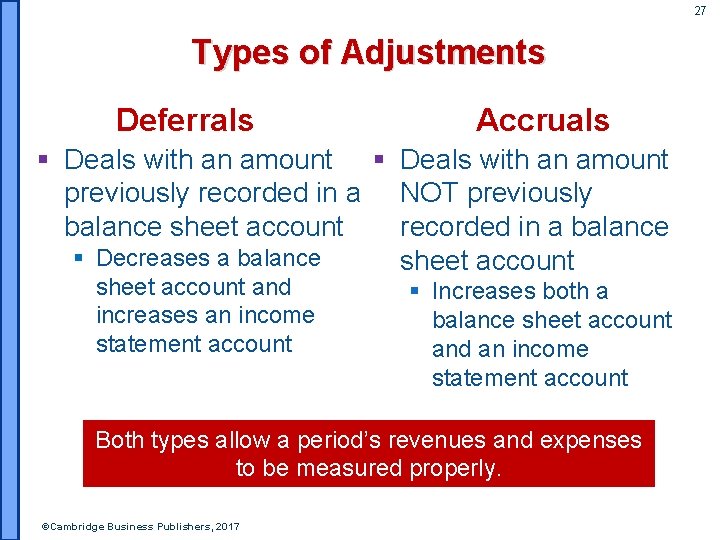
27 Types of Adjustments Deferrals Accruals § Deals with an amount previously recorded in a NOT previously balance sheet account recorded in a balance § Decreases a balance sheet account and increases an income statement account § Increases both a balance sheet account and an income statement account Both types allow a period’s revenues and expenses to be measured properly. ©Cambridge Business Publishers, 2017
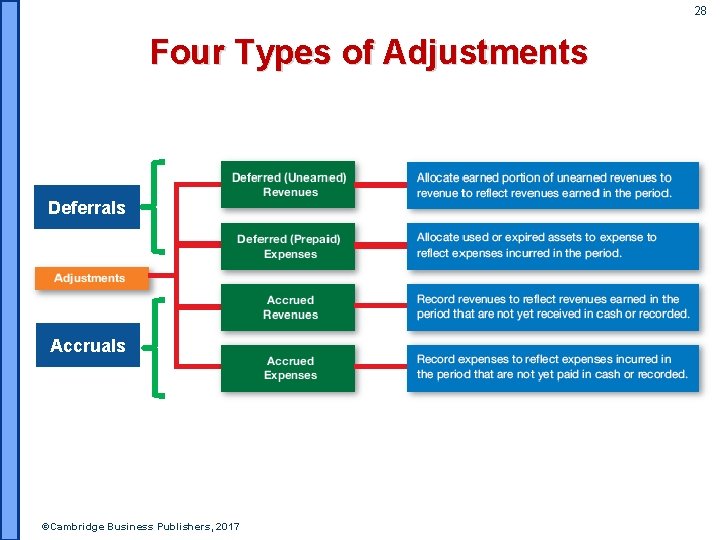
28 Four Types of Adjustments Deferrals Accruals ©Cambridge Business Publishers, 2017
29 Deferred Revenue The process of allocating unearned revenue to revenue § Amounts received in advance are recorded as liabilities § Because an obligation exists to provide future services or assets (such as inventory or a refund of cash) § Situations requiring adjusting entries: § Prepaid property casualty insurance is earned over time § Subscriptions to newspaper and magazines received in advance are earned ©Cambridge Business Publishers, 2017
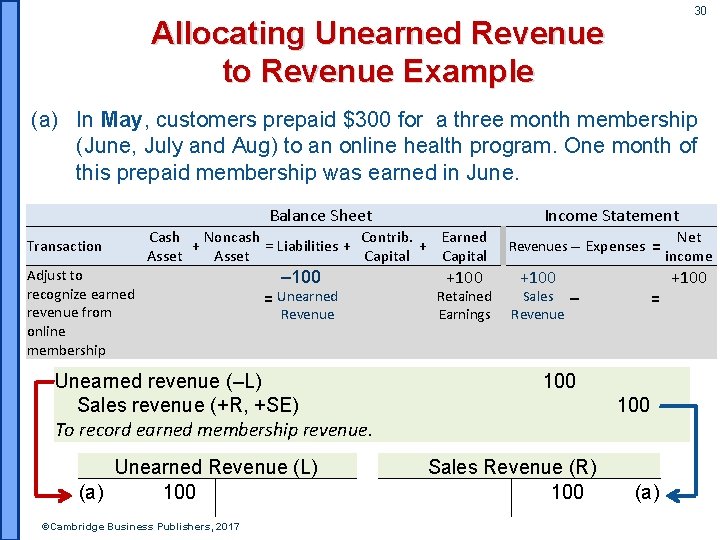
30 Allocating Unearned Revenue to Revenue Example (a) In May, customers prepaid $300 for a three month membership (June, July and Aug) to an online health program. One month of this prepaid membership was earned in June. Balance Sheet Transaction Income Statement Cash Noncash Contrib. Earned + = Liabilities + + Asset Capital Adjust to recognize earned revenue from online membership ‒ 100 = Unearned Revenue Unearned revenue (‒L) Sales revenue (+R, +SE) To record earned membership revenue. Unearned Revenue (L) (a) 100 ©Cambridge Business Publishers, 2017 +100 Retained Earnings Revenues – Expenses +100 Sales Revenue – Net = income = 100 Sales Revenue (R) 100 (a) +100
31 Prepaid Expenses The process of allocating prepaid assets to expenses § Amounts paid in advance of using assets that benefit more than one period § Situations requiring adjusting entries § Equipment, buildings, or vehicles become used up over time § Prepayment of advertising, insurance, or rent becomes used up over time § Supplies are used over time § Purchased intangibles may be used over time ©Cambridge Business Publishers, 2017
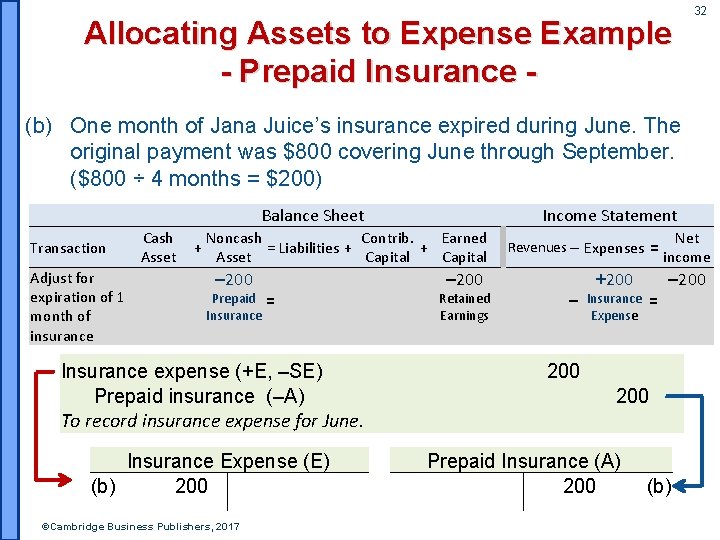
32 Allocating Assets to Expense Example - Prepaid Insurance (b) One month of Jana Juice’s insurance expired during June. The original payment was $800 covering June through September. ($800 ÷ 4 months = $200) Balance Sheet Transaction Adjust for expiration of 1 month of insurance Cash Asset + Income Statement Noncash Contrib. Earned = Liabilities + + Asset Capital ‒ 200 Prepaid Insurance ‒ 200 = Insurance expense (+E, ‒SE) Prepaid insurance (‒A) To record insurance expense for June. Insurance Expense (E) (b) 200 ©Cambridge Business Publishers, 2017 Retained Earnings Net Revenues – Expenses = income +200 – ‒ 200 = Insurance Expense 200 Prepaid Insurance (A) 200 (b)
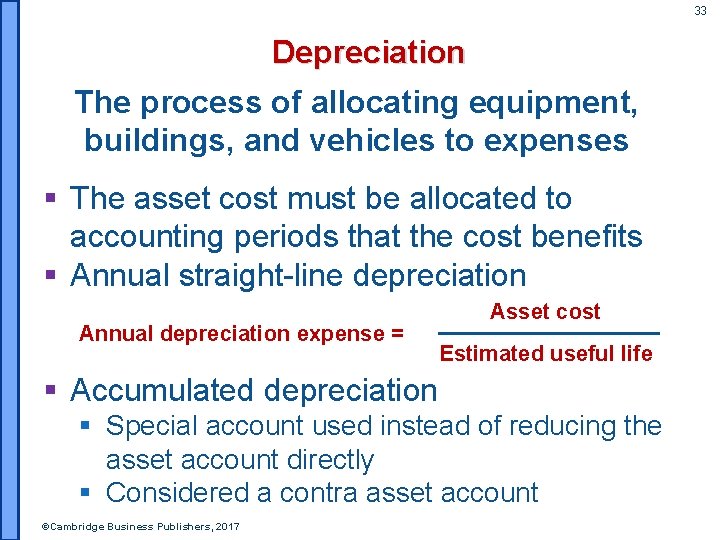
33 Depreciation The process of allocating equipment, buildings, and vehicles to expenses § The asset cost must be allocated to accounting periods that the cost benefits § Annual straight-line depreciation Annual depreciation expense = Asset cost Estimated useful life § Accumulated depreciation § Special account used instead of reducing the asset account directly § Considered a contra asset account ©Cambridge Business Publishers, 2017
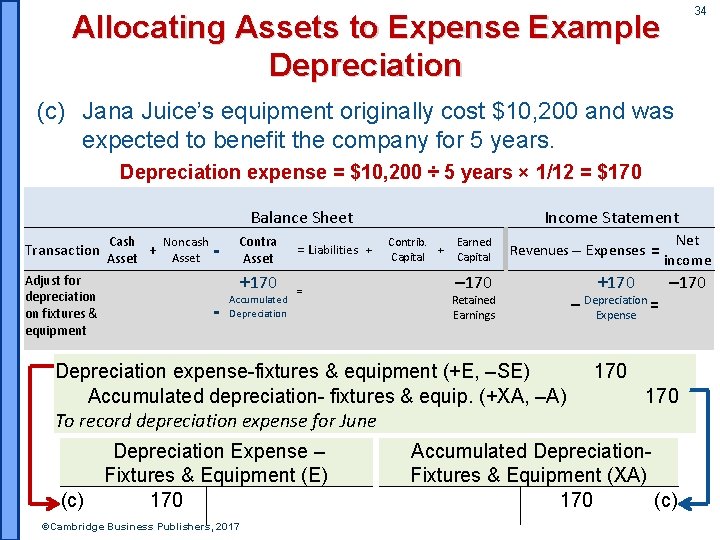
34 Allocating Assets to Expense Example Depreciation (c) Jana Juice’s equipment originally cost $10, 200 and was expected to benefit the company for 5 years. Depreciation expense = $10, 200 ÷ 5 years × 1/12 = $170 Balance Sheet Cash Noncash Transaction Asset + Asset Adjust for depreciation on fixtures & equipment Contra Asset +170 - Accumulated Depreciation = Liabilities + = Income Statement Contrib. + Capital Earned Capital Revenues – Expenses ‒ 170 +170 Retained Earnings – Depreciation = Expense Depreciation expense-fixtures & equipment (+E, ‒SE) Accumulated depreciation- fixtures & equip. (+XA, ‒A) To record depreciation expense for June (c) Depreciation Expense – Fixtures & Equipment (E) 170 ©Cambridge Business Publishers, 2017 Net = income ‒ 170 170 Accumulated Depreciation. Fixtures & Equipment (XA) 170 (c)
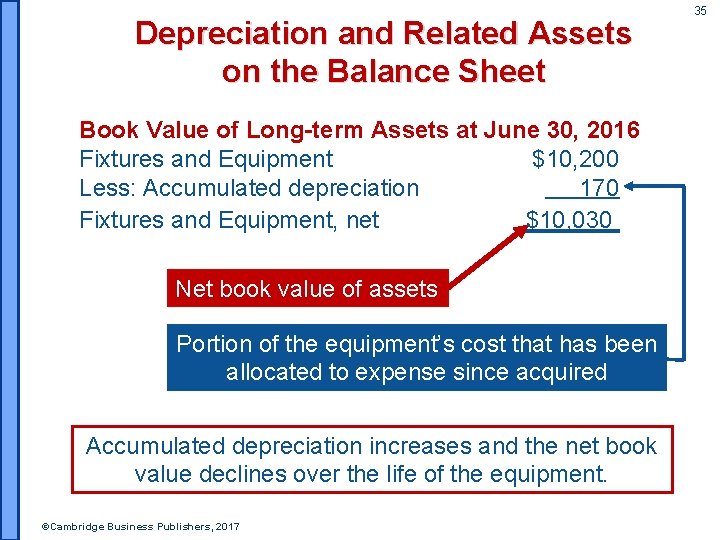
Depreciation and Related Assets on the Balance Sheet Book Value of Long-term Assets at June 30, 2016 Fixtures and Equipment $10, 200 Less: Accumulated depreciation 170 Fixtures and Equipment, net $10, 030 Net book value of assets Portion of the equipment’s cost that has been allocated to expense since acquired Accumulated depreciation increases and the net book value declines over the life of the equipment. ©Cambridge Business Publishers, 2017 35
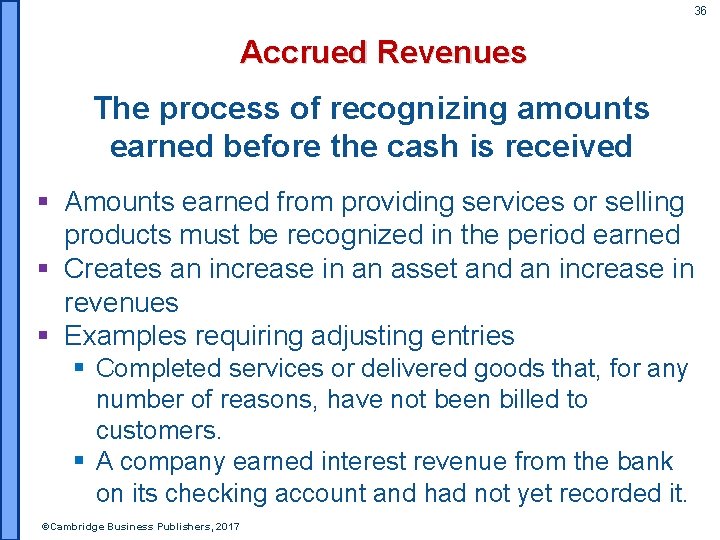
36 Accrued Revenues The process of recognizing amounts earned before the cash is received § Amounts earned from providing services or selling products must be recognized in the period earned § Creates an increase in an asset and an increase in revenues § Examples requiring adjusting entries § Completed services or delivered goods that, for any number of reasons, have not been billed to customers. § A company earned interest revenue from the bank on its checking account and had not yet recorded it. ©Cambridge Business Publishers, 2017
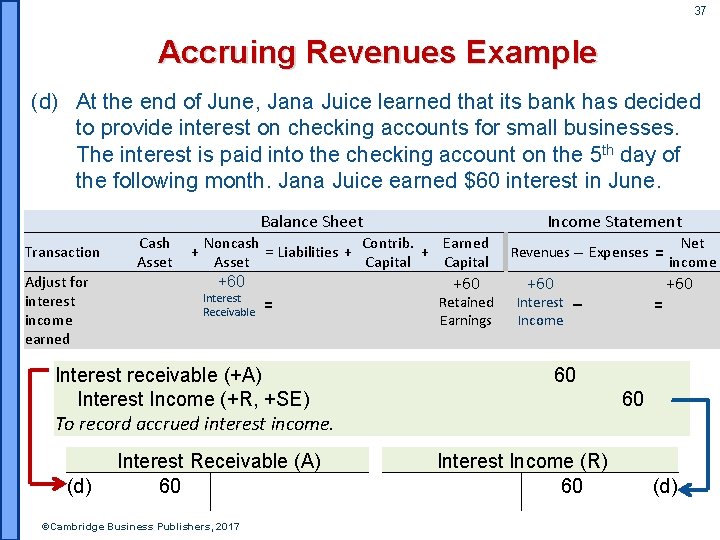
37 Accruing Revenues Example (d) At the end of June, Jana Juice learned that its bank has decided to provide interest on checking accounts for small businesses. The interest is paid into the checking account on the 5 th day of the following month. Jana Juice earned $60 interest in June. Balance Sheet Transaction Adjust for interest income earned Cash Asset + Noncash Contrib. Earned = Liabilities + + Asset Capital +60 Interest Receivable = Interest receivable (+A) Interest Income (+R, +SE) To record accrued interest income. (d) Income Statement Interest Receivable (A) 60 ©Cambridge Business Publishers, 2017 Retained Earnings Revenues – Expenses +60 Interest Income – Net = income = +60 60 60 Interest Income (R) 60 (d)
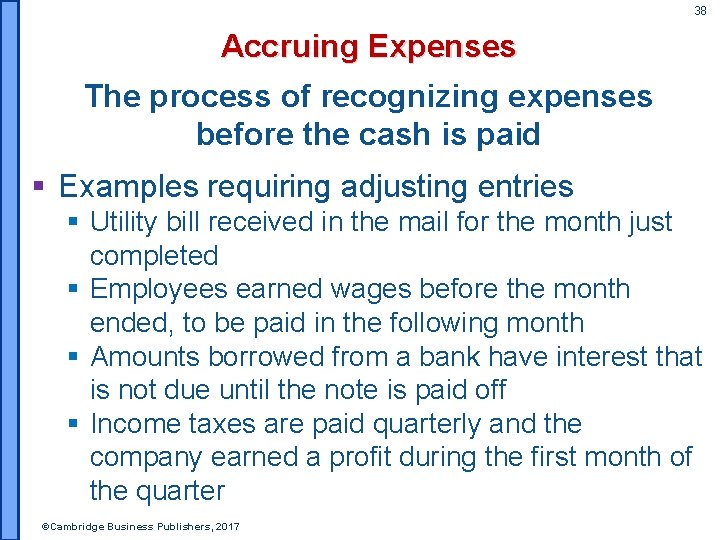
38 Accruing Expenses The process of recognizing expenses before the cash is paid § Examples requiring adjusting entries § Utility bill received in the mail for the month just completed § Employees earned wages before the month ended, to be paid in the following month § Amounts borrowed from a bank have interest that is not due until the note is paid off § Income taxes are paid quarterly and the company earned a profit during the first month of the quarter ©Cambridge Business Publishers, 2017
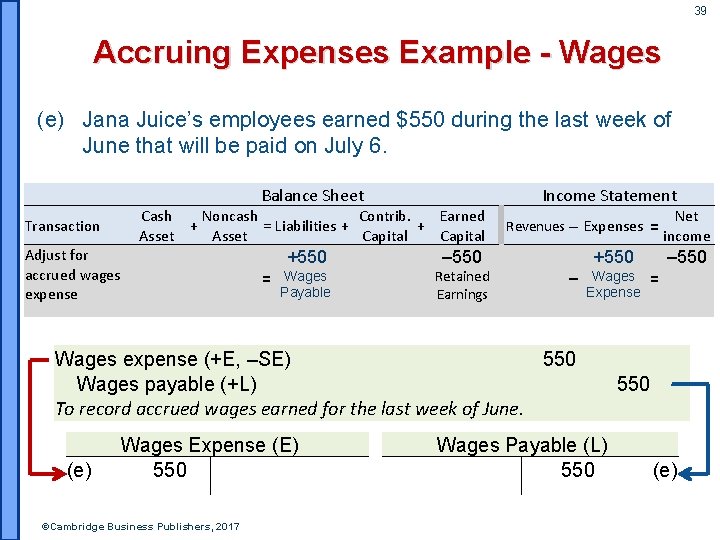
39 Accruing Expenses Example - Wages (e) Jana Juice’s employees earned $550 during the last week of June that will be paid on July 6. Balance Sheet Transaction Income Statement Cash Noncash Contrib. Earned + = Liabilities + + Asset Capital Adjust for accrued wages expense = +550 ‒ 550 Wages Payable Retained Earnings Revenues – Expenses +550 – Wages Expense Wages expense (+E, ‒SE) 550 Wages payable (+L) To record accrued wages earned for the last week of June. (e) Wages Expense (E) 550 ©Cambridge Business Publishers, 2017 Net = income Wages Payable (L) 550 ‒ 550 = 550 (e)
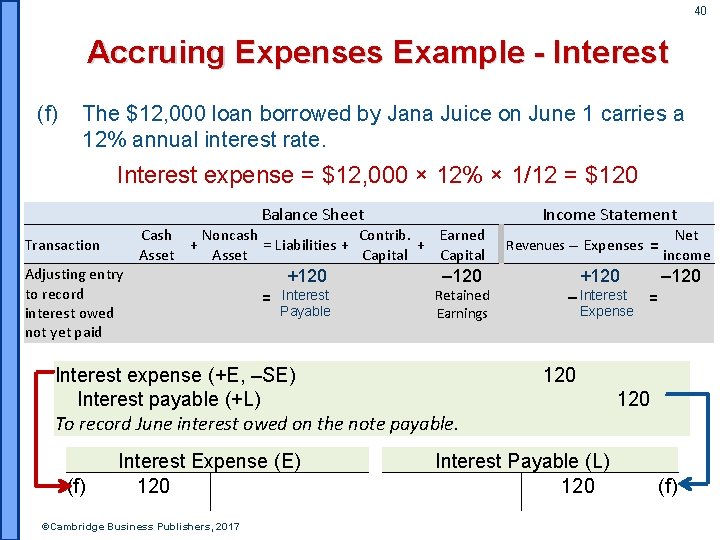
40 Accruing Expenses Example - Interest (f) The $12, 000 loan borrowed by Jana Juice on June 1 carries a 12% annual interest rate. Interest expense = $12, 000 × 12% × 1/12 = $120 Balance Sheet Income Statement Cash Noncash Contrib. Earned + = Liabilities + + Asset Capital Transaction Adjusting entry to record interest owed not yet paid = +120 ‒ 120 +120 Interest Payable Retained Earnings – Interest expense (+E, ‒SE) Interest payable (+L) To record June interest owed on the note payable. (f) Interest Expense (E) 120 ©Cambridge Business Publishers, 2017 Revenues – Expenses Expense Net = income ‒ 120 = 120 Interest Payable (L) 120 (f)
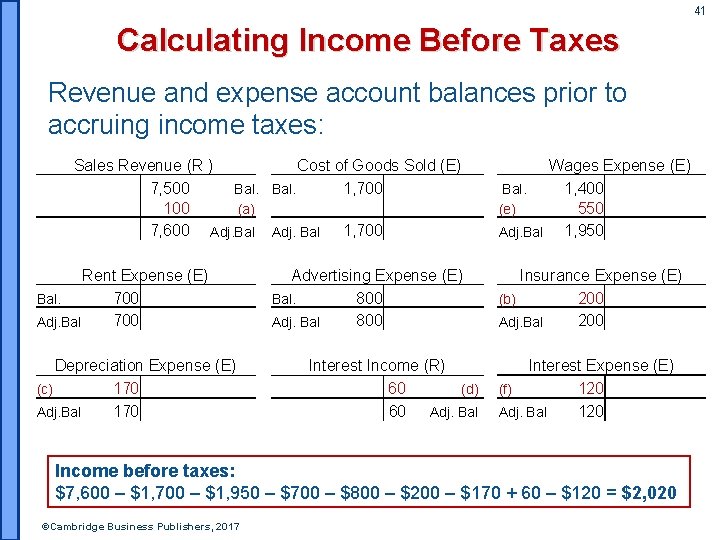
41 Calculating Income Before Taxes Revenue and expense account balances prior to accruing income taxes: Sales Revenue (R ) Cost of Goods Sold (E) 7, 500 1, 700 Bal. 100 (a) 7, 600 Adj. Bal 1, 700 Rent Expense (E) 700 Bal. 700 Adj. Bal Depreciation Expense (E) 170 (c) 170 Adj. Bal Advertising Expense (E) 800 Bal. 800 Adj. Bal Interest Income (R) 60 (d) 60 Adj. Bal Wages Expense (E) 1, 400 Bal. 550 (e) 1, 950 Adj. Bal Insurance Expense (E) 200 (b) 200 Adj. Bal Interest Expense (E) 120 (f) 120 Adj. Bal Income before taxes: $7, 600 ‒ $1, 700 ‒ $1, 950 ‒ $700 ‒ $800 ‒ $200 ‒ $170 + 60 ‒ $120 = $2, 020 ©Cambridge Business Publishers, 2017
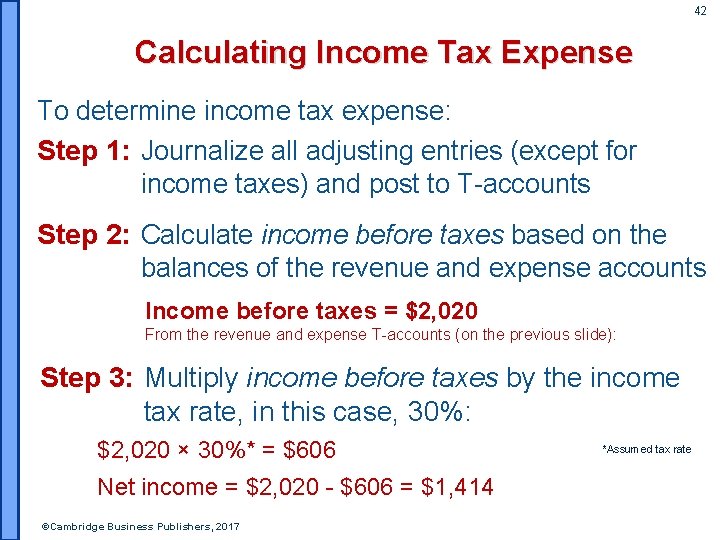
42 Calculating Income Tax Expense To determine income tax expense: Step 1: Journalize all adjusting entries (except for income taxes) and post to T-accounts Step 2: Calculate income before taxes based on the balances of the revenue and expense accounts Income before taxes = $2, 020 From the revenue and expense T-accounts (on the previous slide): Step 3: Multiply income before taxes by the income tax rate, in this case, 30%: $2, 020 × 30%* = $606 Net income = $2, 020 - $606 = $1, 414 ©Cambridge Business Publishers, 2017 *Assumed tax rate
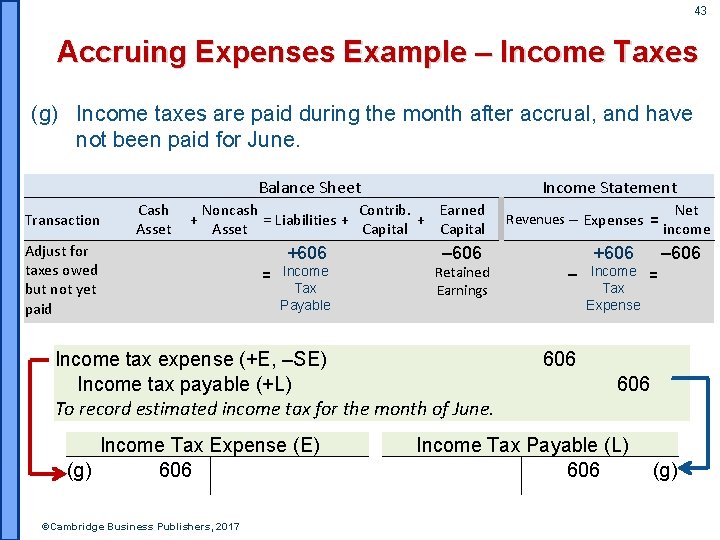
43 Accruing Expenses Example – Income Taxes (g) Income taxes are paid during the month after accrual, and have not been paid for June. Balance Sheet Transaction Cash Asset + Income Statement Noncash Contrib. Earned = Liabilities + + Asset Capital Adjust for taxes owed but not yet paid = +606 ‒ 606 Income Tax Payable Retained Earnings Income tax expense (+E, ‒SE) Income tax payable (+L) To record estimated income tax for the month of June. Income Tax Expense (E) (g) 606 ©Cambridge Business Publishers, 2017 Revenues – Expenses Net = income +606 – Income Tax Expense ‒ 606 = 606 Income Tax Payable (L) 606 (g)
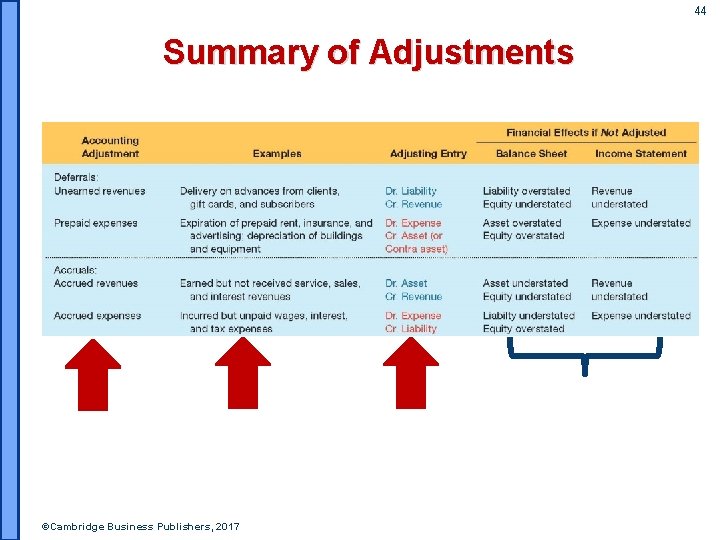
44 Summary of Adjustments ©Cambridge Business Publishers, 2017
45 Ethics and Adjusting Entries § Adjusting entries are dependent upon estimates § Management’s estimates are affected by corporate pressures § Desire to meet analysts expectations § Desire to disguise a planned course of action § Controls are imposed by the financial reporting environment ©Cambridge Business Publishers, 2017
46 Learning Objective 4 Prepare financial statements from adjusted accounts. ©Cambridge Business Publishers, 2017
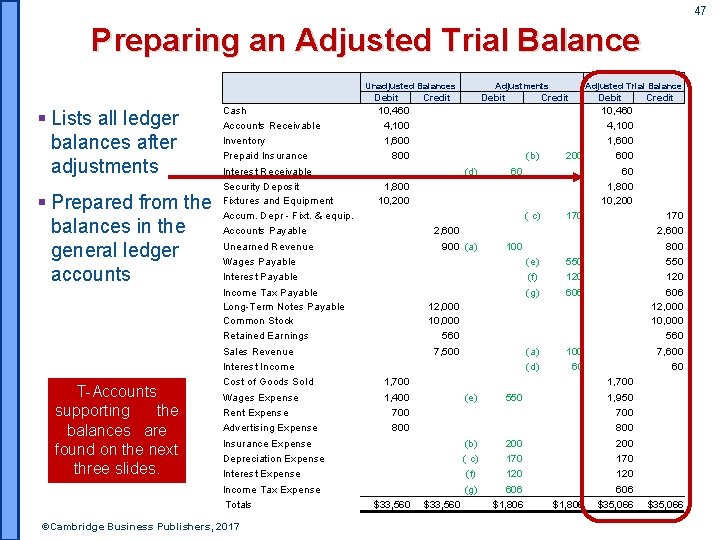
47 Preparing an Adjusted Trial Balance Unadjusted Balances Debit § Lists all ledger balances after adjustments § Prepared from the balances in the general ledger accounts T-Accounts supporting the balances are found on the next three slides. Cash Accounts Receivable Inventory Prepaid Insurance Interest Receivable Security Deposit Fixtures and Equipment Accum. Depr - Fixt. & equip. Accounts Payable Unearned Revenue Wages Payable Interest Payable Income Tax Payable Long-Term Notes Payable Common Stock Retained Earnings Sales Revenue Interest Income Cost of Goods Sold Wages Expense Rent Expense Advertising Expense Insurance Expense Depreciation Expense Interest Expense Income Tax Expense Totals ©Cambridge Business Publishers, 2017 Adjustments Credit Debit 10, 460 4, 100 1, 600 800 (d) Adjusted Trial Balance Credit (b) 200 ( c) 170 (e) (f) (g) 550 120 606 (a) (d) 100 60 60 1, 800 10, 200 2, 600 900 (a) $33, 560 (e) 550 (b) ( c) (f) (g) 200 170 120 606 $1, 806 Credit 10, 460 4, 100 1, 600 60 1, 800 10, 200 170 2, 600 800 550 120 606 12, 000 10, 000 560 7, 600 60 100 12, 000 10, 000 560 7, 500 1, 700 1, 400 700 800 Debit 1, 700 1, 950 700 800 200 170 120 606 $35, 066
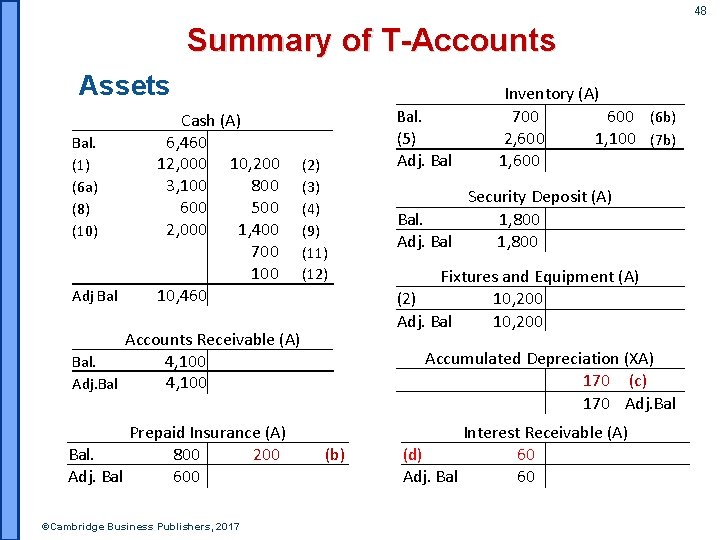
48 Summary of T-Accounts Assets Bal. (1) (6 a) (8) (10) Adj Bal Cash (A) 6, 460 12, 000 10, 200 3, 100 800 600 500 2, 000 1, 400 700 10, 460 Bal. (5) (2) (3) (4) (9) (11) (12) Accounts Receivable (A) 4, 100 Bal. 4, 100 Adj. Bal Prepaid Insurance (A) Bal. 800 200 Adj. Bal 600 ©Cambridge Business Publishers, 2017 Adj. Bal Inventory (A) 700 600 (6 b) 2, 600 1, 100 (7 b) 1, 600 Security Deposit (A) Bal. 1, 800 Adj. Bal 1, 800 Fixtures and Equipment (A) (2) 10, 200 Adj. Bal 10, 200 Accumulated Depreciation (XA) 170 (c) 170 Adj. Bal (b) Interest Receivable (A) (d) 60 Adj. Bal 60
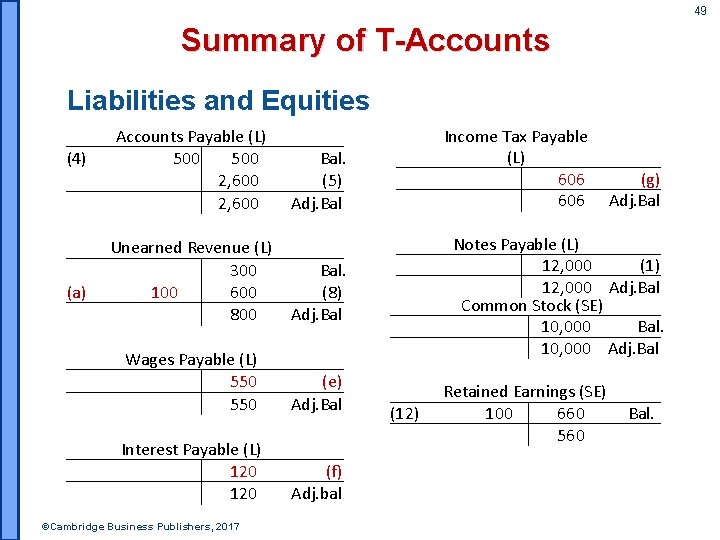
49 Summary of T-Accounts Liabilities and Equities (4) (a) Accounts Payable (L) 500 2, 600 Bal. (5) Adj. Bal Unearned Revenue (L) 300 100 600 800 Bal. (8) Adj. Bal Wages Payable (L) 550 (e) Adj. Bal Interest Payable (L) 120 (f) Adj. bal ©Cambridge Business Publishers, 2017 Income Tax Payable (L) 606 (g) Adj. Bal Notes Payable (L) 12, 000 (1) 12, 000 Adj. Bal Common Stock (SE) 10, 000 Bal. 10, 000 Adj. Bal (12) Retained Earnings (SE) 100 660 560 Bal.
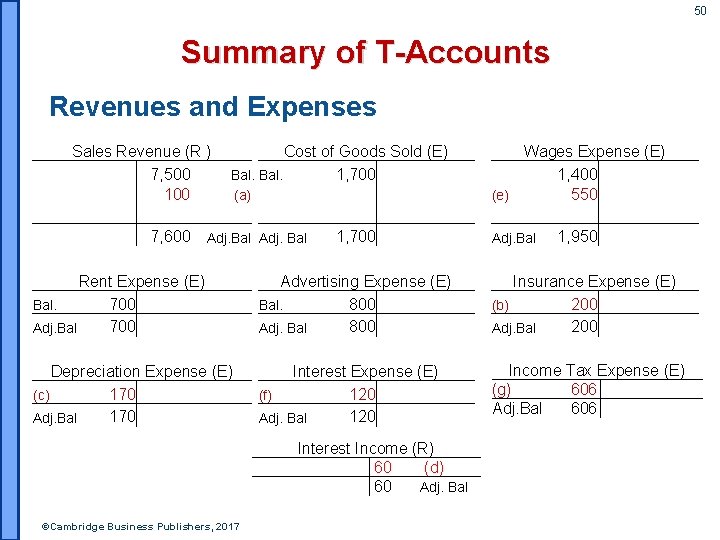
50 Summary of T-Accounts Revenues and Expenses Sales Revenue (R ) 7, 500 100 7, 600 Cost of Goods Sold (E) 1, 700 Bal. (a) Adj. Bal 1, 700 Wages Expense (E) 1, 400 550 (e) Adj. Bal 1, 950 Rent Expense (E) 700 Bal. 700 Adj. Bal Advertising Expense (E) 800 Bal. 800 Adj. Bal Insurance Expense (E) 200 (b) 200 Adj. Bal Depreciation Expense (E) 170 (c) 170 Adj. Bal Interest Expense (E) 120 (f) 120 Adj. Bal Income Tax Expense (E) (g) 606 Adj. Bal 606 Interest Income (R) 60 (d) 60 Adj. Bal ©Cambridge Business Publishers, 2017
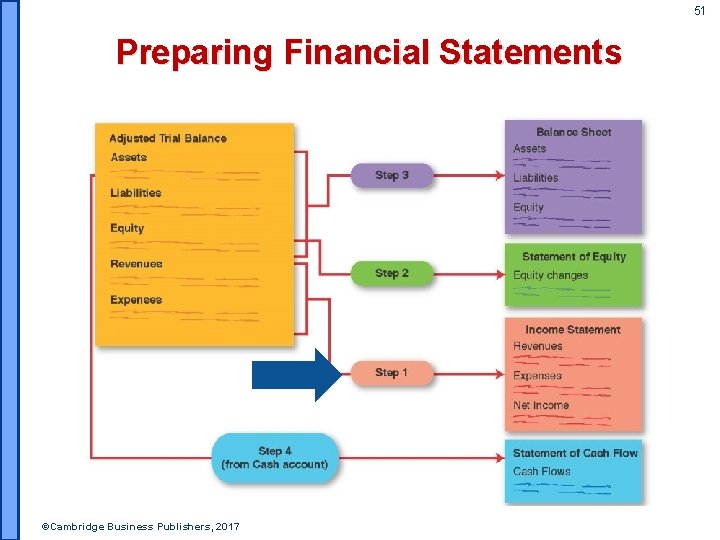
51 Preparing Financial Statements ©Cambridge Business Publishers, 2017
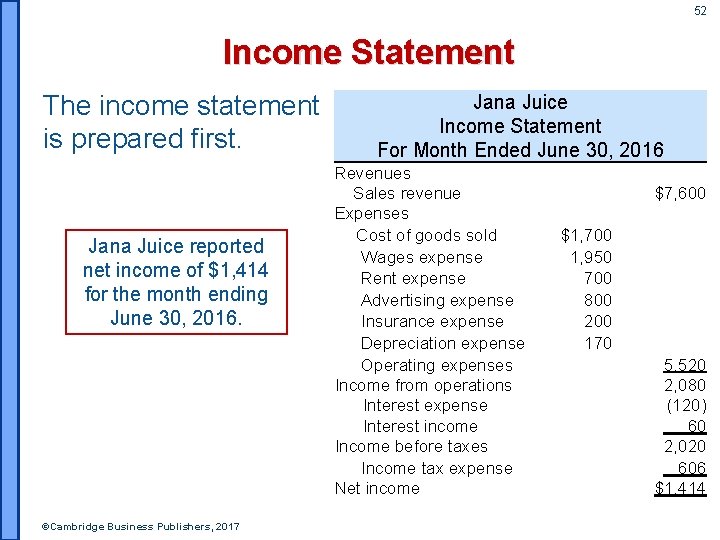
52 Income Statement The income statement is prepared first. Jana Juice reported net income of $1, 414 for the month ending June 30, 2016. ©Cambridge Business Publishers, 2017 Jana Juice Income Statement For Month Ended June 30, 2016 Revenues Sales revenue Expenses Cost of goods sold Wages expense Rent expense Advertising expense Insurance expense Depreciation expense Operating expenses Income from operations Interest expense Interest income Income before taxes Income tax expense Net income $7, 600 $1, 700 1, 950 700 800 200 170 5, 520 2, 080 (120) 60 2, 020 606 $1, 414
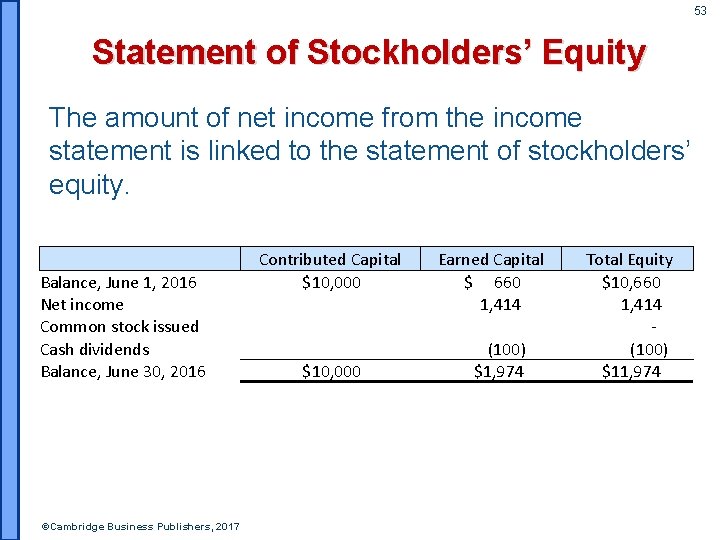
53 Statement of Stockholders’ Equity The amount of net income from the income statement is linked to the statement of stockholders’ equity. Balance, June 1, 2016 Net income Common stock issued Cash dividends Balance, June 30, 2016 ©Cambridge Business Publishers, 2017 Contributed Capital $10, 000 Earned Capital $ 660 1, 414 (100) $1, 974 Total Equity $10, 660 1, 414 (100) $11, 974
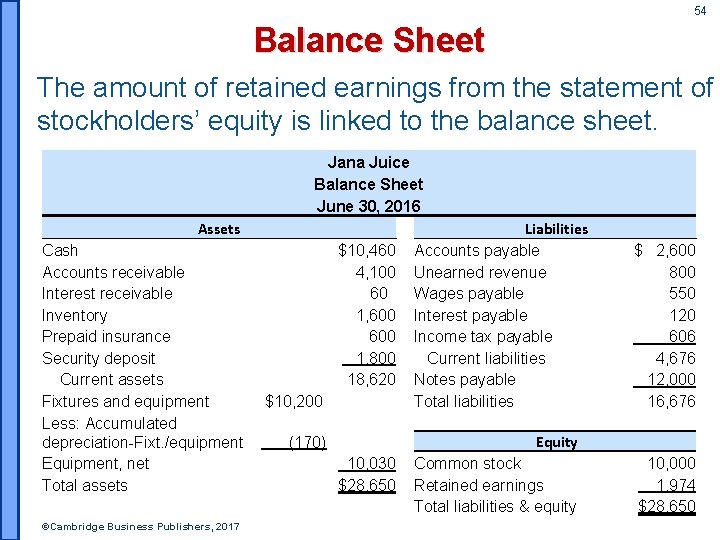
54 Balance Sheet The amount of retained earnings from the statement of stockholders’ equity is linked to the balance sheet. Jana Juice Balance Sheet June 30, 2016 Assets Cash Accounts receivable Interest receivable Inventory Prepaid insurance Security deposit Current assets Fixtures and equipment Less: Accumulated depreciation-Fixt. /equipment Equipment, net Total assets ©Cambridge Business Publishers, 2017 $10, 460 4, 100 60 1, 600 1, 800 18, 620 $10, 200 Liabilities Accounts payable Unearned revenue Wages payable Interest payable Income tax payable Current liabilities Notes payable Total liabilities $ 2, 600 800 550 120 606 4, 676 12, 000 16, 676 Equity (170) 10, 030 $28, 650 Common stock Retained earnings Total liabilities & equity 10, 000 1, 974 $28, 650
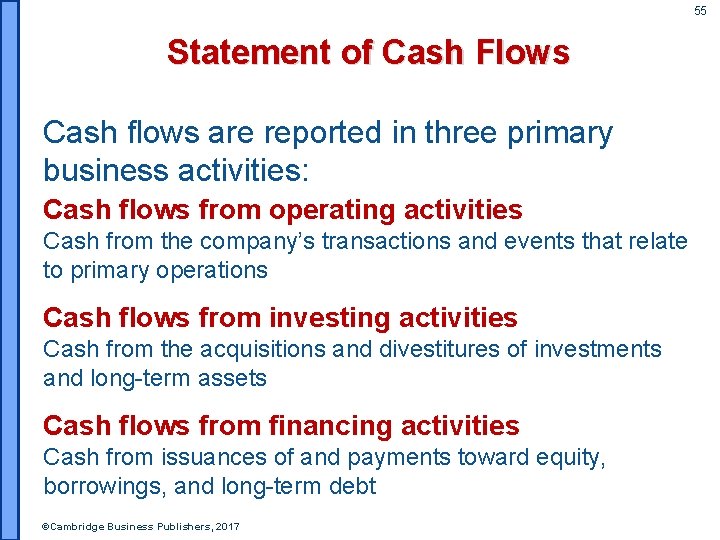
55 Statement of Cash Flows Cash flows are reported in three primary business activities: Cash flows from operating activities Cash from the company’s transactions and events that relate to primary operations Cash flows from investing activities Cash from the acquisitions and divestitures of investments and long-term assets Cash flows from financing activities Cash from issuances of and payments toward equity, borrowings, and long-term debt ©Cambridge Business Publishers, 2017
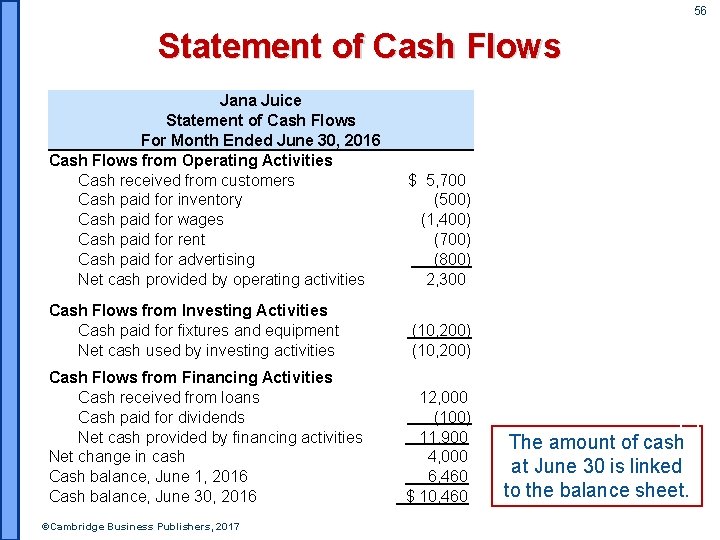
56 Statement of Cash Flows Jana Juice Statement of Cash Flows For Month Ended June 30, 2016 Cash Flows from Operating Activities Cash received from customers Cash paid for inventory Cash paid for wages Cash paid for rent Cash paid for advertising Net cash provided by operating activities $ 5, 700 (500) (1, 400) (700) (800) 2, 300 Cash Flows from Investing Activities Cash paid for fixtures and equipment Net cash used by investing activities (10, 200) Cash Flows from Financing Activities Cash received from loans Cash paid for dividends Net cash provided by financing activities Net change in cash Cash balance, June 1, 2016 Cash balance, June 30, 2016 ©Cambridge Business Publishers, 2017 12, 000 (100) 11, 900 4, 000 6, 460 $ 10, 460 The amount of cash at June 30 is linked to the balance sheet.
57 Learning Objective 5 Describe the process of closing temporary accounts. ©Cambridge Business Publishers, 2017
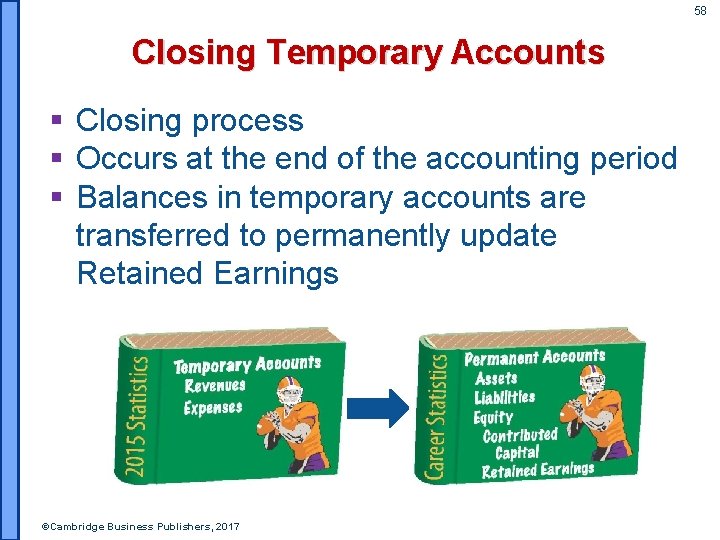
58 Closing Temporary Accounts § Closing process § Occurs at the end of the accounting period § Balances in temporary accounts are transferred to permanently update Retained Earnings ©Cambridge Business Publishers, 2017
59 Closing Temporary Accounts Two transactions to close temporary accounts. 1. Close revenue accounts Debit each revenue account for an amount equal to its balance, and credit Retained Earnings for the total of revenues. 2. Close expense accounts Credit each expense account for an amount equal to its balance, and debit Retained Earnings for the total of expenses. ©Cambridge Business Publishers, 2017
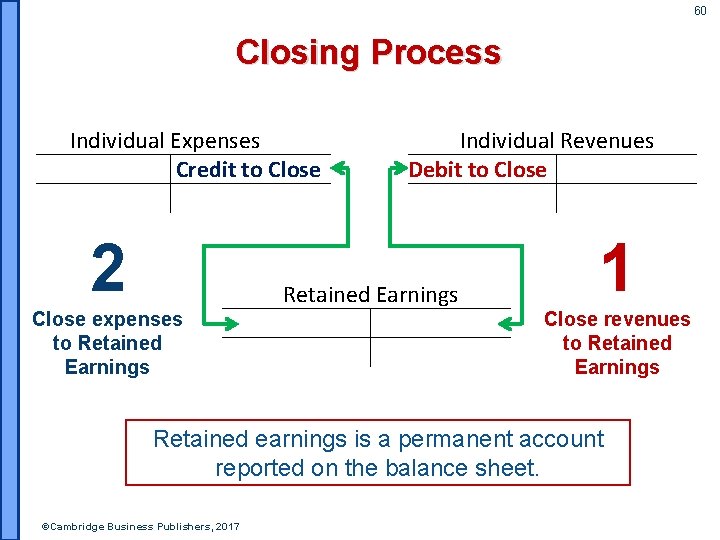
60 Closing Process Individual Expenses Credit to Close 2 Close expenses to Retained Earnings Individual Revenues Debit to Close Retained Earnings 1 Close revenues to Retained Earnings Retained earnings is a permanent account reported on the balance sheet. ©Cambridge Business Publishers, 2017
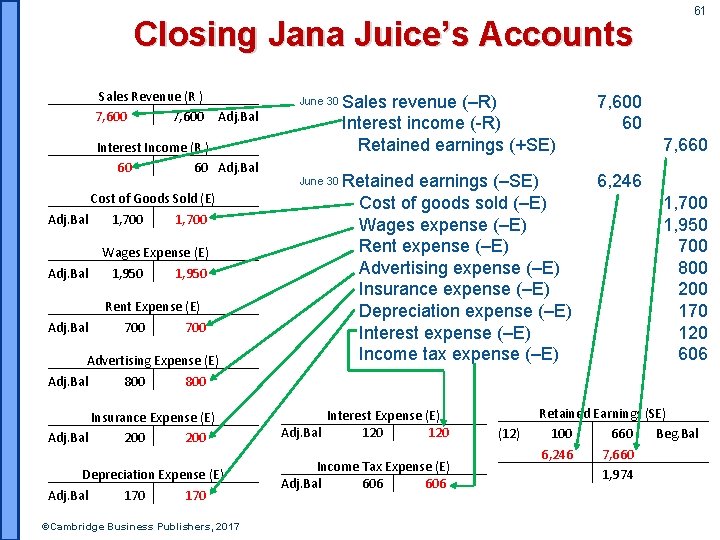
Closing Jana Juice’s Accounts Sales Revenue (R ) 7, 600 June 30 Adj. Bal Interest Income (R ) 60 60 Adj. Bal Cost of Goods Sold (E) Adj. Bal 1, 700 Adj. Bal Wages Expense (E) 1, 950 Adj. Bal Rent Expense (E) 700 Advertising Expense (E) Adj. Bal 800 Insurance Expense (E) Adj. Bal 200 Depreciation Expense (E) Adj. Bal 170 ©Cambridge Business Publishers, 2017 June 30 Sales revenue (–R) Interest income (-R) Retained earnings (+SE) 7, 600 60 Retained earnings (–SE) Cost of goods sold (–E) Wages expense (–E) Rent expense (–E) Advertising expense (–E) Insurance expense (–E) Depreciation expense (–E) Interest expense (–E) Income tax expense (–E) 6, 246 Interest Expense (E) Adj. Bal 120 Income Tax Expense (E) Adj. Bal 606 (12) 61 7, 660 1, 700 1, 950 700 800 200 170 120 606 Retained Earnings (SE) 100 660 Beg. Bal 6, 246 7, 660 1, 974
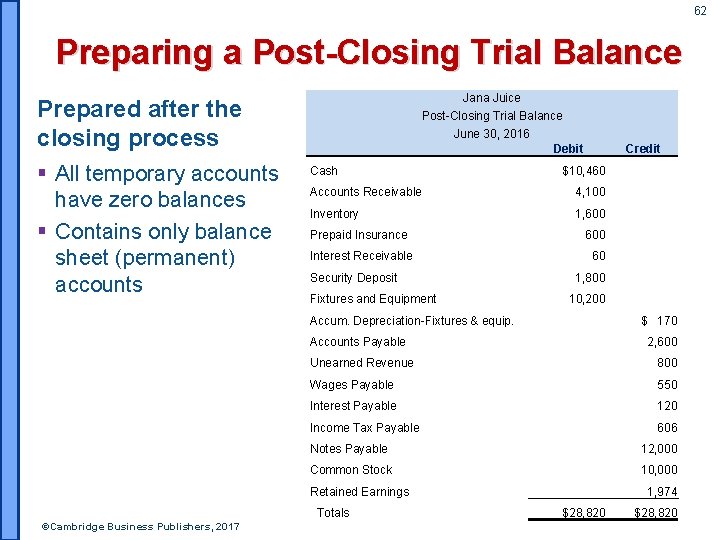
62 Preparing a Post-Closing Trial Balance Jana Juice Post-Closing Trial Balance June 30, 2016 Debit Prepared after the closing process § All temporary accounts have zero balances § Contains only balance sheet (permanent) accounts Cash Credit $10, 460 Accounts Receivable 4, 100 Inventory 1, 600 Prepaid Insurance 600 Interest Receivable 60 Security Deposit Fixtures and Equipment 1, 800 10, 200 Accum. Depreciation-Fixtures & equip. $ 170 Accounts Payable 2, 600 Unearned Revenue 800 Wages Payable 550 Interest Payable 120 Income Tax Payable 606 Notes Payable 12, 000 Common Stock 10, 000 Retained Earnings Totals ©Cambridge Business Publishers, 2017 1, 974 $28, 820
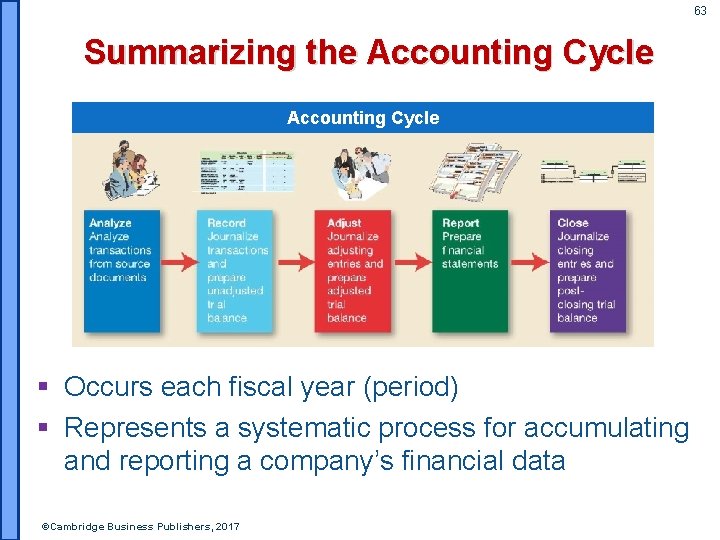
63 Summarizing the Accounting Cycle § Occurs each fiscal year (period) § Represents a systematic process for accumulating and reporting a company’s financial data ©Cambridge Business Publishers, 2017
64 Learning Objective 6 Analyze changes in balance sheet accounts. ©Cambridge Business Publishers, 2017
65 Using Information on Levels and Flows § Levels § Portrayed on the balance sheet as levels of resources and claims to those resources § Point in time § Flows § Portrayed on the income statement as changes in the levels of resources § Period of time ©Cambridge Business Publishers, 2017
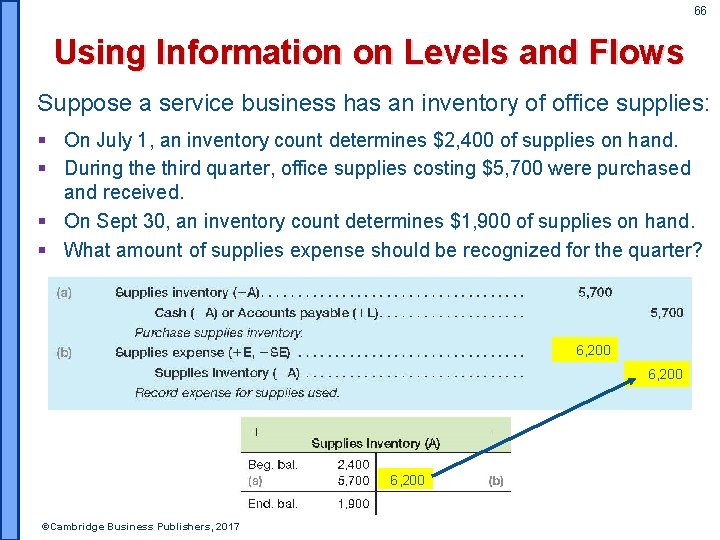
66 Using Information on Levels and Flows Suppose a service business has an inventory of office supplies: § On July 1, an inventory count determines $2, 400 of supplies on hand. § During the third quarter, office supplies costing $5, 700 were purchased and received. § On Sept 30, an inventory count determines $1, 900 of supplies on hand. § What amount of supplies expense should be recognized for the quarter? 6, 200 ©Cambridge Business Publishers, 2017
The End ©Cambridge Business Publishers, 2017
- Slides: 67