
Financial Accounting 5 e Weygandt Kieso Kimmel John
- Slides: 53
Financial Accounting, 5 e Weygandt, Kieso, Kimmel John Wiley & Sons, Inc.
CHAPTER 1 ACCOUNTING MATTERS! STUDY OBJECTIVES After studying this chapter, you should understand: What accounting is Monetary unit & economic entity assumptions Uses and users of accounting The accounting equation Ethics as a fundamental business concept How business transactions affect the accounting equation GAAP Basic financial statements
STUDY OBJECTIVE 1 WHY STUDY ACCOUNTING? Accounting scandals and corporate misdeeds prevails. – – – Enron (虛增 5億美元盈餘) Worldcom (浮誇資產近市值 100億美元) Xeron Corp. (60億美元營收錯誤認列) 博達科技(63億現金不翼而飛) … Accounting is important. Good accounting is essential to sound business and investing decision. Bad accounting cannot be tolerated.
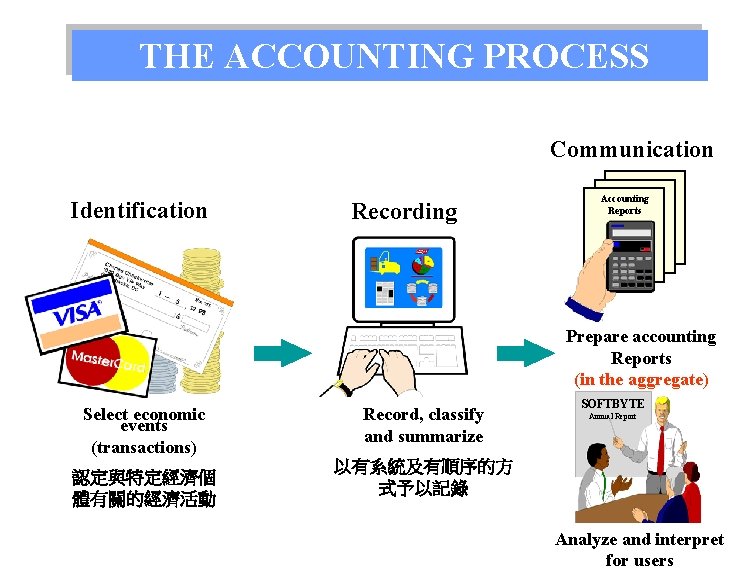
STUDY OBJECTIVE 1 WHAT IS ACCOUNTING? Accounting is an information system that identifies, records, and communicates the economic events (transactions) of an organization to interested users.
THE ACCOUNTING PROCESS Communication Identification Recording Accounting Reports Prepare accounting Reports (in the aggregate) Select economic events (transactions) 認定與特定經濟個 體有關的經濟活動 Record, classify and summarize SOFTBYTE Annual Report 以有系統及有順序的方 式予以記錄 Analyze and interpret for users
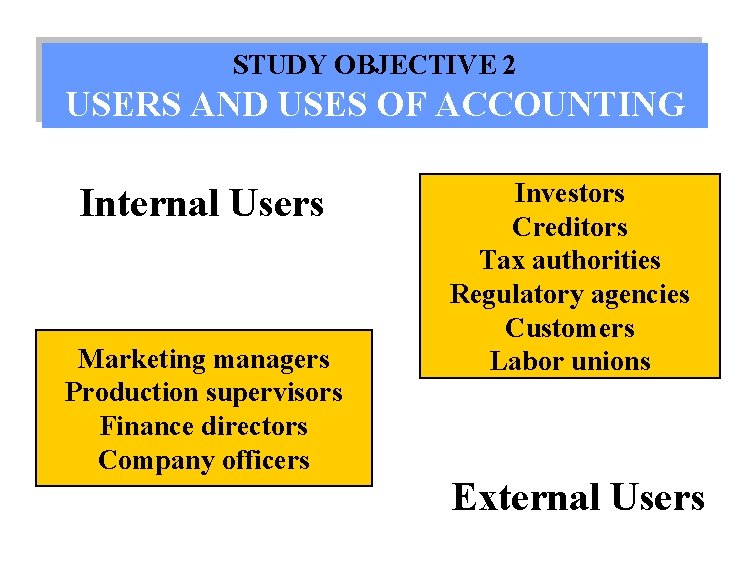
STUDY OBJECTIVE 2 USERS AND USES OF ACCOUNTING Internal Users Marketing managers Production supervisors Finance directors Company officers Investors Creditors Tax authorities Regulatory agencies Customers Labor unions External Users
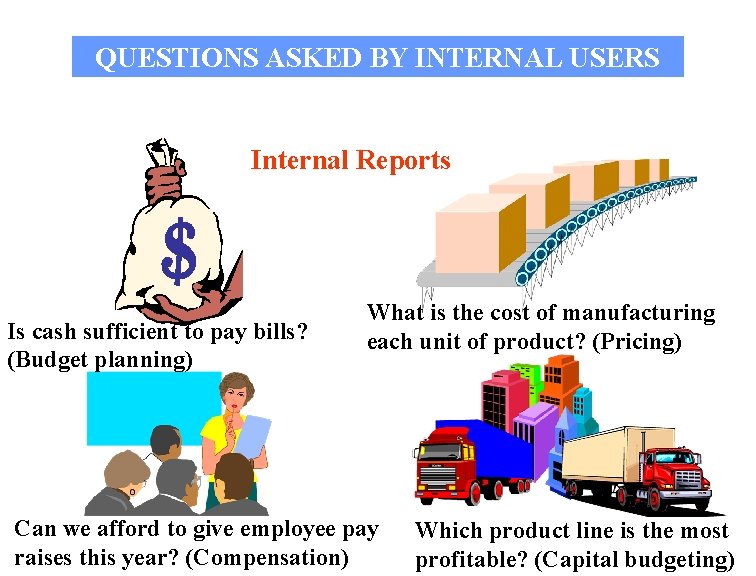
QUESTIONS ASKED BY INTERNAL USERS Internal Reports Is cash sufficient to pay bills? (Budget planning) What is the cost of manufacturing each unit of product? (Pricing) Can we afford to give employee pay raises this year? (Compensation) Which product line is the most profitable? (Capital budgeting)
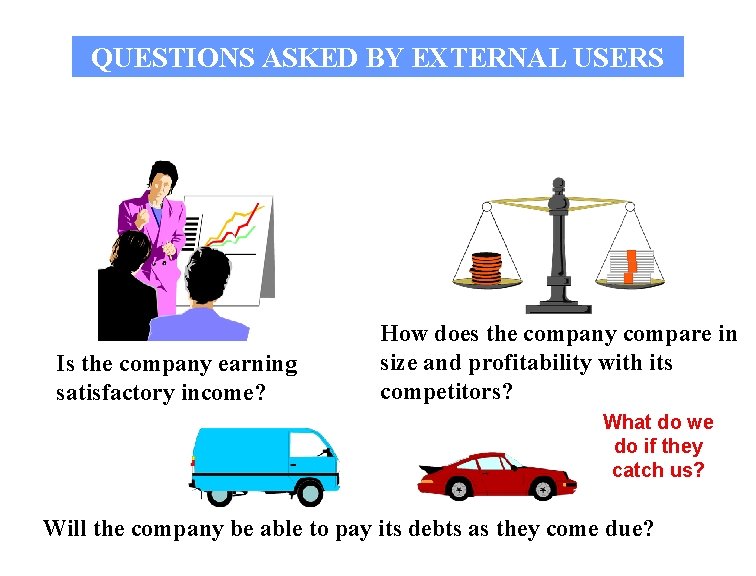
QUESTIONS ASKED BY EXTERNAL USERS Is the company earning satisfactory income? How does the company compare in size and profitability with its competitors? What do we do if they catch us? Will the company be able to pay its debts as they come due?
STUDY OBJECTIVE 3 ETHICS: A FUNDAMENTAL BUSINESS CONCEPT ETHICS: A set of standards by which one’s actions are deemed right or wrong, honest or dishonest.
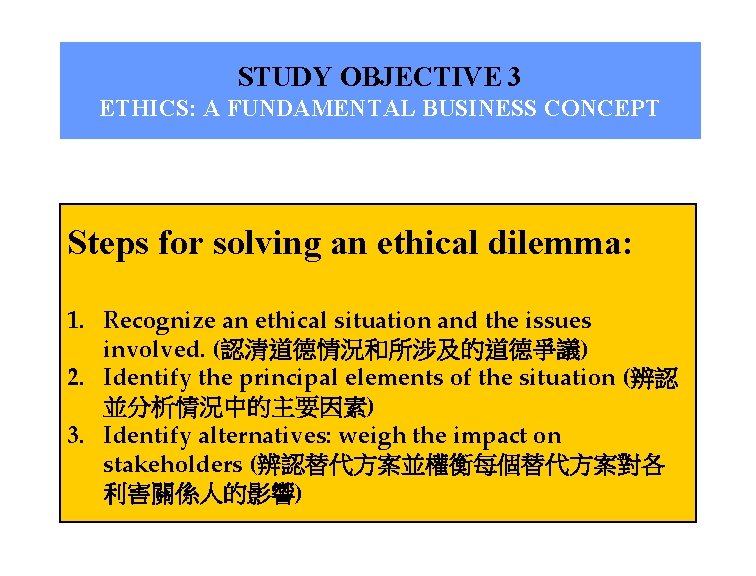
STUDY OBJECTIVE 3 ETHICS: A FUNDAMENTAL BUSINESS CONCEPT Steps for solving an ethical dilemma: 1. Recognize an ethical situation and the issues involved. (認清道德情況和所涉及的道德爭議) 2. Identify the principal elements of the situation (辨認 並分析情況中的主要因素) 3. Identify alternatives: weigh the impact on stakeholders (辨認替代方案並權衡每個替代方案對各 利害關係人的影響)
STUDY OBJECTIVE 4 GAAP (Generally Accepted Accounting Principles) What is GAAP? A set of standards generally accepted and universally practiced by accountants 1. Indicates how economic events are reported 2. Generated by the Financial Accounting Standards Board (FASB) and Securities & Exchange Commission (SEC)
STUDY OBJECTIVE 4 GAAP (Generally Accepted Accounting Principles) A main purpose of GAAP is to make information in financial statements relevant(攸關), reliable(可靠), and comparable(可比較性). l Relevant information affects the decisions of its users. l Reliable information is trusted by users. l Comparable information is helpful in contrasting organization.
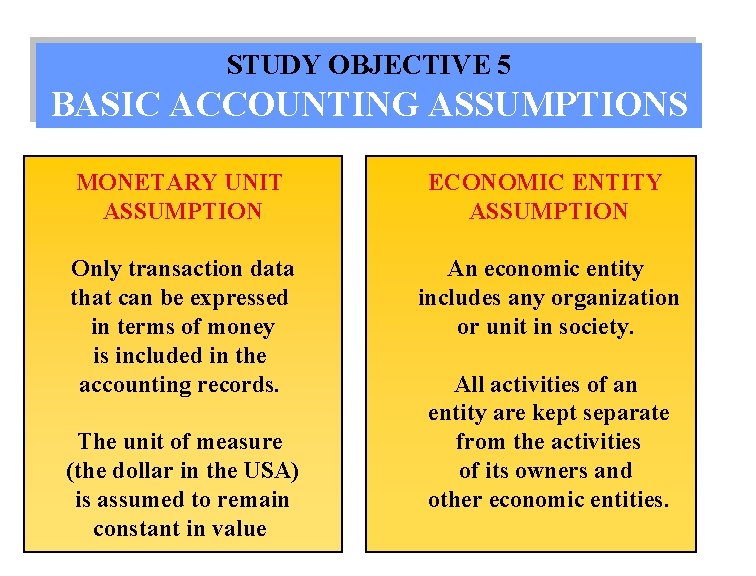
STUDY OBJECTIVE 5 BASIC ACCOUNTING ASSUMPTIONS MONETARY UNIT ASSUMPTION ECONOMIC ENTITY ASSUMPTION Only transaction data that can be expressed in terms of money is included in the accounting records. An economic entity includes any organization or unit in society. The unit of measure (the dollar in the USA) is assumed to remain constant in value All activities of an entity are kept separate from the activities of its owners and other economic entities.
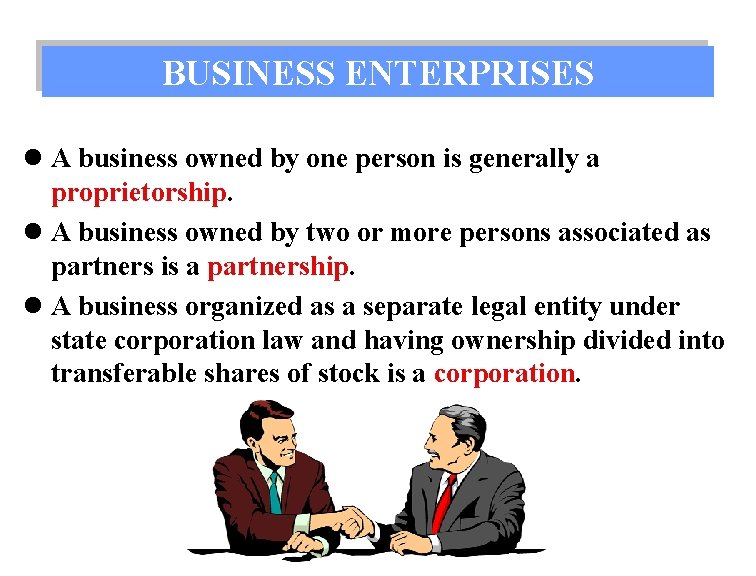
BUSINESS ENTERPRISES l A business owned by one person is generally a proprietorship. l A business owned by two or more persons associated as partners is a partnership. l A business organized as a separate legal entity under state corporation law and having ownership divided into transferable shares of stock is a corporation.
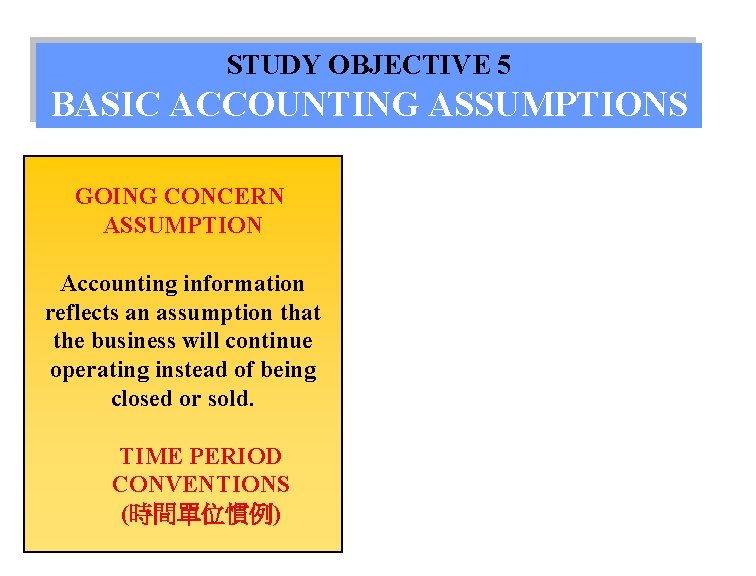
STUDY OBJECTIVE 5 BASIC ACCOUNTING ASSUMPTIONS GOING CONCERN ASSUMPTION Accounting information reflects an assumption that the business will continue operating instead of being closed or sold. TIME PERIOD CONVENTIONS (時間單位慣例)
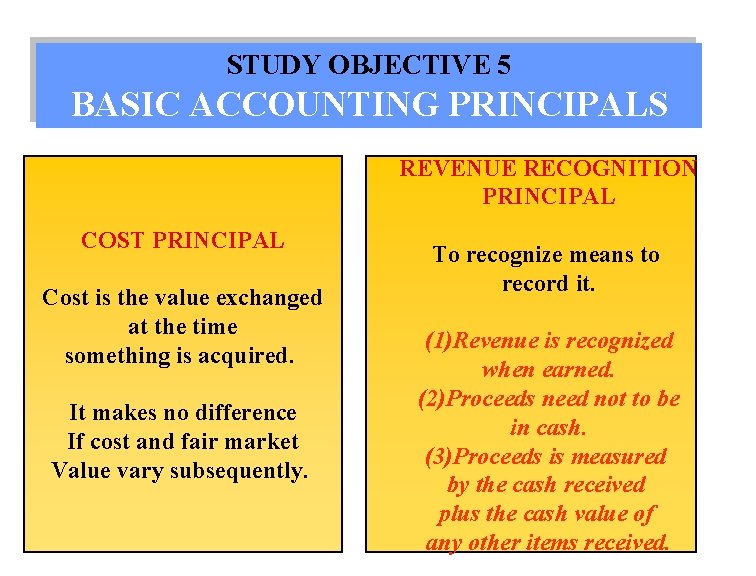
STUDY OBJECTIVE 5 BASIC ACCOUNTING PRINCIPALS REVENUE RECOGNITION PRINCIPAL COST PRINCIPAL Cost is the value exchanged at the time something is acquired. It makes no difference If cost and fair market Value vary subsequently. To recognize means to record it. (1)Revenue is recognized when earned. (2)Proceeds need not to be in cash. (3)Proceeds is measured by the cash received plus the cash value of any other items received.
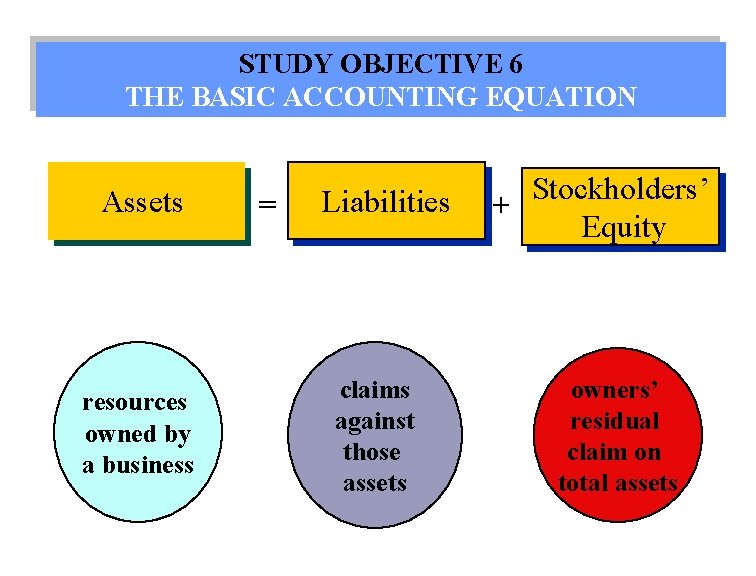
STUDY OBJECTIVE 6 THE BASIC ACCOUNTING EQUATION Assets resources owned by a business = Liabilities claims against those assets Stockholders’ + Equity owners’ residual claim on total assets
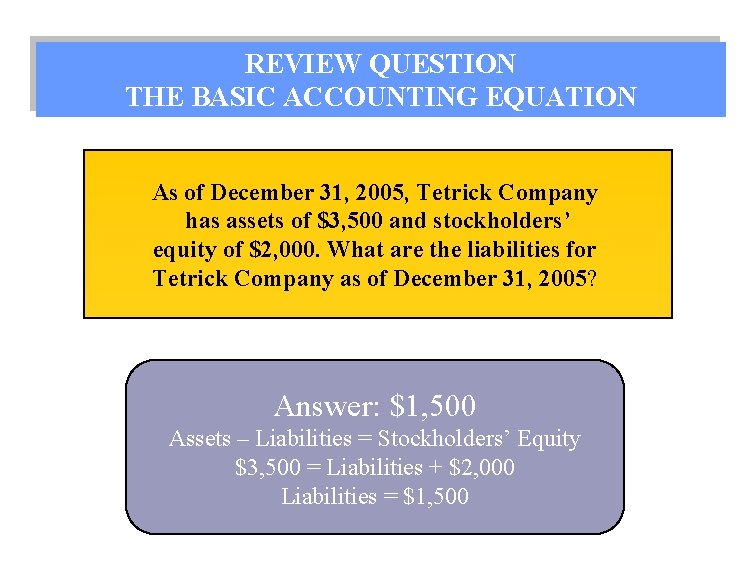
REVIEW QUESTION THE BASIC ACCOUNTING EQUATION As of December 31, 2005, Tetrick Company has assets of $3, 500 and stockholders’ equity of $2, 000. What are the liabilities for Tetrick Company as of December 31, 2005? Answer: $1, 500 Assets – Liabilities = Stockholders’ Equity $3, 500 = Liabilities + $2, 000 Liabilities = $1, 500
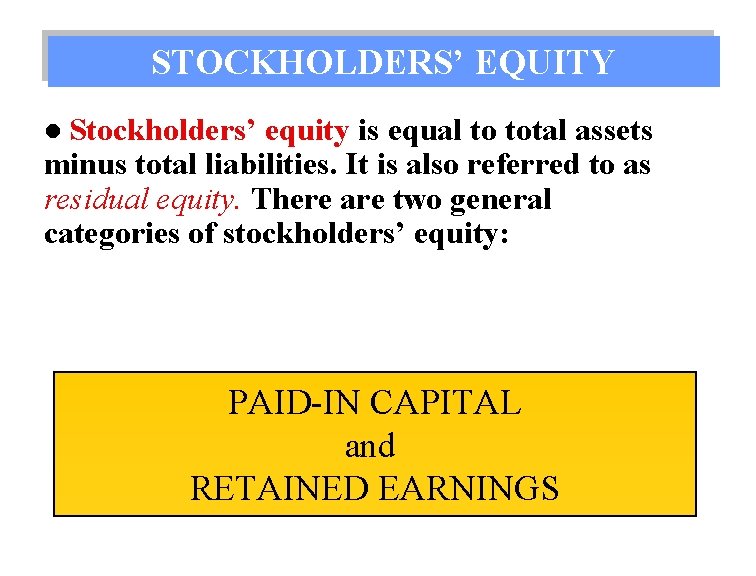
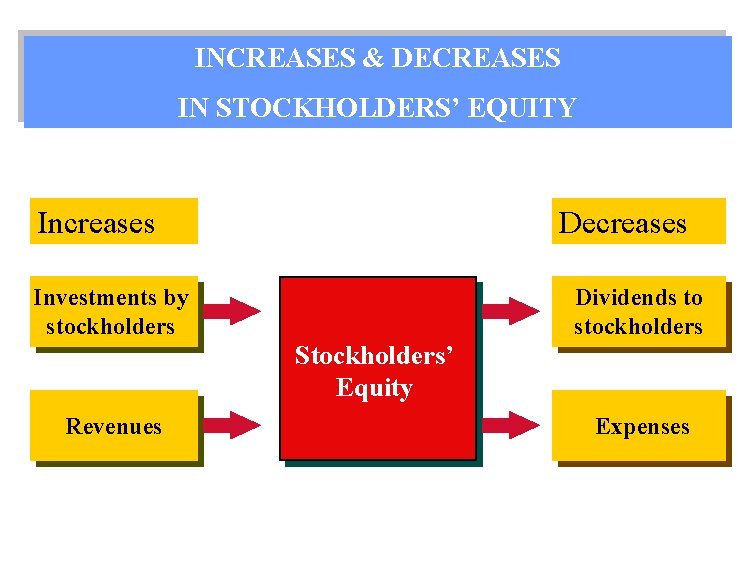
STOCKHOLDERS’ EQUITY l Stockholders’ equity is equal to total assets minus total liabilities. It is also referred to as residual equity. There are two general categories of stockholders’ equity: PAID-IN CAPITAL and RETAINED EARNINGS
PAID-IN CAPITAL l Paid in Capital represents the total amount invested by stockholders in a corporation. l Stockholders invest cash or other assets in exchange for common or preferred stock.
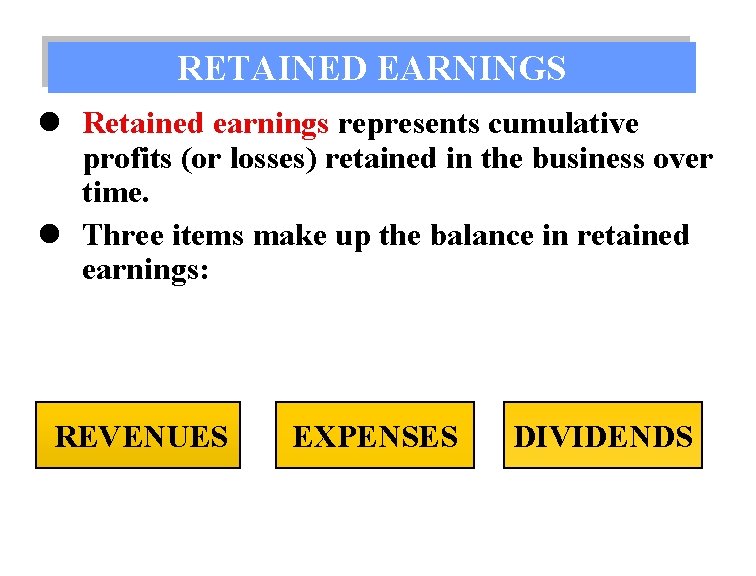
RETAINED EARNINGS l Retained earnings represents cumulative profits (or losses) retained in the business over time. l Three items make up the balance in retained earnings: REVENUES EXPENSES DIVIDENDS
REVENUES l Revenues are the gross increases in stockholders’ equity from engaging in business activities entered into for the purpose of earning income. l Revenues result from sales of merchandise, performance of services, rental of property, or lending of money. l Revenues usually result in an increase in an asset.
EXPENSES l Expenses are the decreases in stockholders’ equity that result from operating the business. l They are the cost of assets consumed or services used in the process of earning revenue. l Examples are: utility expense, rent expense, supplies expense, tax expense, insurance expense, depreciation expense.
DIVIDENDS l When a company is successful, it generates Net Income. l Dividends: the distribution of cash or other assets to stockholders that are available as a result of Net Income. l Dividends are NOT considered an expense of the corporation.
INCREASES & DECREASES IN STOCKHOLDERS’ EQUITY Increases Decreases Investments by stockholders Dividends to stockholders Stockholders’ Equity Revenues Expenses
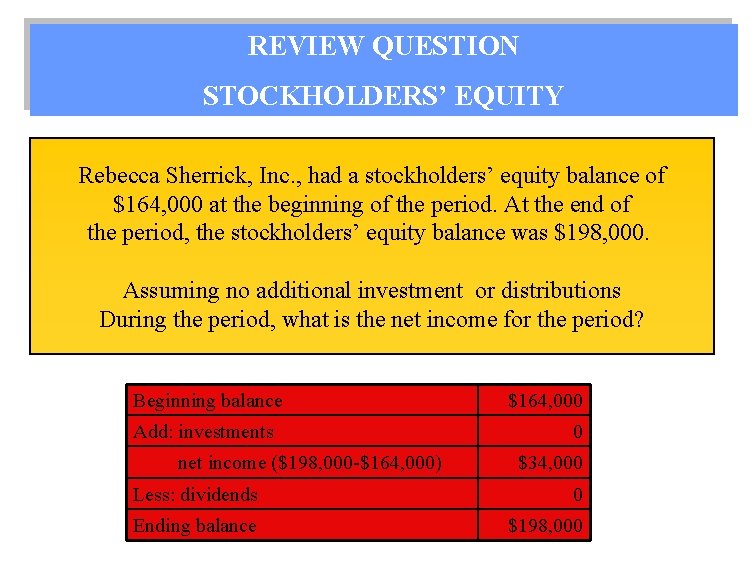
REVIEW QUESTION STOCKHOLDERS’ EQUITY Rebecca Sherrick, Inc. , had a stockholders’ equity balance of $164, 000 at the beginning of the period. At the end of the period, the stockholders’ equity balance was $198, 000. Assuming no additional investment or distributions During the period, what is the net income for the period? Beginning balance Add: investments net income ($198, 000 -$164, 000) $164, 000 0 $34, 000 Less: dividends 0 Ending balance $198, 000
STUDY OBJECTIVE 7 HOW BUSINESS TRANSACTIONS AFFECT THE ACCOUNTING EQUATION • Transaction: 係指會計人員所記錄的經 濟事項。 • Every transaction must have a dual effect on the accounting equation. Thus, if an asset is increased, there must be a corresponding: 1. Decrease in another asset, or 2. Increase in a liability, or 3. Increase in stockholders’ equity
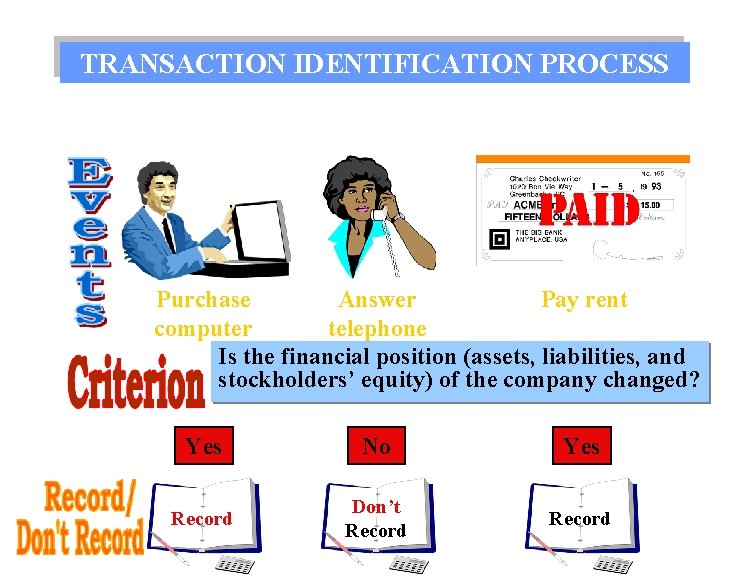
TRANSACTION IDENTIFICATION PROCESS Purchase Answer Pay rent computer telephone Is the financial position (assets, liabilities, and stockholders’ equity) of the company changed? Yes No Yes Record Don’t Record
TRANSACTION ANALYSIS TRANSACTION 1 l Ray and Barbara Neal decide to open a computer programming company to be incorporated as Softbyte, Inc. l They invest $15, 000 cash in exchange for $15, 000 of common stock.
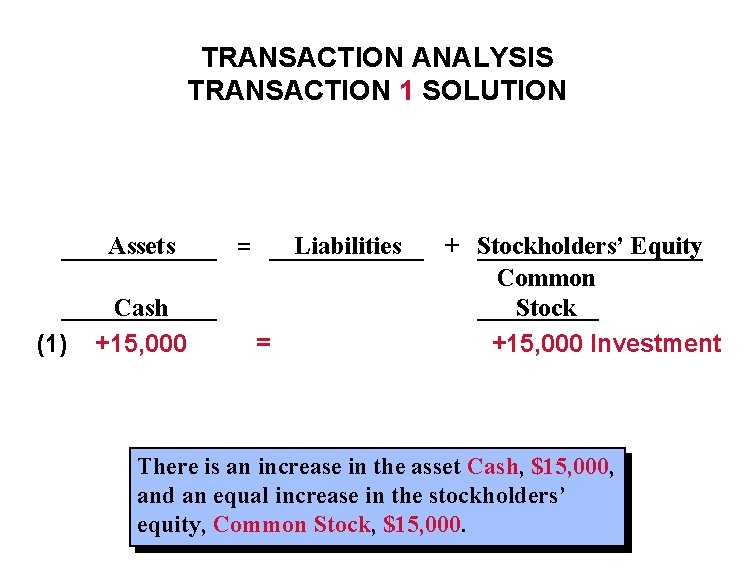
TRANSACTION ANALYSIS TRANSACTION 1 SOLUTION Assets (1) Cash +15, 000 = Liabilities = + Stockholders’ Equity Common Stock +15, 000 Investment There is an increase in the asset Cash, $15, 000, and an equal increase in the stockholders’ equity, Common Stock, $15, 000.
TRANSACTION ANALYSIS TRANSACTION 2 Softbyte purchases computer equipment for $7, 000 cash.
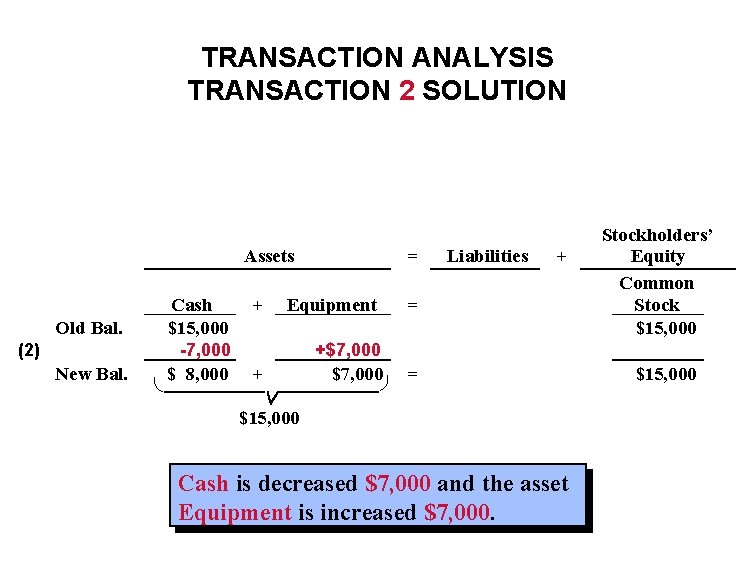
TRANSACTION ANALYSIS TRANSACTION 2 SOLUTION Assets Old Bal. (2) Cash $15, 000 + Equipment -7, 000 New Bal. $ 8, 000 = Liabilities + = Stockholders’ Equity Common Stock $15, 000 +$7, 000 + $7, 000 = $15, 000 Cash is decreased $7, 000 and the asset Equipment is increased $7, 000. $15, 000
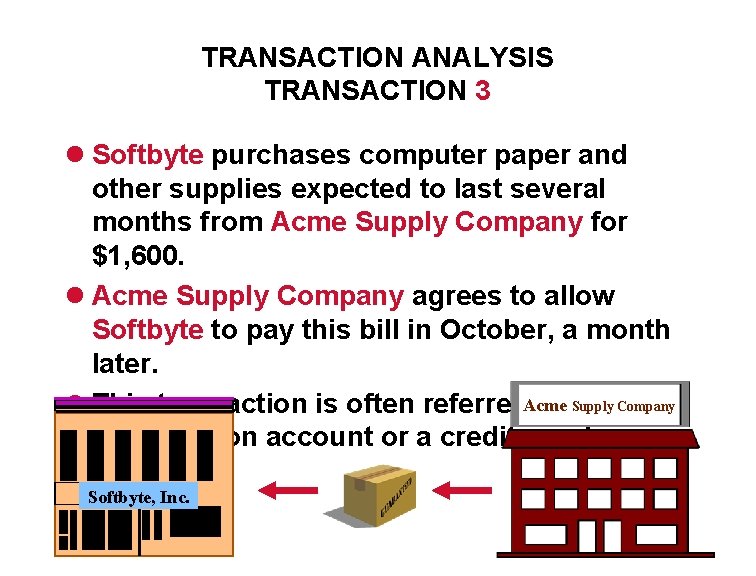
TRANSACTION ANALYSIS TRANSACTION 3 l Softbyte purchases computer paper and other supplies expected to last several months from Acme Supply Company for $1, 600. l Acme Supply Company agrees to allow Softbyte to pay this bill in October, a month later. Supplya Company l This transaction is often referred. Acme to as purchase on account or a credit purchase. Softbyte, Inc.
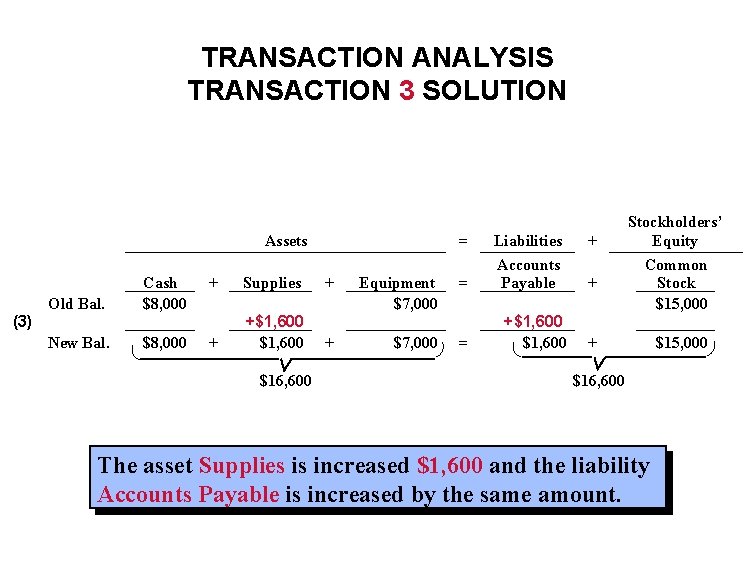
TRANSACTION ANALYSIS TRANSACTION 3 SOLUTION Assets Old Bal. Cash $8, 000 + Supplies + +$1, 600 (3) New Bal. $8, 000 $16, 600 = + + Equipment $7, 000 = = Liabilities Accounts Payable +$1, 600 + + Stockholders’ Equity Common Stock $15, 000 + $16, 600 The asset Supplies is increased $1, 600 and the liability Accounts Payable is increased by the same amount. $15, 000
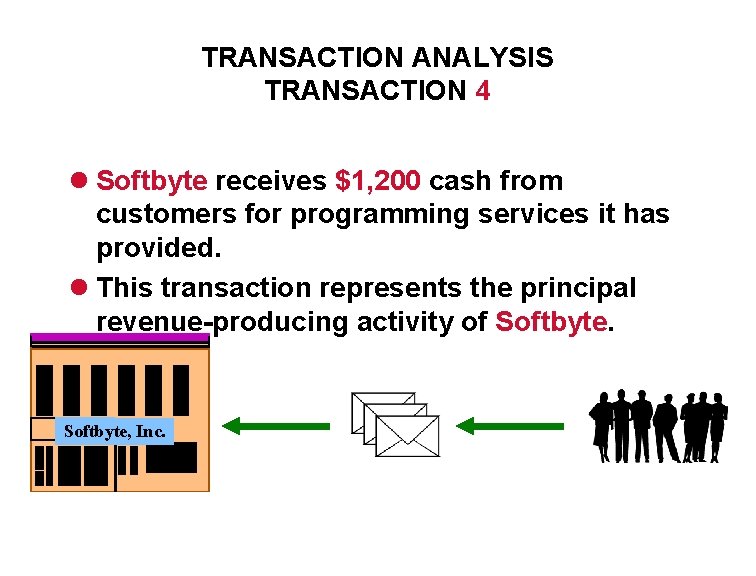
TRANSACTION ANALYSIS TRANSACTION 4 l Softbyte receives $1, 200 cash from customers for programming services it has provided. l This transaction represents the principal revenue-producing activity of Softbyte, Inc.
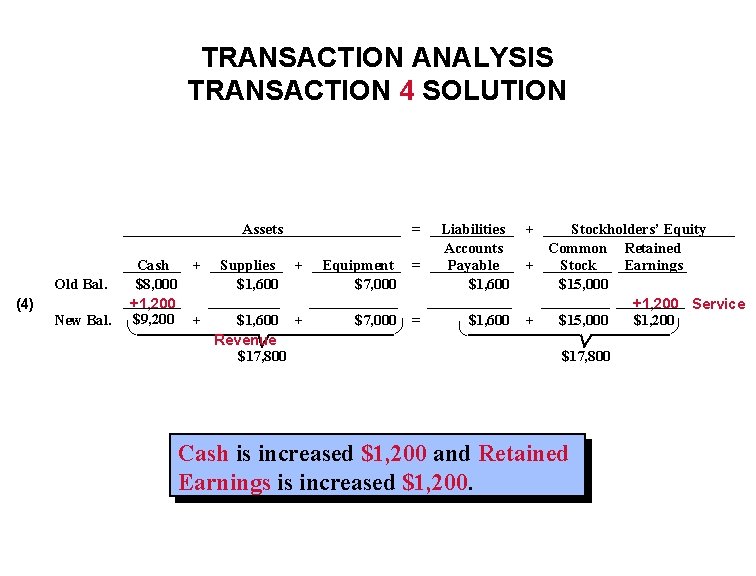
TRANSACTION ANALYSIS TRANSACTION 4 SOLUTION Assets Old Bal. (4) New Bal. Cash $8, 000 +1, 200 $9, 200 + + Supplies $1, 600 = + Equipment $7, 000 = $1, 600 + Revenue $17, 800 $7, 000 = Liabilities Accounts Payable $1, 600 + Stockholders’ Equity Common Retained + Stock Earnings $15, 000 +1, 200 Service + $15, 000 $1, 200 $17, 800 Cash is increased $1, 200 and Retained Earnings is increased $1, 200.
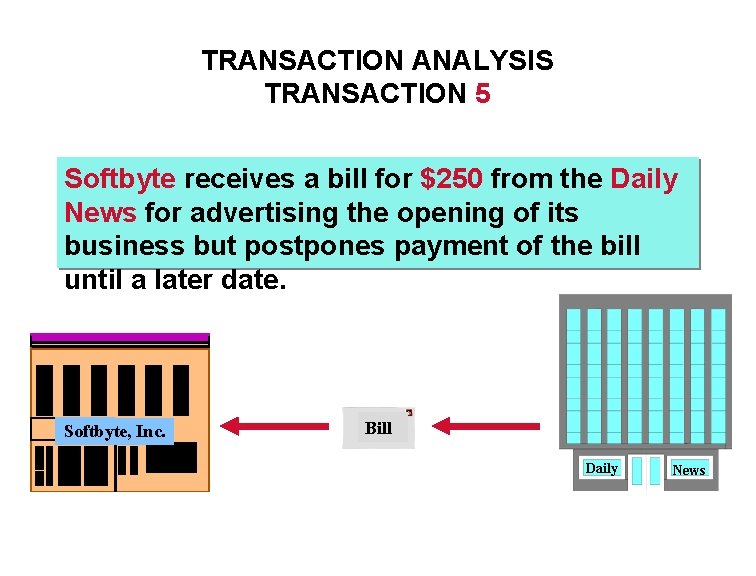
TRANSACTION ANALYSIS TRANSACTION 5 Softbyte receives a bill for $250 from the Daily News for advertising the opening of its business but postpones payment of the bill until a later date. Softbyte, Inc. Bill Daily News
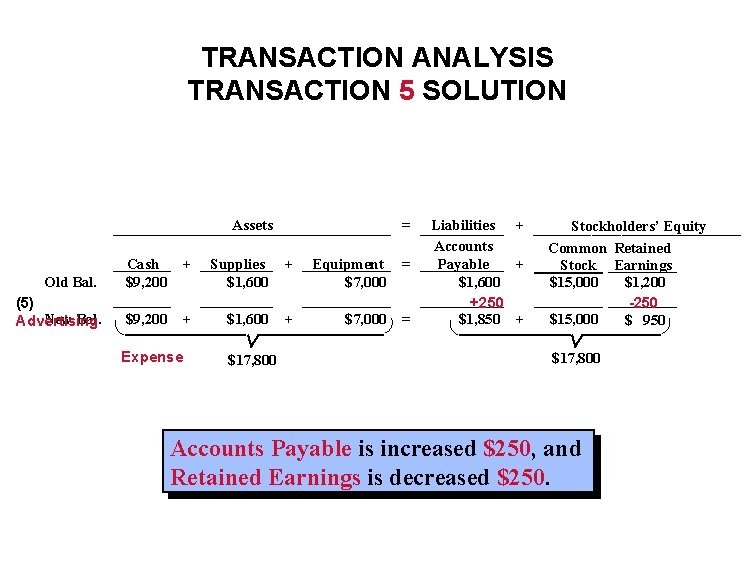
TRANSACTION ANALYSIS TRANSACTION 5 SOLUTION Assets = + Supplies $1, 600 + Equipment $7, 000 = Old Bal. Cash $9, 200 (5) New Bal. Advertising $9, 200 + $1, 600 + $7, 000 = Expense $17, 800 Liabilities + Accounts Payable + $1, 600 +250 $1, 850 + Stockholders’ Equity Common Retained Stock Earnings $15, 000 $1, 200 -250 $15, 000 $ 950 $17, 800 Accounts Payable is increased $250, and Retained Earnings is decreased $250.
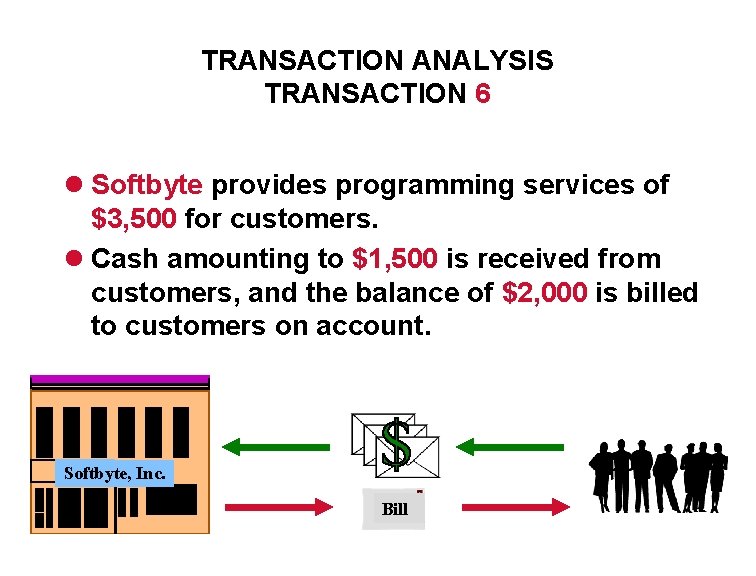
TRANSACTION ANALYSIS TRANSACTION 6 l Softbyte provides programming services of $3, 500 for customers. l Cash amounting to $1, 500 is received from customers, and the balance of $2, 000 is billed to customers on account. Softbyte, Inc. Bill
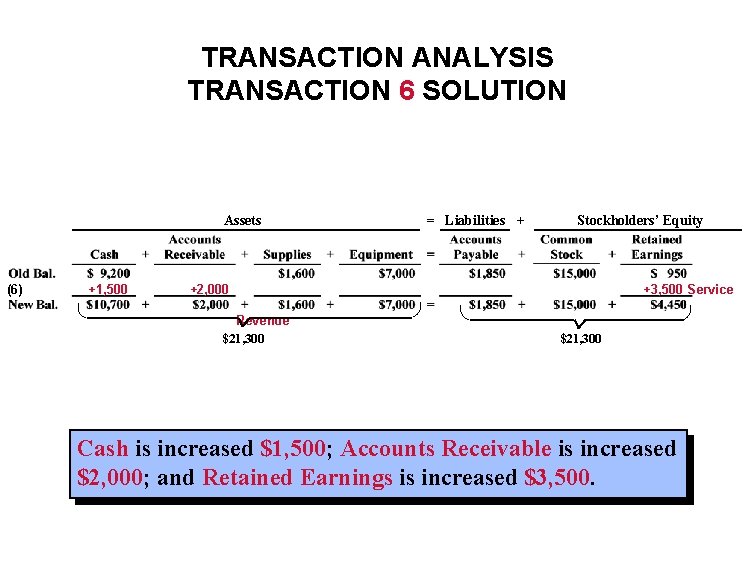
TRANSACTION ANALYSIS TRANSACTION 6 SOLUTION Assets (6) +1, 500 = Liabilities + Stockholders’ Equity +2, 000 Revenue $21, 300 +3, 500 Service $21, 300 Cash is increased $1, 500; Accounts Receivable is increased $2, 000; and Retained Earnings is increased $3, 500.
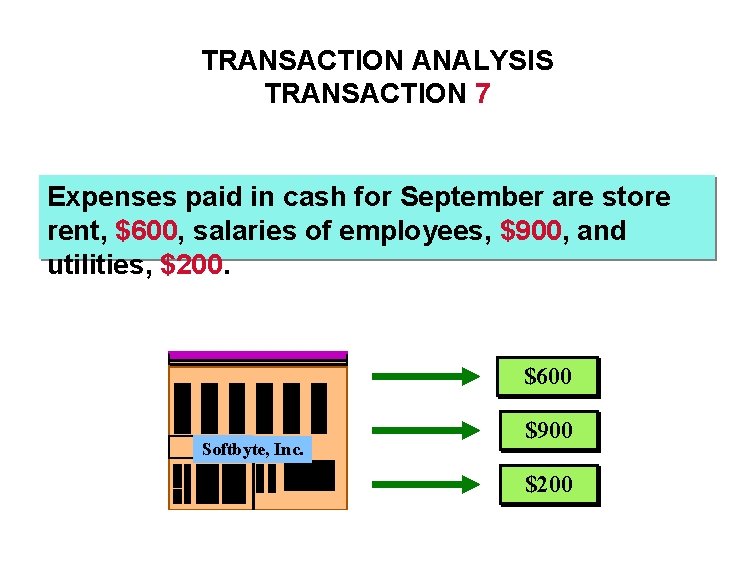
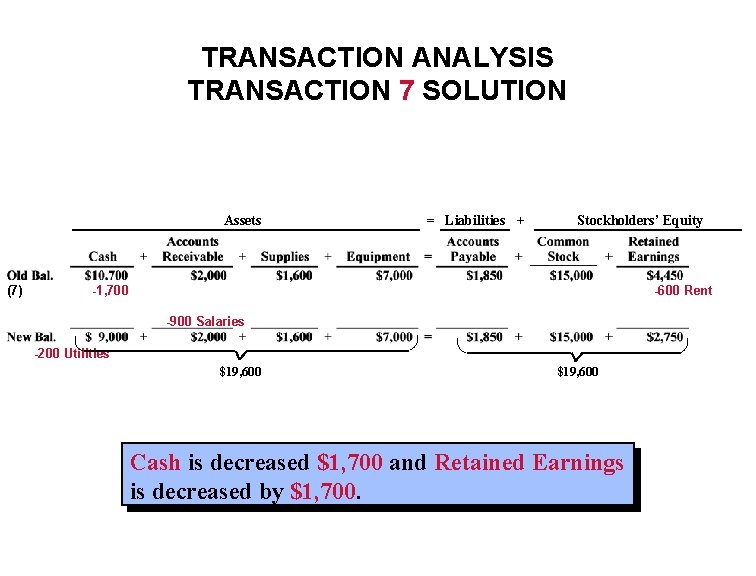
TRANSACTION ANALYSIS TRANSACTION 7 Expenses paid in cash for September are store rent, $600, salaries of employees, $900, and utilities, $200. $600 Softbyte, Inc. $900 $200
TRANSACTION ANALYSIS TRANSACTION 7 SOLUTION Assets (7) = Liabilities + Stockholders’ Equity -1, 700 -600 Rent -900 Salaries -200 Utilities $19, 600 Cash is decreased $1, 700 and Retained Earnings is decreased by $1, 700.
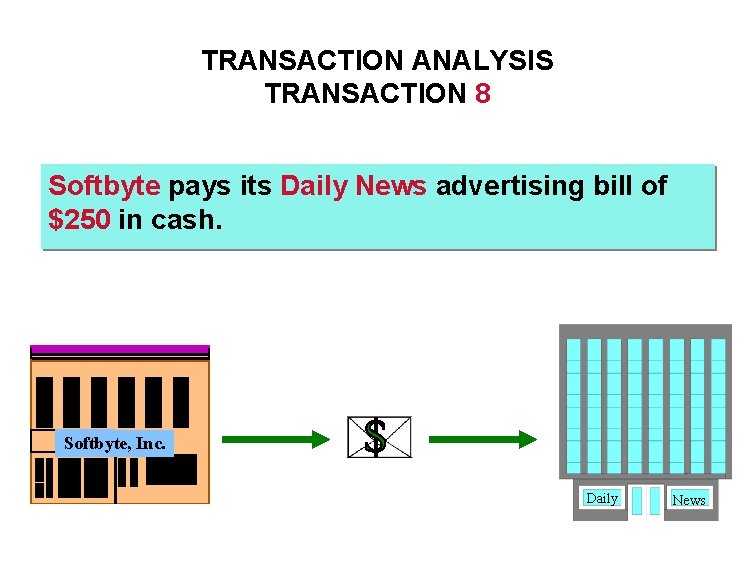
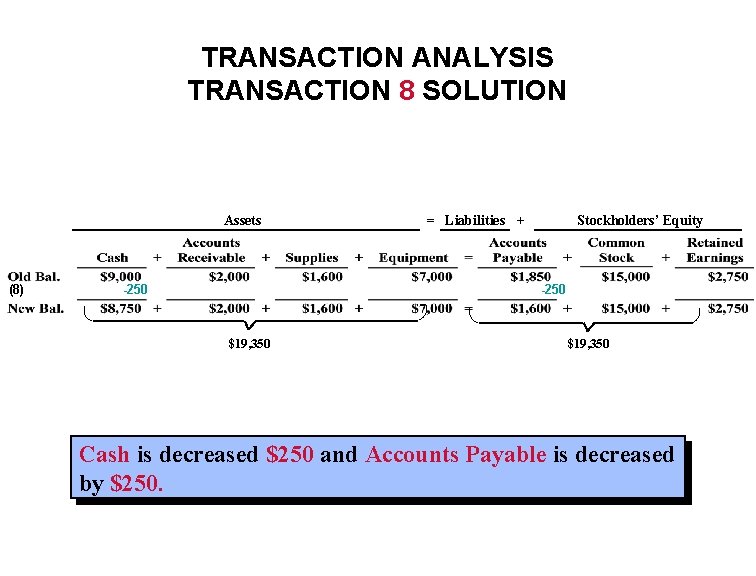
TRANSACTION ANALYSIS TRANSACTION 8 Softbyte pays its Daily News advertising bill of $250 in cash. Softbyte, Inc. Daily News
TRANSACTION ANALYSIS TRANSACTION 8 SOLUTION Assets (8) -250 = Liabilities + Stockholders’ Equity -250 $19, 350 Cash is decreased $250 and Accounts Payable is decreased by $250.
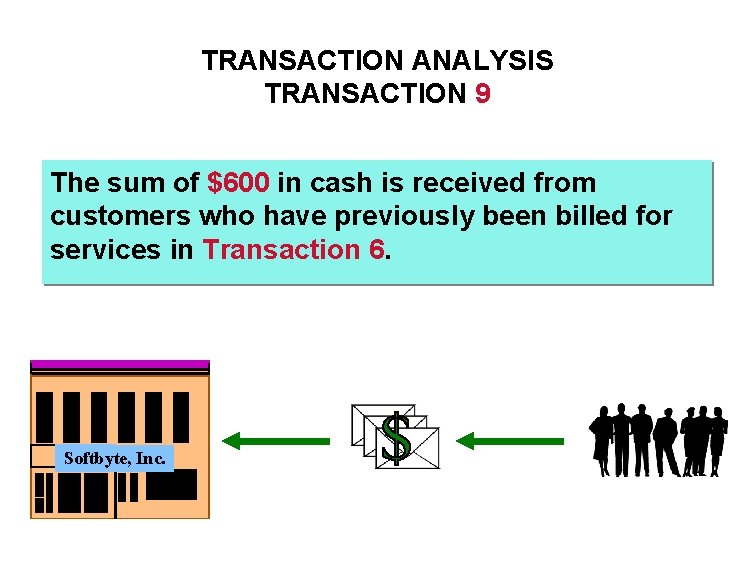
TRANSACTION ANALYSIS TRANSACTION 9 The sum of $600 in cash is received from customers who have previously been billed for services in Transaction 6. Softbyte, Inc.
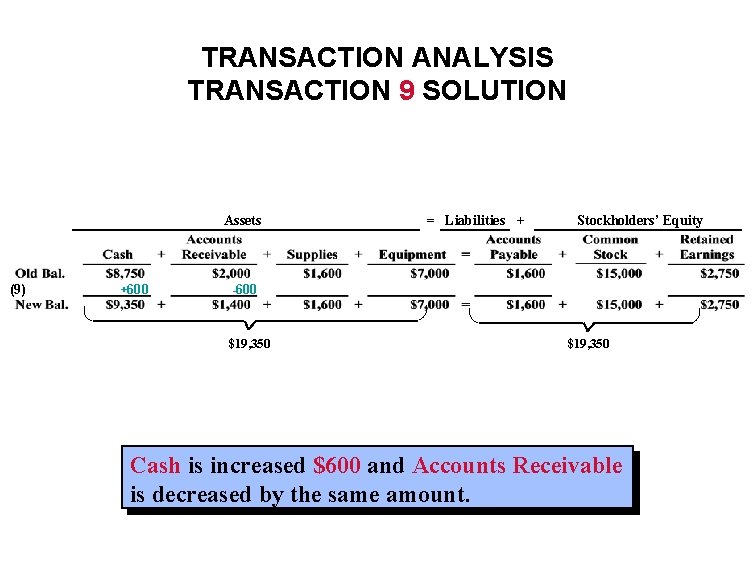
TRANSACTION ANALYSIS TRANSACTION 9 SOLUTION Assets (9) +600 = Liabilities + Stockholders’ Equity -600 $19, 350 Cash is increased $600 and Accounts Receivable is decreased by the same amount.
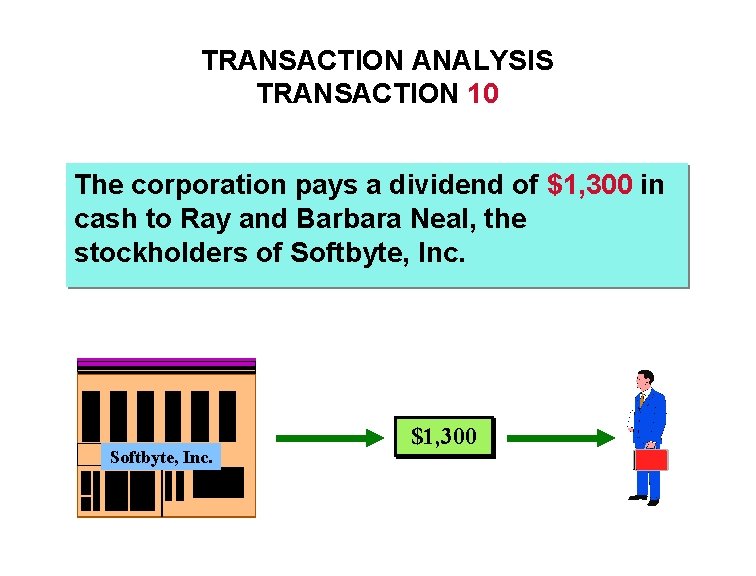
TRANSACTION ANALYSIS TRANSACTION 10 The corporation pays a dividend of $1, 300 in cash to Ray and Barbara Neal, the stockholders of Softbyte, Inc. $1, 300
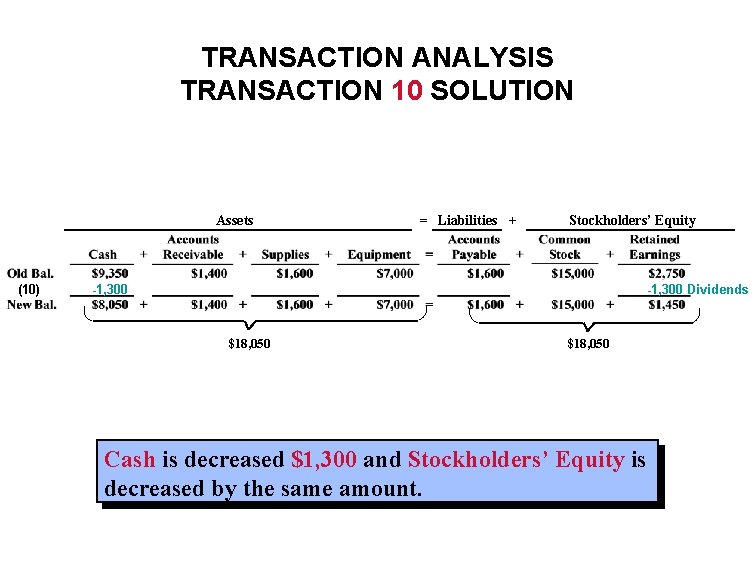
TRANSACTION ANALYSIS TRANSACTION 10 SOLUTION Assets (10) = Liabilities + Stockholders’ Equity -1, 300 Dividends $18, 050 Cash is decreased $1, 300 and Stockholders’ Equity is decreased by the same amount.
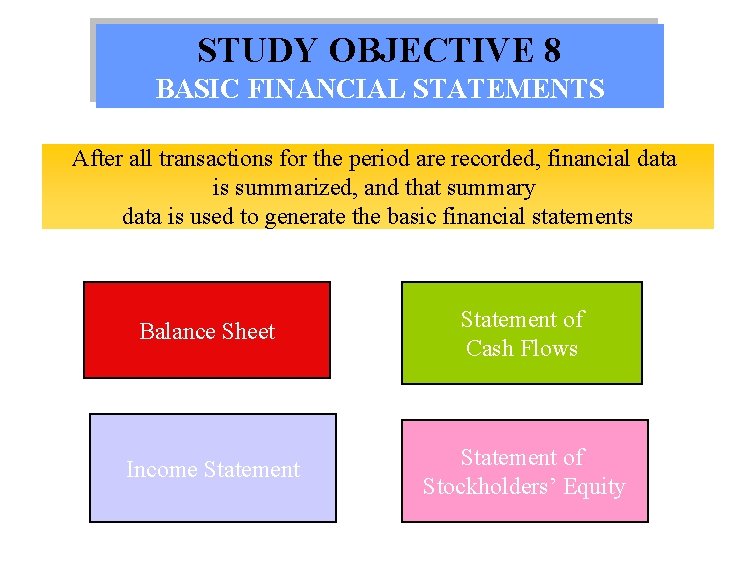
STUDY OBJECTIVE 8 BASIC FINANCIAL STATEMENTS After all transactions for the period are recorded, financial data is summarized, and that summary data is used to generate the basic financial statements Balance Sheet Statement of Cash Flows Income Statement of Stockholders’ Equity
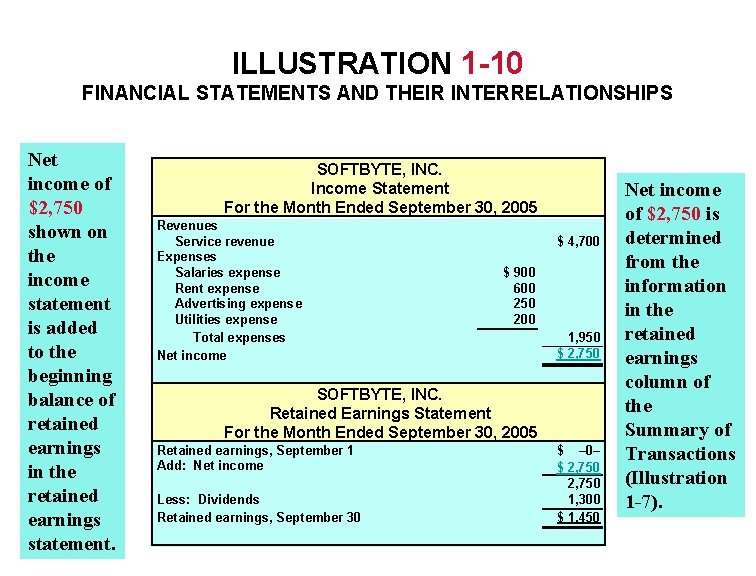
ILLUSTRATION 1 -10 FINANCIAL STATEMENTS AND THEIR INTERRELATIONSHIPS Net income of $2, 750 shown on the income statement is added to the beginning balance of retained earnings in the retained earnings statement. SOFTBYTE, INC. Income Statement For the Month Ended September 30, 2005 Revenues Service revenue Expenses Salaries expense Rent expense Advertising expense Utilities expense Total expenses Net income $ 4, 700 $ 900 600 250 200 1, 950 $ 2, 750 SOFTBYTE, INC. Retained Earnings Statement For the Month Ended September 30, 2005 Retained earnings, September 1 Add: Net income Less: Dividends Retained earnings, September 30 $ – 0– $ 2, 750 1, 300 $ 1, 450 Net income of $2, 750 is determined from the information in the retained earnings column of the Summary of Transactions (Illustration 1 -7).
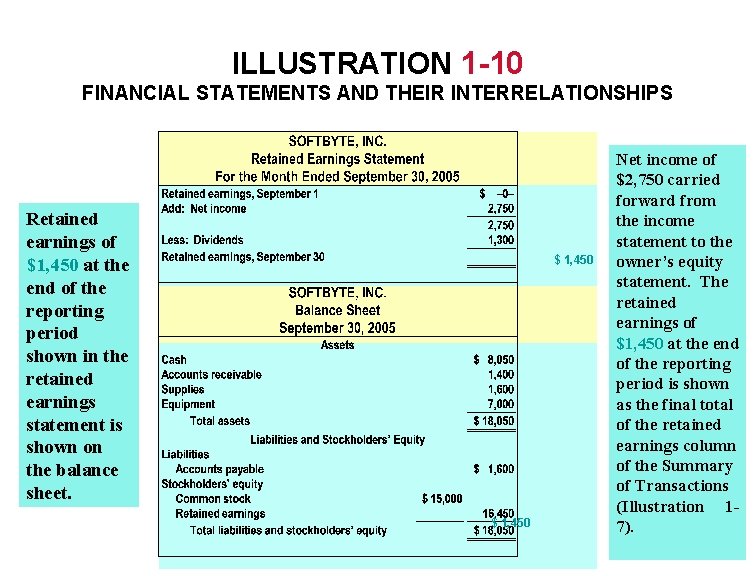
ILLUSTRATION 1 -10 FINANCIAL STATEMENTS AND THEIR INTERRELATIONSHIPS Retained earnings of $1, 450 at the end of the reporting period shown in the retained earnings statement is shown on the balance sheet. $ 1, 450 Net income of $2, 750 carried forward from the income statement to the owner’s equity statement. The retained earnings of $1, 450 at the end of the reporting period is shown as the final total of the retained earnings column of the Summary of Transactions (Illustration 17).
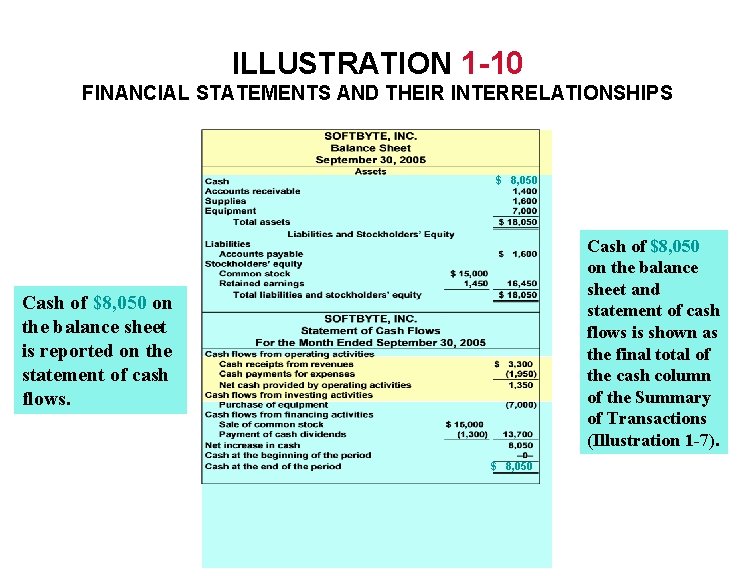
ILLUSTRATION 1 -10 FINANCIAL STATEMENTS AND THEIR INTERRELATIONSHIPS $ 8, 050 Cash of $8, 050 on the balance sheet and statement of cash flows is shown as the final total of the cash column of the Summary of Transactions (Illustration 1 -7). Cash of $8, 050 on the balance sheet is reported on the statement of cash flows. $ 8, 050
CHAPTER 1 ACCOUNTING IN ACTION