
FINANCE 383 BANKING AND FINANCIAL INSTITUTIONS Tutorial 9
FINANCE 383 BANKING AND FINANCIAL INSTITUTIONS Tutorial 9 – 2017 S 1 aria. zhang@auckland. ac. nz
outline Textbook: Casu et al. , Introduction to banking, 2015 PART 3: ISSUES IN BANK MANAGEMENT Mid-term Test Chapter 8: Bank failures and bank crises Suggestions for the assignment
Review of mid-term test (Average Score 18. 4/25, 74%, ½ of you are higher than 20!) 1. Why is bad bank needed? � Good bank (continue operation) build up confidence and reduce contagion; � Bad bank: maximise the value of dysfunctional assets 2. Net stable funding ratio (NSFR) � The difference between NSF (liability side) and liquidity coverage ratio (asset side)
Review of mid-term test 3. Loan to value ratio � Credit risk (default by mortgage payer) � Market risk (collateral value in downturn) � Systematic risk (built up in housing sector) 4. Create money/ make money? 5. Sovereign risk/ country risk?
Review of mid-term test 6. Use swap to reduce exchange rate risk. The concept of exposure. The concept of mismatch. Think: (1) Is fixed always better than floating? (2) Is swap only happen when there is a difference in fix/floating exchange rate?
Banking failures and banking crises Q 1: What are the common causes of bank failures? v High proportion of bad loans and non-performing loans v Depositors’ panic/bank runs Q 2: What is the moral hazard from bailing out troubled banks? v The probability of surviving depends less on the bank’s choice of risk and more on the central bank’s actions
Banking failures and banking crises **Q 3: How does a bail in work? • • • Officials would be given the authority to force banks to recapitalize from within, using private money rather than public money. Write assets down wiping out existing shareholders Recapitalize the bank (e. g. Preferred stock and subordinated debt investors as well as holders of senior unsecured debt convert a percentage of their existing holdings in return for a high proportion of the equity in the new bank) The remaining % of senior debt, bank’s secured creditors and customers are unaffected. Bank’s previous shareholders receive warrants that will have value if the new bank rebounds.
Banking failures and banking crises **Q 4: What is contingent capital? (Co. Cos: Contingent convertible bonds) Type of debt issued by a firm that could be converted into equity during a period of financial stress (or when bank’s capital falls to a certain point) Benefit to banks: (1) Issuing contingent capital in good time fixes the recapitalization cost at a reasonable level in a future distressed situation. Apparently it is a cheaper way than raising capital in bad time. (2) It will not cause the concern of higher required Ro. E (3) The payment of debt interest can be deducted from tax Benefit to regulators: (1) It can reduce the default probability without government bailout. (2) Contingent capital may work in an ex ante sense as a disciplining mechanism. §
Banking failures and banking crises **Q 5: Why do we need deposit insurance? v Customers’ protection v Financial stability v Lighten the burden of tax-payers **Q 6: What is the LOLR function? v Institution willing to extend credit when no one else is v Protects depositors v Prevents widespread panic withdrawal v Provides liquidity Q 7: What are living wills and funeral plans? v Recovery and resolution plans v A living will is a recovery plan that forces a bank to think through in advance what it would do if it experienced an extreme stress. Such plans should include the steps that it would take to recover from the stress as well as the steps that would have to be taken, if the institution failed to recover and resolution was required. v The funeral plan is a set of instructions for how the institution could be quickly dismantled if the need to do so arose. In this case, authorities take over the bank; while in the case of living wills, the bank remains in control.
Banking failures and banking crises **Q 8: What are Asset Management Companies? § Bad banks established to hold nonperforming assets owned by a state guaranteed bank § The good part of the bank keeps doing business (sometimes acquired by another bank) without interruptions. Good bank-bridge bank (an institution created by a national regulator or central bank to operate a failed bank until a buyer can be found for its operations. Main purpose: enable a bank to operate its core business without ) Bad bank--asset management companies. (Main purpose: specialize in maximizing value from the high risk assets. )
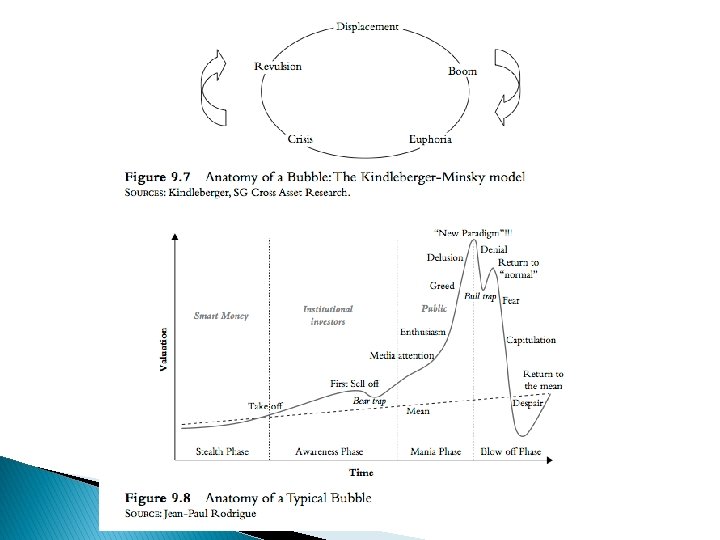
Banking failures and banking crises Q 9: What is a Minsky moment? v v 1. 2. 3. 4. 5. because long periods of prosperity and increasing value of investments lead to increasing speculation using borrowed money. Rejection of EMH-Minsky’s financial instability hypothesis holds that the structure of a capitalist economy becomes more fragile over a period of prosperity (why? ) Five stages of the credit cycle: displacement, boom, euphoria, profit taking, and panic. Displacement: investors get excited about something (e. g. internet or an abrupt change in economic policy-Alan Greenspan decision to reduce shortterm interest rate to 1%) Boom: capital influx & historical low mortgage rates-->real-estate boom Euphoria: banks and other commercial lenders extend credit to more dubious borrowers-securitization: enables banks to provide home loans without worrying if they will be ever repaid. Profit taking: at the top (e. g. Mid-2006) some smart traders start to cash in their profits. Panic: triggered by a dramatic effect (e. g. two Bear Sterns hedge funds that had invested heavily in mortgage securities collapsed).
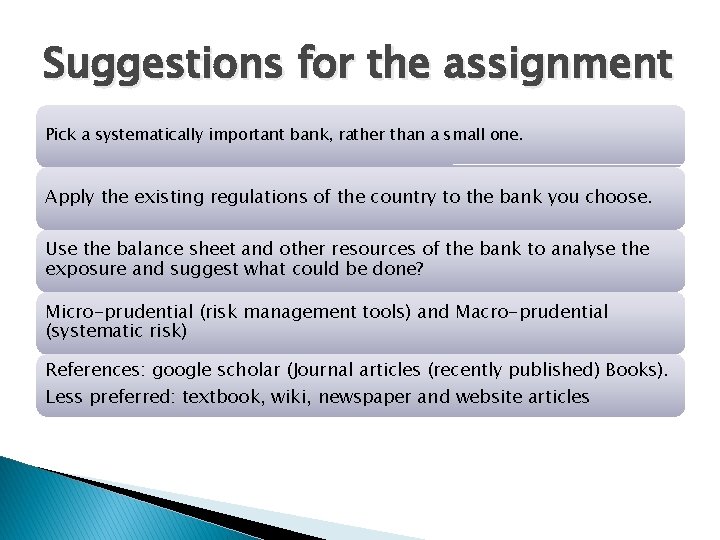
Suggestions for the assignment Pick a systematically important bank, rather than a small one. Apply the existing regulations of the country to the bank you choose. Use the balance sheet and other resources of the bank to analyse the exposure and suggest what could be done? Micro-prudential (risk management tools) and Macro-prudential (systematic risk) References: google scholar (Journal articles (recently published) Books). Less preferred: textbook, wiki, newspaper and website articles
- Slides: 13