
FINANCE 3 Present Value Professor Andr Farber Solvay
FINANCE 3. Present Value Professor André Farber Solvay Business School Université Libre de Bruxelles Fall 2004 MBA 2004
Present Value • Objectives for this session : • • 1. Introduce present value calculation in a simple 1 -period setting 2. Extend present value calculation to several periods 3. Analyse the impact of the compounding periods 4. Introduce shortcut formulas for PV calculations MBA 2004 2
Present Value: teaching strategy • 1 -period: • FV, PV, 1 -year discount factor DF 1 • NPV, IRR • Several periods: start from Strips – Zero-coupons & disc. Factors • General PV formula – From prices to interest rates: spot rates – Shortcut formulas: perpetuities and annuities – Compounding interval MBA 2004 3
Interest rates and present value: 1 period • Suppose that the 1 -year interest rate r 1 = 5% • € 1 at time 0 → € 1. 05 at time 1 • € 1/1. 05 = 0. 9523 at time 0 → € 1 at time 1 • 1 -year discount factor: DF 1 = 1 / (1+r 1) • Suppose that the 1 -year discount factor DF 1 = 0. 95 • € 0. 95 at time 0 → → € 1 at time 1 • € 1 at time 0 € 1/0. 95 = 1. 0526 at time 1 • The 1 -year interest rate r 1 = 5. 26% • Future value of C 0 : FV 1(C 0) = C 0 ×(1+r 1) = C 0 / DF 1 • Present value of C 1: PV(C 1) = C 1 / (1+r 1) = C 1 × DF 1 • Data: r 1 → DF 1 = 1/(1+r 1) or Data: DF 1 → r 1 = 1/DF 1 - 1 MBA 2004 4
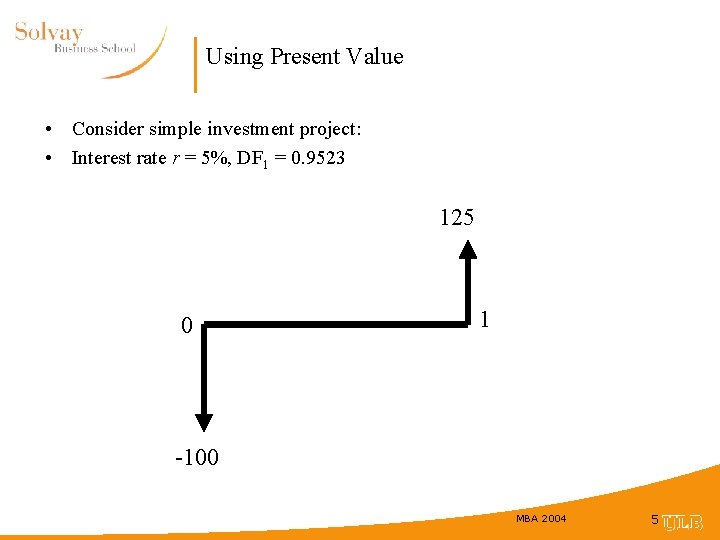
Using Present Value • Consider simple investment project: • Interest rate r = 5%, DF 1 = 0. 9523 125 0 1 -100 MBA 2004 5
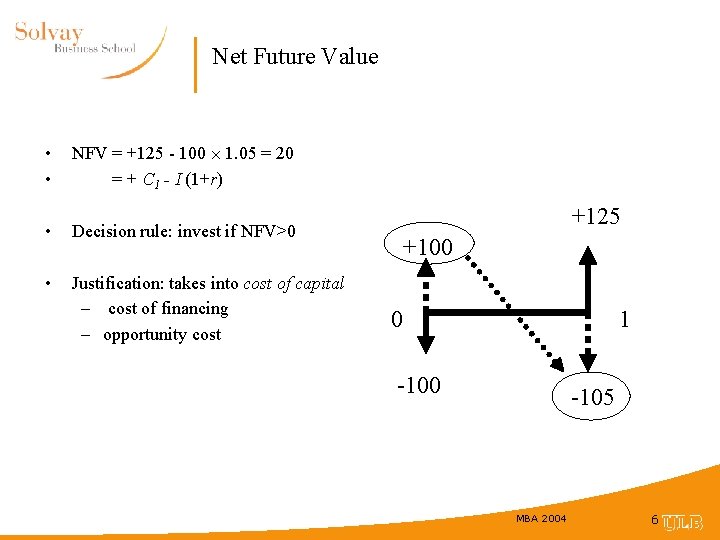
Net Future Value • • NFV = +125 - 100 1. 05 = 20 = + C 1 - I (1+r) • Decision rule: invest if NFV>0 • Justification: takes into cost of capital – cost of financing – opportunity cost +125 +100 0 1 -100 -105 MBA 2004 6
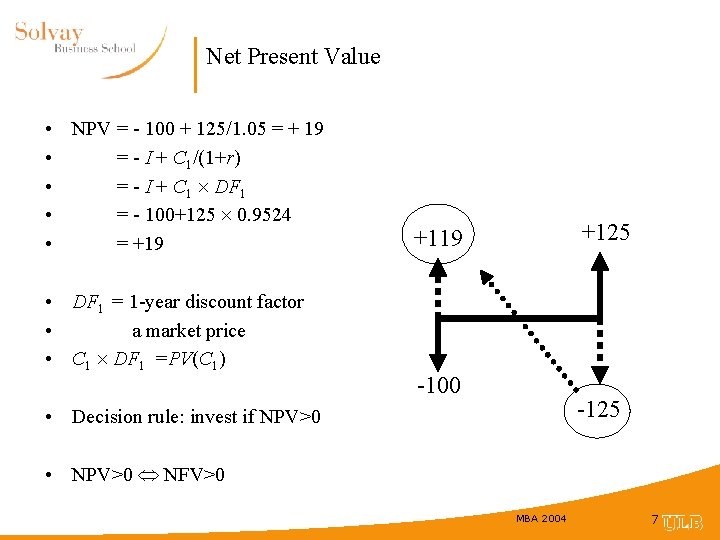
Net Present Value • NPV = - 100 + 125/1. 05 = + 19 • = - I + C 1/(1+r) • = - I + C 1 DF 1 • = - 100+125 0. 9524 • = +19 • DF 1 = 1 -year discount factor • a market price • C 1 DF 1 =PV(C 1) +125 +119 -100 -125 • Decision rule: invest if NPV>0 • NPV>0 NFV>0 MBA 2004 7
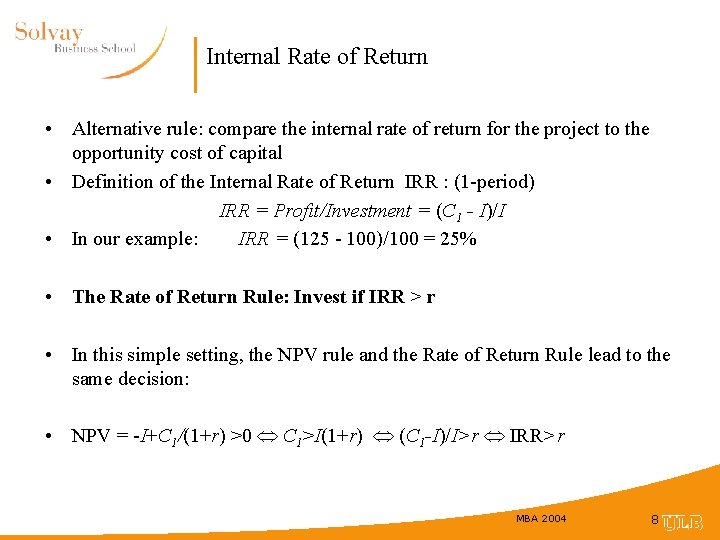
Internal Rate of Return • Alternative rule: compare the internal rate of return for the project to the opportunity cost of capital • Definition of the Internal Rate of Return IRR : (1 -period) IRR = Profit/Investment = (C 1 - I)/I • In our example: IRR = (125 - 100)/100 = 25% • The Rate of Return Rule: Invest if IRR > r • In this simple setting, the NPV rule and the Rate of Return Rule lead to the same decision: • NPV = -I+C 1/(1+r) >0 C 1>I(1+r) (C 1 -I)/I>r IRR>r MBA 2004 8
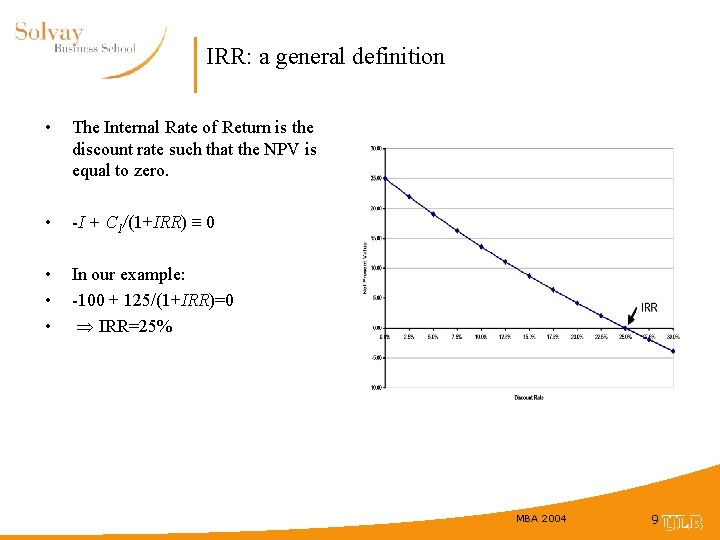
IRR: a general definition • The Internal Rate of Return is the discount rate such that the NPV is equal to zero. • -I + C 1/(1+IRR) 0 • • • In our example: -100 + 125/(1+IRR)=0 IRR=25% MBA 2004 9
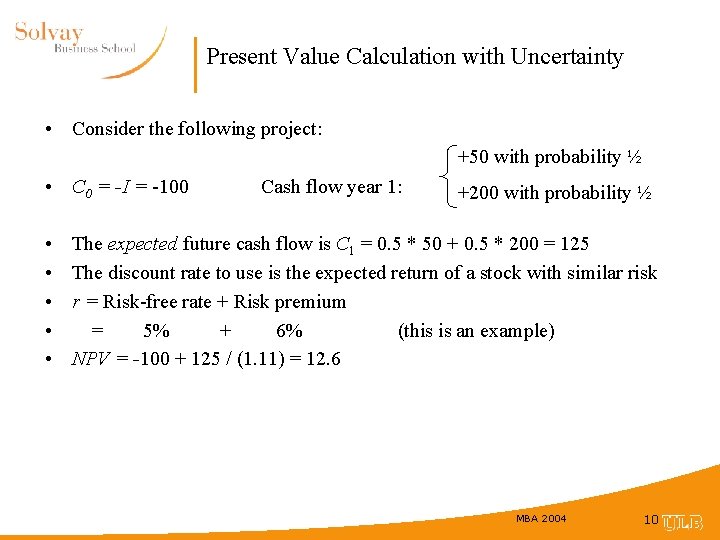
Present Value Calculation with Uncertainty • Consider the following project: +50 with probability ½ • C 0 = -I = -100 • • • Cash flow year 1: +200 with probability ½ The expected future cash flow is C 1 = 0. 5 * 50 + 0. 5 * 200 = 125 The discount rate to use is the expected return of a stock with similar risk r = Risk-free rate + Risk premium = 5% + 6% (this is an example) NPV = -100 + 125 / (1. 11) = 12. 6 MBA 2004 10
A simple investment problem • Consider the following project: • Cash flow t = 0 C 0 = - I = - 100 • Cash flow t = 5 C 5 = + 150 (risk-free) • How to calculate the economic profit? • Compare initial investment with the market value of the future cash flow. • Market value of C 5 • • • = Present value of C 5 = C 5 * Present value of $1 in year 5 = C 5 * 5 -year discount factor = C 5 * DF 5 • Profit = Net Present Value = - I + C 5 * DF 5 MBA 2004 11
Using prices of U. S. Treasury STRIPS • Separate Trading of Registered Interest and Principal of Securities • Prices of zero-coupons • Example: Suppose you observe the following prices Maturity Price for $100 face value 1 98. 03 2 94. 65 3 90. 44 4 86. 48 5 80. 00 • The market price of $1 in 5 years is DF 5 = 0. 80 • NPV = - 100 + 150 * 0. 80 = - 100 + 120 = +20 MBA 2004 12
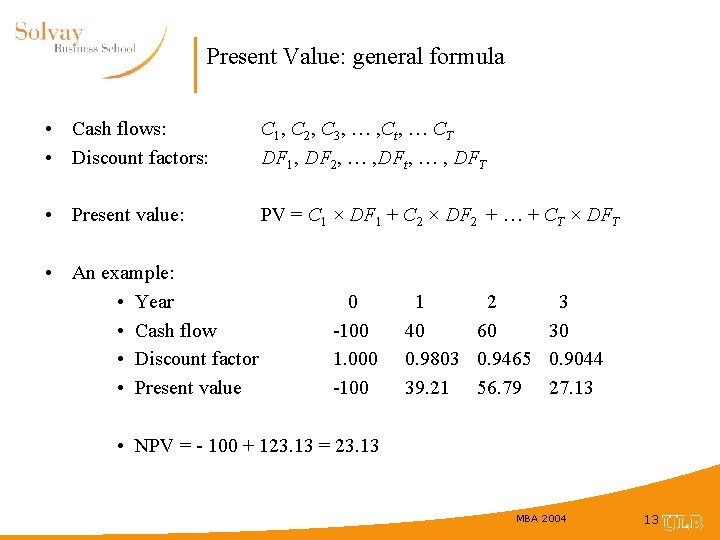
Present Value: general formula • Cash flows: • Discount factors: C 1, C 2, C 3, … , Ct, … CT DF 1, DF 2, … , DFt, … , DFT • Present value: PV = C 1 × DF 1 + C 2 × DF 2 + … + CT × DFT • An example: • Year • Cash flow • Discount factor • Present value 0 -100 1. 000 -100 1 40 0. 9803 39. 21 2 60 0. 9465 56. 79 3 30 0. 9044 27. 13 • NPV = - 100 + 123. 13 = 23. 13 MBA 2004 13
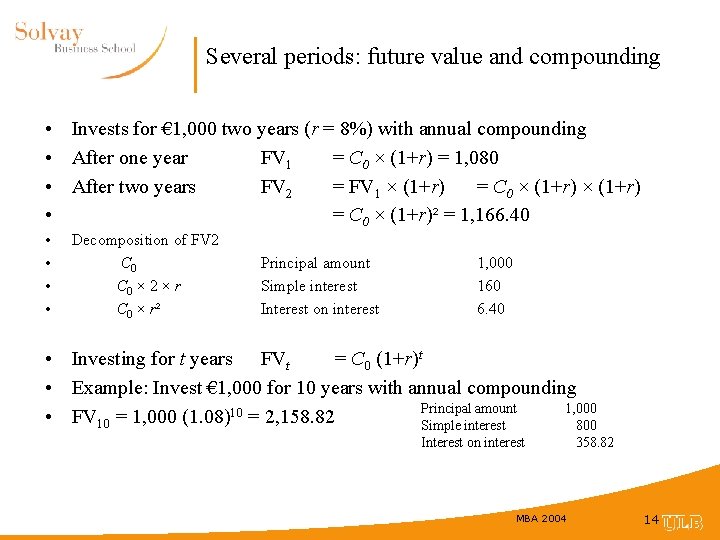
Several periods: future value and compounding • Invests for € 1, 000 two years (r = 8%) with annual compounding • After one year FV 1 = C 0 × (1+r) = 1, 080 • After two years FV 2 = FV 1 × (1+r) = C 0 × (1+r) • = C 0 × (1+r)² = 1, 166. 40 • • Decomposition of FV 2 C 0 × 2 × r C 0 × r² Principal amount Simple interest Interest on interest 1, 000 160 6. 40 • Investing for t years FVt = C 0 (1+r)t • Example: Invest € 1, 000 for 10 years with annual compounding Principal amount 1, 000 • FV 10 = 1, 000 (1. 08)10 = 2, 158. 82 Simple interest 800 Interest on interest 358. 82 MBA 2004 14
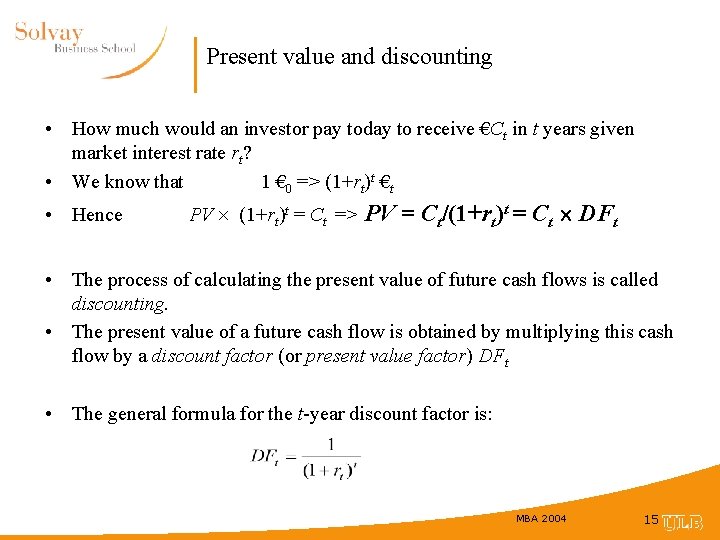
Present value and discounting • How much would an investor pay today to receive €Ct in t years given market interest rate rt? • We know that 1 € 0 => (1+rt)t €t • Hence PV (1+rt)t = Ct => PV = Ct/(1+rt)t = Ct DFt • The process of calculating the present value of future cash flows is called discounting. • The present value of a future cash flow is obtained by multiplying this cash flow by a discount factor (or present value factor) DFt • The general formula for the t-year discount factor is: MBA 2004 15
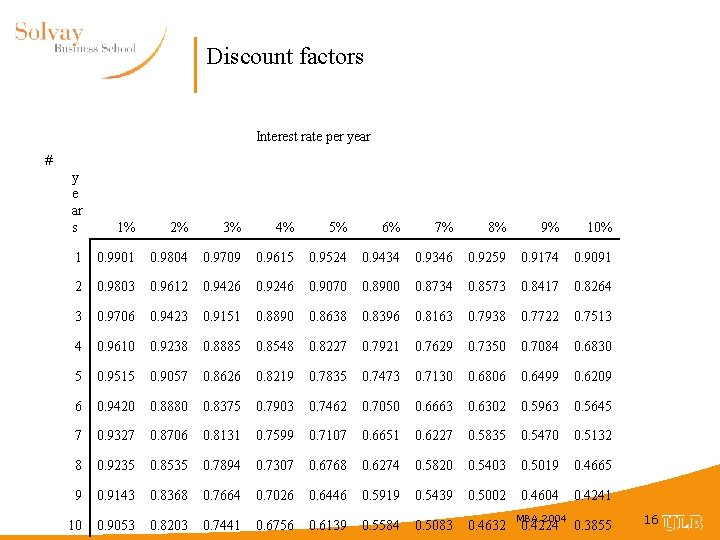
Discount factors Interest rate per year # y e ar s 1% 2% 3% 4% 5% 6% 7% 8% 9% 10% 1 0. 9901 0. 9804 0. 9709 0. 9615 0. 9524 0. 9434 0. 9346 0. 9259 0. 9174 0. 9091 2 0. 9803 0. 9612 0. 9426 0. 9246 0. 9070 0. 8900 0. 8734 0. 8573 0. 8417 0. 8264 3 0. 9706 0. 9423 0. 9151 0. 8890 0. 8638 0. 8396 0. 8163 0. 7938 0. 7722 0. 7513 4 0. 9610 0. 9238 0. 8885 0. 8548 0. 8227 0. 7921 0. 7629 0. 7350 0. 7084 0. 6830 5 0. 9515 0. 9057 0. 8626 0. 8219 0. 7835 0. 7473 0. 7130 0. 6806 0. 6499 0. 6209 6 0. 9420 0. 8880 0. 8375 0. 7903 0. 7462 0. 7050 0. 6663 0. 6302 0. 5963 0. 5645 7 0. 9327 0. 8706 0. 8131 0. 7599 0. 7107 0. 6651 0. 6227 0. 5835 0. 5470 0. 5132 8 0. 9235 0. 8535 0. 7894 0. 7307 0. 6768 0. 6274 0. 5820 0. 5403 0. 5019 0. 4665 9 0. 9143 0. 8368 0. 7664 0. 7026 0. 6446 0. 5919 0. 5439 0. 5002 0. 4604 0. 4241 10 0. 9053 0. 8203 0. 7441 0. 6756 0. 6139 0. 5584 0. 5083 0. 4632 MBA 2004 0. 4224 0. 3855 16
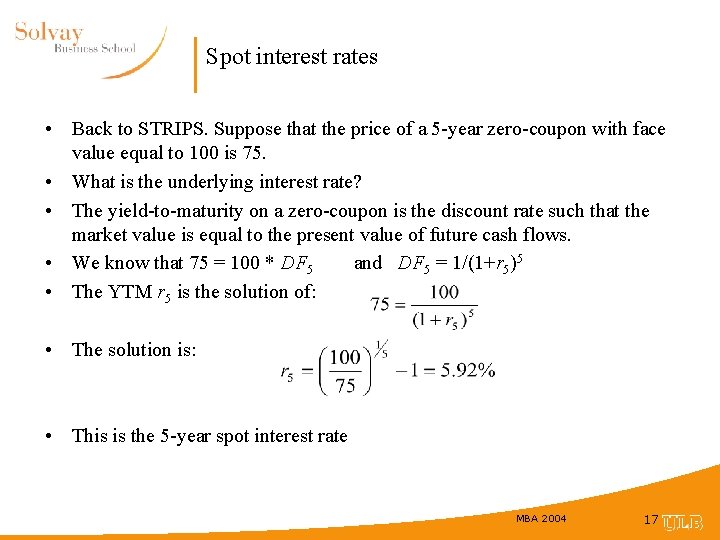
Spot interest rates • Back to STRIPS. Suppose that the price of a 5 -year zero-coupon with face value equal to 100 is 75. • What is the underlying interest rate? • The yield-to-maturity on a zero-coupon is the discount rate such that the market value is equal to the present value of future cash flows. • We know that 75 = 100 * DF 5 and DF 5 = 1/(1+r 5)5 • The YTM r 5 is the solution of: • The solution is: • This is the 5 -year spot interest rate MBA 2004 17
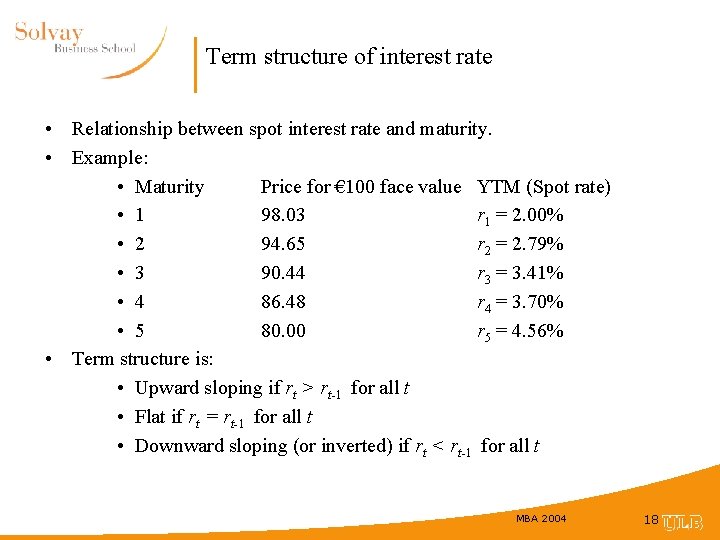
Term structure of interest rate • Relationship between spot interest rate and maturity. • Example: • Maturity Price for € 100 face value YTM (Spot rate) • 1 98. 03 r 1 = 2. 00% • 2 94. 65 r 2 = 2. 79% • 3 90. 44 r 3 = 3. 41% • 4 86. 48 r 4 = 3. 70% • 5 80. 00 r 5 = 4. 56% • Term structure is: • Upward sloping if rt > rt-1 for all t • Flat if rt = rt-1 for all t • Downward sloping (or inverted) if rt < rt-1 for all t MBA 2004 18
Using one single discount rate • When analyzing risk-free cash flows, it is important to capture the current term structure of interest rates: discount rates should vary with maturity. • When dealing with risky cash flows, the term structure is often ignored. • Present value are calculated using a single discount rate r, the same for all maturities. • Remember: this discount rate represents the expected return. • = Risk-free interest rate + Risk premium • This simplifying assumption leads to a few useful formulas for: • Perpetuities (constant or growing at a constant rate) • Annuities (constant or growing at a constant rate) MBA 2004 19
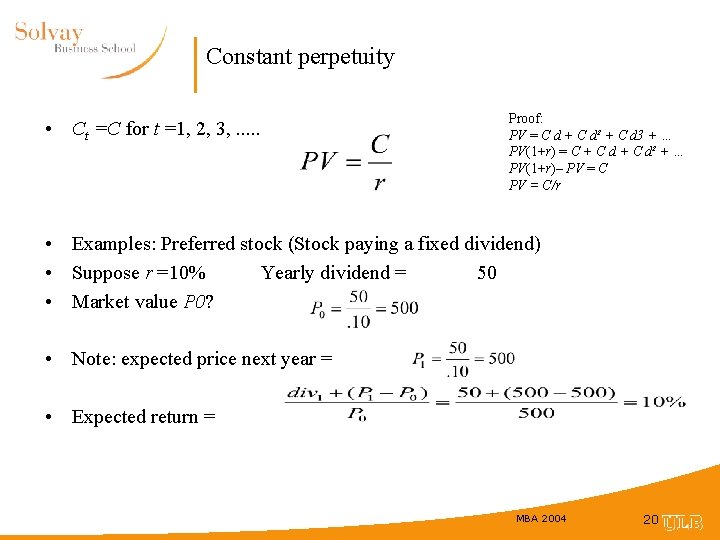
Constant perpetuity • Ct =C for t =1, 2, 3, . . . Proof: PV = C d + C d² + C d 3 + … PV(1+r) = C + C d² + … PV(1+r)– PV = C/r • Examples: Preferred stock (Stock paying a fixed dividend) • Suppose r =10% Yearly dividend = 50 • Market value P 0? • Note: expected price next year = • Expected return = MBA 2004 20
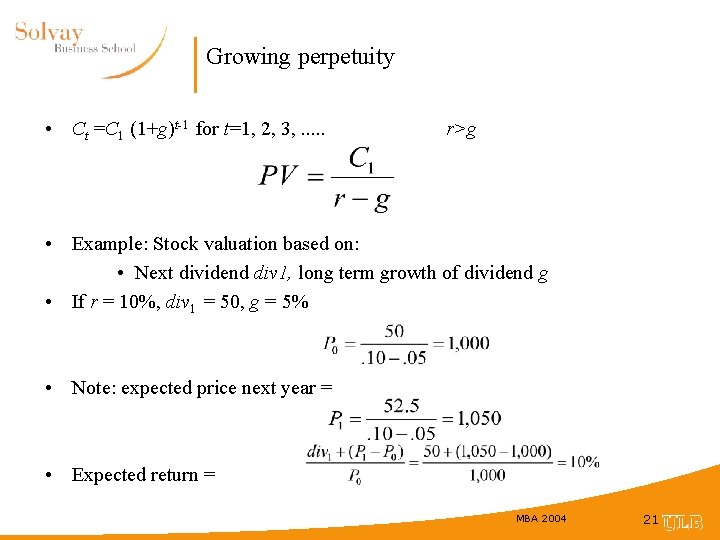
Growing perpetuity • Ct =C 1 (1+g)t-1 for t=1, 2, 3, . . . r>g • Example: Stock valuation based on: • Next dividend div 1, long term growth of dividend g • If r = 10%, div 1 = 50, g = 5% • Note: expected price next year = • Expected return = MBA 2004 21
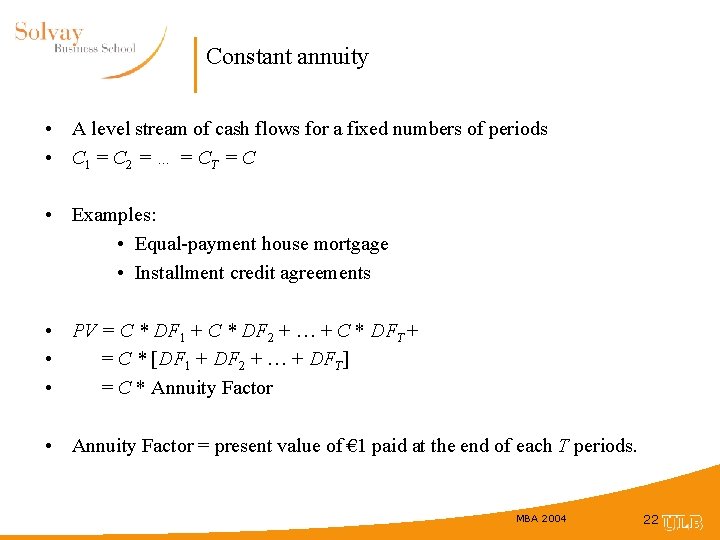
Constant annuity • A level stream of cash flows for a fixed numbers of periods • C 1 = C 2 = … = CT = C • Examples: • Equal-payment house mortgage • Installment credit agreements • PV = C * DF 1 + C * DF 2 + … + C * DFT + • = C * [DF 1 + DF 2 + … + DFT] • = C * Annuity Factor • Annuity Factor = present value of € 1 paid at the end of each T periods. MBA 2004 22
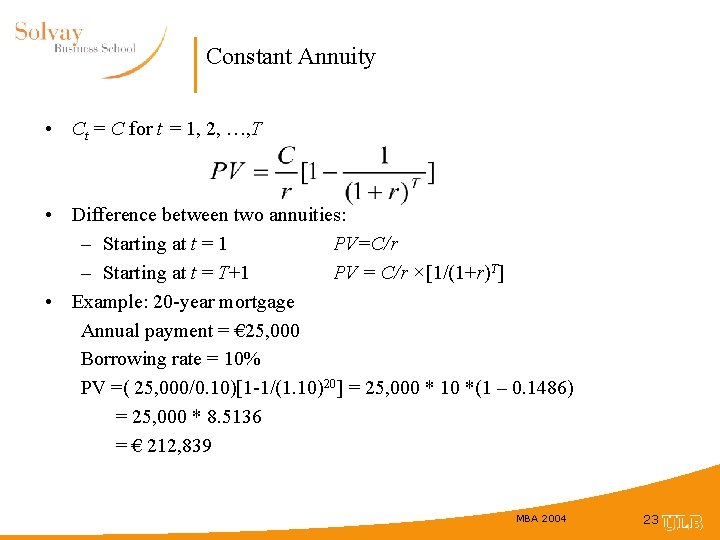
Constant Annuity • Ct = C for t = 1, 2, …, T • Difference between two annuities: – Starting at t = 1 PV=C/r – Starting at t = T+1 PV = C/r ×[1/(1+r)T] • Example: 20 -year mortgage Annual payment = € 25, 000 Borrowing rate = 10% PV =( 25, 000/0. 10)[1 -1/(1. 10)20] = 25, 000 * 10 *(1 – 0. 1486) = 25, 000 * 8. 5136 = € 212, 839 MBA 2004 23
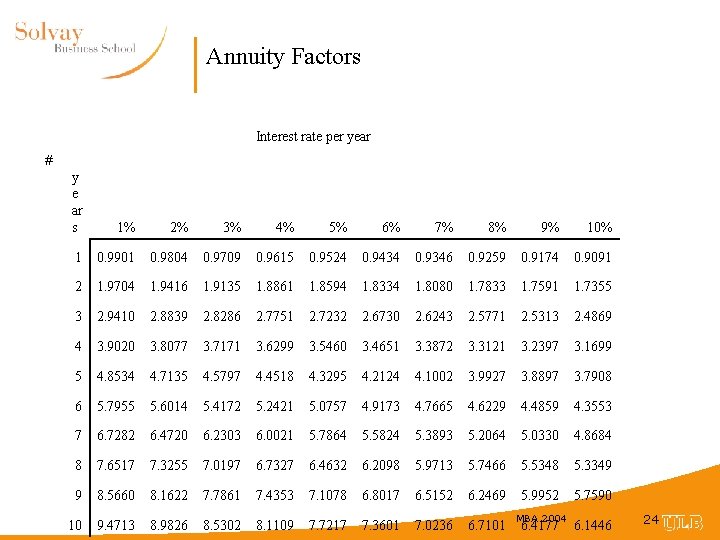
Annuity Factors Interest rate per year # y e ar s 1% 2% 3% 4% 5% 6% 7% 8% 9% 10% 1 0. 9901 0. 9804 0. 9709 0. 9615 0. 9524 0. 9434 0. 9346 0. 9259 0. 9174 0. 9091 2 1. 9704 1. 9416 1. 9135 1. 8861 1. 8594 1. 8334 1. 8080 1. 7833 1. 7591 1. 7355 3 2. 9410 2. 8839 2. 8286 2. 7751 2. 7232 2. 6730 2. 6243 2. 5771 2. 5313 2. 4869 4 3. 9020 3. 8077 3. 7171 3. 6299 3. 5460 3. 4651 3. 3872 3. 3121 3. 2397 3. 1699 5 4. 8534 4. 7135 4. 5797 4. 4518 4. 3295 4. 2124 4. 1002 3. 9927 3. 8897 3. 7908 6 5. 7955 5. 6014 5. 4172 5. 2421 5. 0757 4. 9173 4. 7665 4. 6229 4. 4859 4. 3553 7 6. 7282 6. 4720 6. 2303 6. 0021 5. 7864 5. 5824 5. 3893 5. 2064 5. 0330 4. 8684 8 7. 6517 7. 3255 7. 0197 6. 7327 6. 4632 6. 2098 5. 9713 5. 7466 5. 5348 5. 3349 9 8. 5660 8. 1622 7. 7861 7. 4353 7. 1078 6. 8017 6. 5152 6. 2469 5. 9952 5. 7590 10 9. 4713 8. 9826 8. 5302 8. 1109 7. 7217 7. 3601 7. 0236 6. 7101 MBA 2004 6. 4177 6. 1446 24
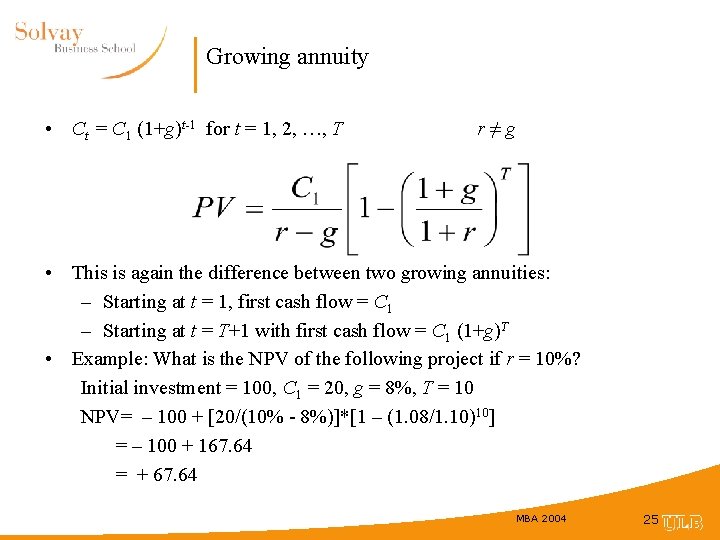
Growing annuity • Ct = C 1 (1+g)t-1 for t = 1, 2, …, T r≠g • This is again the difference between two growing annuities: – Starting at t = 1, first cash flow = C 1 – Starting at t = T+1 with first cash flow = C 1 (1+g)T • Example: What is the NPV of the following project if r = 10%? Initial investment = 100, C 1 = 20, g = 8%, T = 10 NPV= – 100 + [20/(10% - 8%)]*[1 – (1. 08/1. 10)10] = – 100 + 167. 64 = + 67. 64 MBA 2004 25
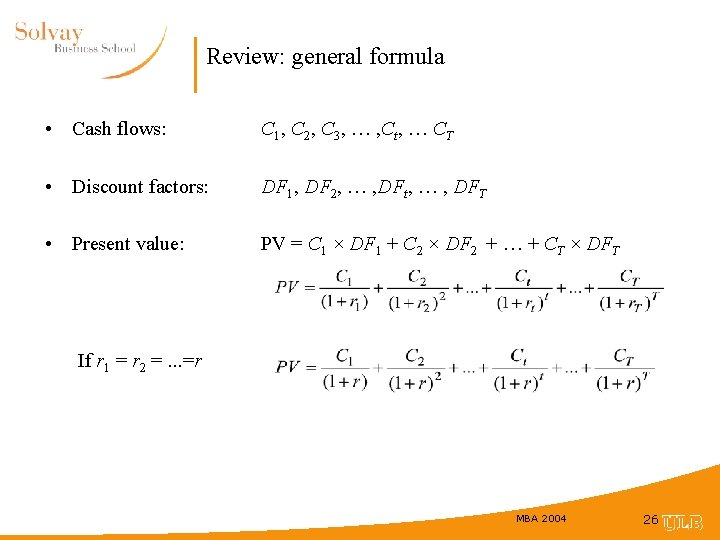
Review: general formula • Cash flows: C 1, C 2, C 3, … , Ct, … CT • Discount factors: DF 1, DF 2, … , DFt, … , DFT • Present value: PV = C 1 × DF 1 + C 2 × DF 2 + … + CT × DFT If r 1 = r 2 =. . . =r MBA 2004 26
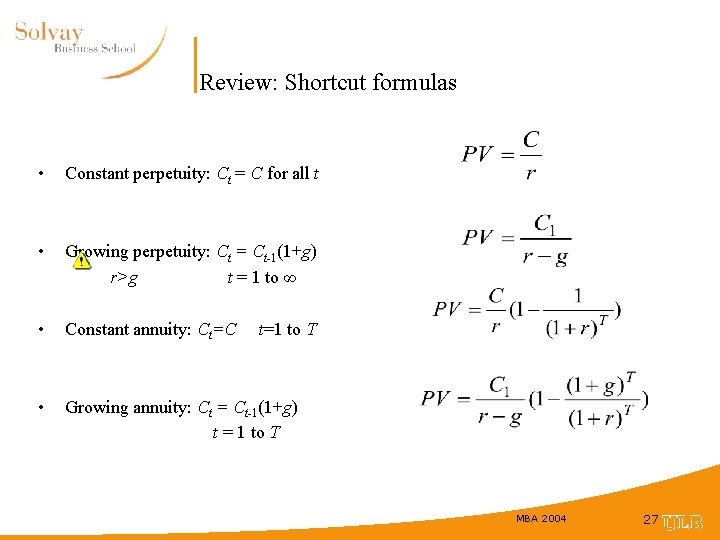
Review: Shortcut formulas • Constant perpetuity: Ct = C for all t • Growing perpetuity: Ct = Ct-1(1+g) r>g t = 1 to ∞ • Constant annuity: Ct=C t=1 to T • Growing annuity: Ct = Ct-1(1+g) t = 1 to T MBA 2004 27
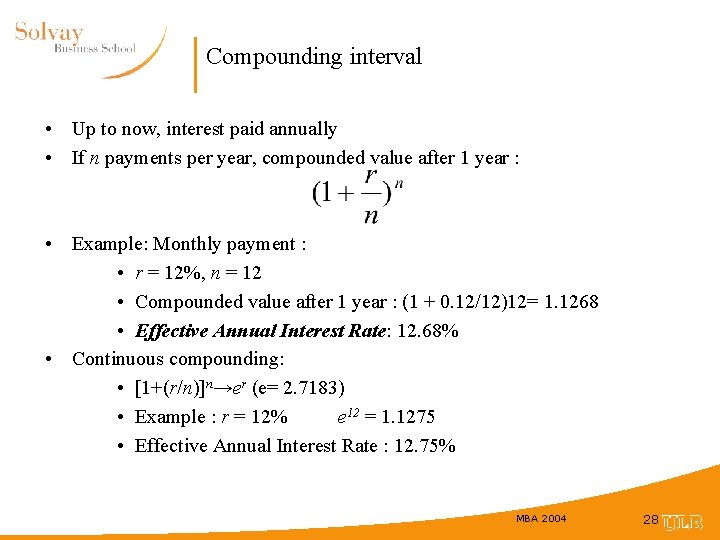
Compounding interval • Up to now, interest paid annually • If n payments per year, compounded value after 1 year : • Example: Monthly payment : • r = 12%, n = 12 • Compounded value after 1 year : (1 + 0. 12/12)12= 1. 1268 • Effective Annual Interest Rate: 12. 68% • Continuous compounding: • [1+(r/n)]n→er (e= 2. 7183) • Example : r = 12% e 12 = 1. 1275 • Effective Annual Interest Rate : 12. 75% MBA 2004 28
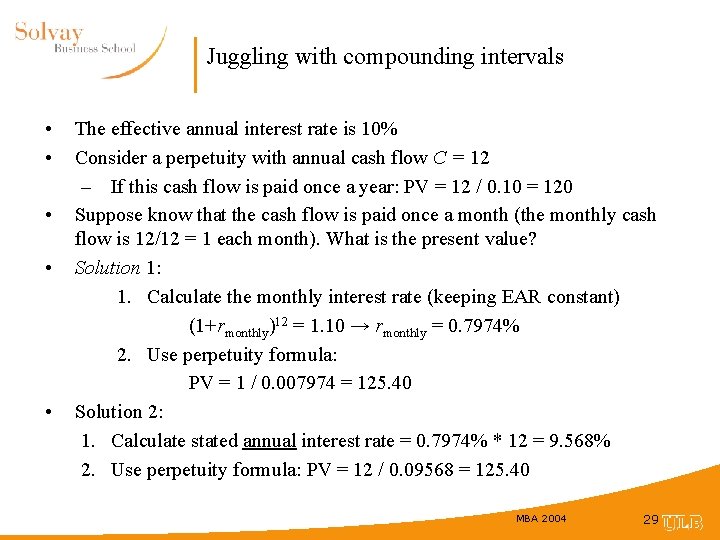
Juggling with compounding intervals • • • The effective annual interest rate is 10% Consider a perpetuity with annual cash flow C = 12 – If this cash flow is paid once a year: PV = 12 / 0. 10 = 120 Suppose know that the cash flow is paid once a month (the monthly cash flow is 12/12 = 1 each month). What is the present value? Solution 1: 1. Calculate the monthly interest rate (keeping EAR constant) (1+rmonthly)12 = 1. 10 → rmonthly = 0. 7974% 2. Use perpetuity formula: PV = 1 / 0. 007974 = 125. 40 Solution 2: 1. Calculate stated annual interest rate = 0. 7974% * 12 = 9. 568% 2. Use perpetuity formula: PV = 12 / 0. 09568 = 125. 40 MBA 2004 29
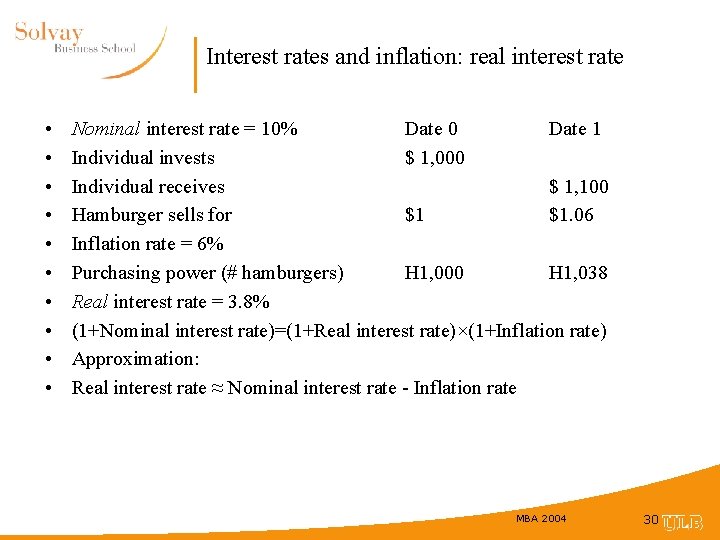
Interest rates and inflation: real interest rate • • • Nominal interest rate = 10% Date 0 Date 1 Individual invests $ 1, 000 Individual receives $ 1, 100 Hamburger sells for $1 $1. 06 Inflation rate = 6% Purchasing power (# hamburgers) H 1, 000 H 1, 038 Real interest rate = 3. 8% (1+Nominal interest rate)=(1+Real interest rate)×(1+Inflation rate) Approximation: Real interest rate ≈ Nominal interest rate - Inflation rate MBA 2004 30
- Slides: 30