
Final Year Project Presenstation Supervisor Prof Wei Jin
- Slides: 34
Final Year Project Presenstation Supervisor: Prof. Wei Jin Project number: PT_FYP_29 Group members: Lam Hoi Leong 13040305 d Project tile: Horizontal angular measurement by fibre optic gyroscope
Content Background A. Ø Ø Gyroscope Fiber Optic Gyroscope (FOG) System design B. Ø Ø Objectives Apparatus used Testing of system C. Ø Ø Sensitive Cabliration System implementation D. Ø Ø Clockwise and anti-clockwise measurement Discussion of measurement results Conclusion E. Ø Future work for improvement
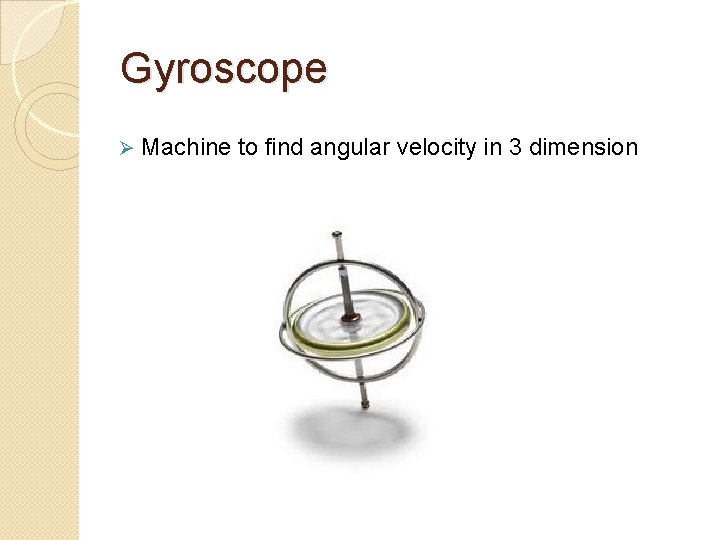
Gyroscope Ø Machine to find angular velocity in 3 dimension
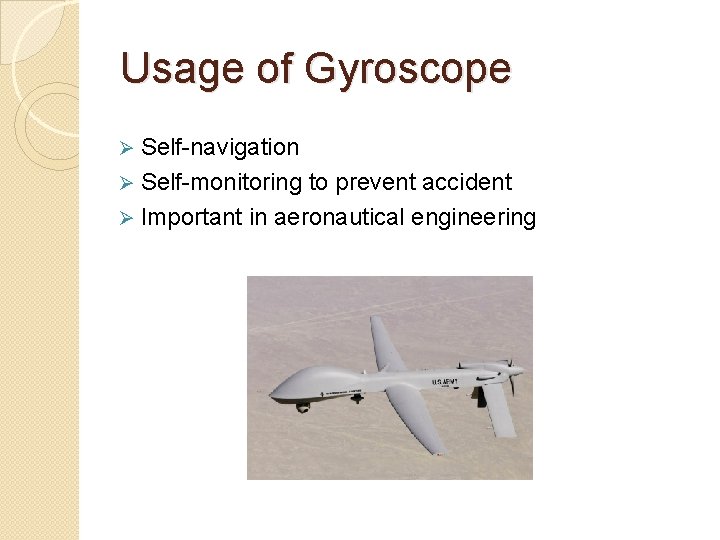
Usage of Gyroscope Self-navigation Ø Self-monitoring to prevent accident Ø Important in aeronautical engineering Ø
Mechanical Rotary Gyroscope �Rotational rate depends on counteracting torque in fixed time interval �Size cannot be small �Jamming may occur due to moving parts
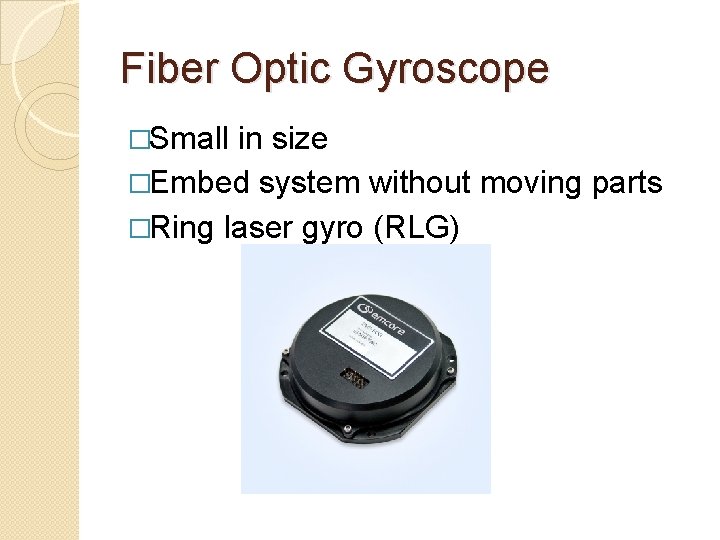
Fiber Optic Gyroscope �Small in size �Embed system without moving parts �Ring laser gyro (RLG)
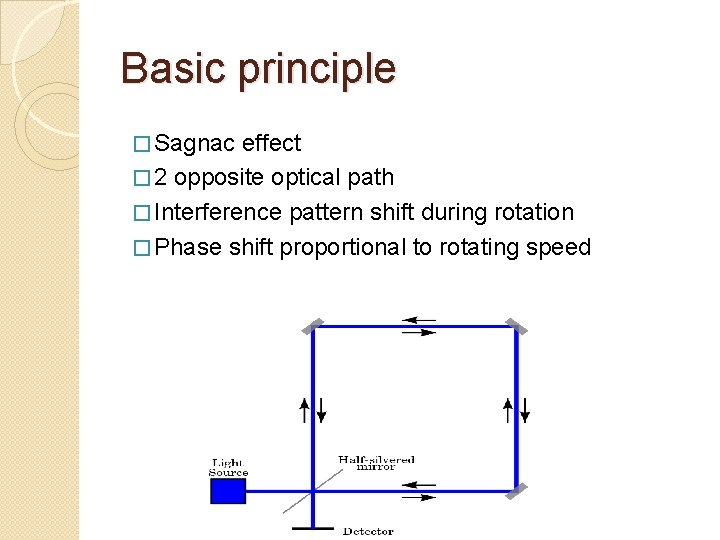
Basic principle � Sagnac effect � 2 opposite optical path � Interference pattern shift during rotation � Phase shift proportional to rotating speed
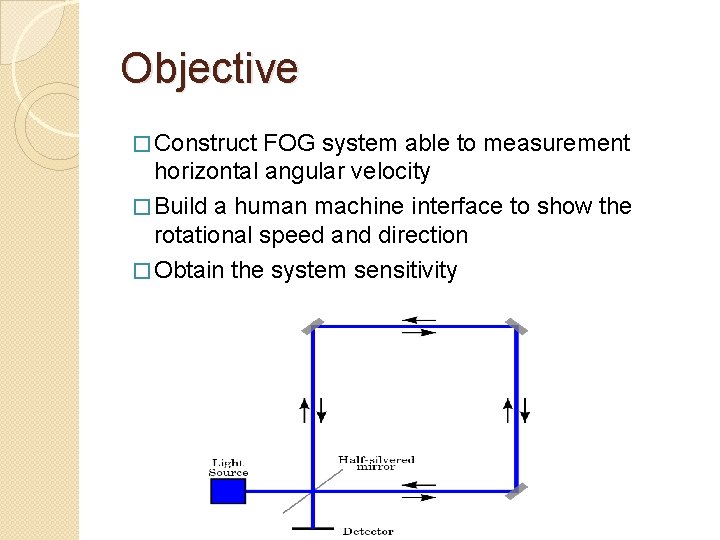
Objective � Construct FOG system able to measurement horizontal angular velocity � Build a human machine interface to show the rotational speed and direction � Obtain the system sensitivity
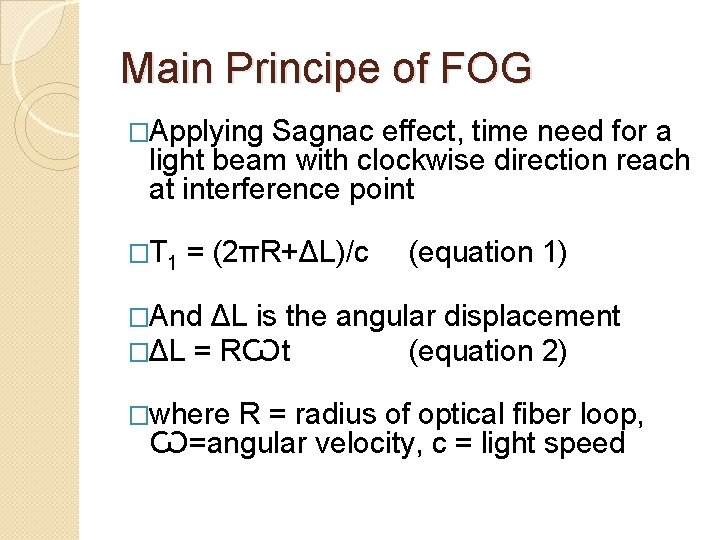
Main Principe of FOG �Applying Sagnac effect, time need for a light beam with clockwise direction reach at interference point �T 1 = (2πR+ΔL)/c �And ΔL is the �ΔL = RѠt �where (equation 1) angular displacement (equation 2) R = radius of optical fiber loop, Ѡ=angular velocity, c = light speed
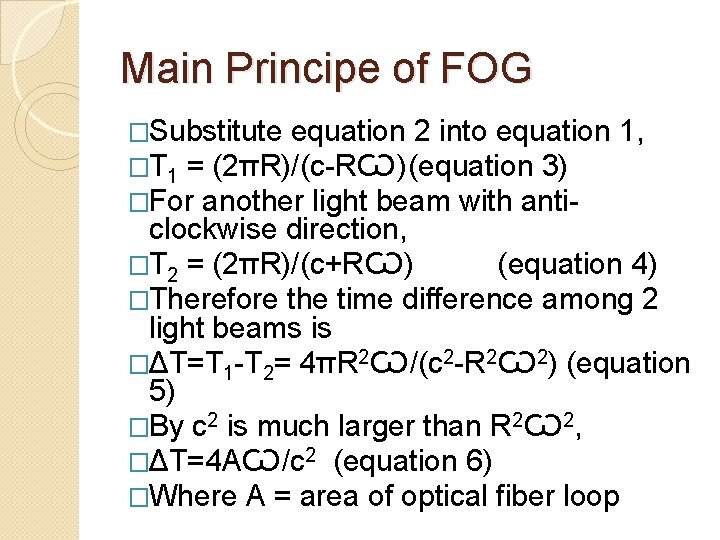
Main Principe of FOG �Substitute equation 2 into equation �T 1 = (2πR)/(c-RѠ)(equation 3) �For another light beam with anti- 1, clockwise direction, �T 2 = (2πR)/(c+RѠ) (equation 4) �Therefore the time difference among 2 light beams is �ΔT=T 1 -T 2= 4πR 2Ѡ/(c 2 -R 2Ѡ 2) (equation 5) �By c 2 is much larger than R 2Ѡ 2, �ΔT=4 AѠ/c 2 (equation 6) �Where A = area of optical fiber loop
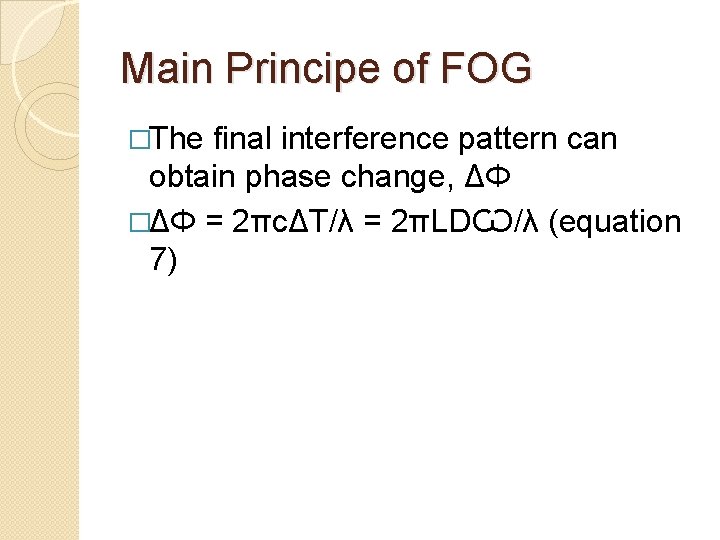
Main Principe of FOG �The final interference pattern can obtain phase change, ΔΦ �ΔΦ = 2πcΔT/λ = 2πLDѠ/λ (equation 7)
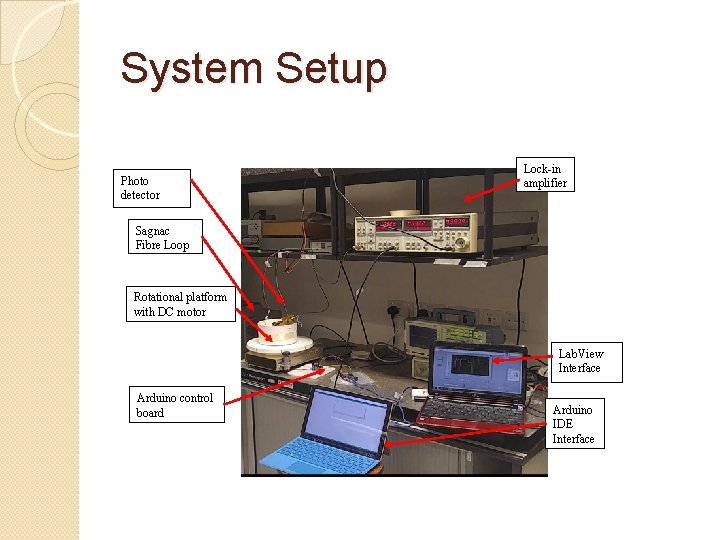
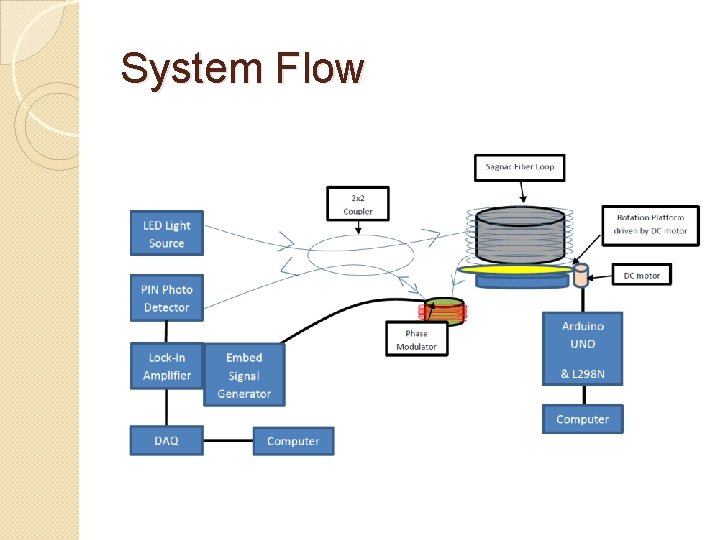
System Setup Photo detector Lock-in amplifier Sagnac Fibre Loop Rotational platform with DC motor Lab. View Interface Arduino control board Arduino IDE Interface
System Flow
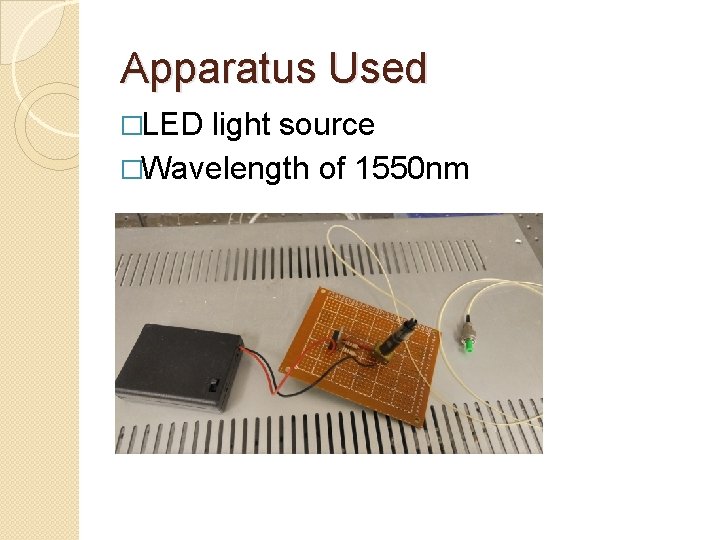
Apparatus Used �LED light source �Wavelength of 1550 nm
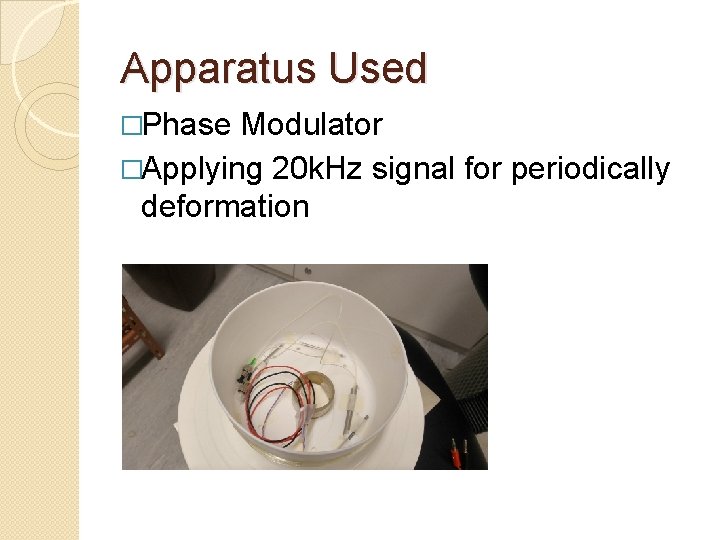
Apparatus Used �Phase Modulator �Applying 20 k. Hz signal for periodically deformation
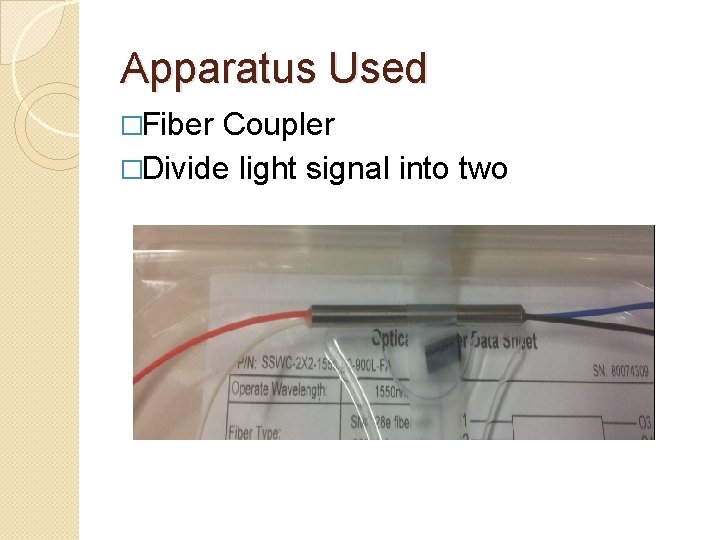
Apparatus Used �Fiber Coupler �Divide light signal into two
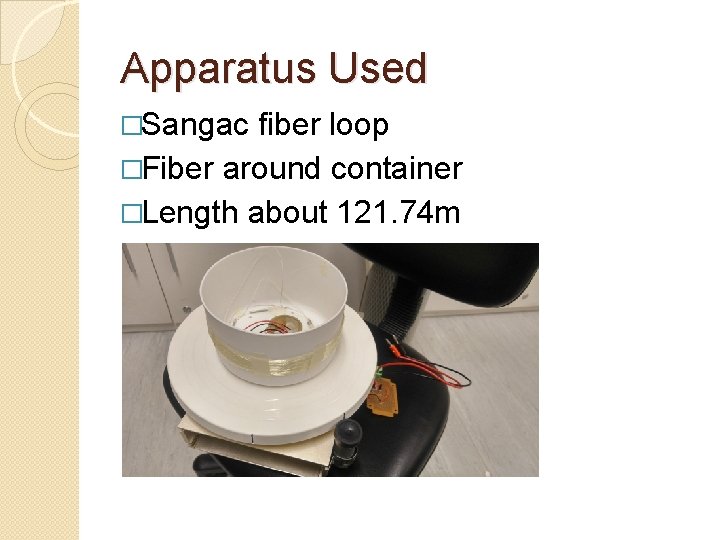
Apparatus Used �Sangac fiber loop �Fiber around container �Length about 121. 74 m
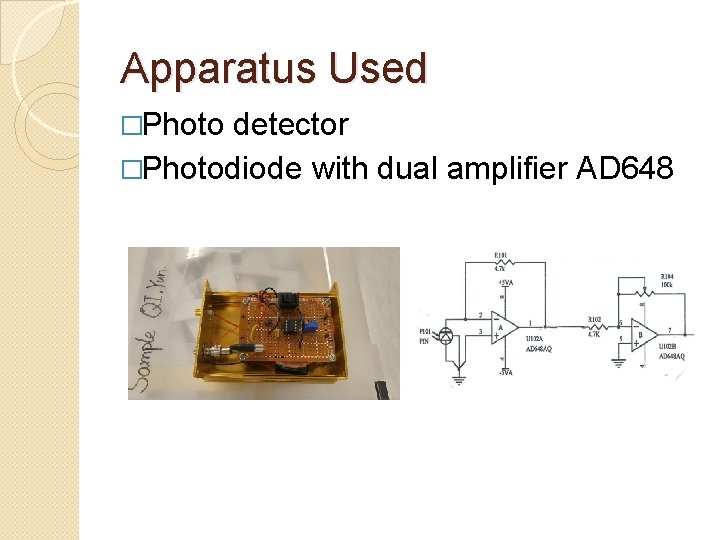
Apparatus Used �Photo detector �Photodiode with dual amplifier AD 648
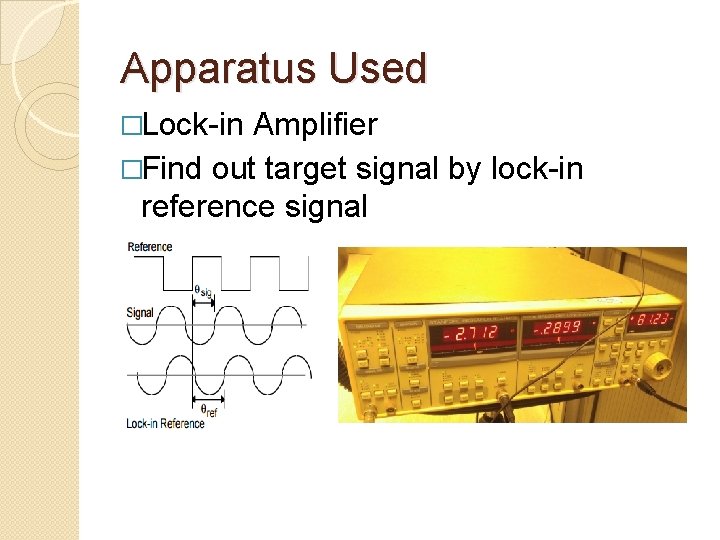
Apparatus Used �Lock-in Amplifier �Find out target signal by lock-in reference signal
Apparatus Used �If lock-in successfully, filtered PSD output in form of DC voltage �Output DC voltage amplitude is directly proportional to phase shift �Embed signal generator supply 20 k. Hz to phase modulator
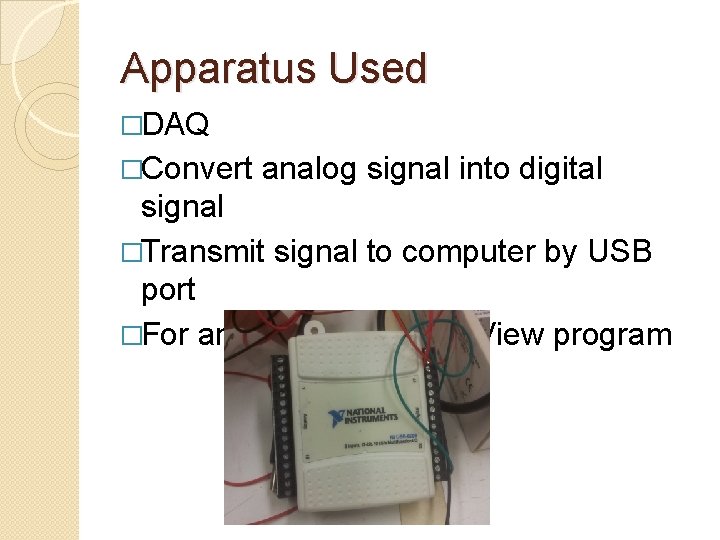
Apparatus Used �DAQ �Convert analog signal into digital signal �Transmit signal to computer by USB port �For analyze data in Lab. View program
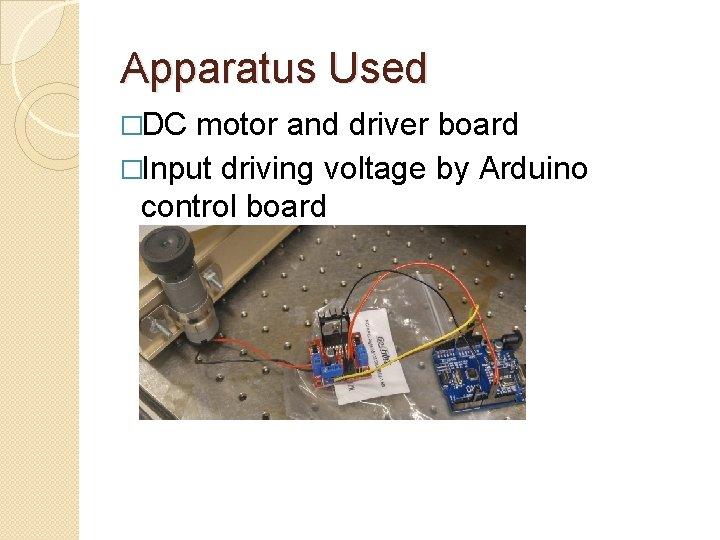
Apparatus Used �DC motor and driver board �Input driving voltage by Arduino control board
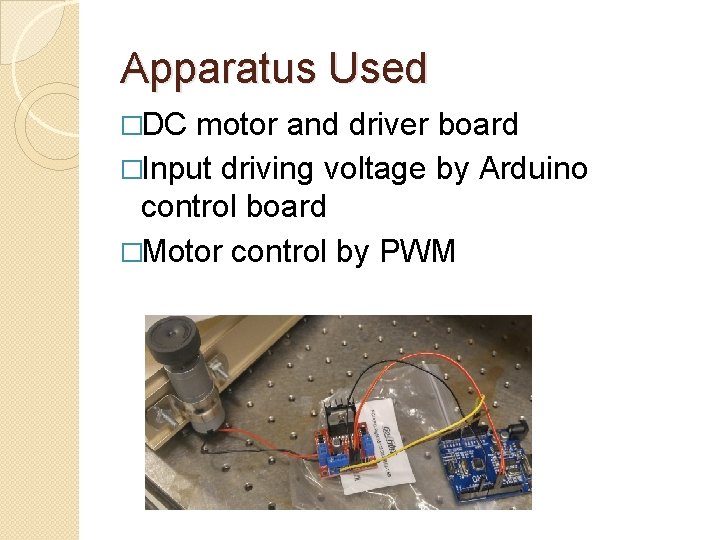
Apparatus Used �DC motor and driver board �Input driving voltage by Arduino control board �Motor control by PWM
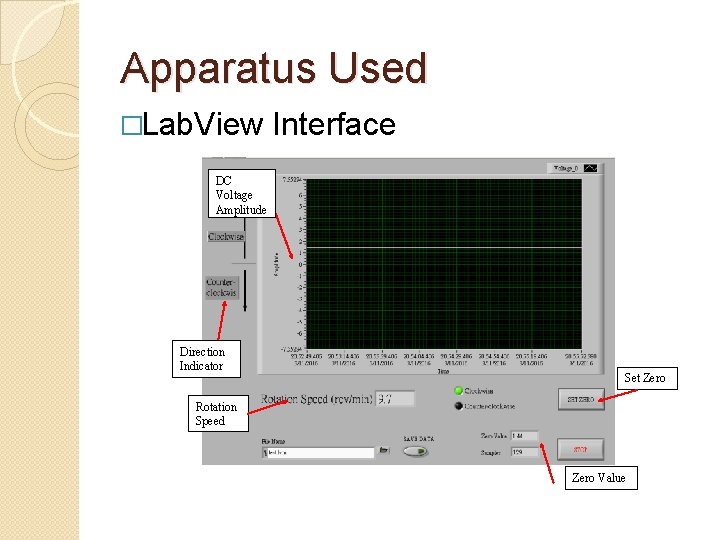
Apparatus Used �Lab. View Interface DC Voltage Amplitude Direction Indicator Set Zero Rotation Speed Zero Value
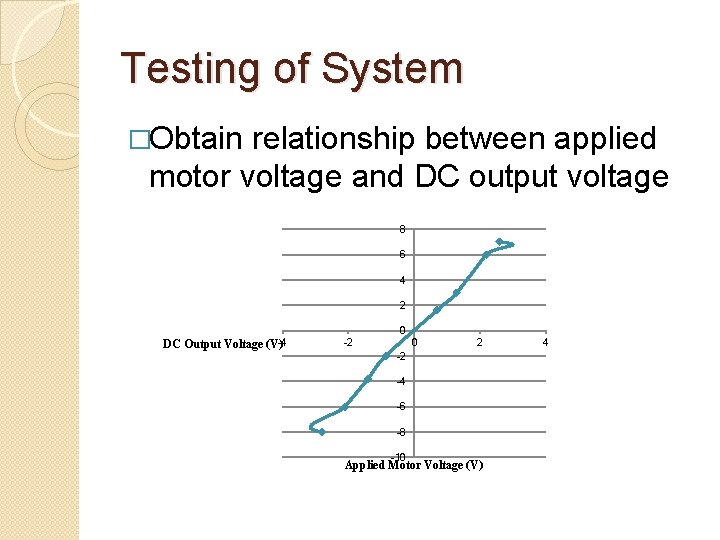
Testing of System �Obtain relationship between applied motor voltage and DC output voltage 8 6 4 2 0 DC Output Voltage (V)-4 -2 0 2 -2 -4 -6 -8 -10 Applied Motor Voltage (V) 4
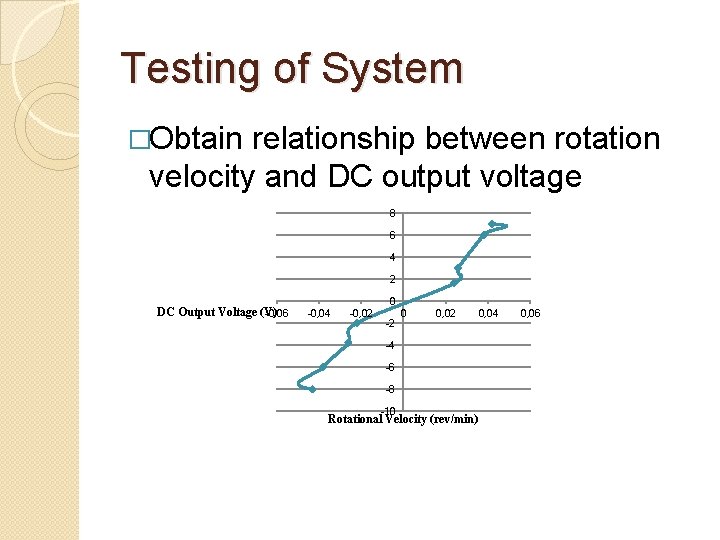
Testing of System �Obtain relationship between rotation velocity and DC output voltage 8 6 4 2 DC Output Voltage (V) -0, 06 0 -0, 04 -0, 02 -2 0 0, 02 -4 -6 -8 -10 Rotational Velocity (rev/min) 0, 04 0, 06
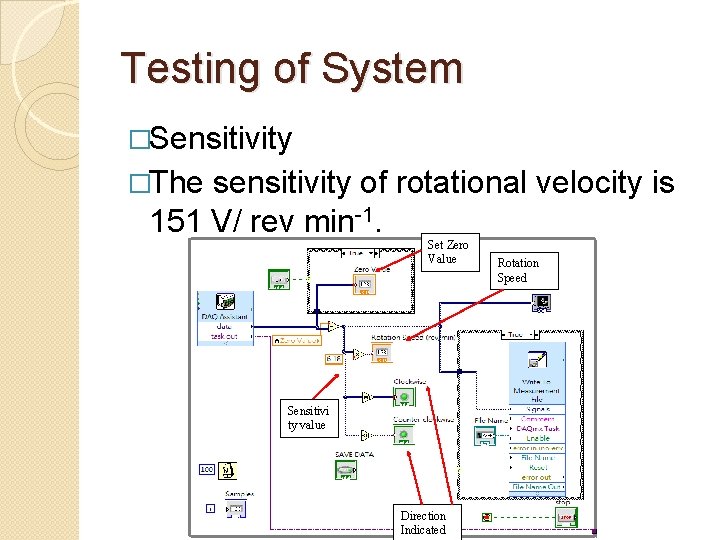
Testing of System �Sensitivity �The sensitivity of rotational velocity is 151 V/ rev min-1. Set Zero Value Sensitivi ty value Direction Indicated Rotation Speed
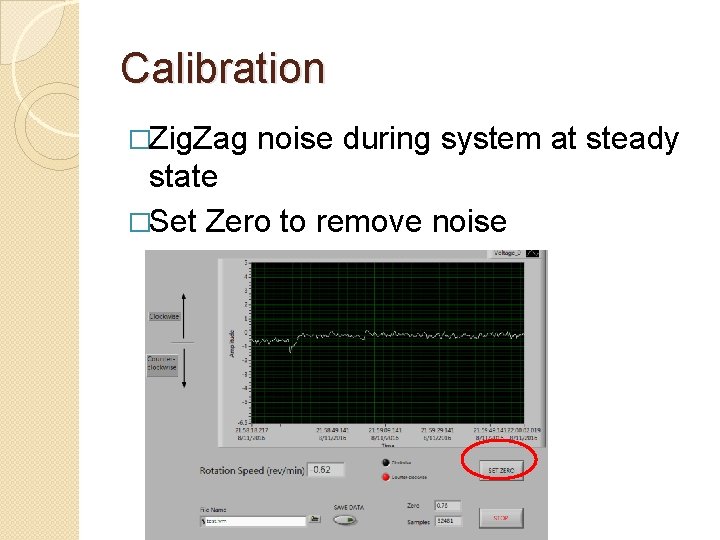
Calibration �Zig. Zag noise during system at steady state �Set Zero to remove noise
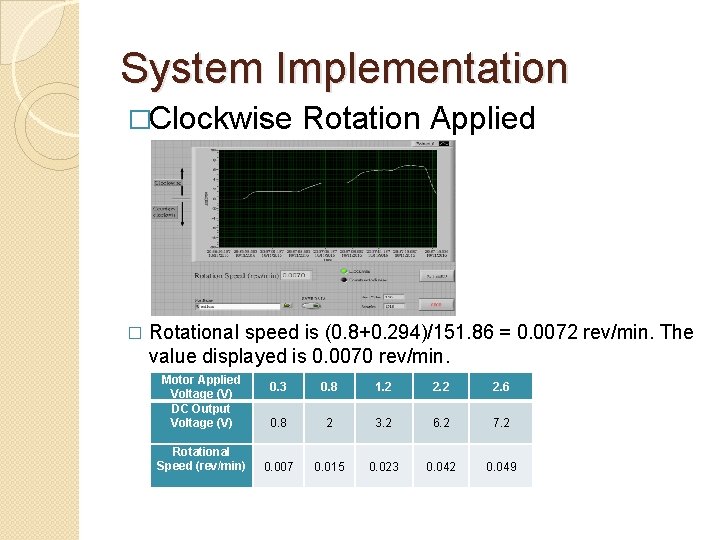
System Implementation �Clockwise � Rotation Applied Rotational speed is (0. 8+0. 294)/151. 86 = 0. 0072 rev/min. The value displayed is 0. 0070 rev/min. Motor Applied Voltage (V) DC Output Voltage (V) Rotational Speed (rev/min) 0. 3 0. 8 1. 2 2. 6 0. 8 2 3. 2 6. 2 7. 2 0. 007 0. 015 0. 023 0. 042 0. 049
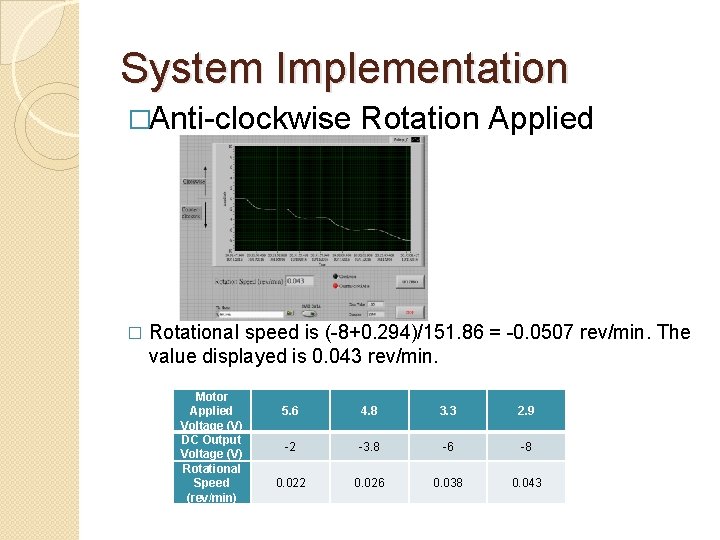
System Implementation �Anti-clockwise � Rotation Applied Rotational speed is (-8+0. 294)/151. 86 = -0. 0507 rev/min. The value displayed is 0. 043 rev/min. Motor Applied Voltage (V) DC Output Voltage (V) Rotational Speed (rev/min) 5. 6 4. 8 3. 3 2. 9 -2 -3. 8 -6 -8 0. 022 0. 026 0. 038 0. 043
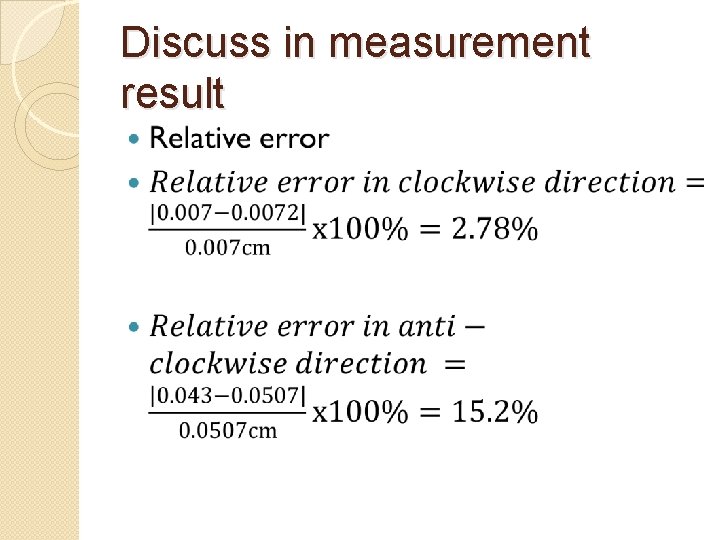
Discuss in measurement result
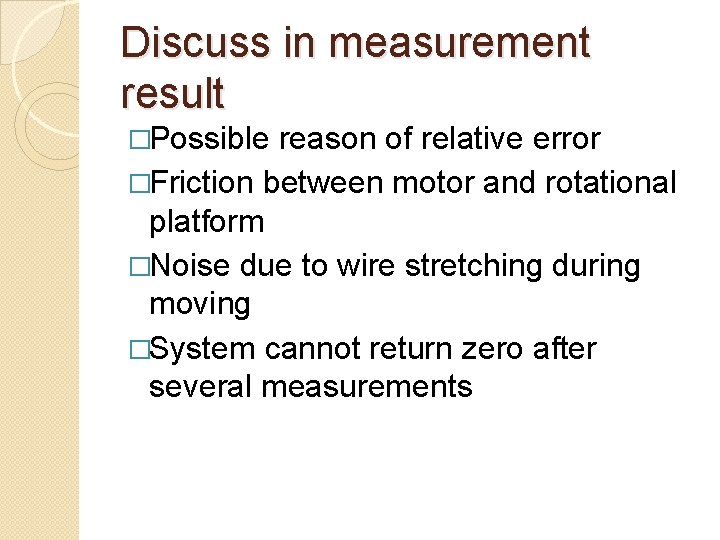
Discuss in measurement result �Possible reason of relative error �Friction between motor and rotational platform �Noise due to wire stretching during moving �System cannot return zero after several measurements
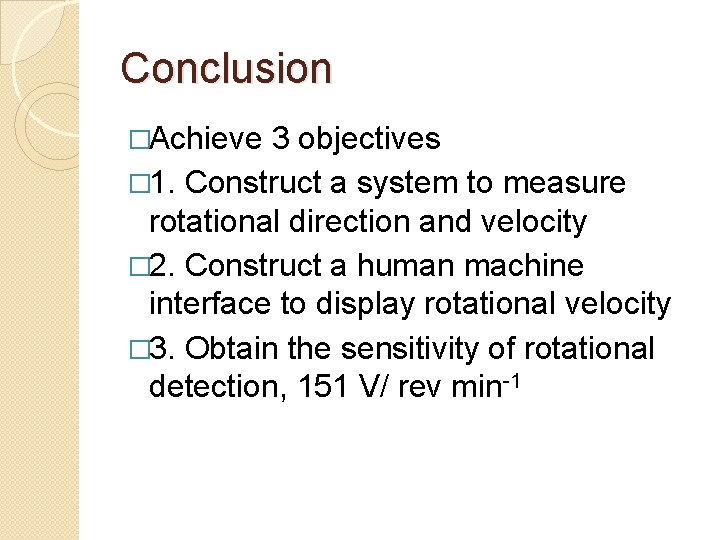
Conclusion �Achieve 3 objectives � 1. Construct a system to measure rotational direction and velocity � 2. Construct a human machine interface to display rotational velocity � 3. Obtain the sensitivity of rotational detection, 151 V/ rev min-1
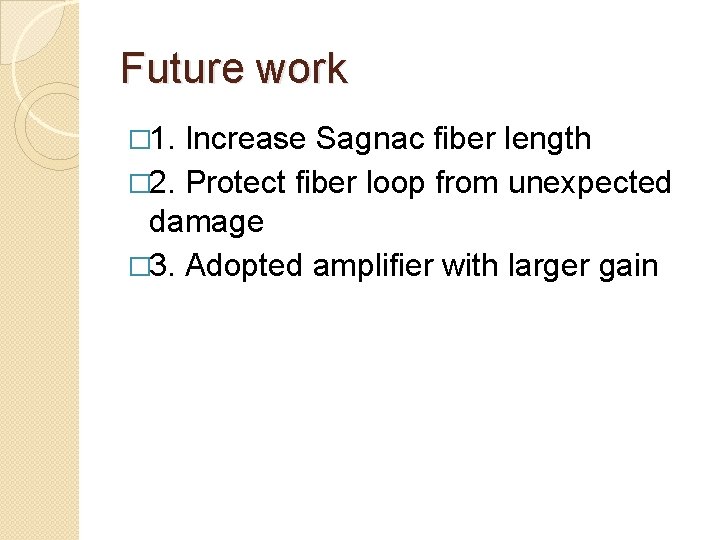
Future work � 1. Increase Sagnac fiber length � 2. Protect fiber loop from unexpected damage � 3. Adopted amplifier with larger gain