
Final Rule on Foreign Supplier Verification Programs http
- Slides: 25
Final Rule on Foreign Supplier Verification Programs http: //www. fda. gov/fsma 1
Background • FSMA Sec. 301 requires importers to have FSVPs and FDA to issue regulations. • Proposed rule: July 29, 2013 • Supplemental proposal: Sept. 29, 2014 • Public comments: 300+ for proposed rule and 100+ for supplemental • Final rule published: Nov. 27, 2015 2
Key Principles of FSVP Rule • Requires importers to share responsibility for ensuring safety of imported food • Risk-based (according to types of hazards, importers, and suppliers) • Flexibility in meeting requirements (assessing activities conducted by others) • Alignment with PC supply-chain provisions 3
Purpose of FSVPs • To provide adequate assurances that: – Foreign suppliers produce food using processes and procedures providing same level of public health protection as FSMA preventive controls or produce safety provisions – Food is not adulterated or misbranded (as to allergen labeling) 4
Who Must Comply? • “Importer” is U. S. owner or consignee of a food at time of U. S. entry. • If no U. S. owner or consignee at entry, importer is U. S. agent or representative of the foreign owner or consignee, as confirmed in signed statement of consent. 5
Exemptions from FSVP • Firms subject to juice or seafood HACCP regulations • Food for research or evaluation • Food for personal consumption • Alcoholic beverages and ingredients (when importer uses them to make an alcoholic beverage) 6
FSVP Exemptions (cont. ) • • Food transshipped through U. S. Food imported for processing and export “U. S. food returned” Meat, poultry, and egg products subject to USDA regulation at time of importation 7
Importers in Compliance with Preventive Controls • Importers are deemed in compliance with most of FSVP when they: – Comply with PC supply-chain provisions – Implement preventive controls under PC regulation for hazards in food they import – Are not required to implement a preventive control under certain PC provisions 8
Use of Qualified Individuals • Must use a qualified individual to perform all required FSVP tasks – Must have education, training, or experience (or combination thereof) necessary to perform the activity – Must be able to read and understand the language of any records reviewed in performing an activity 9
Hazard Analysis • Evaluate known or reasonably foreseeable hazards to determine if they require a control – Biological, chemical (including radiological), and physical hazards – Naturally occurring, unintentionally introduced, or intentionally introduced for economic gain • May assess another’s hazard analysis 10
Evaluation of Food and Foreign Supplier • To approve suppliers and determine appropriate supplier verification activities • Consider: – Risk posed by the food (hazard analysis) – Entities controlling hazards or verifying control – Supplier characteristics (procedures, processes, and practices; FDA compliance; food safety history) 11
Supplier Verification Activities • Procedures to ensure food is obtained from approved suppliers • May use unapproved suppliers on temporary basis when subject food to verification • Written procedures for verification activities 12
Verification Activities (cont. ) • Determine appropriate verification activities (and frequency) based on food and supplier evaluation – Activities may include: onsite auditing; sampling and testing; review of supplier records; other appropriate measures • Annual onsite auditing is default approach when a food has a SAHCODHA hazard. 13
Reliance on Verification Activities Conducted by Others • May rely on another entity’s determination or performance of appropriate verification activities (e. g. , farm audits conducted by produce distributor) • Must review and assess results of verification activities (importer’s own or others on which it relies) 14
Verification Activities (cont. ) • Onsite audits: – Must be conducted by “qualified auditor”; may be government employee – Consider applicable FDA food safety regulations (or laws and regulations of country with comparable or equivalent food safety system) – Substitute results of inspection by FDA or food safety authority in comparable or equivalent food safety system 15
Other Circumstances • Food cannot be consumed without application of control (e. g. , coffee beans) • Hazard controlled by importer’s customer or subsequent entity in U. S. distribution – Disclosure statement – Written assurance • Importer establishes other system to ensure control of hazard at subsequent distribution step 16
Other FSVP Requirements • Corrective actions • Importer identification at entry • Recordkeeping 17
Dietary Supplements • Most standard requirements do not apply when an imported dietary supplement component or packaging meets specifications established in accordance with dietary supplement CGMPs. • Other dietary supplements (including finished supplements): hazard analysis not required; verification standard is compliance with CGMPs. 18
Very Small Importers and Food from Certain Small Suppliers • Very small importer (VSI) – Less than $1 million/yr. in human food sales – Less than $2. 5 million/yr. in animal food sales • Food from certain small suppliers – Qualified facility – Produce from certain small suppliers that are not covered farms – Shell egg producers with < 3, 000 laying hens 19
VSIs and Importers of Food from Small Suppliers (cont. ) • Annually document eligibility • Verification: Written assurances from suppliers • Additional requirements for food from small suppliers: – Evaluate supplier compliance history – Approve suppliers – Ensure food is from approved suppliers 20
Countries with Comparable or Equivalent Safety Systems • Most FSVP requirements would not apply when importing certain food from supplier in country whose food safety system FDA has officially recognized as comparable or determined to be equivalent. – Systems recognition initiative • Applies to food that will not be processed further (packaged food; fresh produce) 21
Food from Countries with Comparable Systems (cont. ) • Importer must document that: – Foreign supplier is under oversight of comparable or equivalent food safety system. – Food is within scope of official recognition or determination. – Supplier is in good compliance standing with comparable or equivalent food safety authority. 22
Compliance Dates • Importers will be required to comply with FSVP no earlier than 18 months after issuance of final rule (i. e. , May 2017) • If foreign supplier is subject to preventive controls or produce safety regulations, importer must comply with FSVP 6 months after supplier must comply with the relevant regulations 23
Guidance and Outreach • Developing FSVP draft guidance for industry • Food Safety Preventive Controls Alliance will develop course materials for FSVP. • Webinars and meetings 24
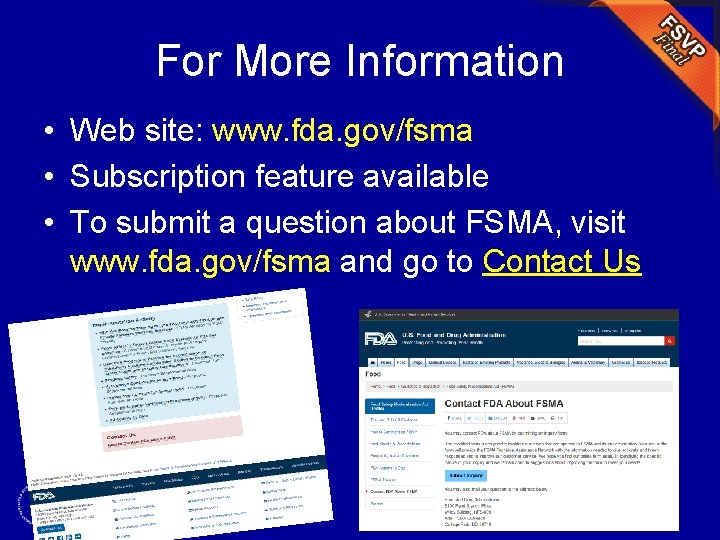
For More Information • Web site: www. fda. gov/fsma • Subscription feature available • To submit a question about FSMA, visit www. fda. gov/fsma and go to Contact Us 25