
FINAL REVIEW Notes Available Remotely from Thursday April
FINAL REVIEW
Notes • Available Remotely from Thursday, April 29 th through Tuesday, May 4 th • Official Exam Blocks: • Section 1: Thursday, April 29 th, 7: 00 am – 9: 50 am • Section 2: Tuesday, May 4 th, 4: 00 pm – 6: 50 pm • 2 hour time limit • Open Notes • Please restrict to notes on the webcourse or those you have created • Calculator Encouraged
Previous Material • Combinational Logic • Truth Tables • Logic Gates • Canonical Forms • Karnaugh Maps • Sequential Logic • Shift Register • Data Register • Register File • Binary Conversions • Arithmetic Logic Unit
MIPS Assembly • Operations • Arithmetic • Logical • Load/Store • Branches • Instruction Formats • R-Type • I-Type • J-Type • Software Conventions • Registers • Procedures • Stacks
Sample Question • Write a sequence of MIPS instructions to implement the following segment of C code: int count_positive(int * a, int n) { int i = 0; int v = 0; while (n > 0) { if(a[i] > 0) v++; i++; n--; } return v; } Use the following register allocation in your code: $a 0 base address of a $a 1 n $v 0 v
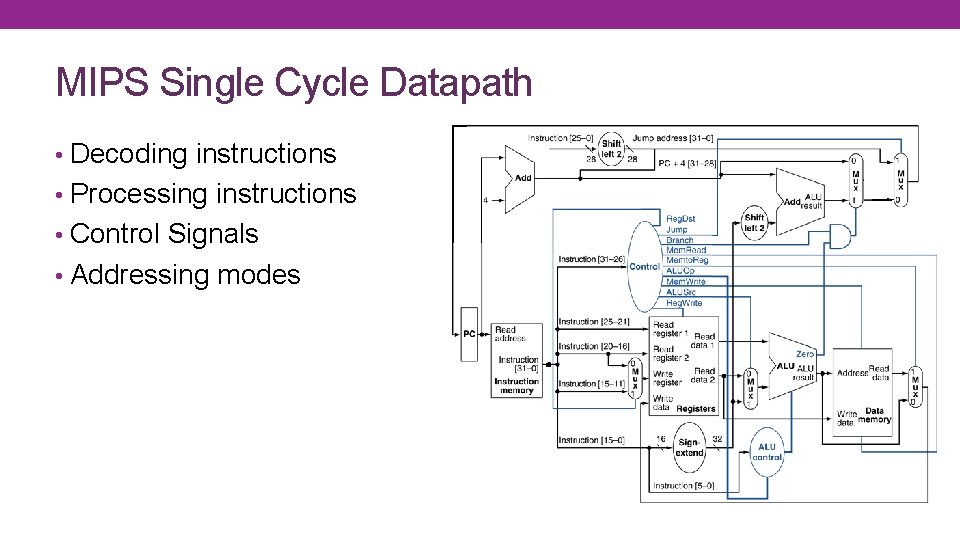
MIPS Single Cycle Datapath • Decoding instructions • Processing instructions • Control Signals • Addressing modes
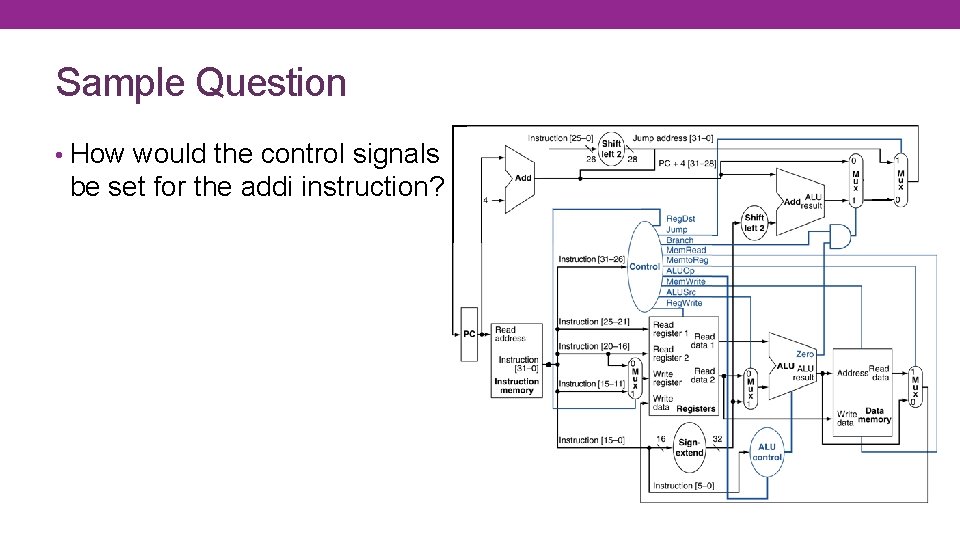
Sample Question • How would the control signals be set for the addi instruction?
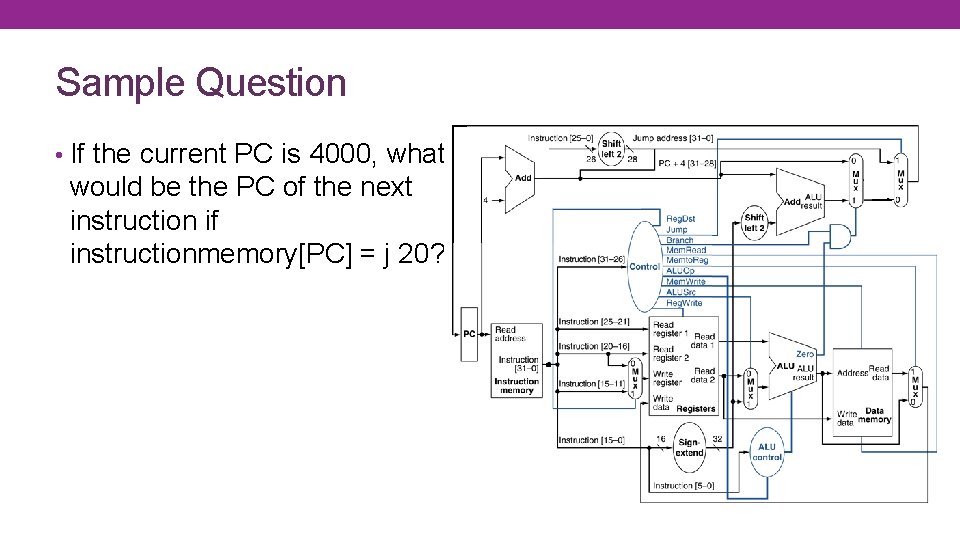
Sample Question • If the current PC is 4000, what would be the PC of the next instruction if instructionmemory[PC] = j 20?
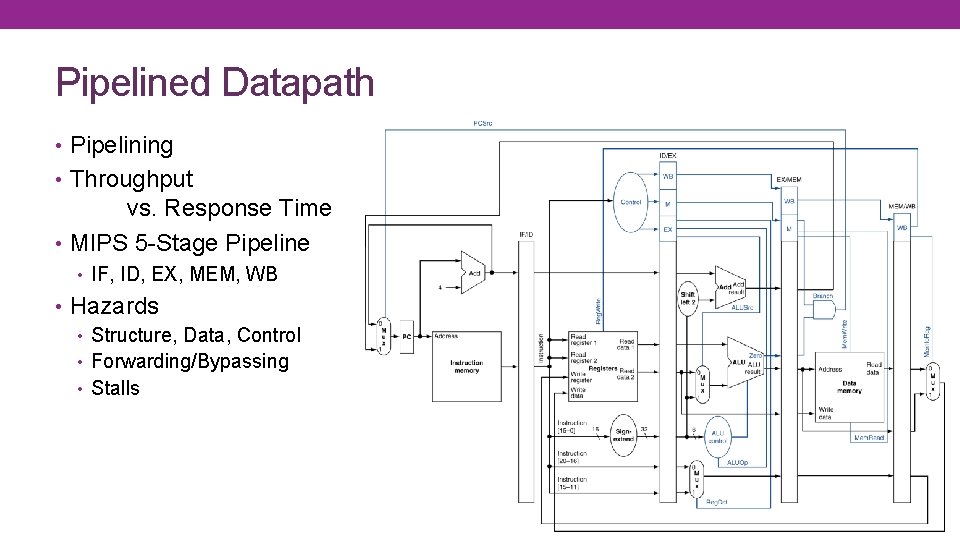
Pipelined Datapath • Pipelining • Throughput vs. Response Time • MIPS 5 -Stage Pipeline • IF, ID, EX, MEM, WB • Hazards • Structure, Data, Control • Forwarding/Bypassing • Stalls
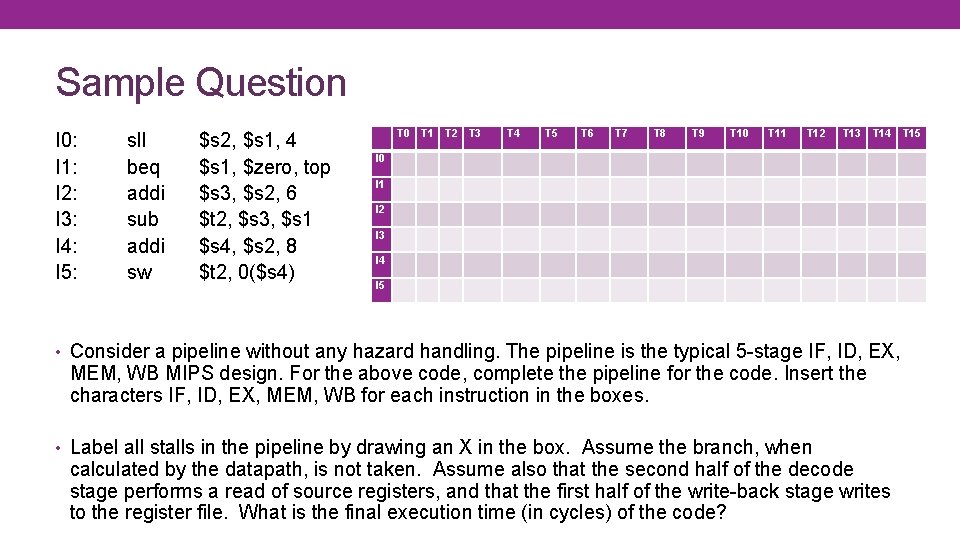
Sample Question I 0: I 1: I 2: I 3: I 4: I 5: sll beq addi sub addi sw $s 2, $s 1, 4 $s 1, $zero, top $s 3, $s 2, 6 $t 2, $s 3, $s 1 $s 4, $s 2, 8 $t 2, 0($s 4) T 0 T 1 T 2 T 3 T 4 T 5 T 6 T 7 T 8 T 9 T 10 T 11 T 12 T 13 T 14 T 15 I 0 I 1 I 2 I 3 I 4 I 5 • Consider a pipeline without any hazard handling. The pipeline is the typical 5 -stage IF, ID, EX, MEM, WB MIPS design. For the above code, complete the pipeline for the code. Insert the characters IF, ID, EX, MEM, WB for each instruction in the boxes. • Label all stalls in the pipeline by drawing an X in the box. Assume the branch, when calculated by the datapath, is not taken. Assume also that the second half of the decode stage performs a read of source registers, and that the first half of the write-back stage writes to the register file. What is the final execution time (in cycles) of the code?
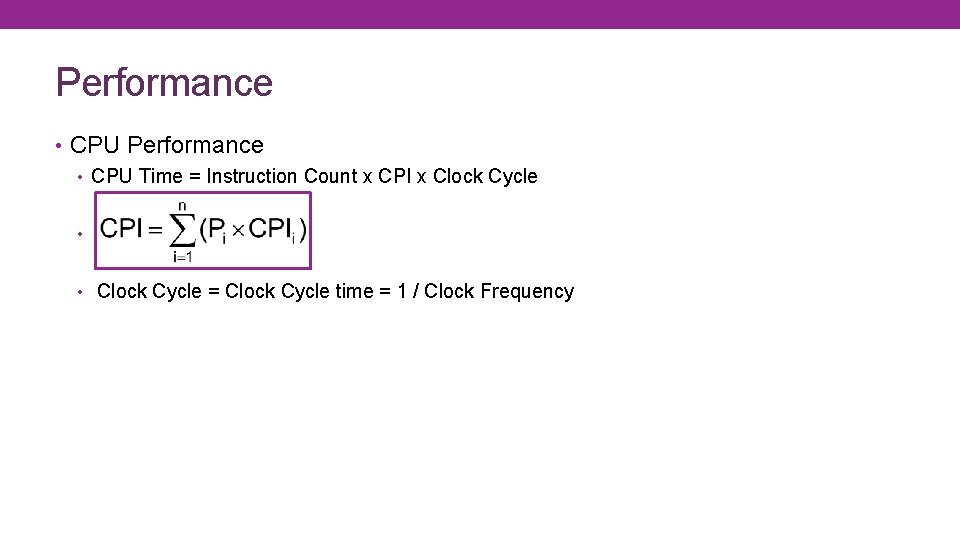
Performance • CPU Time = Instruction Count x CPI x Clock Cycle • • Clock Cycle = Clock Cycle time = 1 / Clock Frequency
Sample Question • Computer A has an overall CPI of 1. 3 and can be run at a clock rate of 600 MHz. Computer B has a CPI of 2. 5 and can be run at a clock rate of 750 Mhz. • Suppose we have a particular program we wish to run. When compiled for computer A, this program has exactly 100, 000 instructions. How many instructions would the program need to have when compiled for Computer B, in order for the two computers to have exactly the same execution time for this program?
Memory Hierarchy • Locality • Caches • Associativity • Replacement policies • Write policies
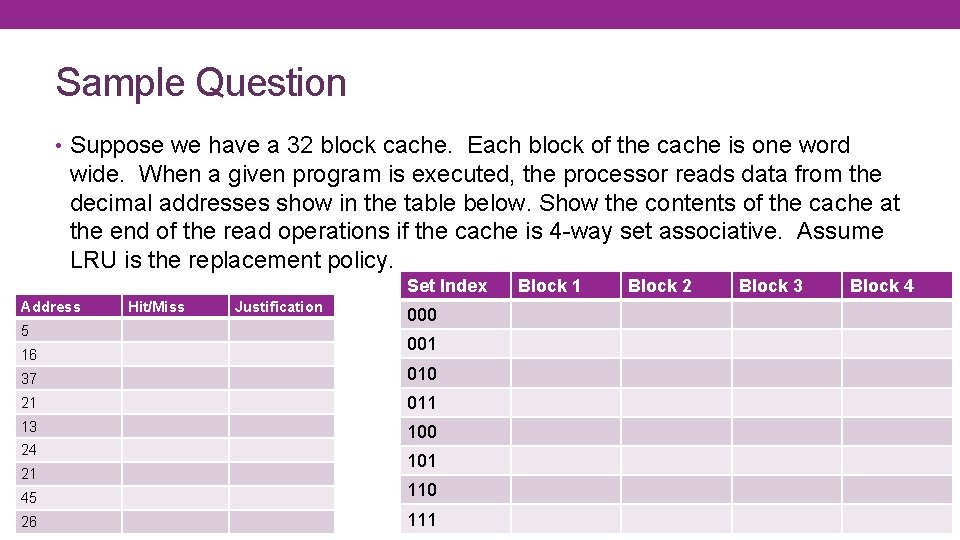
Sample Question • Suppose we have a 32 block cache. Each block of the cache is one word wide. When a given program is executed, the processor reads data from the decimal addresses show in the table below. Show the contents of the cache at the end of the read operations if the cache is 4 -way set associative. Assume LRU is the replacement policy. Set Index Address 5 16 Hit/Miss Justification 000 001 37 010 21 011 13 100 24 21 101 45 110 26 111 Block 2 Block 3 Block 4
- Slides: 14