
Final report of the E 821 muon anomalous

- Slides: 23
Final report of the E 821 muon anomalous magnetic moment measurement at BNL G. W. Bennett et al. (Muon(g-2)Collaboration) Phys. Rev. D. 73, 072003 (2006) Contents 1. 2. 3. 4. 5. 6. Muon Anomalous magnetic moment Experiment Analysis Results Summary Shibata Lab. 11 B 01329 Koji Igarashi 1 st, July, 2014 1
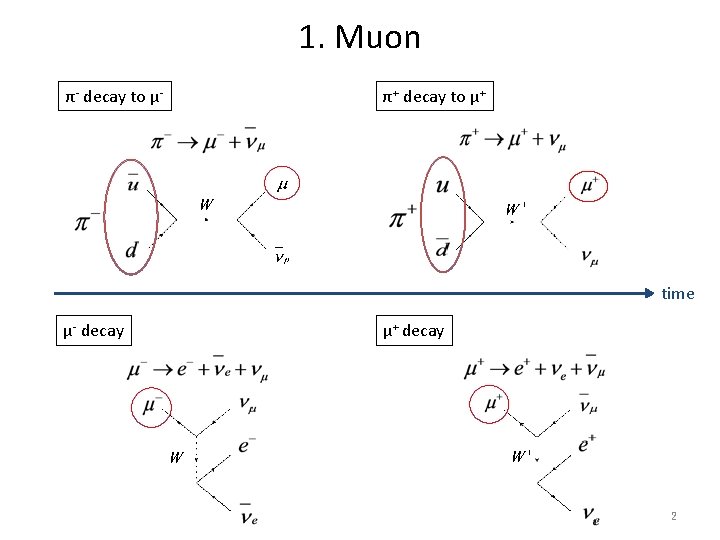
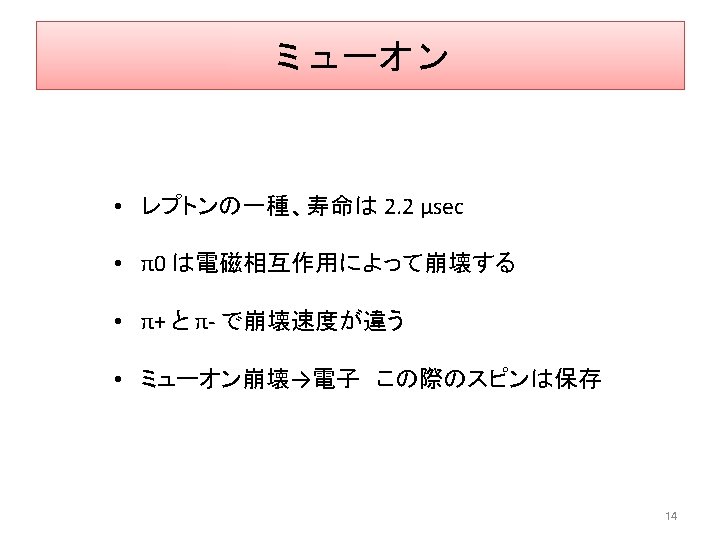
1. Muon π- decay to μ- π+ decay to μ+ time μ- decay μ+ decay 2
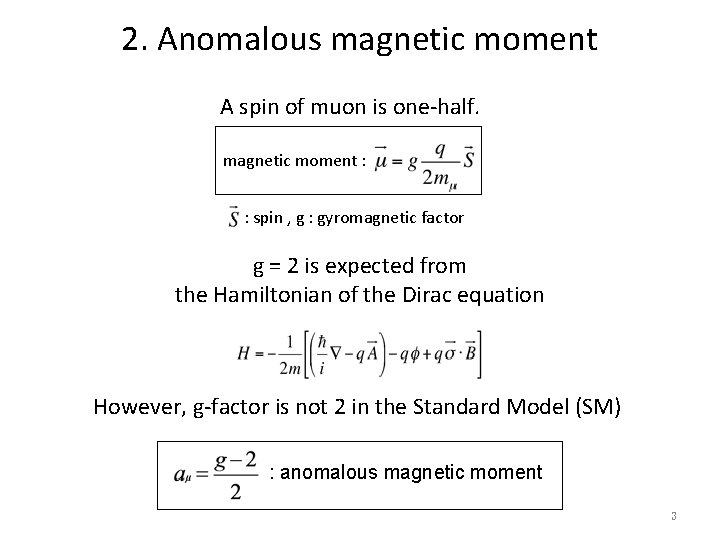
2. Anomalous magnetic moment A spin of muon is one-half. magnetic moment : : spin , g : gyromagnetic factor g = 2 is expected from the Hamiltonian of the Dirac equation However, g-factor is not 2 in the Standard Model (SM) : anomalous magnetic moment 3
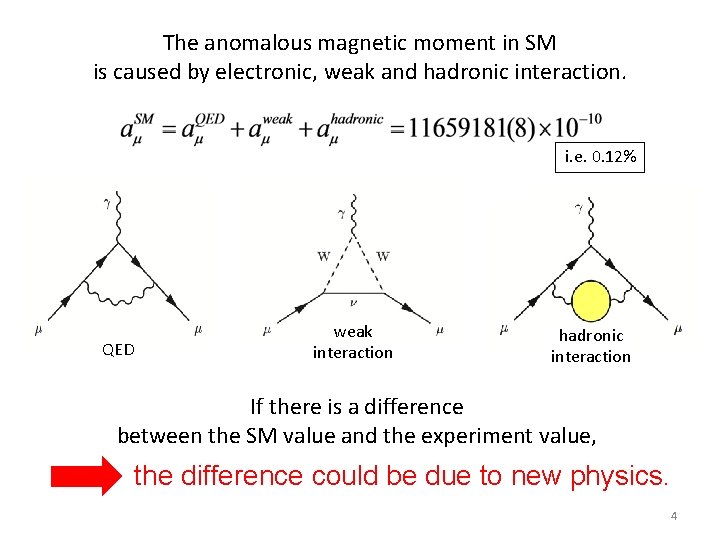
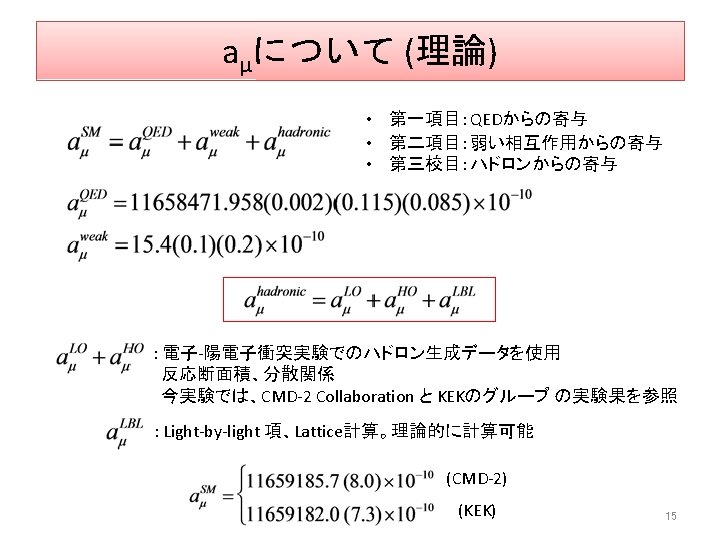
The anomalous magnetic moment in SM is caused by electronic, weak and hadronic interaction. i. e. 0. 12% QED weak interaction hadronic ああああ interaction If there is a difference between the SM value and the experiment value, the difference could be due to new physics. 4
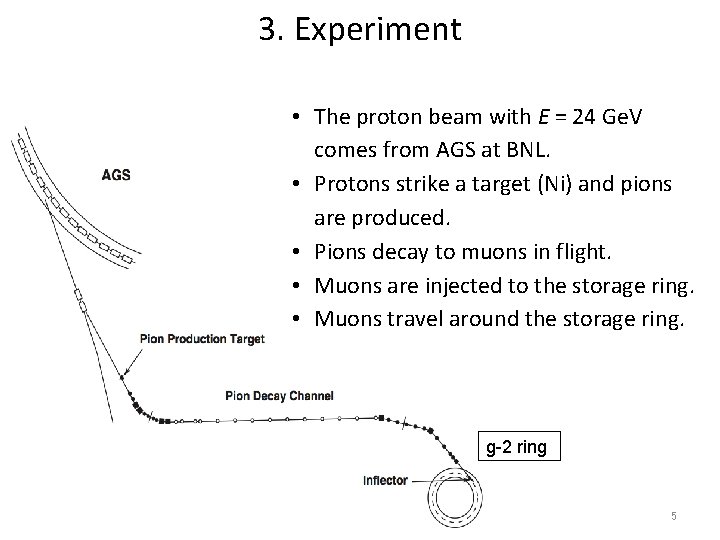
3. Experiment • The proton beam with E = 24 Ge. V comes from AGS at BNL. • Protons strike a target (Ni) and pions are produced. • Pions decay to muons in flight. • Muons are injected to the storage ring. • Muons travel around the storage ring. g-2 ring 5
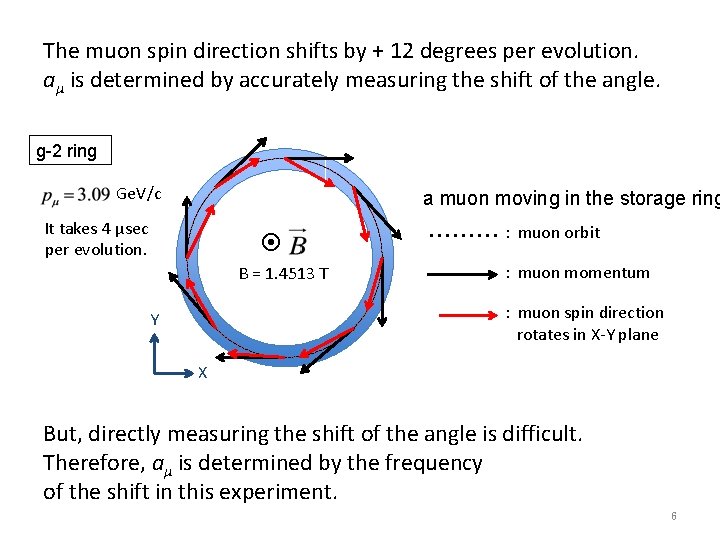
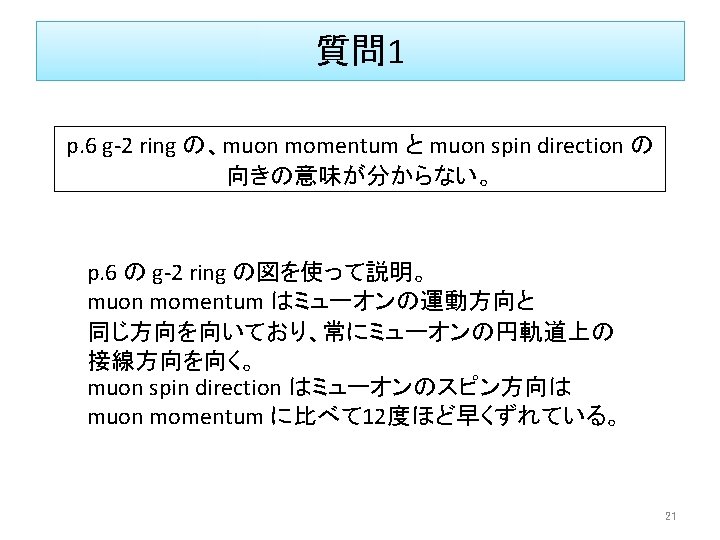
The muon spin direction shifts by + 12 degrees per evolution. aμ is determined by accurately measuring the shift of the angle. g-2 ring Ge. V/c a muon moving in the storage ring It takes 4 μsec per evolution. B = 1. 4513 T : muon orbit : muon momentum : muon spin direction rotates in X-Y plane Y X But, directly measuring the shift of the angle is difficult. Therefore, aμ is determined by the frequency of the shift in this experiment. 6
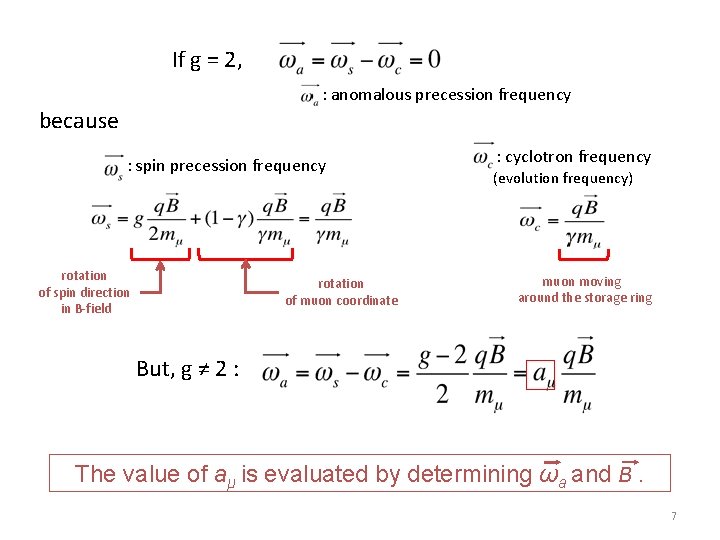
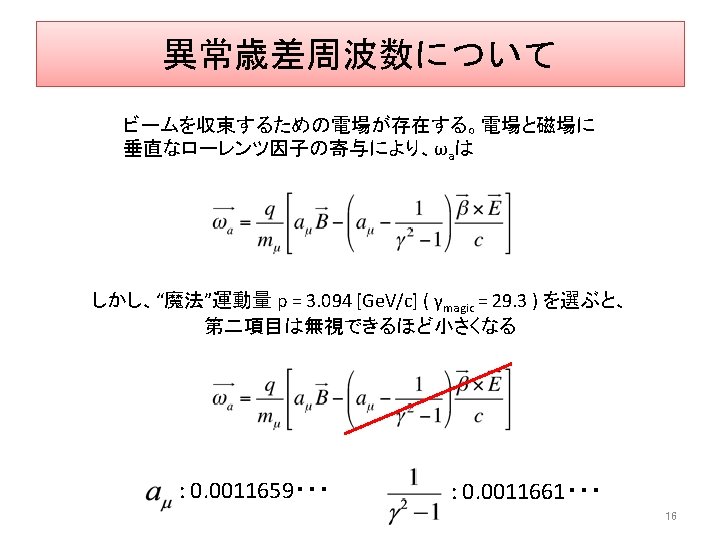
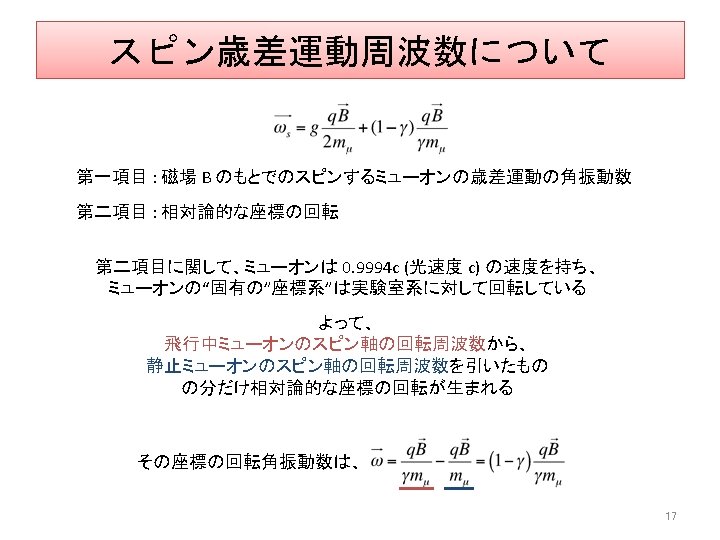
If g = 2, : anomalous precession frequency because : spin precession frequency rotation of spin direction in B-field rotation of muon coordinate : cyclotron frequency (evolution frequency) muon moving around the storage ring But, g ≠ 2 : The value of aμ is evaluated by determining ωa and B. 7
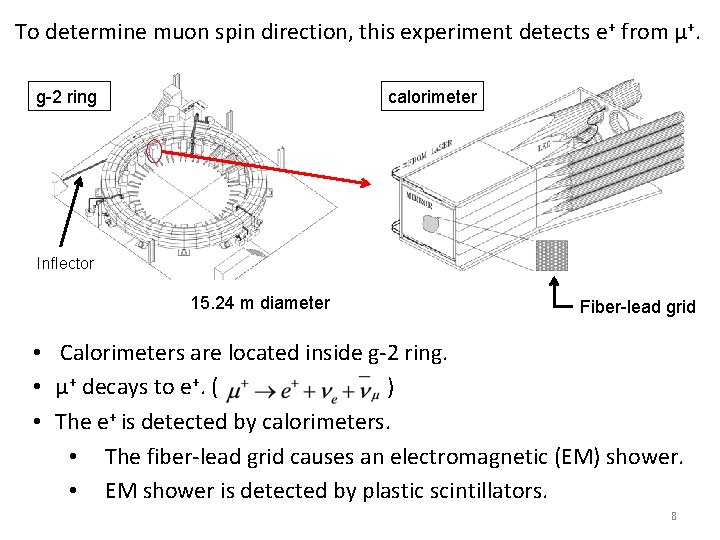
To determine muon spin direction, this experiment detects e+ from μ+. g-2 ring calorimeter Inflector 15. 24 m diameter Fiber-lead grid • Calorimeters are located inside g-2 ring. • μ+ decays to e+. ( ) • The e+ is detected by calorimeters. • The fiber-lead grid causes an electromagnetic (EM) shower. • EM shower is detected by plastic scintillators. 8
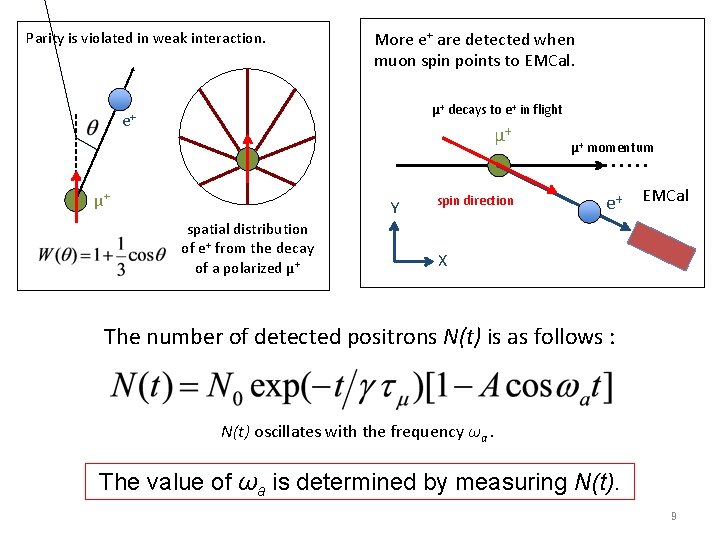
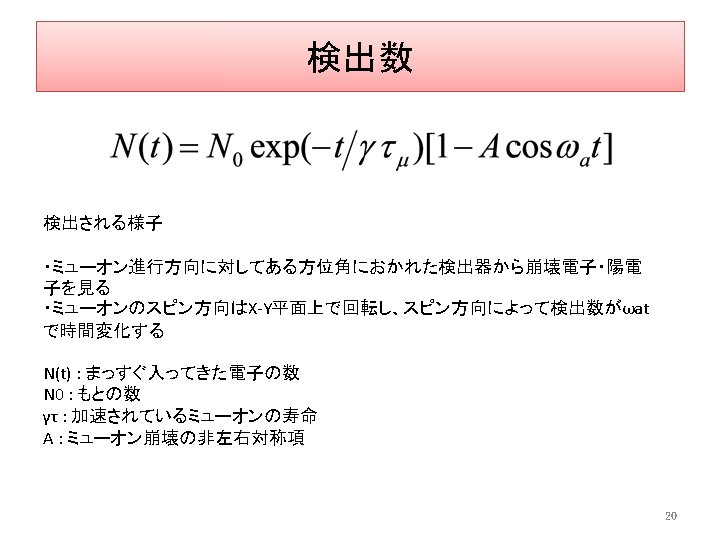
Parity is violated in weak interaction. More e+ are detected when muon spin points to EMCal. μ+ decays to e+ in flight e+ μ+ μ+ Y spatial distribution of e+ from the decay of a polarized μ+ spin direction μ+ momentum e+ EMCal X The number of detected positrons N(t) is as follows : N(t) oscillates with the frequency ωa. The value of ωa is determined by measuring N(t). 9
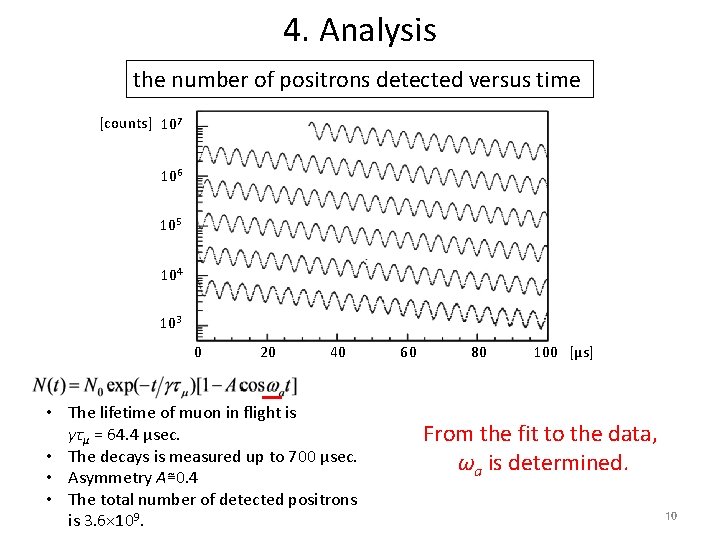
4. Analysis the number of positrons detected versus time [counts] 107 106 105 104 103 0 20 40 • The lifetime of muon in flight is γτμ = 64. 4 μsec. • The decays is measured up to 700 μsec. • Asymmetry A≅0. 4 • The total number of detected positrons is 3. 6× 10⁹. 60 80 100 [μs] From the fit to the data, ωa is determined. 10
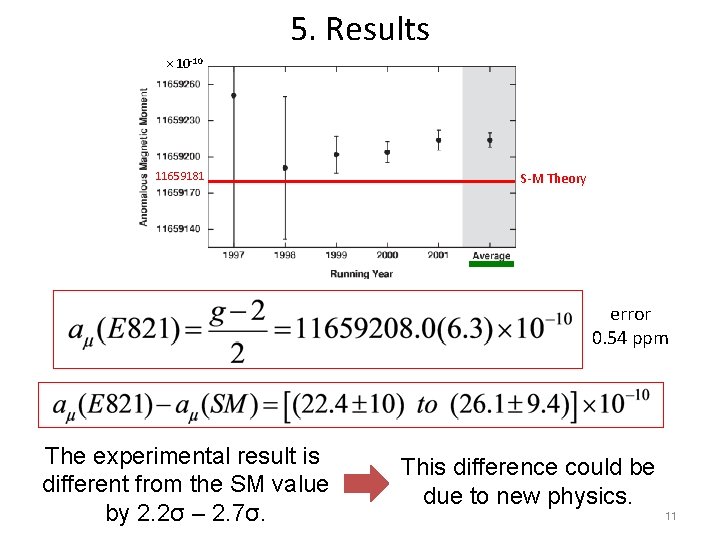
5. Results × 10 -10 11659181 S-M Theory error 0. 54 ppm The experimental result is different from the SM value by 2. 2σ – 2. 7σ. This difference could be due to new physics. 11
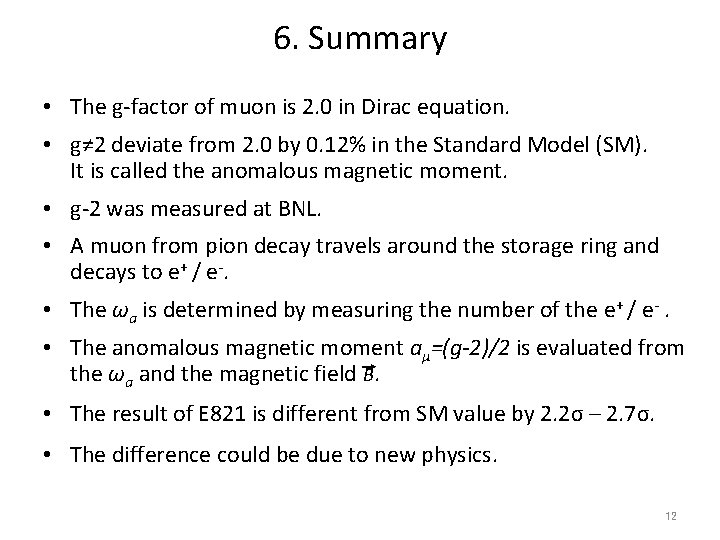
6. Summary • The g-factor of muon is 2. 0 in Dirac equation. • g≠ 2 deviate from 2. 0 by 0. 12% in the Standard Model (SM). It is called the anomalous magnetic moment. • g-2 was measured at BNL. • A muon from pion decay travels around the storage ring and decays to e+ / e-. • The ωa is determined by measuring the number of the e+ / e-. • The anomalous magnetic moment aμ=(g-2)/2 is evaluated from the ωa and the magnetic field B. • The result of E 821 is different from SM value by 2. 2σ – 2. 7σ. • The difference could be due to new physics. 12