
Final Presentation Short Circuit Model of VSCHVDC Terminal
![Background Operation principle of VSC [3]: Q P |Vc| ∠Vc](https://slidetodoc.com/presentation_image_h2/b8d3e0244d0a7ad26dbeb0a9c3336266/image-9.jpg "Background Operation principle of VSC [3]: Q P |Vc| ∠Vc")
![Methodology Modelling technique: Control Based Equivalent Circuit Approach [2] VSC-HVDC terminal is represented by](https://slidetodoc.com/presentation_image_h2/b8d3e0244d0a7ad26dbeb0a9c3336266/image-11.jpg "Methodology Modelling technique: Control Based Equivalent Circuit Approach [2] VSC-HVDC terminal is represented by")
![Methodology Modelling technique: Modified-Augmented-Nodal-Analysis (MANA) [4] Vc: Independent voltage sources Dc: Dependent voltage sources](https://slidetodoc.com/presentation_image_h2/b8d3e0244d0a7ad26dbeb0a9c3336266/image-12.jpg "Methodology Modelling technique: Modified-Augmented-Nodal-Analysis (MANA) [4] Vc: Independent voltage sources Dc: Dependent voltage sources")
![Proposed Algorithm VSC-HVDC Control Strategy: Vector current control [5] This technology allows separate control](https://slidetodoc.com/presentation_image_h2/b8d3e0244d0a7ad26dbeb0a9c3336266/image-15.jpg "Proposed Algorithm VSC-HVDC Control Strategy: Vector current control [5] This technology allows separate control")
- Slides: 24
Final Presentation Short Circuit Model of VSC-HVDC Terminal for Protection Studies Student: Tsang Fan Him (14113875 D) Supervisor: Dr. Ulas Karaagac Code: FYP_91
Content 1. Introduction 2. Background 3. Methodology 4. Proposed Algorithm 5. Short Circuit Model 6. Result 7. Conclusion
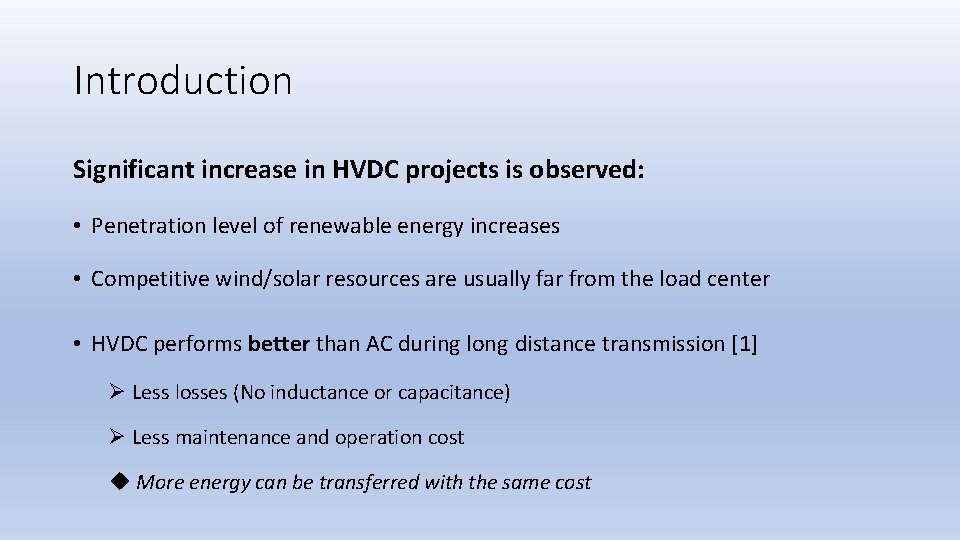
Introduction Significant increase in HVDC projects is observed: • Penetration level of renewable energy increases • Competitive wind/solar resources are usually far from the load center • HVDC performs better than AC during long distance transmission [1] Ø Less losses (No inductance or capacitance) Ø Less maintenance and operation cost u More energy can be transferred with the same cost
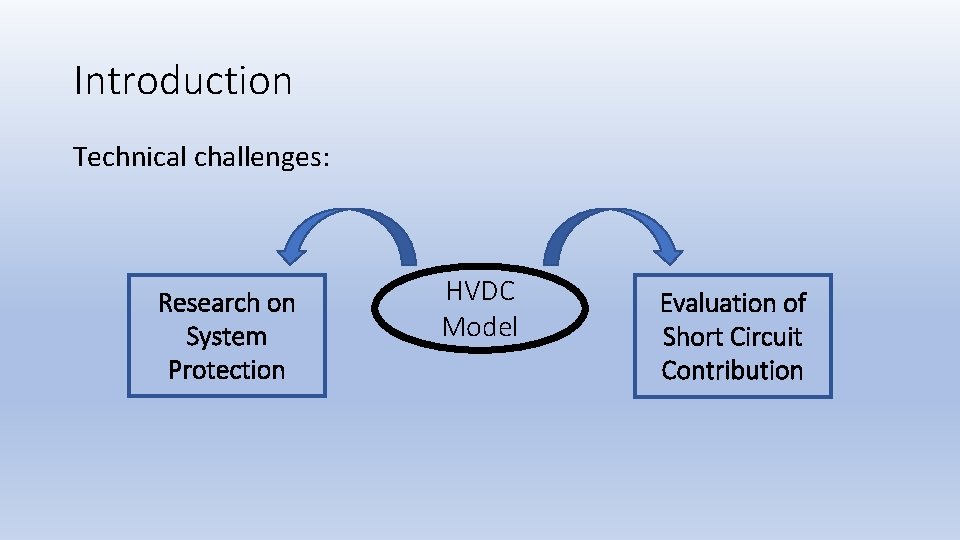
Introduction Technical challenges: Research on System Protection HVDC Model Evaluation of Short Circuit Contribution
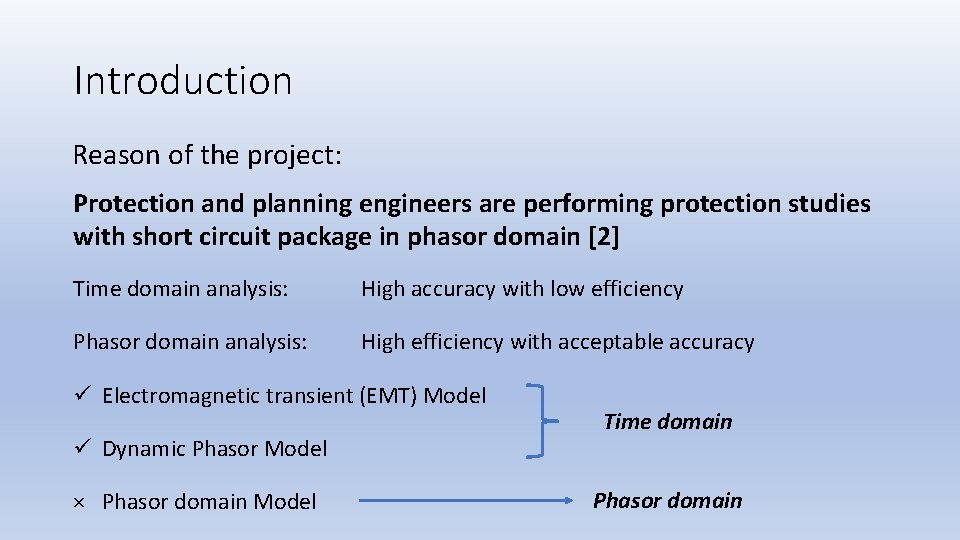
Introduction Reason of the project: Protection and planning engineers are performing protection studies with short circuit package in phasor domain [2] Time domain analysis: High accuracy with low efficiency Phasor domain analysis: High efficiency with acceptable accuracy ü Electromagnetic transient (EMT) Model ü Dynamic Phasor Model × Phasor domain Model Time domain Phasor domain
Introduction Objective: Ø Propose an algorithm for the behaviour of VSC HVDC terminal Ø Develop a short circuit analysis package for VSC HVDC terminal Ø Validate the performance of the proposed model with EMT solutions
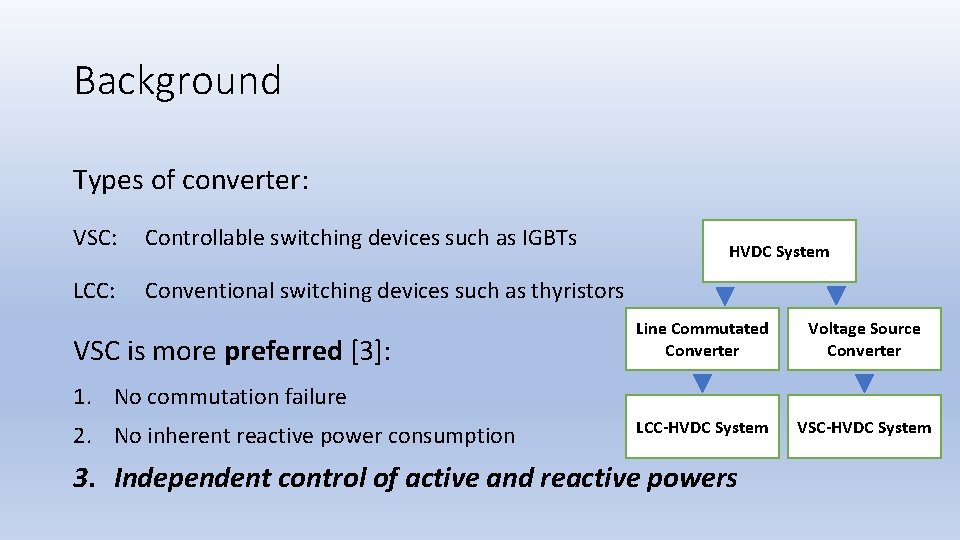
Background Types of converter: VSC: Controllable switching devices such as IGBTs LCC: Conventional switching devices such as thyristors VSC is more preferred [3]: HVDC System Line Commutated Converter Voltage Source Converter LCC-HVDC System VSC-HVDC System 1. No commutation failure 2. No inherent reactive power consumption 3. Independent control of active and reactive powers
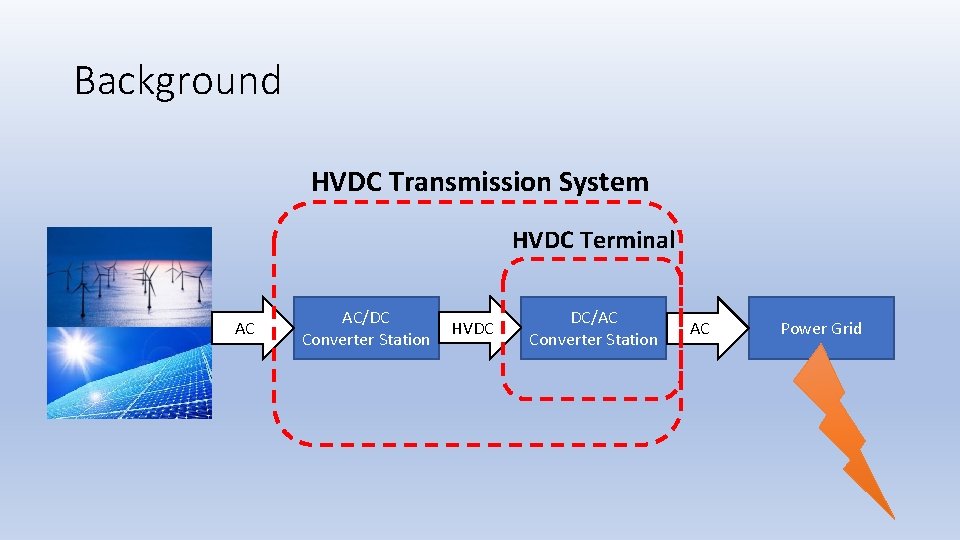
Background HVDC Transmission System HVDC Terminal AC AC/DC Converter Station HVDC DC/AC Converter Station AC Power Grid
Background Operation principle of VSC [3]: Q P |Vc| ∠Vc
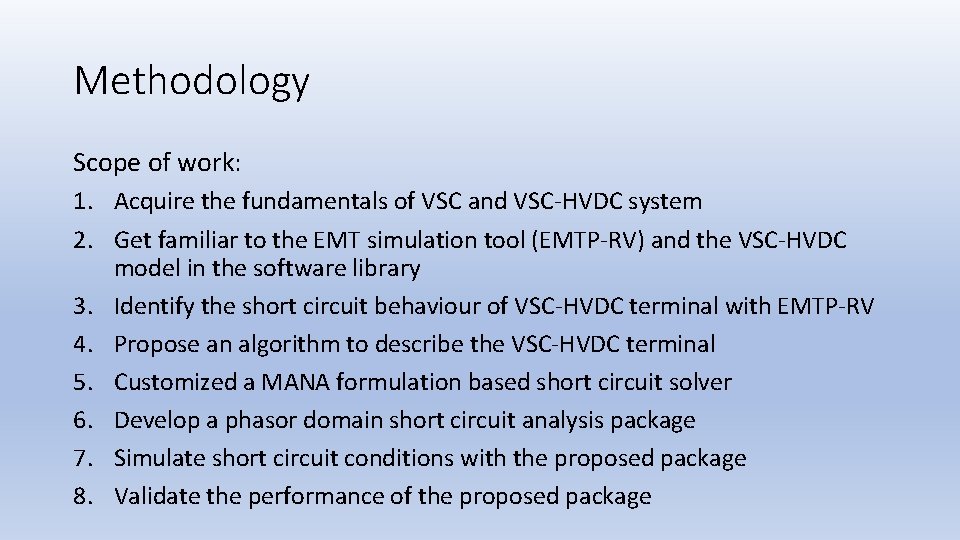
Methodology Scope of work: 1. Acquire the fundamentals of VSC and VSC-HVDC system 2. Get familiar to the EMT simulation tool (EMTP-RV) and the VSC-HVDC model in the software library 3. Identify the short circuit behaviour of VSC-HVDC terminal with EMTP-RV 4. Propose an algorithm to describe the VSC-HVDC terminal 5. Customized a MANA formulation based short circuit solver 6. Develop a phasor domain short circuit analysis package 7. Simulate short circuit conditions with the proposed package 8. Validate the performance of the proposed package
Methodology Modelling technique: Control Based Equivalent Circuit Approach [2] VSC-HVDC terminal is represented by a controlled current source and its complex characteristic of the VSC control will be accounted in the proposed algorithm via an iteration solution.
Methodology Modelling technique: Modified-Augmented-Nodal-Analysis (MANA) [4] Vc: Independent voltage sources Dc: Dependent voltage sources Sc: Zero impedance devices In: Known currents Vb: Known voltages System equations: Ax = B (Sparse Matrix) Rapidly solved by LU factorization algorithms
Methodology Software: EMTP-RV is an advance software for engineers to carry out power system studies. In the project, EMTP-RV is used to characterize the short circuit behaviour of the VSCHVDC terminal and generate EMT solutions. MATLAB is a versatile algorithm software commonly used by engineers for system modelling. In the project, MATLAB will be used to develop the phasor domain short circuit analysis package for the VSC HVDC terminal.
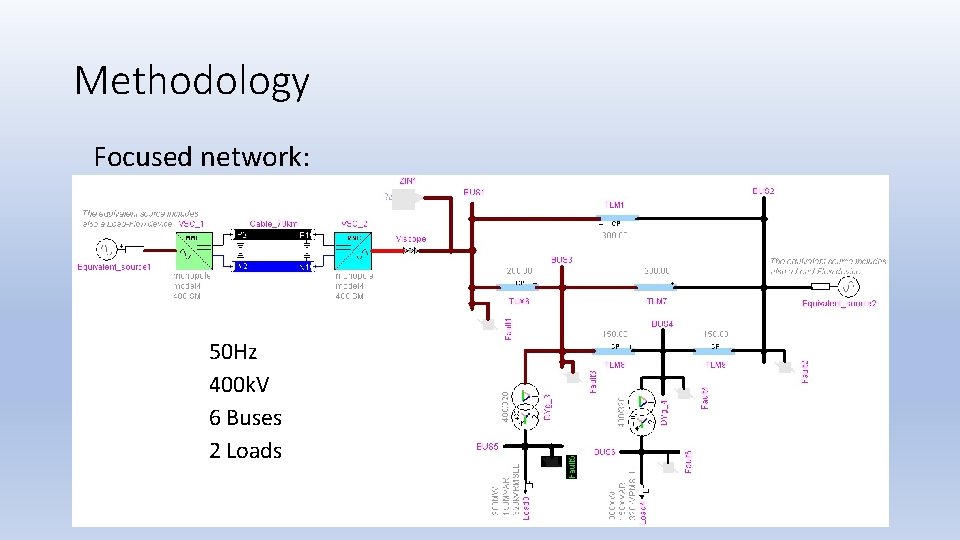
Methodology Focused network: 50 Hz 400 k. V 6 Buses 2 Loads
Proposed Algorithm VSC-HVDC Control Strategy: Vector current control [5] This technology allows separate control of the active and reactive power via a fast inner control loop. With the dq decomposition technique, active power control (P/Vdc control) and reactive power control (Q/Vac control) can be achieved. Reference d and q current components in different control modes: P control Vdc control Q control Vac control
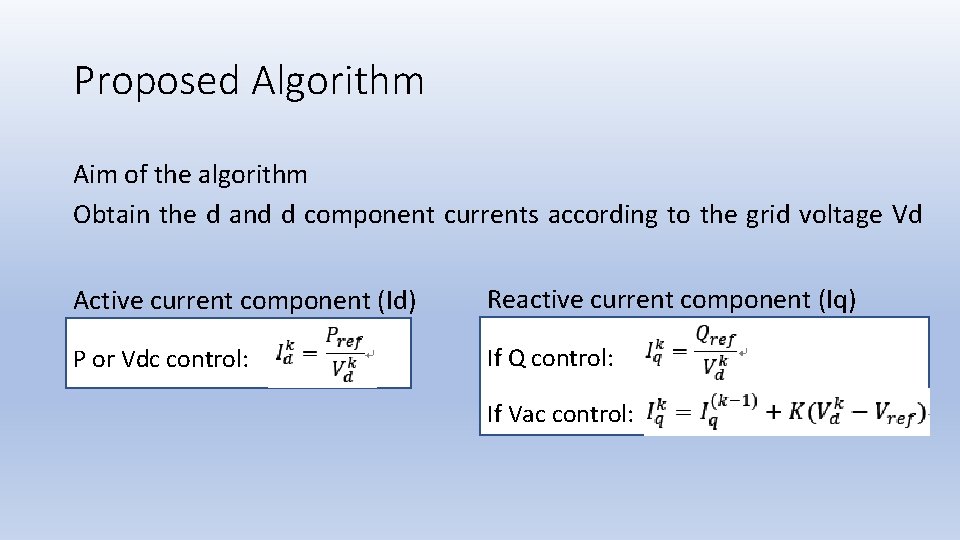
Proposed Algorithm Aim of the algorithm Obtain the d and d component currents according to the grid voltage Vd Active current component (Id) Reactive current component (Iq) P or Vdc control: If Q control: If Vac control:
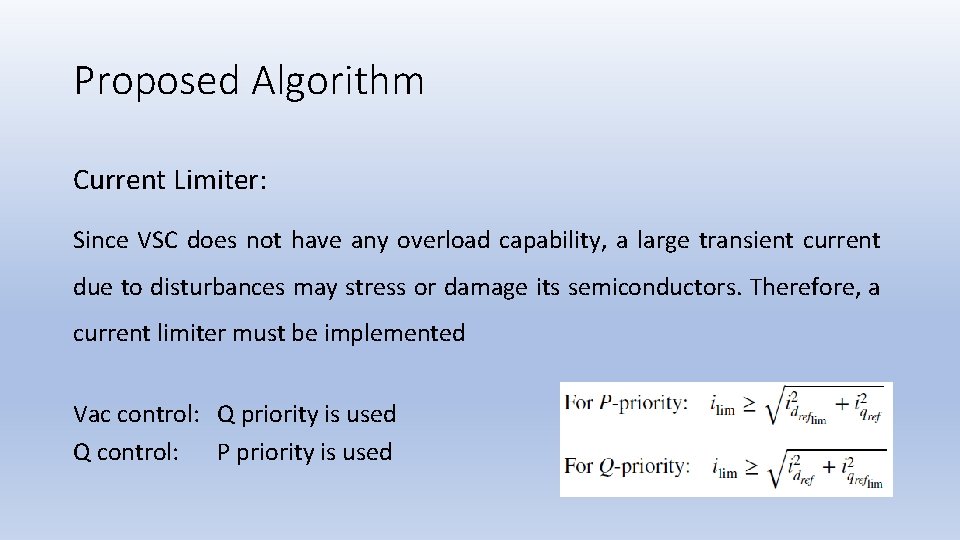
Proposed Algorithm Current Limiter: Since VSC does not have any overload capability, a large transient current due to disturbances may stress or damage its semiconductors. Therefore, a current limiter must be implemented Vac control: Q priority is used Q control: P priority is used
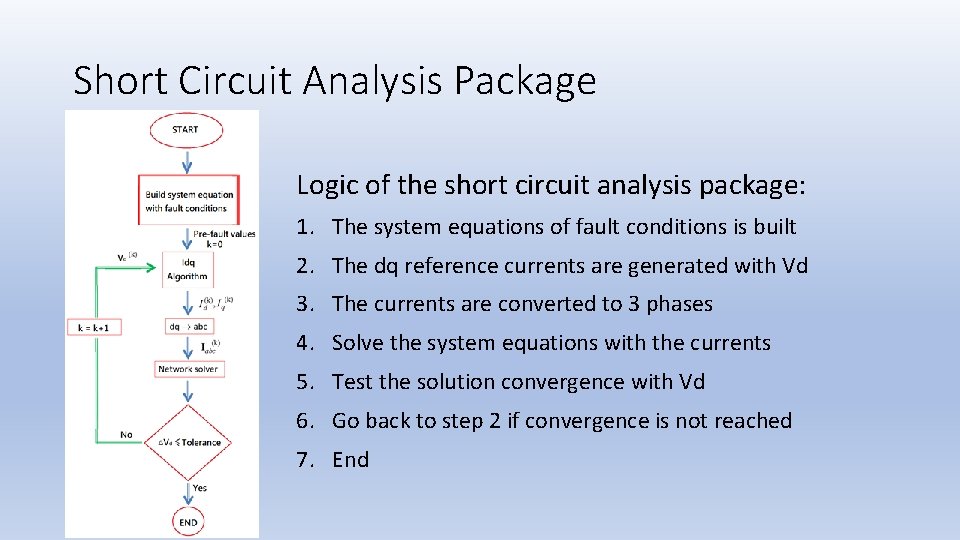
Short Circuit Analysis Package Logic of the short circuit analysis package: 1. The system equations of fault conditions is built 2. The dq reference currents are generated with Vd 3. The currents are converted to 3 phases 4. Solve the system equations with the currents 5. Test the solution convergence with Vd 6. Go back to step 2 if convergence is not reached 7. End
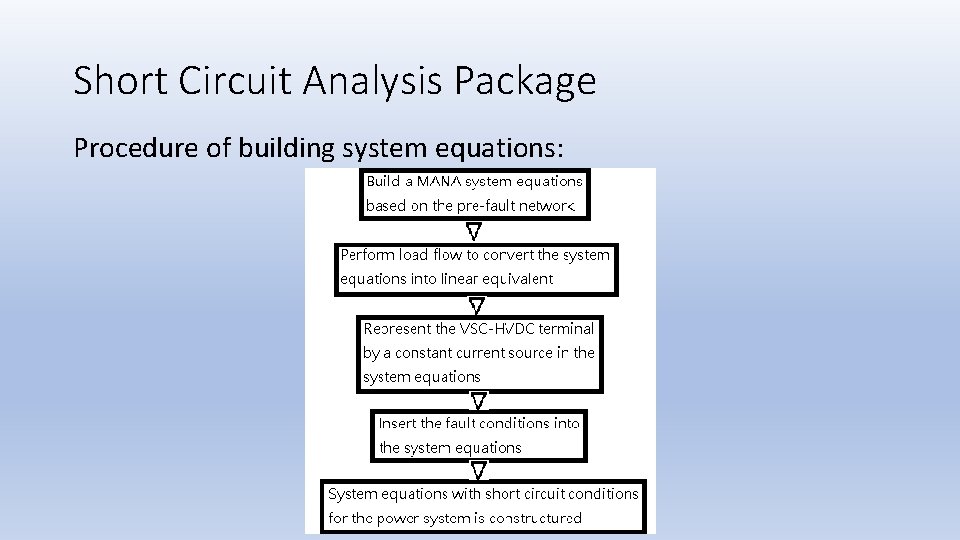
Short Circuit Analysis Package Procedure of building system equations:
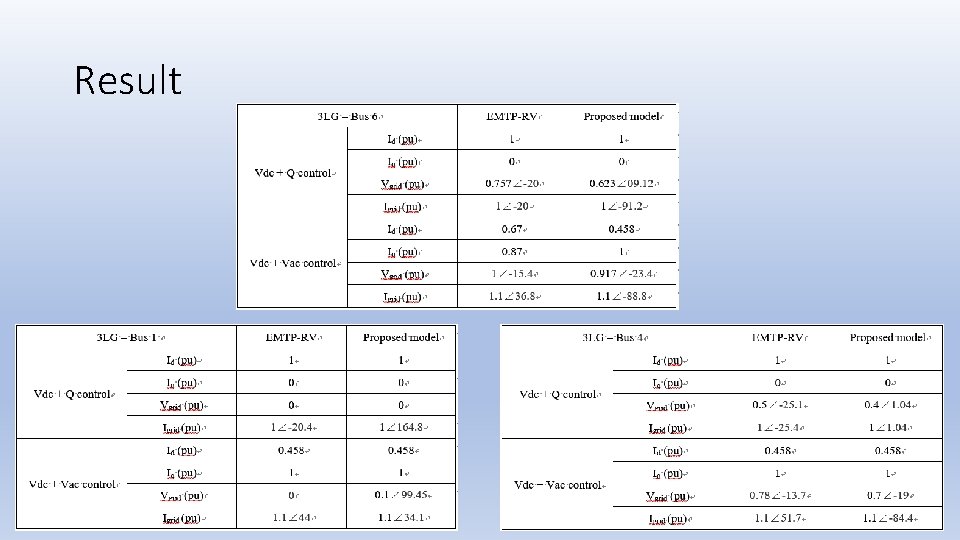
Result
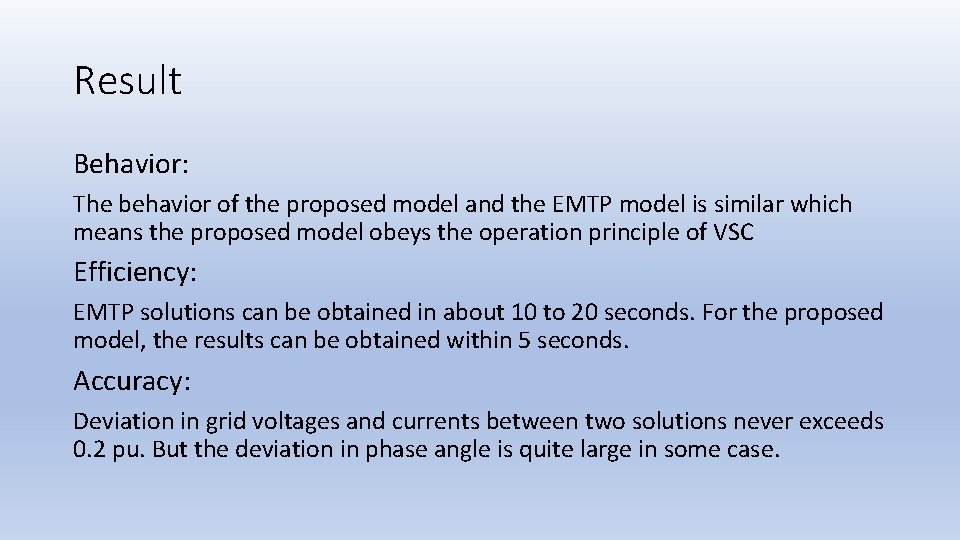
Result Behavior: The behavior of the proposed model and the EMTP model is similar which means the proposed model obeys the operation principle of VSC Efficiency: EMTP solutions can be obtained in about 10 to 20 seconds. For the proposed model, the results can be obtained within 5 seconds. Accuracy: Deviation in grid voltages and currents between two solutions never exceeds 0. 2 pu. But the deviation in phase angle is quite large in some case.
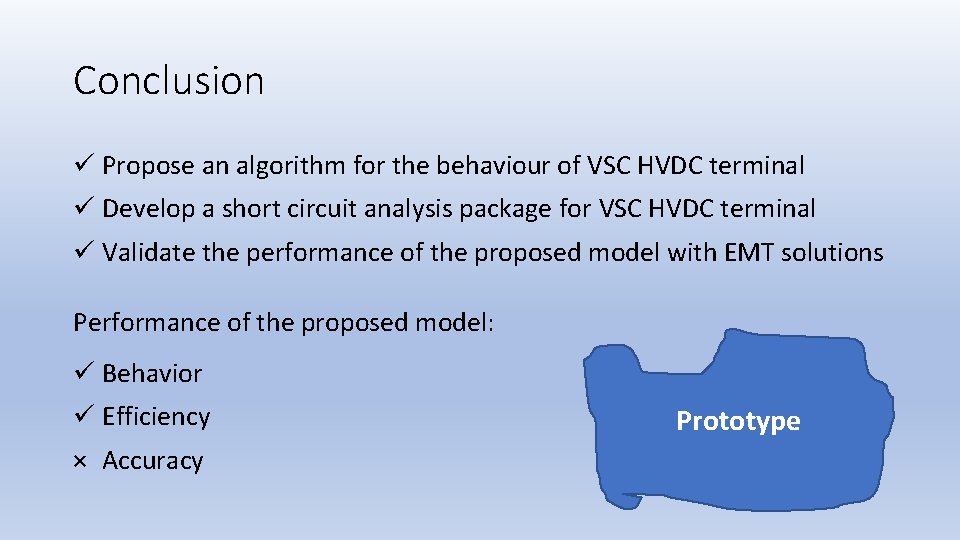
Conclusion ü Propose an algorithm for the behaviour of VSC HVDC terminal ü Develop a short circuit analysis package for VSC HVDC terminal ü Validate the performance of the proposed model with EMT solutions Performance of the proposed model: ü Behavior ü Efficiency × Accuracy Prototype
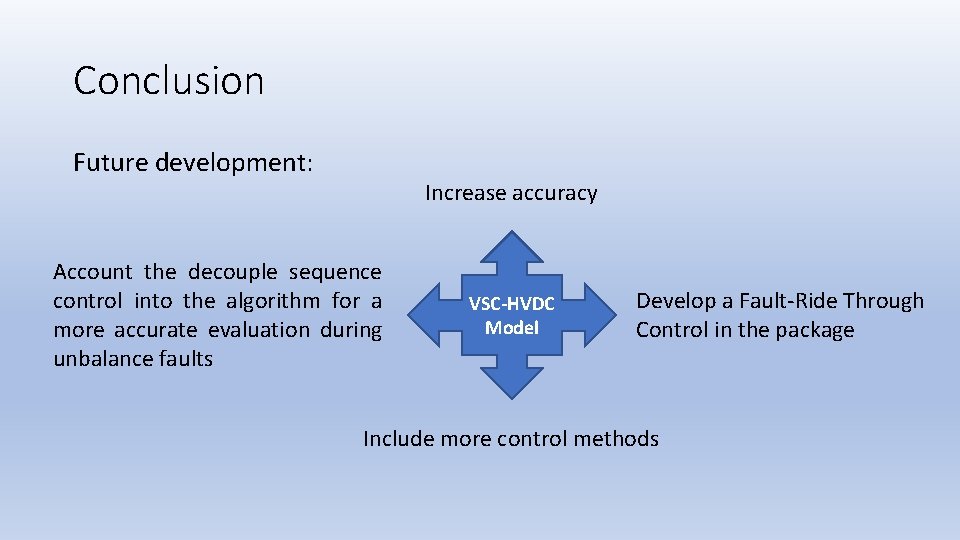
Conclusion Future development: Increase accuracy Account the decouple sequence control into the algorithm for a more accurate evaluation during unbalance faults VSC-HVDC Model Develop a Fault-Ride Through Control in the package Include more control methods
Reference 1. Z. Lidong, Modeling and Control of VSC-HVDC Links Connected to Weak AC Systems. Sweden: LATEX, 2010. 2. U. Karaagac et al. , "Phasor domain modeling of type-IV wind turbine generator for protection studies, " 2015 IEEE Power & Energy Society General Meeting, Denver, CO, pp. 1 -5, July. 2015. 3. N. Flourentzou, V. G. Agelidis, and G. D. Demetriades. “VSC-based HVDC power transmission systems: an overview, ” IEEE Transactions on Power Electronics, 24(3), 592 -602, 2009. 4. J. Mahseredjian, S. Dennetière, L. Dubé, B. Khodabakhchian and L. Gérin-Lajoie, “On a new approach for the simulation of transients in power systems, ” Electric Power Systems Research, vol. 77, no. 11, pp. 1514– 1520, 2007. 5. Martinez-Velasco, Juan A. , Transient Analysis of Power Systems : Solution Techniques, Tools and Applications. New York: John Wiley & Sons, Incorporated, 2014.