
Final Physics 101 Lecture 26 Conduction Convection Radiation
- Slides: 17
Final Physics 101: Lecture 26 Conduction, Convection, Radiation Today’s lecture will cover Textbook Chapter 14. 4 -14. 9 Physics 101: Lecture 26, Pg 1
Calendar Today: HE 3 at 7 pm, conflict in 151 Loomis at 5: 15 pm April 27, Wednesday Lecture: Thermodynamics I May 2, Monday Lecture: Thermodynamics II May 4, Wednesday Lecture: no lecture, just review Quiz 11 this week. It will be about thermal expansion, ideal gas and perhaps Bernoulli (no special preparation should be needed beyond the one for HE 3 Check your grades in gradebook! The deadline to turn in your excuses to us in 231/233 Loomis is Wednesday, April 27 at 4 PM. Finals: Monday May 9 th 1: 30 pm, Tuesday May 10 th 7 pm MUST select final by TOMORROW, 10 pm Tuesday April 26 th. Gradebook will soon be LOCKED. Physics 101: Lecture 26, Pg 2
Review l Heat is FLOW of energy èFlow of energy may increase temperature l Specific Heat è T = Q / (c m) l Latent Heat èheat associated with change in phase l Today: Heat èConduction èConvection èRadiation Physics 101: Lecture 26, Pg 3 07
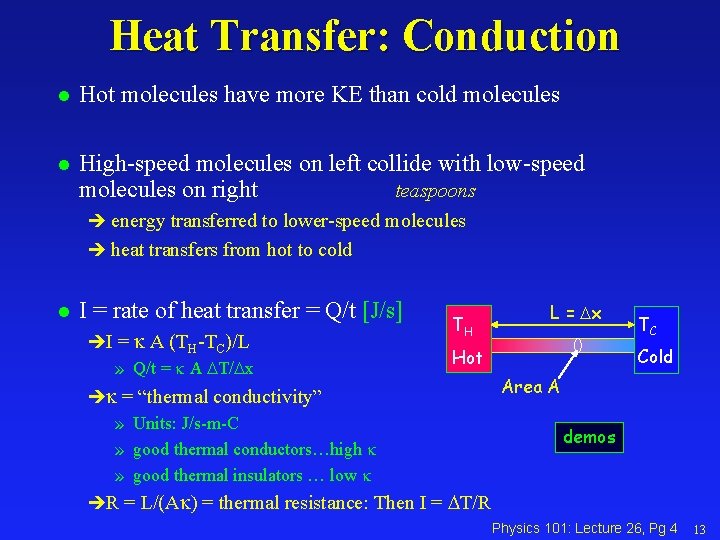
Heat Transfer: Conduction l Hot molecules have more KE than cold molecules l High-speed molecules on left collide with low-speed molecules on right teaspoons è energy transferred to lower-speed molecules è heat transfers from hot to cold l I = rate of heat transfer = Q/t [J/s] èI = k A (TH-TC)/L » Q/t = k A T/ x TH L = x Cold Hot èk = “thermal conductivity” » Units: J/s-m-C » good thermal conductors…high k » good thermal insulators … low k TC Area A demos èR = L/(Ak) = thermal resistance: Then I = T/R Physics 101: Lecture 26, Pg 4 13
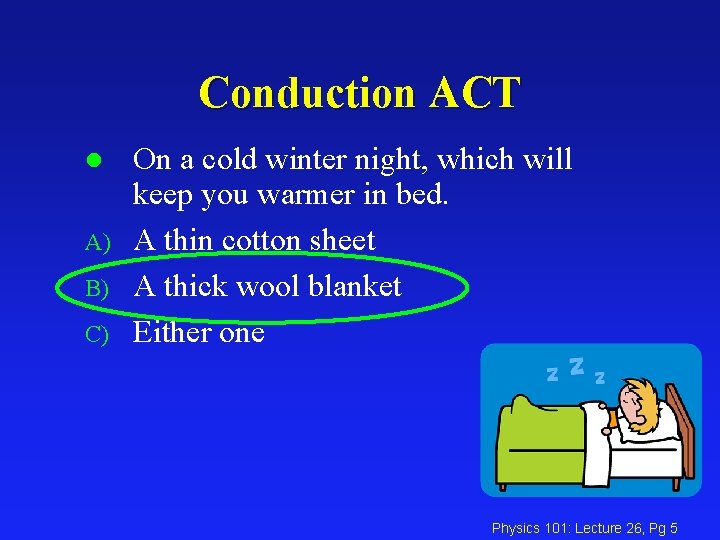
Conduction ACT l A) B) C) On a cold winter night, which will keep you warmer in bed. A thin cotton sheet A thick wool blanket Either one Physics 101: Lecture 26, Pg 5
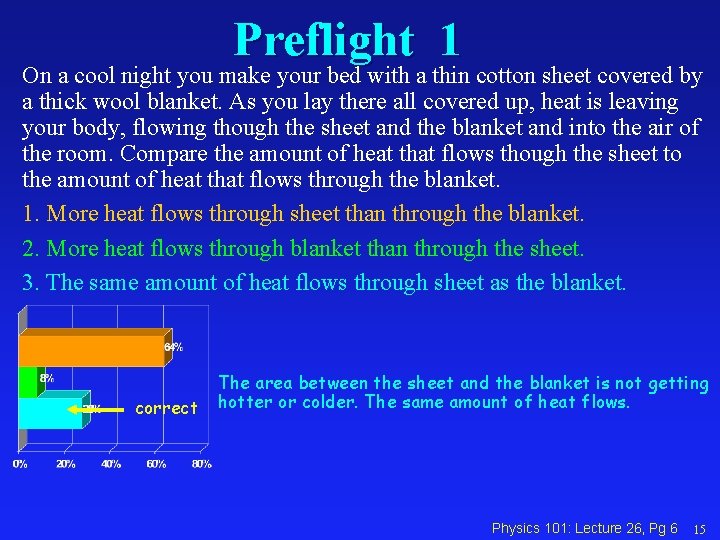
Preflight 1 On a cool night you make your bed with a thin cotton sheet covered by a thick wool blanket. As you lay there all covered up, heat is leaving your body, flowing though the sheet and the blanket and into the air of the room. Compare the amount of heat that flows though the sheet to the amount of heat that flows through the blanket. 1. More heat flows through sheet than through the blanket. 2. More heat flows through blanket than through the sheet. 3. The same amount of heat flows through sheet as the blanket. correct The area between the sheet and the blanket is not getting hotter or colder. The same amount of heat flows. Physics 101: Lecture 26, Pg 6 15
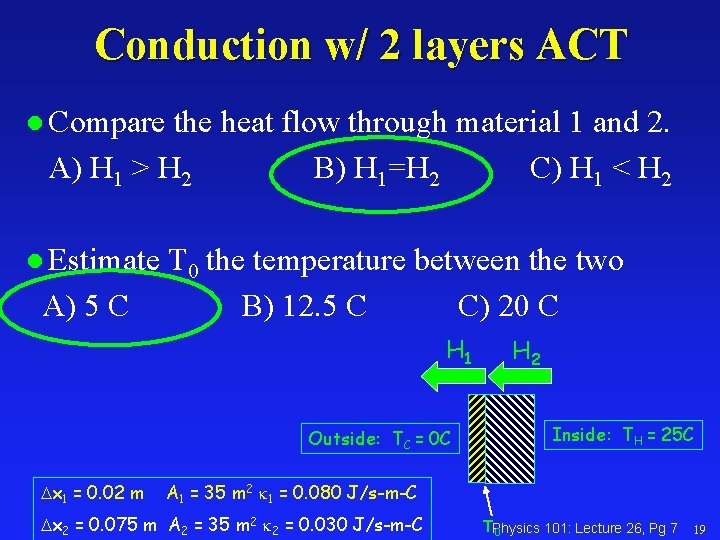
Conduction w/ 2 layers ACT l Compare the heat flow through material 1 and 2. A) H 1 > H 2 B) H 1=H 2 C) H 1 < H 2 l Estimate A) 5 C T 0 the temperature between the two B) 12. 5 C C) 20 C H 1 Outside: TC = 0 C x 1 = 0. 02 m H 2 Inside: TH = 25 C A 1 = 35 m 2 k 1 = 0. 080 J/s-m-C x 2 = 0. 075 m A 2 = 35 m 2 k 2 = 0. 030 J/s-m-C TPhysics 101: Lecture 26, Pg 7 0 19
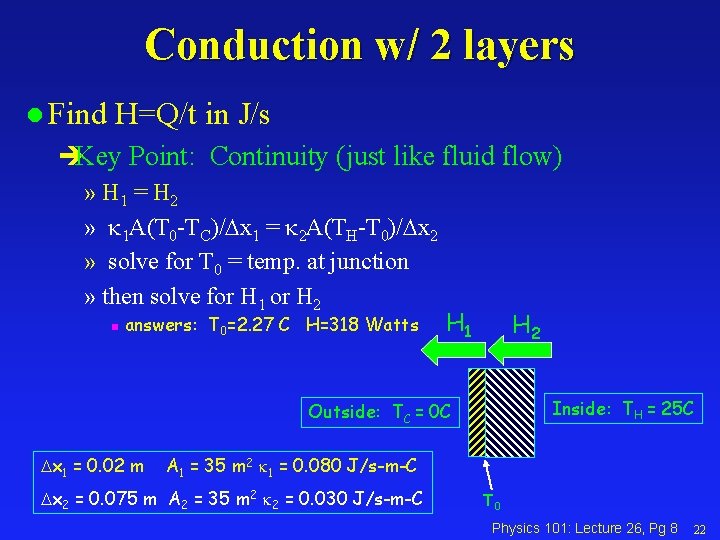
Conduction w/ 2 layers l Find H=Q/t in J/s èKey Point: Continuity (just like fluid flow) » H 1 = H 2 » k 1 A(T 0 -TC)/ x 1 = k 2 A(TH-T 0)/ x 2 » solve for T 0 = temp. at junction » then solve for H 1 or H 2 n answers: T 0=2. 27 C H=318 Watts H 1 H 2 Inside: TH = 25 C Outside: TC = 0 C x 1 = 0. 02 m A 1 = 35 m 2 k 1 = 0. 080 J/s-m-C x 2 = 0. 075 m A 2 = 35 m 2 k 2 = 0. 030 J/s-m-C T 0 Physics 101: Lecture 26, Pg 8 22
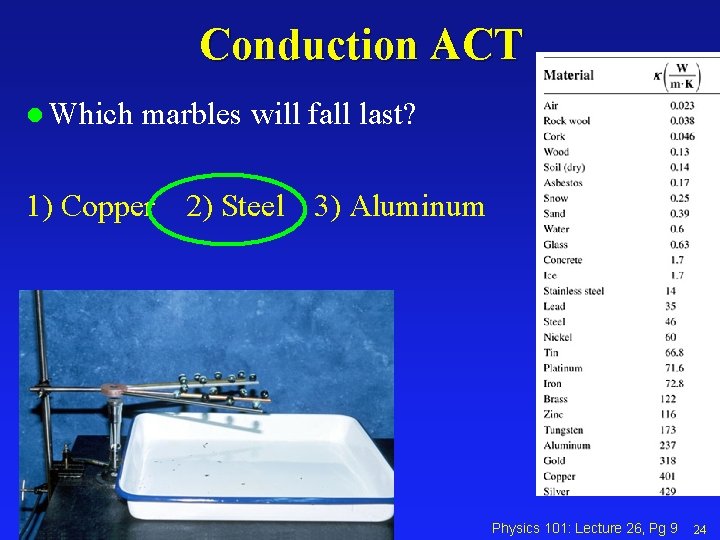
Conduction ACT l Which marbles will fall last? 1) Copper 2) Steel 3) Aluminum Physics 101: Lecture 26, Pg 9 24
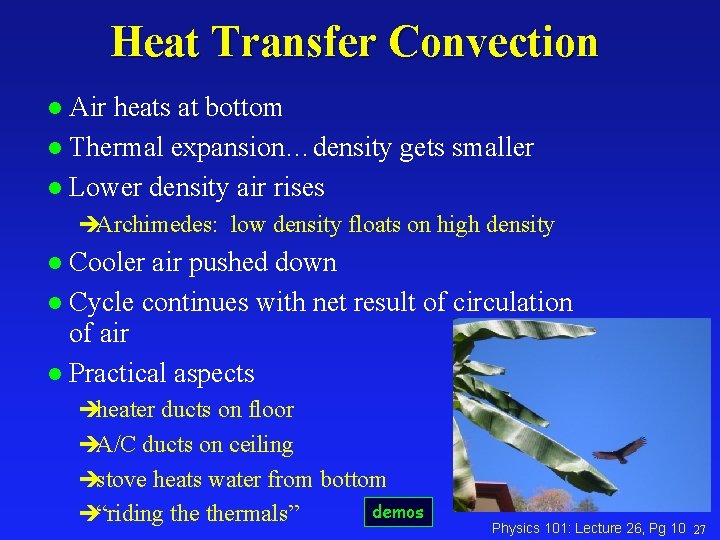
Heat Transfer Convection Air heats at bottom l Thermal expansion…density gets smaller l Lower density air rises l èArchimedes: low density floats on high density Cooler air pushed down l Cycle continues with net result of circulation of air l Practical aspects l èheater ducts on floor èA/C ducts on ceiling èstove heats water from bottom è“riding thermals” demos Physics 101: Lecture 26, Pg 10 27
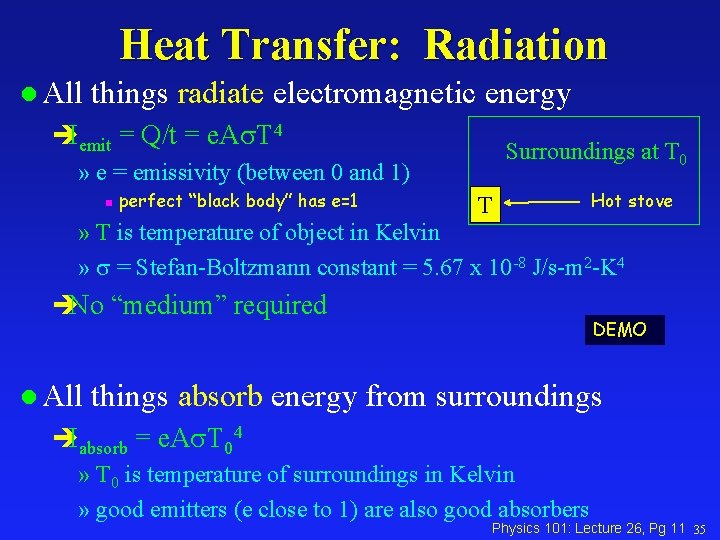
Heat Transfer: Radiation l All things radiate electromagnetic energy èIemit = Q/t = e. A T 4 » e = emissivity (between 0 and 1) n perfect “black body” has e=1 Surroundings at T 0 T Hot stove » T is temperature of object in Kelvin » = Stefan-Boltzmann constant = 5. 67 x 10 -8 J/s-m 2 -K 4 èNo “medium” required l All DEMO things absorb energy from surroundings èIabsorb = e. A T 04 » T 0 is temperature of surroundings in Kelvin » good emitters (e close to 1) are also good absorbers Physics 101: Lecture 26, Pg 11 35
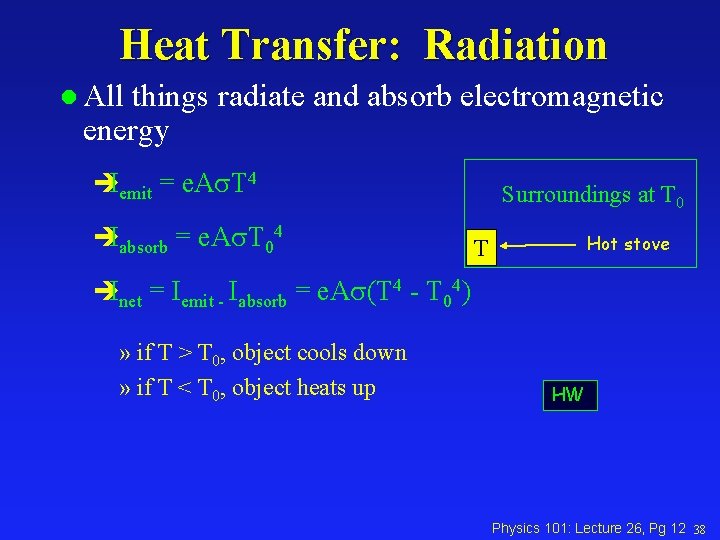
Heat Transfer: Radiation l All things radiate and absorb electromagnetic energy èIemit = e. A T 4 èIabsorb = e. A T 04 Surroundings at T 0 Hot stove T èInet = Iemit - Iabsorb = e. A (T 4 - T 04) » if T > T 0, object cools down » if T < T 0, object heats up HW Physics 101: Lecture 26, Pg 12 38
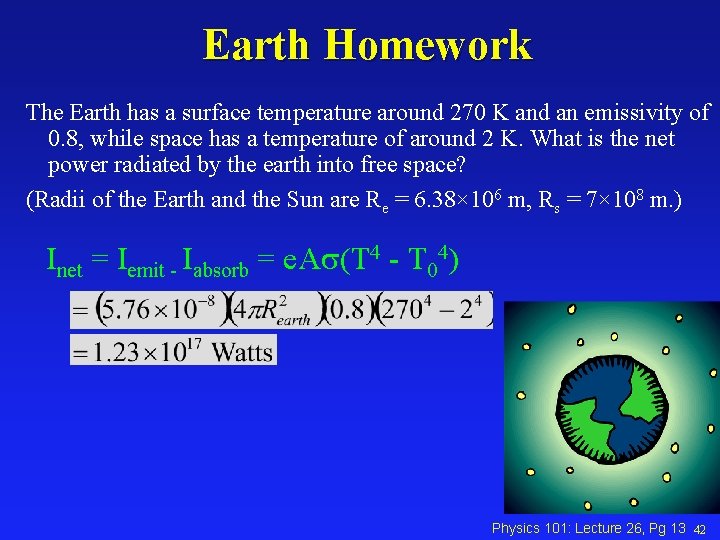
Earth Homework The Earth has a surface temperature around 270 K and an emissivity of 0. 8, while space has a temperature of around 2 K. What is the net power radiated by the earth into free space? (Radii of the Earth and the Sun are Re = 6. 38× 106 m, Rs = 7× 10⁸ m. ) Inet = Iemit - Iabsorb = e. A (T 4 - T 04) Physics 101: Lecture 26, Pg 13 42
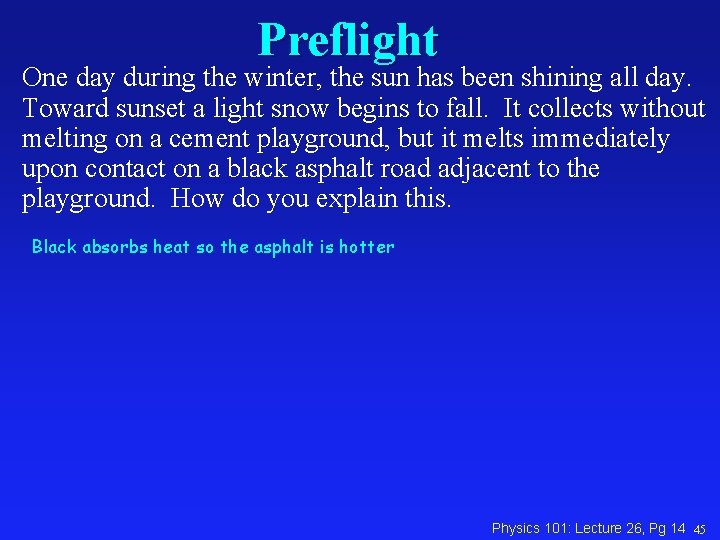
Preflight One day during the winter, the sun has been shining all day. Toward sunset a light snow begins to fall. It collects without melting on a cement playground, but it melts immediately upon contact on a black asphalt road adjacent to the playground. How do you explain this. Black absorbs heat so the asphalt is hotter Physics 101: Lecture 26, Pg 14 45
Summary l Conduction - contact l Convection - fluid motion l Radiation Physics 101: Lecture 26, Pg 15 50
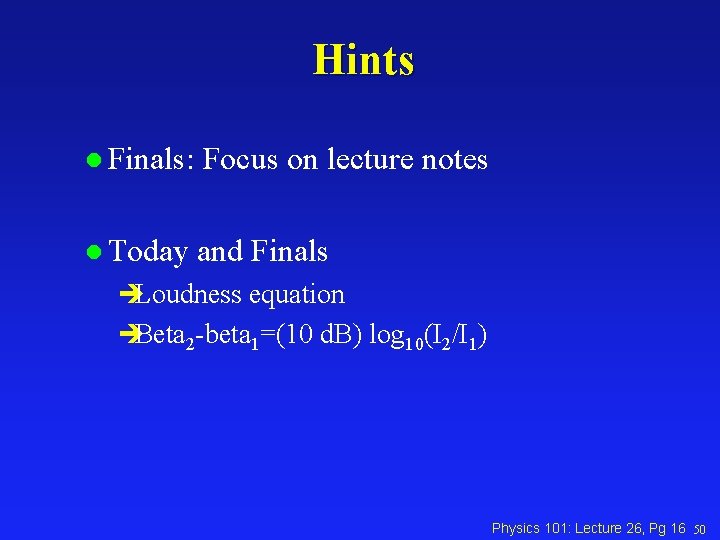
Hints l Finals: Focus on lecture notes l Today and Finals èLoudness equation èBeta 2 -beta 1=(10 d. B) log 10(I 2/I 1) Physics 101: Lecture 26, Pg 16 50
Physics 101: Lecture 26, Pg 17