
Final PFS updated OS and safety data from
- Slides: 1
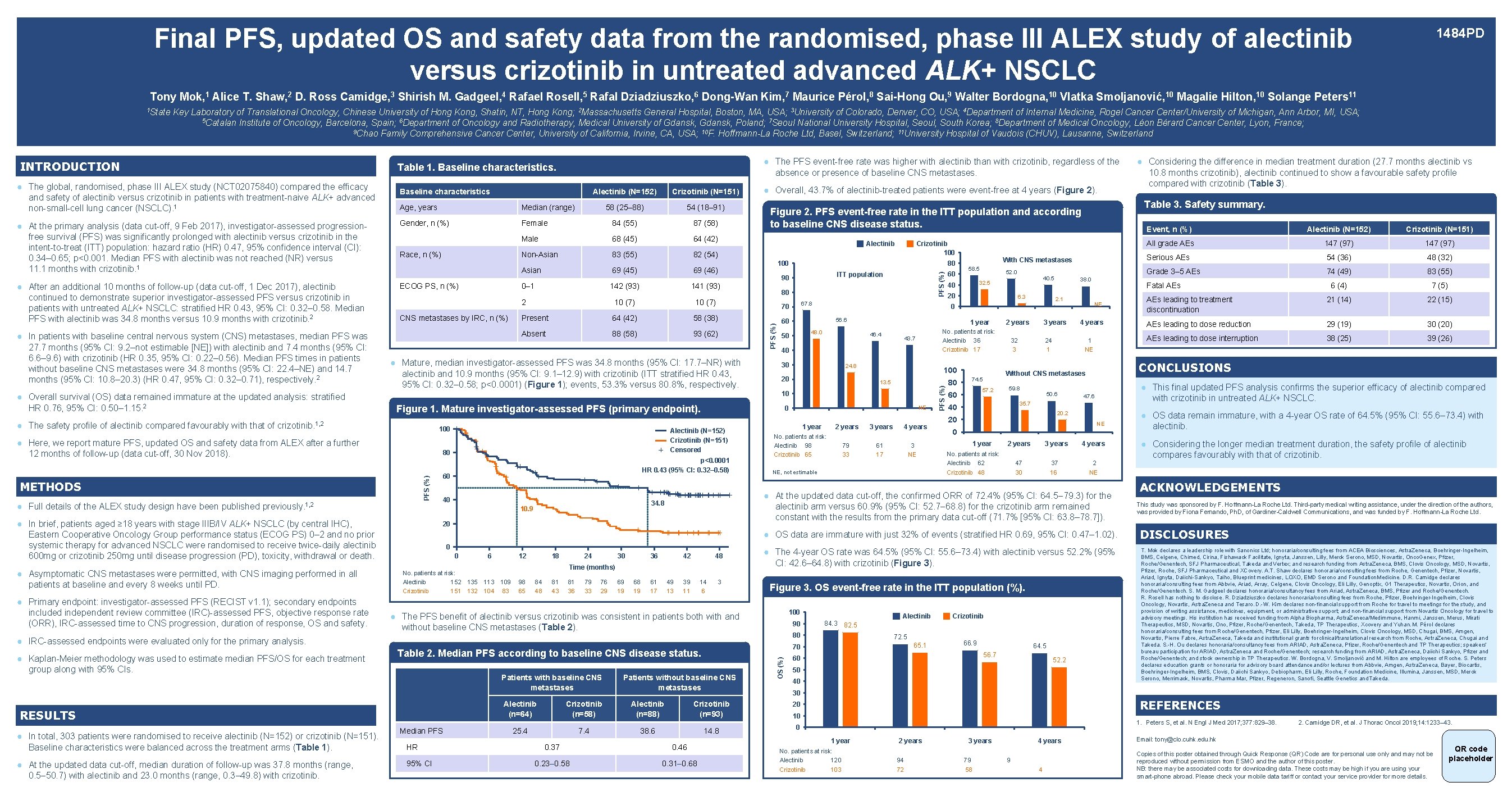
Final PFS, updated OS and safety data from the randomised, phase III ALEX study of alectinib versus crizotinib in untreated advanced ALK+ NSCLC 1484 PD Tony Mok, 1 Alice T. Shaw, 2 D. Ross Camidge, 3 Shirish M. Gadgeel, 4 Rafael Rosell, 5 Rafal Dziadziuszko, 6 Dong-Wan Kim, 7 Maurice Pérol, 8 Sai-Hong Ou, 9 Walter Bordogna, 10 Vlatka Smoljanović, 10 Magalie Hilton, 10 Solange Peters 11 Key Laboratory of Translational Oncology, Chinese University of Hong Kong, Shatin, NT, Hong Kong; 2 Massachusetts General Hospital, Boston, MA, USA; 3 University of Colorado, Denver, CO, USA; 4 Department of Internal Medicine, Rogel Cancer Center/University of Michigan, Ann Arbor, MI, USA; 5 Catalan Institute of Oncology, Barcelona, Spain; 6 Department of Oncology and Radiotherapy, Medical University of Gdansk, Poland; 7 Seoul National University Hospital, Seoul, South Korea; 8 Department of Medical Oncology, Léon Bérard Cancer Center, Lyon, France; 9 Chao Family Comprehensive Cancer Center, University of California, Irvine, CA, USA; 10 F. Hoffmann-La Roche Ltd, Basel, Switzerland; 11 University Hospital of Vaudois (CHUV), Lausanne, Switzerland Baseline characteristics ● Overall survival (OS) data remained immature at the updated analysis: stratified HR 0. 76, 95% CI: 0. 50– 1. 15. 2 ● 54 (18– 91) Gender, n (%) Female 84 (55) 87 (58) Male 68 (45) 64 (42) Non-Asian 83 (55) 82 (54) Asian ECOG PS, n (%) 69 (45) 0– 1 CNS metastases by IRC, n (%) ● Overall, 43. 7% of alectinib-treated patients were event-free at 4 years (Figure 2). 141 (93) 2 10 (7) Present 64 (42) 58 (38) 80 70 93 (62) 100 PFS (%) 80 46. 4 60 40 43. 7 0 No. patients at risk: Alectinib 152 Crizotinib 151 6 12 18 24 30 36 42 48 Time (months) 135 132 113 104 109 83 98 65 84 48 81 43 81 36 79 33 76 29 69 19 68 19 61 17 13. 5 Median PFS HR 95% CI Crizotinib (n=58) 25. 4 7. 4 2 years No. patients at risk: Alectinib 98 Crizotinib 65 79 33 3 years 61 17 4 years 3 NE NE, not estimable 2. 1 80 NE 32 3 3 years 24 1 4 years 1 NE 57. 2 59. 8 50. 6 47. 6 20. 2 20 NE 0 1 year No. patients at risk: Alectinib 62 Crizotinib 48 2 years 47 30 3 years 37 16 49 13 39 11 14 6 3 Alectinib (n=88) Figure 3. OS event-free rate in the ITT population (%). 100 90 0. 31– 0. 68 Alectinib 72. 5 65. 1 OS (%) Crizotinib 66. 9 64. 5 56. 7 60 52. 2 50 40 54 (36) 48 (32) Grade 3– 5 AEs 74 (49) 83 (55) 6 (4) 7 (5) AEs leading to treatment discontinuation 21 (14) 22 (15) AEs leading to dose reduction 29 (19) 30 (20) AEs leading to dose interruption 38 (25) 39 (26) 4 years ● OS data remain immature, with a 4 -year OS rate of 64. 5% (95% CI: 55. 6– 73. 4) with alectinib. ● Considering the longer median treatment duration, the safety profile of alectinib compares favourably with that of crizotinib. 2 NE ACKNOWLEDGEMENTS This study was sponsored by F. Hoffmann-La Roche Ltd. Third-party medical writing assistance, under the direction of the authors, was provided by Fiona Fernando, Ph. D, of Gardiner-Caldwell Communications, and was funded by F. Hoffmann-La Roche Ltd. 30 14. 8 0. 23– 0. 58 84. 3 82. 5 80 0 0. 46 Serious AEs T. Mok declares a leadership role with Sanonics Ltd; honoraria/consulting fees from ACEA Biosciences, Astra. Zeneca, Boehringer-Ingelheim, BMS, Celgene, Chimed, Cirina, Fishawack Facilitate, Ignyta, Janssen, Lilly, Merck Serono, MSD, Novartis, Onco. Genex, Pfizer, Roche/Genentech, SFJ Pharmaceutical, Takeda and Vertex; and research funding from Astra. Zeneca, BMS, Clovis Oncology, MSD, Novartis, Pfizer, Roche, SFJ Pharmaceutical and XCovery. A. T. Shaw declares honoraria/consulting fees from Roche, Genentech, Pfizer, Novartis, Ariad, Ignyta, Daiichi-Sankyo, Taiho, Blueprint medicines, LOXO, EMD Serono and Foundation Medicine. D. R. Camidge declares honoraria/consulting fees from Abbvie, Ariad, Array, Celgene, Clovis Oncology, Eli Lilly, Genoptix, G 1 Therapeutics, Novartis, Orion, and Roche/Genentech. S. M. Gadgeel declares honoraria/consultancy fees from Ariad, Astra. Zeneca, BMS, Pfizer and Roche/Genentech. R. Rosell has nothing to disclose. R. Dziadziuszko declares honoraria/consulting fees from Roche, Pfizer, Boehringer-Ingelheim, Clovis Oncology, Novartis, Astra. Zeneca and Tesaro. D. -W. Kim declares non-financial support from Roche for travel to meetings for the study, and provision of writing assistance, medicines, equipment, or administrative support; and non-financial support from Novartis Oncology for travel to advisory meetings. His institution has received funding from Alpha Biopharma, Astra. Zeneca/Medimmune, Hanmi, Janssen, Merus, Mirati Therapeutics, MSD, Novartis, Ono, Pfizer, Roche/Genentech, Takeda, TP Therapeutics, Xcovery and Yuhan. M. Pérol declares honoraria/consulting fees from Roche/Genentech, Pfizer, Eli Lilly, Boehringer-Ingelheim, Clovis Oncology, MSD, Chugai, BMS, Amgen, Novartis, Pierre Fabre, Astra. Zeneca, Takeda and institutional grants for clinical/translational research from Roche, Astra. Zeneca, Chugai and Takeda. S. -H. Ou declares honoraria/consultancy fees from ARIAD, Astra. Zeneca, Pfizer, Roche/Genentech and TP Therapeutics; speakers’ bureau participation for ARIAD, Astra. Zeneca and Roche/Genentech; research funding from ARIAD, Astra. Zeneca, Daiichi Sankyo, Pfizer and Roche/Genentech; and stock ownership in TP Therapeutics. W. Bordogna, V. Smoljanović and M. Hilton are employees of Roche. S. Peters declares education grants or honoraria for advisory board attendance and/or lectures from Abbvie, Amgen, Astra. Zeneca, Bayer, Biocartis, Boehringer-Ingelheim, BMS, Clovis, Daiichi Sankyo, Debiopharm, Eli Lilly, Roche, Foundation Medicine, Illumina, Janssen, MSD, Merck Serono, Merrimack, Novartis, Pharma Mar, Pfizer, Regeneron, Sanofi, Seattle Genetics and Takeda. 20 0. 37 147 (97) ● The 4 -year OS rate was 64. 5% (95% CI: 55. 6– 73. 4) with alectinib versus 52. 2% (95% CI: 42. 6– 64. 8) with crizotinib (Figure 3). Crizotinib (n=93) 38. 6 147 (97) DISCLOSURES 70 Patients without baseline CNS metastases All grade AEs ● This final updated PFS analysis confirms the superior efficacy of alectinib compared with crizotinib in untreated ALK+ NSCLC. 35. 7 40 Crizotinib (N=151) CONCLUSIONS Without CNS metastases 74. 5 60 2 years Alectinib (N=152) ● OS data are immature with just 32% of events (stratified HR 0. 69, 95% CI: 0. 47– 1. 02). Table 2. Median PFS according to baseline CNS disease status. Alectinib (n=64) NE 1 year ● The PFS benefit of alectinib versus crizotinib was consistent in patients both with and without baseline CNS metastases (Table 2). Patients with baseline CNS metastases 6. 3 Event, n (%) Fatal AEs 38. 0 ● At the updated data cut-off, the confirmed ORR of 72. 4% (95% CI: 64. 5 79. 3) for the alectinib arm versus 60. 9% (95% CI: 52. 7 68. 8) for the crizotinib arm remained constant with the results from the primary data cut-off (71. 7% [95% CI: 63. 8– 78. 7]). 20 0 20 100 0 34. 8 10. 9 40. 5 32. 5 No. patients at risk: Alectinib 36 Crizotinib 17 24. 8 20 p<0. 0001 HR 0. 43 (95% CI: 0. 32– 0. 58) 52. 0 1 year 40 ● IRC-assessed endpoints were evaluated only for the primary analysis. ● At the updated data cut-off, median duration of follow-up was 37. 8 months (range, 0. 5 50. 7) with alectinib and 23. 0 months (range, 0. 3 49. 8) with crizotinib. 48. 0 50 58. 5 40 56. 6 30 Alectinib (N=152) Crizotinib (N=151) Censored 60 With CNS metastases 0 60 Figure 1. Mature investigator-assessed PFS (primary endpoint). ● Asymptomatic CNS metastases were permitted, with CNS imaging performed in all patients at baseline and every 8 weeks until PD. ● In total, 303 patients were randomised to receive alectinib (N=152) or crizotinib (N=151). Baseline characteristics were balanced across the treatment arms (Table 1). 67. 8 10 ● In brief, patients aged ≥ 18 years with stage IIIB/IV ALK+ NSCLC (by central IHC), Eastern Cooperative Oncology Group performance status (ECOG PS) 0– 2 and no prior systemic therapy for advanced NSCLC were randomised to receive twice-daily alectinib 600 mg or crizotinib 250 mg until disease progression (PD), toxicity, withdrawal or death. RESULTS ITT population 90 ● Mature, median investigator-assessed PFS was 34. 8 months (95% CI: 17. 7–NR) with alectinib and 10. 9 months (95% CI: 9. 1– 12. 9) with crizotinib (ITT stratified HR 0. 43, 95% CI: 0. 32– 0. 58; p<0. 0001) (Figure 1); events, 53. 3% versus 80. 8%, respectively. METHODS ● Kaplan-Meier methodology was used to estimate median PFS/OS for each treatment group along with 95% CIs. 80 100 69 (46) 88 (58) Crizotinib 100 ● Considering the difference in median treatment duration (27. 7 months alectinib vs 10. 8 months crizotinib), alectinib continued to show a favourable safety profile compared with crizotinib (Table 3). Table 3. Safety summary. Figure 2. PFS event-free rate in the ITT population and according to baseline CNS disease status. Alectinib 142 (93) Absent ● Here, we report mature PFS, updated OS and safety data from ALEX after a further 12 months of follow-up (data cut-off, 30 Nov 2018). ● Primary endpoint: investigator-assessed PFS (RECIST v 1. 1); secondary endpoints included independent review committee (IRC)-assessed PFS, objective response rate (ORR), IRC-assessed time to CNS progression, duration of response, OS and safety. 58 (25– 88) Median (range) The safety profile of alectinib compared favourably with that of crizotinib. 1, 2 ● Full details of the ALEX study design have been published previously. 1, 2 Crizotinib (N=151) Age, years Race, n (%) ● After an additional 10 months of follow-up (data cut-off, 1 Dec 2017), alectinib continued to demonstrate superior investigator-assessed PFS versus crizotinib in patients with untreated ALK+ NSCLC: stratified HR 0. 43, 95% CI: 0. 32– 0. 58. Median PFS with alectinib was 34. 8 months versus 10. 9 months with crizotinib. 2 ● In patients with baseline central nervous system (CNS) metastases, median PFS was 27. 7 months (95% CI: 9. 2–not estimable [NE]) with alectinib and 7. 4 months (95% CI: 6. 6– 9. 6) with crizotinib (HR 0. 35, 95% CI: 0. 22– 0. 56). Median PFS times in patients without baseline CNS metastases were 34. 8 months (95% CI: 22. 4–NE) and 14. 7 months (95% CI: 10. 8– 20. 3) (HR 0. 47, 95% CI: 0. 32– 0. 71), respectively. 2 Alectinib (N=152) PFS (%) ● The global, randomised, phase III ALEX study (NCT 02075840) compared the efficacy and safety of alectinib versus crizotinib in patients with treatment-naive ALK+ advanced non-small-cell lung cancer (NSCLC). 1 ● At the primary analysis (data cut-off, 9 Feb 2017), investigator-assessed progressionfree survival (PFS) was significantly prolonged with alectinib versus crizotinib in the intent-to-treat (ITT) population: hazard ratio (HR) 0. 47, 95% confidence interval (CI): 0. 34– 0. 65; p<0. 001. Median PFS with alectinib was not reached (NR) versus 11. 1 months with crizotinib. 1 ● The PFS event-free rate was higher with alectinib than with crizotinib, regardless of the absence or presence of baseline CNS metastases. Table 1. Baseline characteristics. PFS (%) INTRODUCTION PFS (%) 1 State REFERENCES 10 1. Peters S, et al. N Engl J Med 2017; 377: 829– 38. 1 year No. patients at risk: Alectinib 120 Crizotinib 103 2 years 94 72 3 years 4 years 79 58 4 2. Camidge DR, et al. J Thorac Oncol 2019; 14: 1233– 43. Email: tony@clo. cuhk. edu. hk Copies of this poster obtained through Quick Response (QR) Code are for personal use only and may not be reproduced without permission from ESMO and the author of this poster. NB: there may be associated costs for downloading data. These costs may be high if you are using your smart-phone abroad. Please check your mobile data tariff or contact your service provider for more details. QR code placeholder