
Final Exam Study Guide MKT 324 Marketing Concepts



- Slides: 14
Final Exam Study Guide MKT 324 Marketing Concepts An on-line course for advanced degree-seeking professionals
Final Exam Study Guide Key Topic Material: 10 Questions on the Final Exam All multiple choice 30 Minute Time Limit
Product • How is it defined? • A tangible good and/or a service and/or an idea • Anything that can be bought, sold, or offered for consideration • What are the impacts? • Products are made up of a mixture of things • Because products can be tangible goods, services, or ideas what is offered in a marketing exchange can be misunderstood by buyer and seller • Organizations may be more adept at delivering one aspect, such as the tangible good, and less adept and delivering another, such as a service • When is it used or not used? • Products, goods, and services are often used and define differently across business school courses and in different markets • For this course, we will remain very specific with our “Product” definition • The term product will be further broken down later in the course
The Exchange (The Marketing Exchange) • How is it defined? • Two or more parties, each with something of value, with the ability to accept or reject, can communicate and deliver with each other having the expectation of being better off as a result • What are the impacts? • Parties in an exchange expect to benefit regardless of whethere is sale, trade, or barter • Governments can hinder or facilitate exchanges but government is not required in order to have an exchange • Exchanges provide economic benefit regardless of whether or not money is involved • When is it used or not used? • It is NOT an exchange when there is force or coercion • It is NOT an exchange when parties cannot communicate • Example: A farmer trades some of their crop for clothing and is better off. The person trading the clothing for food also benefits.
Market Penetration • How is it defined? • The percentage of customers an organization has versus the market in which they participate as a whole • What are the impacts? • Not a consistently used term, often creates confusion across course, subjects, and markets in the real world • Requires some estimation of number of buyers from others • An important metric for pursuing growth • When is it used or not used? • When assessing the strength of a competitive position and when establishing realistic goals • Often ignored with specialized products or the product philosophy • A company with 200 customers in a total market of 1, 000 customers has a 20% market penetration
Market Share • How is it defined? • The percentage of sales dollars an organization has versus the market in which they participate as a whole • What are the impacts? • Requires a specific definition of “Market” • Requires some estimation of sales from others • The most common metric for comparing sales • When is it used or not used? • When assessing the strength of a competitive position and establishing realistic goals • Often ignored with specialized products or the product philosophy • Example: A company with $100 sales in a $1, 000 market has a 10% market share
Market • How is it defined? • A group or individual with needs and/or wants plus the ability and willingness to buy • What are the impacts? • Can be a narrow definition, such as buyers of a specific type of product • Can be a broad definition, such as buyers with a potential need or desire • Must be defined and understood to establish market scope • When is it used or not used? • Establishing goals or potential • Considering similar choices or benefits buyer may view as alternatives • May be limited or may be so large no size is defined
Segments (Criteria or Requirements) • How is it defined? • Marketing segments should be meaningfully different from each other, substantial, quantifiable, and responsive • What are the impacts? • Substantial segments “big enough to justify a specific effort” • Quantifiable segments can be counted and reached (Identifiable and Measurable Accessible) • Responsive segments will respond (or not) to an offer of an exchange • When is it used or not used? • When developing products, offers, and communication to groups of people • When assessing markets in an actionable way • When considering marketing costs (both fixed and variable) for a product
Promotions • Push • All the selling activities conducted within the marketing channel to drive products to the consumer • Trade Promotion • A "Push" sales promotion directed at intermediaries • Retailers and wholesalers are intermediaries • Pull • All the selling activities conducted outside the marketing channel to drive consumers to the products • Consumer Promotion • A "Pull" sales promotion directed at consumers • Pull marketing activities includes advertising to consumers
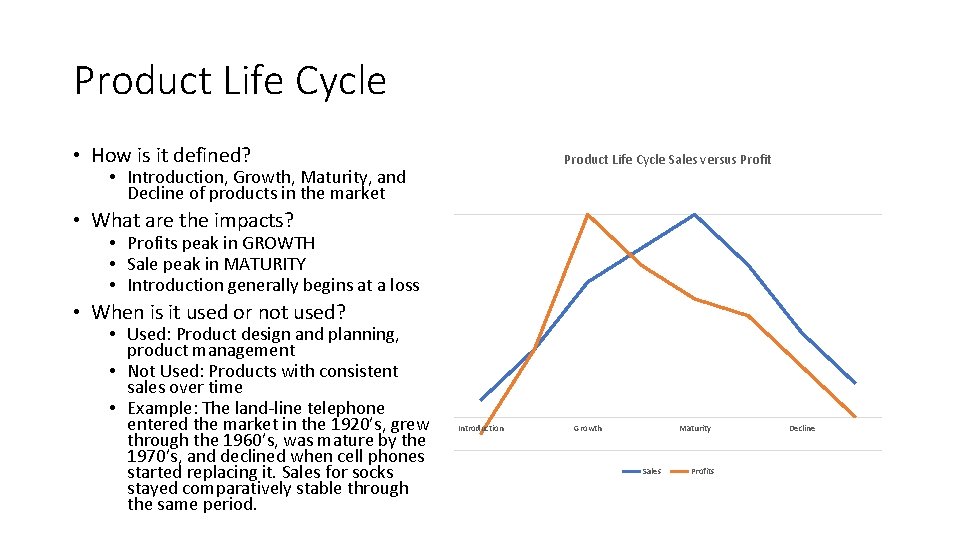
Product Life Cycle • How is it defined? Product Life Cycle Sales versus Profit • Introduction, Growth, Maturity, and Decline of products in the market • What are the impacts? • Profits peak in GROWTH • Sale peak in MATURITY • Introduction generally begins at a loss • When is it used or not used? • Used: Product design and planning, product management • Not Used: Products with consistent sales over time • Example: The land-line telephone entered the market in the 1920’s, grew through the 1960’s, was mature by the 1970’s, and declined when cell phones started replacing it. Sales for socks stayed comparatively stable through the same period. Introduction Growth Maturity Sales Profits Decline
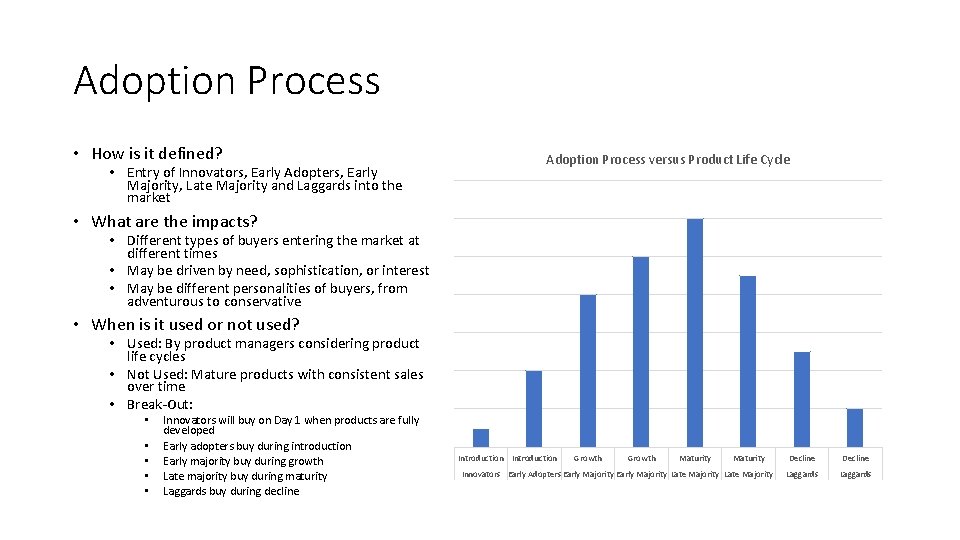
Adoption Process • How is it defined? • Entry of Innovators, Early Adopters, Early Majority, Late Majority and Laggards into the market Adoption Process versus Product Life Cycle • What are the impacts? • Different types of buyers entering the market at different times • May be driven by need, sophistication, or interest • May be different personalities of buyers, from adventurous to conservative • When is it used or not used? • Used: By product managers considering product life cycles • Not Used: Mature products with consistent sales over time • Break-Out: • • • Innovators will buy on Day 1 when products are fully developed Early adopters buy during introduction Early majority buy during growth Late majority buy during maturity Laggards buy during decline Introduction Growth Maturity Innovators Early Adopters Early Majority Late Majority Decline Laggards
Positioning • How is it defined? • Where consumers hold a brand or product in their mind versus competitor • What are the impacts? • How customers see a product as being special, different, or unique • Part of the Unique Value Proposition, could relate to price, value, quality, durability, or style • Helps customers match products with their needs and wants • When is it used or not used? • Used: All branded products • Not Used: Undifferentiated Commodities • Example: Fast food restaurants may have a low-priced positioning strategy for items on the 99 cent menu, whereas Five Guys takes a higher-priced positioning strategy for all of its products
Influencing Consumers • What is it? • Marketers can influence the outcome of the evaluation stage of the consumer purchase decision process by a variety of methods • What are Marketers Options? • Attempting to convince consumers that certain attributes are more important than others in deciding which product to buy from among an array of them • Identifying which evaluative criteria are important to the individual, and pointing out which brand best meets those criteria • Trying to get the customer to reduce the size of the consideration set to exclude many of the choices • Attempting to convince the consumer to spend more than was budgeted for the purchase to acquire more features they might have originally preferred • When is it used or not used? • Used: Any or all of the above options can be used • Not Used: Not limited to the options shown here • Example: A marketer could use one, all, or several of the options on this slide
Marketing Concepts An on-line course for advanced degree-seeking professionals