
FINAL DRIVE NOTES BASIC FUNCTIONS CONSTRUCTION AND OPERATION
FINAL DRIVE NOTES: BASIC FUNCTIONS, CONSTRUCTION AND OPERATION • • Spiral bevel type Hypoid type Conventional differential Limited slip differential

Basic construction, operation and functions Final drive consists of crown wheel and pinion that engage with each other and that, together with the differential, are contained in a housing. The crown wheel is bolted to the differential carrier while the pinion is coupled with the drive shafts. Functions: The final drive provides a drive at right angles from the drive shaft to the side shaft the rear axle assembly. It provides a constant reduction between the speed of the drive wheels and the engine in order to develop the engine revolutions required to drive the vehicle with ease. The two types of final drives are Spiral bevel gear and Hypoid final drive
Spiral Bevel Gear Construction: The teeth on both the pinion and crown wheel are of spiral design and tapered in order to maintain parallel spacing between the teeth. This design makes provision for longer teeth and more contact area. The pinion is mounted on two tapered roller bearings in the rear axle housing. The centre line of the pinion shaft is on the same plane as that of the crown wheel. Advantages: This is a strong drive because more than one tooth is in contact at any give time and this increases the contact area. The design offers quiet operation due to sliding action between the teeth.

Spiral bevel final drive
Spiral bevel gear cont… Disadvantages: The floor must be equipped with a relatively high tunnel to provide the clearance for the drive shaft. There is relatively high side and end thrust on the pinion bearing. Friction is increased due to the sliding action between the teeth
Hypoid final drive Construction: The teeth on the pinion and crown wheel are, like those of the spiral bevel gear, also of spiral design, but are cut to increase the angle at which it meets the centre line through the gears. The pinion is also mounted on tapered roller bearings in the rear axle housing, just below the centre line through the crown wheel. The increased angle of the teeth causes a larger degree of sliding action and consequently more side and end thrust. Increased pressure on the teeth causes more friction and more heat is generated. As a result of the high pressure and temperature, a special hypoid or high-pressure oil is required (extreme pressure[EP] oil).

Hypoid final drive

Hypoid final drive cont… Advantages: • A large degree of sliding action between the teeth ensures a very quiet operation • The teeth are larger, increasing the contact area thereby offering a stronger drive • The pinion with its bearing is closer to the lubricating oil, therefore, lubrication is more efficient • The pinion can be designed to be larger with stronger teeth. • Because the pinion and the drive shaft are mounted lower, a lower floor is possible

Hypoid final drive cont…. Disadvantages: • The larger contact area and sliding action between the teeth causes friction and decrease efficiency • The high degree of side and end thrust causes more load on the pinion bearings • High pressure and temperature can only be resisted by special hypoid oil • If the vehicle is equipped with a torque tube drive shaft, efficient seals must be used to prevent the gearbox oil from mixing with the special hypoid oil

Conventional differential Functions: • The differential allows the drive wheels to rotate at different rotational frequencies when the car move around corners and over uneven road surfaces • Even torque is transmitted to the side shaft and the drive wheels irrespective of the different rotational frequency between the wheels
Conventional differential cont… Construction: The differential consists of a differential carrier, which is bolted and rotate with the crown wheel. A set of gears and a differential shaft is housed within the differential carrier. The differential shaft fits reasonably tightly into the differential carrier and is kept in position by a locking method. Two planet gears are mounted on the differential shaft and are free to rotate about the shaft. The planet gears are in constant mesh with two larger gears, which are splined to the side shaft. These side shafts transmit torque to the drive wheels.

Conventional differential cont. .

Conventional differential cont…
Conventional differential cont… Operation: When a vehicle moves straight ahead • The crown wheel drives the differential carrier • The differential shaft turns with the differential carrier • The planet gears turn with the differential shaft, but do not rotate about the shaft • The teeth on the planet gears exert even force on the teeth of the side gears, thus pulling them • The side gears transmit the torque to the side shaft, and the drive wheels are driven at the same rotational frequency
Conventional differential cont… Operation : When turning to the left or right • The inner wheel must cover a shorter distance than the outer wheel, it rotates at lower frequency • The rotational frequency of the inner side shaft is less than that of the outer side shaft as well as that of the differential carrier • The planet gears rotate slowly about the differential shaft and spin around the inner side gear • The rotary movement of the planet gears around the differential shaft causes them to drive the outer side gear at an increased rotational frequency, which is also more than that of the differential carrier
Conventional differential cont… One drive wheel is locked while the other one is free to rotate • This condition arises when, one drive wheel is standing in loose sand or mud or loses contact with the road surface, while the other drive wheel offers ideal traction • The side shaft and the side gear on the drive wheel that offers ideal traction, remains stationary • The planet gear spin around the stationary side gear and rotate about the differential shaft • Rotary movement of the planet gears drives the side gear, which offers minimum traction
Conventional differential cont… When cornering: It should be noted that differential action is in operation only when there is a difference in rotational frequency between the two drive wheels. This means that, apart from uneven road surfaces and while cornering, differential action will also occur in the event of uneven tyre pressures, uneven load distribution, difference in tyre sizes, and when one tyre is more worn than another. Disadvantages: The conventional differential is that more torque is transmitted to the drive wheel, which offers the least traction This disadvantage is overcome by the use of a Limited-slip differential
Limited-slip differential All limited-slip differentials work on the same basic principle, although the internal construction may differ. Some use a cone clutch while others use a multi-disc clutch. The operation is independent of any driven action and is purely automatic. Functions: By inserting a wedge at both ends of the differential pinion shaft, this differential unit applies more power to the rear wheel that is experiencing more resistance.
Limited slip differential
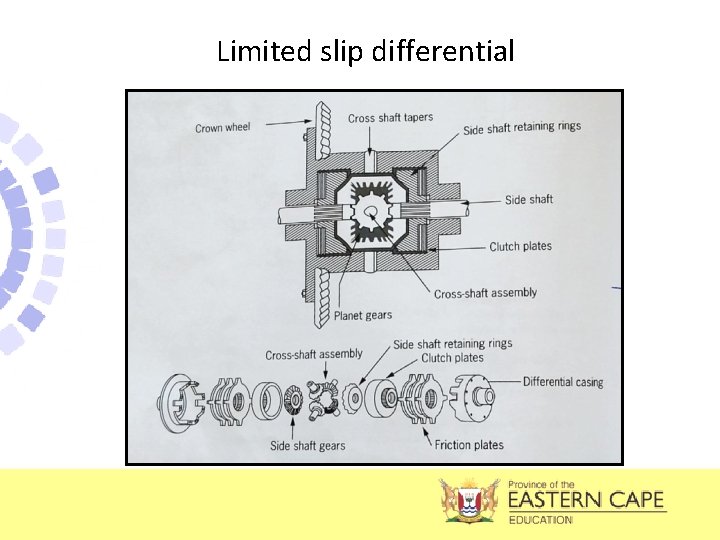
Limited-slip differential cont… Construction: This differential is similar in construction to the conventional types except that it has two sets of clutch plates and, in addition, the ends of the two separate pinion shafts have tapered faces that form a shallow V and lie rather loosely in notches in the halves of the differential case. The clutch plates are placed on either side between the differential side gears and the differential case
Limited-slip differential cont… Operation: When a vehicle moves straight ahead • The differential pinion gears encounter resistance when they attempt to turn the axle’s side gears • The resistance is transferred to the pinion shaft that are driving the pinions • As both ends of each pinion shaft are seated on tapered ramp and because there is some play at this point, the shaft are forced to slide up the ramp surface • This sliding motion moves both shafts in an outward direction
Limited-slip differential cont… • As each shaft moves outwards, it pushes its pinion in the same direction causing the pinion thrust member to lock the clutches against the differential case • This causes the wheels to rotate at the same speed when the car is driven straight ahead When turning to the left or right • The inner wheel thrust member exerts force on its clutch • The outer wheel thrust member lessens its force • This allows the clutch to slip, thereby allowing the wheels to rotate at different speeds to round the corner
Limited-slip differential cont… When one wheel spins: Under certain conditions, such as when driving on ice, in mud or when the wheel becomes airborne, pressure is applied to the clutches due to the pinion shaft movement on the ramp of the non-slipping wheel, the wheel with most traction. This allows more torque to be transferred to the wheel with most traction, resulting in better road handling and greater safety
Limited-slip differential cont… Advantages: • Ability to move a vehicle when only one wheel has a traction • Better acceleration on the road(even though one wheel may be airborne) • Reduction in shock load on the driving shaft and axles when an airborne wheel turns to the ground • Easier and more affective handling of the vehicle on bumpy roads Disadvantages: Requires the use of special differential lubricant. Care should be taken to avoid sudden acceleration when both driving wheels are on a slippery surface, this causes both wheels to spin and allows the vehicle to slide sideways on the curved surface of a road on a turn.
- Slides: 24